BigDBM vs SalesBot: Best B2B Data Provider for 2026?
BigDBM vs SalesBot compared on data accuracy, coverage, pricing, and integrations — plus where a dedicated email finder beats both for outbound teams in 2026.
Choosing a B2B data provider is really a bet on two things: how fresh the records are, and how easily that data lands inside the tools your reps already use. BigDBM and SalesBot sit on opposite ends of that bet — one is a deep identity-data house, the other an AI-flavored prospecting layer. This guide breaks down where each wins, where each frustrates, and when a focused email finder does the job better than either.
TL;DR#
- BigDBM is a heavyweight identity and consumer/B2B data provider — strongest when you need large-scale demographic, intent, and contact graphs licensed in bulk.
- SalesBot leans into AI-assisted prospecting and list-building, optimized for reps who want quick lists rather than raw data licensing.
- Neither is purpose-built for verified, real-time email discovery at the per-lookup level — that's where a dedicated email finder closes the gap.
- Pricing models differ sharply: BigDBM trends toward enterprise licensing, SalesBot toward seat/credit subscriptions.
- For most outbound teams, the smart stack is a data provider for enrichment plus Tomba for accurate, verifiable contact data.
What is BigDBM?#
BigDBM is a US-focused data provider known for large identity graphs spanning consumer and business records — think demographic attributes, contact points, property and intent signals, all licensable at scale. It's the kind of vendor you talk to when you want to own a dataset or pipe millions of records into a data warehouse, not when you want to look up one contact at a time.
That depth is its selling point. If your use case is audience modeling, identity resolution, or feeding a CDP, BigDBM's breadth is hard to match. The tradeoff is that this power assumes you have the technical muscle to ingest, match, and maintain the data — and a budget that reflects enterprise licensing.
What is SalesBot?#
SalesBot positions itself closer to the rep's daily workflow: build a list, apply filters, let automation surface prospects, and push them into outreach. It's the "get me leads fast" layer rather than the "license me a data graph" layer. For SDRs who live in a sequencer and just need names and emails to load, that immediacy is appealing.
The catch is that convenience layers are only as good as the data underneath them, and AI-assisted list-building can over-promise on coverage while under-delivering on verification. A list that looks full is not the same as a list that lands in the inbox.
)
BigDBM vs SalesBot: how do they compare?#
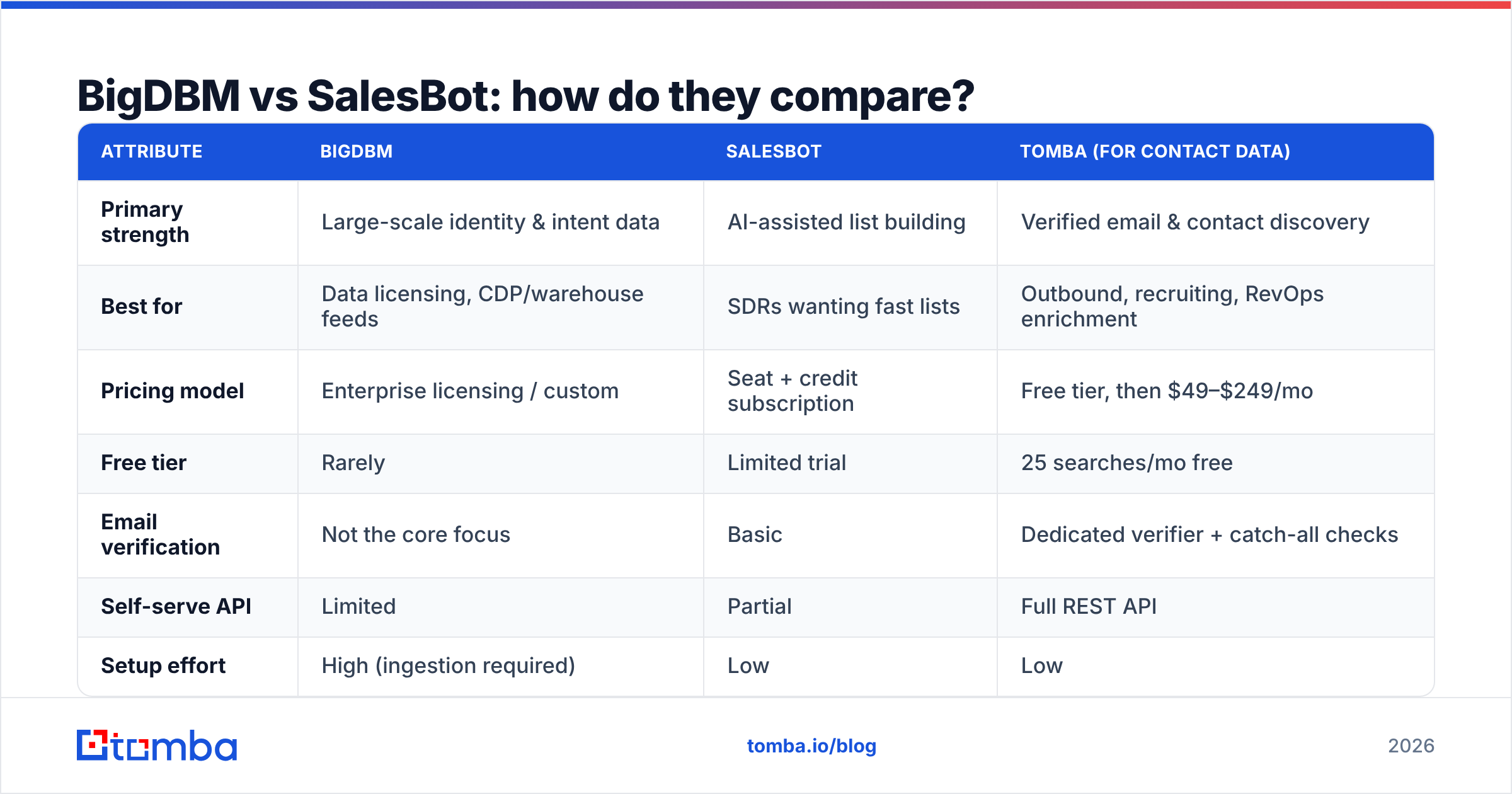
Here's the head-to-head on the attributes that actually change your results. Treat the pricing rows as directional — both vendors quote based on volume and contract.
| Attribute | BigDBM | SalesBot | Tomba (for contact data) |
|---|---|---|---|
| Primary strength | Large-scale identity & intent data | AI-assisted list building | Verified email & contact discovery |
| Best for | Data licensing, CDP/warehouse feeds | SDRs wanting fast lists | Outbound, recruiting, RevOps enrichment |
| Pricing model | Enterprise licensing / custom | Seat + credit subscription | Free tier, then $49–$249/mo |
| Free tier | Rarely | Limited trial | 25 searches/mo free |
| Email verification | Not the core focus | Basic | Dedicated verifier + catch-all checks |
| Self-serve API | Limited | Partial | Full REST API |
| Setup effort | High (ingestion required) | Low | Low |
| Real-time lookups | No (bulk-oriented) | Partial | Yes |
The pattern is clear: BigDBM optimizes for scale and ownership, SalesBot for speed and convenience, and a tool like Tomba for accuracy at the point of use. They're not strictly substitutes — they solve different layers of the same problem.
Which one has more accurate data?#
Accuracy is two questions, not one: how complete is the dataset, and how current is each record at the moment you use it.
BigDBM's edge is completeness — its identity graphs are broad, and for modeling work that breadth matters more than any single field being perfect today. But bulk-licensed data ages the instant it's exported. People change jobs, domains migrate, and a 90-day-old record decays fast.
SalesBot's AI list-building can feel accurate because it returns plausible results, but plausibility isn't verification. An email that follows the right pattern still bounces if the mailbox doesn't exist.
This is the structural reason teams bolt a verification layer on top of any provider. A dedicated email verifier confirms deliverability before you send, and a catch-all verifier handles the domains that silently accept everything. No amount of dataset size removes the need to check the record at send time.
)
How does pricing compare?#
The pricing philosophies tell you who each tool is for.
- BigDBM — Enterprise-style licensing. You're negotiating a dataset or a feed, often with minimums that make sense only at volume. Great economics if you're enriching millions of records; overkill if you need a few thousand targeted contacts a month.
- SalesBot — Subscription with seats and credits. Predictable for a small team, but per-credit costs add up once you scale, and you pay for results whether or not they verify.
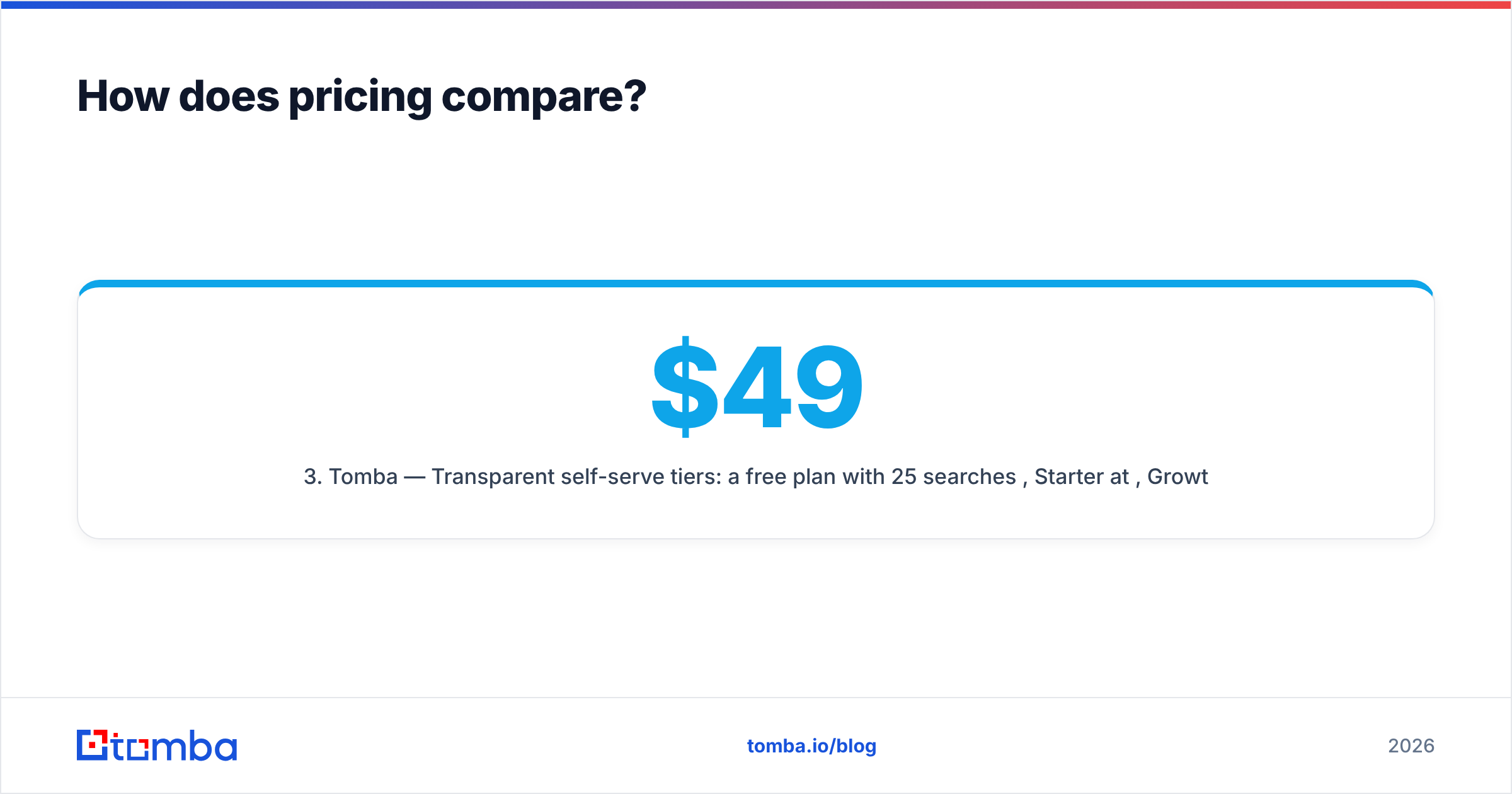
- Tomba — Transparent self-serve tiers: a free plan with 25 searches/month, Starter at $49/mo, Growth at $99/mo, Pro at $249/mo, and custom Enterprise. You can see full Tomba pricing without a sales call.
For most early-stage and mid-market teams, the friction of an enterprise contract isn't worth it until volume justifies it — and the convenience of a credit tool isn't worth it if half the credits return unverified data. Transparent per-search pricing with a real free tier is the lowest-risk way to start.
What about coverage and use cases?#
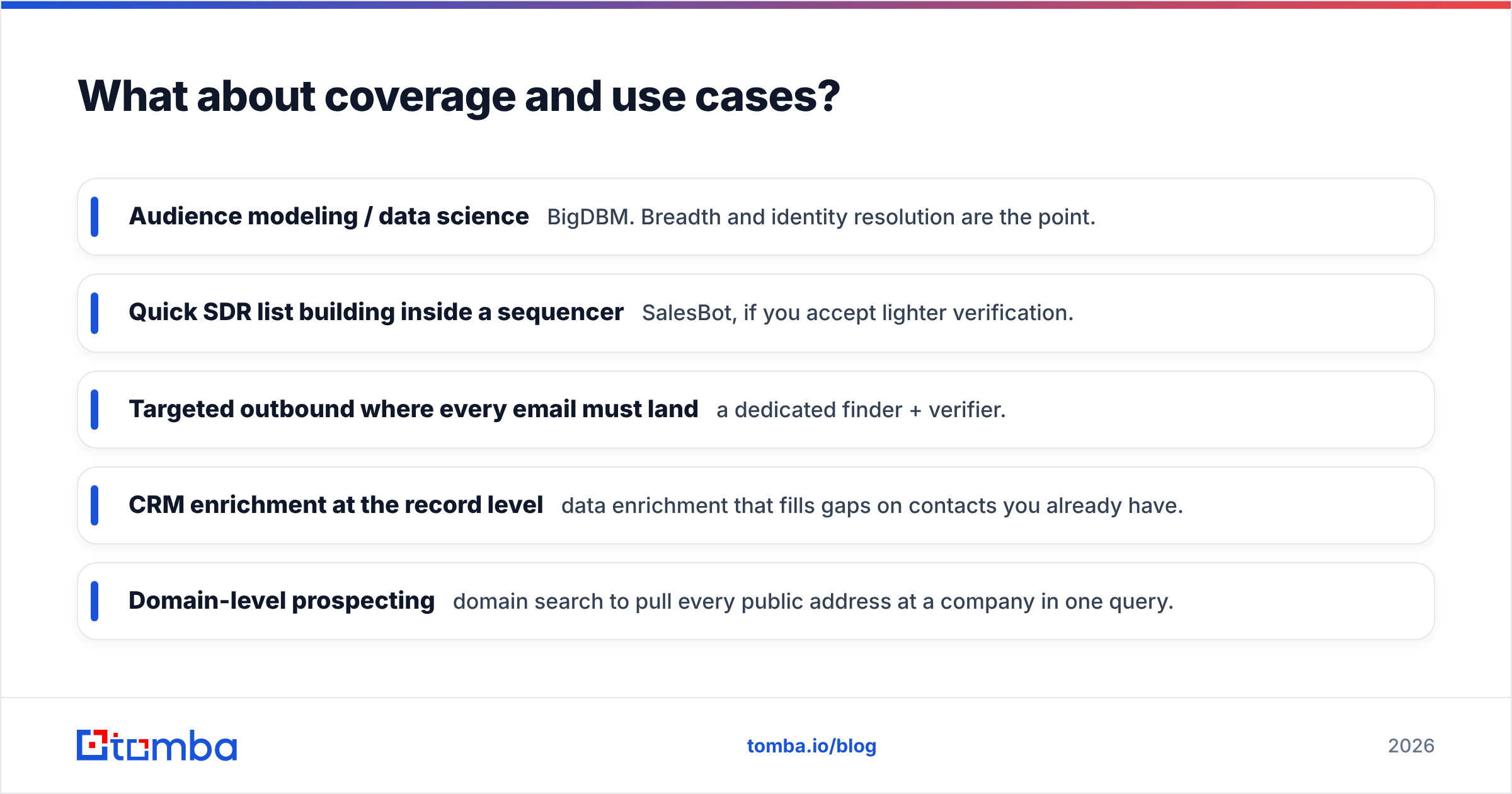
Match the tool to the job:
- Audience modeling / data science — BigDBM. Breadth and identity resolution are the point.
- Quick SDR list building inside a sequencer — SalesBot, if you accept lighter verification.
- Targeted outbound where every email must land — a dedicated finder + verifier.
- CRM enrichment at the record level — data enrichment that fills gaps on contacts you already have.
- Domain-level prospecting — domain search to pull every public address at a company in one query.
Notice that "more data" and "better outreach" aren't the same axis. A 10-million-row file you can't keep current is worse for a 5-person sales team than 2,000 verified, current contacts that actually convert.
Where does Tomba fit against both?#
Tomba isn't trying to out-license BigDBM or out-automate SalesBot. It does one layer extremely well: turning a name, domain, or company into a verified, current contact you can act on immediately.
That focus shows up in the workflow. You can run single lookups, push thousands through the bulk email finder, or wire it straight into your stack with the Tomba API. Every result is checked against deliverability signals rather than handed over as a raw guess, and the underlying data sources are documented rather than opaque.
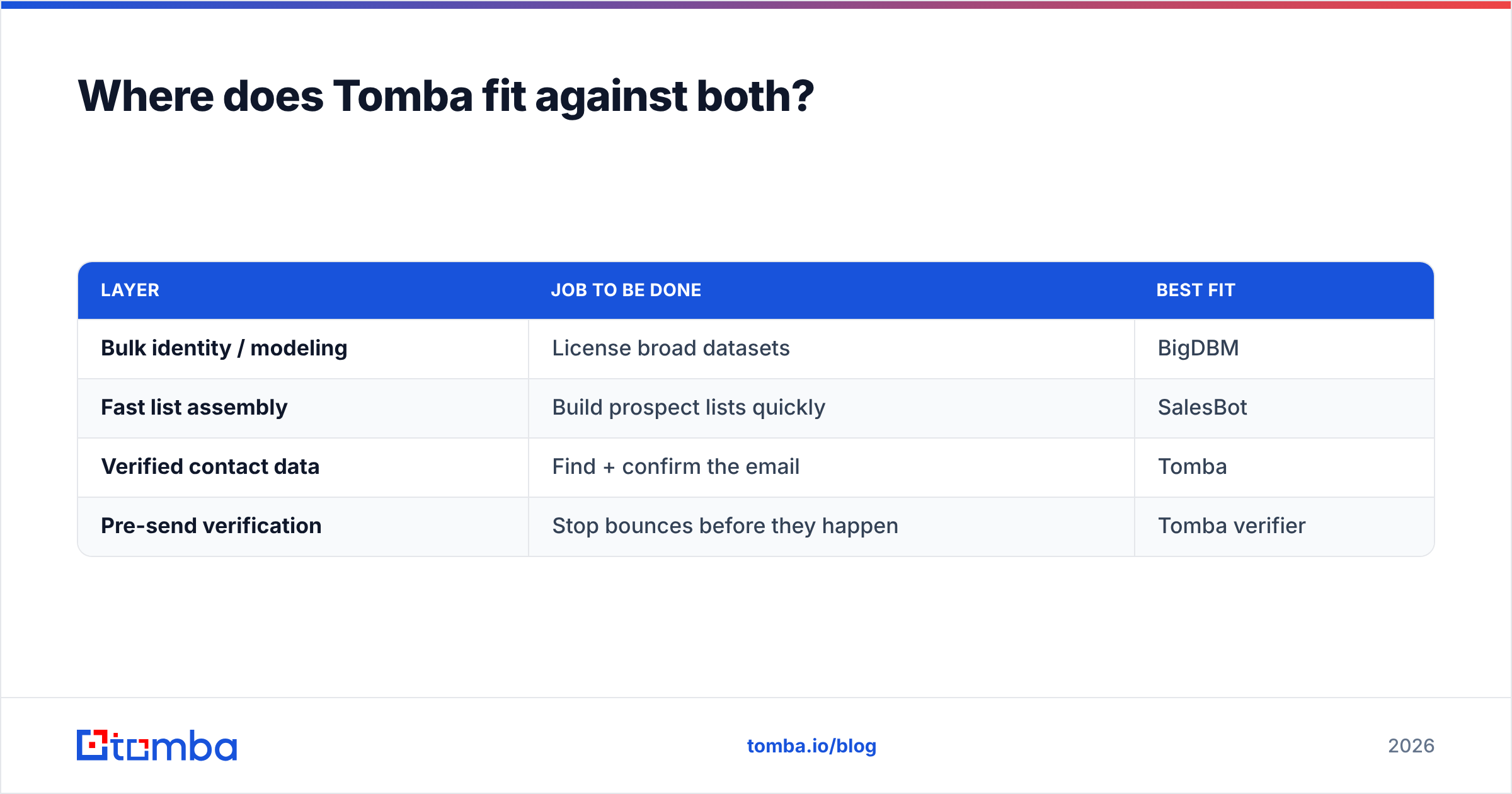
Here's a practical split most teams land on:
| Layer | Job to be done | Best fit |
|---|---|---|
| Bulk identity / modeling | License broad datasets | BigDBM |
| Fast list assembly | Build prospect lists quickly | SalesBot |
| Verified contact data | Find + confirm the email | Tomba |
| Pre-send verification | Stop bounces before they happen | Tomba verifier |
You can run all three. A common pattern: source breadth from a big provider, then pass every record through Tomba to confirm the email is real before it ever enters a sequence. That keeps your sender reputation intact and your bounce rate low.
Are BigDBM and SalesBot worth it?#
Yes — for the right job. BigDBM earns its keep when you're operating at data-warehouse scale and have engineers to match. SalesBot earns its keep when speed of list-building outweighs strict verification, and your team is comfortable cleaning the output.
But "worth it" is conditional. Buying a giant dataset you can't keep fresh, or a credit pack that returns unverifiable emails, is a fast way to torch deliverability and waste budget. Independent reviews on platforms like G2 and analyst coverage from firms like Gartner consistently flag the same theme: data decay, not data volume, is what kills outbound performance. The buyers who win are the ones who pair coverage with verification.
How do I choose between BigDBM and SalesBot?#
Work backward from your real bottleneck:
- If your problem is "we don't have enough data to model" → BigDBM.
- If your problem is "my reps spend too long building lists" → SalesBot.
- If your problem is "our emails bounce and replies are low" → that's a verification and accuracy problem, and neither tool fully solves it. Add a dedicated finder.
Most teams discover the third problem is the expensive one. You don't need ten million records; you need the next few thousand to be correct. That reframing usually changes the purchase decision — and the budget allocation — entirely.
The bottom line#
BigDBM and SalesBot are solving different layers: BigDBM owns scale and identity, SalesBot owns speed and convenience. Neither is built to guarantee that the specific email you're about to send actually reaches a real inbox — and that guarantee is what protects your domain reputation and your reply rate.
That's the gap Tomba fills. Start free with 25 searches a month, find verified professional emails by name, domain, or company, and only upgrade when volume demands it. Spin up the Tomba Email Finder, run your next list through it, and compare the bounce rate against whatever you're using now. The difference in deliverability is usually obvious by the first send.
Ready to find emails that actually work?
Join 150,000+ professionals who stopped guessing and started sending. Free credits on signup — no credit card required.
Get the Tomba newsletter
Practical outbound tactics and product updates — once every two weeks.
About the author