BigDBM vs SMARTe 2026: Which B2B Data Provider Wins?
A neutral, hands-on breakdown of BigDBM vs SMARTe in 2026 — coverage, data accuracy, pricing models, and which contact-data provider fits your go-to-market motion.
BigDBM vs SMARTe: Which B2B Data Provider Actually Fits Your GTM in 2026?
TL;DR
- BigDBM is a US-centric data aggregator known for huge consumer + B2B identity graphs, intent data, and audience targeting — strong if you run paid media and need scale over surgical precision.
- SMARTe is a B2B-only contact and account intelligence platform built for sales and SDR teams, with strong global mobile-number coverage and GDPR/CCPA-aligned compliance.
- They are not the same kind of tool. BigDBM sells reach and signals; SMARTe sells targeted, sales-ready contact records.
- Pricing models differ sharply: BigDBM leans toward custom/volume licensing and data feeds, while SMARTe sells credit-based seats for prospecting.
- If you mainly need accurate work emails on demand for cold outreach, a focused email finder like Tomba often beats both on cost-per-verified-contact — we'll show where each one wins.
If you're comparing BigDBM vs SMARTe, you're really asking a deeper question: do you need a data firehose or a prospecting scalpel? This guide answers that without the marketing gloss, then shows where a dedicated email finder changes the math entirely.
What Are BigDBM and SMARTe, Really?#
Think of BigDBM as a wholesale grocery supplier and SMARTe as a meal-kit service. BigDBM delivers raw ingredients at scale — identity records, demographics, intent signals — that you assemble into audiences. SMARTe hands you pre-portioned, ready-to-cook contact records aimed at one job: getting a salesperson on the phone with the right buyer.
BigDBM (bigdbm.com) is a data aggregator and compiler. It maintains large US identity graphs spanning consumer and business records, sells intent and audience data, and powers use cases like programmatic advertising, lead generation feeds, identity resolution, and lookalike modeling. Its center of gravity is volume and signal breadth, not one-click prospecting.
SMARTe (smarte.io) is a B2B sales-intelligence platform. It focuses on verified business contacts — work emails, direct dials, and mobile numbers — plus account firmographics and technographics, delivered through a web app and a browser extension that works on top of LinkedIn. Its center of gravity is sales-ready accuracy for outbound teams.
Here's the structured breakdown of who each tool is built for:
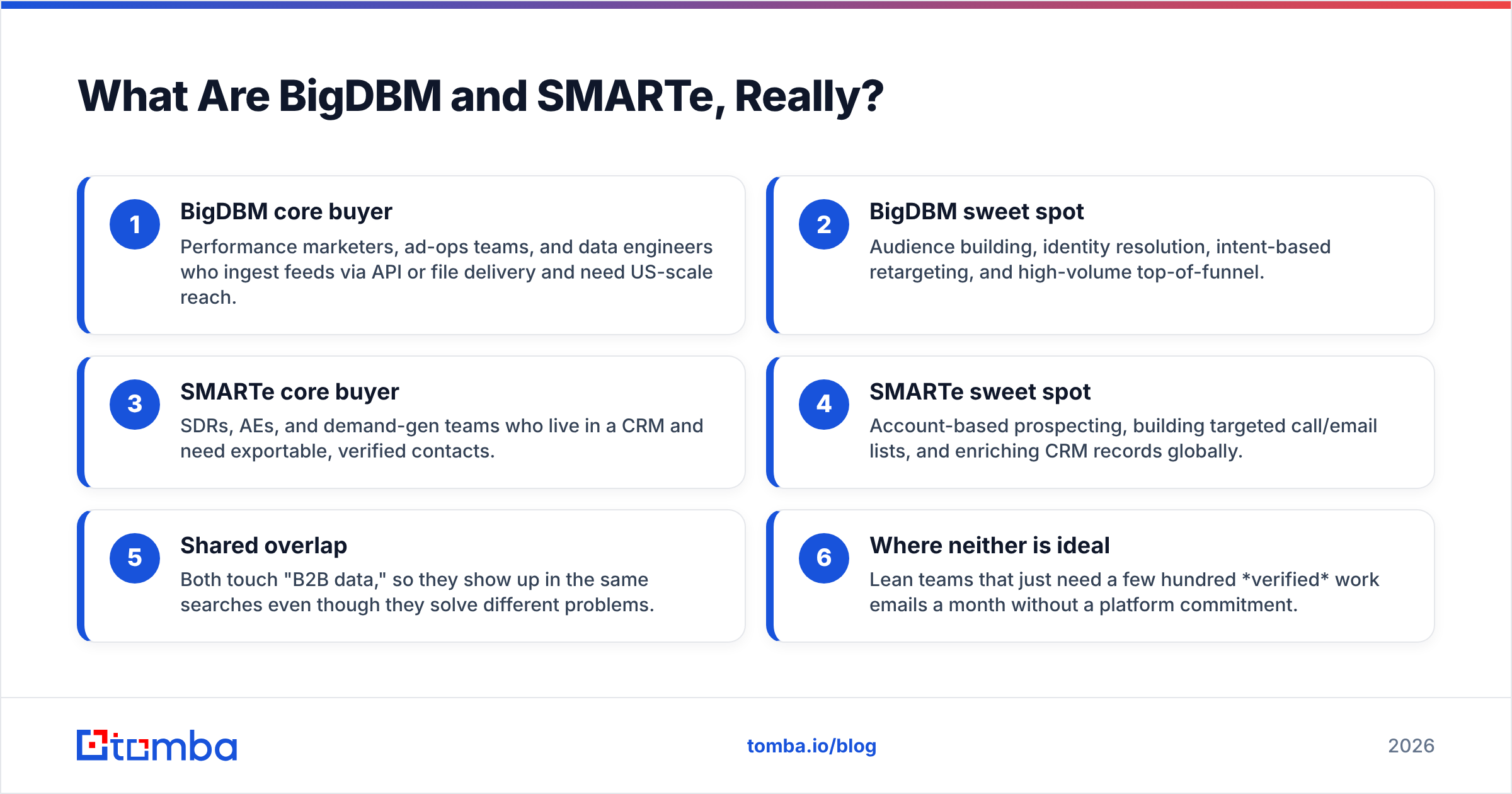
- BigDBM core buyer — Performance marketers, ad-ops teams, and data engineers who ingest feeds via API or file delivery and need US-scale reach.
- BigDBM sweet spot — Audience building, identity resolution, intent-based retargeting, and high-volume top-of-funnel.
- SMARTe core buyer — SDRs, AEs, and demand-gen teams who live in a CRM and need exportable, verified contacts.
- SMARTe sweet spot — Account-based prospecting, building targeted call/email lists, and enriching CRM records globally.
- Shared overlap — Both touch "B2B data," so they show up in the same searches even though they solve different problems.
- Where neither is ideal — Lean teams that just need a few hundred verified work emails a month without a platform commitment.
How Do BigDBM and SMARTe Compare Head-to-Head?#
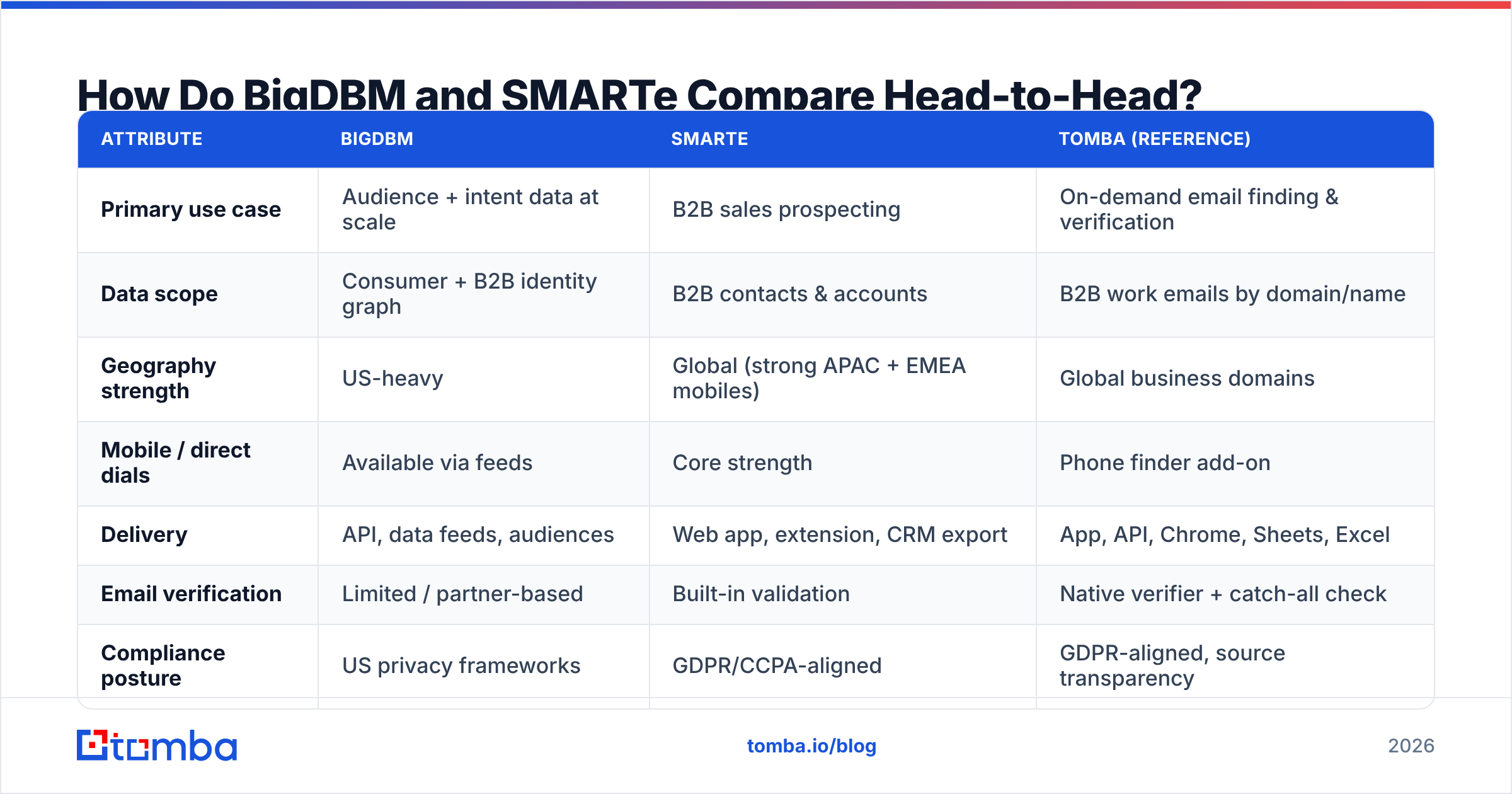
The honest answer to "bigdbm vs smarte" is that they win on different axes. Below is a like-for-like comparison using publicly described capabilities and typical buyer experience. Always confirm current numbers directly with each vendor, since data products change quotas often.
| Attribute | BigDBM | SMARTe | Tomba (reference) |
|---|---|---|---|
| Primary use case | Audience + intent data at scale | B2B sales prospecting | On-demand email finding & verification |
| Data scope | Consumer + B2B identity graph | B2B contacts & accounts | B2B work emails by domain/name |
| Geography strength | US-heavy | Global (strong APAC + EMEA mobiles) | Global business domains |
| Mobile / direct dials | Available via feeds | Core strength | Phone finder add-on |
| Delivery | API, data feeds, audiences | Web app, extension, CRM export | App, API, Chrome, Sheets, Excel |
| Email verification | Limited / partner-based | Built-in validation | Native verifier + catch-all check |
| Compliance posture | US privacy frameworks | GDPR/CCPA-aligned | GDPR-aligned, source transparency |
| Pricing model | Custom / volume licensing | Credit + seat based | Free tier, then $49–$249/mo |
| Best for | Paid media & data teams | SDR/AE outbound | Cost-efficient verified outreach |
A few takeaways from the table:
- BigDBM wins on scale and signal. If your campaigns need millions of US identities or intent-scored audiences for retargeting, SMARTe isn't built for that.
- SMARTe wins on sales usability. A rep can open LinkedIn, grab a verified mobile number, and push it to the CRM. BigDBM expects you to do data engineering.
- Verification is the quiet differentiator. Raw aggregated data (BigDBM's strength) often needs a separate email verifier pass before you send, or you'll torch your domain reputation.
Which Has Better Data Accuracy and Coverage?#
Accuracy depends on what you're measuring. BigDBM's identity graph is broad, but breadth and freshness pull in opposite directions — the larger and more consumer-oriented a database, the more records drift out of date for B2B purposes (people change jobs roughly every 2–4 years). SMARTe invests heavily in re-verification and human-in-the-loop checks for business contacts, which is why sales teams tend to rate its direct-dial accuracy highly in peer reviews on G2.
That said, no aggregator is perfect. Independent buyers consistently report two patterns:
- Coverage is regional. BigDBM is exceptional for US audiences and weaker outside North America. SMARTe is the reverse-friendly option, with notably strong mobile coverage across APAC and EMEA.
- Bounce rates vary by record age. Both providers benefit from a final verification step before any cold campaign. This is the single biggest lever on deliverability — see our primer on email deliverability for why a 5% bounce rate can quietly cap your sending.
If your workflow is "pull a list, then blast it," you will get burned by stale records from any large aggregator. The fix is a verification gate. Tools that bundle finding and verifying — or a standalone catch-all verifier for risky domains — protect your sender reputation far more than chasing the single "most accurate" vendor claim.
How Do BigDBM and SMARTe Price Their Data?#
Pricing is where the two diverge most, and where buyers get surprised.
BigDBM typically sells through custom contracts, volume licensing, or data feeds. You're often quoted based on record volume, data fields, refresh frequency, and use case (advertising vs. CRM enrichment). This is great if you're buying millions of records, and painful if you just want a few thousand contacts — there's usually a meaningful minimum commitment and an onboarding conversation before you see a price.
SMARTe uses a more familiar credit- and seat-based SaaS model. Reps get a quota of reveals/credits per month, with team and enterprise tiers. It's more self-serve-friendly than BigDBM, but per-contact costs climb quickly once your team scales reveals across hundreds of accounts.
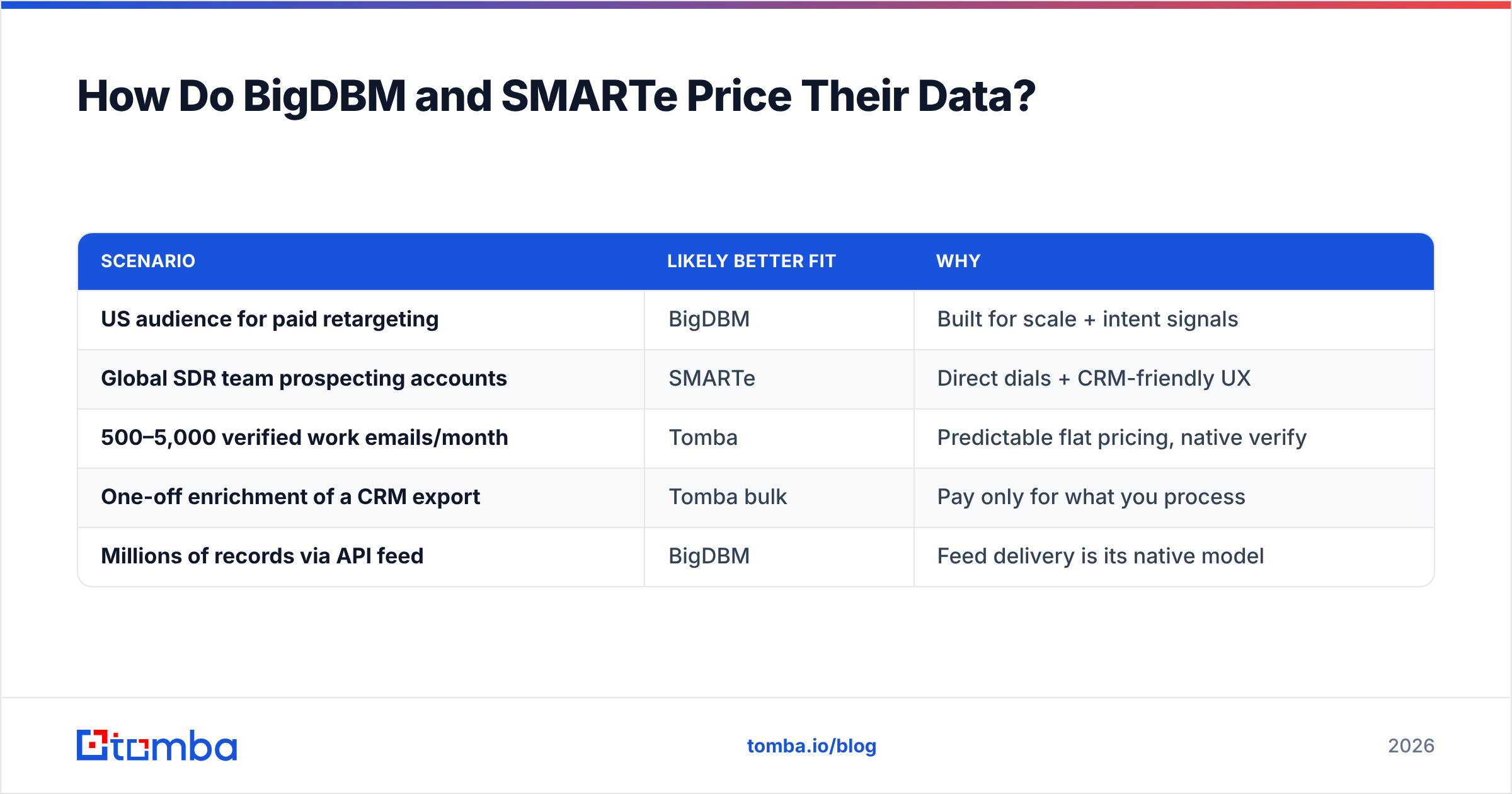
Here's the practical cost lens most teams skip:
| Scenario | Likely better fit | Why |
|---|---|---|
| US audience for paid retargeting | BigDBM | Built for scale + intent signals |
| Global SDR team prospecting accounts | SMARTe | Direct dials + CRM-friendly UX |
| 500–5,000 verified work emails/month | Tomba | Predictable flat pricing, native verify |
| One-off enrichment of a CRM export | Tomba bulk | Pay only for what you process |
| Millions of records via API feed | BigDBM | Feed delivery is its native model |
For lean and mid-market teams, the hidden winner is often a transparent, flat-rate finder. Tomba pricing runs a Free tier (25 searches/month), Starter at $49/mo, Growth at $99/mo, and Pro at $249/mo — no "contact sales to see a number" gate. That predictability matters when finance asks for cost-per-verified-lead.
When Should You Choose BigDBM Over SMARTe?#
Pick BigDBM when your problem is reach and signal, not individual outreach:
- You run programmatic or paid social and need large US audiences.
- You want intent data to score and retarget in-market accounts.
- You have a data team comfortable consuming feeds and doing identity resolution.
- Your KPIs are impressions, match rates, and audience scale — not reply rates.
BigDBM is a poor fit if you're a three-person sales team that just wants emails for a Monday-morning sequence. You'd pay for infrastructure you can't use.
When Should You Choose SMARTe Over BigDBM?#
Pick SMARTe when your problem is targeted outbound:
- Your SDRs prospect inside LinkedIn and need a reveal-and-export flow.
- You sell internationally and need mobile numbers outside the US.
- You want records that drop cleanly into HubSpot or Salesforce.
- You value GDPR/CCPA-aligned sourcing for EU and California outreach.
SMARTe struggles if you need massive ad audiences or consumer-level identity data — that's simply not its lane.
Where Does a Dedicated Email Finder Beat Both?#
Here's the case neither vendor makes for you: most teams overbuy. They sign a platform contract for "data intelligence" when 80% of their actual need is a verified work email for a named person at a known company.
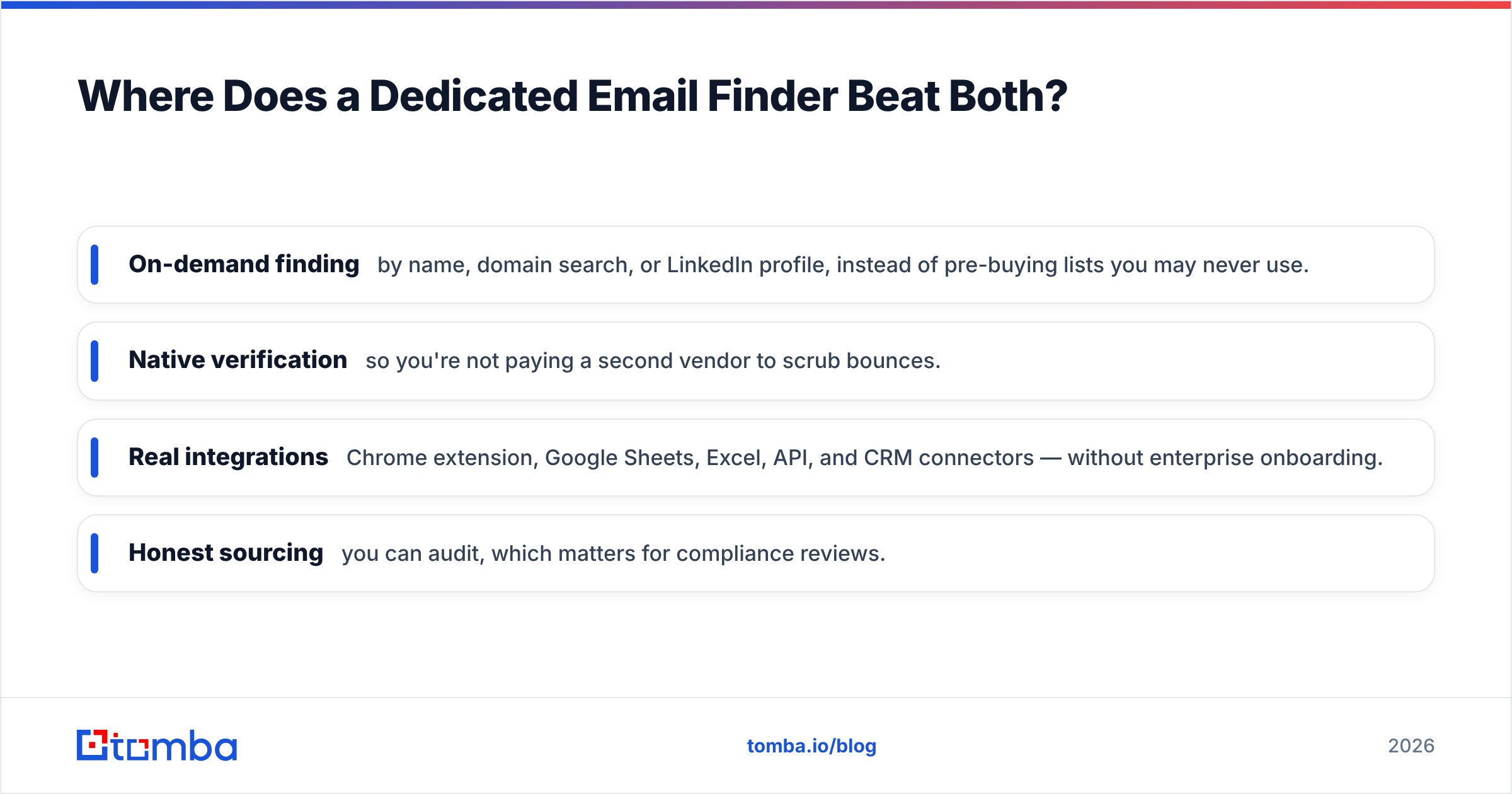
That specific job — turning firstname + company.com into a deliverable, verified email — is exactly what a focused finder optimizes for. A dedicated tool gives you:
- On-demand finding by name, domain search, or LinkedIn profile, instead of pre-buying lists you may never use.
- Native verification so you're not paying a second vendor to scrub bounces.
- Real integrations — Chrome extension, Google Sheets, Excel, API, and CRM connectors — without enterprise onboarding.
- Honest sourcing you can audit, which matters for compliance reviews.
It's not that BigDBM or SMARTe are bad — they're bigger than the job for a lot of buyers. If your monthly need is "a few thousand accurate emails and the occasional phone number," a finder with a phone finder add-on covers it at a fraction of a data-feed contract. And when you do need to process a list, a bulk email finder handles enrichment without a platform seat per rep.
BigDBM vs SMARTe: The Honest Verdict#
There's no universal winner — there's a winner for your motion:
- Choose BigDBM if you're a data/performance-marketing team that needs US-scale audiences and intent signals.
- Choose SMARTe if you're a global sales team that needs verified contacts and direct dials inside a CRM workflow.
- Choose a focused email finder if your real job is verified work emails for outreach, and you want flat, predictable pricing instead of a custom quote.
The mistake is treating "bigdbm vs smarte" as a single shootout. They're different categories wearing the same "B2B data" label. Match the tool to the job, gate everything through verification, and your cost-per-verified-lead drops no matter which platform you license.
Start With Verified Emails, Not a Year-Long Contract#
If your next quarter depends on reaching real buyers — not assembling an ad audience — start where the pipeline actually begins: a clean, verified email. The Tomba Email Finder finds professional addresses by name, domain, or company, verifies them natively, and exports straight to your stack — with a free tier so you can test accuracy before you spend a cent. Find and verify your next 25 leads free with Tomba, then scale on a flat plan when the results prove out. No "contact sales" wall, no minimum-volume contract — just deliverable emails when you need them.
Ready to find emails that actually work?
Join 150,000+ professionals who stopped guessing and started sending. Free credits on signup — no credit card required.
Get the Tomba newsletter
Practical outbound tactics and product updates — once every two weeks.
About the author