BigDBM vs UpLead (2026): B2B Data Provider Comparison
BigDBM and UpLead both sell B2B contact data, but they serve very different buyers. Here is a side-by-side breakdown of pricing, accuracy, coverage, and fit for 2026.
BigDBM vs UpLead: Which B2B Data Provider Actually Fits Your Team in 2026?
TL;DR
- BigDBM is a data-licensing and identity-resolution provider built for marketers, agencies, and platforms that want large raw audience files (B2C + B2B, intent, identity graphs) delivered as feeds or via API — not a self-serve prospecting UI.
- UpLead is a self-serve B2B prospecting database (~160M contacts) with a clean web app, real-time email verification, and per-credit pricing aimed at SDRs and small sales teams.
- Pick BigDBM if you need licensed bulk audiences, identity resolution, or data to power your own product. Pick UpLead if reps need to build verified prospect lists inside a UI today.
- Both can get expensive fast, and neither is a precision email-finder. If your core job is finding and verifying work emails by domain or name, a tool like Tomba Email Finder covers that for a fraction of the price.
- Below: a feature-by-feature table, pricing reality, accuracy notes, and how to decide.
What is BigDBM?#
BigDBM is a US-based data provider that licenses consumer and business datasets, identity graphs, and intent signals. Think of it less as a "log in and search for prospects" tool and more as a data supplier: you tell them the audience or the records you need, and they deliver files or wire data into your systems through an API.
Its strength is breadth and identity resolution — matching scattered signals (emails, devices, addresses, business records) back to a single person or company. Marketing agencies, ad-tech platforms, and companies building their own B2B database products are the typical buyers. The trade-off: there is no polished prospecting workflow for an individual SDR. You are buying data plumbing, not a daily driver app.
What is UpLead?#
UpLead is a self-serve B2B prospecting platform. You log in, filter by job title, industry, company size, technology, location, and more, then pull verified contacts into a list or push them to your CRM. It advertises a database of roughly 160 million contacts and a headline 95% data accuracy guarantee backed by real-time email verification at the moment you reveal a contact.
UpLead is the more familiar shape for a sales team: credit-based, list-building, CRM integrations, a Chrome extension. It competes directly with tools like ZoomInfo, Apollo, and Lusha. Its appeal is simplicity and the verify-before-you-spend model. The limits are coverage outside North America and credits that disappear quickly on bulk work.

BigDBM vs UpLead: how do they compare head to head?#
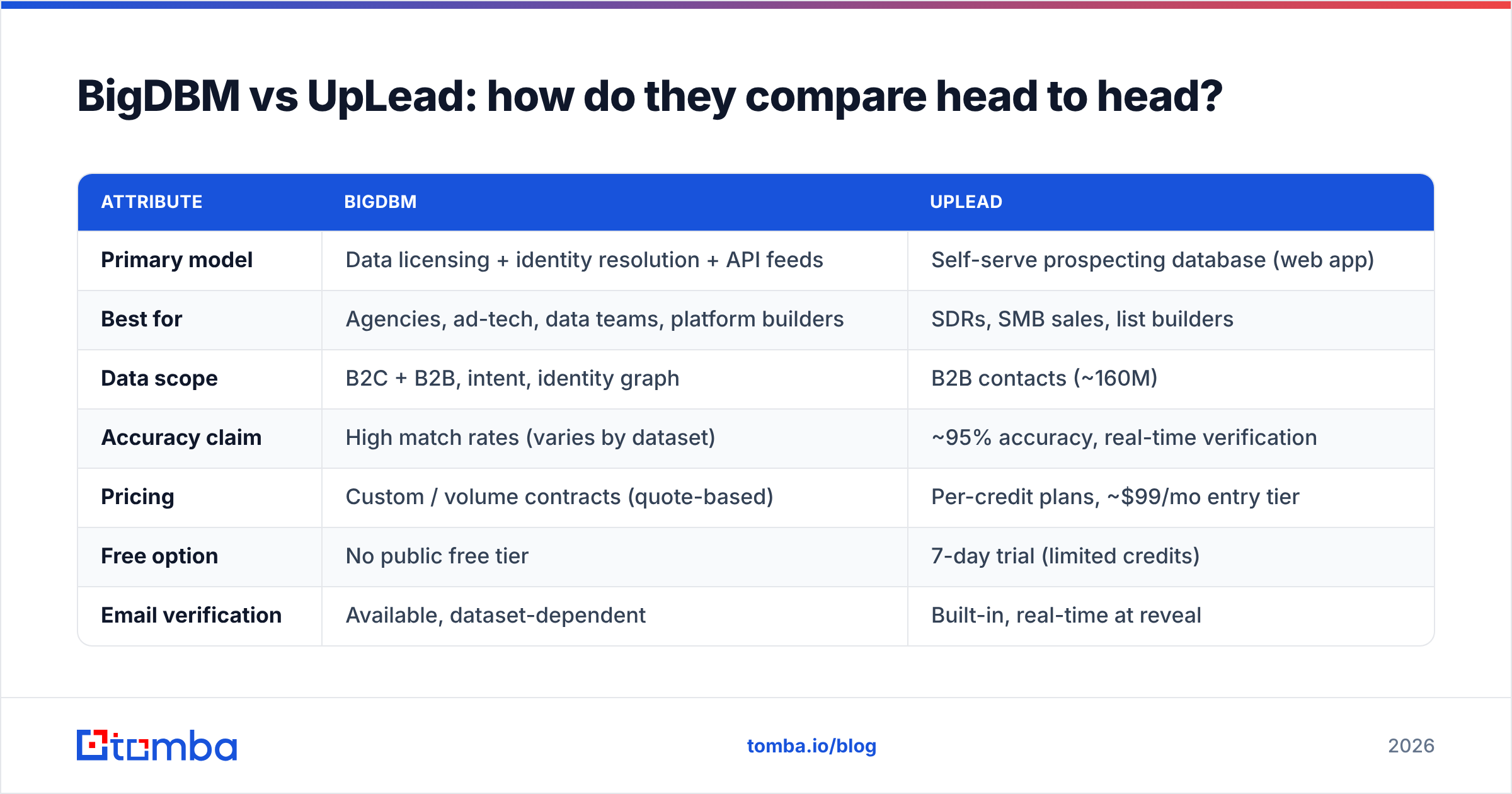
The two products overlap on the word "data" and almost nowhere else. One is a licensing/identity engine; the other is a prospecting UI. Here is the side-by-side.
| Attribute | BigDBM | UpLead |
|---|---|---|
| Primary model | Data licensing + identity resolution + API feeds | Self-serve prospecting database (web app) |
| Best for | Agencies, ad-tech, data teams, platform builders | SDRs, SMB sales, list builders |
| Data scope | B2C + B2B, intent, identity graph | B2B contacts (~160M) |
| Accuracy claim | High match rates (varies by dataset) | ~95% accuracy, real-time verification |
| Pricing | Custom / volume contracts (quote-based) | Per-credit plans, ~$99/mo entry tier |
| Free option | No public free tier | 7-day trial (limited credits) |
| Email verification | Available, dataset-dependent | Built-in, real-time at reveal |
| Self-serve UI | Limited | Yes — full web app + Chrome extension |
| International coverage | Strong US, varies elsewhere | US-heavy, thinner outside NA |
| Typical contract | Annual / volume commitment | Monthly or annual, lower commitment |
A few honest takeaways from that grid:
- They rarely compete for the same buyer. A 4-person sales team is not signing a BigDBM data-licensing contract. A programmatic ad platform is not building on UpLead credits.
- Pricing transparency favors UpLead. You can see UpLead's tiers; BigDBM is quote-driven, which means cost depends entirely on volume and dataset.
- Identity resolution is BigDBM's moat. If you need to stitch records together across channels, UpLead does not do that.
- Verification-at-reveal favors UpLead. You are less likely to burn budget on dead emails inside the app.
Which one is more accurate?#
Accuracy depends on what you're measuring. UpLead's 95% guarantee applies to records you reveal through its app, and because it re-verifies emails in real time, the email you export is usually current. That is a meaningful protection for cold outbound, where bounces wreck your sender reputation.
BigDBM's accuracy is dataset-specific. Identity-resolution match rates and consumer file freshness can be excellent, but "accuracy" for a 50-million-row licensed file is a different statistic than "is this one SDR's email still valid today." If you license bulk data from BigDBM, you should run it through an email verifier before any send — bulk files always carry decay.
The practical rule: never trust any provider's headline accuracy number for cold email without your own verification pass. Even a 95% list means 1 in 20 bounces, and a few hundred bounces in a fresh inbox is enough to tank deliverability. Run lists through verification and, for catch-all domains, a dedicated catch-all verifier before you hit send.
What does each one cost?#
UpLead publishes credit-based plans. Its entry paid tier sits around $99/month for a fixed bundle of credits, with higher tiers (Plus, Professional) adding credits, advanced filters, and API access. Credits map to revealed contacts, so heavy list-building exhausts a plan quickly and pushes you to annual commitments or overage.
BigDBM is quote-based. There is no public price card because cost scales with volume, dataset, refresh cadence, and delivery method (file vs API). Expect an annual or volume commitment, and expect the conversation to start with "how many records and how often."
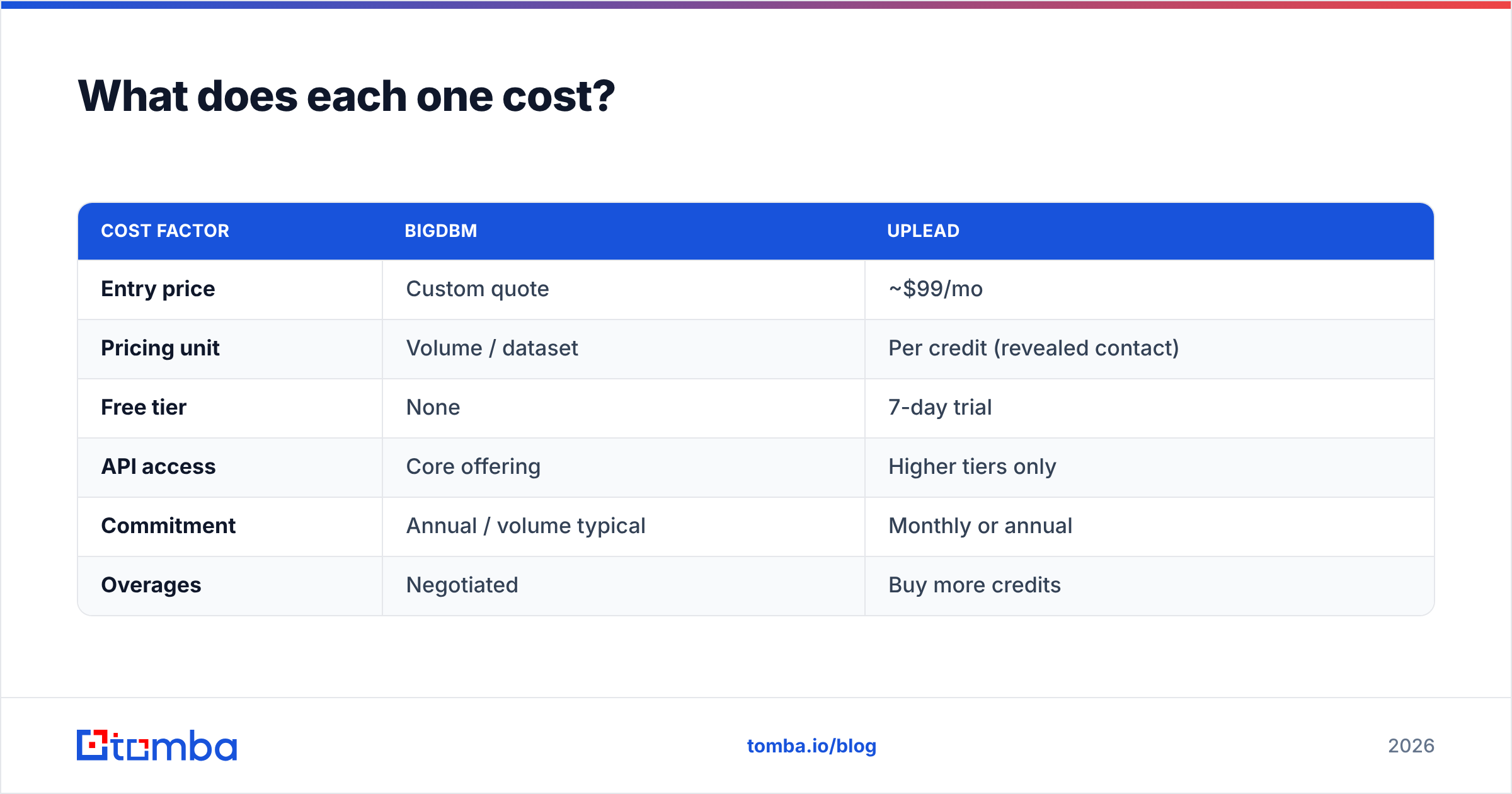
| Cost factor | BigDBM | UpLead |
|---|---|---|
| Entry price | Custom quote | ~$99/mo |
| Pricing unit | Volume / dataset | Per credit (revealed contact) |
| Free tier | None | 7-day trial |
| API access | Core offering | Higher tiers only |
| Commitment | Annual / volume typical | Monthly or annual |
| Overages | Negotiated | Buy more credits |
The hidden cost in both cases is waste. Credits spent on contacts you never email, or licensed rows that decayed before you used them, are pure burn. That is where a cheaper, targeted finder changes the math — you only pay to find the specific people you actually plan to contact.
When should you choose BigDBM?#
Choose BigDBM when data is the product or the fuel for one:
- You're building a platform that needs contact, consumer, or identity data wired in via API.
- You run an agency that needs licensed audiences for ad targeting and audience modeling.
- You need identity resolution — matching anonymous or fragmented signals back to real people or companies.
- You buy data in bulk and have the engineering to ingest, dedupe, and verify it yourself.
If none of those describe you, BigDBM is overkill. You'd be buying a tanker truck to water a houseplant.
When should you choose UpLead?#
Choose UpLead when reps need to build verified lists themselves, today:
- Small to mid sales teams doing targeted outbound in North America.
- Teams that value verify-at-reveal so they don't waste budget on bad emails.
- Buyers who want predictable monthly pricing and a UI, not a data contract.
- CRM-centric workflows — UpLead pushes cleanly into HubSpot, Salesforce, and Pipedrive.
UpLead struggles when you need deep non-US coverage, very high volume (credits get expensive), or niche roles its database thins out on.

Is there a leaner alternative to both?#
Yes — and it depends on the job you're actually hiring a tool to do. Both BigDBM and UpLead bundle a lot you may never use. If your real need is "find the verified work email for these specific people or domains," a focused email-finder is dramatically cheaper and often more accurate per lookup, because it verifies in real time instead of serving a pre-built row.
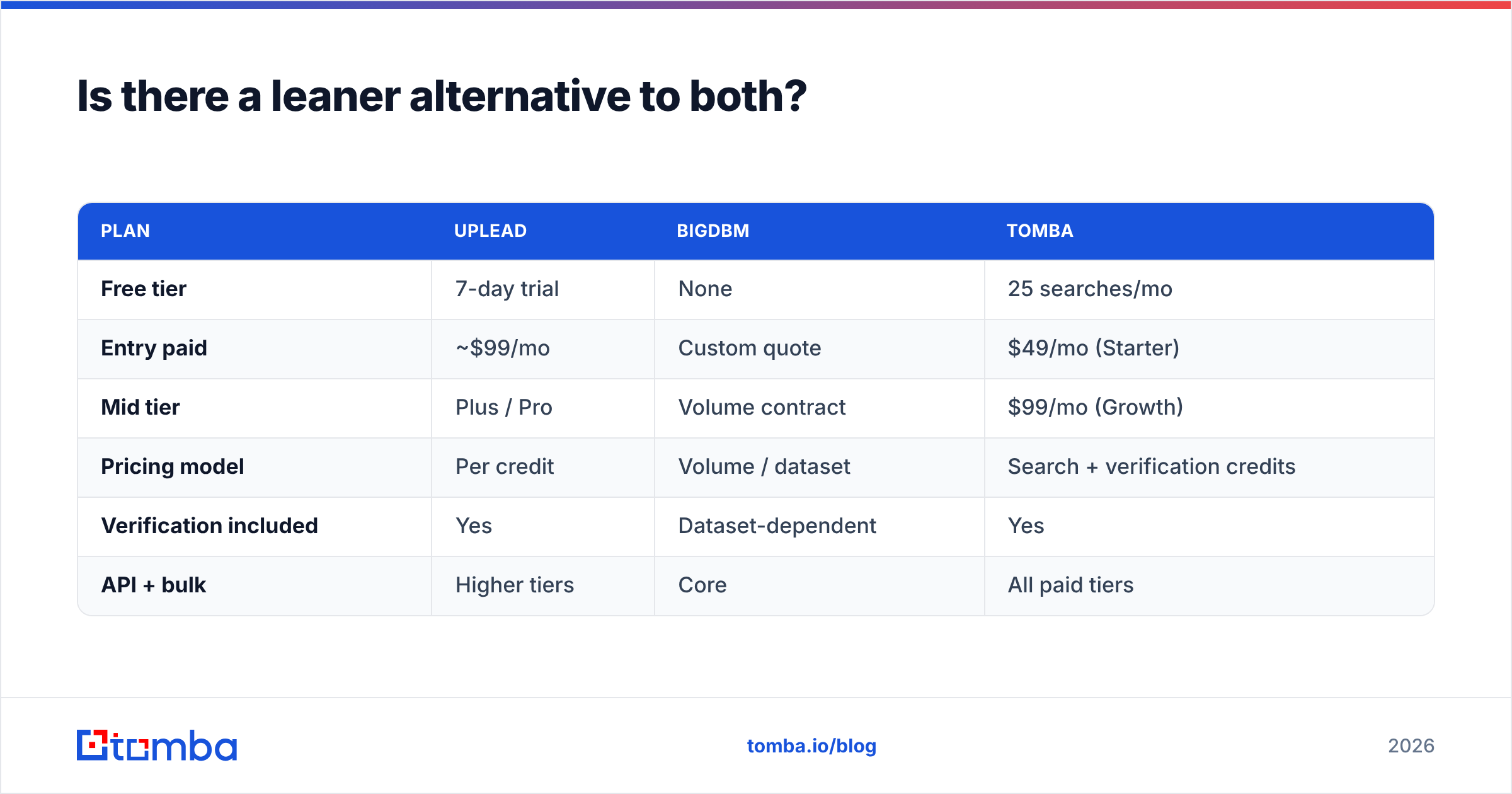
That's where Tomba fits. Instead of licensing a giant file or burning reveal credits, you query exactly the people and companies you care about. Compare the entry economics:
| Plan | UpLead | BigDBM | Tomba |
|---|---|---|---|
| Free tier | 7-day trial | None | 25 searches/mo |
| Entry paid | ~$99/mo | Custom quote | $49/mo (Starter) |
| Mid tier | Plus / Pro | Volume contract | $99/mo (Growth) |
| Pricing model | Per credit | Volume / dataset | Search + verification credits |
| Verification included | Yes | Dataset-dependent | Yes |
| API + bulk | Higher tiers | Core | All paid tiers |
With Tomba you can run domain search to pull every public email pattern at a company, use the bulk email finder for list work, and validate everything through built-in verification before export. Full Tomba pricing starts at $49/mo for Starter, $99/mo for Growth, and $249/mo for Pro — with a genuine free tier of 25 searches a month so you can test accuracy on your own target accounts before paying anything.
This is not an argument that Tomba replaces a data-licensing engine like BigDBM for ad-tech use cases — it doesn't. It's that most teams comparing "BigDBM vs UpLead" are really asking "how do I get good contact data without overpaying," and a targeted finder answers that more cheaply than either.
How do you actually decide?#
Work backward from the job, not the brand:
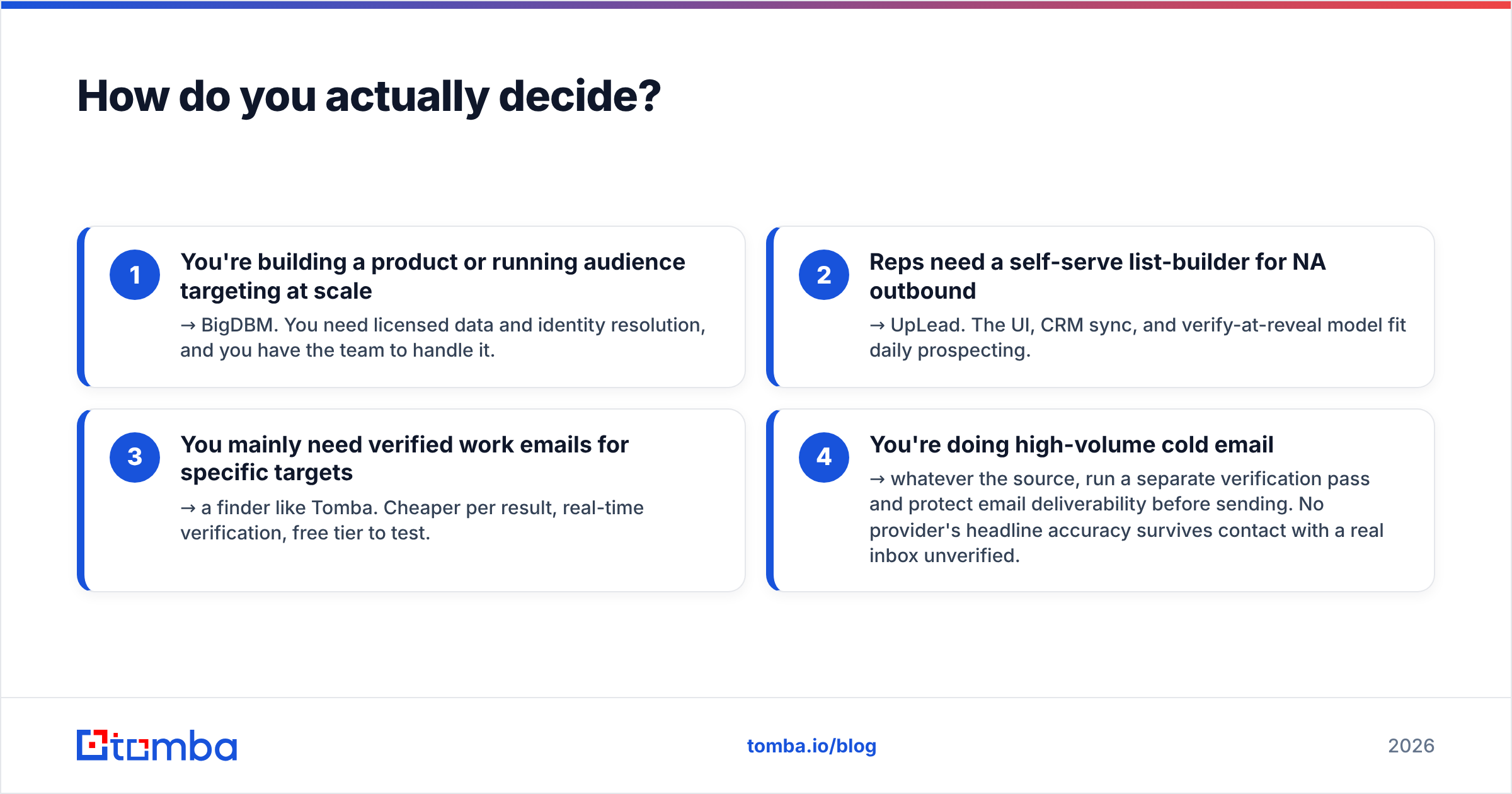
- You're building a product or running audience targeting at scale → BigDBM. You need licensed data and identity resolution, and you have the team to handle it.
- Reps need a self-serve list-builder for NA outbound → UpLead. The UI, CRM sync, and verify-at-reveal model fit daily prospecting.
- You mainly need verified work emails for specific targets → a finder like Tomba. Cheaper per result, real-time verification, free tier to test.
- You're doing high-volume cold email → whatever the source, run a separate verification pass and protect email deliverability before sending. No provider's headline accuracy survives contact with a real inbox unverified.
A useful gut check: if you can't articulate why you need identity resolution or licensed bulk files, you probably don't, and you're overbuying. Start with the cheapest tool that produces verified contacts for your exact targets, then scale up to a data contract only when volume demands it.
For deeper vendor research, UpLead and BigDBM both maintain profiles on review sites like G2 and Capterra where you can read role-specific reviews, and you can sanity-check market category definitions on Gartner. Treat star ratings as directional, not gospel — the right tool is the one that matches your workflow and budget, not the one with the most reviews.
The bottom line#
BigDBM and UpLead aren't really rivals — they're answers to different questions. BigDBM sells data infrastructure and identity resolution to teams that build on data. UpLead sells a clean, verify-as-you-go prospecting app to sales teams that build lists. Match the tool to the job and either can be the right call.
But if you landed here because you just need accurate, verified business emails without a quote-based contract or vanishing credits, start smaller. Try Tomba Email Finder — find emails by domain, name, or company, verify them in real time, and keep your bounce rate low. The free tier gives you 25 searches a month to benchmark accuracy against your own accounts before you spend a dollar, and paid plans start at $49/mo when you're ready to scale.
// get started
Find, verify and enrich your first contacts today
Start on the free plan with 25 searches a month, then scale when your team is ready.
Free plan · No credit card required · GDPR & CCPA
// about the author