BigDBM vs ZoomInfo 2026: Data Coverage, Pricing & Accuracy
BigDBM vs ZoomInfo in 2026: how the two B2B data providers compare on coverage, accuracy, pricing, and which one actually fits your go-to-market budget.
Choosing a B2B data provider is really a bet on two things: how much of your market they actually have, and how much you'll bleed in annual contracts to reach it. BigDBM vs ZoomInfo is one of the more lopsided versions of that bet — a quietly powerful US identity-data shop versus the most recognized sales-intelligence brand on the market. This guide breaks down what each one is good at, where the data quality really lands, and how the pricing math plays out for a revenue team in 2026.
TL;DR#
- ZoomInfo is the enterprise standard: deep firmographics, intent data, org charts, and a huge contact database — sold on annual contracts that typically start around $15,000/year and climb fast.
- BigDBM is a US-focused identity and consumer/B2B data provider built for volume buyers, data resellers, and performance marketers — strong on records, lighter on the polished sales-intelligence workflow.
- Accuracy is the real differentiator: ZoomInfo invests heavily in verification, but both providers degrade on stale records, and you should verify before you send regardless of vendor.
- Cost is where most teams flinch. ZoomInfo's seat-and-contract model prices out small teams; BigDBM is licensing/volume-oriented and not a self-serve prospecting tool.
- If you mainly need accurate, on-demand business emails without a five-figure contract, a pay-as-you-go email finder like Tomba covers the prospecting job for a fraction of the cost.
What is BigDBM?#
BigDBM is a US-based big-data provider that specializes in identity resolution — stitching together consumer and business records into matchable profiles. Think of it less as a "log in and prospect" tool and more as a data supply company: you license data, pipe it into your systems, and use it to enrich, append, or target.
Its core strengths sit in volume and breadth of US records. BigDBM markets billions of data points across consumer demographics, business contacts, property, automotive, and online behavioral signals. That makes it popular with performance marketers, lead-generation agencies, data resellers, and teams running large append or identity-match jobs.
What it is not is a turnkey seller-facing app with sequence builders, browser extensions, and Salesforce-native workflows. If your SDR wants to click a name on LinkedIn and get a verified work email in two seconds, BigDBM is not built for that motion out of the box.
What is ZoomInfo?#
ZoomInfo is the most established sales-intelligence platform in B2B. It combines a massive contact and company database with workflow features that revenue teams actually live in: advanced search, org charts, technographics, intent data, website-visitor tracking, and tight CRM integration through its broader RevOS suite.
The pitch is breadth plus context. You're not just buying emails and phone numbers — you're buying the surrounding signal: who's in-market, who reports to whom, what tech a company runs, and which accounts are heating up. For large outbound and account-based teams, that context is the whole point.
The catch is the commercial model. ZoomInfo sells annual contracts, often with credit caps, seat minimums, and add-on modules for the features that make the platform shine. The sticker price is rarely the all-in price.
)
BigDBM vs ZoomInfo: how do they compare?#
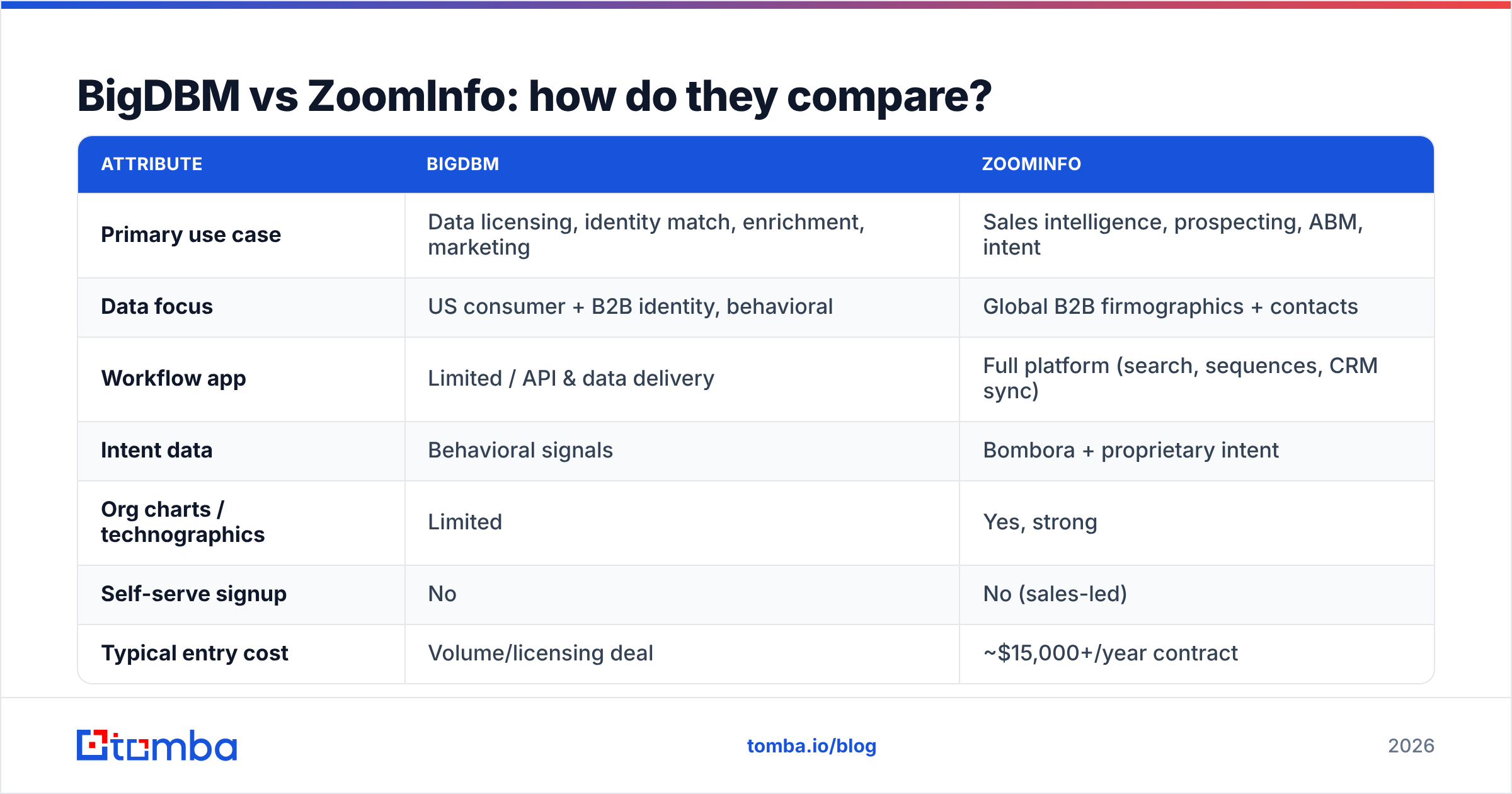
Here's the head-to-head on the attributes that decide most purchases. Treat the numbers as directional — both vendors negotiate and neither publishes fully transparent retail pricing.
| Attribute | BigDBM | ZoomInfo |
|---|---|---|
| Primary use case | Data licensing, identity match, enrichment, marketing | Sales intelligence, prospecting, ABM, intent |
| Data focus | US consumer + B2B identity, behavioral | Global B2B firmographics + contacts |
| Workflow app | Limited / API & data delivery | Full platform (search, sequences, CRM sync) |
| Intent data | Behavioral signals | Bombora + proprietary intent |
| Org charts / technographics | Limited | Yes, strong |
| Self-serve signup | No | No (sales-led) |
| Typical entry cost | Volume/licensing deal | ~$15,000+/year contract |
| Best for | Resellers, marketers, data ops | Mid-market to enterprise sales |
| Contract model | Custom data agreement | Annual, seat + credit based |
The pattern is clear: these tools win in different lanes. BigDBM is a data-supply decision; ZoomInfo is a sales-workflow decision. Comparing them straight-up only makes sense if you're trying to solve a contact-data problem and haven't yet decided whether you want raw data or a full platform on top of it.
Which has better data coverage and accuracy?#
Conclusion first: ZoomInfo wins on B2B contact depth and global firmographics; BigDBM wins on US identity volume and consumer-adjacent data. Neither wins "accuracy" outright, because accuracy is a moving target that depends on how fresh the record is the day you use it.
A few things to keep in mind when you evaluate either provider's claims:
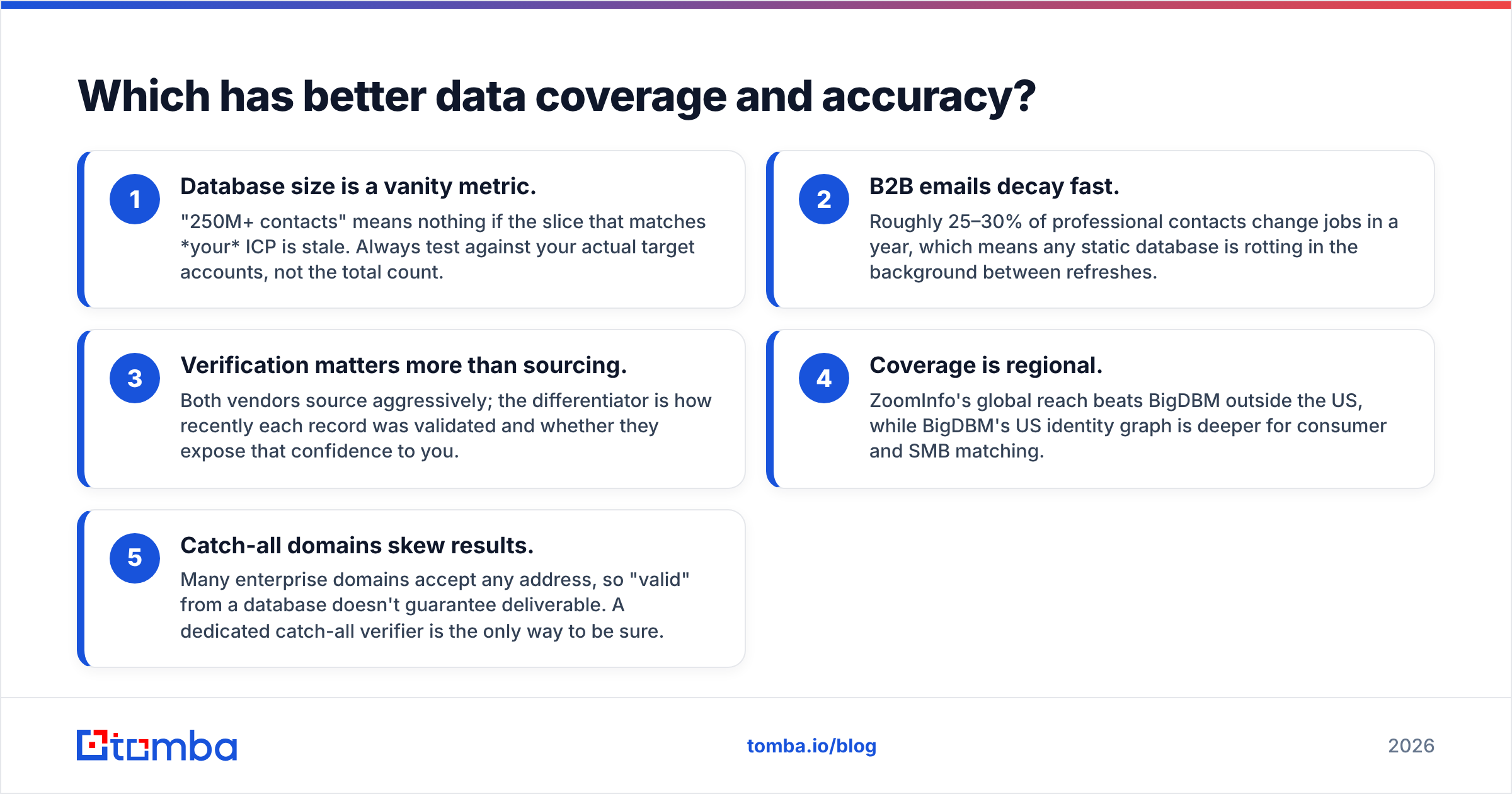
- Database size is a vanity metric. "250M+ contacts" means nothing if the slice that matches your ICP is stale. Always test against your actual target accounts, not the total count.
- B2B emails decay fast. Roughly 25–30% of professional contacts change jobs in a year, which means any static database is rotting in the background between refreshes.
- Verification matters more than sourcing. Both vendors source aggressively; the differentiator is how recently each record was validated and whether they expose that confidence to you.
- Coverage is regional. ZoomInfo's global reach beats BigDBM outside the US, while BigDBM's US identity graph is deeper for consumer and SMB matching.
- Catch-all domains skew results. Many enterprise domains accept any address, so "valid" from a database doesn't guarantee deliverable. A dedicated catch-all verifier is the only way to be sure.
The practical takeaway: whatever provider you license, run new contacts through an independent email verifier before you send. It's cheaper than a wrecked sender reputation and far cheaper than the deals you lose to bounces.
How does pricing actually compare?#
ZoomInfo is famous — and infamous — for its pricing. Public reports and review sites consistently put entry contracts in the $15,000/year and up range, with the all-in number rising quickly once you add intent, the enrichment engine, extra seats, and credit overages. It's a serious line item that needs serious sign-off.
BigDBM doesn't sell in the same shape. It's a data licensing relationship: pricing depends on volume, data types, delivery method (API vs file vs match), and use case. That works beautifully if you're moving millions of records, and not at all if you just need a few thousand verified emails this quarter.
This is exactly where a lot of teams realize they've been pricing the wrong solution. If your real need is "find and verify business emails for outbound, on demand, without a contract," neither a six-figure platform nor a bulk data license is the efficient answer.
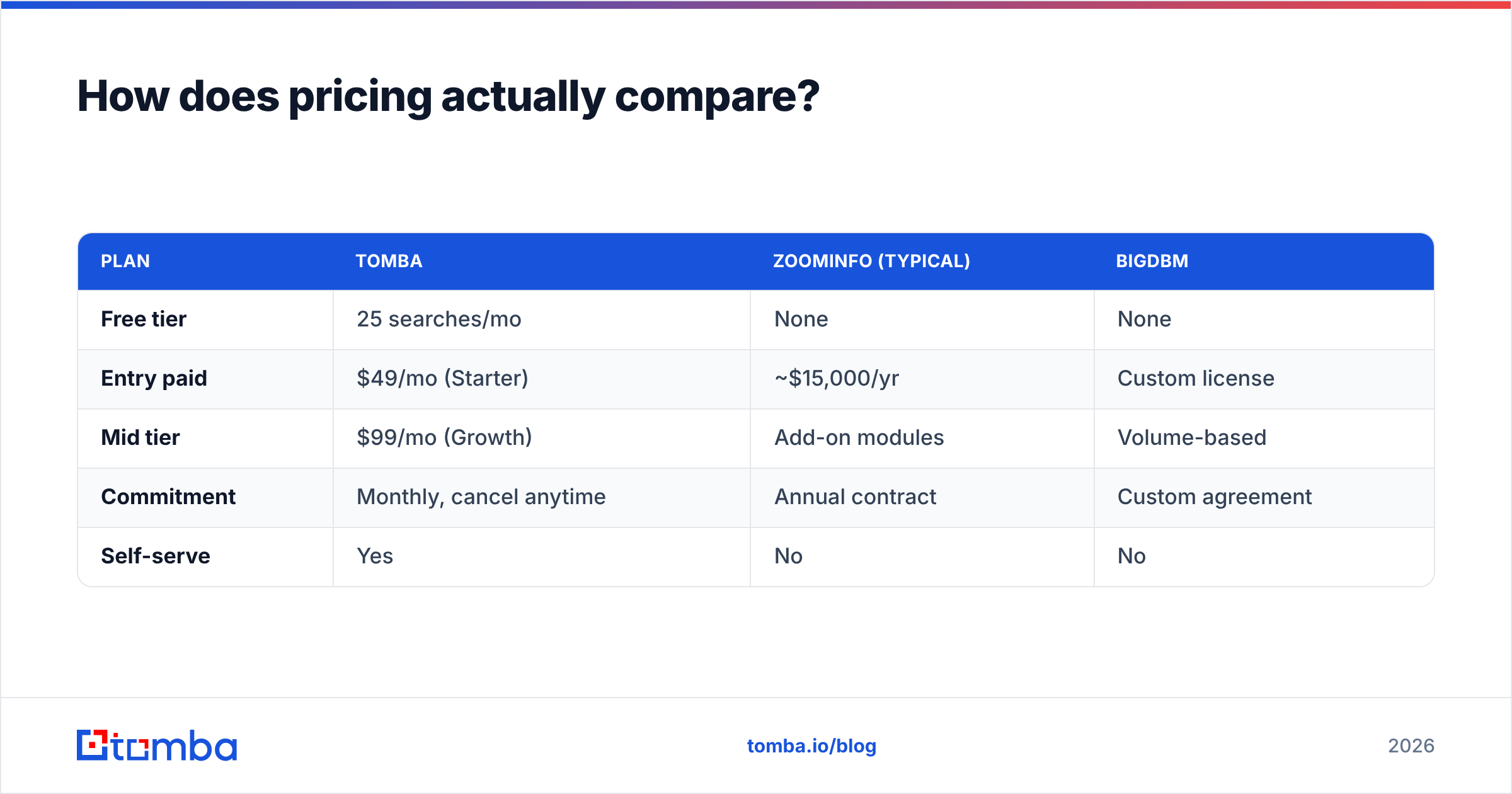
That's the gap Tomba's pricing is built for:
| Plan | Tomba | ZoomInfo (typical) | BigDBM |
|---|---|---|---|
| Free tier | 25 searches/mo | None | None |
| Entry paid | $49/mo (Starter) | ~$15,000/yr | Custom license |
| Mid tier | $99/mo (Growth) | Add-on modules | Volume-based |
| Commitment | Monthly, cancel anytime | Annual contract | Custom agreement |
| Self-serve | Yes | No | No |
)
Who should choose BigDBM?#
Choose BigDBM if you're operating at the data-supply layer, not the rep layer. Specifically:
- You're a lead-gen agency or reseller that needs to license large US datasets.
- You run identity resolution, append, or match jobs at scale.
- You're a performance marketer who wants consumer + business behavioral signals for targeting.
- You have data engineers who can consume an API or flat-file delivery and build the workflow yourself.
If you're an SDR who just wants a verified email for the VP of Marketing at a target account, BigDBM is the wrong altitude — you'd be buying a firehose to fill a cup.
Who should choose ZoomInfo?#
Choose ZoomInfo if you're a mid-market or enterprise sales org that will genuinely use the surrounding platform:
- You run account-based motions and need org charts, technographics, and intent in one place.
- You have a revenue operations function that will operationalize the data into CRM workflows.
- Your deal sizes justify a five-figure-plus annual tool.
- You need global B2B coverage, not just US records.
If you can't honestly say your team will use intent data, org charts, and the workflow layer, you're paying enterprise prices for a contact database — and there are far cheaper ways to get contacts.
Is there a cheaper alternative to both?#
Yes — and for most small-to-mid teams, it's the right call. The honest framing: BigDBM and ZoomInfo are heavyweight solutions for heavyweight problems. A large share of buyers evaluating them actually have a lighter, more common need: accurate business emails and phone numbers, found on demand, without a contract.
For that job, a focused email-finding and verification stack does the work:
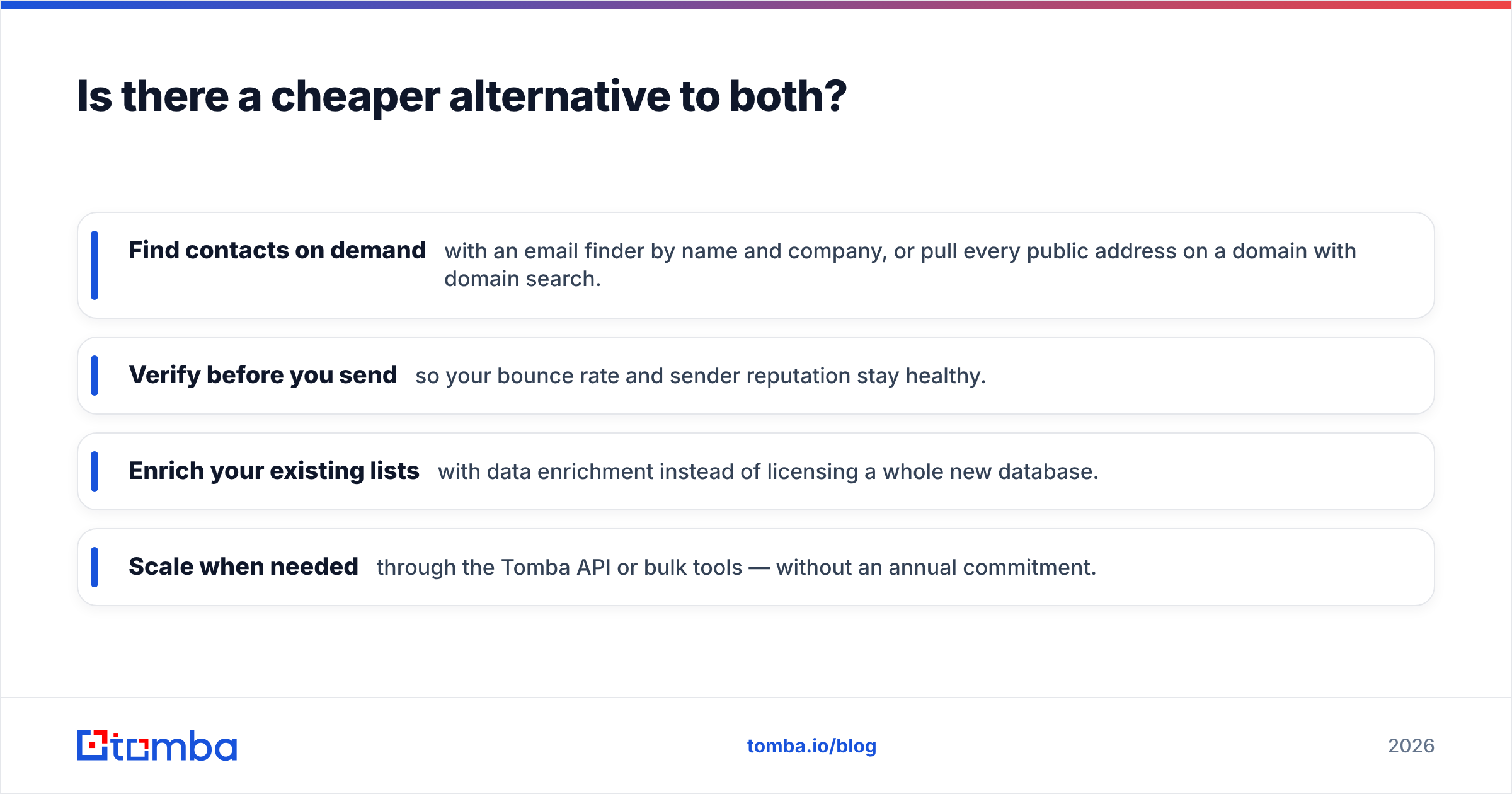
- Find contacts on demand with an email finder by name and company, or pull every public address on a domain with domain search.
- Verify before you send so your bounce rate and sender reputation stay healthy.
- Enrich your existing lists with data enrichment instead of licensing a whole new database.
- Scale when needed through the Tomba API or bulk tools — without an annual commitment.
You give up ZoomInfo's intent firehose and BigDBM's identity-graph volume. In exchange you get a $49/month starting point, a free tier to test against your real list, and zero procurement theater. For teams whose core problem is "I need to reach the right people," that trade is a no-brainer.
You can sanity-check vendor claims independently too — G2's category listings show real-user accuracy and support reviews, ZoomInfo documents its own data process at zoominfo.com, and BigDBM's data catalog lives at bigdbm.com. Compare claims against your own test batch before signing anything.
How should you decide?#
Work backward from the job, not the brand:
- Need raw US data at volume? BigDBM is built for that supply problem.
- Need a full enterprise sales-intelligence platform with intent and org charts, and have the budget? ZoomInfo earns its keep — if you'll use the whole thing.
- Need accurate contacts for outbound without a five-figure contract? A pay-as-you-go finder and verifier wins on cost and speed every time.
The most expensive mistake in this category is buying altitude you don't need. Plenty of teams sign a ZoomInfo contract to solve a problem a $49 plan would have handled — and plenty of marketers license a giant dataset when a few thousand verified emails was the actual requirement.
The bottom line#
BigDBM and ZoomInfo aren't really competitors so much as two answers to two different questions. ZoomInfo is the platform play for funded sales orgs; BigDBM is the data-supply play for marketers and resellers. Both demand commitment, and both reward scale.
If you're not at that scale yet — or you simply want verified business emails without a contract and a sales call — start lean. Spin up the free tier of the Tomba Email Finder, test it against the exact accounts you'd hand a ZoomInfo rep, and only graduate to a heavyweight provider when your volume genuinely demands it. You'll find most of your pipeline doesn't.
// get started
Find, verify and enrich your first contacts today
Start on the free plan with 25 searches a month, then scale when your team is ready.
Free plan · No credit card required · GDPR & CCPA
// about the author