Bigly Sales Pricing, Reviews, Pros and Cons (2026 Guide)
A neutral 2026 breakdown of Bigly Sales pricing, real user reviews, and the pros and cons that matter before you commit to its AI calling and texting platform.
Bigly Sales markets itself as an AI-first sales engine: AI voice agents that dial, AI texting that follows up, and SMS campaigns that run while your reps sleep. The pitch is seductive. The reality, like every tool, is more nuanced. This guide breaks down Bigly Sales pricing, the reviews people actually leave, and the pros and cons you should weigh before you sign anything in 2026.
TL;DR — Bigly Sales at a glance#
- What it is: an AI calling, AI texting, and SMS marketing platform aimed at high-volume outbound and follow-up teams.
- Pricing: tiered subscriptions plus usage-based charges (AI minutes and message volume). Expect a published entry plan and custom enterprise quotes — always confirm live numbers on their site.
- Best for: call-heavy teams (insurance, real estate, solar, agencies) that want to automate first-touch and reminders.
- Weak spots: it is not a contact-data provider. You still need accurate phone numbers and emails to feed it, and review volume is thinner than incumbents.
- Bottom line: strong for conversational AI outreach, but pair it with a real data source so your AI agents are not dialing dead numbers.
What is Bigly Sales and who is it for?#
Bigly Sales is an AI sales automation platform built around two engines: AI voice agents that place and answer calls, and AI text agents that handle SMS conversations. Think of it as hiring a tireless SDR who only does the repetitive parts — first dials, appointment reminders, "are you still interested?" nudges — and hands warm replies back to your humans.
The sweet spot is industries that live on the phone and text. Insurance agencies, real estate teams, solar and home-services companies, and lead-gen agencies are the typical buyers. If your motion is "buy a list, hammer it with calls and texts, book the meeting," Bigly Sales is designed for you.
It is not a prospecting database. Bigly moves messages; it does not find people. That distinction matters for budgeting, because the platform is only as good as the contact data you pour into it. Garbage numbers in, wasted AI minutes out.
How much does Bigly Sales cost in 2026?#
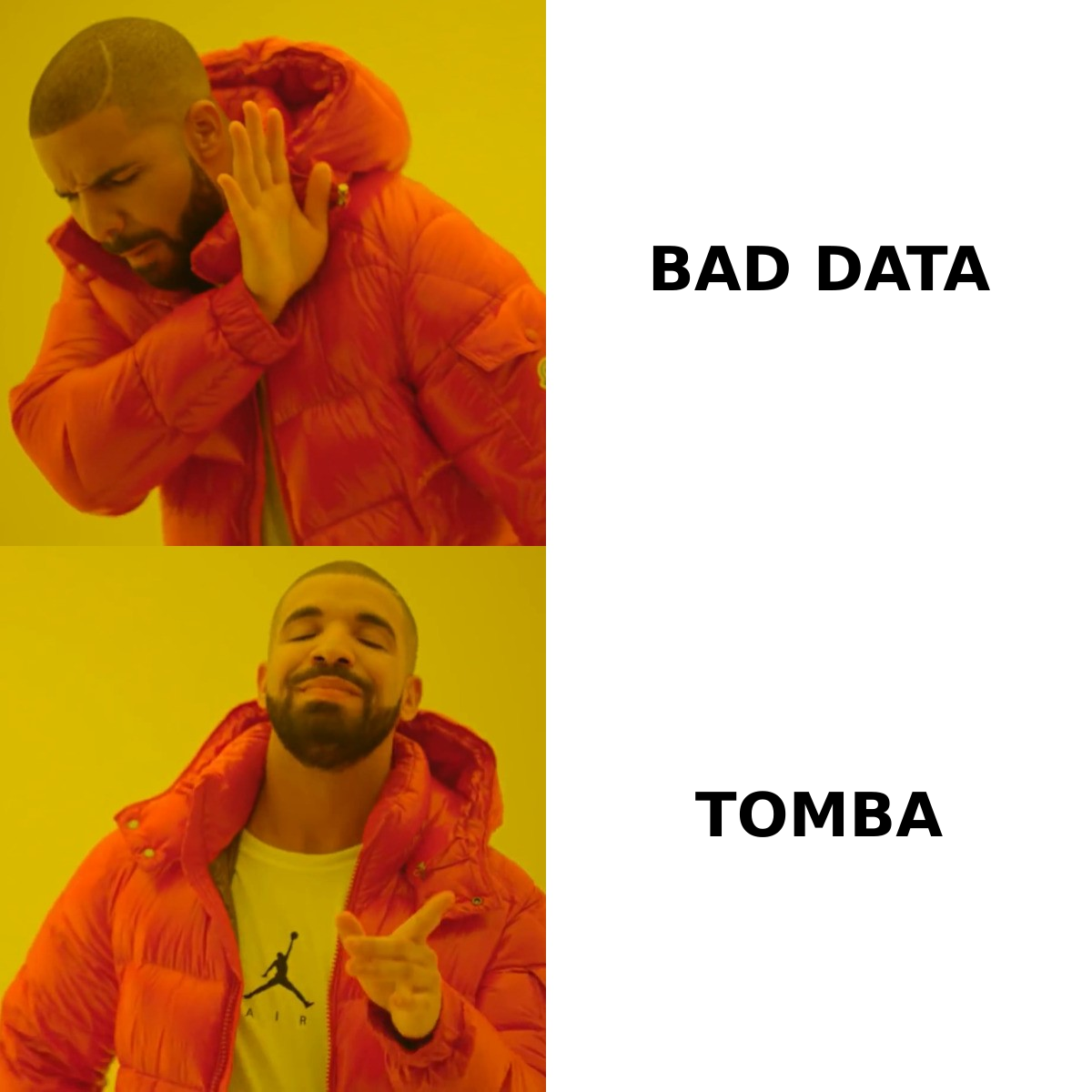
Bigly Sales uses a subscription + usage model rather than one flat fee. You pay a recurring plan price for access and seats, then consume credits for AI call minutes and outbound messages on top. That two-part structure is the single most important thing to understand about the pricing, because the sticker price rarely reflects your real monthly bill.
Pricing pages change often, so treat the table below as a structure map, not a live quote — verify current numbers directly on biglysales.com before you buy.
| Plan tier | Who it targets | What's typically included | Usage charges |
|---|---|---|---|
| Entry / Starter | Solo reps, small agencies | Core AI texting, limited contacts, basic templates | Per-message + per-minute on top |
| Growth / Pro | Scaling sales teams | AI voice agents, more seats, integrations, analytics | Higher included volume, overage billed |
| Business | Multi-rep call centers | Advanced routing, CRM sync, team reporting | Bulk minute/message bundles |
| Enterprise | High-volume operations | Custom AI training, SLAs, dedicated support | Negotiated, custom contract |
Three budgeting rules to take away:
- Model your usage first. Estimate monthly call minutes and message count, then ask sales for the all-in number — not just the plan price.
- Watch the overages. Usage-based tools are cheap until volume spikes; a busy month can multiply your bill.
- Compare to headcount, not to other software. Bigly's value case is "cheaper than another rep," so benchmark it against a salary, not a $49 tool.
For context on how a transparent, flat-tier model reads, compare it to published Tomba pricing where the Free, Starter ($49/mo), Growth ($99/mo), and Pro ($249/mo) tiers are fixed and predictable. Different product, but a useful mental yardstick for "what will I actually pay."
What do Bigly Sales reviews say?#
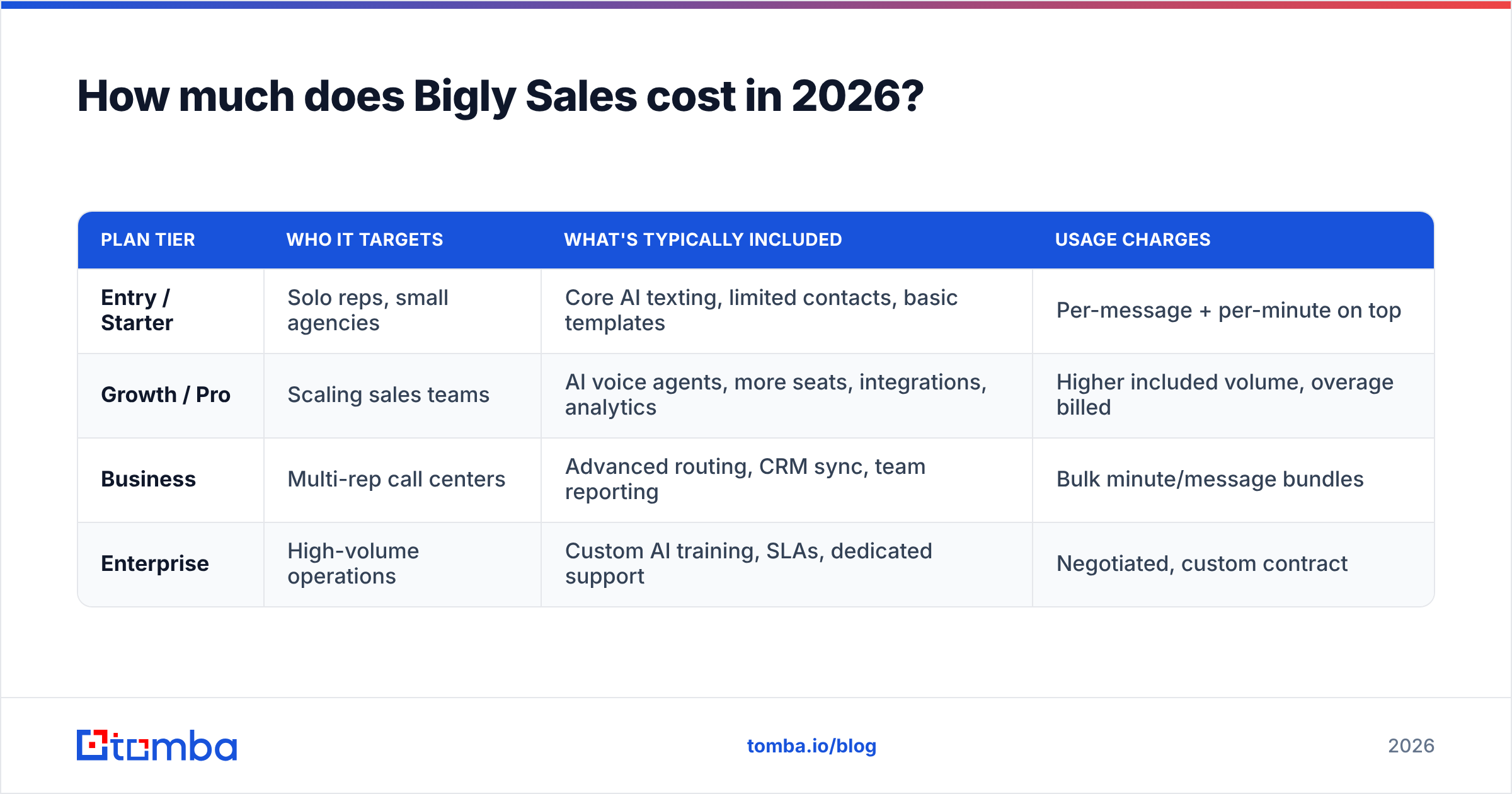
Reviews skew positive on automation and mixed on polish. Aggregators like G2 and Capterra are the places to read unfiltered feedback, and the themes are consistent.
What reviewers praise:
- Speed-to-lead. AI texts and calls fire within seconds of a lead coming in, which users repeatedly credit for higher contact rates.
- Volume handling. The AI agents work nights and weekends without complaint, covering follow-up that reps drop.
- Setup support. Several reviews mention hands-on onboarding to train the AI on their scripts.
What reviewers criticize:
- AI quality variance. Conversations can go off-script or feel robotic on edge cases, requiring human takeover.
- Billing surprises. Usage overages catch people who did not model volume.
- Smaller review base. Compared to category giants, there are fewer reviews, so the sample is thinner and harder to generalize from.
The honest read: Bigly Sales earns its keep for teams that genuinely have high call and text volume, and frustrates those who expected a fully autonomous closer. It automates the grind; it does not replace judgment.
What are the pros and cons of Bigly Sales?#
Here is the balanced scorecard before we talk alternatives.
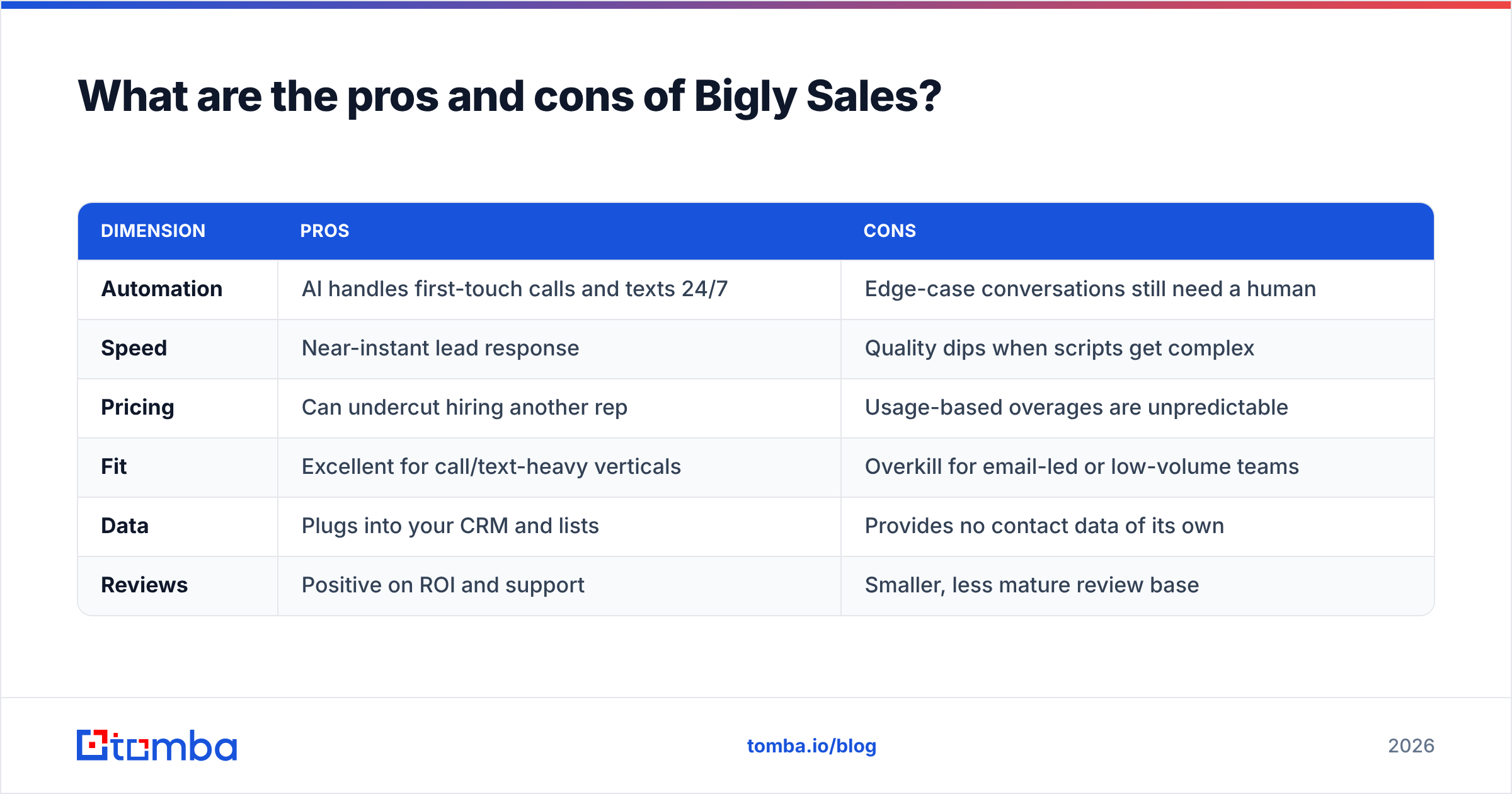
| Dimension | Pros | Cons |
|---|---|---|
| Automation | AI handles first-touch calls and texts 24/7 | Edge-case conversations still need a human |
| Speed | Near-instant lead response | Quality dips when scripts get complex |
| Pricing | Can undercut hiring another rep | Usage-based overages are unpredictable |
| Fit | Excellent for call/text-heavy verticals | Overkill for email-led or low-volume teams |
| Data | Plugs into your CRM and lists | Provides no contact data of its own |
| Reviews | Positive on ROI and support | Smaller, less mature review base |
The recurring asterisk in every "con" column is data dependency. Bigly Sales assumes you already have valid phone numbers and email addresses. It does not find, verify, or enrich them. That is the gap you have to fill yourself.
Is Bigly Sales worth it, or should you consider alternatives?#
It is worth it if three things are true: you run real phone/SMS volume, you have clean contact data to feed it, and you have modeled the usage cost against a rep's salary. If any of those are missing, you will either overpay or under-utilize.
If your motion is more email-led, or you are earlier in building a pipeline, an AI dialer is the wrong first purchase. You need accurate contacts before you need an AI to contact them. In that case, spend on a data enrichment and contact-finding layer first, then layer outreach automation on top once your list is real.
A quick decision filter:
- You sell on the phone, high volume, data is solid → Bigly Sales is a strong candidate.
- You sell over email, or volume is modest → start with finding and verifying contacts, automate later.
- You are not sure your list is accurate → fix data first, regardless of which outreach tool you choose.
How do you feed Bigly Sales accurate data?#
This is where the workflow actually comes together, because an AI agent dialing a wrong number or texting a dead address burns paid minutes for nothing. The fix is a data layer in front of your outreach engine.
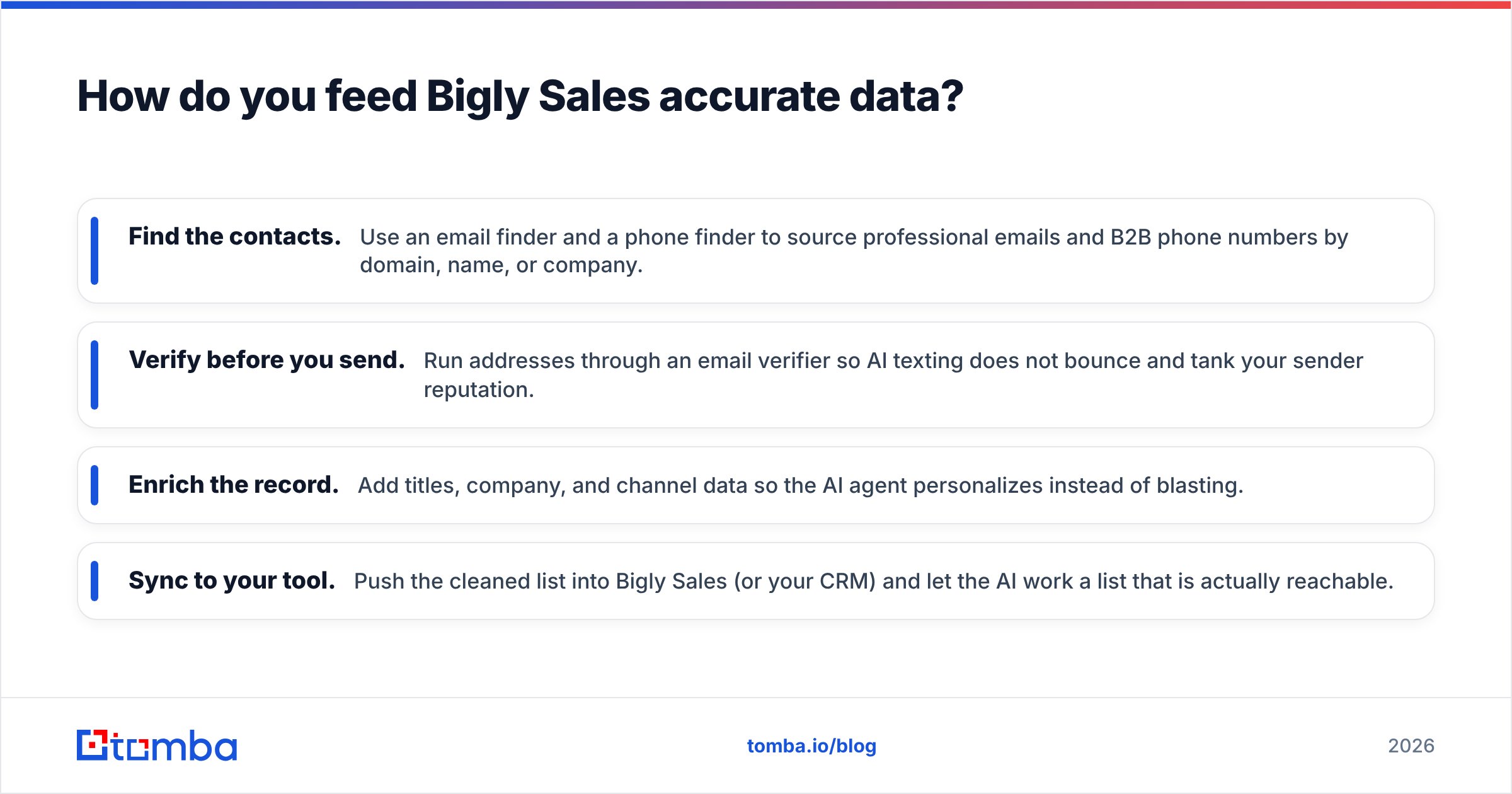
A practical stack looks like this:
- Find the contacts. Use an email finder and a phone finder to source professional emails and B2B phone numbers by domain, name, or company.
- Verify before you send. Run addresses through an email verifier so AI texting does not bounce and tank your sender reputation.
- Enrich the record. Add titles, company, and channel data so the AI agent personalizes instead of blasting.
- Sync to your tool. Push the cleaned list into Bigly Sales (or your CRM) and let the AI work a list that is actually reachable.
That sequence — find, verify, enrich, then automate — is what separates teams that get ROI from AI calling from teams that just generate expensive noise. Bigly Sales is the megaphone. Accurate data is what makes the megaphone worth pointing at anyone.
Bigly Sales vs. the data-first approach: which comes first?#
The mistake teams make is buying the automation before the data. AI calling and texting amplify whatever list you give them — including its errors, at scale. If 20% of your numbers are wrong, an AI agent will faithfully waste 20% of your paid minutes proving it.
So sequence matters:
- Build a clean, verified contact list with a dedicated finder and verifier.
- Then decide whether AI calling (Bigly Sales) or another channel fits your sales motion.
- Measure cost per booked meeting, not cost per message, so usage pricing stays honest.
Tools like Bigly Sales and a data platform are not competitors — they sit at different layers. One is the engine; the other is the fuel. Buying the engine with an empty tank is the most common way teams overspend on AI sales tech in 2026.
Final verdict and recommendation#
Bigly Sales is a legitimate AI calling and texting platform that earns strong reviews from high-volume phone teams and frustrates everyone who expected magic without inputs. The pricing is fair when you model usage honestly and benchmark it against a salary; it bites when you ignore overages. The biggest caveat is structural: it moves messages but finds no data, so its results are capped by the quality of the list you feed it.
Before you automate a single call or text, fix the input. Use the Tomba Email Finder to source accurate, professional contacts by domain, name, or company — start free with 25 searches a month, then scale on the $49/mo Starter plan as your volume grows. Get the data right first, and whatever outreach engine you choose, including Bigly Sales, finally has something worth dialing.
// get started
Find, verify and enrich your first contacts today
Start on the free plan with 25 searches a month, then scale when your team is ready.
Free plan · No credit card required · GDPR & CCPA
// about the author