Biscred vs Bookyourdata 2026: B2B Data Tools Compared
Biscred targets commercial real estate intelligence; Bookyourdata sells pay-as-you-go B2B contact lists. Here is which one fits your pipeline in 2026 — and where a verified email finder beats both.
You are comparing Biscred vs Bookyourdata because you need B2B contact data, and the two tools could not be more different under the hood. One is a niche commercial real estate intelligence platform. The other is a broad, pay-as-you-go email list marketplace. Picking the wrong one wastes budget and clogs your CRM with leads you can't use.
This guide breaks down what each tool actually does, how they price, where their data comes from, and which team each one fits. At the end, you'll see why many outbound teams skip the static-list model entirely and pull verified contacts on demand instead.
TL;DR#
- Biscred is built for commercial real estate (CRE): brokers, investors, lenders, and proptech teams hunting owners, tenants, and decision-makers in property deals.
- Bookyourdata is a horizontal, pay-as-you-go B2B contact database — buy targeted email lists by industry, title, and geography, credits never expire.
- Biscred wins if your entire motion is CRE and you need building-level firmographics. Bookyourdata wins if you want cheap, broad lists across many industries without a subscription.
- Both sell pre-built records that decay the moment you download them. Neither verifies in real time at the point of send.
- If accuracy at send-time matters more than list volume, a live email finder with built-in verification is a better fit than either static source.
What is Biscred?#
Biscred is a commercial real estate data and intelligence platform. Think of it as a specialized search engine for the property world: instead of generic company records, you get building-level data — owners, tenants, property managers, lenders, and the executives attached to each deal.
Sales teams selling into CRE (proptech vendors, construction suppliers, brokerage tech, lenders) use Biscred to find the right contact at a firm that owns or manages a specific asset. The value is depth in one vertical, not breadth across all of B2B.
If you sell to dentists, SaaS founders, or manufacturers, Biscred is the wrong tool — its coverage is concentrated where commercial property lives.

What is Bookyourdata?#
Bookyourdata is a horizontal B2B contact-list marketplace with a pay-as-you-go model. You filter by industry, job title, company size, technology, and location, preview the count, and buy the records as a downloadable list. Its headline selling points are that credits don't expire and that it advertises a high deliverability guarantee on purchased emails.
It's the opposite philosophy from Biscred: maximum breadth, minimal specialization. You can pull a list of marketing directors in Texas one day and HR managers in Germany the next, paying only for what you export.
The trade-off is that broad list databases live and die by freshness. A title that was accurate at scrape time is often stale by the time you import it — which is why email verification on any purchased list is non-negotiable before you hit send.
Biscred vs Bookyourdata: how do they compare?#
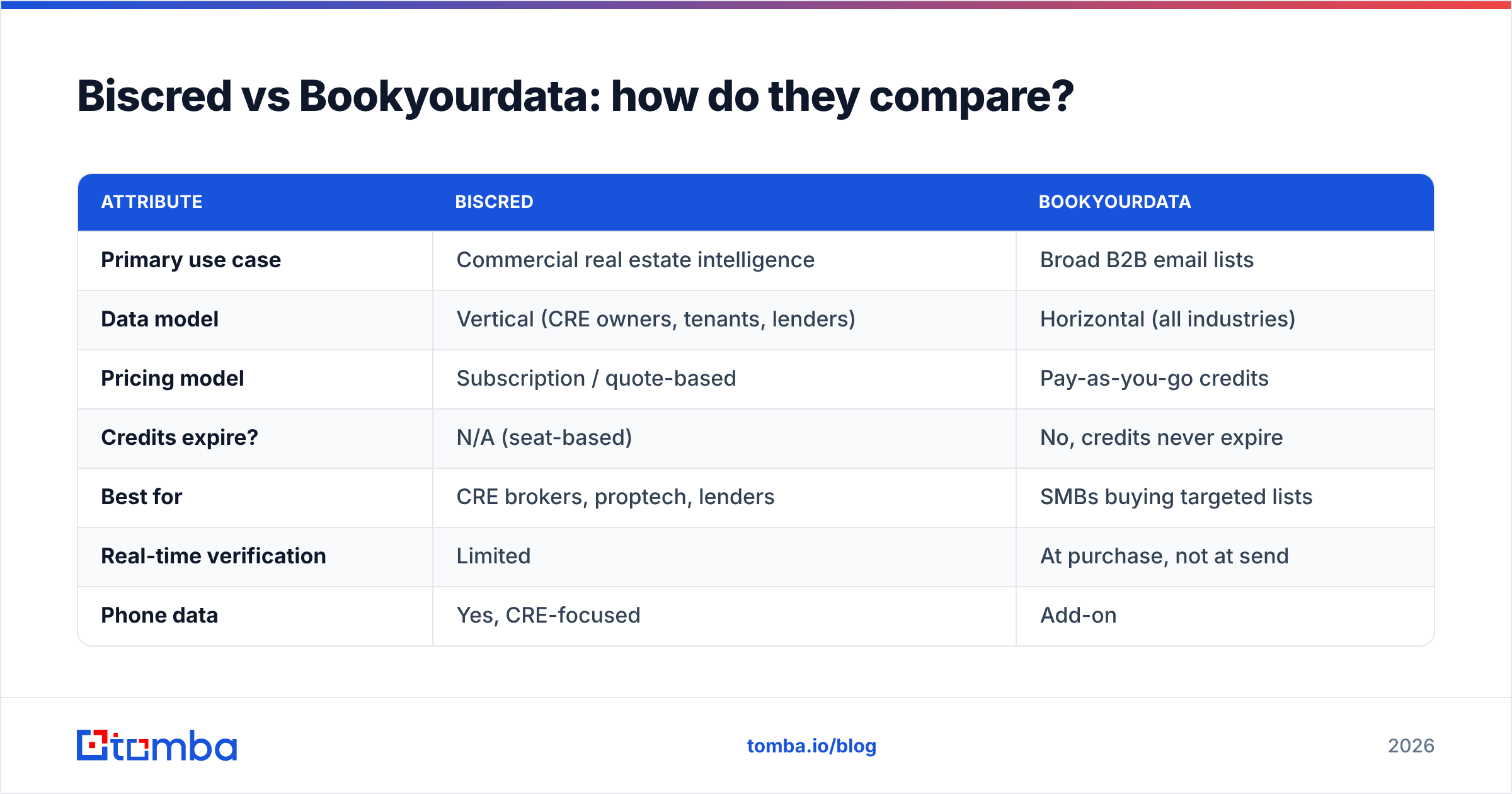
Here's the head-to-head on the attributes that actually change your buying decision.
| Attribute | Biscred | Bookyourdata |
|---|---|---|
| Primary use case | Commercial real estate intelligence | Broad B2B email lists |
| Data model | Vertical (CRE owners, tenants, lenders) | Horizontal (all industries) |
| Pricing model | Subscription / quote-based | Pay-as-you-go credits |
| Credits expire? | N/A (seat-based) | No, credits never expire |
| Best for | CRE brokers, proptech, lenders | SMBs buying targeted lists |
| Real-time verification | Limited | At purchase, not at send |
| Phone data | Yes, CRE-focused | Add-on |
| Free trial | Demo / limited | Free sample credits |
The pattern is clear: Biscred is a depth play, Bookyourdata is a volume play. Neither is a real-time finder — both hand you a snapshot of data that starts aging immediately.
Which one has better data accuracy?#
Accuracy depends on when you ask the question. Both tools can look accurate on the day a record was added and wrong three months later, because the underlying model is the same: scrape and aggregate, then sell the snapshot.
- Biscred is generally more accurate within CRE because its dataset is narrow and maintained for that vertical. Owner and tenant records tied to specific buildings are its strength.
- Bookyourdata trades depth for reach. With horizontal coverage across every industry, individual records are harder to keep current, so list hygiene falls on you.
The structural problem with both is decay. Industry research consistently shows B2B contact data degrades roughly 30% per year as people change jobs, companies rebrand, and domains shift. A list you bought in January is measurably worse by summer.
That's why teams serious about deliverability run every imported record through a verifier and re-check catch-all domains before launching a campaign. Buying a list is step one; proving the addresses still resolve is step two — and most list vendors quietly skip step two.
How does pricing work for each?#
The pricing philosophies are as different as the data models.
Biscred uses a subscription / quote-based structure aimed at teams. You typically talk to sales, get seats, and pay for ongoing access to the CRE dataset. That makes sense for a brokerage or proptech vendor that prospects CRE every day, but it's overkill if you only need data occasionally.
Bookyourdata is genuinely pay-as-you-go. You buy credits, spend them on records, and unused credits don't expire. For a small team running occasional list pulls, that flexibility is the main draw — there's no monthly commitment burning whether you use it or not.
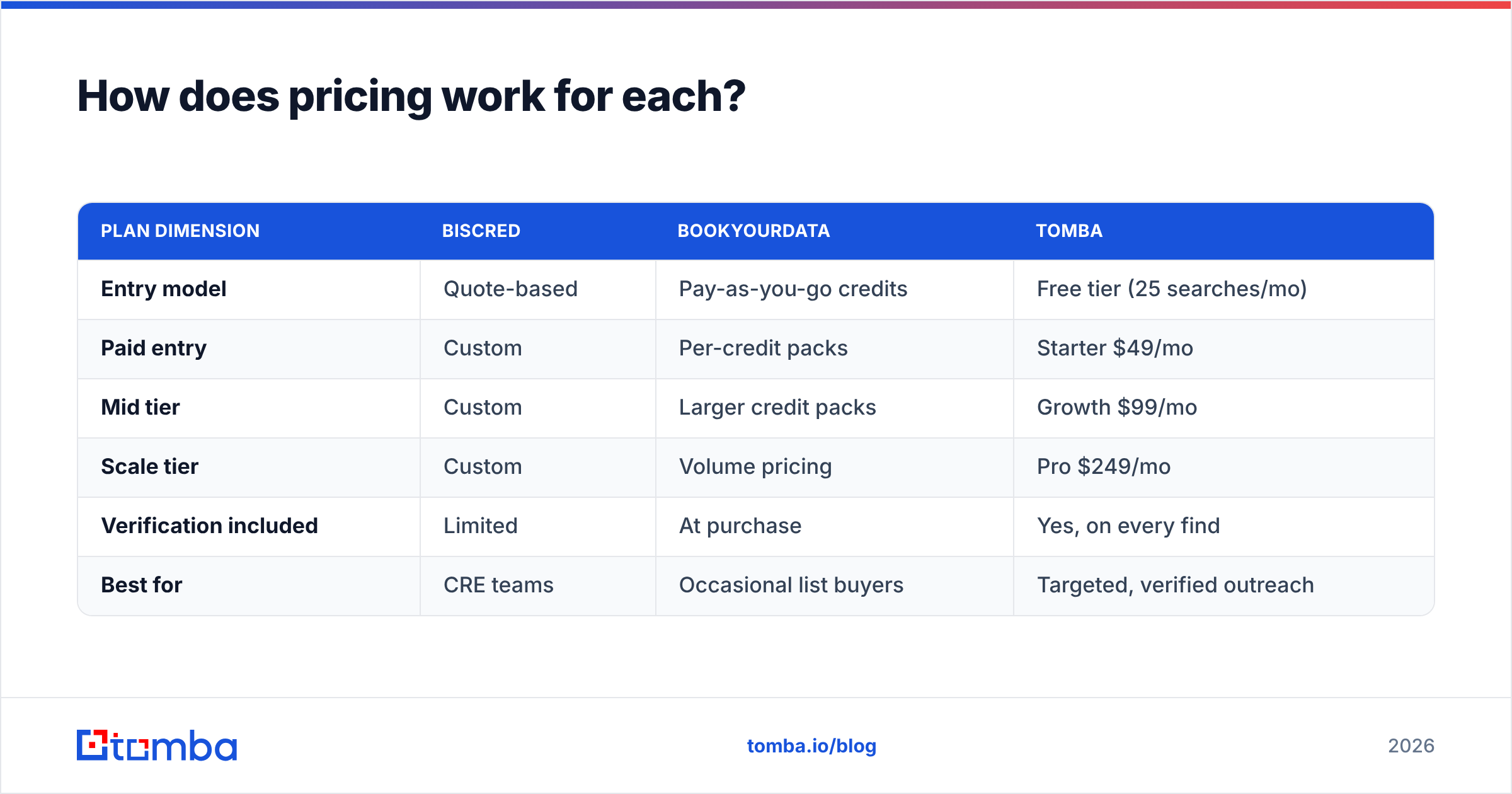
Here's how the cost models stack up against a credit-based finder like Tomba:
| Plan dimension | Biscred | Bookyourdata | Tomba |
|---|---|---|---|
| Entry model | Quote-based | Pay-as-you-go credits | Free tier (25 searches/mo) |
| Paid entry | Custom | Per-credit packs | Starter $49/mo |
| Mid tier | Custom | Larger credit packs | Growth $99/mo |
| Scale tier | Custom | Volume pricing | Pro $249/mo |
| Verification included | Limited | At purchase | Yes, on every find |
| Best for | CRE teams | Occasional list buyers | Targeted, verified outreach |
If you want to see how transparent per-credit access compares, the published Tomba pricing is a useful benchmark — there's a free tier to test accuracy before you commit a dollar, which neither Biscred nor a bulk list purchase really offers.
Where does each tool get its data?#
This is the question most buyers skip, and it's the one that predicts your bounce rate.
Biscred aggregates CRE-specific sources: property records, ownership filings, tenant data, and firm-level intelligence. Because the universe is bounded — commercial properties and the people attached to them — the sourcing is tractable and the records are relatively deep.
Bookyourdata compiles from broad B2B sources across every industry. Breadth is the feature and the bug: the wider the net, the harder it is to keep any single record current.
A modern finder takes a third path. Instead of selling you a pre-scraped snapshot, it searches public sources at query time and verifies the result against the mail server before returning it. You can read how that sourcing differs on Tomba's data page. The practical upshot: the data is fresh because you just pulled it, not because someone refreshed a database last quarter.
Is there a better alternative to both?#
For most outbound and growth teams, yes — if your goal is verified, current contacts rather than the biggest possible list.
The core weakness shared by Biscred and Bookyourdata is the static-snapshot model. You pay for records, download them, and inherit whatever decay has set in since they were collected. A real-time email finder inverts that: you search for the exact person or company you need, right now, and get a verified address back.
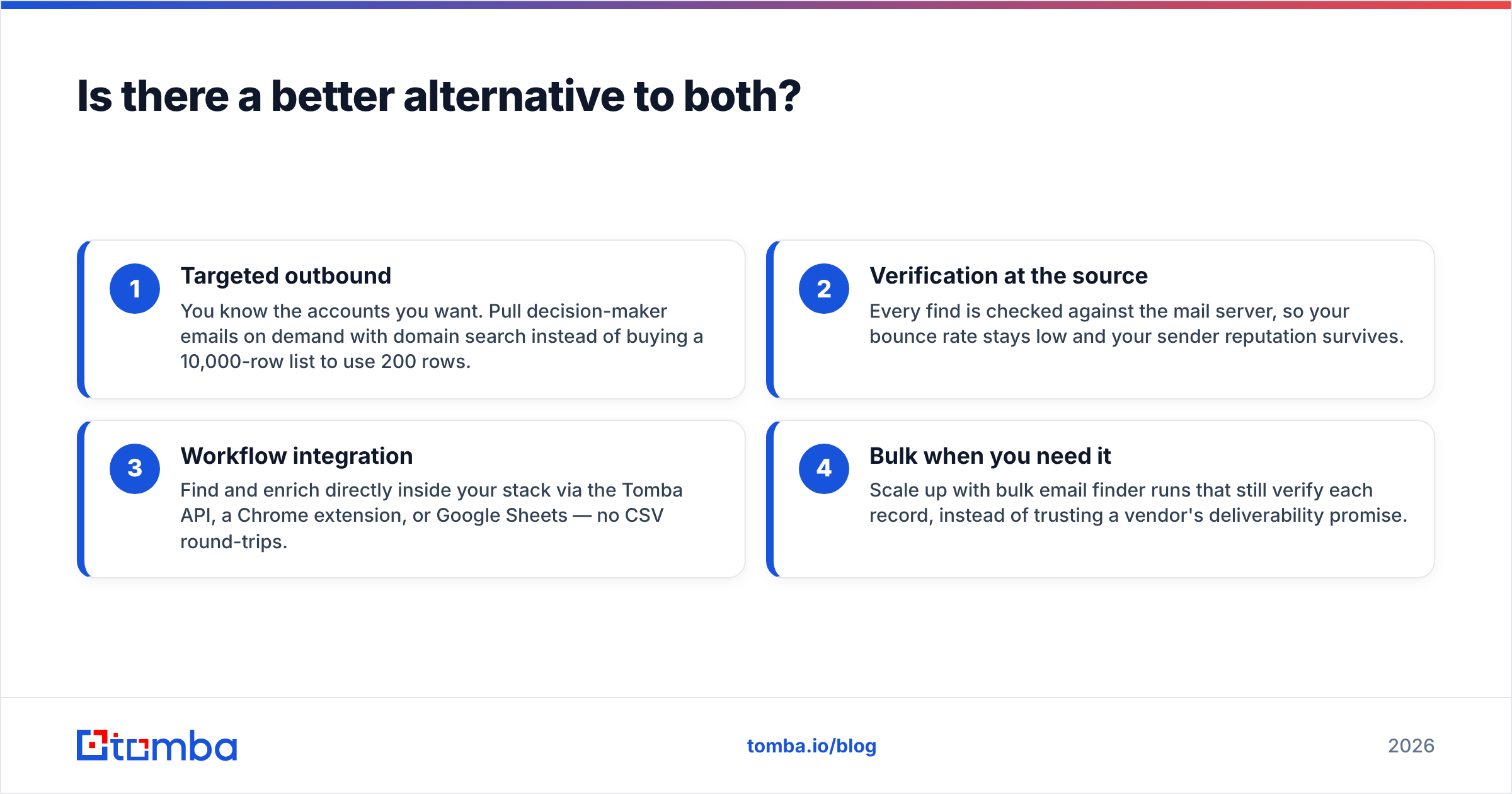
Here's where a finder fits better than a list:
- Targeted outbound — You know the accounts you want. Pull decision-maker emails on demand with domain search instead of buying a 10,000-row list to use 200 rows.
- Verification at the source — Every find is checked against the mail server, so your bounce rate stays low and your sender reputation survives.
- Workflow integration — Find and enrich directly inside your stack via the Tomba API, a Chrome extension, or Google Sheets — no CSV round-trips.
- Bulk when you need it — Scale up with bulk email finder runs that still verify each record, instead of trusting a vendor's deliverability promise.
To be fair: a finder is not a replacement for Biscred if you specifically need building-level CRE ownership data. That's a genuine specialization. But for everything outside that niche — general B2B prospecting across industries — a verified finder beats both a CRE platform and a horizontal list vendor on data freshness and cost-per-usable-contact.
Biscred vs Bookyourdata: which should you choose?#
Match the tool to your motion:
- Choose Biscred if commercial real estate is your business. You need owners, tenants, lenders, and building-level firmographics, and you prospect CRE daily enough to justify a subscription.
- Choose Bookyourdata if you want cheap, broad lists across many industries with no recurring commitment, and you're disciplined about verifying every list before you send.
- Choose a verified email finder if you do targeted outbound, care more about deliverability than raw list size, and want fresh data you can pull and verify in one step.
A common stack: use Biscred for CRE-specific intelligence, and a finder for everything else — net-new prospecting, enrichment, and on-demand verification. They solve different problems, and the static-list middle ground is the part most teams can drop.
How do I verify any list before sending?#
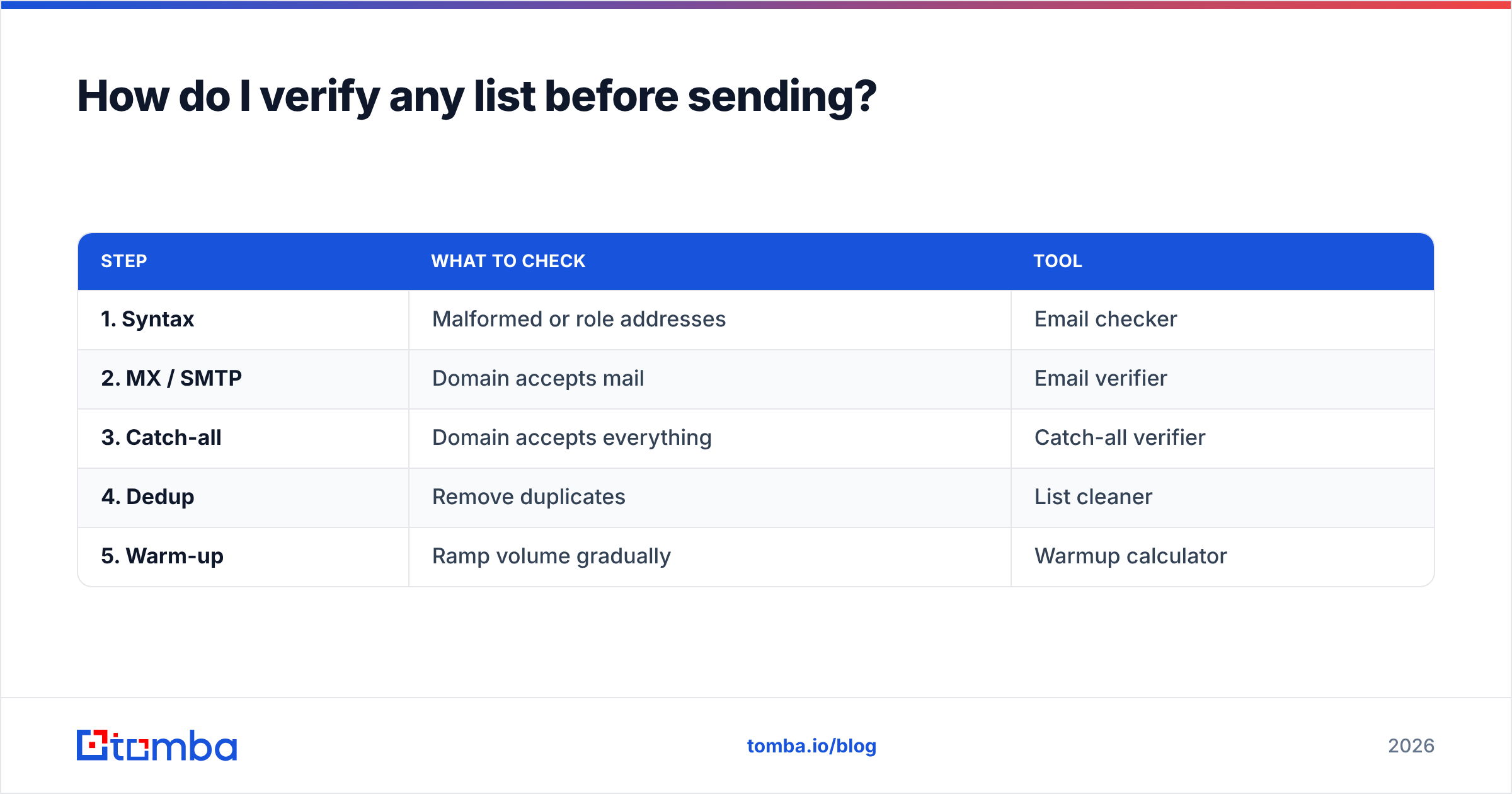
Whichever source you pick, never send to raw records. A quick pre-flight protects your domain:
| Step | What to check | Tool |
|---|---|---|
| 1. Syntax | Malformed or role addresses | Email checker |
| 2. MX / SMTP | Domain accepts mail | Email verifier |
| 3. Catch-all | Domain accepts everything | Catch-all verifier |
| 4. Dedup | Remove duplicates | List cleaner |
| 5. Warm-up | Ramp volume gradually | Warmup calculator |
Run a purchased list through verification first and you'll often find 15–30% of records are already dead — which reframes the "cheap list" math entirely. For more on protecting inbox placement, see HubSpot's guidance on email deliverability and the verified-buyer reviews on G2. You can also sanity-check vendor claims against independent listings on Capterra before you commit budget.
The bottom line#
Biscred and Bookyourdata aren't really competitors — they're different answers to different questions. Biscred is the specialist for commercial real estate intelligence. Bookyourdata is the generalist for cheap, broad, pay-as-you-go lists. Both sell you a snapshot that starts decaying on download.
If your priority is verified, current contacts for targeted outbound across any industry, skip the static-list trade-off. The Tomba Email Finder lets you search by name, company, or domain and returns verified emails in real time — with a free tier of 25 searches a month so you can test the accuracy against your own target accounts before paying. Start with the free plan, run your toughest domains through it, and compare the bounce rate to your last purchased list. The numbers usually make the decision for you.
Ready to find emails that actually work?
Join 150,000+ professionals who stopped guessing and started sending. Free credits on signup — no credit card required.
Get the Tomba newsletter
Practical outbound tactics and product updates — once every two weeks.
About the author