Biscred vs BrandNav 2026: Which B2B Data Platform Wins?
Biscred targets commercial real estate data, BrandNav focuses on email enrichment. Here's a neutral 2026 breakdown of features, pricing, accuracy, and the best fit for your outbound motion.
Choosing between Biscred and BrandNav comes down to one question: do you need deep commercial real estate (CRE) contact data, or broad email enrichment across any industry? They look similar on a feature grid, but they solve different problems and price very differently.
This is a neutral, hands-on comparison for 2026 — what each tool does well, where it falls short, what you'll actually pay, and how to decide. We'll also be honest about where a dedicated email finder beats both for general B2B prospecting.
TL;DR — Biscred vs BrandNav at a glance#
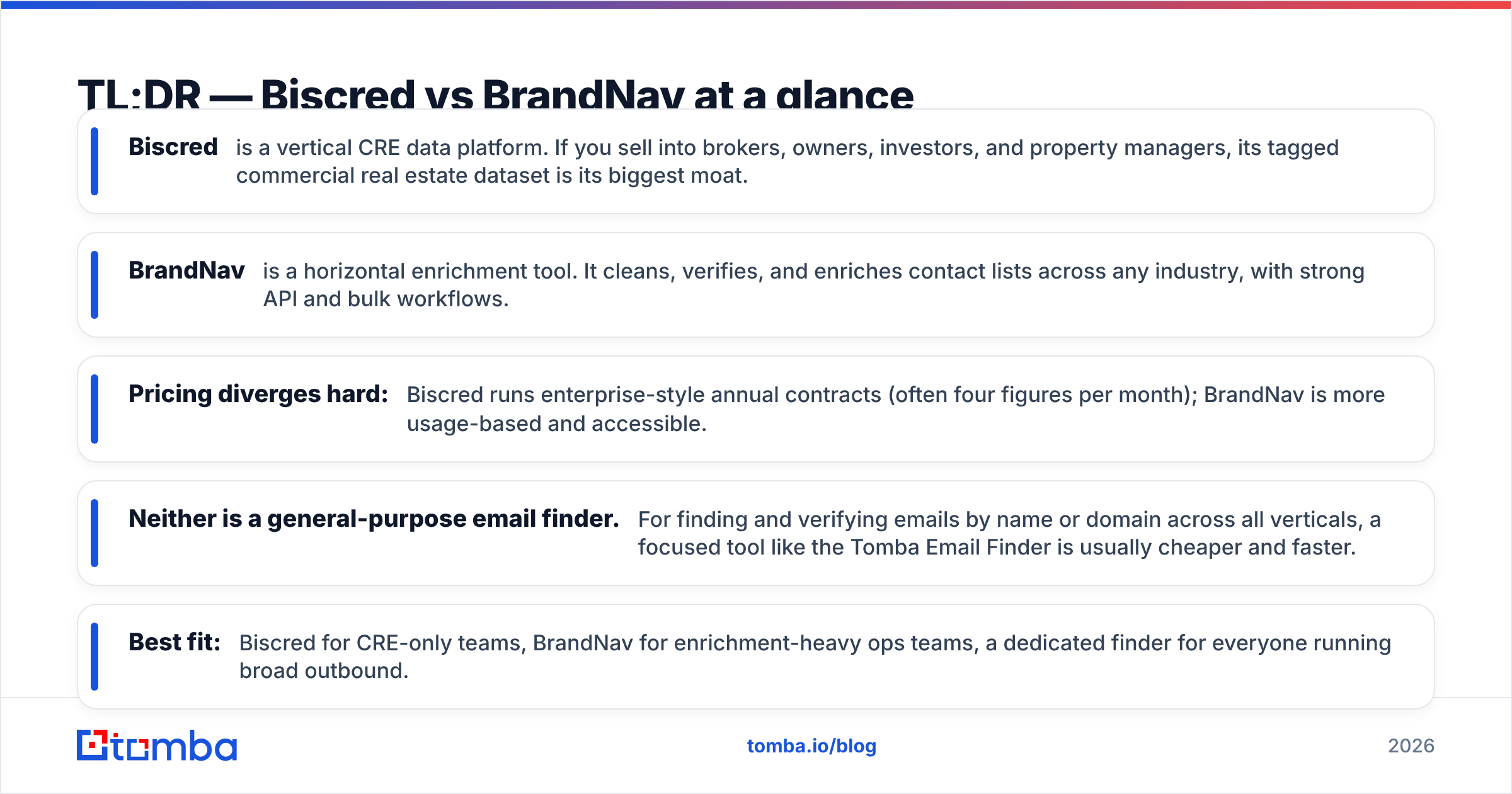
- Biscred is a vertical CRE data platform. If you sell into brokers, owners, investors, and property managers, its tagged commercial real estate dataset is its biggest moat.
- BrandNav is a horizontal enrichment tool. It cleans, verifies, and enriches contact lists across any industry, with strong API and bulk workflows.
- Pricing diverges hard: Biscred runs enterprise-style annual contracts (often four figures per month); BrandNav is more usage-based and accessible.
- Neither is a general-purpose email finder. For finding and verifying emails by name or domain across all verticals, a focused tool like the Tomba Email Finder is usually cheaper and faster.
- Best fit: Biscred for CRE-only teams, BrandNav for enrichment-heavy ops teams, a dedicated finder for everyone running broad outbound.
What is Biscred?#
Biscred is a B2B data platform built specifically for commercial real estate. Instead of trying to cover every industry, it indexes companies and people across the CRE ecosystem — brokerages, REITs, lenders, developers, property managers, and tenant reps — and tags them by role, asset class, and market.
That focus is the point. A generic database might list a "Director" at a real estate firm; Biscred tries to tell you whether that person handles office acquisitions in Dallas or multifamily debt nationally. For teams selling proptech, construction services, or CRE financial products, that tagging removes a lot of manual qualification.
The tradeoff: if your buyers live outside commercial real estate, most of Biscred's depth is wasted. You're paying a premium for vertical precision you won't use.

What is BrandNav?#
BrandNav is a horizontal data enrichment and verification platform. You feed it a list — emails, domains, or partial records — and it returns cleaned, verified, enriched contacts: job titles, company data, social profiles, and validation status.
BrandNav's strength is the pipeline. It's built for revenue operations and growth teams who already have raw data and need it deduplicated, validated, and filled in before it hits the CRM or a sequencer. Its API and bulk processing make it a fit for automated data enrichment workflows rather than one-off manual lookups.
Where it's weaker: BrandNav is not a discovery engine in the way Biscred is. It enriches what you give it; it's less about surfacing net-new accounts in a specific niche.
How do Biscred and BrandNav compare on features?#
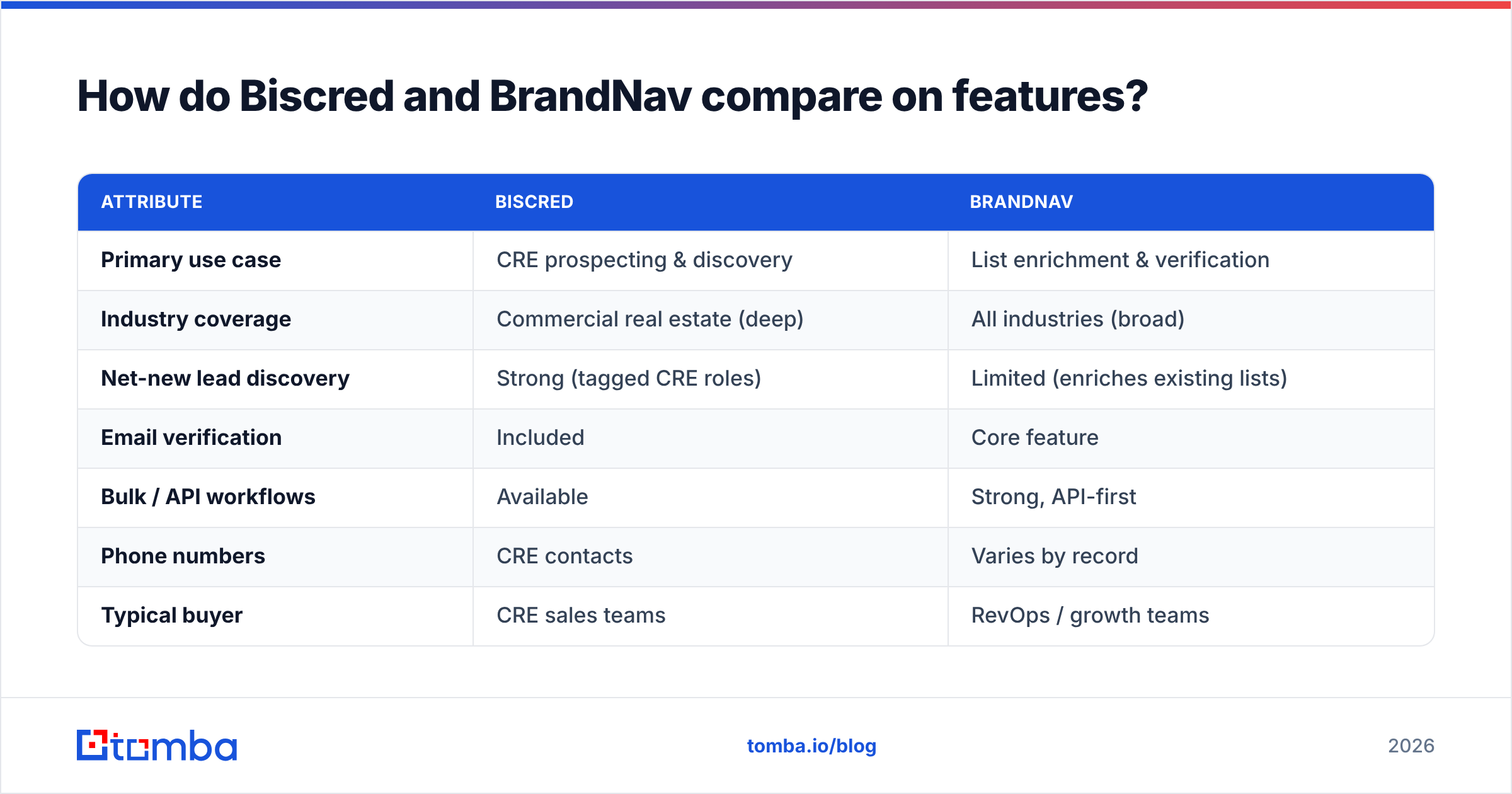
Here's the side-by-side on the attributes that actually change your workflow.
| Attribute | Biscred | BrandNav |
|---|---|---|
| Primary use case | CRE prospecting & discovery | List enrichment & verification |
| Industry coverage | Commercial real estate (deep) | All industries (broad) |
| Net-new lead discovery | Strong (tagged CRE roles) | Limited (enriches existing lists) |
| Email verification | Included | Core feature |
| Bulk / API workflows | Available | Strong, API-first |
| Phone numbers | CRE contacts | Varies by record |
| Typical buyer | CRE sales teams | RevOps / growth teams |
| Pricing model | Annual, enterprise | Usage-based, flexible |
The honest summary: Biscred wins on finding the right CRE people; BrandNav wins on cleaning and completing records you already have. They overlap less than their marketing implies.
)
Which has better data accuracy?#
Accuracy depends on what you're measuring. Biscred's CRE records tend to be more accurate within its niche because the dataset is curated and tagged for one industry — fewer stale "Director of Unknown" entries. BrandNav's accuracy comes from its verification layer: it actively validates and flags risky addresses across any vertical.
Two practical caveats apply to both:
- Catch-all domains inflate "valid" rates. A domain that accepts every address (common in CRE and enterprise) can't be confirmed by a normal SMTP check. You need a dedicated catch-all verifier to avoid false confidence.
- Decay is constant. B2B contact data degrades roughly 25-30% per year as people change jobs. Neither tool escapes this — re-verification matters more than the headline accuracy number.
Always test on your own ICP before committing. A vendor's global accuracy claim rarely matches your specific segment. Independent reviews on G2 and Capterra are a better sanity check than the sales deck.
How much do Biscred and BrandNav cost?#
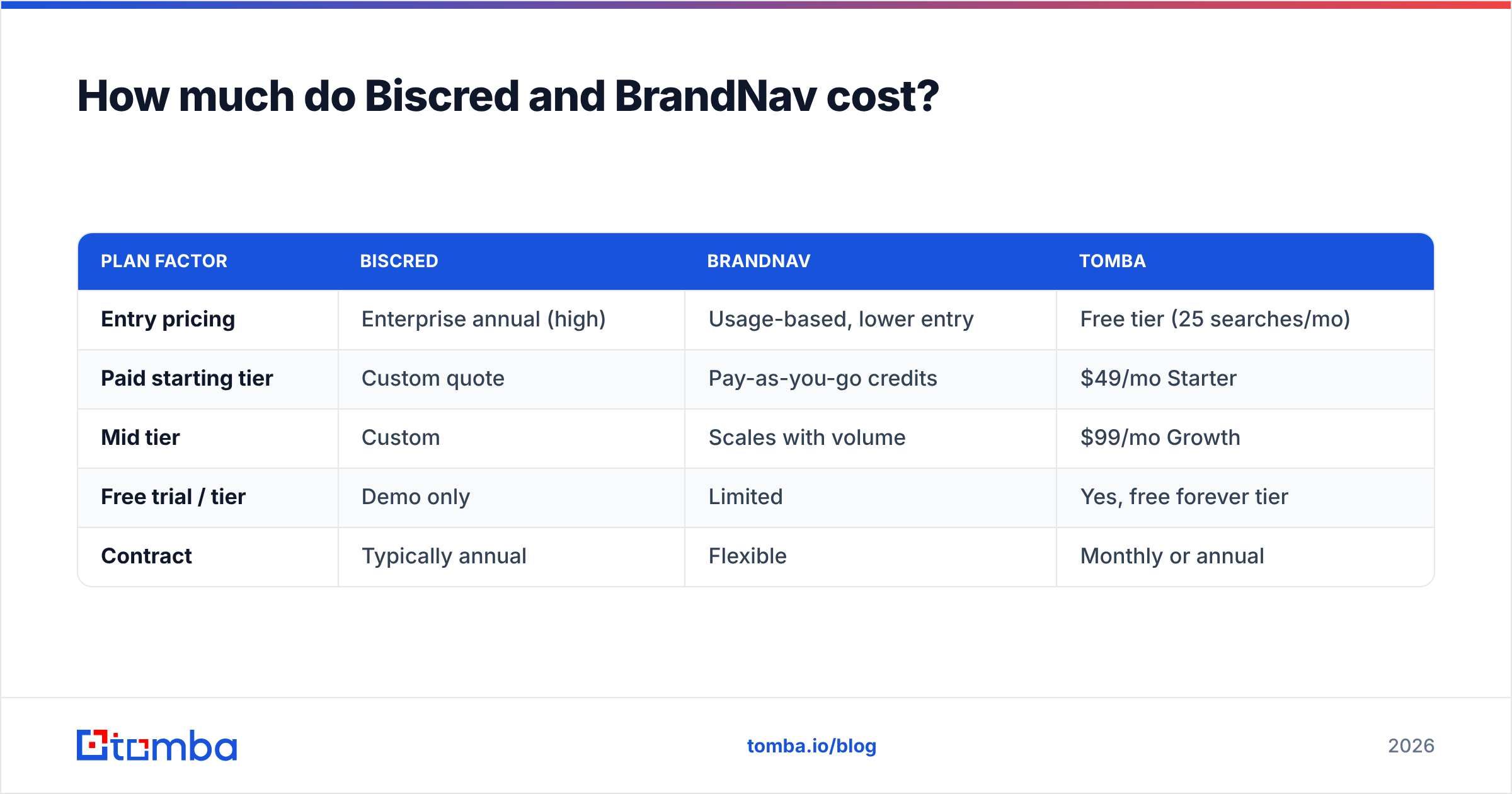
This is where the two split most sharply, and where a third option becomes relevant.
| Plan factor | Biscred | BrandNav | Tomba |
|---|---|---|---|
| Entry pricing | Enterprise annual (high) | Usage-based, lower entry | Free tier (25 searches/mo) |
| Paid starting tier | Custom quote | Pay-as-you-go credits | $49/mo Starter |
| Mid tier | Custom | Scales with volume | $99/mo Growth |
| Free trial / tier | Demo only | Limited | Yes, free forever tier |
| Contract | Typically annual | Flexible | Monthly or annual |
Biscred is built for teams that will close enough CRE deals to justify a four-figure monthly commitment. BrandNav is friendlier to smaller budgets and variable usage. If your need is broad email finding rather than CRE-specific discovery or enrichment-at-scale, neither pricing model is ideal — that's the gap a focused finder fills. You can see transparent Tomba pricing without booking a demo.
When should you pick a dedicated email finder instead?#
Pick a focused finder when your prospecting isn't locked to one vertical. Biscred is overkill if you sell to marketing agencies, SaaS, or e-commerce. BrandNav assumes you already have a list to clean. But most outbound teams start from a name and a company and need the email — fast, verified, across any domain.
That's the classic email finder job. With domain search you pull every public address at a company; with the email finder API you wire it into your own enrichment flow the way you'd use BrandNav, without the CRE premium of Biscred.
A simple decision framework:
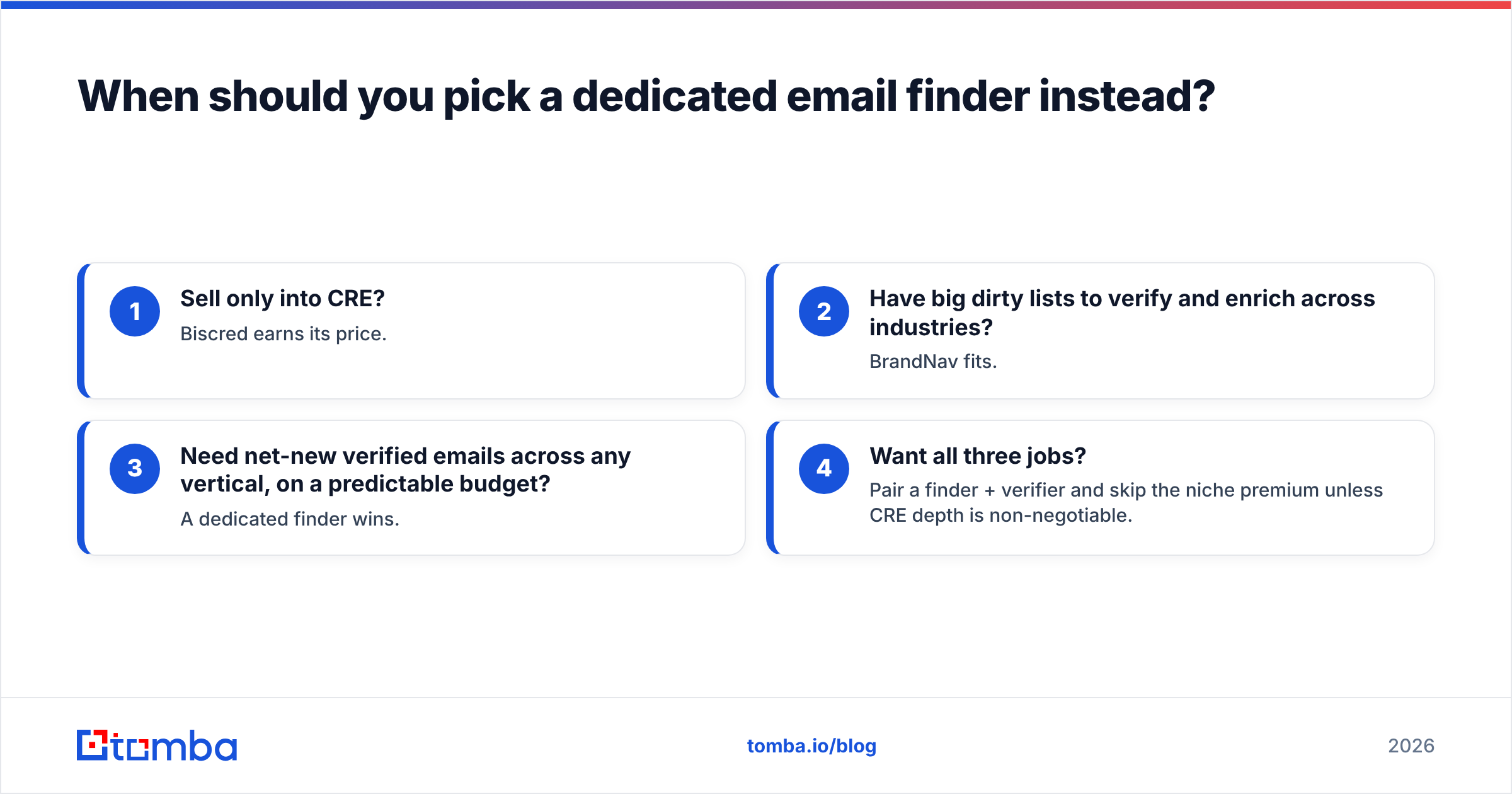
- Sell only into CRE? Biscred earns its price.
- Have big dirty lists to verify and enrich across industries? BrandNav fits.
- Need net-new verified emails across any vertical, on a predictable budget? A dedicated finder wins.
- Want all three jobs? Pair a finder + verifier and skip the niche premium unless CRE depth is non-negotiable.
)
Biscred vs BrandNav: pros and cons#
Biscred — pros
- Best-in-class CRE coverage and role tagging
- Strong for net-new discovery in real estate
- Less manual qualification for CRE sellers
Biscred — cons
- Useless outside commercial real estate
- Enterprise pricing, annual lock-in
- Demo-gated; hard to test cheaply
BrandNav — pros
- Flexible, usage-based pricing
- Solid verification and API-first enrichment
- Industry-agnostic
BrandNav — cons
- Weaker at surfacing net-new accounts
- Enrichment quality depends on your input list
- Not a discovery engine for niche verticals
How do you actually choose between them?#
Conclusion first: match the tool to your motion, not to the feature list.
If your entire pipeline is commercial real estate and you can fund an annual contract, Biscred is the sharper instrument — its tagging will save your reps hours of qualification every week. If you're a RevOps or growth team drowning in half-complete records across many industries, BrandNav slots into your stack as a cleaning-and-enrichment layer.
But be realistic about the most common case: you're running broad outbound, you start from names and companies, and you need verified emails on a budget you can predict month to month. In that scenario both platforms are either too narrow (Biscred) or too dependent on existing data (BrandNav). A focused finder plus an email verifier covers the job for a fraction of the cost, and you can layer enrichment on top only when you need it.
One more practical tip: whatever you choose, build re-verification into your process. Data decays whether it came from a niche CRE index or a broad enrichment API. The team that re-checks quarterly beats the team with the "better" dataset that's gone stale. For background on why list hygiene drives results, the email deliverability fundamentals are worth a read.
The bottom line#
Biscred and BrandNav aren't really rivals — they're specialists pointed at different problems. Biscred sells CRE depth; BrandNav sells enrichment breadth. Your decision is mostly about which problem you actually have.
If neither fits cleanly — because you need fast, accurate emails across any industry without an enterprise contract — start with a tool built for exactly that. The Tomba Email Finder finds professional addresses by name, domain, or company, verifies them as you go, and starts free with 25 searches a month, then $49/mo when you scale. Test it against your own ICP before you sign anyone's annual deal — that's the only benchmark that matters.
// get started
Find, verify and enrich your first contacts today
Start on the free plan with 25 searches a month, then scale when your team is ready.
Free plan · No credit card required · GDPR & CCPA
// about the author