Biscred vs Cufinder 2026: B2B Data Tool Comparison
Biscred targets commercial real estate data; Cufinder chases broad B2B enrichment. Here is an honest 2026 breakdown of accuracy, pricing, and which one fits your pipeline.
Choosing between Biscred and Cufinder usually means you are stuck deciding between depth in one vertical and breadth across everything. They are not really the same product, and pretending they are is how teams waste a quarter of budget on the wrong subscription.
This breakdown is for revenue, RevOps, and prospecting teams trying to pick a B2B data source in 2026. We will compare coverage, email accuracy, pricing, integrations, and the use cases each tool actually wins — then show where a focused email finder like Tomba beats both for pure contact discovery.
TL;DR — Biscred vs Cufinder at a glance#
- Biscred is a commercial real estate (CRE) intelligence platform. If you sell into brokers, owners, lenders, and property firms, its vertical depth is the draw.
- Cufinder is a broad B2B lead-generation and enrichment suite — company search, contact finding, and data appending across most industries.
- Accuracy is the real differentiator: niche databases age fast, and broad databases trade precision for volume. Always verify before you send.
- Pricing favors Cufinder for self-serve experimentation; Biscred skews toward seat-based, sales-led contracts.
- If you mainly need verified work emails, neither is a specialist — a dedicated finder-plus-verifier stack is cheaper and more accurate per contact.
What is Biscred?#
Biscred is a B2B data platform built specifically for commercial real estate. Instead of trying to index every company on earth, it concentrates on CRE firms, owners, investors, brokerages, lenders, and the people inside them — with role tagging that matters in that world (acquisitions, asset management, capital markets, leasing).
That focus is the entire value proposition. A generic database will list a property firm and maybe a few contacts. A vertical tool like Biscred tries to tell you who runs acquisitions in the Southeast and which firm just changed mandates. For a CRE seller, that context shortens research dramatically.
The trade-off is obvious: if your ICP drifts outside commercial real estate, the coverage thins out fast. You are paying a premium for one vertical, so it only pays back if that vertical is your whole world. You can sanity-check positioning on the official Biscred site and against peer reviews on G2.
What is Cufinder?#
Cufinder is a general-purpose B2B lead generation and data enrichment engine. It markets a stack of functions: company search, contact and email finding, phone enrichment, and bulk appending against your existing lists. The pitch is breadth — one tool to source and enrich leads across most industries and geographies.
Cufinder leans into an API-and-engine framing, so it appeals to teams that want to programmatically enrich records or build lists at scale rather than hand-pick a handful of accounts. You can review current capabilities on the official Cufinder site and check buyer sentiment on Capterra.
Breadth has its own tax. A database covering everything has to refresh everything, and that is hard. Generic enrichment tools are notorious for catch-all domains, stale titles, and "guessed" email patterns that look right but bounce. Which brings us to the part that actually decides outbound results.

Which is more accurate for emails and contact data?#
Accuracy is where vendor marketing and inbox reality diverge. Both tools publish confidence in their data; your bounce rate is the only number that matters.
Two structural realities to keep in mind:
- Niche depth ages quickly. A CRE-specific database is excellent the day it is refreshed and decays as people change firms — and CRE has heavy job mobility.
- Broad coverage dilutes precision. General enrichment has to model email patterns for millions of domains, so a meaningful slice of "found" emails are pattern guesses, not verified addresses.
The fix is the same regardless of source: treat any provider's email as a candidate, then run it through an independent email verifier before it touches a sequence. Verifying upstream protects your sender reputation and keeps you off blacklists. This is exactly why dedicated finders publish per-source confidence and SMTP checks rather than a single blended score.

Biscred vs Cufinder vs Tomba: full comparison#
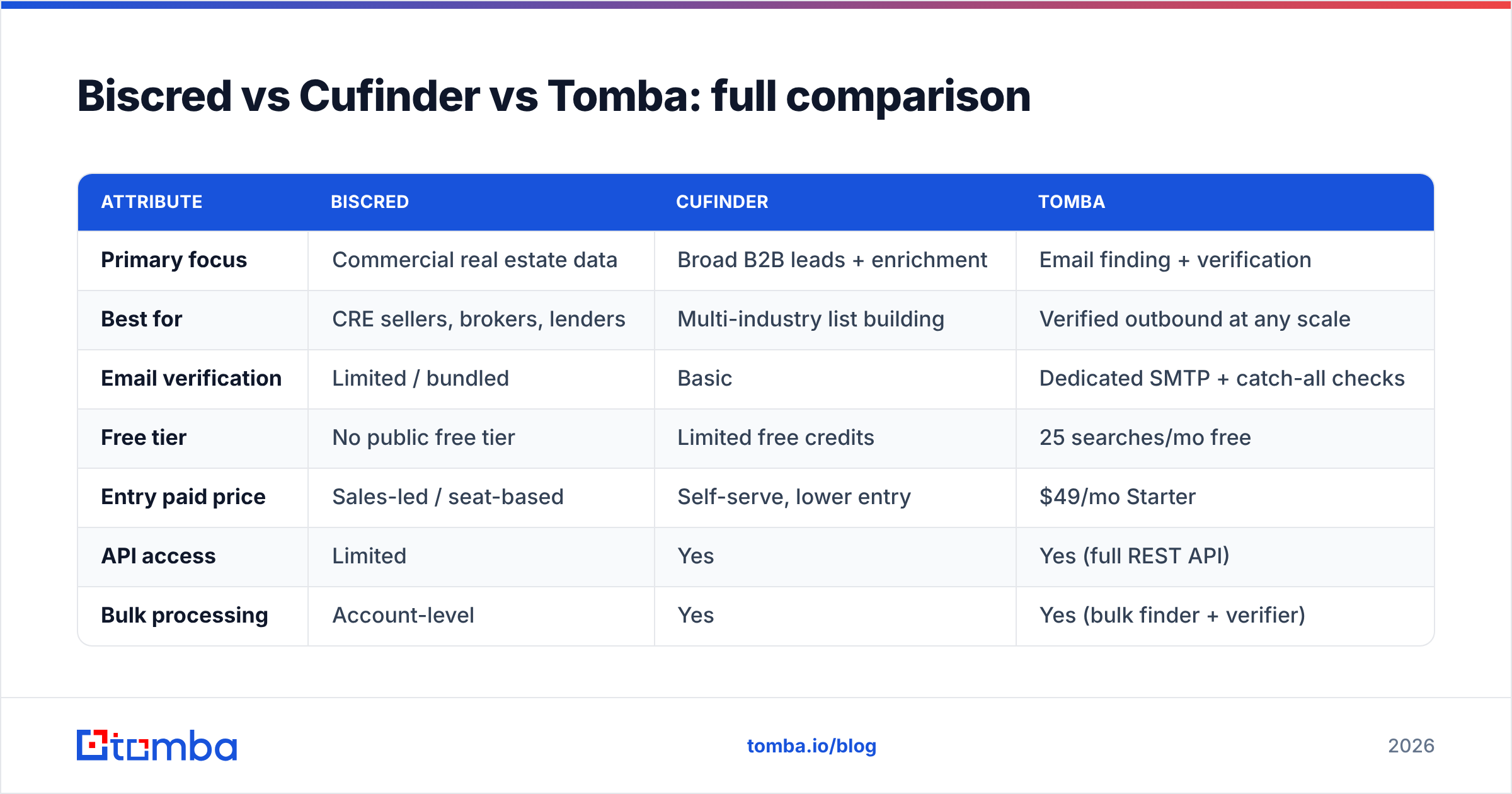
Here is the side-by-side. Tomba is included because most teams evaluating these tools actually want verified contact discovery, not a full database license.
| Attribute | Biscred | Cufinder | Tomba |
|---|---|---|---|
| Primary focus | Commercial real estate data | Broad B2B leads + enrichment | Email finding + verification |
| Best for | CRE sellers, brokers, lenders | Multi-industry list building | Verified outbound at any scale |
| Email verification | Limited / bundled | Basic | Dedicated SMTP + catch-all checks |
| Free tier | No public free tier | Limited free credits | 25 searches/mo free |
| Entry paid price | Sales-led / seat-based | Self-serve, lower entry | $49/mo Starter |
| API access | Limited | Yes | Yes (full REST API) |
| Bulk processing | Account-level | Yes | Yes (bulk finder + verifier) |
| Coverage breadth | Narrow (one vertical) | Wide | Wide, contact-level |
A few honest takeaways from the table:
- Pick Biscred if commercial real estate is your only market and the vertical context (deal roles, firm mandates) saves your reps research hours.
- Pick Cufinder if you need broad, programmatic enrichment across industries and want a self-serve entry point.
- Pick a finder-first stack if your core job is turning a name and domain into a verified email and phone — that is a different tool category, and pricing reflects it.
How does pricing compare in 2026?#
Pricing philosophy splits the two cleanly. Cufinder runs a self-serve, credit-style model with a low entry point, which is friendly for testing before you commit. Biscred trends toward sales-led, seat-based contracts typical of vertical data platforms — you talk to sales, you get a quote, and the floor is usually higher.
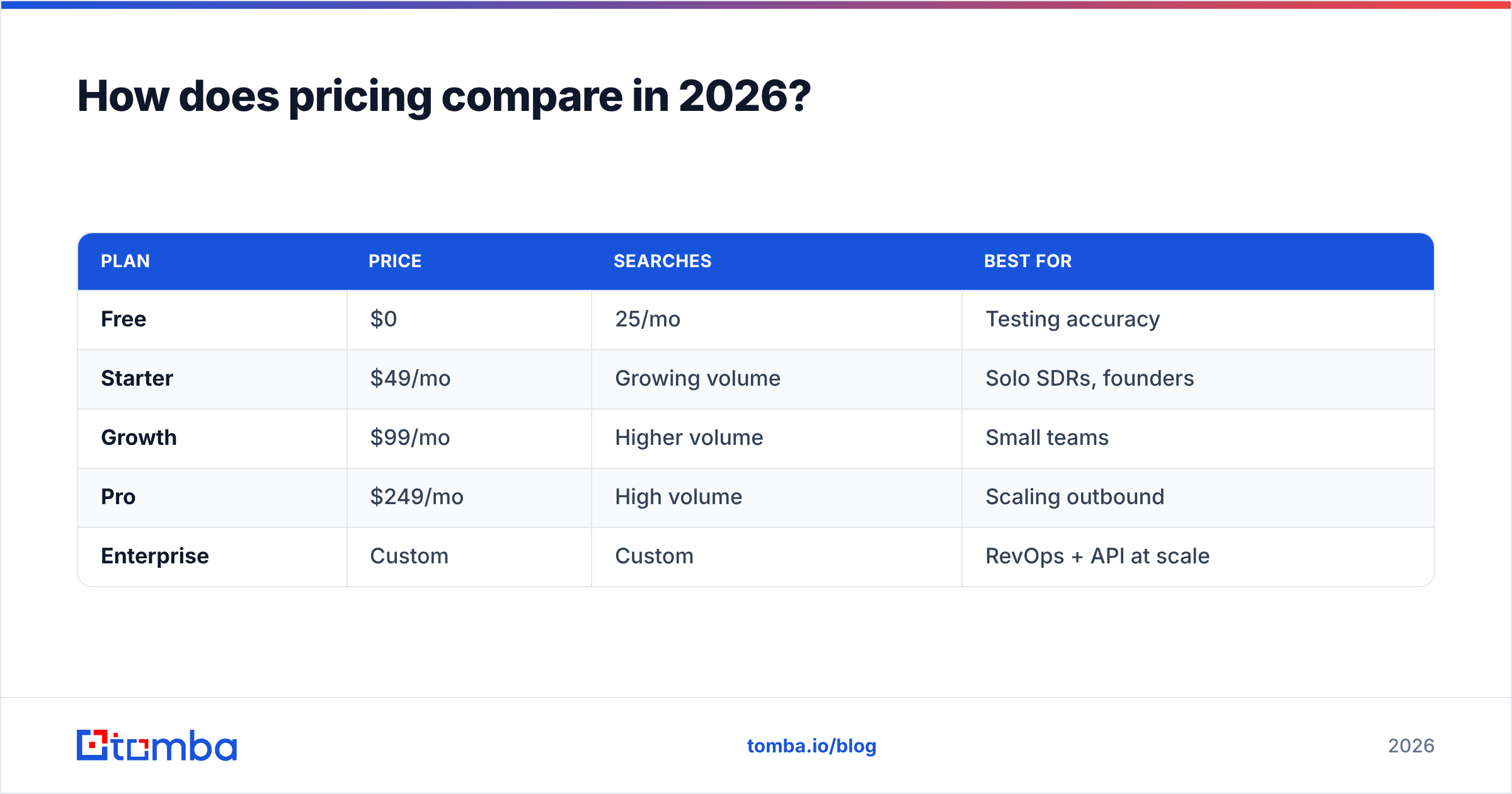
For comparison, here is how a focused finder is priced. Tomba's pricing is public and predictable:
| Plan | Price | Searches | Best for |
|---|---|---|---|
| Free | $0 | 25/mo | Testing accuracy |
| Starter | $49/mo | Growing volume | Solo SDRs, founders |
| Growth | $99/mo | Higher volume | Small teams |
| Pro | $249/mo | High volume | Scaling outbound |
| Enterprise | Custom | Custom | RevOps + API at scale |
The strategic point: vertical platforms and broad databases bill you for the whole database, whether or not you touch most of it. A finder bills you for the contacts you actually pull. If 80% of your usage is "find and verify this person's email," paying database prices is overspending.
Which tool fits your use case?#
Map the tool to the job, not the hype.
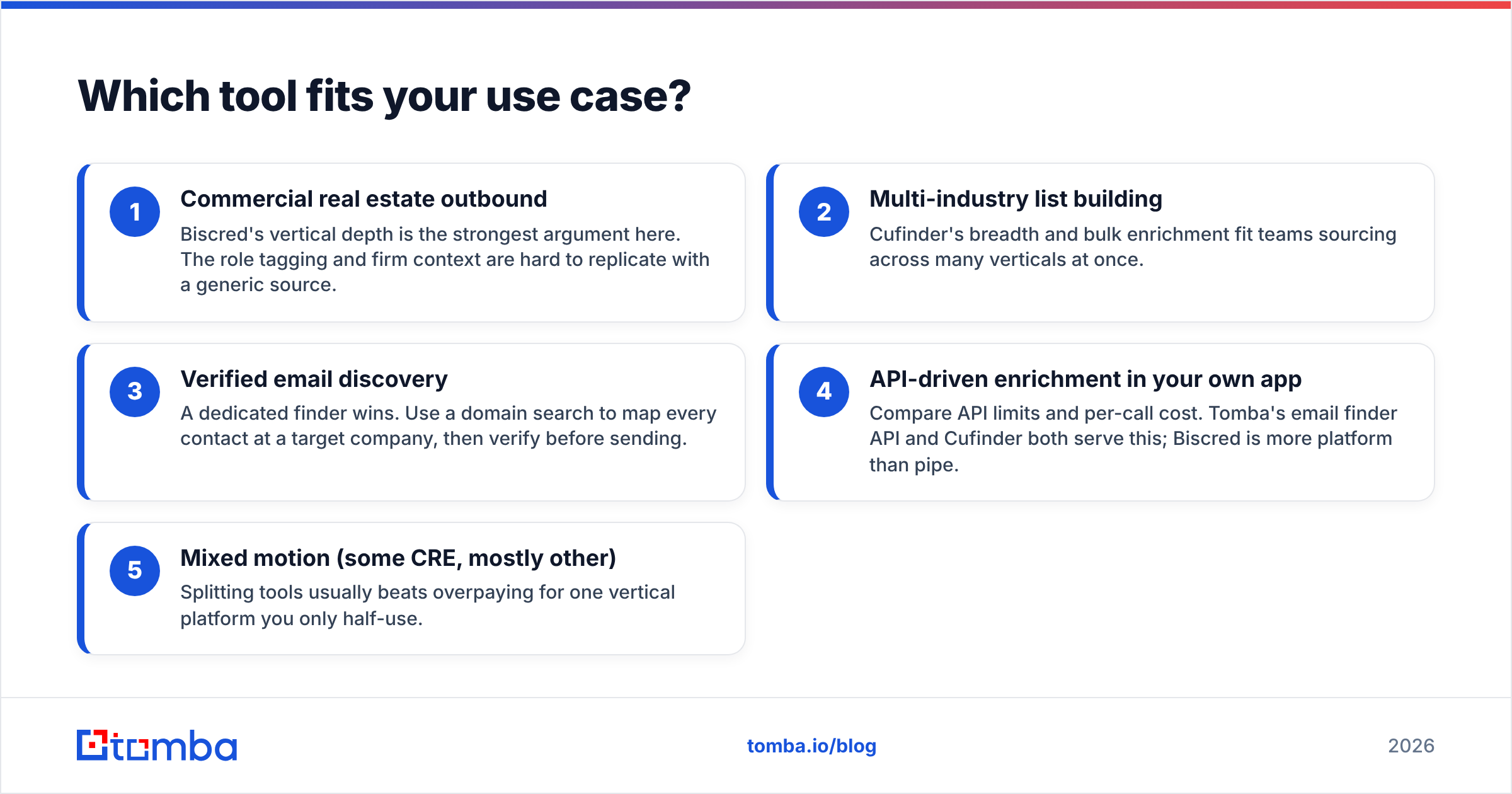
- Commercial real estate outbound — Biscred's vertical depth is the strongest argument here. The role tagging and firm context are hard to replicate with a generic source.
- Multi-industry list building — Cufinder's breadth and bulk enrichment fit teams sourcing across many verticals at once.
- Verified email discovery — A dedicated finder wins. Use a domain search to map every contact at a target company, then verify before sending.
- API-driven enrichment in your own app — Compare API limits and per-call cost. Tomba's email finder API and Cufinder both serve this; Biscred is more platform than pipe.
- Mixed motion (some CRE, mostly other) — Splitting tools usually beats overpaying for one vertical platform you only half-use.
What about deliverability and compliance?#
A data tool is only as good as what survives the inbox. Whatever source you pick, the post-purchase workflow decides your results:
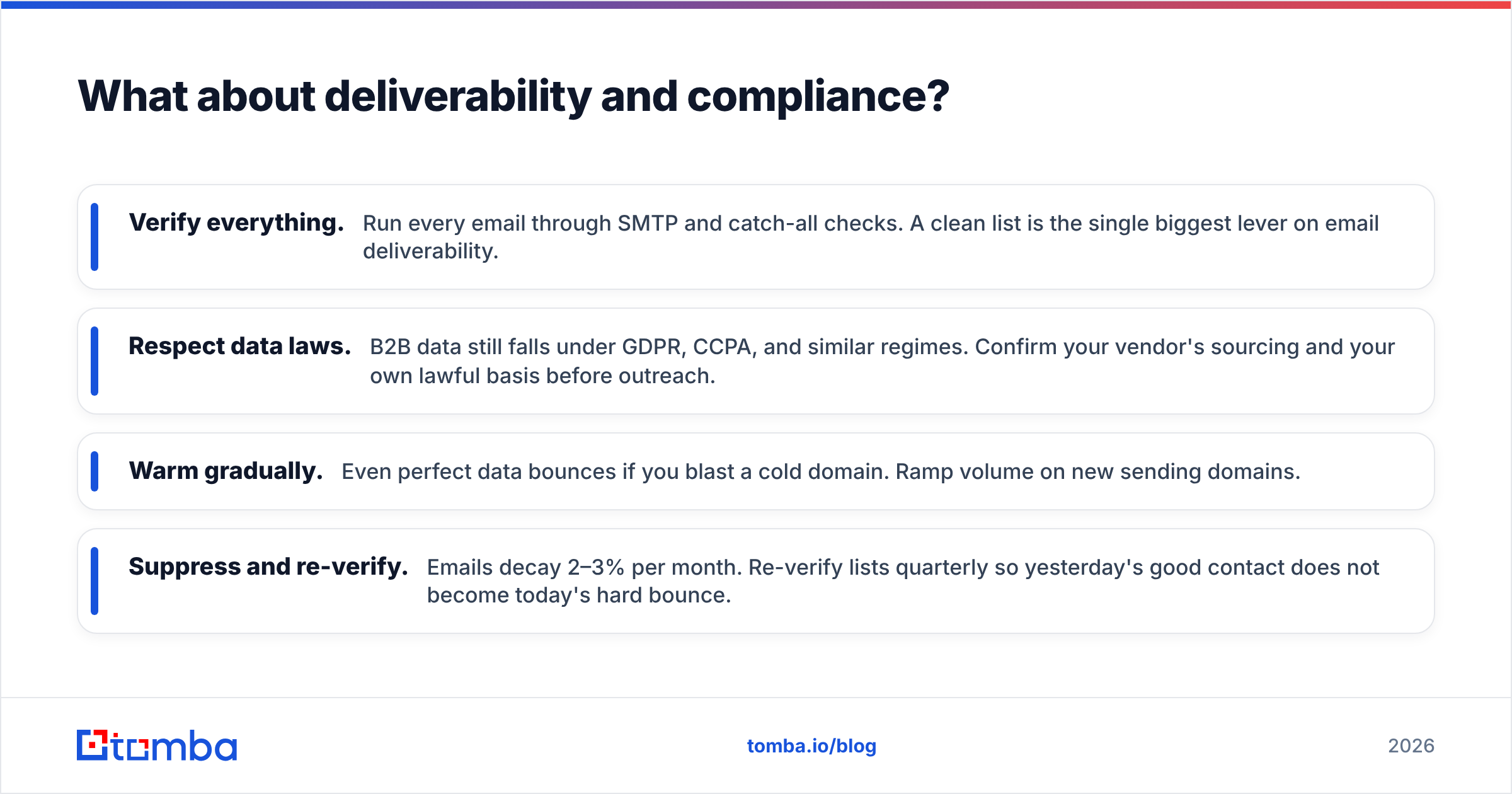
- Verify everything. Run every email through SMTP and catch-all checks. A clean list is the single biggest lever on email deliverability.
- Respect data laws. B2B data still falls under GDPR, CCPA, and similar regimes. Confirm your vendor's sourcing and your own lawful basis before outreach.
- Warm gradually. Even perfect data bounces if you blast a cold domain. Ramp volume on new sending domains.
- Suppress and re-verify. Emails decay 2–3% per month. Re-verify lists quarterly so yesterday's good contact does not become today's hard bounce.
Neither Biscred nor Cufinder removes this work. Treat them as the sourcing layer and keep verification independent so one vendor's optimistic confidence score never becomes your bounce problem.

Biscred vs Cufinder: the verdict#
There is no universal winner — there is a winner for your motion.
- Choose Biscred when commercial real estate is your entire market and vertical depth pays for itself in reduced research time.
- Choose Cufinder when you need broad, self-serve, multi-industry enrichment and want a low-friction entry point.
- Choose a finder-first stack when your real need is verified emails and phones at predictable per-contact cost — the job both tools do as a feature, not a focus.
Most teams overweight database breadth and underweight verification. The tool that finds a contact is far less important than the check that confirms the email is real before you hit send.
Get verified B2B emails without overpaying for a database#
If your day-to-day is turning company names into verified contacts, you do not need a vertical platform contract or a broad enrichment license to start — you need accurate emails and a verifier you trust.
Tomba Email Finder finds professional emails by domain, name, or company, with built-in verification and catch-all detection, a public REST API, and a free tier of 25 searches a month so you can benchmark accuracy against Biscred or Cufinder before paying anyone. Paid plans start at $49/mo and bill for the contacts you actually pull — not the whole database. Run a side-by-side test this week and let the bounce rate pick the winner.
Ready to find emails that actually work?
Join 150,000+ professionals who stopped guessing and started sending. Free credits on signup — no credit card required.
Get the Tomba newsletter
Practical outbound tactics and product updates — once every two weeks.
About the author