Biscred vs Exellius: Which B2B Data Platform Wins in 2026?
Biscred targets commercial real estate data; Exellius sells managed lead-gen. We compare coverage, pricing, accuracy, and fit to help you pick the right B2B data stack in 2026.
Choosing between Biscred and Exellius comes down to one question most comparison posts dodge: are you buying a self-serve niche database or outsourced lead generation? They are not the same product, and picking the wrong category wastes a quarter of budget. This guide breaks down what each tool actually does, where the data comes from, what you pay, and when a general-purpose email finder beats both.
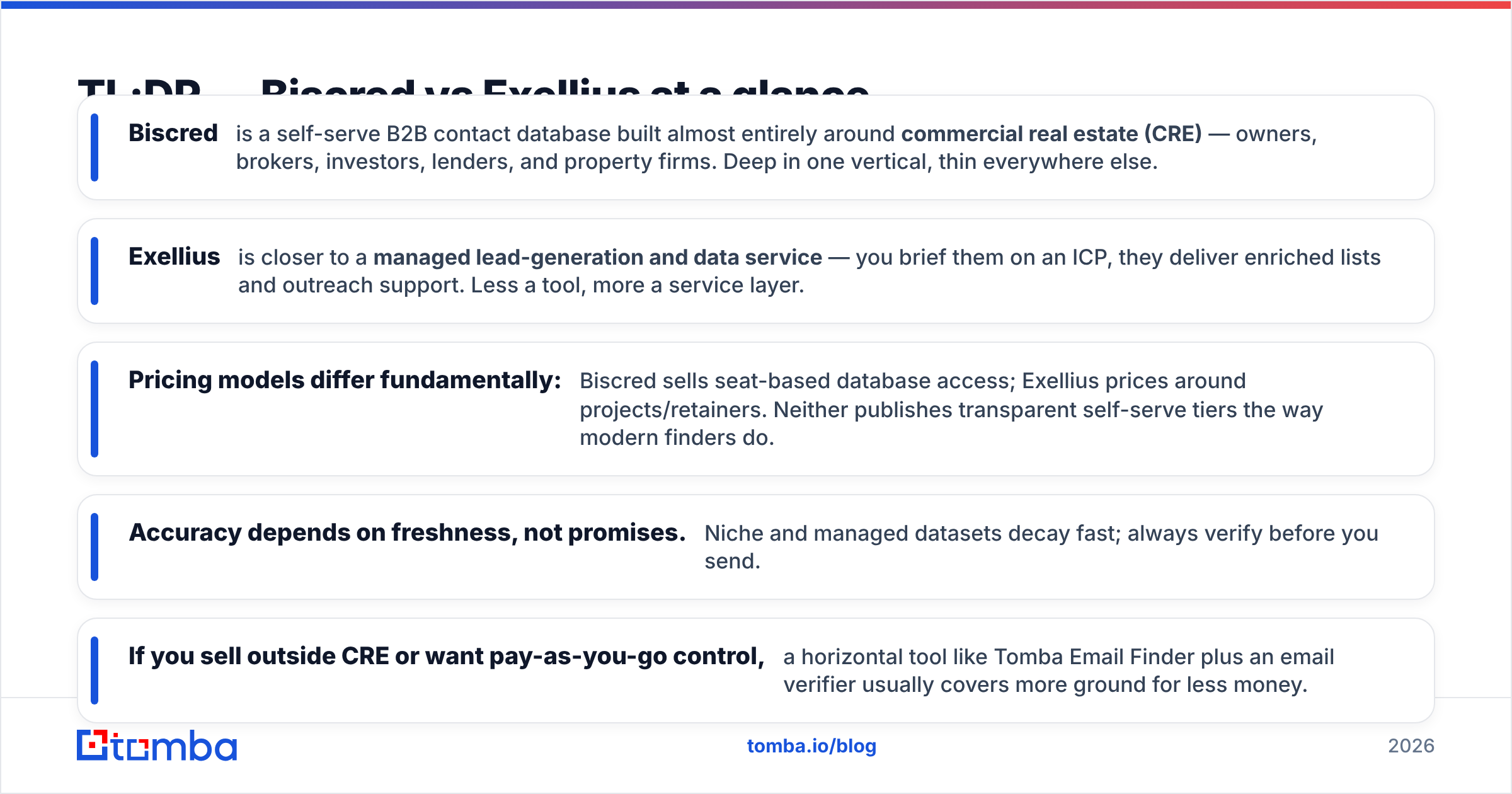
TL;DR — Biscred vs Exellius at a glance#
- Biscred is a self-serve B2B contact database built almost entirely around commercial real estate (CRE) — owners, brokers, investors, lenders, and property firms. Deep in one vertical, thin everywhere else.
- Exellius is closer to a managed lead-generation and data service — you brief them on an ICP, they deliver enriched lists and outreach support. Less a tool, more a service layer.
- Pricing models differ fundamentally: Biscred sells seat-based database access; Exellius prices around projects/retainers. Neither publishes transparent self-serve tiers the way modern finders do.
- Accuracy depends on freshness, not promises. Niche and managed datasets decay fast; always verify before you send.
- If you sell outside CRE or want pay-as-you-go control, a horizontal tool like Tomba Email Finder plus an email verifier usually covers more ground for less money.
What is Biscred?#
Biscred is a B2B data platform focused on the commercial real estate industry. Think of it as a specialist bookstore: if you want CRE titles, the shelves are unmatched; if you want anything else, you are in the wrong shop.
Its database centers on companies and people tied to property — brokerage firms, REITs, developers, property managers, lenders, and investment shops. You search by firm type, asset class, geography, and role, then pull contact records (names, titles, business emails, sometimes phones) into a list or CRM.
The pitch is vertical depth. Generic databases tag a contact as "Real Estate" and stop. Biscred tries to model the industry's structure — distinguishing a multifamily acquisitions analyst from an industrial leasing broker — so CRE teams can target precisely. For a CRE brokerage or proptech vendor, that specificity is the whole value.
The trade-off is obvious: outside commercial real estate, coverage drops off a cliff. If your ICP is SaaS CFOs or manufacturing ops leaders, Biscred is not built for you.

What is Exellius?#
Exellius operates more like a service than a product. Instead of handing you a search bar and a credit balance, the model leans toward you describing a target audience and the team delivering enriched contact lists, data appends, and outreach assistance.
That positions it alongside managed lead-gen and data-as-a-service providers rather than self-serve tools. The everyday analogy: Biscred sells you the fishing rod and the stocked pond; Exellius offers to fish for you and hand over the catch.
This suits teams that lack the headcount to run prospecting in-house, or that want a partner to assemble lists across multiple industries on demand. The cost is control and speed: you depend on a vendor's turnaround instead of querying a database at 11pm and exporting in five minutes. You also have less visibility into where each record came from, which matters for both data accuracy and compliance.
How do Biscred and Exellius compare on features and pricing?#
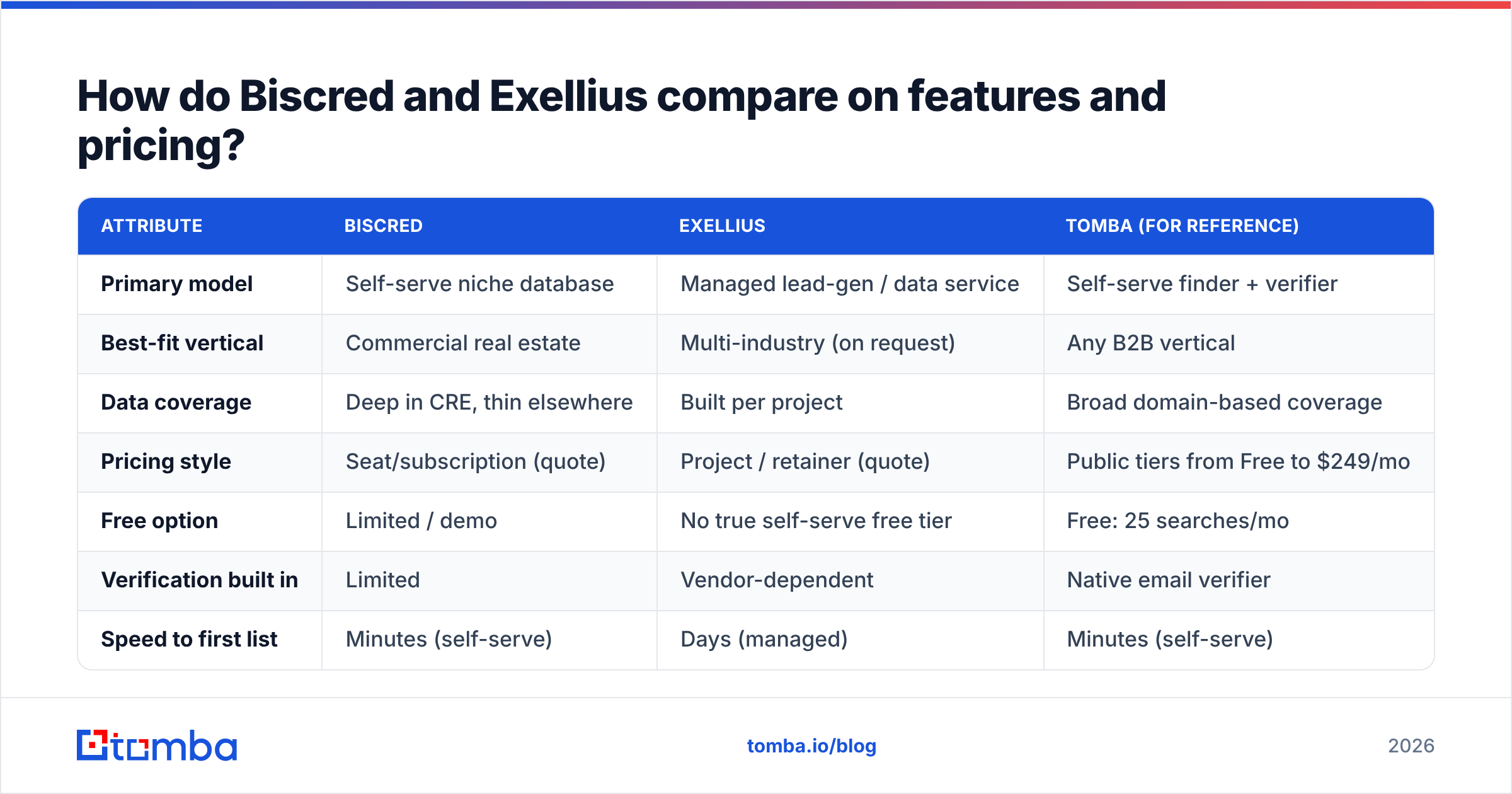
Here is the core comparison. Treat published figures as directional — both vendors quote based on use case rather than a public price page, so confirm current terms directly.
| Attribute | Biscred | Exellius | Tomba (for reference) |
|---|---|---|---|
| Primary model | Self-serve niche database | Managed lead-gen / data service | Self-serve finder + verifier |
| Best-fit vertical | Commercial real estate | Multi-industry (on request) | Any B2B vertical |
| Data coverage | Deep in CRE, thin elsewhere | Built per project | Broad domain-based coverage |
| Pricing style | Seat/subscription (quote) | Project / retainer (quote) | Public tiers from Free to $249/mo |
| Free option | Limited / demo | No true self-serve free tier | Free: 25 searches/mo |
| Verification built in | Limited | Vendor-dependent | Native email verifier |
| Speed to first list | Minutes (self-serve) | Days (managed) | Minutes (self-serve) |
| API access | Limited | Limited | Full email finder API |
| Control over sourcing | Medium | Low | High |
A few takeaways:
- Biscred wins on CRE depth. No horizontal tool models real estate roles as granularly.
- Exellius wins on done-for-you convenience. If you have budget but no SDR bandwidth, outsourcing the build has real appeal.
- Neither is pay-as-you-go friendly. Quote-based pricing slows down small teams that just want emails today.
- Verification is the gap. A niche or managed list still needs an independent email verification pass before launch, because even good data decays roughly 25–30% per year as people change jobs.
Which has better data accuracy?#
Accuracy is a function of freshness and verification, not vertical specialization. This is where buyers most often get burned.
A CRE-specific database like Biscred can be extremely current within its niche because the vendor concentrates its data operations there. But specialization does not exempt it from churn — brokers move firms constantly, and a deep but stale record is still a bounce.
Managed services like Exellius live or die by the moment of delivery. A list built fresh against your brief can be excellent on day one and noticeably worse 90 days later, because you are buying a snapshot rather than a continuously refreshed database.
The honest rule for both: never trust a vendor's accuracy claim, verify it. Run any purchased or delivered list through a verifier and a catch-all verifier before your first send. According to deliverability guidance from providers like Mailchimp, bounce rates above ~2% start hurting sender reputation — one stale list can drag a whole domain down. Industry review sites such as G2 are also useful for sanity-checking vendor accuracy claims against real user reports.
Biscred vs Exellius: which should you choose?#
Match the tool to your situation rather than chasing the "best" label.
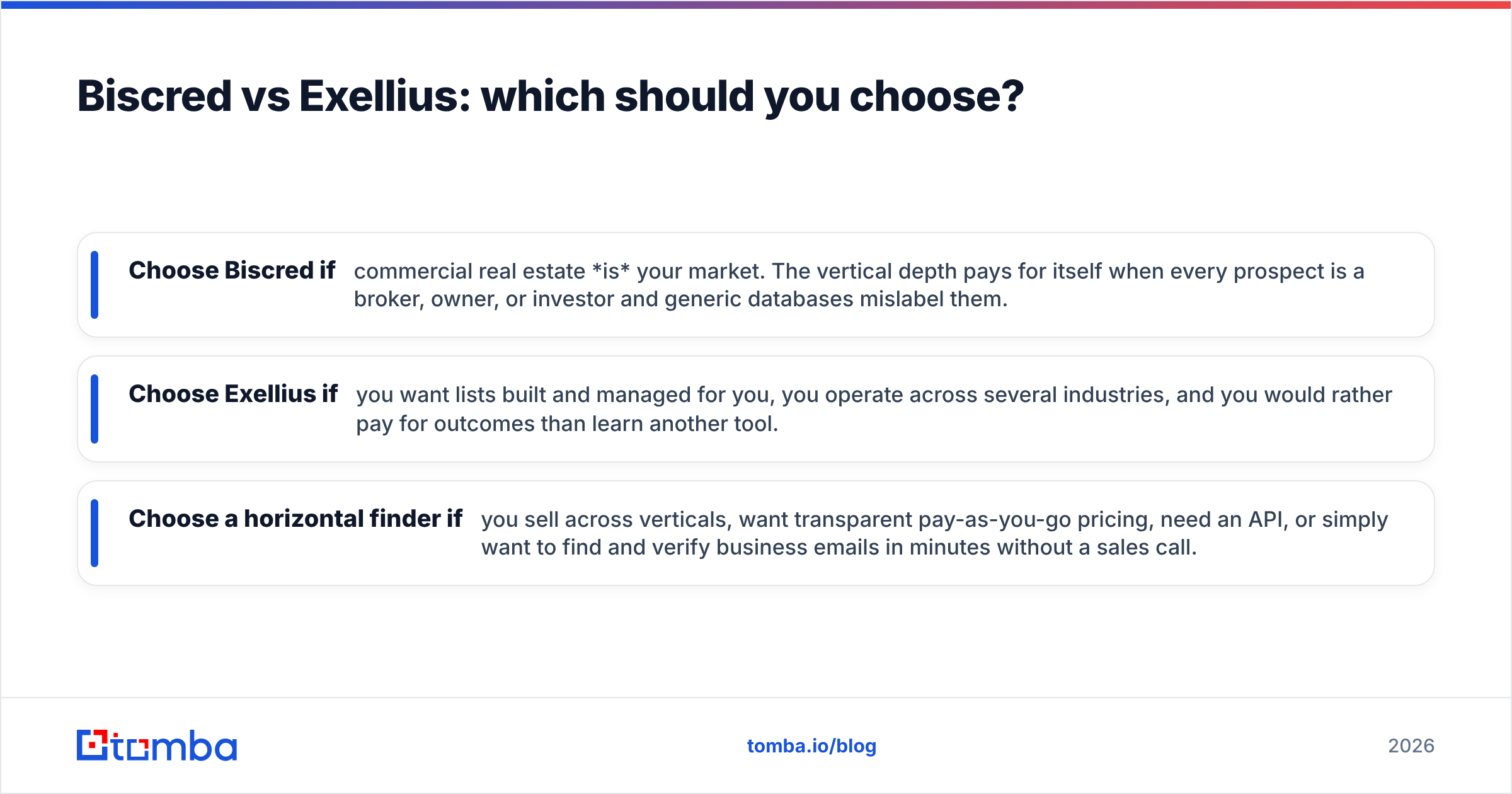
- Choose Biscred if commercial real estate is your market. The vertical depth pays for itself when every prospect is a broker, owner, or investor and generic databases mislabel them.
- Choose Exellius if you want lists built and managed for you, you operate across several industries, and you would rather pay for outcomes than learn another tool.
- Choose a horizontal finder if you sell across verticals, want transparent pay-as-you-go pricing, need an API, or simply want to find and verify business emails in minutes without a sales call.
That last category is where most B2B teams actually live, and it is worth being honest that a specialist database and a managed service both struggle with the "I just need 200 verified emails for this campaign by Friday" job.
How does a general email finder fit in?#
A horizontal email finder solves a different shape of problem: breadth, speed, and self-serve control. Instead of being locked to one vertical or one vendor's turnaround, you work from the company domains and names you already have.
Typical workflow with Tomba:
- Domain search — pull every discoverable email pattern at a target company with domain search.
- Email finder — resolve a specific person's address from name + company.
- Verify — confirm deliverability with the built-in verifier, including catch-all handling.
- Enrich and export — append data and push to your CRM, or scale with the bulk email finder.
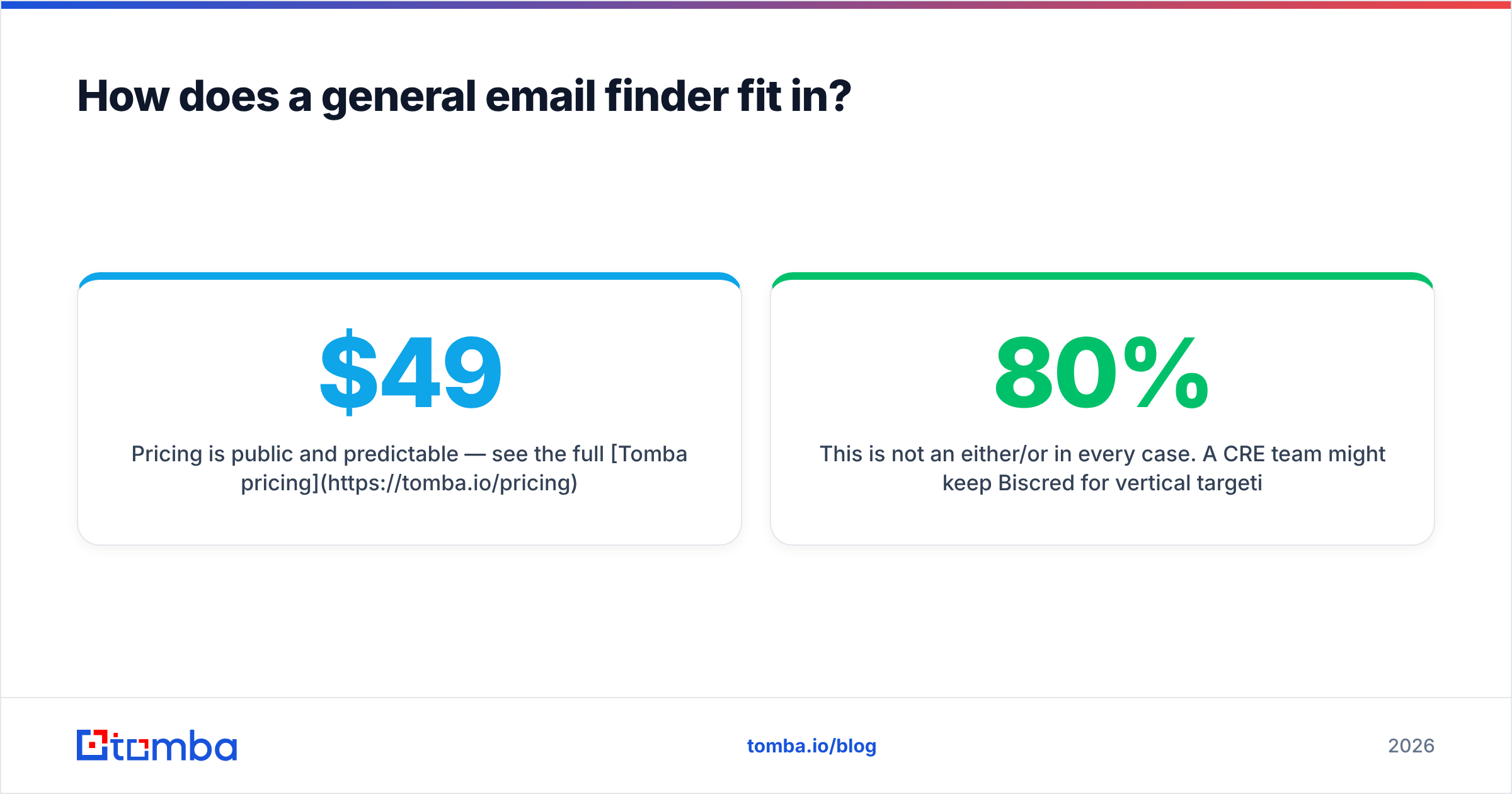
Pricing is public and predictable — see the full Tomba pricing page — starting with a Free tier (25 searches/mo), then Starter at $49/mo, Growth at $99/mo, and Pro at $249/mo. No quote, no onboarding gate, no minimum commitment. For teams comparing total cost, transparent tiers beat "contact sales" almost every time you are running lean campaigns.
This is not an either/or in every case. A CRE team might keep Biscred for vertical targeting and add a finder for the contacts Biscred misses. A lean outbound team replacing a managed service often finds a self-serve finder plus verifier covers 80% of what they paid Exellius for, at a fraction of the cost.
What about coverage outside the niche?#
This is the deciding factor for most readers. Biscred's strength is also its ceiling: leave commercial real estate and the data thins dramatically. Exellius can theoretically cover any industry, but each new vertical is a fresh project with fresh lead time and cost.
A domain-based finder sidesteps both limits. Because it works from public web signals and verification rather than a single curated vertical, coverage scales with the open web instead of a predefined list. You are not asking "is my industry in their database?" — you are asking "does this company have a website?" For B2B, the answer is almost always yes.
If phone outreach matters, the same logic applies: a dedicated phone finder and phone validator give you multichannel coverage without committing to a niche dataset or a managed retainer.
Final verdict#
Biscred and Exellius are good at narrow jobs: Biscred for commercial real estate depth, Exellius for hands-off managed lists. If you live squarely inside one of those use cases, they earn their place. But both ask you to accept quote-based pricing, slower self-serve workflows, and — critically — verification gaps you must close yourself.
For the majority of B2B teams who sell across verticals and want speed, transparency, and control, the smarter foundation is a horizontal email finder you can run today. Start free with Tomba Email Finder: find professional email addresses by domain, name, or company, verify them natively, and scale through the API — without a sales call. Pair it with the email verifier and you have a complete, pay-as-you-go prospecting stack that does not box you into a single niche or vendor.
// get started
Find, verify and enrich your first contacts today
Start on the free plan with 25 searches a month, then scale when your team is ready.
Free plan · No credit card required · GDPR & CCPA
// about the author