Biscred vs Generect 2026: Which B2B Data Tool Wins?
Biscred specializes in commercial real estate data while Generect bets on real-time B2B leads. Here's how the two compare on coverage, accuracy, and price — plus where a tool like Tomba fits.
Choosing between Biscred and Generect comes down to one question: do you need deep commercial real estate data, or fresh, broad B2B leads at scale? They are both "B2B data" tools on paper, but they solve different problems for different teams.
This guide breaks down what each platform actually does, where their data comes from, how they price, and which one fits your motion. We'll also show where a transparent, self-serve option like Tomba changes the math.
TL;DR#
- Biscred is a niche commercial real estate (CRE) data platform — brokers, investors, developers, lenders, and property managers with CRE-specific firmographics.
- Generect is a real-time B2B lead generation platform that pulls fresh contacts on demand, with an API-first design aimed at agencies and SDR teams.
- Pricing is quote-based for Biscred and subscription/API-tiered for Generect; neither publishes the kind of transparent self-serve plan most teams want.
- If your targets aren't exclusively CRE and you mostly need accurate work emails at a predictable price, a focused email-finding tool like Tomba (free tier, then $49/mo) is often the cheaper, faster path.
- Pick by use case: Biscred for CRE depth, Generect for real-time breadth, Tomba for affordable email discovery and verification.
What is Biscred?#
Biscred is a B2B data provider built specifically for the commercial real estate industry. Instead of trying to cover every sector, it goes deep on one: it maps the people and companies behind office, industrial, retail, multifamily, and other asset classes.
That vertical focus is the whole pitch. Generic databases know a company is "a real estate firm." Biscred aims to know whether a contact is a debt broker, an acquisitions lead, a property manager, or an LP — and which property types and deal sizes they touch. For CRE teams, that granularity is the difference between a relevant outbound email and noise.
You can read more on the official Biscred site, and cross-check user sentiment on G2.
Where Biscred fits best:
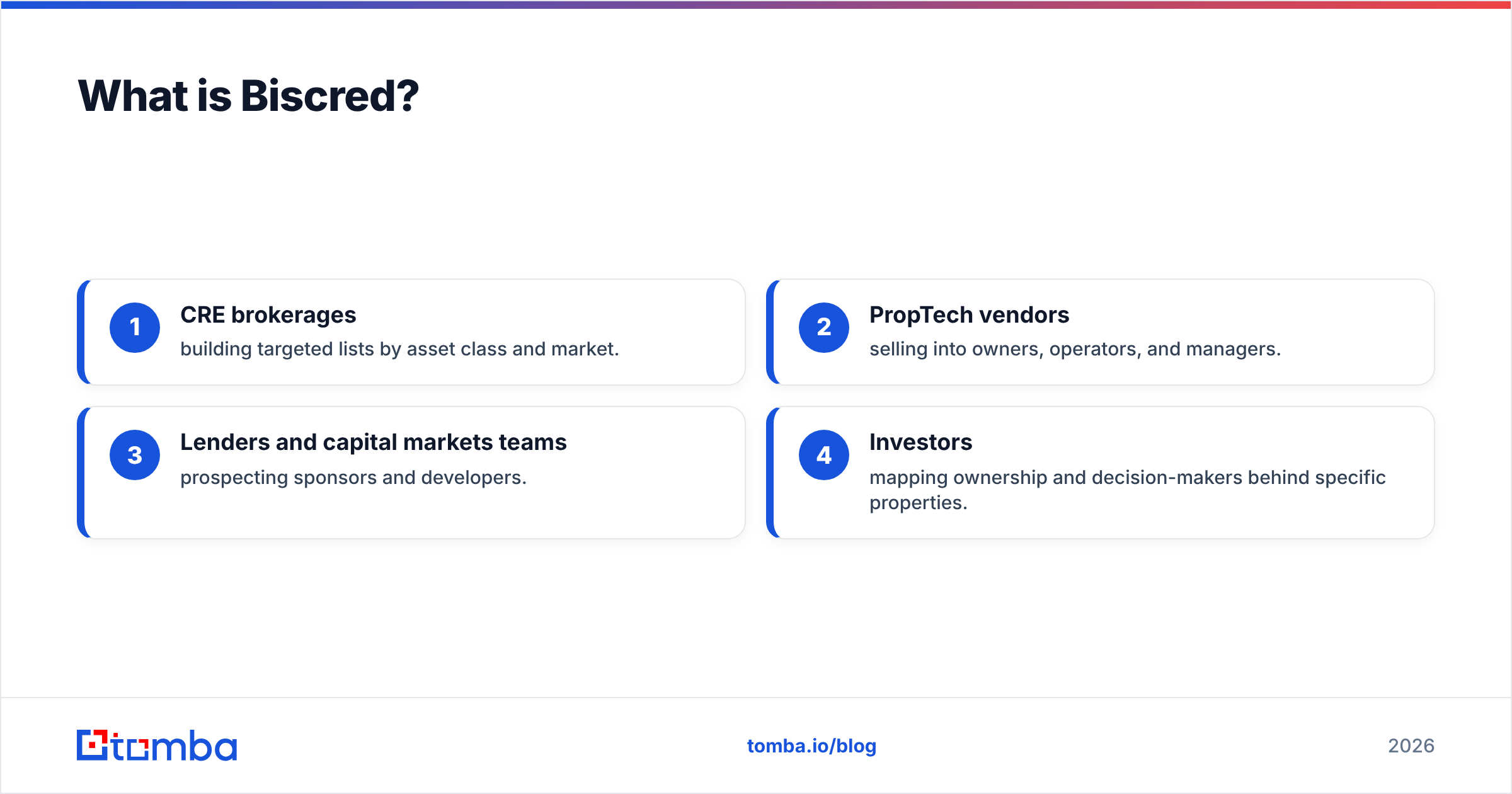
- CRE brokerages building targeted lists by asset class and market.
- PropTech vendors selling into owners, operators, and managers.
- Lenders and capital markets teams prospecting sponsors and developers.
- Investors mapping ownership and decision-makers behind specific properties.
The tradeoff: if your total addressable market extends much beyond commercial real estate, a vertical tool leaves gaps you'll fill with another vendor anyway.
What is Generect?#
Generect is a real-time B2B lead generation platform. Its core differentiator is freshness — rather than serving records from a database snapshot that may be months old, it generates and verifies contact data closer to the moment you request it. That approach targets one of the oldest complaints in outbound: stale data and bounced emails.
Generect leans API-first, which makes it a fit for agencies and growth teams that want to wire lead generation into their own tooling, enrichment pipelines, or sequencers rather than living inside a UI. You can review its positioning on the Generect site.

Where Generect fits best:
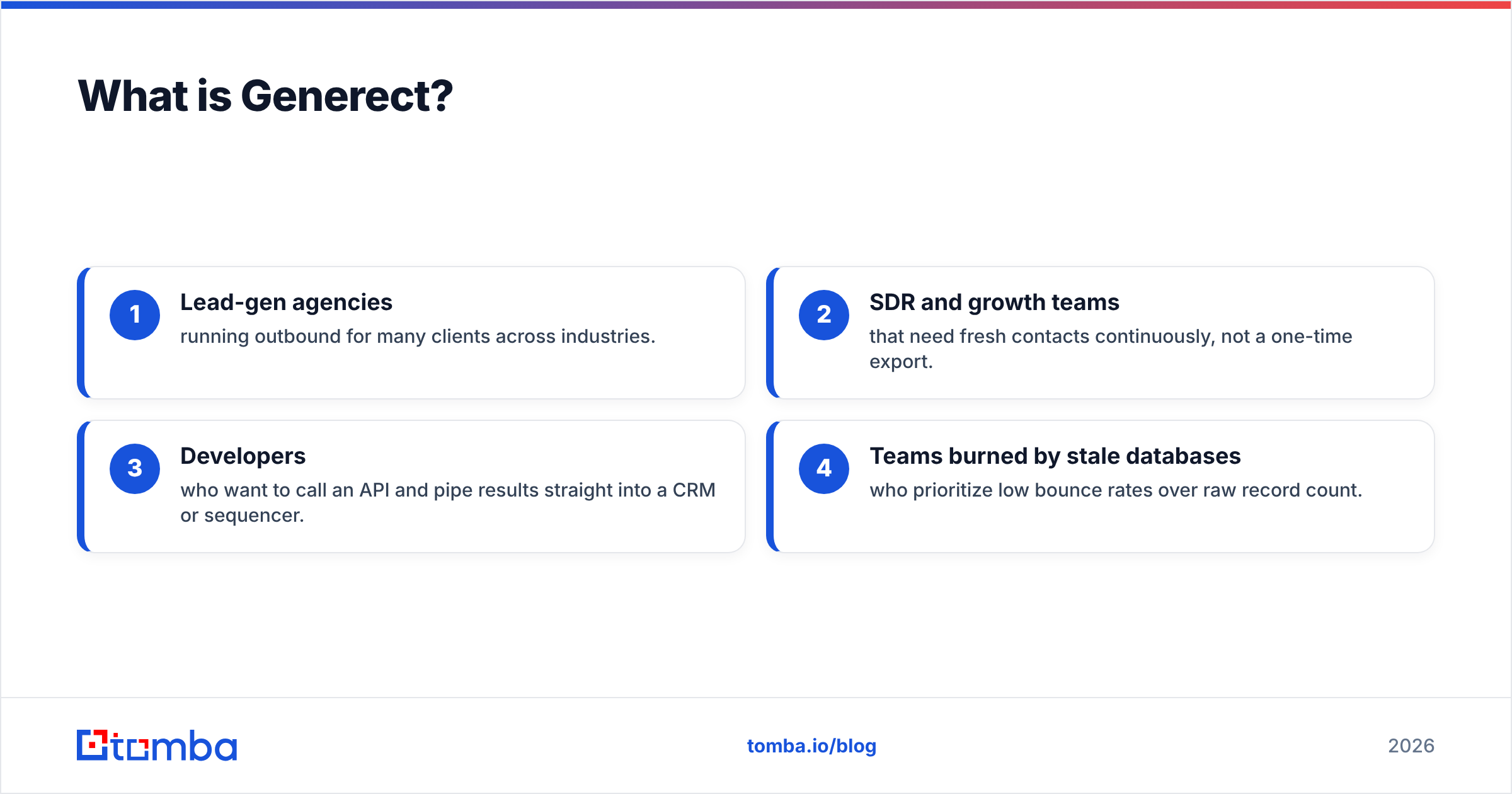
- Lead-gen agencies running outbound for many clients across industries.
- SDR and growth teams that need fresh contacts continuously, not a one-time export.
- Developers who want to call an API and pipe results straight into a CRM or sequencer.
- Teams burned by stale databases who prioritize low bounce rates over raw record count.
Biscred vs Generect: How do they compare?#
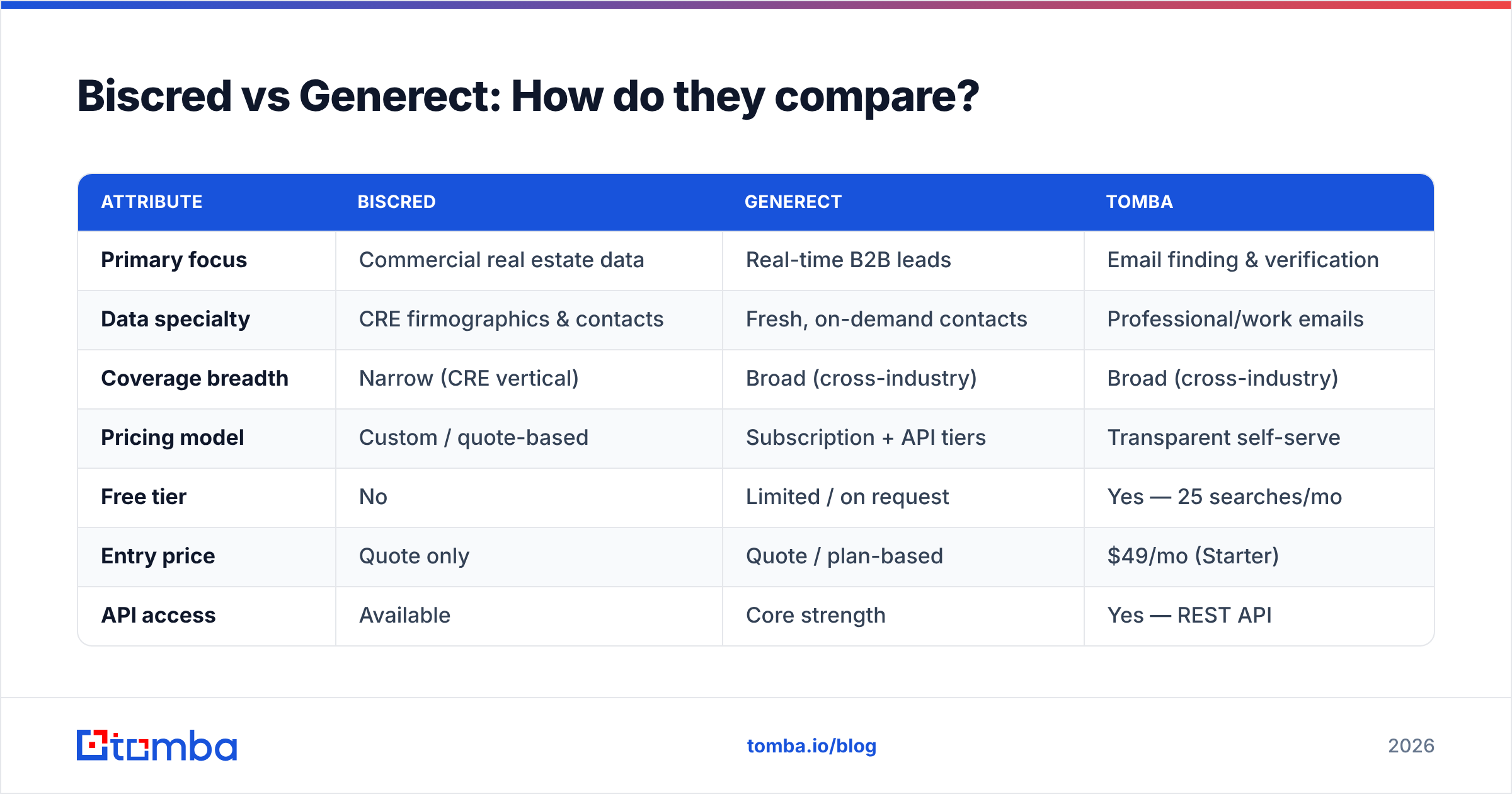
Here's the head-to-head on the attributes that actually drive a buying decision. Tomba is included as the transparent, email-focused reference point.
| Attribute | Biscred | Generect | Tomba |
|---|---|---|---|
| Primary focus | Commercial real estate data | Real-time B2B leads | Email finding & verification |
| Data specialty | CRE firmographics & contacts | Fresh, on-demand contacts | Professional/work emails |
| Coverage breadth | Narrow (CRE vertical) | Broad (cross-industry) | Broad (cross-industry) |
| Pricing model | Custom / quote-based | Subscription + API tiers | Transparent self-serve |
| Free tier | No | Limited / on request | Yes — 25 searches/mo |
| Entry price | Quote only | Quote / plan-based | $49/mo (Starter) |
| API access | Available | Core strength | Yes — REST API |
| Real-time verification | Varies | Yes | Yes — email verifier |
| Best for | CRE specialists | Agencies & SDR teams | Cost-aware email discovery |
A few honest caveats: Biscred and Generect don't publish full pricing, so "quote only" reflects a sales-led motion rather than a knock on quality. If transparent, predictable cost matters to you, that opacity is itself a signal — compare it against Tomba's published pricing before you commit to a demo cycle.
Whose data is more accurate?#
Accuracy depends less on brand and more on method. There are two strategies in play here, and each wins in a different scenario.
Biscred's accuracy comes from depth in a narrow lane. Because it curates a single vertical, its CRE-specific attributes — roles, asset classes, deal involvement — tend to be richer than what a horizontal database offers for the same contacts. If you're selling into commercial real estate, that context is worth more than a bigger but shallower record.
Generect's accuracy comes from recency. Real-time generation reduces the decay problem: people change jobs, and a record verified today beats one cached six months ago. For high-volume outbound across many industries, fresher contacts usually mean fewer bounces and better sender reputation.
For pure email correctness, the reliable pattern regardless of provider is: find, then verify before you send. That's why running discovered addresses through an email verifier and screening risky domains with a catch-all verifier protects deliverability no matter which database produced the contact.
How do they price, and what does it really cost?#
This is where many teams get surprised. Both Biscred and Generect run sales-led pricing, which means the sticker number depends on seats, data volume, contract length, and how hard you negotiate. That's normal for enterprise data, but it has real consequences: longer sales cycles, less ability to "try before you scale," and budget that's hard to forecast.

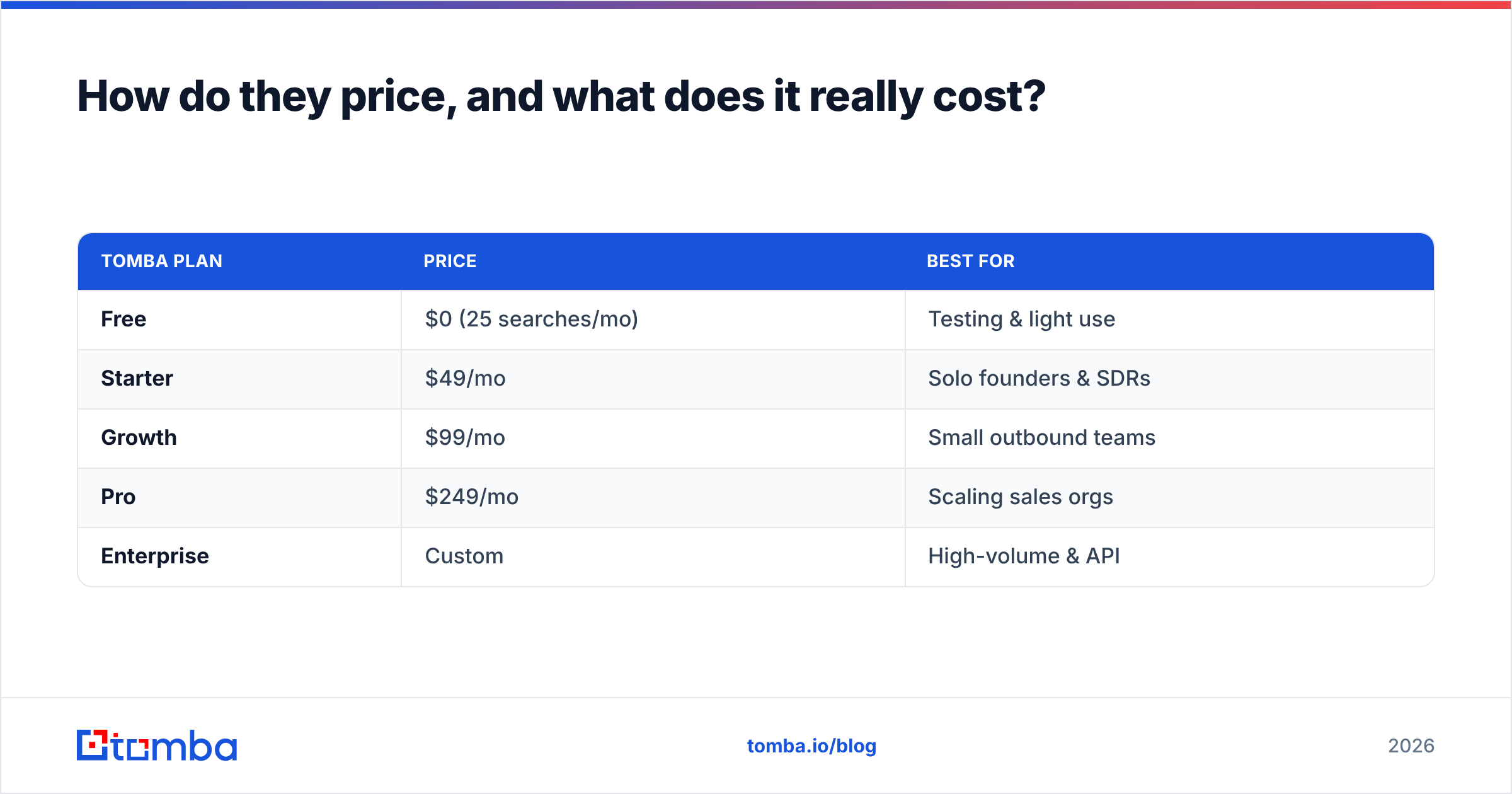
Transparent tools price differently. For comparison, Tomba publishes its tiers outright:
| Tomba plan | Price | Best for |
|---|---|---|
| Free | $0 (25 searches/mo) | Testing & light use |
| Starter | $49/mo | Solo founders & SDRs |
| Growth | $99/mo | Small outbound teams |
| Pro | $249/mo | Scaling sales orgs |
| Enterprise | Custom | High-volume & API |
The point isn't that cheaper is automatically better — it's that you can self-serve, start small, and scale without a procurement gauntlet. If your need is "find and verify work emails reliably," paying enterprise data prices for capabilities you won't use is poor ROI. If your need is "deep CRE intelligence" or "real-time leads at agency scale," the specialized platforms earn their cost.
Which one should you choose?#
Match the tool to the job rather than chasing the longest feature list.
- Choose Biscred if commercial real estate is your market and CRE-specific attributes — asset classes, deal roles, ownership context — drive your targeting. A vertical database will outperform any generalist here.
- Choose Generect if you run broad, high-volume outbound across industries and value fresh, API-delivered contacts that you can wire into your own stack. Agencies and SDR teams that hate stale lists are the sweet spot.
- Choose Tomba if your core need is finding and verifying professional emails at a transparent, predictable price — with a free tier to test and a real email finder API when you're ready to automate.
Many teams end up using more than one. A common stack: a specialist (Biscred or Generect) for sourcing in their core segment, plus an affordable verification and email-finding layer to keep deliverability high and fill gaps with domain search when a database comes up empty on a target account.
What about coverage gaps and overlap?#
No single database covers everyone. Biscred is intentionally narrow, so any non-CRE prospecting falls outside it. Generect is broad but, like every provider, has thinner coverage in some regions and seniority bands than others. Even the best real-time engine occasionally returns nothing for a given person.
That's where a lightweight, pay-as-you-grow finder earns its place as a backstop. When your primary tool misses a contact, you can run a name + company through an email finder, verify the result, and keep moving — without buying a second enterprise contract. For larger lists, a bulk email finder handles the gap-filling in one pass instead of one record at a time.
The practical rule: pick your primary by your dominant use case, then add a cheap, accurate verification layer so you're never blocked by a single vendor's blind spots — and never sending to addresses you haven't checked.
The bottom line#
Biscred and Generect aren't really competitors so much as specialists pointed at different problems. Biscred wins on commercial real estate depth. Generect wins on real-time, cross-industry breadth and API delivery. Both ask you to enter a sales cycle to learn what you'll pay.
If your actual day-to-day need is finding correct work emails and verifying them before you hit send — the foundation under any outbound motion — you don't need to start with an enterprise data contract. Start with a transparent tool, prove the workflow, and scale from there.
Ready to find and verify emails without a quote wall? Try the Tomba Email Finder free — 25 searches a month, no card required — then move to a $49/mo plan when you're ready to scale. Pair it with built-in verification to protect your sender reputation and keep bounce rates low, whether your leads come from Biscred, Generect, or your own research.
// get started
Find, verify and enrich your first contacts today
Start on the free plan with 25 searches a month, then scale when your team is ready.
Free plan · No credit card required · GDPR & CCPA
// about the author