Biscred vs GetProspect 2026: Which B2B Data Tool Wins?
Biscred targets commercial real estate data while GetProspect is a broad email finder. Here's an honest 2026 breakdown of pricing, accuracy, and which fits your prospecting.
Choosing between Biscred and GetProspect is really a choice between two very different philosophies. One is a vertical database built for commercial real estate; the other is a horizontal email finder built for anyone doing B2B outreach. If you pick the wrong one, you either pay for industry depth you'll never touch or you get broad coverage that's thin in the niche you actually sell into.
This guide breaks down what each tool does, how they price, where their data holds up, and who should pick which — without pretending one is a silver bullet.
TL;DR — Biscred vs GetProspect in 30 seconds#
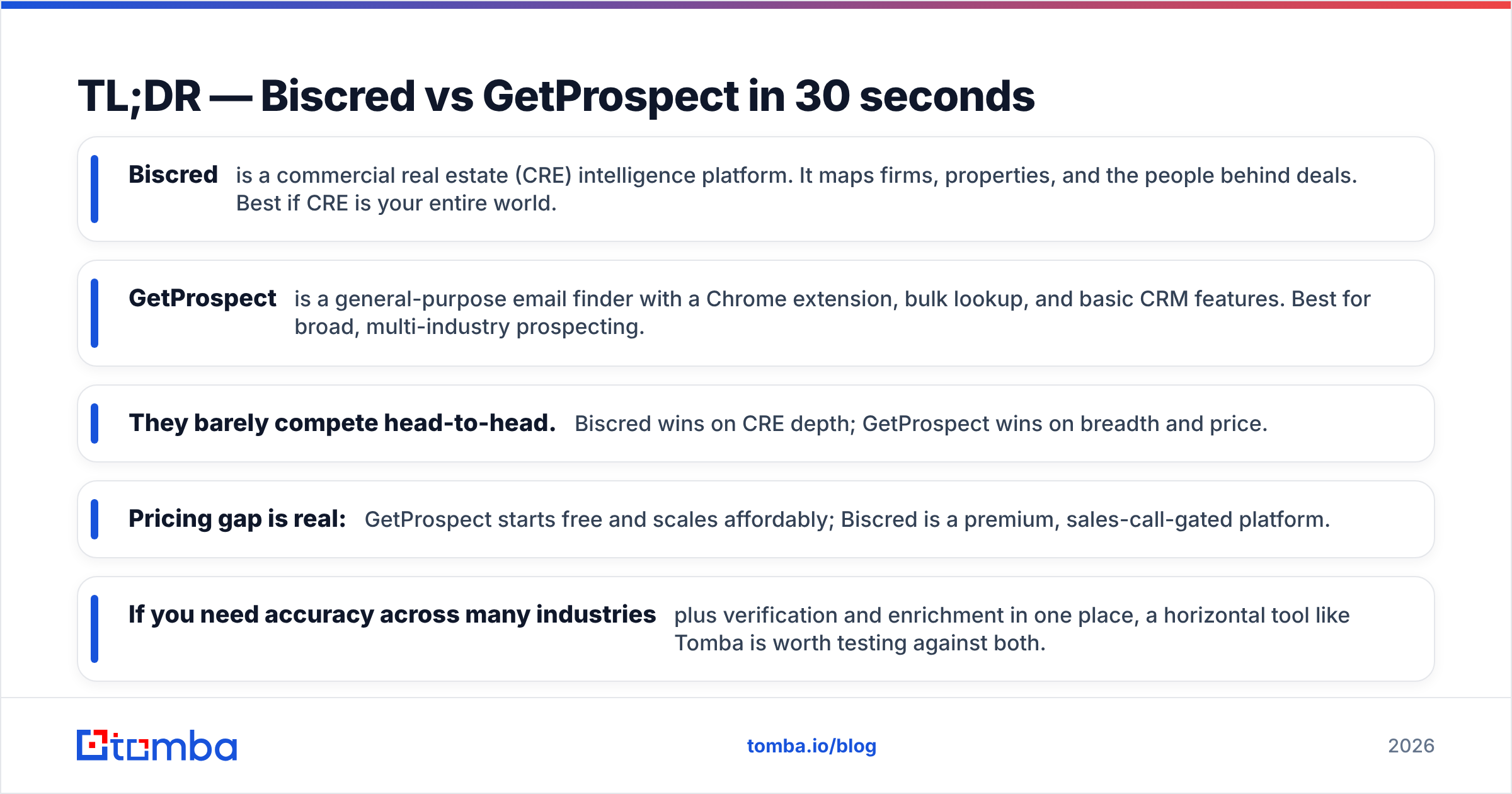
- Biscred is a commercial real estate (CRE) intelligence platform. It maps firms, properties, and the people behind deals. Best if CRE is your entire world.
- GetProspect is a general-purpose email finder with a Chrome extension, bulk lookup, and basic CRM features. Best for broad, multi-industry prospecting.
- They barely compete head-to-head. Biscred wins on CRE depth; GetProspect wins on breadth and price.
- Pricing gap is real: GetProspect starts free and scales affordably; Biscred is a premium, sales-call-gated platform.
- If you need accuracy across many industries plus verification and enrichment in one place, a horizontal tool like Tomba is worth testing against both.
What is Biscred?#
Biscred is a B2B data platform purpose-built for commercial real estate. Instead of trying to cover every industry, it goes deep on one: brokerages, owners, investors, lenders, property managers, and the decision-makers inside those firms. You can search by asset class, firm type, role, and geography, then pull contact details for the people who matter on a deal.
The value proposition is focus. A generic database might list a "VP" at a real estate company; Biscred is built to tell you whether that person actually touches acquisitions, leasing, or capital markets. For teams selling proptech, CRE services, or capital products, that context is the whole point.
The trade-off is scope and cost. Biscred is not a general sales tool — if your prospects sit outside commercial real estate, most of the platform is irrelevant to you. Pricing is not published openly and runs through a sales process, which signals a premium, enterprise-leaning product.
What is GetProspect?#
GetProspect is a horizontal email finder and lightweight prospecting suite. Its core job is simple: give it a name and company (or a LinkedIn profile, or a domain) and it returns a professional email address. Around that core it adds a Chrome extension, bulk search, list management, email verification, and a basic built-in CRM.
GetProspect is industry-agnostic. It's used by recruiters, agencies, SaaS sales teams, and freelancers — anyone who needs contact data without committing to a vertical platform. According to its own site and reviews on G2, it's positioned as an affordable, self-serve alternative to heavier enterprise databases.
The trade-off is depth. GetProspect knows a lot about how to find an email; it knows far less about the specific commercial-real-estate context Biscred specializes in. For broad outreach that's fine. For niche CRE targeting, it's a generalist doing a specialist's job.

How do Biscred and GetProspect compare on core features?#
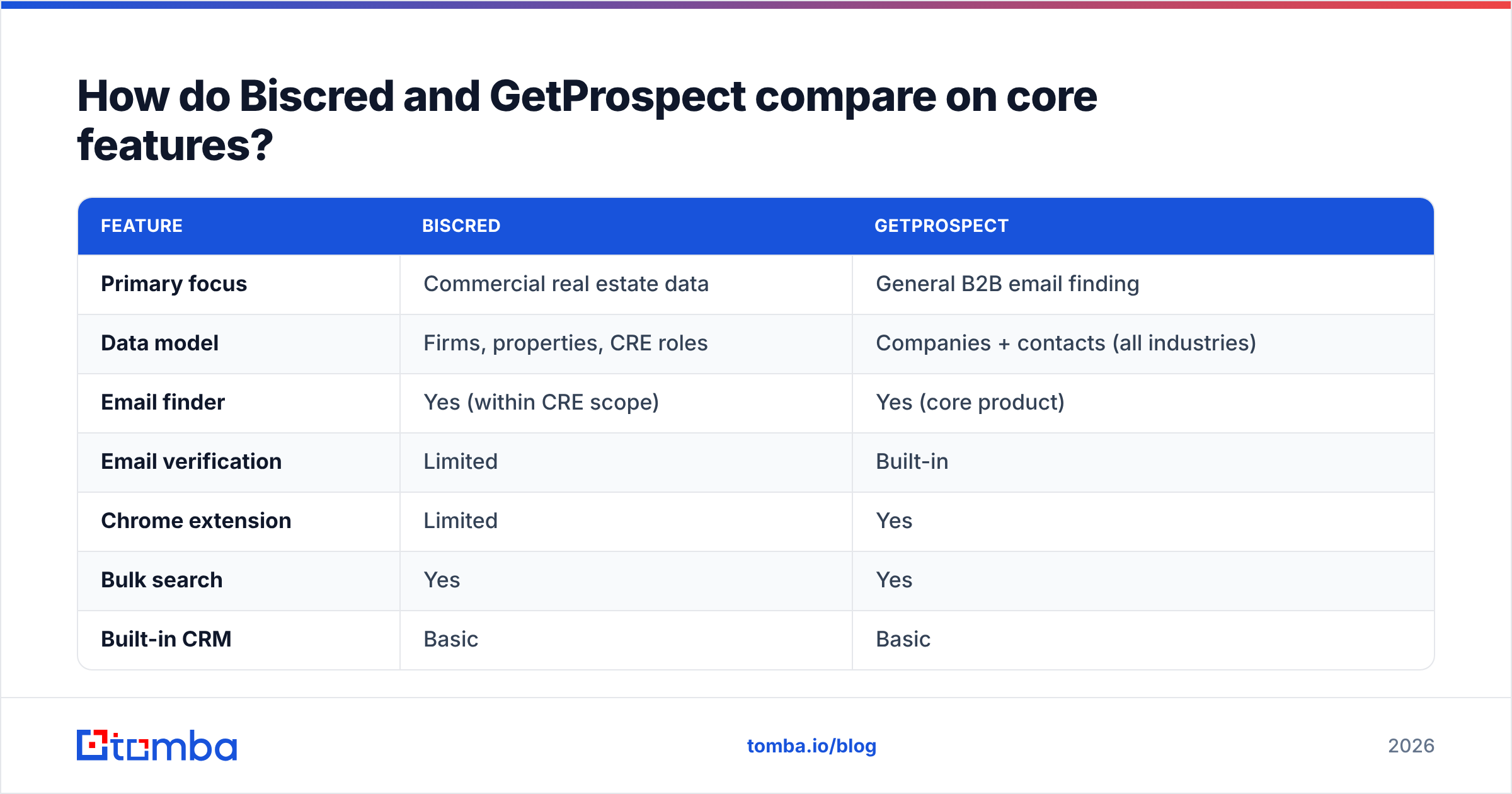
Here's the side-by-side on the attributes that actually drive a buying decision.
| Feature | Biscred | GetProspect |
|---|---|---|
| Primary focus | Commercial real estate data | General B2B email finding |
| Data model | Firms, properties, CRE roles | Companies + contacts (all industries) |
| Email finder | Yes (within CRE scope) | Yes (core product) |
| Email verification | Limited | Built-in |
| Chrome extension | Limited | Yes |
| Bulk search | Yes | Yes |
| Built-in CRM | Basic | Basic |
| Free tier | No (sales-gated) | Yes (limited credits) |
| Best fit | CRE-only sales teams | Multi-industry prospecting |
| Pricing transparency | Low (contact sales) | High (public plans) |
The pattern is clear: Biscred trades breadth for vertical depth, and GetProspect trades depth for breadth and accessibility. Neither is "better" in the abstract — it depends entirely on whether your total addressable market lives inside commercial real estate.
Is Biscred better than GetProspect for accuracy?#
It depends on the target. Inside commercial real estate, Biscred's curated, industry-specific data will usually beat a generalist tool because it understands roles, firms, and relationships that a horizontal database flattens into generic job titles. If you're emailing a "Managing Director" and need to know they run acquisitions and not facilities, that distinction is where Biscred earns its premium.
Outside CRE, the comparison flips. GetProspect covers far more companies and contacts across industries, so for a SaaS or agency team selling broadly, its hit rate on finding a valid email will typically be higher simply because the universe of records is larger.
This is the core lesson of data accuracy: coverage and precision are different things. A 95%-accurate database that doesn't include your prospect is 0% useful. Always run a small live test on your actual target list before committing — both vendors will look great in a demo built around their strengths. For more on how providers source and maintain records, Tomba documents its own approach on its data sources page.
Quick gut-check: are you a CRE specialist, or a generalist who occasionally sells into real estate? That single answer settles most of this debate.
How much do Biscred and GetProspect cost in 2026?#
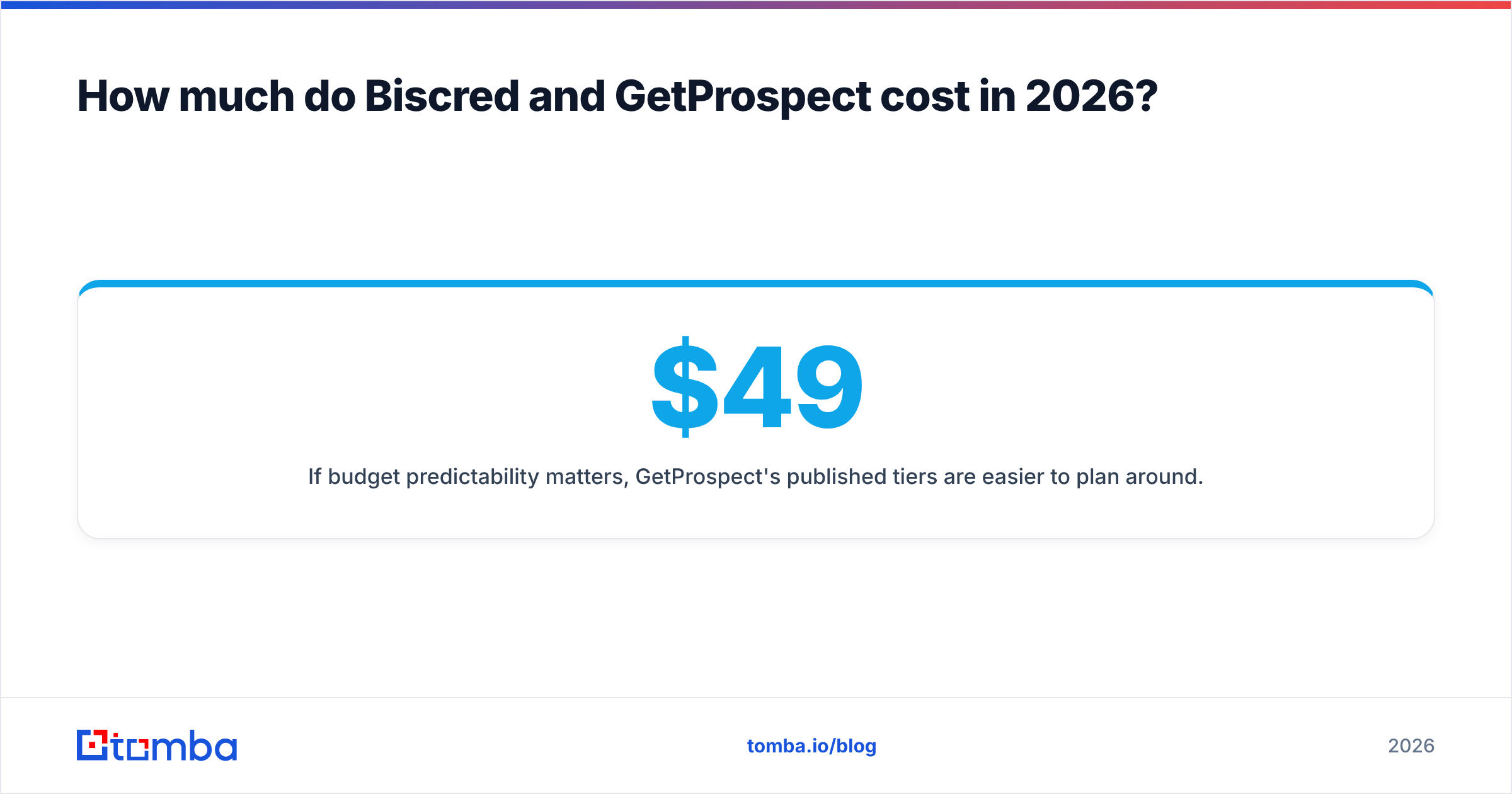
GetProspect is the transparent, self-serve option. It offers a free tier with limited monthly credits and paid plans that scale with the number of email lookups and verifications you need, typically starting in the low tens of dollars per month for solo users and rising for teams. You can sign up and start finding emails the same day.
Biscred sits at the other end. It doesn't publish standard pricing and routes prospects through a sales conversation, which usually means annual contracts and a higher entry point appropriate to a specialized enterprise dataset. That model makes sense for CRE teams with budget and a clear, recurring need — but it's a poor fit for someone who just wants to test a few hundred emails this week.
If budget predictability matters, GetProspect's published tiers are easier to plan around. For reference, transparent per-seat pricing is also how Tomba's plans work — Free (25 searches/mo), Starter at $49/mo, Growth at $99/mo, and Pro at $249/mo — so you can model cost before you ever talk to sales.
Which should you choose: Biscred or GetProspect?#
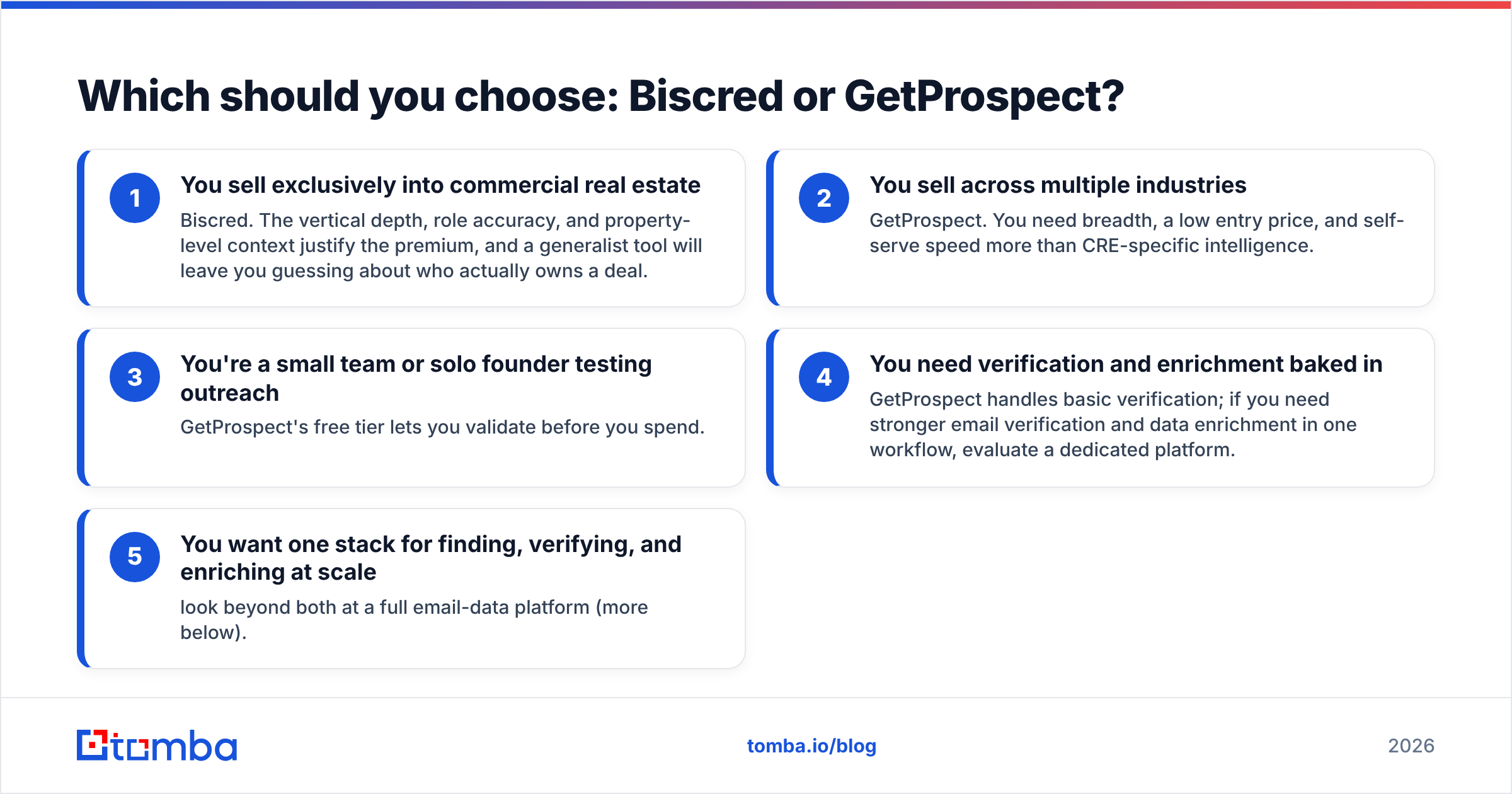
Match the tool to your motion. Use this quick decision framework:
- You sell exclusively into commercial real estate — Biscred. The vertical depth, role accuracy, and property-level context justify the premium, and a generalist tool will leave you guessing about who actually owns a deal.
- You sell across multiple industries — GetProspect. You need breadth, a low entry price, and self-serve speed more than CRE-specific intelligence.
- You're a small team or solo founder testing outreach — GetProspect's free tier lets you validate before you spend.
- You need verification and enrichment baked in — GetProspect handles basic verification; if you need stronger email verification and data enrichment in one workflow, evaluate a dedicated platform.
- You want one stack for finding, verifying, and enriching at scale — look beyond both at a full email-data platform (more below).
The honest answer is that most teams shouldn't agonize over this matchup, because the two products rarely solve the same problem. The real question is whether your buyer lives inside the CRE niche or across the broader B2B map.
Is there a better alternative to both?#
For teams that aren't locked into commercial real estate, a horizontal email-data platform often beats both Biscred and GetProspect on flexibility. That's the gap Tomba fills: it combines an email finder, verifier, domain search, bulk processing, and enrichment in a single account, with transparent pricing and an email finder API for teams that want to automate.
Where Biscred is deep-but-narrow and GetProspect is broad-but-light on verification, Tomba aims for broad coverage and verification in one place. You can find emails by domain or name, verify them to protect email deliverability, and enrich the records — without juggling separate subscriptions. For multi-industry B2B prospecting, that consolidation usually wins on both cost and workflow.

This isn't to say Tomba replaces Biscred for a pure CRE shop — vertical depth is real and valuable. But if your prospecting spans verticals, paying for a single-industry database is overkill, and a lightweight finder without strong verification leaves bounce risk on the table.
What are the main pros and cons?#
Biscred — pros:
- Deep, curated commercial real estate dataset
- Role and firm context generalists miss
- Property-level intelligence for CRE deals
Biscred — cons:
- Useless outside commercial real estate
- Opaque, sales-gated, premium pricing
- Overkill for broad or early-stage outreach
GetProspect — pros:
- Affordable with a real free tier
- Broad multi-industry coverage
- Built-in verification, extension, and bulk search
GetProspect — cons:
- Shallow in any single vertical
- Less authoritative than specialist CRE data
- CRM and enrichment are basic
How do I test either tool before buying?#
Run the same controlled experiment on both. Build a list of 50–100 real prospects you genuinely want to reach. Feed identical names and domains into each tool, then measure three things: match rate (how many emails it returned), verification pass rate (how many survived a verifier), and bounce rate after you actually send.
Pay attention to catch-all domains — many B2B companies use them, and a tool that can't distinguish a deliverable address from a catch-all will quietly inflate your bounce rate. A dedicated catch-all verifier helps you separate safe sends from risky ones. Run this test with your real targets, not the vendor's curated demo, and the right choice usually becomes obvious within an afternoon.
The bottom line#
Biscred and GetProspect aren't really rivals — they're answers to different questions. If commercial real estate is your entire business, Biscred's depth is hard to beat and worth the premium. If you prospect across industries and want speed, affordability, and self-serve access, GetProspect is the more sensible pick.
But if you want one platform that finds, verifies, and enriches B2B contacts across every industry — with transparent pricing and an API — give Tomba's Email Finder a run on your own prospect list. Start free with 25 searches a month, test the match and verification rates side by side with whatever you're using now, and upgrade only when the data proves itself. Let the bounce rate decide, not the demo.
// get started
Find, verify and enrich your first contacts today
Start on the free plan with 25 searches a month, then scale when your team is ready.
Free plan · No credit card required · GDPR & CCPA
// about the author