Biscred vs LeadGenius 2026: B2B Data Platforms Compared
Biscred vs LeadGenius: one owns commercial real estate data, the other sells managed B2B lists. See which fits your GTM motion in 2026 — and the cheaper API path.
TL;DR
- Biscred is a vertical data platform built almost entirely for commercial real estate (CRE) — brokers, lenders, owners, and PropTech sellers who need contacts tied to buildings, deals, and asset classes.
- LeadGenius is a managed, human-verified B2B data service that builds custom contact and account lists to spec, including hard-to-source "long-tail" data and international coverage.
- They rarely compete head-to-head: Biscred wins if your total addressable market is real estate; LeadGenius wins if you need bespoke, researched lists across any industry.
- Both are premium-priced and sales-led — expect annual contracts, seat minimums, and a demo before you see a number.
- If you mostly need accurate work emails and firmographics on demand without a six-figure commitment, a self-serve tool like Tomba covers 80% of the job at a fraction of the cost.
If you searched "Biscred vs LeadGenius," you're probably deciding where to put a real data budget in 2026. Here's the short version: these two tools solve different problems that only look similar from a distance. This post breaks down what each actually does, where the data comes from, how pricing works, and when a leaner alternative beats both.
What is Biscred?#
Biscred is a B2B data and prospecting platform purpose-built for commercial real estate. Instead of trying to cover every industry, it goes deep on one: its database maps companies and contacts to asset classes (office, multifamily, industrial, retail, hospitality), roles (acquisitions, capital markets, asset management, leasing), and deal activity.
That focus is the whole pitch. A generic database might tell you someone is "VP at a real estate firm." Biscred tries to tell you they run industrial acquisitions in the Southeast and let you filter your list down to exactly that. For CRE brokers, PropTech founders selling into landlords, and lenders building borrower pipelines, that specificity removes hours of manual qualification.
The tradeoff is obvious: if you sell SaaS to dentists, Biscred's depth is wasted on you. You're paying for a CRE-shaped knife to cut a non-CRE problem.

What is LeadGenius?#
LeadGenius is a managed data-as-a-service provider. Rather than handing you a self-serve search box, it pairs proprietary technology with a global team of human researchers who build and verify datasets to your exact specification.
This model shines on the data that algorithms struggle with: niche job titles, privately held companies, specific technographics, store-level retail data, or contacts in regions where automated scraping falls apart. You tell LeadGenius the account profile and the fields you need; they deliver a custom, verified list and can keep it refreshed.
Because humans are in the loop, accuracy on hard targets is typically high and the data is "to-spec" rather than "best-effort match." The cost of that model is speed and price — you're buying a service, not a subscription to a button. LeadGenius positions itself for enterprise revenue and operations teams that already know precisely who they want to reach. You can read more about its managed approach on the LeadGenius site.
Biscred vs LeadGenius: how do they compare?#
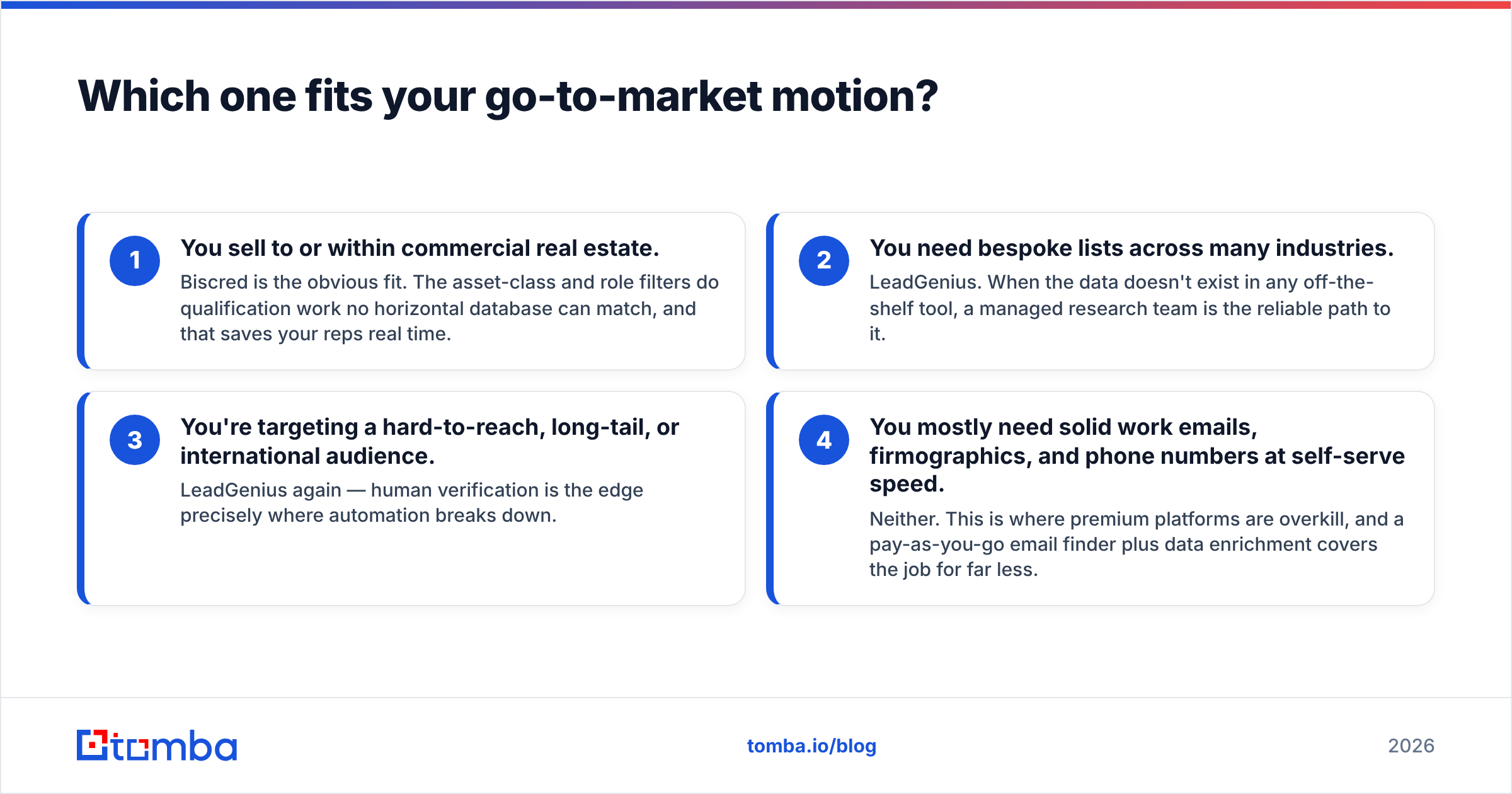
Here's the side-by-side. Treat the pricing as directional — both vendors quote based on volume, fields, and contract length, and neither publishes flat public rates.
| Attribute | Biscred | LeadGenius |
|---|---|---|
| Primary use case | Commercial real estate prospecting | Custom B2B data across any industry |
| Data model | Self-serve database, CRE-specific filters | Managed service, human-researched lists |
| Best for | CRE brokers, lenders, PropTech sellers | Enterprise RevOps, ABM, niche TAMs |
| Coverage strength | Deep in real estate, narrow elsewhere | Broad, strong on long-tail & international |
| Accuracy approach | Tech-driven matching + verification | Human verification to spec |
| Speed to data | Fast (search and export) | Slower (research turnaround) |
| Pricing model | Annual subscription, sales-led | Custom managed contracts, sales-led |
| Self-serve free tier | No | No |
| Typical commitment | Annual | Annual / project-based |
The pattern: Biscred optimizes for speed inside one vertical; LeadGenius optimizes for accuracy and customization across all verticals. Neither is "better" in the abstract. The right answer is dictated by what you sell and to whom.
Which one fits your go-to-market motion?#
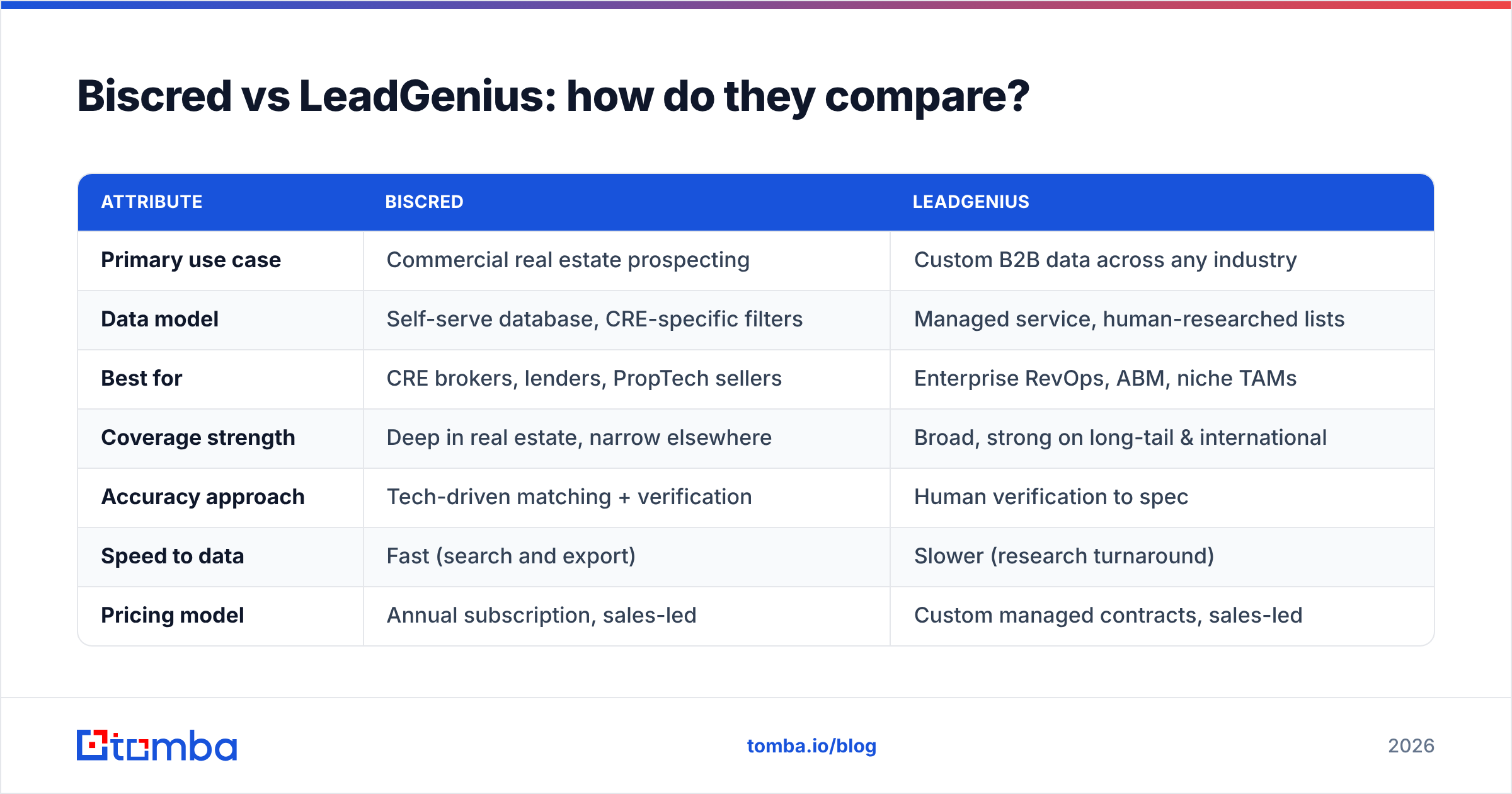
Pick based on your actual sales motion, not the feature list. Use these four scenarios as a shortcut:
- You sell to or within commercial real estate. Biscred is the obvious fit. The asset-class and role filters do qualification work no horizontal database can match, and that saves your reps real time.
- You need bespoke lists across many industries. LeadGenius. When the data doesn't exist in any off-the-shelf tool, a managed research team is the reliable path to it.
- You're targeting a hard-to-reach, long-tail, or international audience. LeadGenius again — human verification is the edge precisely where automation breaks down.
- You mostly need solid work emails, firmographics, and phone numbers at self-serve speed. Neither. This is where premium platforms are overkill, and a pay-as-you-go email finder plus data enrichment covers the job for far less.
That fourth case is more common than vendors admit. Many teams buy a heavyweight platform to solve a lightweight problem — they need contact data, not a managed research operation.
How accurate is the data — and does it stay fresh?#
Accuracy is where these tools justify their price, so scrutinize it.
LeadGenius leans on human verification, which generally produces high accuracy on the specific fields you commission. The catch is freshness: B2B data decays fast. ZoomInfo and other industry sources estimate that a meaningful share of contact records go stale every year as people change jobs, so any "verified" list is a snapshot that needs re-verification on a schedule. With a managed service, refreshes are part of the contract — but they cost time and money.
Biscred's accuracy is strongest inside its lane. Its CRE focus means its team and matching logic are tuned to that world's company structures and titles. Outside CRE, expect coverage gaps.
Whichever you choose, build verification into your workflow rather than trusting any vendor's headline accuracy number. Bounced emails wreck sender reputation and drag down email deliverability, so running new lists through an email verifier before you send is non-negotiable — even for "verified" data.

What about pricing and commitment?#
Both Biscred and LeadGenius are sales-led, premium products. There's no free tier, no public price list, and no swiping a card to start. You book a demo, get scoped, and sign an annual or project-based contract. For an enterprise team with budget and a clear, large TAM, that's normal procurement.
For everyone else — startups, lean sales teams, solo founders, agencies running outbound for clients — the commitment is the friction. You may not know your exact data needs until you've run campaigns, and signing a big annual deal before that is a gamble.
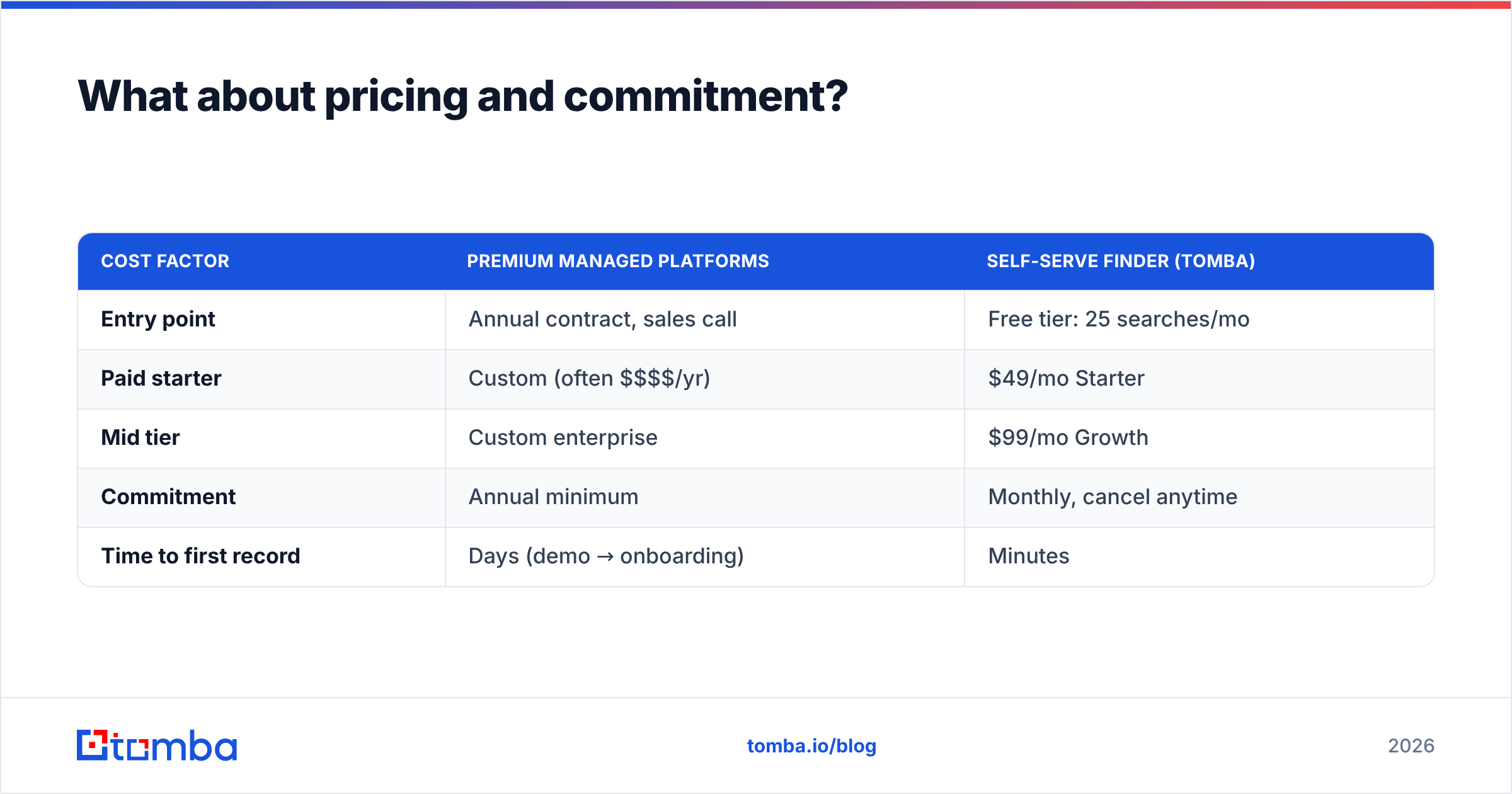
This is the core reason self-serve alternatives exist. Compare the model:
| Cost factor | Premium managed platforms | Self-serve finder (Tomba) |
|---|---|---|
| Entry point | Annual contract, sales call | Free tier: 25 searches/mo |
| Paid starter | Custom (often $$$$/yr) | $49/mo Starter |
| Mid tier | Custom enterprise | $99/mo Growth |
| Commitment | Annual minimum | Monthly, cancel anytime |
| Time to first record | Days (demo → onboarding) | Minutes |
You can see the full Tomba pricing tiers publicly — Free (25 searches/mo), Starter at $49/mo, Growth at $99/mo, Pro at $249/mo, and custom Enterprise. The point isn't that Tomba replaces a CRE-specific database or a managed research team; it's that most "I need contact data" problems don't require either.
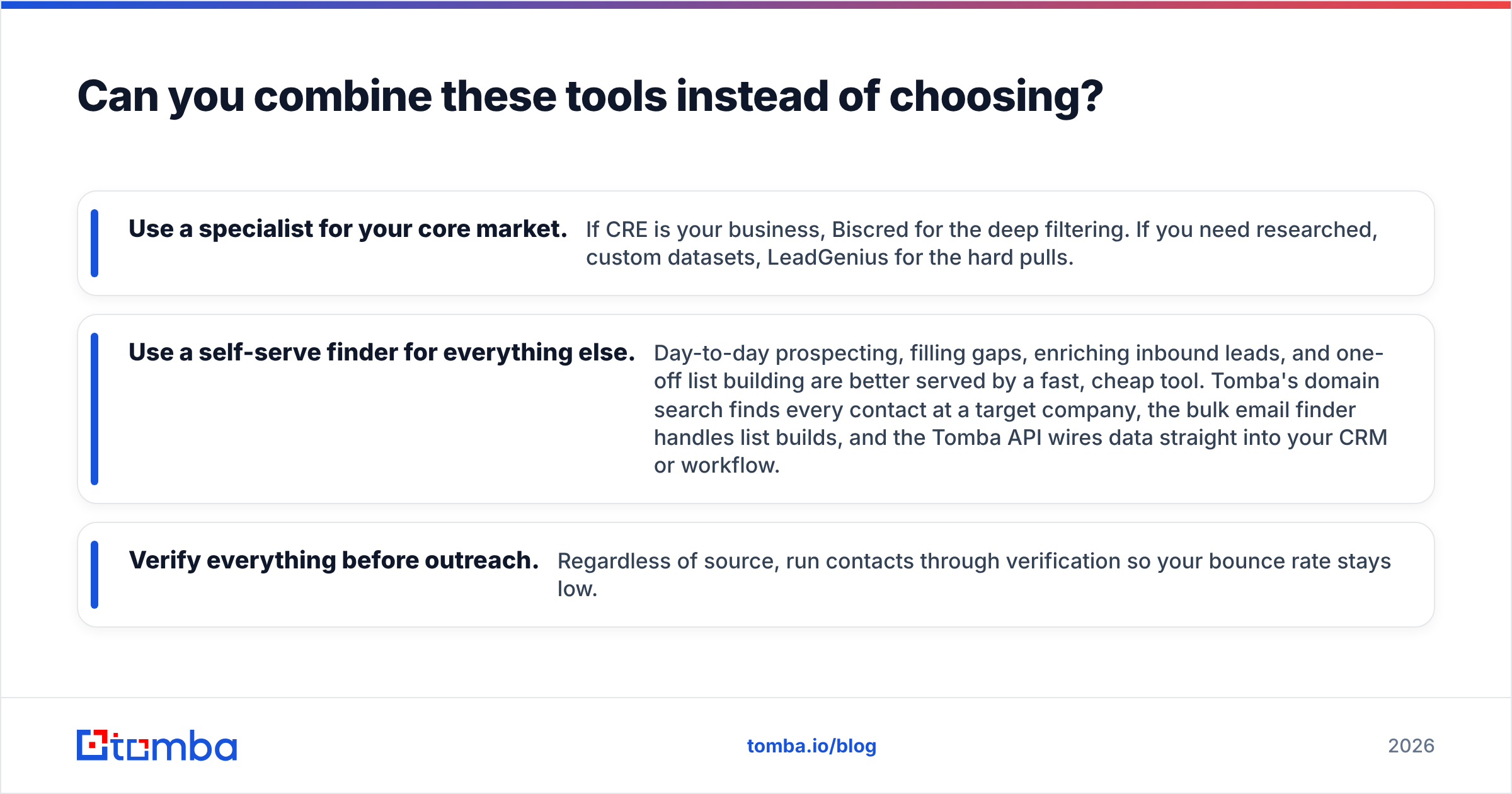
Can you combine these tools instead of choosing?#
Yes — and smart teams often do. A practical stack looks like this:
- Use a specialist for your core market. If CRE is your business, Biscred for the deep filtering. If you need researched, custom datasets, LeadGenius for the hard pulls.
- Use a self-serve finder for everything else. Day-to-day prospecting, filling gaps, enriching inbound leads, and one-off list building are better served by a fast, cheap tool. Tomba's domain search finds every contact at a target company, the bulk email finder handles list builds, and the Tomba API wires data straight into your CRM or workflow.
- Verify everything before outreach. Regardless of source, run contacts through verification so your bounce rate stays low.
This hybrid keeps your expensive contracts scoped to where they actually pay off and stops you from over-buying for routine work.
Biscred vs LeadGenius: the verdict#
- Choose Biscred if commercial real estate is your market. Nothing horizontal matches its asset-class and role granularity, and that focus is worth the premium when every record is in your ICP.
- Choose LeadGenius if you need custom, human-verified data across industries — especially long-tail, private-company, or international targets that automated tools miss.
- Choose a self-serve tool if your real need is accurate emails, phones, and firmographics on demand, without an annual commitment or a sales cycle just to get started.
Most teams overestimate how much managed data they need and underestimate how far a fast, accurate finder gets them. Both Biscred and LeadGenius are excellent at their jobs — those jobs are just narrower and pricier than a lot of buyers assume.
Start finding contacts today#
If your honest answer to "what do I actually need" is reliable work emails and company contacts without a six-figure contract, start with the Tomba Email Finder. Find professional email addresses by domain, name, or company, verify them in the same workflow, and push the results into your CRM through the API — on a free tier first, then a $49/mo plan when you scale. No demo, no annual lock-in. Keep your premium budget for the niche data only a specialist can provide, and let a self-serve finder handle the rest.
// get started
Find, verify and enrich your first contacts today
Start on the free plan with 25 searches a month, then scale when your team is ready.
Free plan · No credit card required · GDPR & CCPA
// about the author