Biscred vs LeadIQ 2026: Which B2B Data Tool Should You Pick?
Biscred targets commercial real estate data; LeadIQ targets fast sales prospecting. See how they compare on coverage, pricing, and fit — and where a general B2B finder beats both.
Biscred vs LeadIQ: Which B2B Data Tool Should You Pick in 2026?
Choosing between Biscred and LeadIQ is really a choice about what kind of pipeline you sell into. One is a niche database built for commercial real estate. The other is a horizontal sales-prospecting tool that lives inside your CRM. Picking the wrong one means paying for coverage you'll never use.
TL;DR#
- Biscred is purpose-built for commercial real estate (CRE) — owners, brokers, investors, property firms. Deep in that vertical, thin everywhere else.
- LeadIQ is a horizontal sales-prospecting tool that captures contacts from LinkedIn and pushes them into Salesforce, HubSpot, and Outreach.
- If you sell to CRE specifically, Biscred wins on relevance. For everything else, LeadIQ's workflow integration is the stronger fit.
- Both run premium, often seat-based or quote-based pricing. If your real need is accurate emails at volume, a general finder like Tomba Email Finder covers the same job from $49/mo.
- Read the use-case fit below before you commit to an annual contract.
What is Biscred?#
Biscred is a B2B data platform focused on the commercial real estate industry. Think of it as a specialist directory: instead of trying to catalog every company on earth, it goes deep on one vertical — property owners, investment firms, brokers, lenders, developers, and the people who work at them.
That focus is the whole pitch. If your ICP is "VP of Acquisitions at a multifamily investment firm," Biscred has structured filters for exactly that — asset class, deal role, firm type, portfolio signals. A horizontal database would force you to reverse-engineer those segments from job titles and guesswork.
The trade-off is obvious: outside CRE, the data thins out fast. You're buying a scalpel, not a Swiss Army knife.
What is LeadIQ?#
LeadIQ is a sales-prospecting tool built around speed and CRM workflow. Its core motion: you browse LinkedIn or a company page, click the LeadIQ extension, and it captures the contact — name, title, work email, phone — then pushes it straight into your CRM or sequencer without copy-paste.
LeadIQ's strength isn't a single vertical; it's the handoff. It plays well with Salesforce, HubSpot, Outreach, and Salesloft, and it layers on features like email verification, "Scribe" AI message writing, and tracking for job changes at tracked accounts.
In short: Biscred answers who exists in CRE. LeadIQ answers how do I get this LinkedIn lead into my sequence in two clicks.

Biscred vs LeadIQ: How do they compare?#
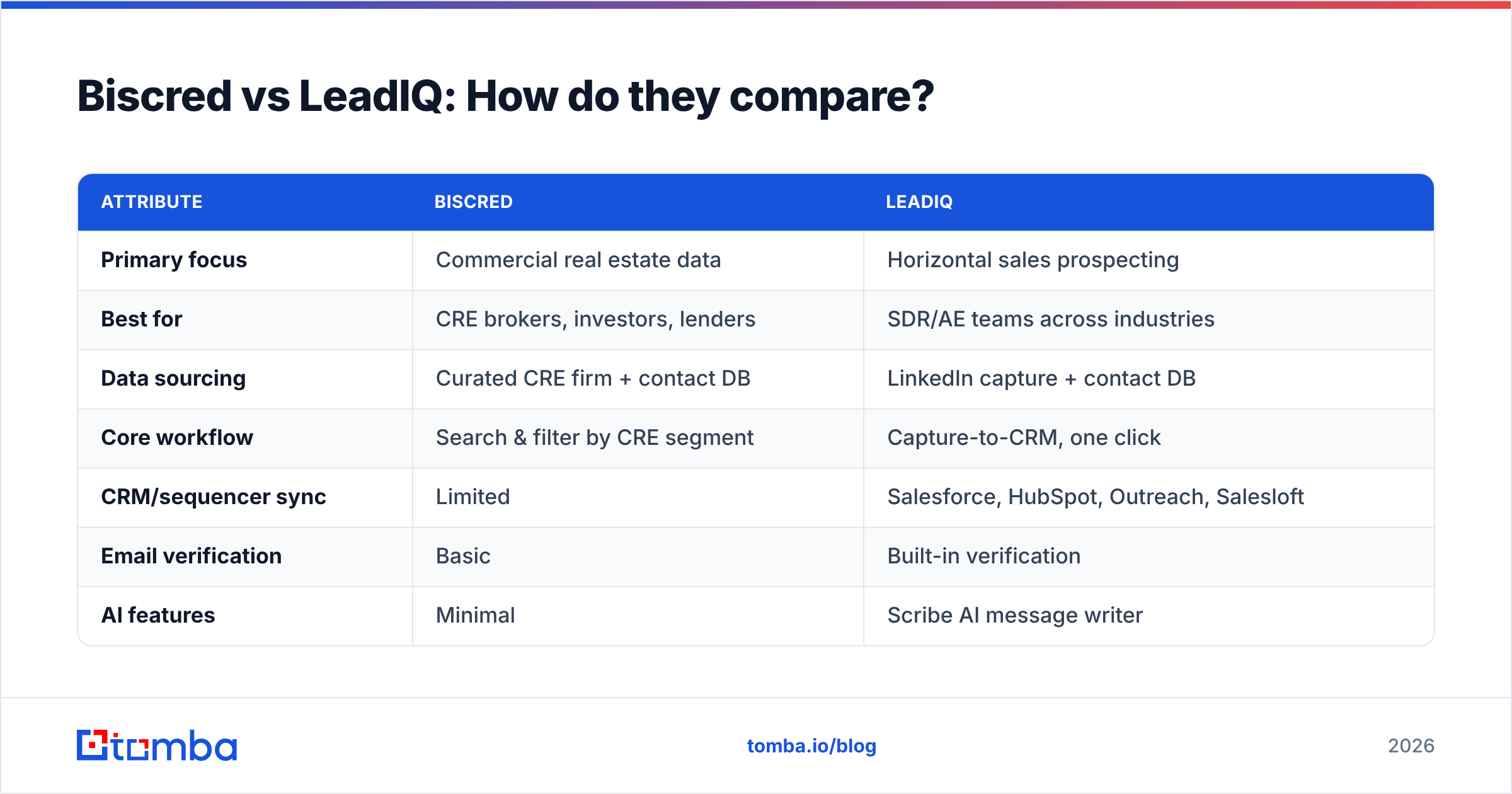
Here's the head-to-head on the attributes that actually drive a buying decision.
| Attribute | Biscred | LeadIQ |
|---|---|---|
| Primary focus | Commercial real estate data | Horizontal sales prospecting |
| Best for | CRE brokers, investors, lenders | SDR/AE teams across industries |
| Data sourcing | Curated CRE firm + contact DB | LinkedIn capture + contact DB |
| Core workflow | Search & filter by CRE segment | Capture-to-CRM, one click |
| CRM/sequencer sync | Limited | Salesforce, HubSpot, Outreach, Salesloft |
| Email verification | Basic | Built-in verification |
| AI features | Minimal | Scribe AI message writer |
| Pricing model | Quote-based | Seat-based tiers + custom |
| Free option | No public free tier | Limited free plan |
| Coverage outside niche | Weak | Broad |
The pattern: Biscred trades breadth for vertical depth; LeadIQ trades vertical depth for breadth and workflow. Neither is "better" in the abstract — they're optimized for different buyers.
Which one fits your use case?#
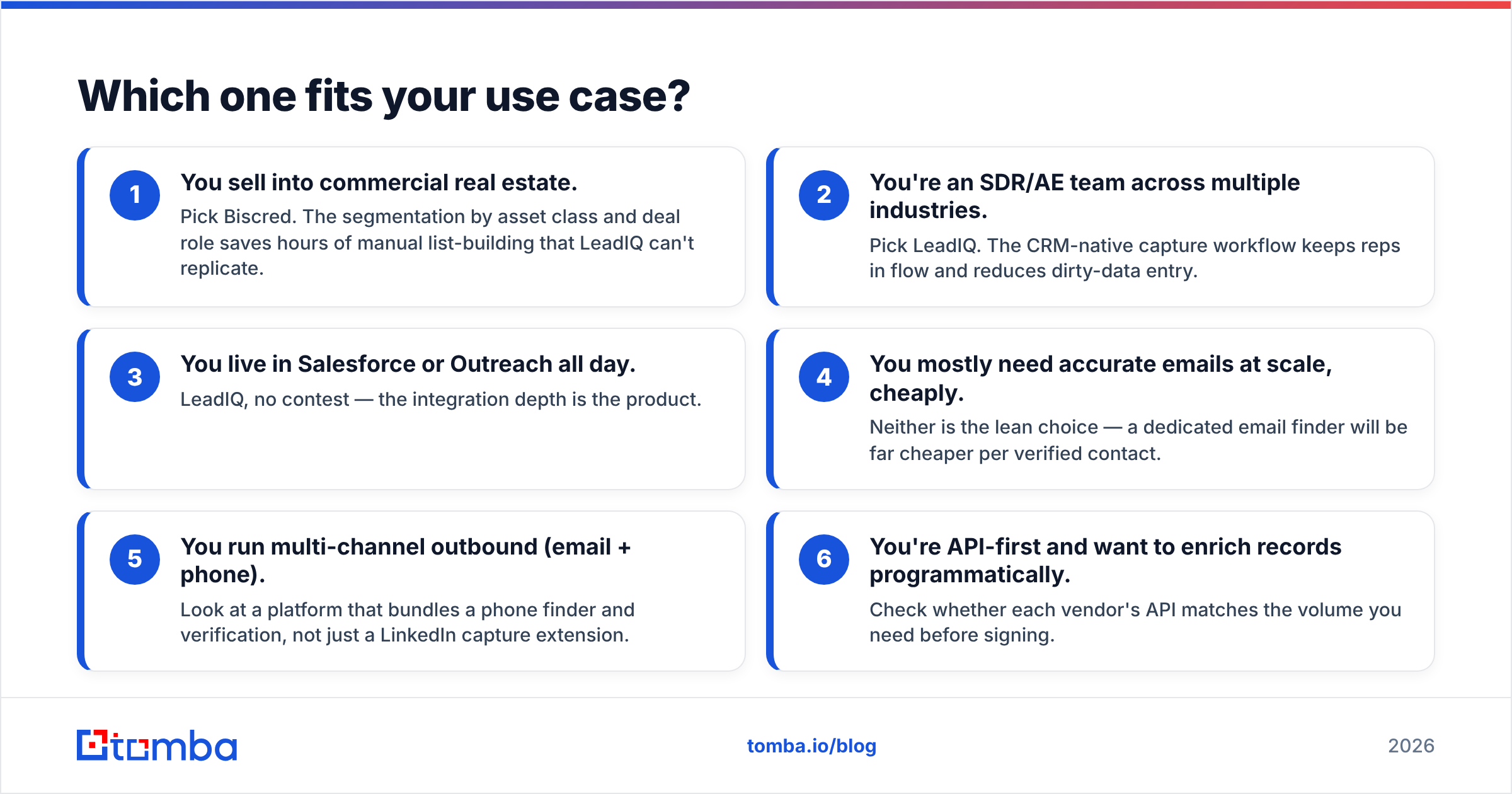
Use this decision shortlist instead of a feature-by-feature crawl:
- You sell into commercial real estate. Pick Biscred. The segmentation by asset class and deal role saves hours of manual list-building that LeadIQ can't replicate.
- You're an SDR/AE team across multiple industries. Pick LeadIQ. The CRM-native capture workflow keeps reps in flow and reduces dirty-data entry.
- You live in Salesforce or Outreach all day. LeadIQ, no contest — the integration depth is the product.
- You mostly need accurate emails at scale, cheaply. Neither is the lean choice — a dedicated email finder will be far cheaper per verified contact.
- You run multi-channel outbound (email + phone). Look at a platform that bundles a phone finder and verification, not just a LinkedIn capture extension.
- You're API-first and want to enrich records programmatically. Check whether each vendor's API matches the volume you need before signing.
Is Biscred or LeadIQ better for data accuracy?#
Accuracy depends on where the data comes from, and the two tools source it differently.
Biscred's accuracy is strongest inside CRE because its records are curated for that vertical — firm relationships, roles, and ownership structures are maintained with that audience in mind. Ask it for a contact outside real estate and the confidence drops.
LeadIQ leans on LinkedIn-driven capture plus its own database, with built-in verification to catch dead addresses before they hit your sequence. That's good for general B2B, but LinkedIn-sourced data inherits LinkedIn's gaps — stale titles, missing direct dials, and the occasional personal-vs-work email mismatch.
Whichever you choose, run captured contacts through an independent email verifier before launching a campaign. No single source is clean enough to skip verification — bounce rates above 3% start hurting your sender reputation, and that damage compounds.

How much do Biscred and LeadIQ cost?#
Both vendors lean toward premium pricing, and both make you talk to sales for the real number.
- Biscred uses quote-based pricing — there's no public self-serve tier. Expect annual contracts sized to your seat count and data needs. That's normal for vertical databases, but it means you can't dip a toe in cheaply.
- LeadIQ publishes seat-based tiers (a limited free plan, then paid tiers that scale with credits and features), with custom enterprise pricing on top. Per-seat costs add up quickly for larger teams, and credit caps can throttle a busy SDR mid-month.
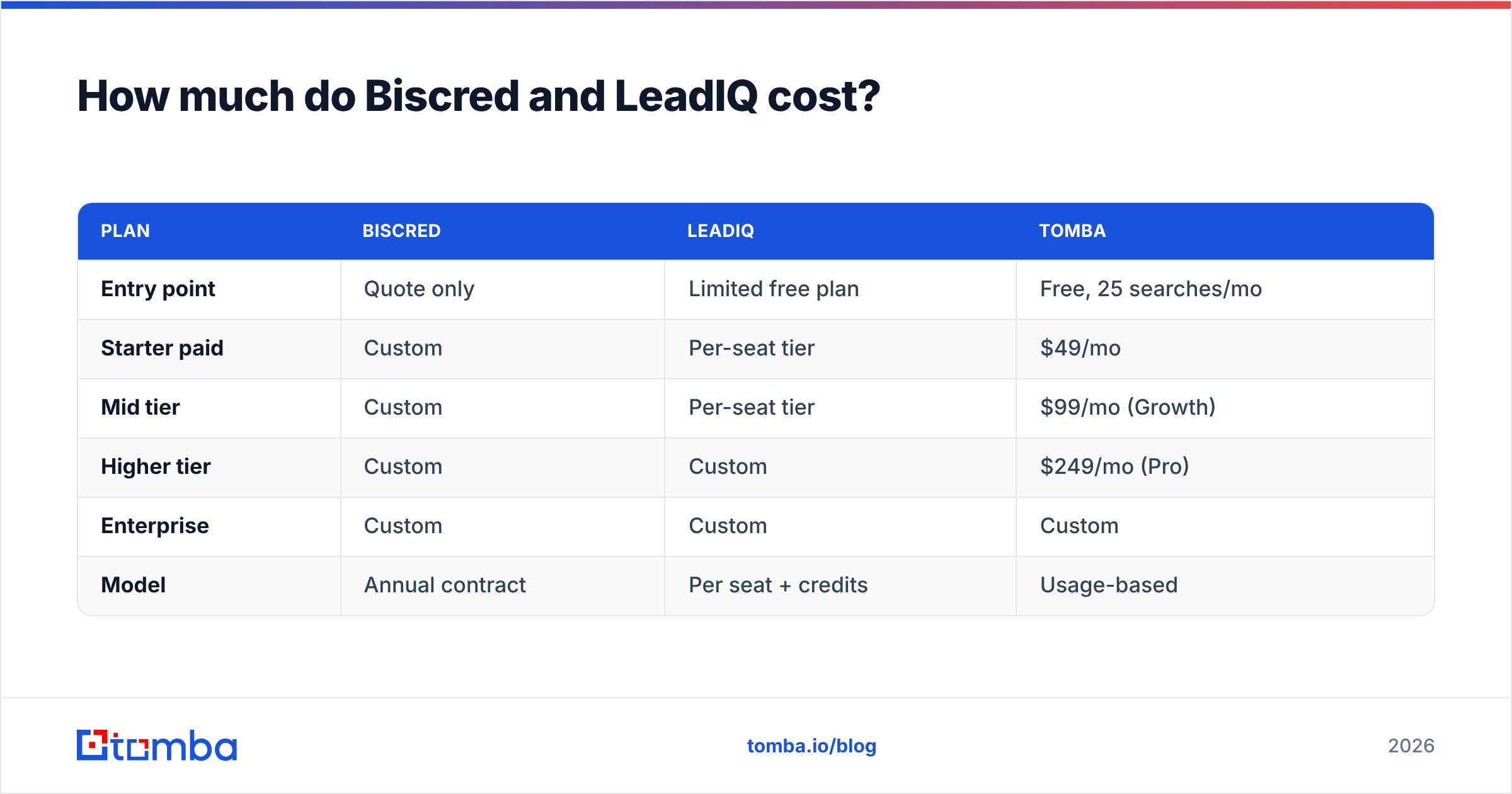
Compare that to a usage-based finder. Here's how the cost shape differs:
| Plan | Biscred | LeadIQ | Tomba |
|---|---|---|---|
| Entry point | Quote only | Limited free plan | Free, 25 searches/mo |
| Starter paid | Custom | Per-seat tier | $49/mo |
| Mid tier | Custom | Per-seat tier | $99/mo (Growth) |
| Higher tier | Custom | Custom | $249/mo (Pro) |
| Enterprise | Custom | Custom | Custom |
| Model | Annual contract | Per seat + credits | Usage-based |
If predictable, usage-based spend matters to you, review the full Tomba pricing before locking into an annual seat commitment elsewhere. For teams that just need to find email addresses and verify them, paying per seat for a CRE database or a capture extension is often overkill.
What are the pros and cons?#
Biscred
- Pros: Unmatched CRE depth, segment-specific filters, purpose-built for property professionals.
- Cons: Useless outside real estate, opaque quote-based pricing, no free trial path, limited workflow integrations.
LeadIQ
- Pros: Fast capture-to-CRM workflow, strong Salesforce/Outreach integration, built-in verification, AI message writing.
- Cons: Per-seat costs escalate, LinkedIn-dependent data has gaps, credit limits can throttle heavy users, not a fit for niche verticals.
The gap both leave open: neither is the cheapest, simplest way to get a large volume of verified work emails when you already know the companies you want to reach. That's a different job — and it's where a focused finder earns its place in the stack.
Is there a better-value alternative to Biscred and LeadIQ?#
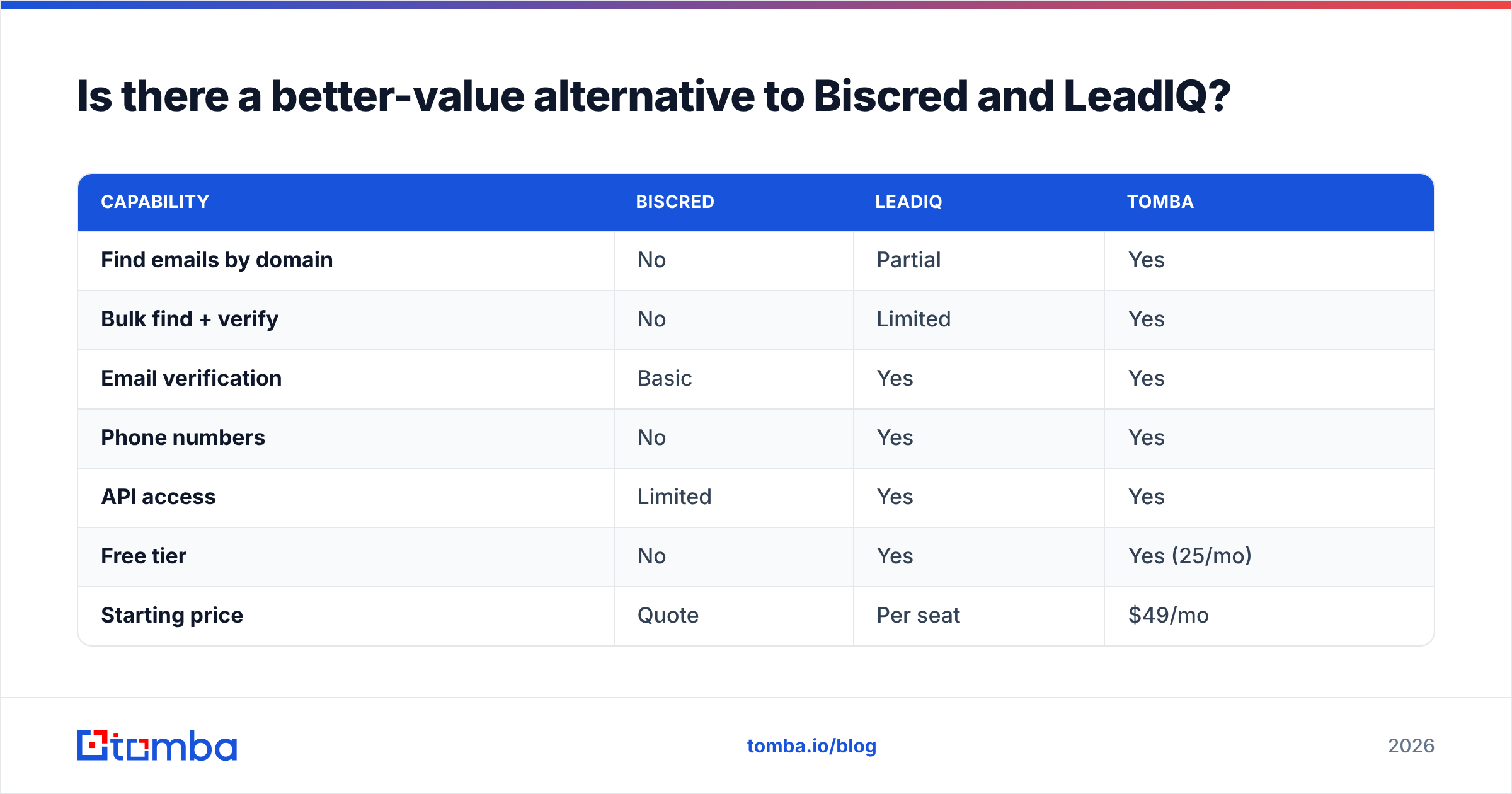
Yes — if your real goal is "get accurate, verified contact details without an enterprise contract," a dedicated email-finding platform covers most of what teams actually buy these tools for.
Tomba approaches the problem from the data layer up: a domain search to map every contact at a target company, an email finder for individual prospects, a verifier to clean the list, and a bulk email finder for whole campaigns. It's transparent, usage-based, and starts free.
| Capability | Biscred | LeadIQ | Tomba |
|---|---|---|---|
| Find emails by domain | No | Partial | Yes |
| Bulk find + verify | No | Limited | Yes |
| Email verification | Basic | Yes | Yes |
| Phone numbers | No | Yes | Yes |
| API access | Limited | Yes | Yes |
| Free tier | No | Yes | Yes (25/mo) |
| Starting price | Quote | Per seat | $49/mo |
This isn't a knock on either incumbent. If you genuinely need CRE segmentation, Biscred is built for you. If your reps live in Salesforce and you value capture speed above all, LeadIQ delivers. Browse more head-to-heads on the Tomba blog and check independent reviews on G2 before deciding. But if you've been reaching for a heavyweight platform to do a finder's job, you're overpaying.
For teams that want to enrich records continuously, Tomba's data enrichment and LeadIQ alternative pages lay out the migration path in detail.
The bottom line#
Match the tool to your motion. Biscred for CRE depth. LeadIQ for CRM-native prospecting across industries. And if what you actually need is verified emails at a fair, predictable price, start with the Tomba Email Finder — find and verify your first contacts free, then scale on a usage-based plan from $49/mo instead of a per-seat contract. Spin up a free account, run a domain search on your top ten target accounts, and see how far 25 free searches get you before you commit a dollar.
// get started
Find, verify and enrich your first contacts today
Start on the free plan with 25 searches a month, then scale when your team is ready.
Free plan · No credit card required · GDPR & CCPA
// about the author