Biscred vs Leadmine (2026): B2B Data & Email Tools Compared
Biscred targets commercial real estate; Leadmine chases general B2B emails. Here's how the two stack up on accuracy, pricing, and coverage in 2026 — plus where a broader alternative beats both.
TL;DR
- Biscred is a niche B2B data platform built for commercial real estate (CRE) — owners, brokers, lenders, and property firms. If you sell outside CRE, most of its value evaporates.
- Leadmine is a general-purpose email finder and lead database with a Chrome extension and bulk search, aimed at broad B2B prospecting.
- They are not really the same product: one is a vertical database, the other a horizontal finder. Picking between them is mostly a question of who you sell to.
- On price, Leadmine is the cheaper entry point; Biscred is enterprise-priced and quote-driven. Neither publishes the kind of transparent self-serve tiers most small teams want.
- If you need broad coverage, verified emails, and predictable pricing without a sales call, a general finder like Tomba Email Finder usually beats both for cross-industry outbound.
What are Biscred and Leadmine?#
Short answer: Biscred is a commercial-real-estate contact database; Leadmine is a general B2B email finder. They get lumped together because both promise "find decision-makers and their contact info," but the overlap stops there.
Biscred indexes companies and people in the commercial real estate ecosystem — investment firms, brokerages, property managers, lenders, developers — and lets you filter by CRE-specific attributes (asset class, deal role, firm type). If you're selling proptech, construction services, or CRE software, that vertical depth is the whole point.
Leadmine is closer to a classic email-finder workflow: search for a person or company, get a professional email, verify it, and export. It ships a browser extension and a bulk API, so it slots into general outbound for SaaS, agencies, recruiting, and most other B2B motions.
So the real question behind "biscred vs leadmine" isn't "which tool is better" in the abstract — it's "is my market narrow enough that a vertical database pays off, or do I need horizontal reach?"

How do Biscred and Leadmine compare at a glance?#
Here's the core comparison. Treat the pricing rows as directional — Biscred is quote-based and Leadmine adjusts plans over time — but the shape of each tool is stable.
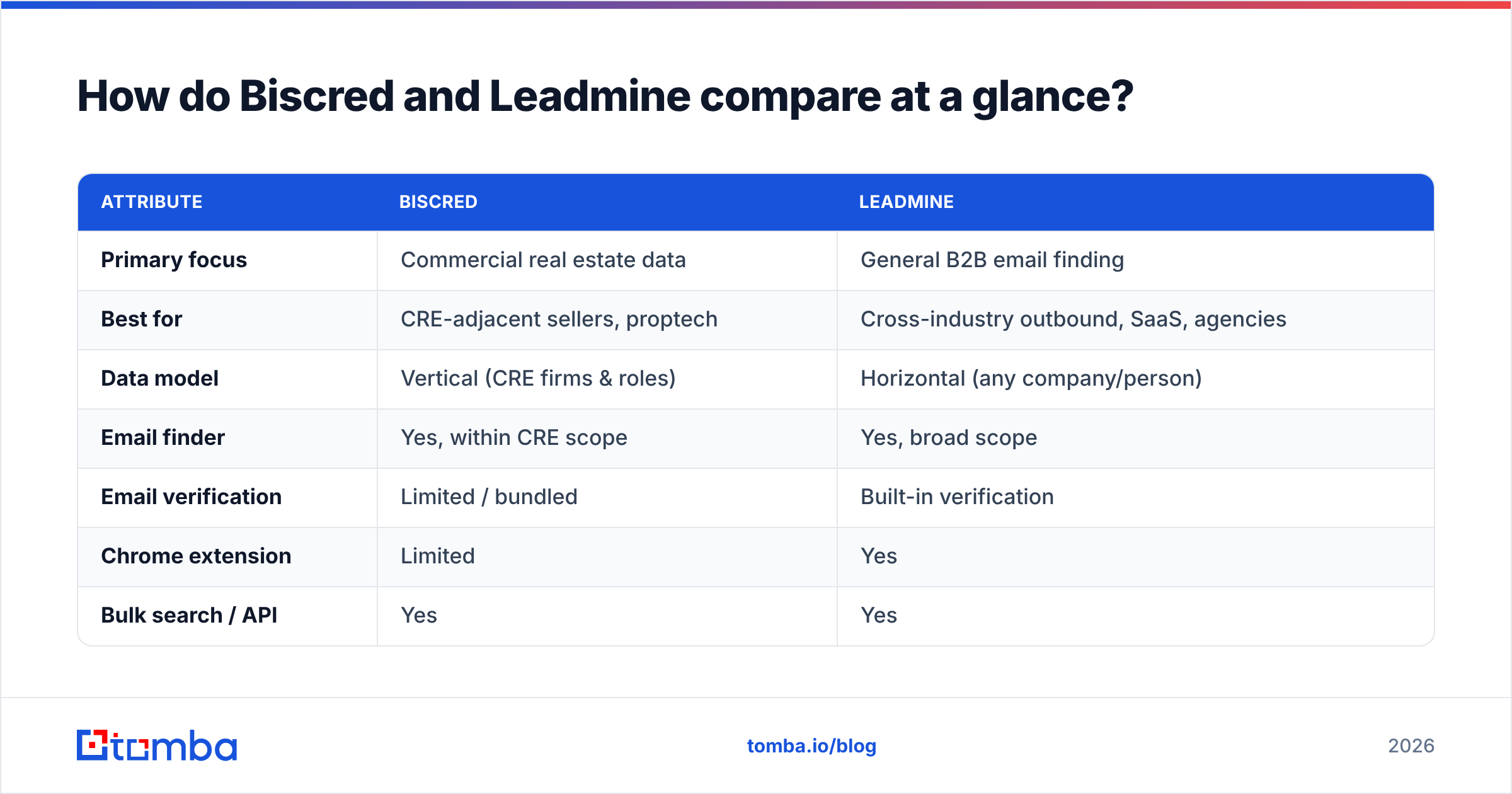
| Attribute | Biscred | Leadmine |
|---|---|---|
| Primary focus | Commercial real estate data | General B2B email finding |
| Best for | CRE-adjacent sellers, proptech | Cross-industry outbound, SaaS, agencies |
| Data model | Vertical (CRE firms & roles) | Horizontal (any company/person) |
| Email finder | Yes, within CRE scope | Yes, broad scope |
| Email verification | Limited / bundled | Built-in verification |
| Chrome extension | Limited | Yes |
| Bulk search / API | Yes | Yes |
| Pricing transparency | Quote-based, enterprise | Published, lower entry point |
| Free option | No public free tier | Limited free credits |
| Ideal team size | Mid-market to enterprise CRE | SMB to mid-market |
The pattern: Biscred trades breadth for depth, Leadmine trades depth for breadth. If you only ever prospect CRE owners and brokers, Biscred's filters save you hours. If you prospect across industries, that same specialization becomes a cage.
Is Biscred better than Leadmine for data accuracy?#
It depends on your target list, and that's the honest answer most comparison posts skip.
Inside commercial real estate, Biscred's accuracy is strong because the database is curated for that vertical — firm hierarchies, role mapping, and deal context are maintained deliberately. For a CRE-only campaign, you'll likely find cleaner matches than a generalist tool that treats a regional brokerage like any other company.
Outside CRE, Biscred has little to offer, so "accuracy" isn't even the right metric — coverage is near zero.
Leadmine's accuracy is the typical generalist story: good on well-indexed companies with public web footprints, weaker on small firms, catch-all domains, and roles that don't appear online. This is exactly where verification matters, and why you should never trust a raw finder result without running it through an email verifier before you send.

A few accuracy realities that apply to both tools:
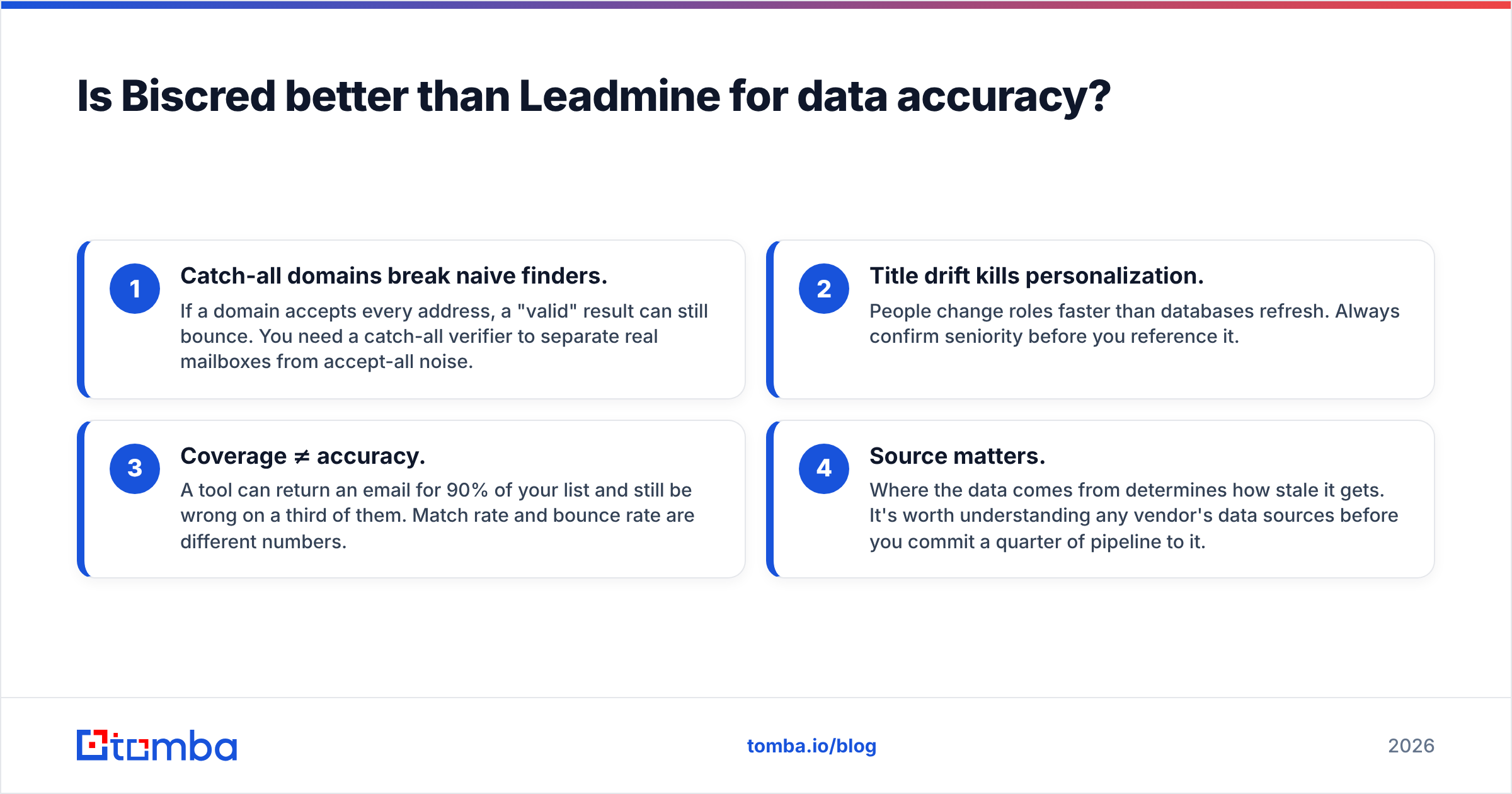
- Catch-all domains break naive finders. If a domain accepts every address, a "valid" result can still bounce. You need a catch-all verifier to separate real mailboxes from accept-all noise.
- Title drift kills personalization. People change roles faster than databases refresh. Always confirm seniority before you reference it.
- Coverage ≠ accuracy. A tool can return an email for 90% of your list and still be wrong on a third of them. Match rate and bounce rate are different numbers.
- Source matters. Where the data comes from determines how stale it gets. It's worth understanding any vendor's data sources before you commit a quarter of pipeline to it.
How much do Biscred and Leadmine cost in 2026?#
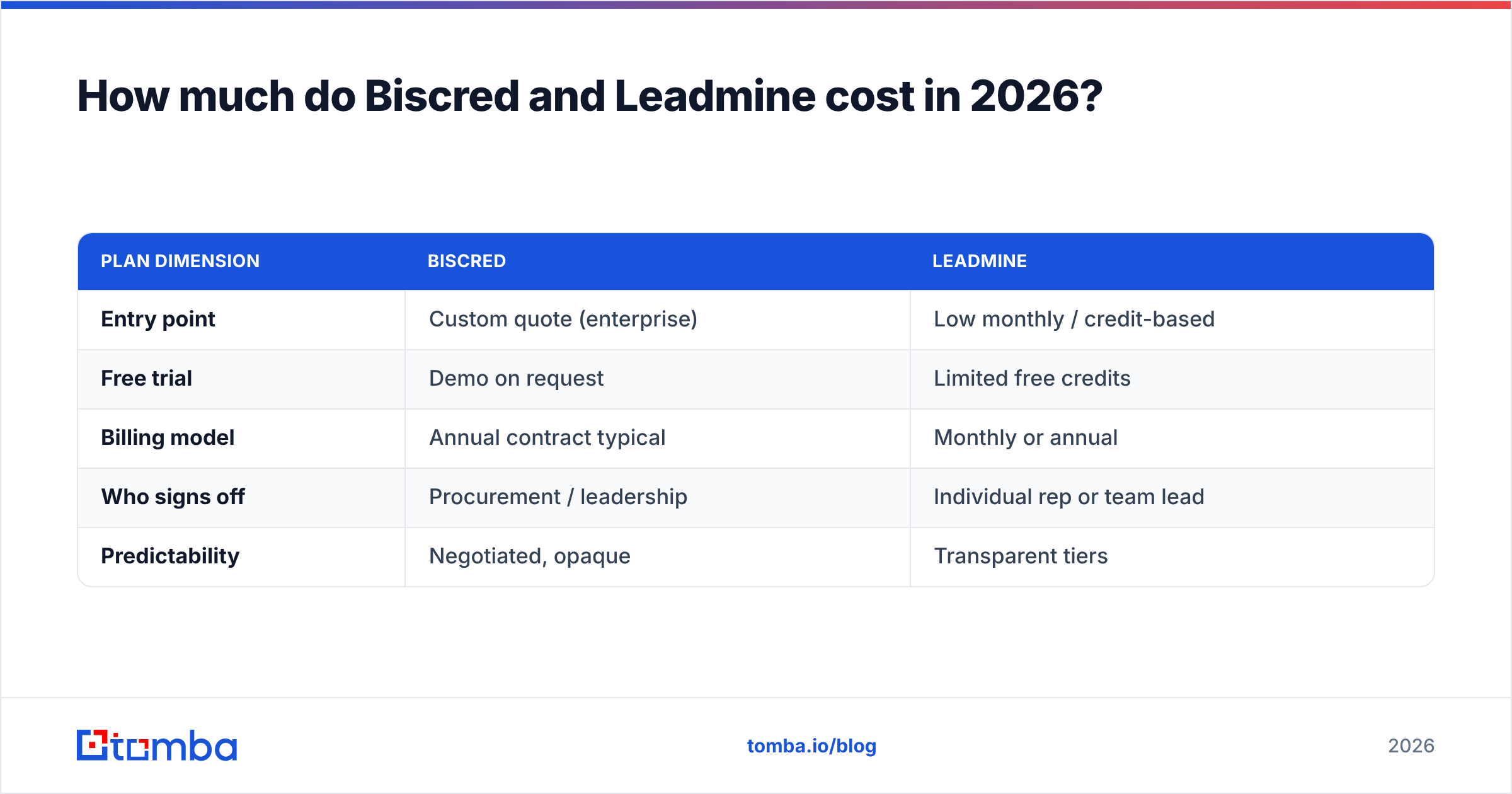
Leadmine is the cheaper, self-serve option; Biscred is enterprise and quote-driven. That difference is structural, not a coincidence — vertical CRE data is expensive to maintain and sold to fewer, higher-value buyers.
| Plan dimension | Biscred | Leadmine |
|---|---|---|
| Entry point | Custom quote (enterprise) | Low monthly / credit-based |
| Free trial | Demo on request | Limited free credits |
| Billing model | Annual contract typical | Monthly or annual |
| Who signs off | Procurement / leadership | Individual rep or team lead |
| Predictability | Negotiated, opaque | Transparent tiers |
If you're a two-person agency, Biscred's model alone probably rules it out — you don't want a procurement cycle to start cold outreach. If you're an enterprise CRE team with a real budget and a narrow ICP, the quote may be justified.
For teams that just want to know what they'll pay before a sales call, neither is ideal. That's where transparent, published Tomba pricing — Free at 25 searches/mo, Starter at $49/mo, Growth at $99/mo, and Pro at $249/mo — removes the guesswork. You scale credits without renegotiating a contract.
Which one fits your use case?#
Map the tool to the motion, not the marketing. Here's the decision in plain terms.
Choose Biscred if:
- Your entire ICP lives in commercial real estate.
- You need CRE-specific filters (asset class, deal role, firm type).
- You have budget and procurement patience for an enterprise contract.
Choose Leadmine if:
- You prospect across multiple industries.
- You want a Chrome extension and bulk search without a big commitment.
- You need a lower, predictable entry price.
Choose a broader alternative if:
- You want verified emails and phone numbers in one workflow.
- You need an API, Sheets/Excel add-ons, and CRM integrations out of the box.
- You want to avoid both a vertical lock-in and a thin generalist database.
This is where Tomba fits between the two extremes. It's horizontal like Leadmine — you can prospect any industry — but it pairs the finder with verification, domain search for mapping every contact at a company, a B2B database, and a documented Tomba API for teams that automate. You get Leadmine's breadth without giving up data hygiene, and you skip Biscred's enterprise gating unless you genuinely need a CRE-only dataset.
What about workflow and integrations?#
The tool you'll actually keep is the one that fits where you already work. A great database that doesn't reach your CRM becomes a copy-paste tax.
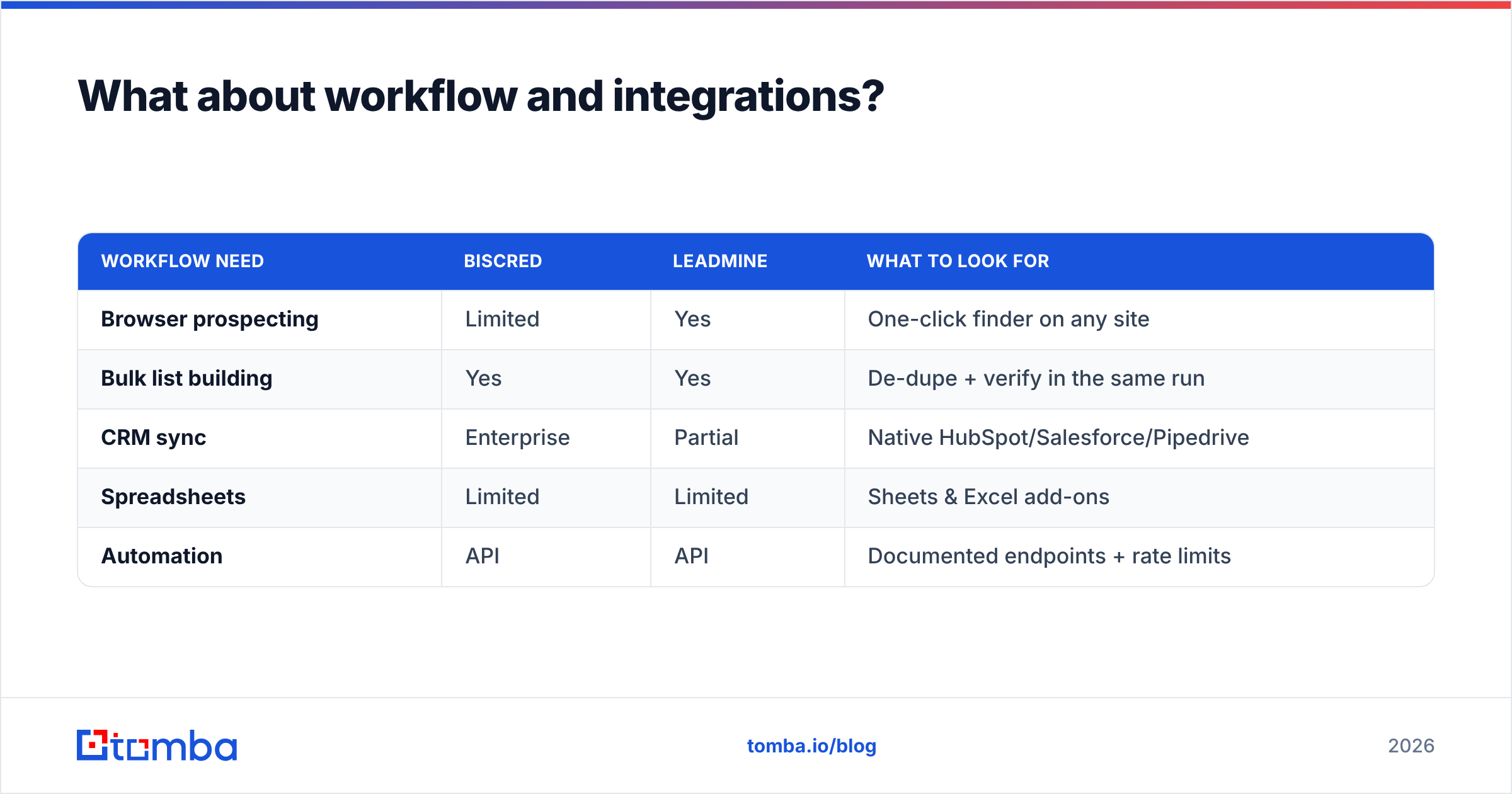
Leadmine covers the basics: extension, bulk export, API. Biscred is built for analysts and CRE teams who live inside its platform, so its strength is in-app research rather than light-weight, everywhere prospecting.
Compare that against what cross-industry teams usually need:
| Workflow need | Biscred | Leadmine | What to look for |
|---|---|---|---|
| Browser prospecting | Limited | Yes | One-click finder on any site |
| Bulk list building | Yes | Yes | De-dupe + verify in the same run |
| CRM sync | Enterprise | Partial | Native HubSpot/Salesforce/Pipedrive |
| Spreadsheets | Limited | Limited | Sheets & Excel add-ons |
| Automation | API | API | Documented endpoints + rate limits |
If spreadsheets are your operating system, an Excel email finder or Google Sheets add-on matters more than any database feature, because that's where your reps actually build lists. And if you route everything through a CRM, native sync beats a clunky export every time.
What are the pros and cons of each?#
Biscred — pros: deep CRE coverage, vertical-specific filters, strong for proptech and CRE services, curated firm/role data. Biscred — cons: useless outside CRE, opaque enterprise pricing, no public free tier, heavier sales cycle.
Leadmine — pros: broad coverage, lower entry price, Chrome extension, simple finder-and-verify flow. Leadmine — cons: generalist accuracy gaps, lighter enterprise features, verification depth varies, less robust on catch-all domains.
Neither is "bad." They solve different problems. The mistake is buying a vertical CRE tool for general outreach, or expecting a lightweight generalist to replace a curated industry database. Match the tool to the territory you actually sell into. For a deeper read on how these tools rank against each other on accuracy and coverage, independent review sites like G2 and Capterra are worth scanning before you buy.

So which should you pick — Biscred or Leadmine?#
If commercial real estate is your whole world, Biscred. If you sell across industries on a budget, Leadmine. If you want breadth without sacrificing data quality, look past both.
The framing "biscred vs leadmine" assumes you must choose one of two narrow answers — a vertical database or a thin generalist finder. Most B2B teams don't fit cleanly into either. You want wide coverage and verified, send-safe data and pricing you can see before a sales call. That combination is exactly what generalist-plus-verification tools are built for.
A practical test: pull 100 of your real target accounts, run them through each tool's free or trial path, and measure match rate and bounce rate, not just one. The tool that returns usable, verified contacts for the most of your list wins — regardless of which one markets harder.
Try a broader alternative before you commit#
Before you sign a CRE enterprise contract or settle for a lightweight finder, test what a transparent, cross-industry tool returns on your own list. Tomba Email Finder lets you find professional emails by name, domain, or company, verify them in the same workflow, and scale from a free tier up to higher volume without a procurement call. Start with the free 25 searches, compare match and bounce rates against Biscred and Leadmine on accounts you actually sell to, and let the numbers — not the category labels — make the decision.
// get started
Find, verify and enrich your first contacts today
Start on the free plan with 25 searches a month, then scale when your team is ready.
Free plan · No credit card required · GDPR & CCPA
// about the author