Biscred vs LeadRocks 2026: Which B2B Data Tool Wins?
Biscred vs LeadRocks compared on data coverage, accuracy, pricing, and use cases for 2026 — plus where a general-purpose email finder beats both niche tools.
Choosing between Biscred and LeadRocks comes down to one question most comparison posts dodge: are you buying a niche dataset or a prospecting workflow? They are not the same purchase, and picking the wrong one wastes budget fast.
TL;DR — Biscred vs LeadRocks in 30 seconds#
- Biscred is a vertical data platform built for commercial real estate (CRE). If your buyers are brokers, owners, investors, and property managers, its tagging and firmographics are purpose-built for you.
- LeadRocks is a horizontal B2B contact database with emails, phone numbers, and LinkedIn data, sold heavily through lifetime deals to small teams and agencies.
- Accuracy and freshness matter more than raw record counts. Both tools quote large databases, but verified, deliverable contacts are what actually move your pipeline.
- Neither is a true email-finder API. If you need to find and verify emails across any industry on demand, a general platform like Tomba Email Finder covers more ground than either niche tool.
- Quick verdict: Biscred for CRE-only teams, LeadRocks for cheap broad lists, and a dedicated email finder when accuracy and coverage decide your deals.
What is Biscred?#
Biscred is a B2B data provider focused almost entirely on commercial real estate. Instead of trying to cover every industry, it goes deep on one: office, retail, industrial, multifamily, brokerage, lending, and the people who work in those segments.
The pitch is precision. A generic database might tag a contact as "Real Estate — Manager." Biscred aims to tell you whether that person is an acquisitions associate, a leasing broker, or an asset manager, and which property types and deal sizes they touch. For CRE sales teams, that specificity removes hours of manual qualification.
The trade-off is obvious: outside CRE, Biscred has little to offer. If you sell SaaS to fintech CFOs or staffing services to manufacturers, a CRE-tuned database is the wrong tool no matter how clean it is.
What is LeadRocks?#
LeadRocks is a horizontal B2B contact database. It markets a large pool of contacts with business emails, direct phone numbers, and LinkedIn profile data, and it pairs that with a Chrome extension and basic list-building features.
Its distribution strategy is the thing most people actually remember: LeadRocks frequently appears on lifetime-deal marketplaces, which is why it's popular with solo founders, agencies, and lean sales teams who want a cheap, one-time data purchase rather than a recurring enterprise contract.
That model has a flip side. Lifetime-deal databases are only as good as their last refresh, and B2B data decays fast — people change jobs, companies rebrand, domains migrate. A static or slowly-updated pool ages badly, which is why verification at the point of use matters more than the headline record count.

Biscred vs LeadRocks: side-by-side comparison#
Here is the honest head-to-head. Treat any vendor's "millions of contacts" claim as a starting point, not a guarantee of deliverability.
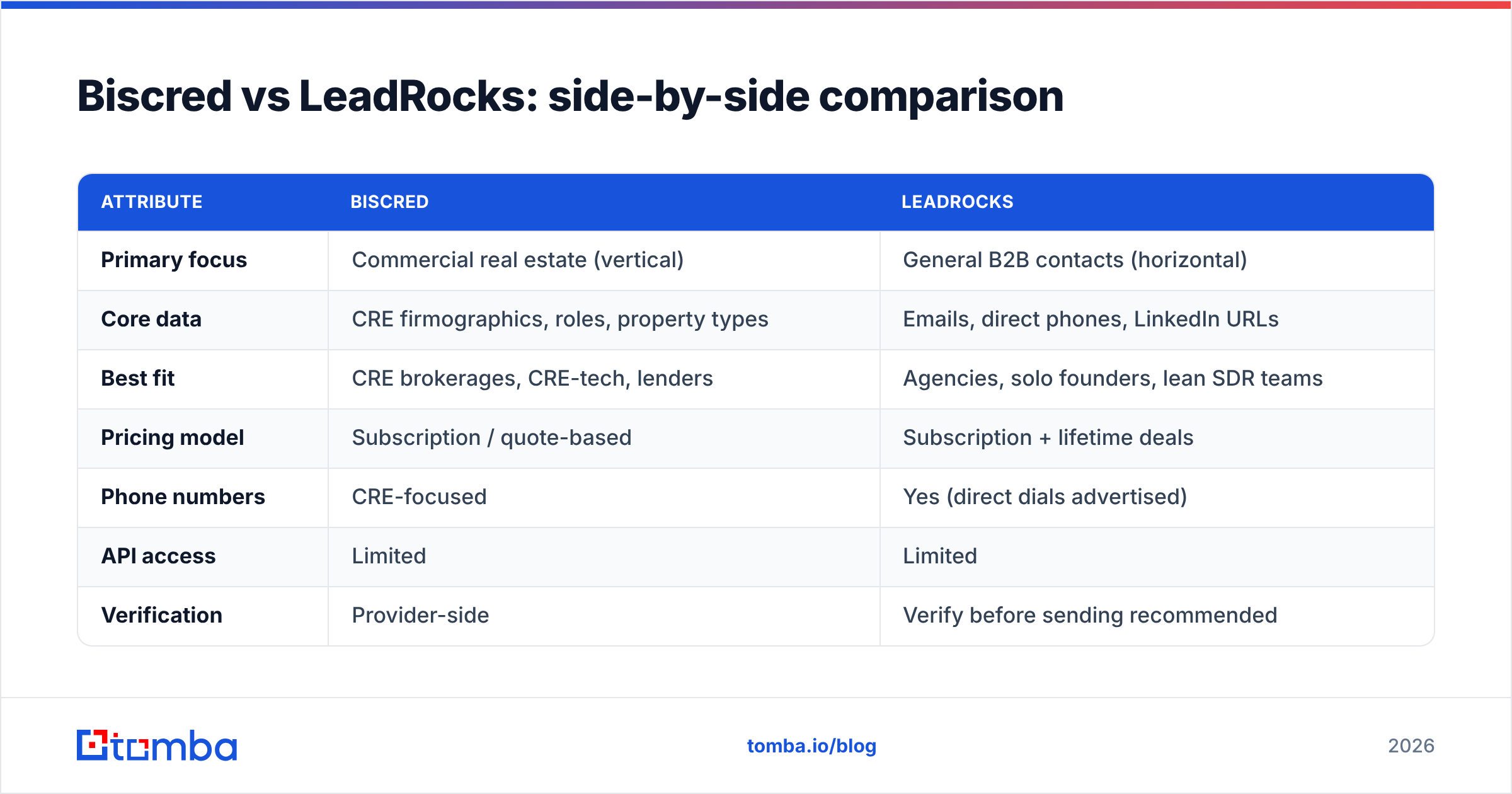
| Attribute | Biscred | LeadRocks |
|---|---|---|
| Primary focus | Commercial real estate (vertical) | General B2B contacts (horizontal) |
| Core data | CRE firmographics, roles, property types | Emails, direct phones, LinkedIn URLs |
| Best fit | CRE brokerages, CRE-tech, lenders | Agencies, solo founders, lean SDR teams |
| Pricing model | Subscription / quote-based | Subscription + lifetime deals |
| Phone numbers | CRE-focused | Yes (direct dials advertised) |
| API access | Limited | Limited |
| Verification | Provider-side | Verify before sending recommended |
| Weakness | Useless outside CRE | Freshness varies by segment |
The pattern: Biscred trades breadth for depth, LeadRocks trades depth for price. Neither is engineered to be your everywhere-accuracy layer, which is the gap a dedicated finder fills.
Which one is more accurate?#
Accuracy is decided at send time, not at purchase time. A record that was correct six months ago can bounce today, and bounces above roughly 2–3% start dragging your sender reputation down with the mailbox providers.
Three factors drive real-world accuracy for either tool:
- Refresh cadence. How often is the underlying data re-checked? Vertical providers often re-verify the segment they specialize in more aggressively than broad databases re-verify everything.
- Catch-all handling. Many B2B domains are catch-all, meaning the server accepts mail to any address. Without a catch-all verifier, "valid" can be a false positive.
- Verification at point of use. The only number that matters is whether this email is deliverable now. That's an email verification step, regardless of which database the contact came from.
The practical workflow that protects deliverability: pull from your database (Biscred or LeadRocks), then run every contact through verification before it enters a sequence. Skipping that step is the most common reason "good" lists underperform.
How does pricing compare?#
Biscred is generally quote-based, positioned as a premium vertical dataset, so pricing scales with seats and data scope. LeadRocks leans on transparent, low entry points and recurring lifetime-deal promotions, which is exactly why budget-conscious teams gravitate to it.
But price-per-record is a trap if half the records bounce. The metric that matters is price per usable, deliverable contact — and that depends on verification, not the sticker.
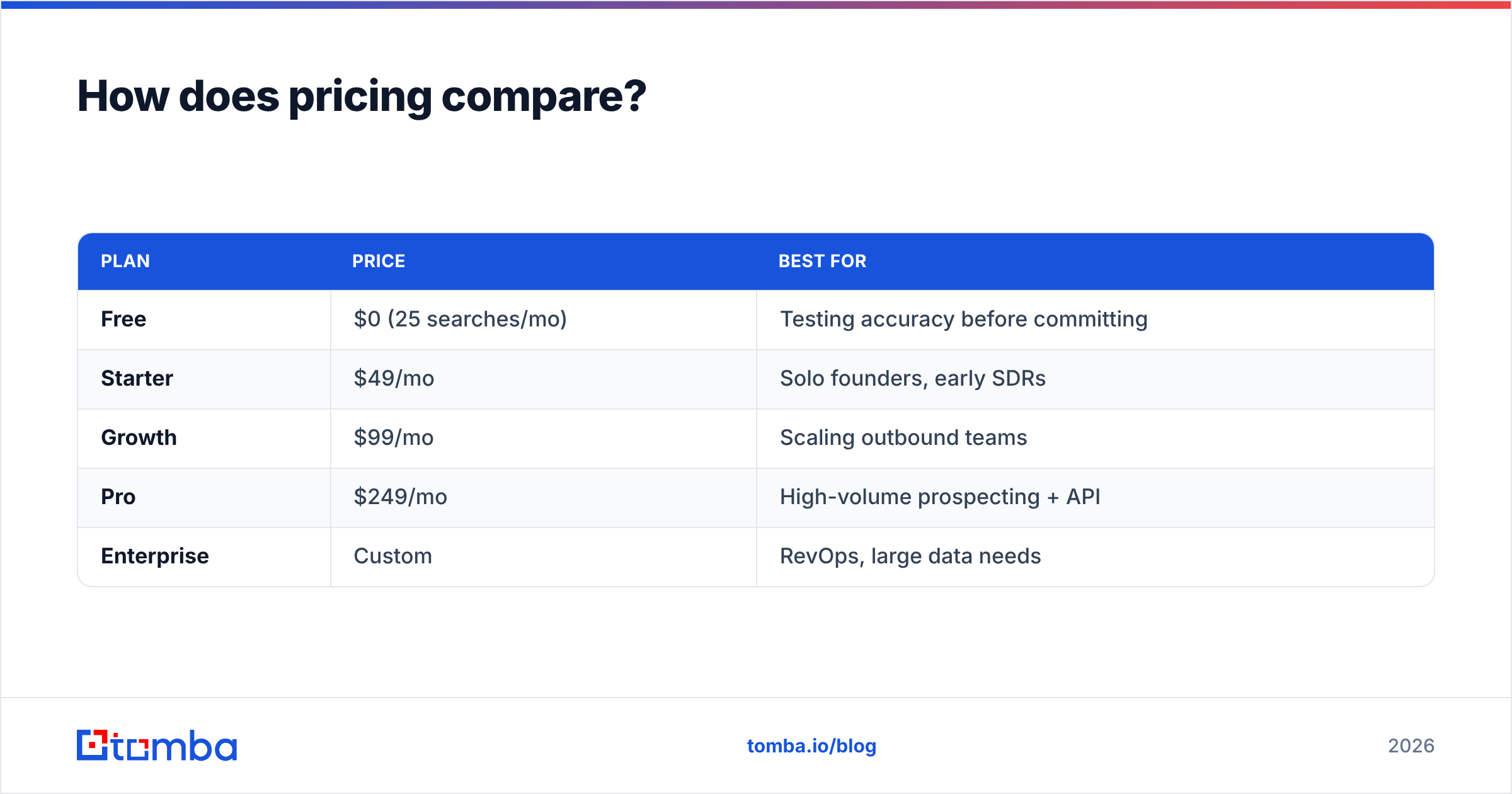
For comparison, here's where a general-purpose finder-plus-verifier sits, using transparent published Tomba pricing:
| Plan | Price | Best for |
|---|---|---|
| Free | $0 (25 searches/mo) | Testing accuracy before committing |
| Starter | $49/mo | Solo founders, early SDRs |
| Growth | $99/mo | Scaling outbound teams |
| Pro | $249/mo | High-volume prospecting + API |
| Enterprise | Custom | RevOps, large data needs |
The point isn't that one is cheapest. It's that a tool combining find + verify + data enrichment in one workflow often beats a cheap-but-stale list once you price in wasted sends and damaged domains.
When should you pick Biscred?#
Pick Biscred when commercial real estate is your entire market, not a side segment. The signals:
- Your ICP is brokers, owners, investors, lenders, or property managers.
- You need to filter by property type, deal role, or CRE-specific firmographics.
- Generic databases keep mislabeling CRE roles, costing your reps qualification time.
In that scenario, Biscred's depth is genuinely hard to replicate with a horizontal tool. You're paying for a curated vertical, and that's a defensible reason to buy.
When should you pick LeadRocks?#
Pick LeadRocks when you want broad, cheap coverage and you're willing to verify aggressively yourself. The signals:
- You're an agency or solo founder running multi-industry outbound.
- A lifetime deal fits your budget better than a recurring contract.
- You already have a verification step, so freshness gaps don't reach the inbox.
LeadRocks is a reasonable starter database for lean teams. Just don't treat its record count as a deliverability promise — build verification into the workflow from day one. You can sanity-check any single address with a free email checker before trusting a batch.

Is there a better option than either?#
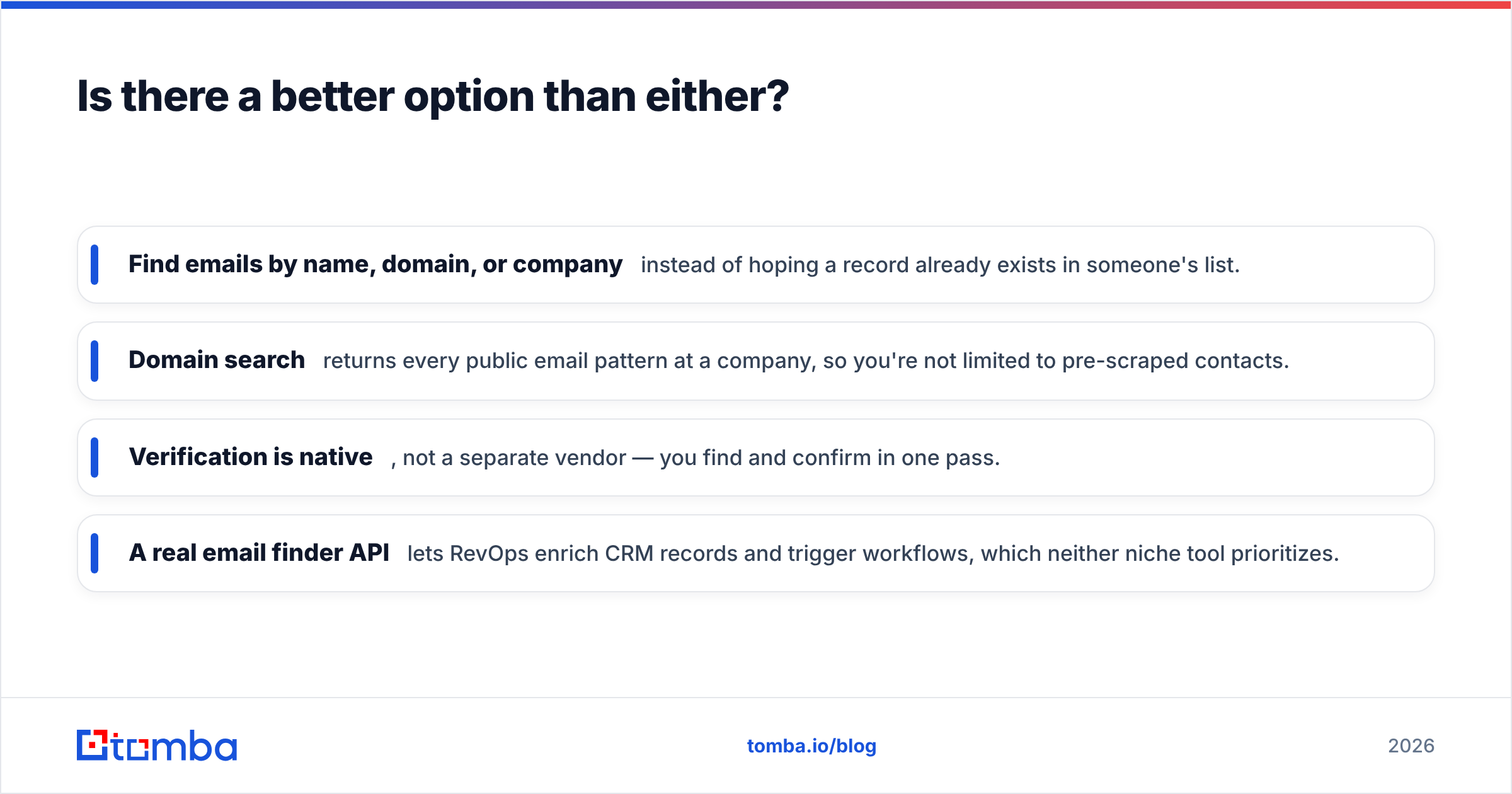
For most teams that aren't 100% CRE, the better option is a general-purpose email finder with built-in verification — because it solves the problem both niche tools leave open: finding accurate, deliverable contacts across any industry, on demand.
Where a platform like Tomba differs from a static database:
- Find emails by name, domain, or company instead of hoping a record already exists in someone's list.
- Domain search returns every public email pattern at a company, so you're not limited to pre-scraped contacts.
- Verification is native, not a separate vendor — you find and confirm in one pass.
- A real email finder API lets RevOps enrich CRM records and trigger workflows, which neither niche tool prioritizes.
This isn't "Tomba beats Biscred at CRE." It won't out-specialize a vertical dataset inside its niche. The honest framing: if your market is narrow and CRE-shaped, a vertical tool wins; if your market is broad and accuracy decides your deals, a finder-plus-verifier wins.
You can validate any of these claims independently on third-party review sites like G2 and Capterra before committing budget — and check each vendor's own documentation at biscred.com and leadrocks.io for current feature sets.
Biscred vs LeadRocks: the verdict#
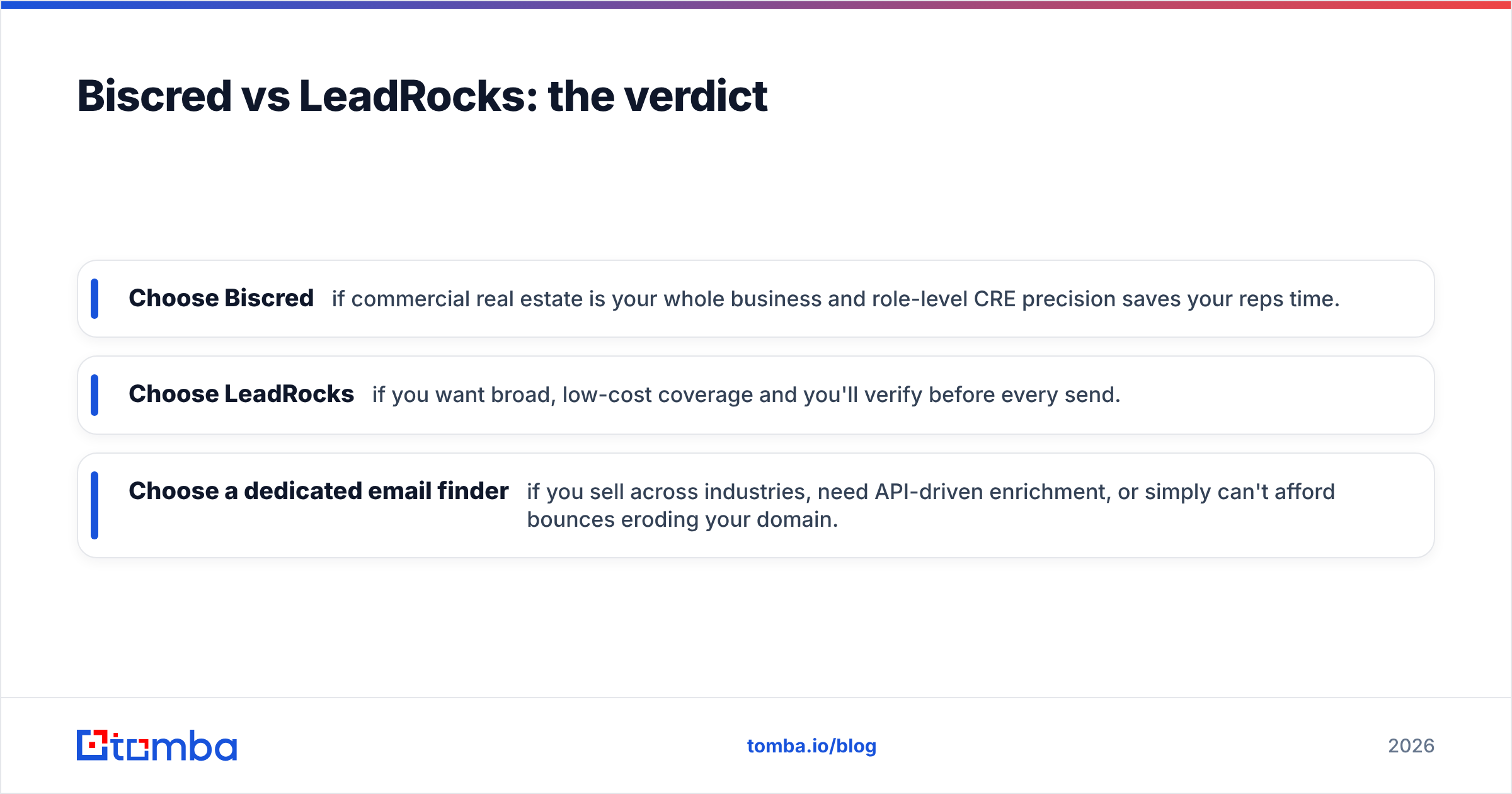
- Choose Biscred if commercial real estate is your whole business and role-level CRE precision saves your reps time.
- Choose LeadRocks if you want broad, low-cost coverage and you'll verify before every send.
- Choose a dedicated email finder if you sell across industries, need API-driven enrichment, or simply can't afford bounces eroding your domain.
The mistake to avoid is buying a database and treating its record count as a deliverability guarantee. Data decays; verification is what keeps your outbound healthy.
If your market is wider than one vertical and accuracy is what closes deals, start with the Tomba Email Finder. Find professional emails by domain, name, or company, verify them in the same workflow, and push clean contacts straight into your CRM — without betting your sender reputation on a list that may be months out of date. Try the free tier first, confirm the accuracy on your own ICP, then scale.
// get started
Find, verify and enrich your first contacts today
Start on the free plan with 25 searches a month, then scale when your team is ready.
Free plan · No credit card required · GDPR & CCPA
// about the author