Biscred vs Leadsforge 2026: Which B2B Data Tool Wins?
Biscred vs Leadsforge: one is built for commercial real estate, the other for AI-generated lead lists. Here's which fits your pipeline in 2026 — and where a verified email layer beats both.
Choosing between Biscred and Leadsforge usually means you've already realized that "more contacts" isn't your problem — the right contacts, with deliverable emails is. These two tools solve that from opposite ends. Biscred is a vertical database built for commercial real estate. Leadsforge is a horizontal, AI-driven list builder that generates prospects from a plain-English prompt. Picking wrong wastes a quarter of pipeline.
This breakdown compares both on coverage, accuracy, pricing, and workflow fit for 2026 — and shows where you'll still need a dedicated verification layer no matter which one you buy.
TL;DR: Biscred vs Leadsforge at a glance#
- Biscred is the better choice if you sell into or around commercial real estate (brokers, owners, lenders, property managers). Its depth in that niche beats any generalist.
- Leadsforge wins if you want fast, AI-generated lead lists across any industry from a conversational prompt, with built-in outreach hooks.
- Neither is a verification tool. Both hand you emails; only one of them is built to keep your bounce rate under 3%. Plan to verify before you send.
- Pricing models differ sharply: Biscred is a seat-based annual contract; Leadsforge sells credit/usage tiers. Your volume decides which is cheaper.
- Best combo for most teams: use the niche or AI tool to source, then layer a dedicated email verifier and enrichment step before outreach.
What is Biscred and who is it for?#
Biscred is a B2B data platform purpose-built for the commercial real estate (CRE) industry. Instead of trying to cover every vertical, it goes deep on one: it maps companies, properties, and the people attached to them — brokers, investors, asset managers, lenders, developers — with role-level detail a generalist database rarely carries.
That focus is the whole pitch. If your ICP is "VP of Acquisitions at a multifamily owner-operator in the Sun Belt," Biscred's taxonomy is designed to filter exactly that. You get firmographics tied to property data, which is something Apollo or ZoomInfo simply don't structure natively.
The tradeoff is obvious: outside CRE, the value drops fast. You're paying for vertical depth, so if your prospects aren't in real estate, most of that depth is dead weight.

What is Leadsforge and who is it for?#
Leadsforge takes the opposite approach. It's an AI-first lead generation tool: you describe your ideal customer in natural language — "founders of seed-stage fintech startups in the UK" — and it assembles a list with contact details, no Boolean filter-building required.
The appeal is speed and accessibility. A non-technical SDR or founder can generate a usable prospect list in minutes, and Leadsforge typically bundles light outreach features so you can move from list to first touch without a separate tool. It's horizontal by design, so it'll attempt any industry you throw at it.
The catch is the catch with most AI list builders: the model is only as good as the data underneath it, and "any industry" often means "shallow in your specific one." Conversational targeting is fast, but it can quietly include contacts that don't actually match your intent — which is why a downstream email verification pass matters even more here.
Biscred vs Leadsforge: full comparison table#
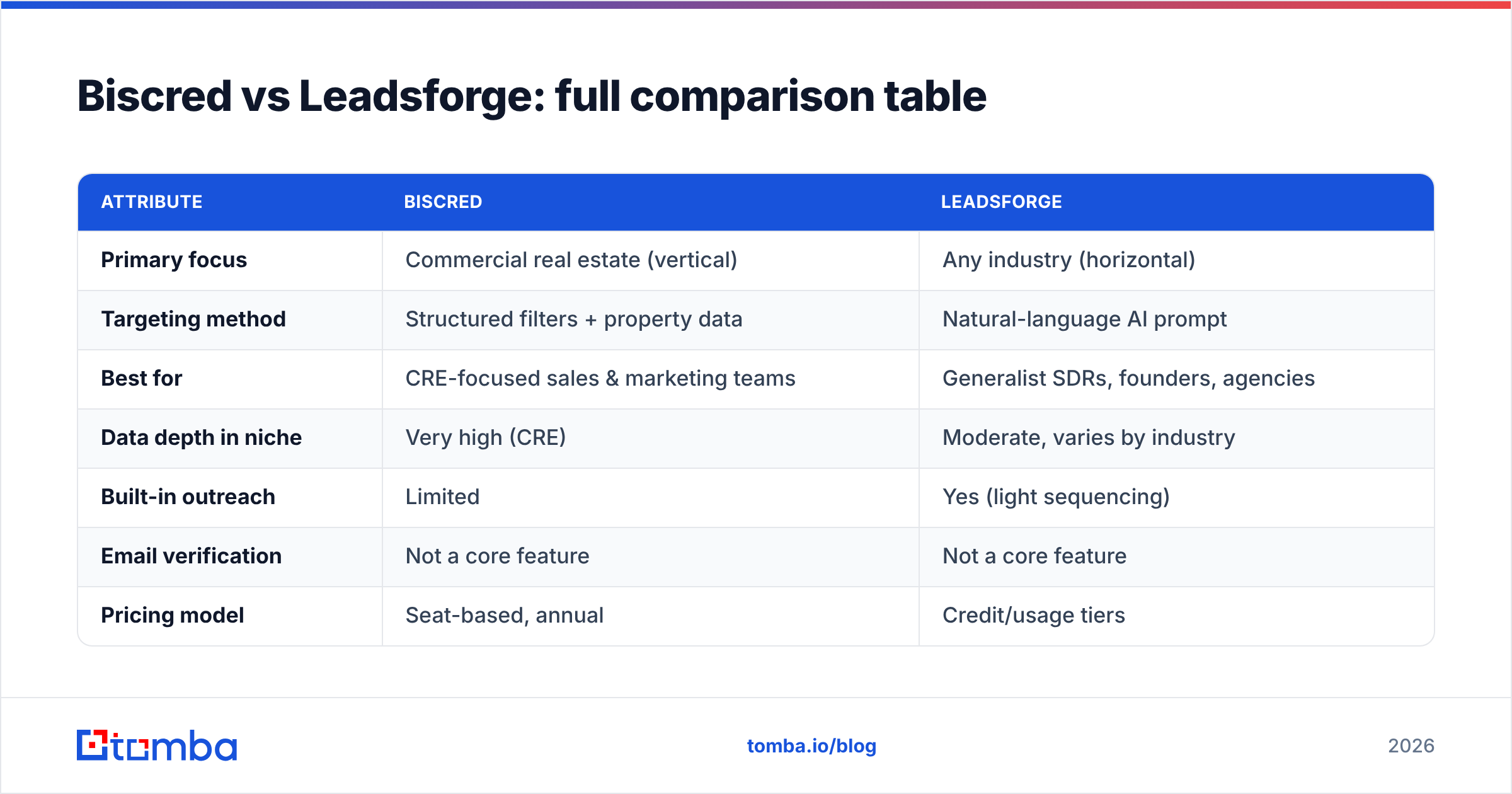
Here's the head-to-head on the attributes that actually change your results.
| Attribute | Biscred | Leadsforge |
|---|---|---|
| Primary focus | Commercial real estate (vertical) | Any industry (horizontal) |
| Targeting method | Structured filters + property data | Natural-language AI prompt |
| Best for | CRE-focused sales & marketing teams | Generalist SDRs, founders, agencies |
| Data depth in niche | Very high (CRE) | Moderate, varies by industry |
| Built-in outreach | Limited | Yes (light sequencing) |
| Email verification | Not a core feature | Not a core feature |
| Pricing model | Seat-based, annual | Credit/usage tiers |
| Learning curve | Moderate (filter taxonomy) | Low (chat prompt) |
| Free trial / tier | Demo-gated | Entry tier available |
The pattern: Biscred trades breadth for depth, Leadsforge trades depth for breadth and speed. Neither owns the part that decides whether your emails land.
Which tool has better data accuracy?#
Accuracy depends on what you're measuring — match rate or deliverability — and the two tools fail differently.
Biscred's accuracy is strong inside CRE because its data is curated for that vertical and refreshed against property and company records. The risk is staleness on contact-level fields (people change firms constantly in brokerage), so emails sourced months ago can decay.
Leadsforge's accuracy is more variable. AI-assembled lists can look complete while including pattern-guessed or outdated addresses, especially in industries where the underlying data is thin. A polished list isn't a verified list.
Here's the rule that applies to both, and to every data vendor: a sourced email is a hypothesis, not a fact. Before you load contacts into a sequence, run them through a verifier that checks MX records, SMTP response, and catch-all status. Skipping this is how good lists produce bad sender reputation.
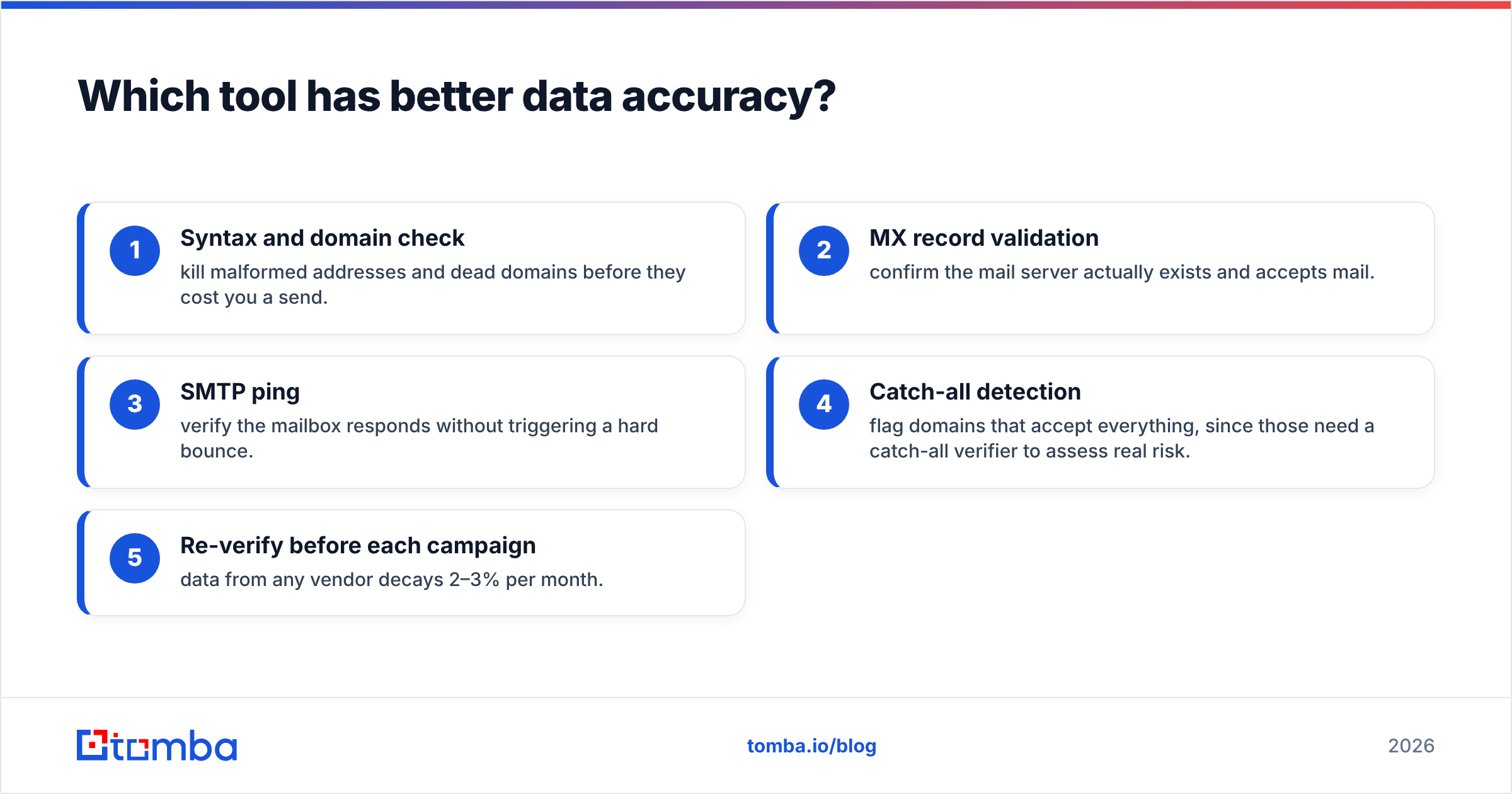
A quick verification checklist that applies regardless of which tool you choose:
- Syntax and domain check — kill malformed addresses and dead domains before they cost you a send.
- MX record validation — confirm the mail server actually exists and accepts mail.
- SMTP ping — verify the mailbox responds without triggering a hard bounce.
- Catch-all detection — flag domains that accept everything, since those need a catch-all verifier to assess real risk.
- Re-verify before each campaign — data from any vendor decays 2–3% per month.
How do Biscred and Leadsforge pricing compare?#
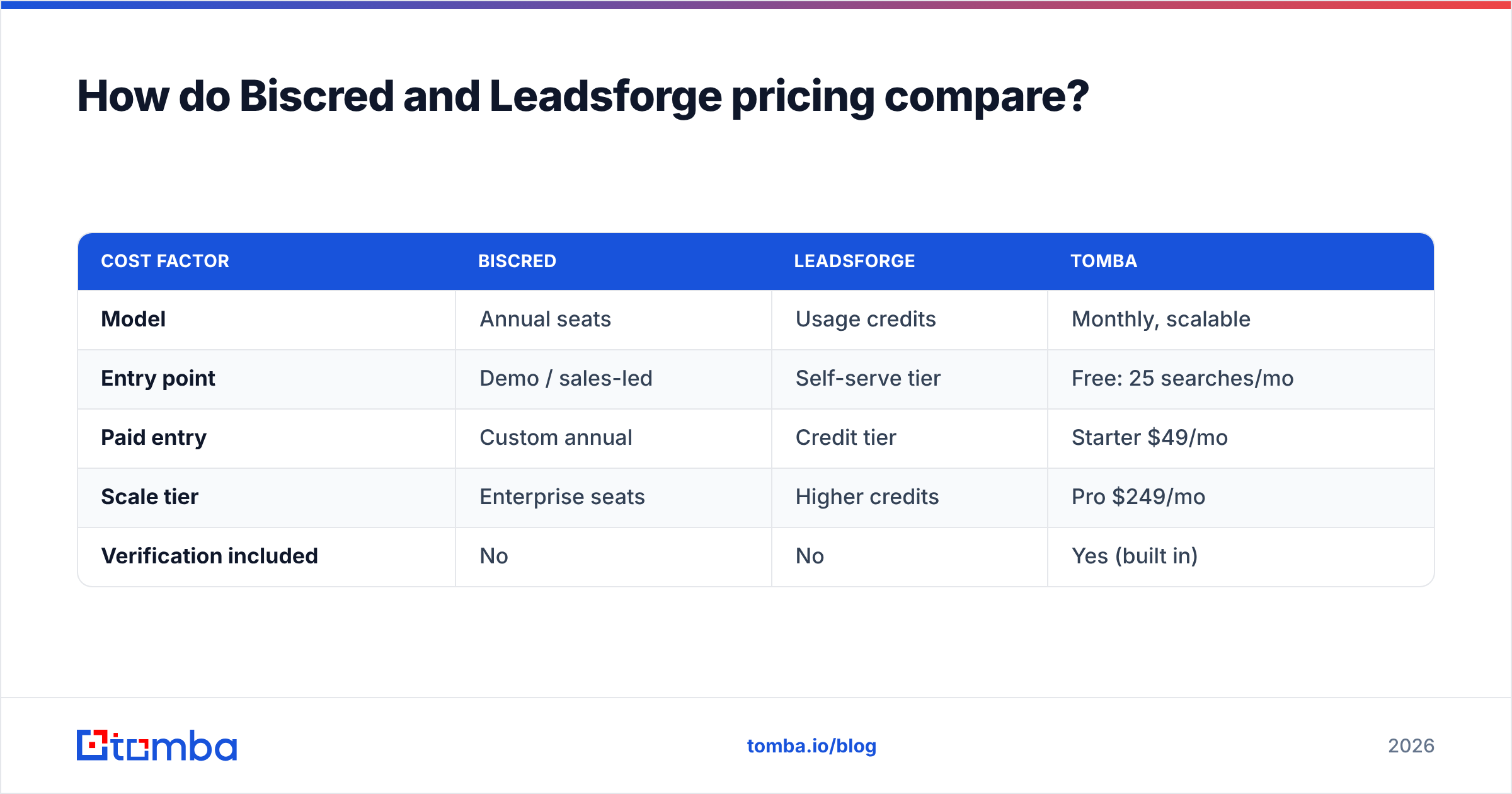
The two use different billing logic, so "which is cheaper" depends entirely on your volume and team size.
Biscred runs on a seat-based annual contract typical of vertical data platforms — you commit upfront, and cost scales with users and access level. That suits a dedicated CRE team that uses it daily and can justify the commitment.
Leadsforge uses credit/usage tiers, which front-loads less risk: you pay for the leads you pull. That's friendlier for agencies, bootstrapped founders, or anyone with spiky, campaign-based demand.
For exact current numbers, check each vendor's page and cross-reference reviews on G2 and Capterra — list pricing on niche tools changes often and is frequently demo-gated. Whatever you land on, factor in the separate cost of verification, because neither price includes it.
| Cost factor | Biscred | Leadsforge | Tomba |
|---|---|---|---|
| Model | Annual seats | Usage credits | Monthly, scalable |
| Entry point | Demo / sales-led | Self-serve tier | Free: 25 searches/mo |
| Paid entry | Custom annual | Credit tier | Starter $49/mo |
| Scale tier | Enterprise seats | Higher credits | Pro $249/mo |
| Verification included | No | No | Yes (built in) |
If verification is a line item you'd otherwise pay for twice, a platform that bundles finding and checking — see Tomba pricing — changes the total-cost math.
When should you choose Biscred over Leadsforge?#
Pick Biscred when:
- Your entire go-to-market is commercial real estate, and you need property-linked firmographics no generalist carries.
- You have a stable team that will use the platform daily enough to justify an annual seat commitment.
- Role precision inside CRE (acquisitions vs. asset management vs. debt) is more valuable to you than industry breadth.
Pick Leadsforge when:
- You sell across multiple industries and want a single, fast tool to spin up lists.
- Your team is small or non-technical and won't invest in learning a filter taxonomy.
- Demand is campaign-based and you'd rather pay per use than commit annually.
If your honest answer is "I want broad, accurate B2B emails I can find by company domain — not a single vertical and not a black-box prompt," then neither tool is the center of your stack. That's a domain search and email-finder job.
Where do both tools leave a gap?#
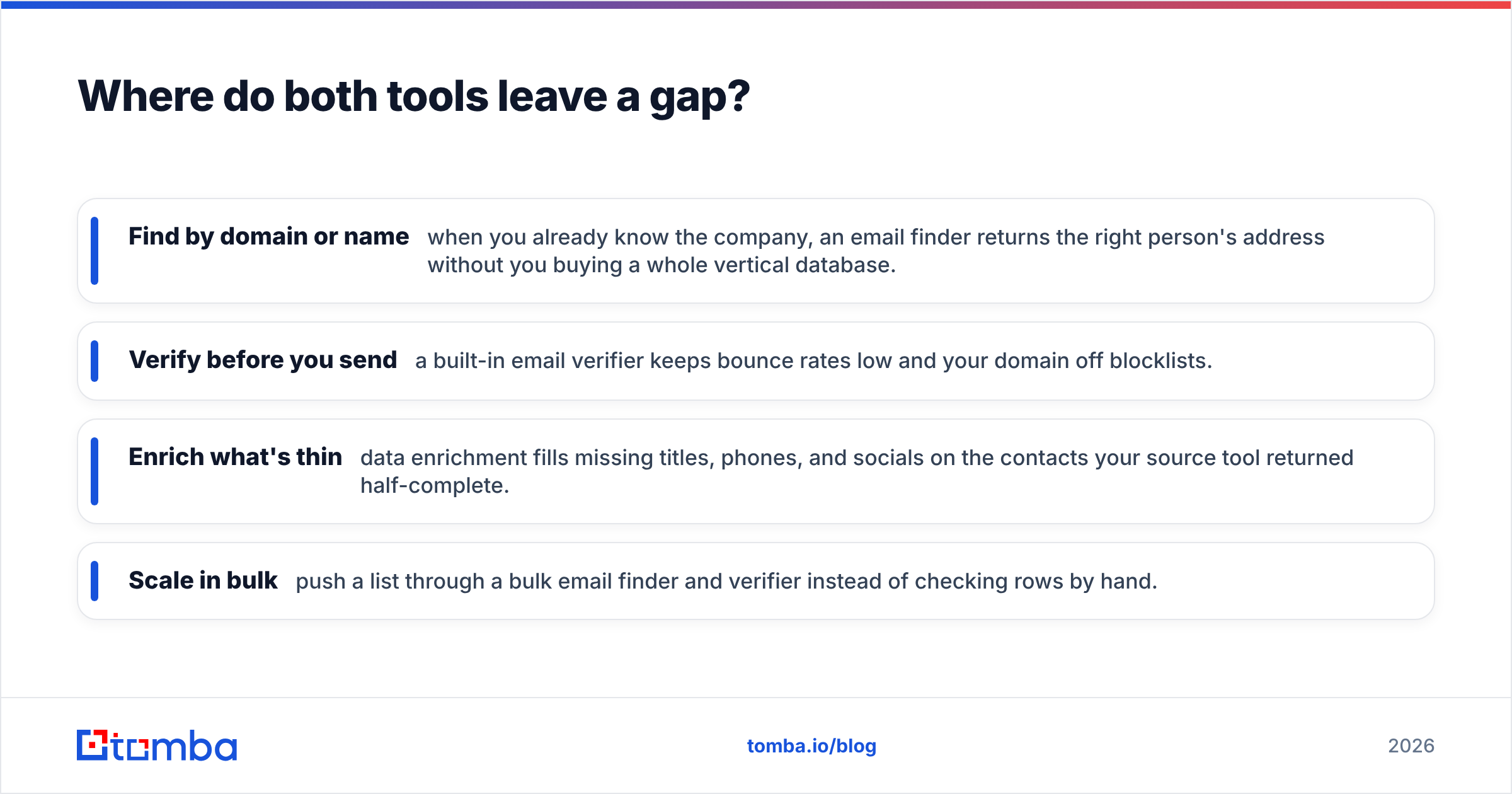
Both Biscred and Leadsforge are sourcing tools. They get you a list. They are not built to do the three things that actually protect deliverability and conversion: verify every address, enrich thin records, and find contacts at any company on demand rather than within a fixed dataset.
That's the gap a dedicated finder-and-verifier fills:
- Find by domain or name — when you already know the company, an email finder returns the right person's address without you buying a whole vertical database.
- Verify before you send — a built-in email verifier keeps bounce rates low and your domain off blocklists.
- Enrich what's thin — data enrichment fills missing titles, phones, and socials on the contacts your source tool returned half-complete.
- Scale in bulk — push a list through a bulk email finder and verifier instead of checking rows by hand.
This is exactly the layer Tomba is built for. It doesn't try to out-niche Biscred on CRE property data or out-prompt Leadsforge's AI — it makes sure the contacts you get from anywhere are real, deliverable, and complete.
Biscred vs Leadsforge vs a verified email layer#
To make the roles concrete:
| Use case | Best fit |
|---|---|
| Deep CRE prospecting | Biscred |
| Fast AI lists, any industry | Leadsforge |
| Find emails at any domain | Tomba Email Finder |
| Verify before sending | Tomba Email Verifier |
| Enrich incomplete records | Tomba enrichment |
| Keep bounce rate under 3% | Tomba (built-in verify) |
Most strong outbound stacks aren't "one tool." They're a sourcing tool matched to your market plus a verification-and-enrichment layer that every sourced contact passes through before outreach. Biscred or Leadsforge can own the first slot. The second slot is where deliverability is won or lost.
The verdict#
Biscred wins for commercial real estate teams; Leadsforge wins for fast, cross-industry AI lists. Pick Biscred for vertical depth and daily CRE use; pick Leadsforge for speed, breadth, and usage-based pricing. But understand what you're actually buying with either: a list, not a guarantee that the list will deliver.
The teams that get the most out of either tool treat sourcing and verification as two separate jobs. Source with the tool that fits your market — then run every contact through a finder-and-verifier that works across every domain, not just one niche or one AI guess.
That's where Tomba fits. Start with the Tomba Email Finder to find and verify professional emails at any company, on a free tier (25 searches/month) before you commit — so the leads you pull from Biscred, Leadsforge, or anywhere else actually land in the inbox.
// get started
Find, verify and enrich your first contacts today
Start on the free plan with 25 searches a month, then scale when your team is ready.
Free plan · No credit card required · GDPR & CCPA
// about the author