Biscred vs Leadzenai 2026: Which B2B Data Tool Wins?
Biscred targets commercial real estate data; Leadzen.ai chases broad lead intelligence. Here's a neutral 2026 breakdown of pricing, coverage, and accuracy to pick the right fit.
Choosing between Biscred and Leadzen.ai usually comes down to one question: do you need deep data on a single vertical, or broad reach across every industry? They are not the same kind of tool, and treating them as interchangeable is how teams waste a quarter's budget.
This is a neutral, hands-on comparison for 2026. We'll cover what each platform actually does, where the data comes from, how pricing works, and which workflows each one fits. Where Tomba is a better fit than either, we'll say so honestly — and where it isn't, we'll say that too.
TL;DR — Biscred vs Leadzenai at a glance#
- Biscred is a niche commercial real estate (CRE) intelligence platform. If you sell into brokers, owners, lenders, and property managers, its depth is hard to beat.
- Leadzen.ai is a broad B2B/B2C lead-generation tool with strong roots in the Indian market and real-time search across many industries.
- Neither is a general-purpose email finder. If your core need is verified work emails at scale across any domain, a dedicated tool like the Tomba Email Finder is usually cheaper and more accurate.
- Pick Biscred for CRE-specific firmographics; pick Leadzen.ai for wide-net prospecting on a budget; pair either with a verifier to protect deliverability.
- Data accuracy — not raw record counts — should drive your decision. A big database full of stale emails costs you more than a smaller verified one.
What is Biscred?#
Biscred is a B2B data platform built specifically for the commercial real estate industry. Instead of trying to cover every sector, it goes deep on one: it maps companies, contacts, and roles across brokerage, investment, lending, development, and property management.
The pitch is specialization. A generic database might tag someone as "VP, Operations" at a real estate firm. Biscred is designed to tell you whether that person handles acquisitions, asset management, or leasing — the distinctions that decide whether your outreach lands or gets ignored. For CRE sales teams, that context is the entire value.
Biscred enriches contacts with emails and phone numbers and integrates into the usual CRM and outreach stack so reps can build targeted lists without manual research. Think of it like a specialist bookstore versus a giant warehouse: fewer total titles, but everything on the shelf is relevant to you.
What is Leadzen.ai?#
Leadzen.ai is a broad lead-generation and sales-intelligence platform. Where Biscred narrows, Leadzen.ai widens. It offers real-time prospect search, bulk extraction, and enrichment across many industries, and it's especially strong in the Indian market where competitors often have thin coverage.
Leadzen.ai leans into volume and accessibility. Its tooling is built for teams that want to cast a wide net — pulling contacts by industry, location, company size, and intent signals, then exporting them into a sequence. It blends B2B and B2C data, which makes it flexible but also means you need to filter carefully to avoid low-quality records.
If Biscred is the specialist bookstore, Leadzen.ai is the warehouse: enormous selection, lower price per unit, and the burden of quality control shifts to you.
How do Biscred and Leadzenai compare on data and pricing?#
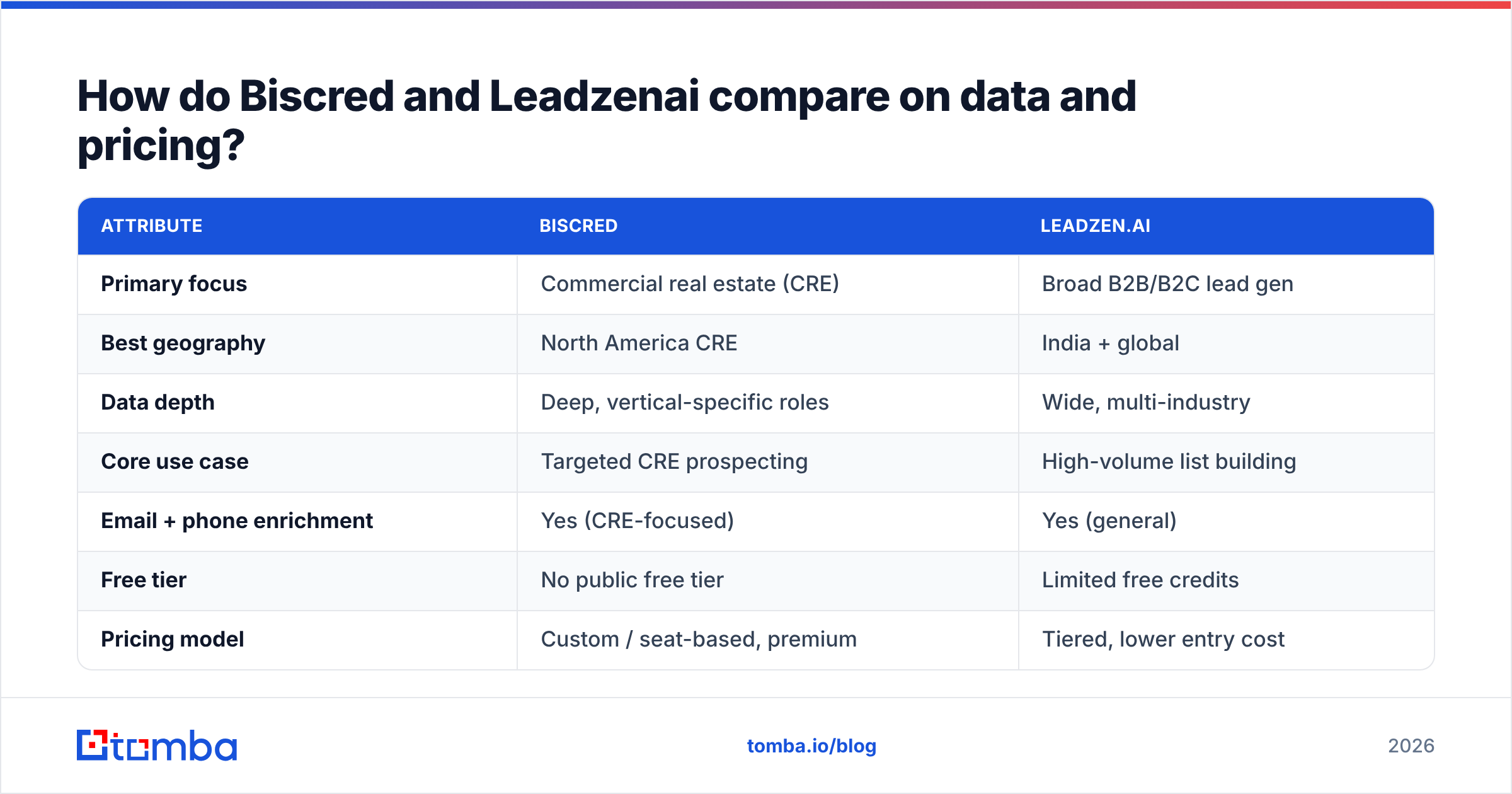
The core differences come down to scope, geography, and what you pay for. Here's the side-by-side.
| Attribute | Biscred | Leadzen.ai |
|---|---|---|
| Primary focus | Commercial real estate (CRE) | Broad B2B/B2C lead gen |
| Best geography | North America CRE | India + global |
| Data depth | Deep, vertical-specific roles | Wide, multi-industry |
| Core use case | Targeted CRE prospecting | High-volume list building |
| Email + phone enrichment | Yes (CRE-focused) | Yes (general) |
| Free tier | No public free tier | Limited free credits |
| Pricing model | Custom / seat-based, premium | Tiered, lower entry cost |
| Ideal user | CRE brokers, lenders, investors | SMBs, agencies, wide-net SDRs |
A few honest caveats: both vendors keep exact pricing behind sales or change it frequently, so confirm current numbers directly on their sites — check Biscred and Leadzen.ai before committing. Treat any third-party pricing (including this table) as directional, not gospel.
Five factors that should decide your choice#
- Vertical fit — If 80%+ of your pipeline is CRE, Biscred's depth pays for itself. If your targets span industries, Biscred is overkill and Leadzen.ai's breadth wins.
- Geography — Leadzen.ai's India coverage is a genuine differentiator. Biscred is North-America-centric.
- Budget per seat — Biscred is a premium, specialist spend. Leadzen.ai has a lower barrier to entry for smaller teams.
- Data freshness — Ask both vendors how often records are re-verified. Stale data is the hidden tax on every list.
- Workflow integrations — Confirm native connections to your CRM (HubSpot, Salesforce, Pipedrive) so enriched records flow without CSV gymnastics.
Is Biscred or Leadzenai better for email accuracy?#
Neither tool is primarily an email-verification engine, and that's the gap most buyers underestimate. Both Biscred and Leadzen.ai surface emails as part of enrichment, but the value of a contact record collapses the moment that email bounces.
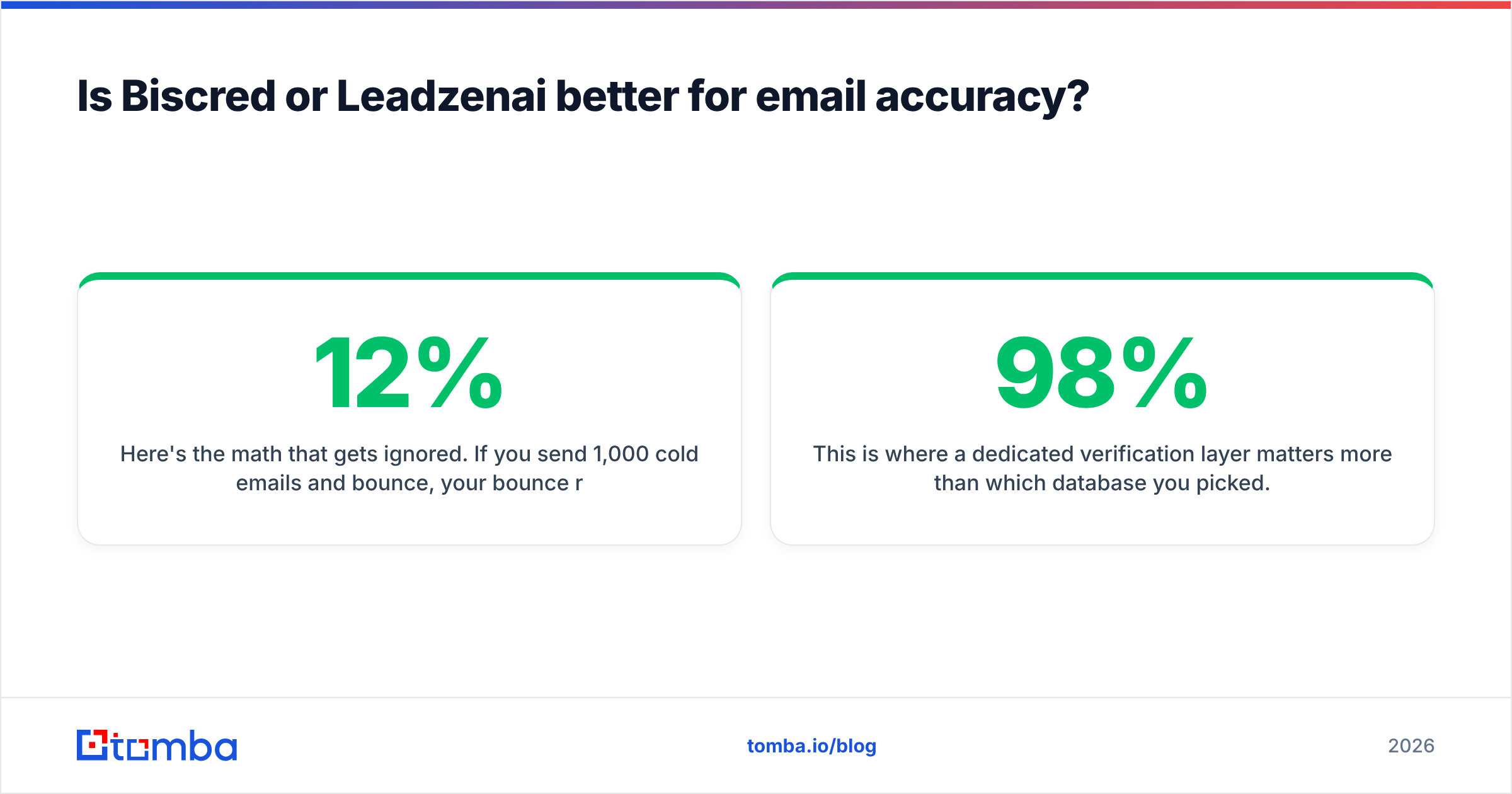
Here's the math that gets ignored. If you send 1,000 cold emails and 12% bounce, your bounce rate alone can flag your domain to spam filters. A 3-5% bounce rate is the commonly cited safety ceiling; above that, your sender reputation erodes and even your good emails start landing in spam. So the "accuracy" question isn't academic — it directly controls whether your campaign works at all.
This is where a dedicated verification layer matters more than which database you picked. Running every list through an email verifier before send catches dead mailboxes, syntax errors, and risky catch-all domains. Independent review sites like G2 are a useful sanity check on any vendor's accuracy claims, since self-reported "98% accurate" figures rarely survive contact with a real send.
The practical takeaway: whichever platform you choose, do not trust raw enrichment emails blindly. Verify first, send second.
When should you use a dedicated email finder instead?#
Use a dedicated email finder when your bottleneck is getting verified work emails at scale, not industry-specific firmographics.
Biscred and Leadzen.ai are list-building platforms first. They're excellent when you need a database to browse and filter. But many teams already know exactly who they want to reach — they have names, companies, or a target domain — and just need the email. Paying for a full intelligence subscription to solve a targeted lookup problem is the wrong tool for the job.
That targeted scenario is where a focused finder shines:
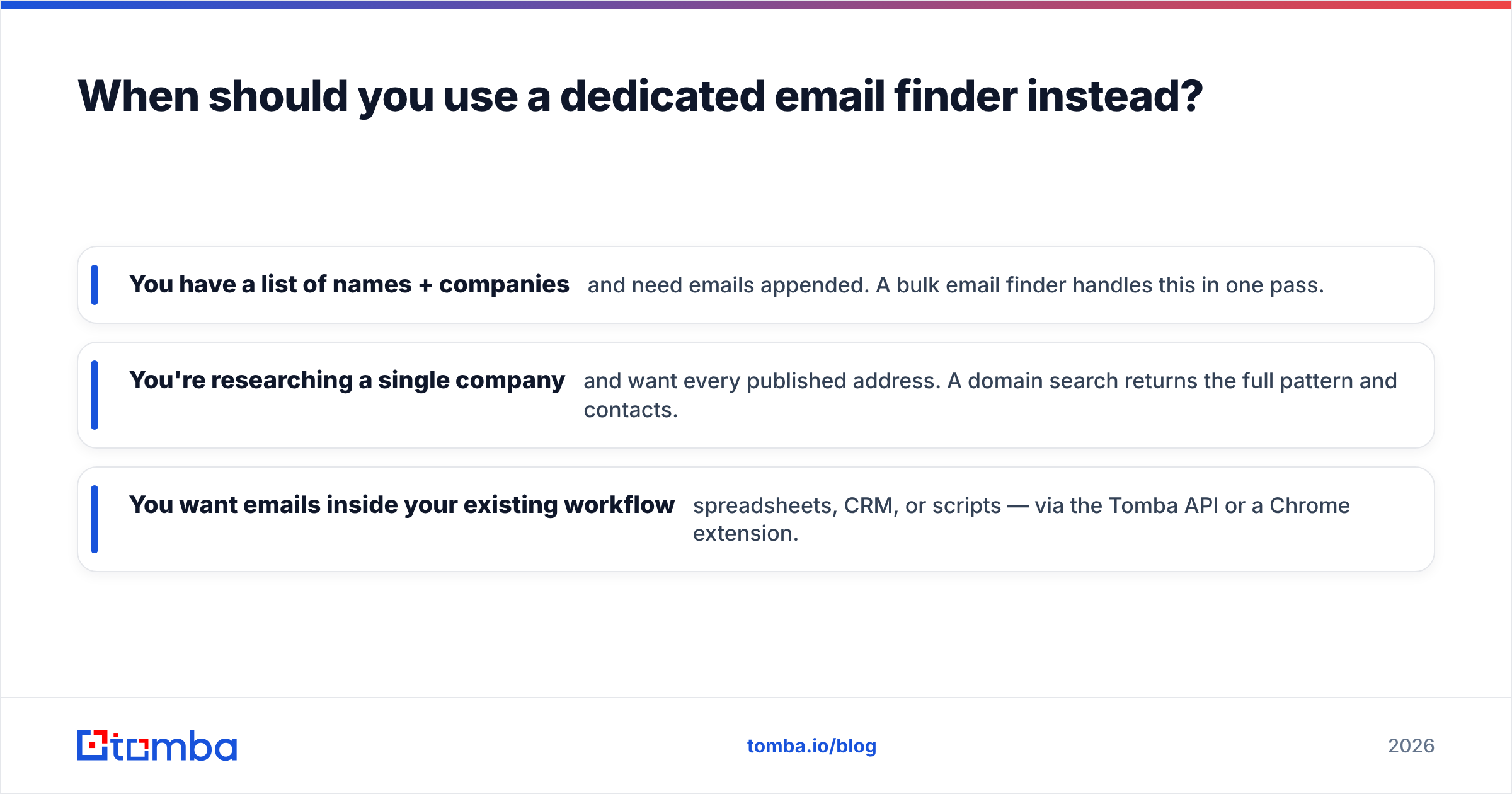
- You have a list of names + companies and need emails appended. A bulk email finder handles this in one pass.
- You're researching a single company and want every published address. A domain search returns the full pattern and contacts.
- You want emails inside your existing workflow — spreadsheets, CRM, or scripts — via the Tomba API or a Chrome extension.
Tomba is built around this finder-first model, and its pricing reflects that focus rather than bundling a full sales-intelligence suite you may not need.
How does Tomba compare to Biscred and Leadzenai?#
Tomba sits in a different lane: it's an email-finder and verification platform, not a vertical CRE database or a broad B2C list tool. That makes it complementary to both, and a direct replacement only when email discovery is your actual job-to-be-done.
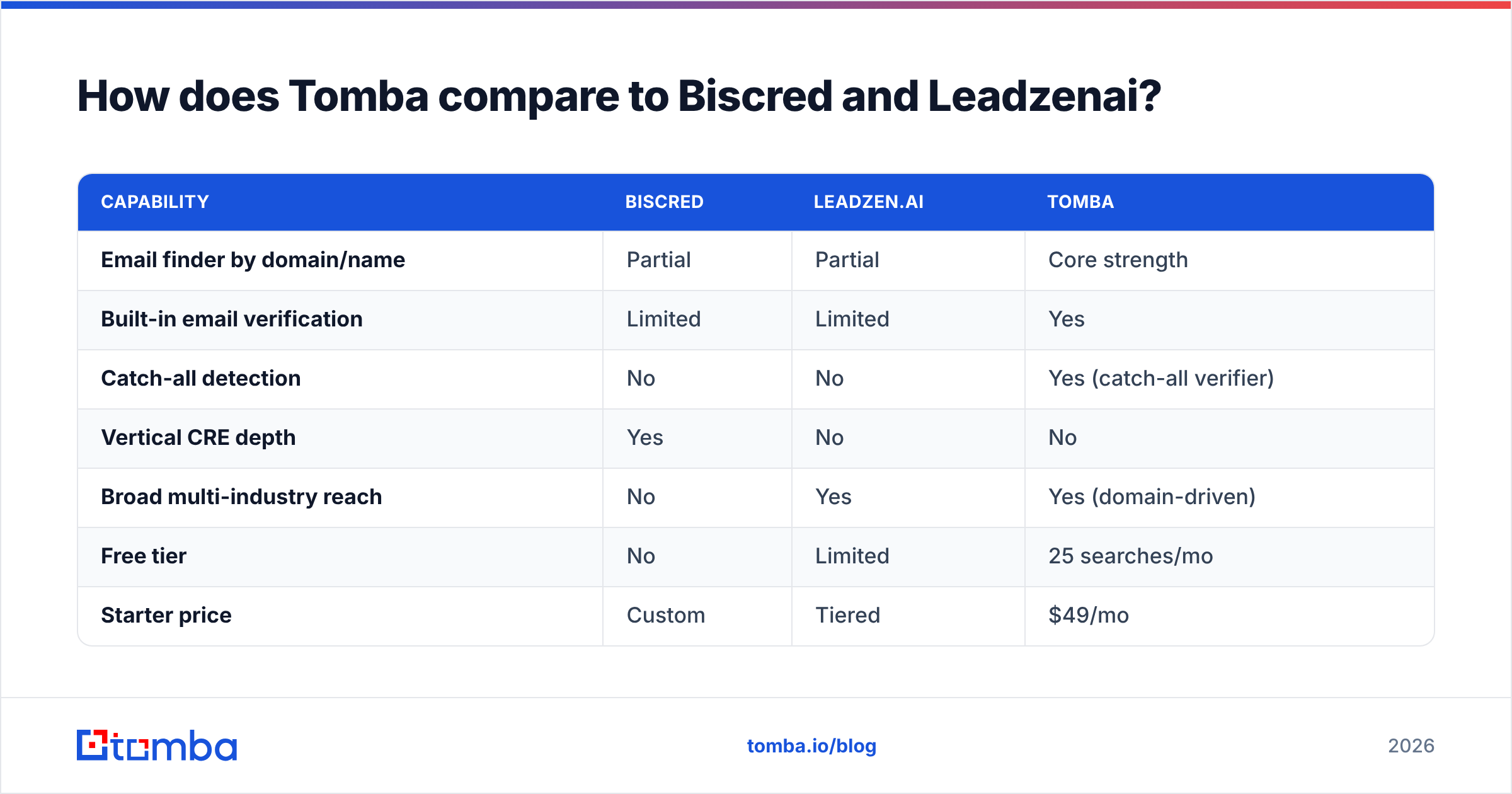
| Capability | Biscred | Leadzen.ai | Tomba |
|---|---|---|---|
| Email finder by domain/name | Partial | Partial | Core strength |
| Built-in email verification | Limited | Limited | Yes |
| Catch-all detection | No | No | Yes (catch-all verifier) |
| Vertical CRE depth | Yes | No | No |
| Broad multi-industry reach | No | Yes | Yes (domain-driven) |
| Free tier | No | Limited | 25 searches/mo |
| Starter price | Custom | Tiered | $49/mo |
| API access | Varies | Yes | Yes |
On price, Tomba is transparent: a free tier with 25 searches per month, Starter at $49/mo, Growth at $99/mo, and Pro at $249/mo, with custom Enterprise plans above that. You can see the full breakdown on the Tomba pricing page. Biscred and Leadzen.ai both quote based on seats, credits, and add-ons, so a clean apples-to-apples comparison is hard until you talk to sales.
The honest framing: if you need CRE intelligence, Tomba won't replace Biscred. If you need wide Indian-market B2C coverage, Tomba won't replace Leadzen.ai. But if you need accurate, verified emails across standard B2B domains — and you want to stop paying for a database you barely browse — Tomba is usually the leaner choice. Many teams run a hybrid: a database tool for discovery, Tomba for verified contact data and ongoing data enrichment.
What are the pros and cons of each platform?#
Biscred — pros
- Unmatched depth in commercial real estate roles and firmographics.
- Reduces manual research for CRE-specific outreach.
- Strong for brokers, lenders, and investment teams in North America.
Biscred — cons
- Useless outside CRE; you pay specialist prices for a narrow scope.
- No public free tier to test before buying.
- Email accuracy depends on a separate verification step.
Leadzen.ai — pros
- Broad multi-industry and strong India-market coverage.
- Lower entry cost and limited free credits to trial.
- Real-time search and bulk extraction for high-volume teams.
Leadzen.ai — cons
- Mixed B2B/B2C data requires careful filtering for quality.
- Variable record accuracy; verify before sending.
- Less depth on any single vertical compared to a specialist.
Where Tomba fits
- Finder-first pricing and a real free tier for testing.
- Verification, catch-all checks, and enrichment in one stack.
- Not a substitute for vertical intelligence or B2C breadth — it's the email layer.
Which one should you choose in 2026?#
Start with your actual bottleneck, not the feature list.
If commercial real estate is your market, Biscred earns its premium — the role-level precision saves your reps hours every week and improves targeting. If you need wide reach, especially in India or across mixed industries on a tighter budget, Leadzen.ai is the more sensible starting point. And if your real problem is simply finding and verifying work emails reliably and cheaply, a dedicated finder beats both.
Whatever you choose, pair it with verification. The most expensive mistake in outbound isn't picking the "wrong" database — it's blasting unverified emails and torching your email deliverability for months.
The bottom line#
Biscred and Leadzen.ai solve different problems: one goes deep on CRE, the other goes wide across industries. Neither is a dedicated email finder, and that's the gap to watch. If your day-to-day is finding verified emails by name, domain, or company — across any industry, at a transparent price — start with the Tomba Email Finder. The free tier gives you 25 searches a month to test accuracy against your own list before you spend a dollar, and the built-in email verifier keeps your bounce rate low and your domain healthy. Find emails, verify them, and protect your sender reputation — then layer a specialist database on top only if your vertical actually demands it.
Ready to find emails that actually work?
Join 150,000+ professionals who stopped guessing and started sending. Free credits on signup — no credit card required.
Get the Tomba newsletter
Practical outbound tactics and product updates — once every two weeks.
About the author