Biscred vs Limeleads 2026: Which B2B Data Tool Wins?
Biscred vs Limeleads compared on data coverage, accuracy, pricing, and fit. See which B2B prospecting database earns your budget in 2026 — and the smarter alternative.
TL;DR
- Biscred is a niche, AI-driven prospecting database built for commercial real estate (CRE) — landlords, brokers, tenant reps, lenders, and the firms that sell to them.
- Limeleads is a general-purpose B2B contact database with real-time email verification, sold on a simpler self-serve, pay-as-you-grow model.
- Pick Biscred if your entire pipeline lives in CRE and you need property-level context. Pick Limeleads if you want broad, cheap, verified B2B lists across industries.
- Neither tool is built to find and verify a specific person's email on demand — that's where a dedicated email finder like Tomba fits alongside or instead of them.
- This guide breaks down coverage, accuracy, pricing, exports, and the honest "who should buy what" so you don't overpay for data you won't use.
What are Biscred and Limeleads?#
Think of these two tools like two different grocery stores. Biscred is a specialty deli stocked deeply for one cuisine — commercial real estate — with hard-to-find ingredients you can't get anywhere else. Limeleads is the general supermarket: broad aisles, predictable prices, everything verified at the checkout, but no specialty section.
Biscred is a B2B data platform focused on the commercial real estate ecosystem. It aggregates company and contact records for brokerages, owners, developers, lenders, and proptech firms, then layers AI-assisted search and filtering so you can build a list of, say, "tenant-rep brokers in Dallas who handle industrial space." The pitch is depth in a vertical that horizontal databases cover poorly.
Limeleads is a horizontal B2B lead-generation database. You filter by industry, title, company size, location, and technology, preview the list, then export verified contacts. Its differentiator is real-time email verification at export and a transparent credit model that smaller teams find approachable.
The core distinction in one line: Biscred sells depth in one industry; Limeleads sells breadth across all of them. That single fact decides most of the buying decision before you ever compare a price.
How do Biscred and Limeleads compare at a glance?#
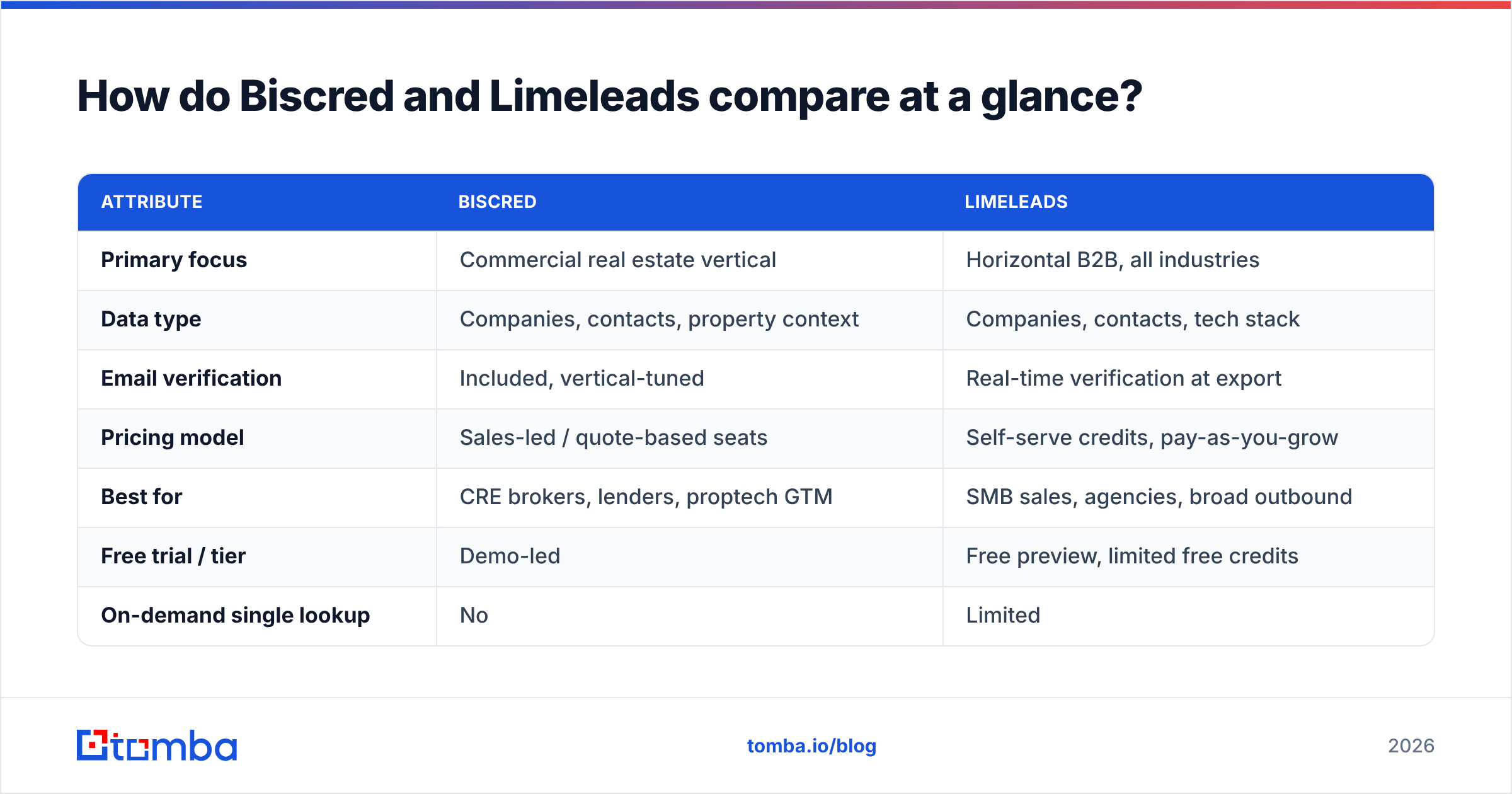
Here's the head-to-head on the attributes that actually change a buying decision. Treat published vendor numbers as directional — both companies adjust packaging, and you should confirm current terms on their own sites before signing.
| Attribute | Biscred | Limeleads |
|---|---|---|
| Primary focus | Commercial real estate vertical | Horizontal B2B, all industries |
| Data type | Companies, contacts, property context | Companies, contacts, tech stack |
| Email verification | Included, vertical-tuned | Real-time verification at export |
| Pricing model | Sales-led / quote-based seats | Self-serve credits, pay-as-you-grow |
| Best for | CRE brokers, lenders, proptech GTM | SMB sales, agencies, broad outbound |
| Free trial / tier | Demo-led | Free preview, limited free credits |
| On-demand single lookup | No | Limited |
| Export formats | CSV / CRM push | CSV / list export |
The pattern is clear: Biscred wins on vertical richness, Limeleads wins on accessibility and price transparency. Neither is strictly "better" — they're built for different buyers.

When is Biscred the right choice?#
Choose Biscred when commercial real estate is your business, not a segment of it. The value of a vertical database compounds when every record carries context a general tool throws away.
Biscred fits best when you can answer "yes" to most of these:
- Your ICP is CRE-native. You sell to or within brokerages, REITs, owner-operators, developers, lenders, or proptech vendors.
- Property and role context matters. You need to know not just a contact's title but their function in a deal — tenant rep vs. landlord rep, debt vs. equity.
- Horizontal tools keep failing you. You've tried general databases and found CRE roles mislabeled, missing, or stale.
- You have budget for a seat-based tool. Vertical depth is rarely cheap, and Biscred is sales-led rather than self-serve.
- Your team works lists, not one-offs. You're building territory plans and account lists, not chasing a single decision-maker's email.
Where Biscred is overkill: if you sell SaaS, agency services, or anything outside the property world, you're paying a premium for an industry filter you'll never use. According to category reviews on G2, buyers consistently rate vertical data tools highest on relevance and lowest on value for money when used outside their niche — the depth you pay for only pays back inside the vertical.
When is Limeleads the right choice?#
Choose Limeleads when you want broad reach, verified contacts, and a price you can predict without a sales call. It's the pragmatic pick for teams that prospect across many industries and care more about cost-per-verified-contact than vertical nuance.
Limeleads tends to win for:
- SMBs and startups that need lists now and can't justify an enterprise seat.
- Agencies building campaigns for clients across wildly different sectors.
- Generalist outbound teams where the ICP changes quarter to quarter.
- Budget-sensitive buyers who want self-serve credits instead of an annual contract.
The honest tradeoff: a horizontal database spread across every industry will rarely match a specialist's depth in any single one. Limeleads' real-time verification at export is a genuine strength — it trims bounces before they hit your sender reputation — but verification is not the same as coverage. A clean, verified record is worthless if the right contact simply isn't in the database. Check current packaging on the Limeleads site, since credit bundles shift.
Which has better data accuracy and deliverability?#
Accuracy is where both tools live or die, and where the conversation usually gets fuzzy. Let's be concrete about the two failure modes that actually cost you money.
Coverage gaps — the contact you need isn't in the database at all. This is Biscred's risk outside CRE and Limeleads' risk inside any deep niche. No verification step fixes a missing record.
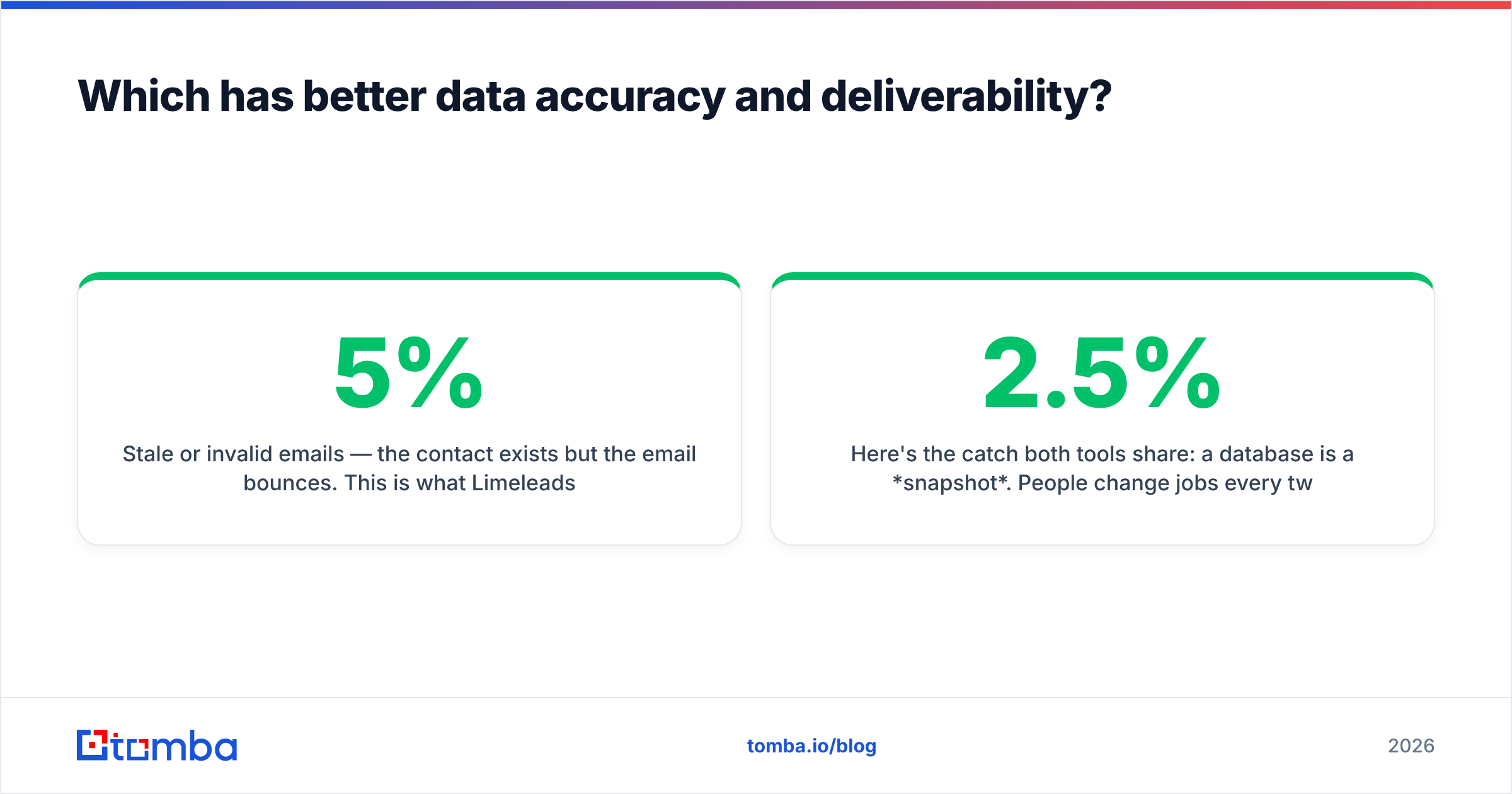
Stale or invalid emails — the contact exists but the email bounces. This is what Limeleads' real-time verification targets, and what Biscred handles with vertical-tuned checks. A bounce rate above 3–5% starts dragging your sender reputation, and once that slips, even your good emails land in spam.
Here's the catch both tools share: a database is a snapshot. People change jobs every two to three years, and B2B data decays at roughly 2–2.5% per month. A list that was 95% accurate at export can be 80% accurate six months later. That's why the smartest teams pair any database with on-demand verification at send time rather than trusting a one-time export forever.
This is exactly the gap a dedicated email verifier closes. You enrich from a database for coverage, then verify each address right before you send for deliverability — two jobs, two tools, no overpaying for one to do both badly.

How much do Biscred and Limeleads cost?#
Pricing is the cleanest difference between them, and it maps directly to their go-to-market.
- Biscred is sales-led. Expect quote-based, seat-priced annual plans typical of vertical data vendors. There's no public self-serve tier; you book a demo, scope your seats, and negotiate. Budget accordingly — specialist data carries a specialist premium.
- Limeleads is self-serve with a transparent credit model and a free preview. You can start small, buy credits as you grow, and avoid an annual commitment. This is its biggest practical advantage for teams that hate procurement friction.
For comparison, a focused email-finding tool like Tomba is also transparent and self-serve: a Free tier at 25 searches/month, Starter at $49/mo, Growth at $99/mo, Pro at $249/mo, and custom Enterprise. You can see the full breakdown on the Tomba pricing page. The point isn't that one number beats another — it's that you should match the pricing model to how you actually buy. If you need to test before you commit, sales-led tools add weeks; self-serve tools let you validate this afternoon.
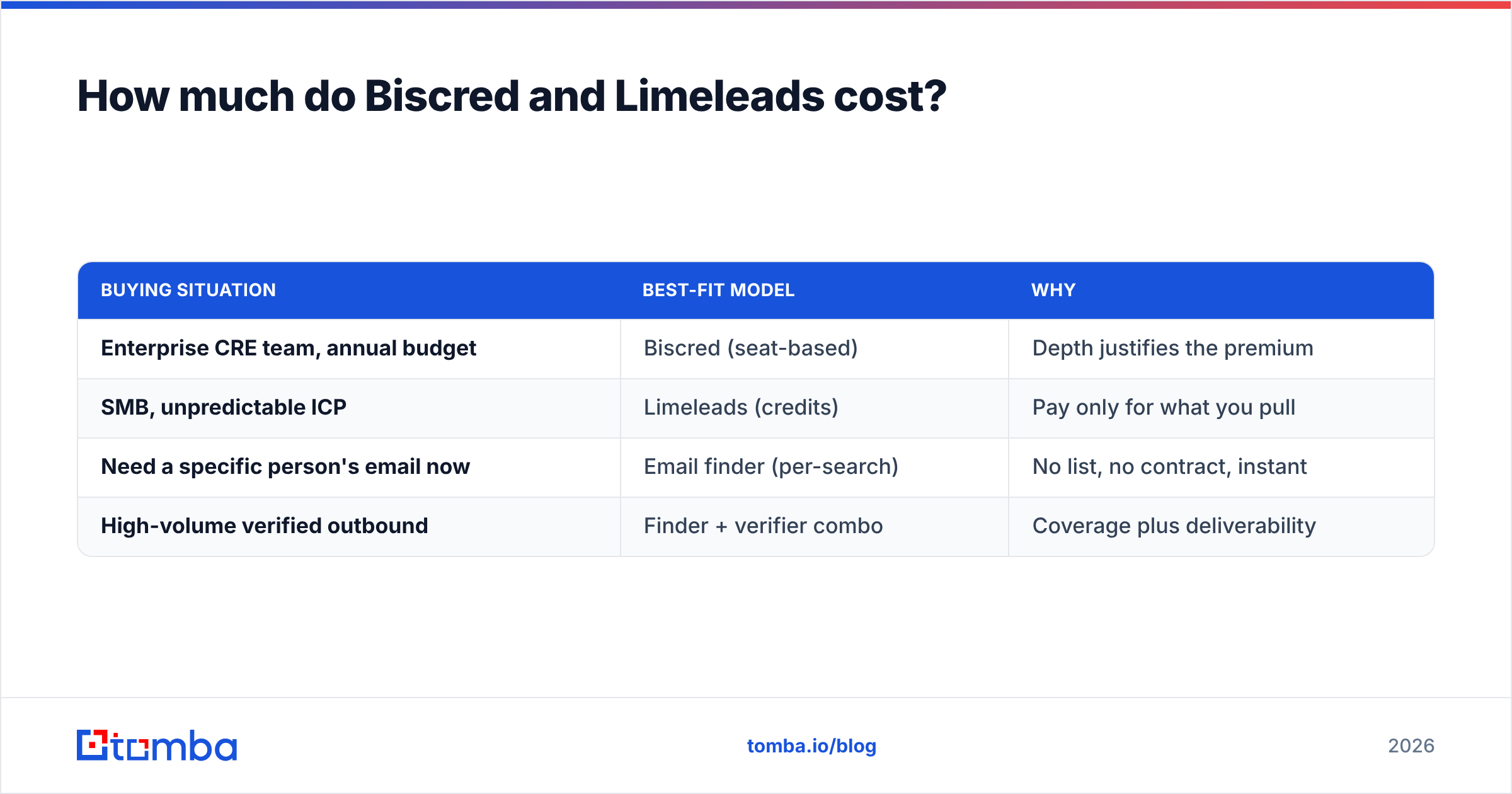
A quick cost-fit framework:
| Buying situation | Best-fit model | Why |
|---|---|---|
| Enterprise CRE team, annual budget | Biscred (seat-based) | Depth justifies the premium |
| SMB, unpredictable ICP | Limeleads (credits) | Pay only for what you pull |
| Need a specific person's email now | Email finder (per-search) | No list, no contract, instant |
| High-volume verified outbound | Finder + verifier combo | Coverage plus deliverability |
What's the smarter alternative for most teams?#
Reframe the question. Biscred vs Limeleads assumes you need a standing database. Many teams don't — they need to find and verify specific people, fast, without renting an entire industry's contact list.
That's the job an email finder does. Instead of buying a static list and hoping the right contacts are inside it, you start from a name and a domain (or just a company) and pull a verified, current email on demand. It's the difference between buying a whole phone book versus looking up exactly the number you need, the moment you need it.
Tomba is built for that workflow, and it overlaps with what both Biscred and Limeleads buyers actually want:
- Email Finder — find a professional email by name, domain, or company, verified at lookup.
- Domain search — pull every public email pattern for a target company in one query.
- Bulk email finder — process a whole prospect list at once instead of one record at a time.
- Data enrichment — fill in missing fields on the contacts you already have.
- Tomba API — wire finding and verification straight into your CRM or sequencer.
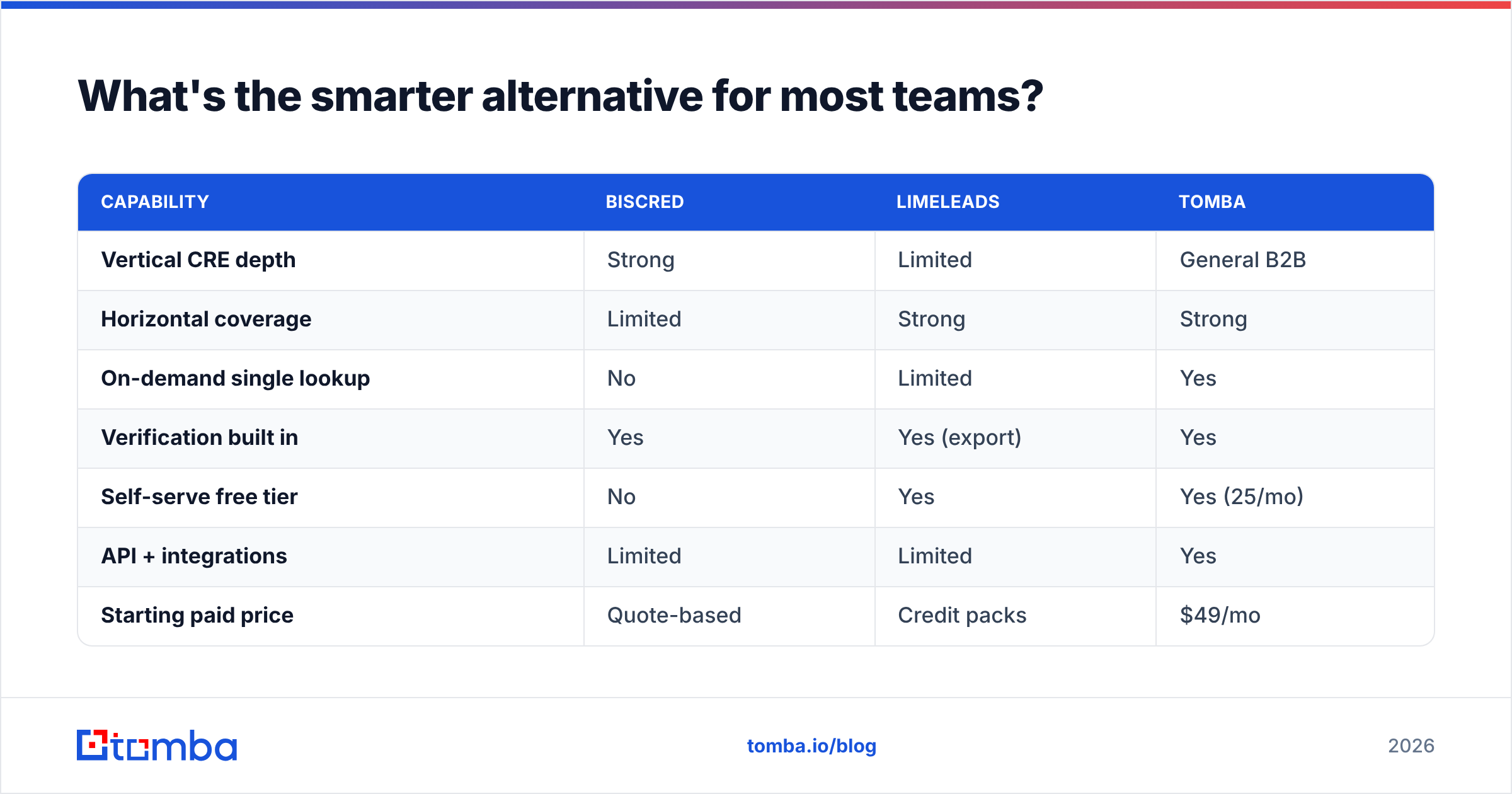
Here's how the three approaches stack up for the most common job — getting verified contacts into a campaign:
| Capability | Biscred | Limeleads | Tomba |
|---|---|---|---|
| Vertical CRE depth | Strong | Limited | General B2B |
| Horizontal coverage | Limited | Strong | Strong |
| On-demand single lookup | No | Limited | Yes |
| Verification built in | Yes | Yes (export) | Yes |
| Self-serve free tier | No | Yes | Yes (25/mo) |
| API + integrations | Limited | Limited | Yes |
| Starting paid price | Quote-based | Credit packs | $49/mo |
This isn't "Tomba beats both at everything." Biscred genuinely owns CRE depth; Limeleads genuinely owns cheap horizontal lists. But if your real need is "find verified emails for the specific people I'm targeting, across any industry, without a sales call," a purpose-built finder is the most direct path — and you can layer it on top of either database to keep stale records honest.
How should you actually decide?#
Run your situation through three questions, in order:
- Is commercial real estate your whole world? If yes, Biscred earns its premium. If CRE is one segment among many, skip it.
- Do you need standing lists across industries on a tight budget? If yes, Limeleads' self-serve credits are hard to beat. If you only need targeted contacts, a database is more than you need.
- Do you mostly need specific verified emails on demand? If yes, an email finder is the cleanest, cheapest, fastest tool — start there, and add a database only when coverage gaps force the upgrade.
Most teams discover their honest answer is some mix: a finder for daily targeted outreach, plus a database for occasional bulk territory builds. The mistake is paying enterprise database prices for a job a per-search tool does better.
The bottom line#
Biscred and Limeleads solve different problems wearing similar clothes. Biscred is the vertical specialist — unmatched in CRE, overpriced everywhere else. Limeleads is the accessible generalist — broad, verified, budget-friendly, but shallow in any single niche. Neither is built to hand you a specific decision-maker's verified email in seconds, which is what most outbound actually runs on.
If that last job is the one you do every day, start with the tool built for it. Try Tomba's Email Finder — find and verify professional emails by name, domain, or company, with a free tier of 25 searches a month and self-serve plans from $49/mo. Validate your workflow this afternoon, no demo required, and add a database later only if your coverage truly demands it.
// get started
Find, verify and enrich your first contacts today
Start on the free plan with 25 searches a month, then scale when your team is ready.
Free plan · No credit card required · GDPR & CCPA
// about the author