Biscred vs Lusha 2026: B2B Data Platform Comparison
Biscred targets commercial real estate data while Lusha covers broad B2B contacts. Here's how the two stack up on coverage, accuracy, and price in 2026 — and where a finder like Tomba fits.
Choosing between Biscred and Lusha usually means choosing between depth and breadth. Biscred goes narrow and deep on commercial real estate (CRE) firms and the people inside them. Lusha goes wide, covering B2B contacts across nearly every industry. Picking the wrong one means paying for data you can't use — or missing the records you actually need.
TL;DR#
- Biscred is a commercial-real-estate-focused B2B data platform — strongest if you sell into brokerages, REITs, property managers, lenders, and CRE service firms.
- Lusha is a horizontal B2B contact-data tool with a browser extension, prospecting platform, and API — strongest for general sales teams across many industries.
- Accuracy and coverage are vertical-dependent: Biscred wins inside CRE; Lusha wins for breadth outside it.
- Pricing favors Lusha for entry, with a free tier and a low-cost paid plan, while Biscred is sold as a niche-data subscription with custom pricing.
- If your real need is just verified work emails at scale, a focused email finder like Tomba is far cheaper than either platform.
What is Biscred?#
Biscred is a B2B data and prospecting platform built specifically for the commercial real estate industry. Instead of trying to index every company on earth, it concentrates on CRE-relevant organizations — brokerages, investment firms, REITs, property management companies, developers, lenders, and the vendors who serve them — and the decision-makers inside those firms.
Its core value is taxonomy. CRE has its own job titles, asset classes (office, industrial, multifamily, retail), and firm types that horizontal databases handle poorly. Biscred structures contacts around that vocabulary, so a user can filter for, say, "acquisitions directors at multifamily owners in the Sunbelt" with precision that a general-purpose tool struggles to match.
The trade-off is obvious: outside commercial real estate, Biscred has little to offer. If you sell SaaS to dentists or recruit software engineers, it is the wrong tool.

What is Lusha?#
Lusha is a horizontal B2B contact-data provider. Its best-known product is a browser extension that surfaces phone numbers and email addresses while you browse LinkedIn or company websites, plus a web prospecting platform and an enrichment API.
Lusha's pitch is reach and convenience. It covers contacts across most industries and regions, layers on intent data and filters, and positions itself as GDPR- and CCPA-aware — a point it markets heavily to compliance-sensitive buyers. You can read its own positioning on lusha.com and cross-check user sentiment on G2.
Because it is horizontal, Lusha's accuracy varies by segment. It tends to be strong for tech, mid-market, and North American contacts, and thinner for niche verticals, smaller firms, and some non-US regions — exactly the gaps a specialist like Biscred is built to fill within its lane.
Biscred vs Lusha: how do they compare?#
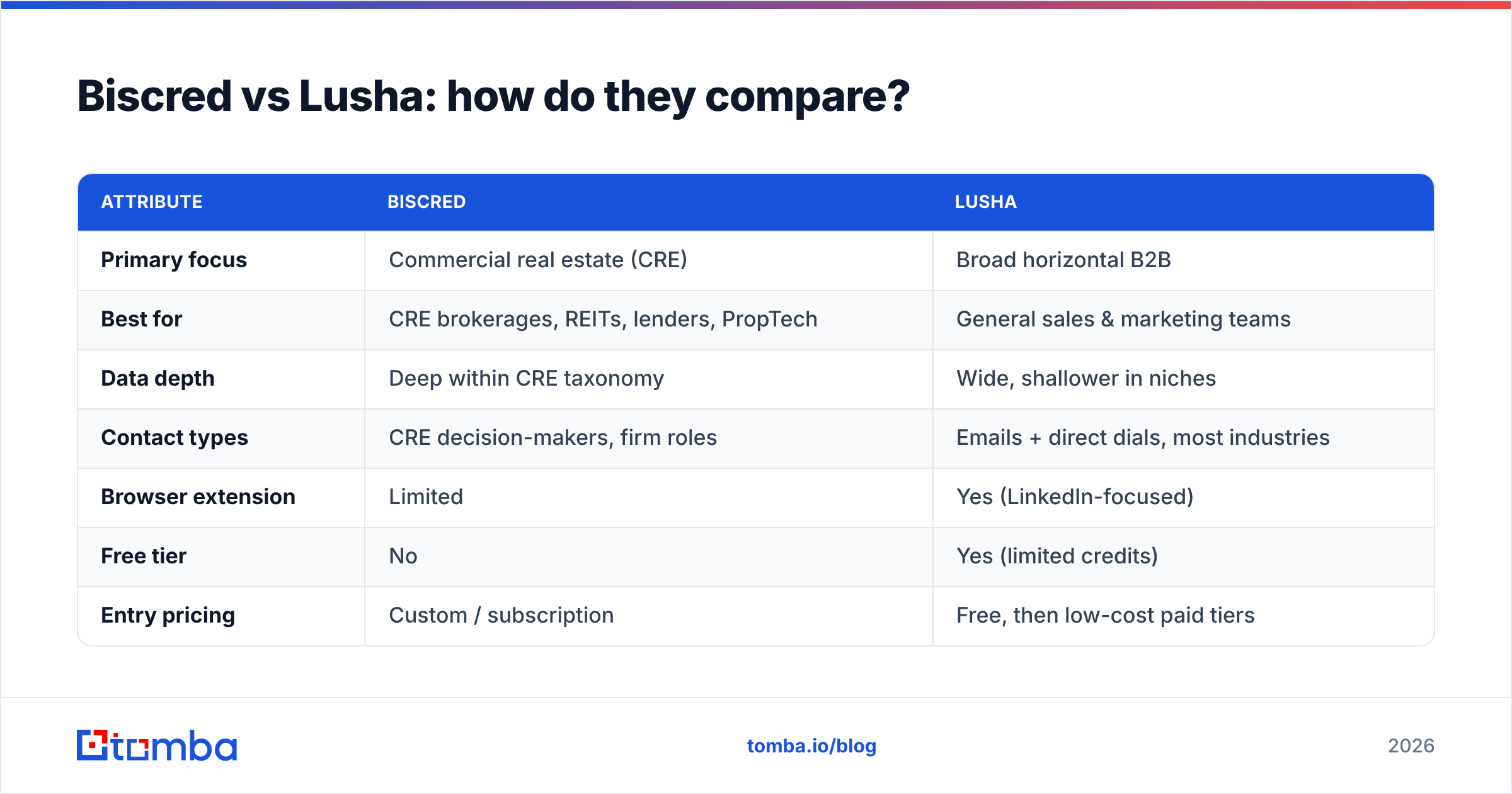
The honest summary: these tools barely compete head-to-head. They overlap only when a CRE-focused team evaluates whether a general database is "good enough." Here is the side-by-side.
| Attribute | Biscred | Lusha |
|---|---|---|
| Primary focus | Commercial real estate (CRE) | Broad horizontal B2B |
| Best for | CRE brokerages, REITs, lenders, PropTech | General sales & marketing teams |
| Data depth | Deep within CRE taxonomy | Wide, shallower in niches |
| Contact types | CRE decision-makers, firm roles | Emails + direct dials, most industries |
| Browser extension | Limited | Yes (LinkedIn-focused) |
| Free tier | No | Yes (limited credits) |
| Entry pricing | Custom / subscription | Free, then low-cost paid tiers |
| API / enrichment | Yes | Yes |
| Compliance posture | Standard B2B | GDPR/CCPA marketed heavily |
Which one has better data accuracy?#
It depends entirely on where you sell. Inside commercial real estate, Biscred's specialized sourcing and CRE-specific taxonomy generally produce cleaner, better-segmented records than a horizontal database — fewer mislabeled firm types, more accurate asset-class tagging. Outside CRE, Biscred has nothing to compare, so Lusha wins by default through sheer coverage.
No third-party database is 100% accurate, regardless of marketing claims. Bounce rates of 5–15% are normal for any B2B provider once data ages. That is why teams serious about deliverability run contacts through an independent email verifier before launching campaigns — it catches stale and risky addresses no matter which database produced them.
Which one is easier to use?#
Lusha is the more approachable day-to-day tool for most reps. The browser extension drops contact data into your workflow while you're already on LinkedIn, and the free tier lets a new user start in minutes. Biscred's interface is built for researchers and CRE-focused SDRs who live inside structured filters and saved searches — powerful, but with a steeper ramp if you're not already fluent in CRE segmentation.
How much do Biscred and Lusha cost?#
Pricing is where the two diverge most clearly.
Lusha publishes a tiered model: a free plan with limited monthly credits, then paid tiers that scale by credits, seats, and features (intent data, advanced filters, API access). That low entry point makes it easy for an individual rep or small team to test without procurement.
Biscred, like many vertical-specific data vendors, is sold primarily through custom subscriptions quoted per team and use case. There is no meaningful free tier — you book a demo and negotiate. That model fits enterprise CRE buyers but frustrates anyone who just wants to try the data first.
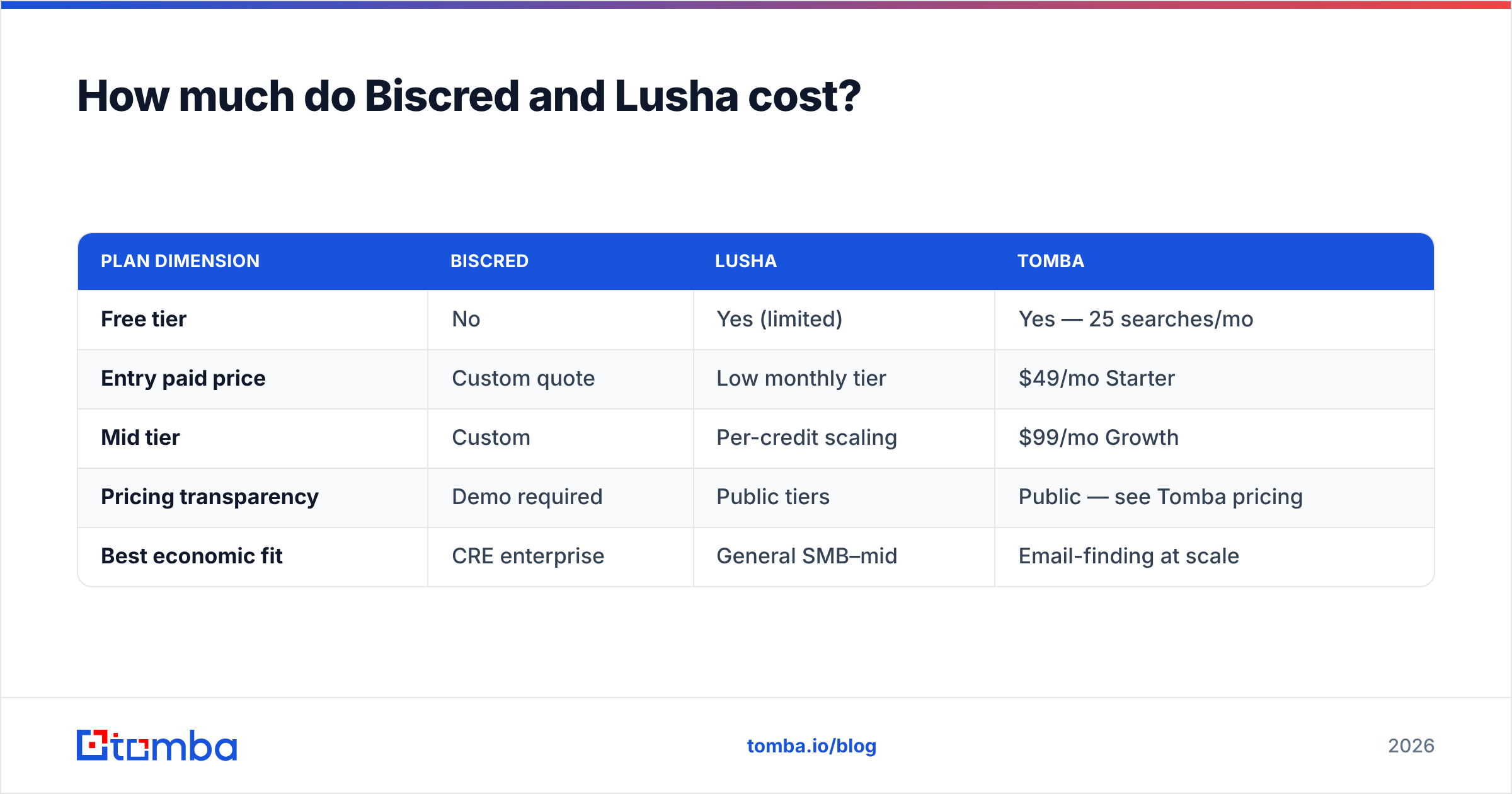
Here is a simplified cost-and-fit comparison, including where a dedicated finder lands:
| Plan dimension | Biscred | Lusha | Tomba |
|---|---|---|---|
| Free tier | No | Yes (limited) | Yes — 25 searches/mo |
| Entry paid price | Custom quote | Low monthly tier | $49/mo Starter |
| Mid tier | Custom | Per-credit scaling | $99/mo Growth |
| Pricing transparency | Demo required | Public tiers | Public — see Tomba pricing |
| Best economic fit | CRE enterprise | General SMB–mid | Email-finding at scale |
When should you pick Biscred?#
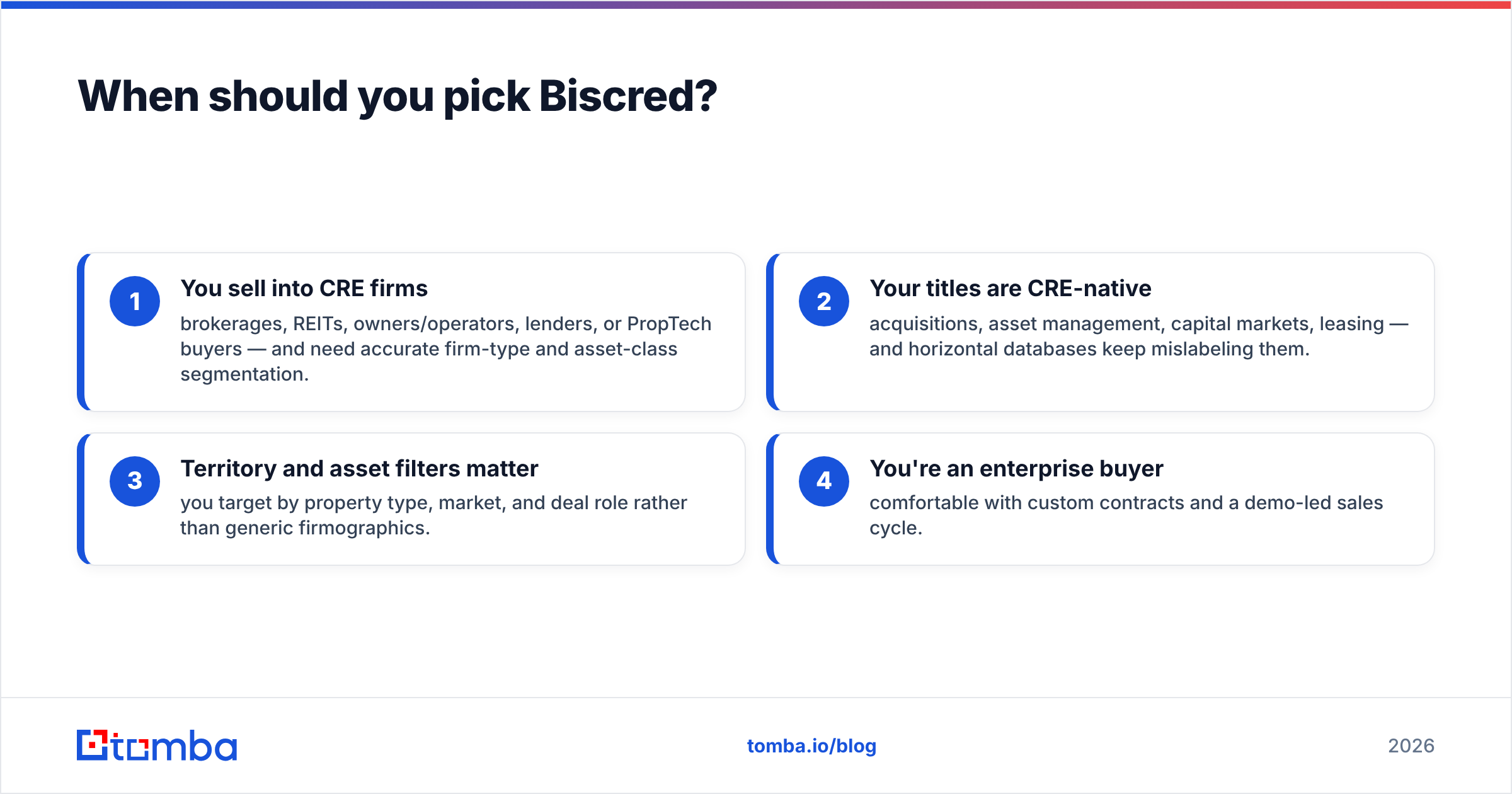
Pick Biscred when commercial real estate is your market, not a side segment. Specifically:
- You sell into CRE firms — brokerages, REITs, owners/operators, lenders, or PropTech buyers — and need accurate firm-type and asset-class segmentation.
- Your titles are CRE-native — acquisitions, asset management, capital markets, leasing — and horizontal databases keep mislabeling them.
- Territory and asset filters matter — you target by property type, market, and deal role rather than generic firmographics.
- You're an enterprise buyer comfortable with custom contracts and a demo-led sales cycle.
If two or more of those describe you, Biscred's depth will likely outperform a generalist tool inside your niche.
When should you pick Lusha?#
Pick Lusha when breadth and speed-to-start matter more than vertical depth:
- You sell across many industries and need one database that covers most of them.
- Your reps live on LinkedIn and want contact data inside the browser as they prospect — a workflow worth pairing with disciplined LinkedIn outreach.
- You want to start free and prove value before committing budget.
- Direct dials matter — Lusha's phone-number coverage is a frequent reason teams choose it over email-only tools.
For a horizontal, self-serve, rep-friendly tool, Lusha is the stronger default of the two.
What if you only need verified emails?#
Here's the question both platforms gloss over: do you need a full data platform, or do you just need accurate work emails for the people you've already identified?
A lot of teams over-buy. They pay platform prices for intent scores, dashboards, and enrichment fields they never touch, when the real bottleneck is simply: what's this person's verified work email? If that's you, a focused email finder is dramatically cheaper and often more accurate at the one job that matters.
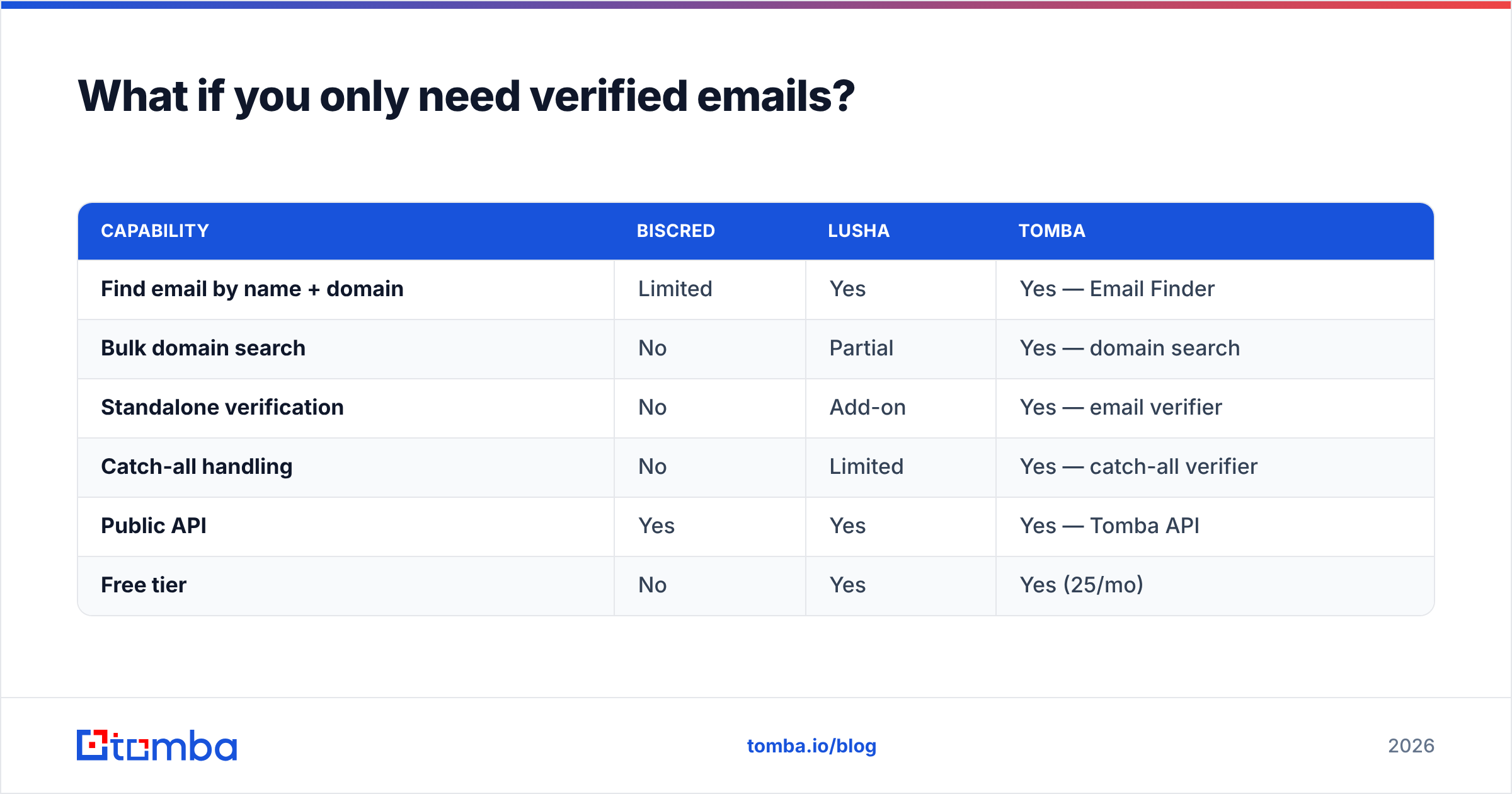
This is where Tomba fits between the two. Instead of a broad database subscription or a CRE-only niche tool, Tomba does email discovery and verification well, with transparent pricing and developer-friendly access:
| Capability | Biscred | Lusha | Tomba |
|---|---|---|---|
| Find email by name + domain | Limited | Yes | Yes — Email Finder |
| Bulk domain search | No | Partial | Yes — domain search |
| Standalone verification | No | Add-on | Yes — email verifier |
| Catch-all handling | No | Limited | Yes — catch-all verifier |
| Public API | Yes | Yes | Yes — Tomba API |
| Free tier | No | Yes | Yes (25/mo) |
The point isn't that Tomba replaces a full CRE database — it doesn't. The point is that many teams reaching for Biscred or Lusha really need accurate emails plus verification, not a platform. Match the tool to the job and you stop overpaying.
Biscred vs Lusha: the verdict#
There's no universal winner because they aren't really the same product. Biscred is a scalpel for commercial real estate. Lusha is a Swiss Army knife for general B2B.
- Choose Biscred if CRE is your entire world and segmentation accuracy inside that vertical is worth a custom contract.
- Choose Lusha if you sell broadly, want a free starting point, and value direct dials and an in-browser workflow.
- Choose a dedicated finder + verifier if your actual need is verified work emails at a sane price — that's the most common case, and the one both platforms quietly overcharge for.
Whatever database you build on, accuracy decays. The teams that protect deliverability treat verification as a continuous step, not a one-time purchase, and keep their sender reputation clean by validating before they send.
Start with accurate emails, not an oversized contract#
If you've read this far comparing two data platforms, you probably just want reliable contact emails without a demo call or an enterprise minimum. Start there. Use the Tomba Email Finder to pull verified, professional email addresses by name, company, or domain — free for your first 25 searches, then $49/mo when you scale. Find the people Biscred and Lusha would charge you a platform fee to reach, verify them before you send, and put your budget into pipeline instead of unused dashboards.
Ready to find emails that actually work?
Join 150,000+ professionals who stopped guessing and started sending. Free credits on signup — no credit card required.
Get the Tomba newsletter
Practical outbound tactics and product updates — once every two weeks.
About the author