Biscred vs Pubrio 2026: B2B Data Platforms Compared
Biscred specializes in commercial real estate data; Pubrio bets on AI-driven B2B enrichment. Here's how the two compare on coverage, accuracy, and price—and where a general tool like Tomba fits in.
Choosing between Biscred and Pubrio usually means you're stuck between two very different bets: one tool that goes deep on a single vertical, and one that goes wide with AI. They aren't really the same product, and picking the wrong one wastes a quarter of pipeline. This post breaks down what each does, who should use it, and where a general-purpose email and enrichment platform beats both.
TL;DR: Biscred vs Pubrio at a glance#
- Biscred is a niche B2B data platform built for commercial real estate (CRE) — brokers, lenders, investors, and proptech teams. Its edge is depth inside one industry, not breadth.
- Pubrio is an AI-first B2B prospecting and data-enrichment tool that promises intent signals, lookalike search, and contact data across many industries.
- Pricing is opaque on both sides; Biscred skews enterprise/seat-based, Pubrio uses credit tiers with a limited free trial.
- If you sell only into commercial real estate, Biscred's specialization is hard to beat. For everyone else, a horizontal finder + verifier stack is cheaper and more flexible.
- A general tool like Tomba Email Finder covers any industry, verifies in real time, and starts at a transparent $49/mo — no annual contract required.
What is Biscred?#
Biscred is a commercial-real-estate data company. Instead of trying to index every business on earth, it concentrates on the CRE ecosystem: property owners, tenants, brokerages, lenders, investment firms, and the decision-makers inside them. You get firmographic data, contact records, and relationship mapping tuned to how CRE deals actually get sourced.
The pitch is precision through narrowness. If you're prospecting a tenant-rep broker in a specific metro, a vertical database that already understands "tenant rep" as a category beats a generic tool that just sees a job title string. Biscred leans into that, plus integrations with CRM and CRE-specific workflows.
The tradeoff is obvious: outside commercial real estate, the data thins out fast. You're paying for a specialist, and specialists are expensive when you only need them occasionally.

What is Pubrio?#
Pubrio markets itself as an AI-powered B2B lead generation and enrichment platform. The headline features are an AI search ("describe your ideal customer in plain English"), lookalike company discovery, buyer-intent signals, and contact enrichment with emails and phone numbers across industries.
Where Biscred is deep-and-narrow, Pubrio is wide-and-automated. The AI layer is the differentiator — you lean on the model to translate fuzzy ICP descriptions into target lists, then enrich them. For teams that don't want to build boolean filters by hand, that's appealing.
The risk with any AI-wrapper data tool is the data underneath. A slick interface doesn't fix a stale email or a guessed phone number. Intent data in particular varies wildly in quality between vendors, and "AI-sourced" can quietly mean "scraped and unverified." Always test the underlying data accuracy before you trust the automation on top of it.
Biscred vs Pubrio: how do they compare?#
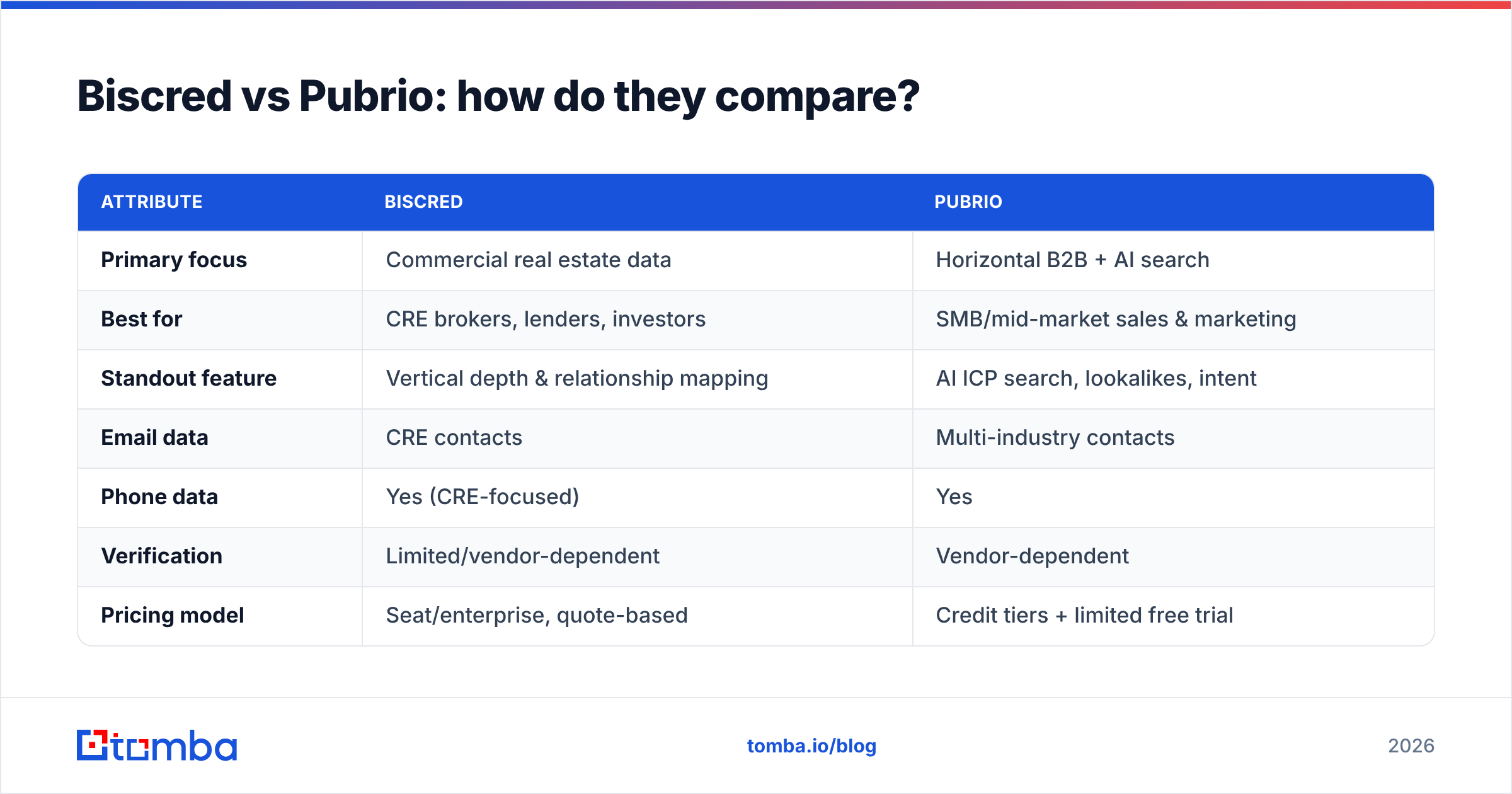
Here's the head-to-head on the attributes that actually affect your pipeline.
| Attribute | Biscred | Pubrio |
|---|---|---|
| Primary focus | Commercial real estate data | Horizontal B2B + AI search |
| Best for | CRE brokers, lenders, investors | SMB/mid-market sales & marketing |
| Standout feature | Vertical depth & relationship mapping | AI ICP search, lookalikes, intent |
| Email data | CRE contacts | Multi-industry contacts |
| Phone data | Yes (CRE-focused) | Yes |
| Verification | Limited/vendor-dependent | Vendor-dependent |
| Pricing model | Seat/enterprise, quote-based | Credit tiers + limited free trial |
| Free plan | No public free tier | Limited trial credits |
| API access | Limited | Yes |
| Coverage outside niche | Weak | Broad but variable quality |
The short read: these tools rarely compete for the same buyer. You choose Biscred because you live in CRE. You choose Pubrio because you want one AI-driven tool to cover many industries. The real question is whether either is the most cost-effective way to get verified contact data — and for most teams, the answer is no.
When should you pick Biscred over Pubrio?#
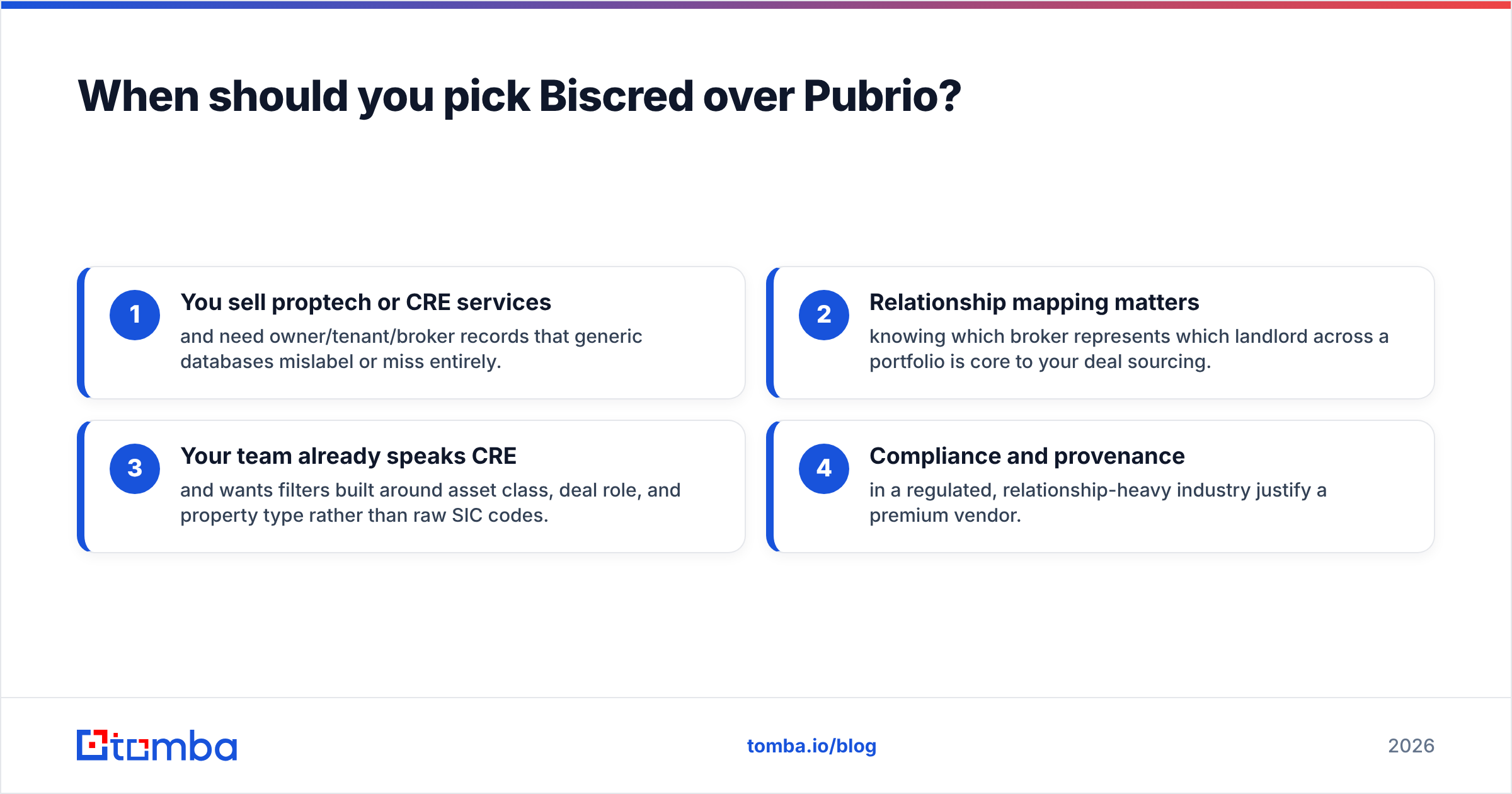
Pick Biscred when commercial real estate is your entire market. A few situations where the specialization pays for itself:
- You sell proptech or CRE services and need owner/tenant/broker records that generic databases mislabel or miss entirely.
- Relationship mapping matters — knowing which broker represents which landlord across a portfolio is core to your deal sourcing.
- Your team already speaks CRE and wants filters built around asset class, deal role, and property type rather than raw SIC codes.
- Compliance and provenance in a regulated, relationship-heavy industry justify a premium vendor.
If two or more of those describe you, Biscred's narrowness is a feature. If none do, you're overpaying for data you'll never use. Check the vendor's own site at biscred.com for current coverage claims, and validate them against a sample before committing to a seat-based contract.
When should you pick Pubrio over Biscred?#
Pick Pubrio when you want AI-assisted prospecting across multiple industries and you're comfortable trusting an interface to do the targeting work. It fits when:
- Your ICP spans several verticals and a CRE-only database is useless to you.
- You'd rather type "Series B fintech companies hiring SDRs" than build a 12-filter boolean query.
- You want intent signals layered onto contact data in one place.
- You need API access to push enriched records into your own systems.
Just budget time to audit the data quality. Run a sample export, then put the emails through an independent email verifier before you load them into a sequence. AI targeting is only as good as the contact records it returns, and bounce rates above 3-5% will quietly tank your sender reputation. You can sanity-check vendor claims with third-party reviews on G2 and on Pubrio's own site, pubrio.com.
Where does a general-purpose tool fit?#
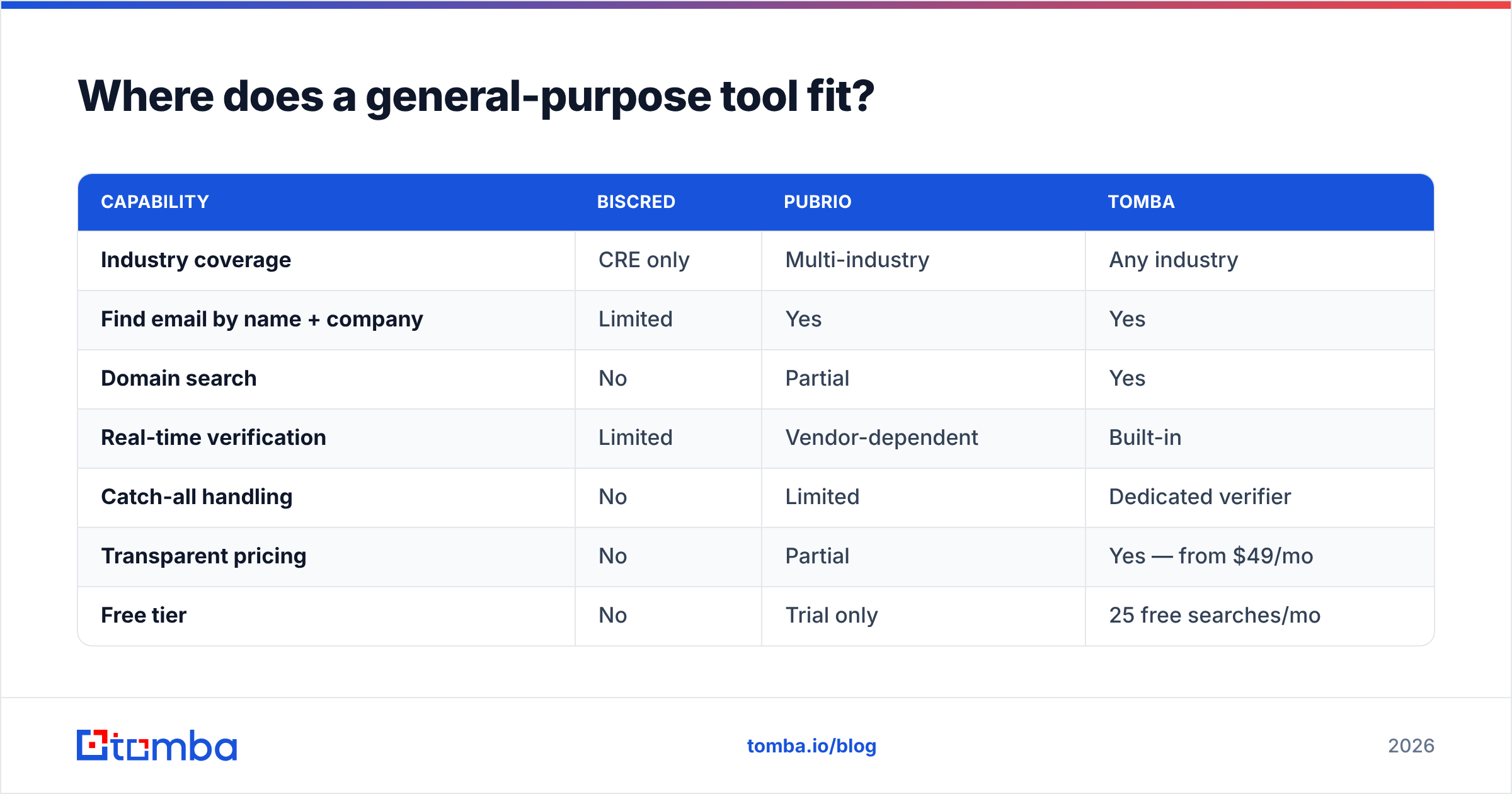
Most teams don't actually need a vertical CRE database or an AI black box — they need accurate emails, verified in real time, across whatever industries they happen to sell into. That's the gap a horizontal finder fills.
Compare the three approaches on the dimensions that drive cost and deliverability:
| Capability | Biscred | Pubrio | Tomba |
|---|---|---|---|
| Industry coverage | CRE only | Multi-industry | Any industry |
| Find email by name + company | Limited | Yes | Yes |
| Domain search | No | Partial | Yes |
| Real-time verification | Limited | Vendor-dependent | Built-in |
| Catch-all handling | No | Limited | Dedicated verifier |
| Transparent pricing | No | Partial | Yes — from $49/mo |
| Free tier | No | Trial only | 25 free searches/mo |
| Bulk + API + extensions | Limited | API | API, CLI, Sheets, Chrome |
The advantage of a general tool is that it doesn't lock you into one industry's data model or one vendor's intent feed. You find the email, verify it, optionally enrich the contact, and move on — at a price you can see before you talk to sales. With Tomba pricing starting at $49/mo (Starter), $99/mo (Growth), and $249/mo (Pro), the economics are clear up front, unlike the quote-driven motion on the specialist side.
Is Biscred or Pubrio more accurate?#
Accuracy depends on where you're prospecting, not on the brand. Inside commercial real estate, Biscred's curated data will usually beat a generic AI export — that's the whole point of a vertical vendor. Outside CRE, Biscred has little to offer, and Pubrio's accuracy becomes a function of whatever data partners sit behind its AI layer.
The honest answer: always test on your own target list. Pull 100 contacts from each tool, send them through an independent verifier, and measure the valid/catch-all/invalid split. A vendor that looks great in a demo can return 15% invalids on your specific segment. Real-time verification — checking the mailbox at the moment you export, not weeks earlier — is what actually protects your bounce rate, and it's the single feature most data platforms treat as an afterthought.
What does each tool cost in 2026?#
Neither Biscred nor Pubrio publishes fully transparent pricing, which is itself a signal.
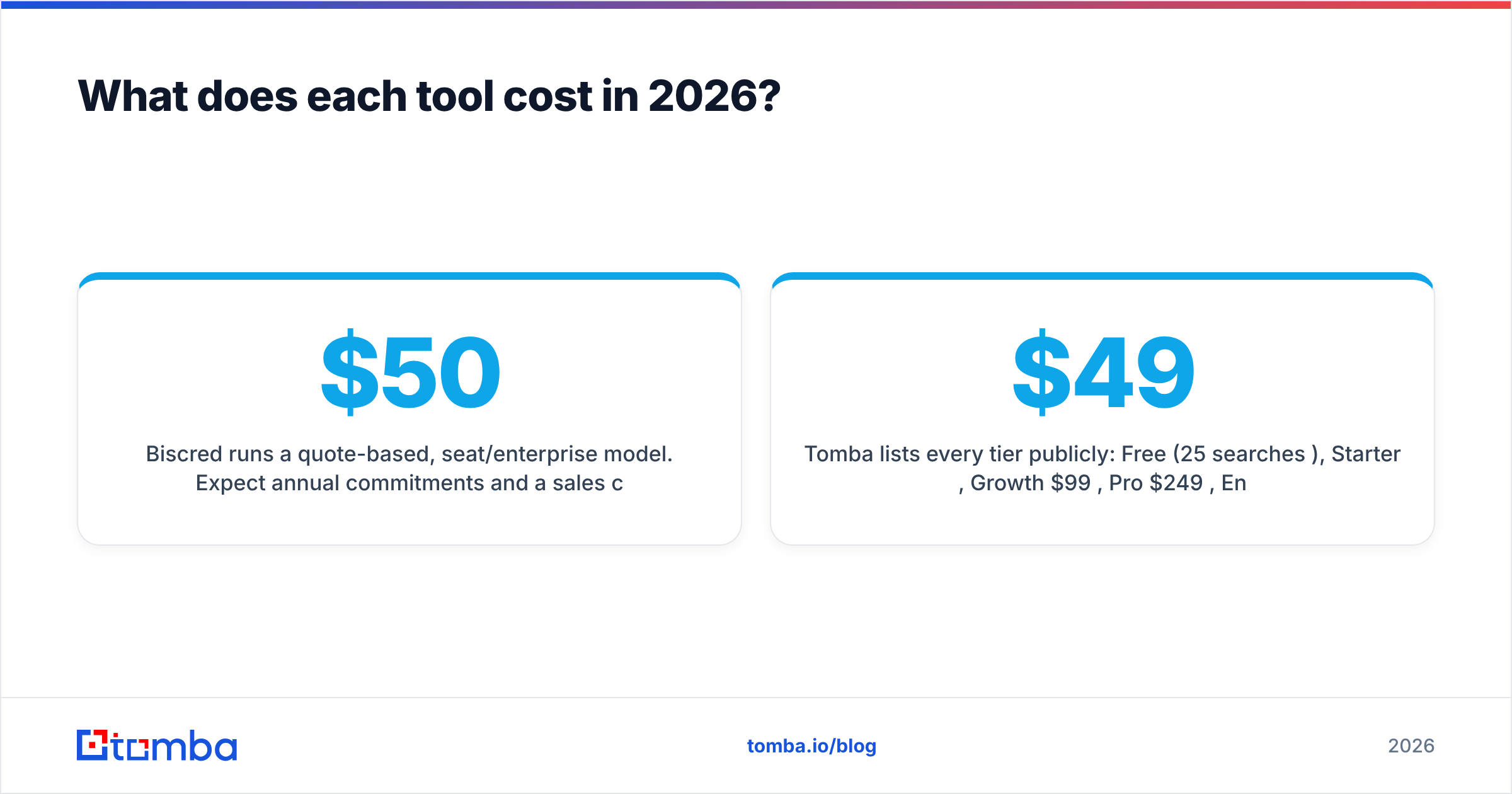
- Biscred runs a quote-based, seat/enterprise model. Expect annual commitments and a sales conversation. That's normal for vertical data vendors but it raises the floor — this isn't a tool you trial for $50 and cancel next month.
- Pubrio uses credit-based tiers with a limited free trial, so you can sample it, but heavy enrichment volume escalates quickly and intent features often sit in higher plans.
- Tomba lists every tier publicly: Free (25 searches/mo), Starter $49/mo, Growth $99/mo, Pro $249/mo, Enterprise custom — month-to-month, no contract required to start.
For a team that wants to control spend and avoid a procurement cycle, transparent per-credit pricing beats "request a quote" almost every time. You can model your cost before the first call.
Which should you choose?#
Decide by your market, not the marketing:
- You sell exclusively into commercial real estate → Biscred. The vertical depth justifies the premium and the contract.
- You want AI-driven targeting across many industries and will audit data quality → Pubrio. Test the underlying records hard before scaling spend.
- You need accurate, verified B2B emails across any industry at a predictable price → a horizontal finder + verifier stack. This is most teams.
The mistake is buying a specialist tool for a generalist problem. If your prospecting isn't CRE-specific, you don't need a CRE database, and you probably don't need an AI wrapper either — you need clean contact data you can trust on the first send.
The bottom line#
Biscred and Pubrio solve narrow problems well: one owns a vertical, the other automates targeting. But if your real job is "get the right person's verified email and reach out," a general-purpose platform is faster, cheaper, and more flexible than either.
Start with the Tomba Email Finder — find professional emails by name, company, or domain across any industry, verify them in real time to keep bounces low, and enrich the records your CRM is missing. Spin up the free tier with 25 searches a month, test it against your actual target list, and only pay the $49/mo Starter price once you've seen the accuracy for yourself. No quote, no annual lock-in, no single-industry ceiling.
Ready to find emails that actually work?
Join 150,000+ professionals who stopped guessing and started sending. Free credits on signup — no credit card required.
Get the Tomba newsletter
Practical outbound tactics and product updates — once every two weeks.
About the author