Biscred vs Reachfast: Which B2B Data Tool Wins in 2026?
Biscred targets commercial real estate data; Reachfast chases contact lookups. Here's an honest 2026 breakdown of pricing, coverage, accuracy, and the better-value alternative.
Choosing between Biscred and Reachfast usually means you're stuck somewhere between "I need commercial real estate contacts" and "I just need verified emails and phone numbers, fast." These two tools get lumped together in comparison searches, but they solve different problems — and picking the wrong one wastes budget on data you'll never use.
This is a neutral teardown. Where Biscred wins, we'll say so. Where Reachfast is the better buy, same. And where a horizontal B2B data tool beats both for general prospecting, we'll show the numbers.
TL;DR — Biscred vs Reachfast at a glance#
- Biscred is a niche commercial real estate (CRE) intelligence platform — strong if you sell to brokers, owners, investors, and property managers, weak for everything else.
- Reachfast is a lightweight contact-lookup tool focused on pulling emails and mobile numbers, often from LinkedIn-style workflows.
- Pricing: Biscred is enterprise-priced (annual, quote-based, typically four figures); Reachfast is credit-based and cheaper to start.
- Accuracy: Both depend heavily on verification you may have to do yourself — neither is a guaranteed deliverability solution.
- Better-value pick for general B2B: a horizontal email-finder like Tomba Email Finder covers any industry with built-in verification starting at $49/mo.
What is Biscred and who is it for?#
Biscred is a vertical B2B data platform built specifically for the commercial real estate industry. Instead of trying to cover every company on earth, it indexes CRE-specific firms and roles: investment sales brokers, debt and equity teams, asset managers, owners, developers, and tenant-rep specialists.
That focus is the whole pitch. If your total addressable market is "people who transact commercial property in North America," Biscred's data model is shaped around your world — property types, deal roles, firm relationships — in a way a generic database isn't. You can filter by asset class (office, industrial, multifamily, retail) and by function, which is genuinely hard to replicate with a horizontal tool.
The trade-off is obvious: outside CRE, Biscred is the wrong tool. You're paying a premium for depth in one vertical. It's also sold on the enterprise model — annual contracts, sales-led onboarding, seat-based pricing — so it's not something you spin up on a Tuesday afternoon to test.

What is Reachfast and who is it for?#
Reachfast sits at the opposite end. It's a contact-finding tool — feed it a name and company (or a LinkedIn profile), and it returns a likely email address and, in many cases, a mobile phone number. The use case is speed: a rep wants a contact's details right now, without leaving their prospecting flow.
Reachfast competes in the same broad space as RocketReach, ContactOut, and Lusha. It's horizontal — no industry lock-in — and credit-based, so cost scales with how many lookups you run. That makes it easier to start than Biscred, but it also means your bill grows with volume, and the per-lookup quality can swing depending on the contact's seniority and region.
The honest caveat with any pure lookup tool: a returned email is a guess plus a check, not a guarantee. Bounce rates depend on how aggressively the tool verifies before handing you the address. If you skip your own email verification step, you'll feel it in your sender reputation.
Biscred vs Reachfast: the core comparison table#
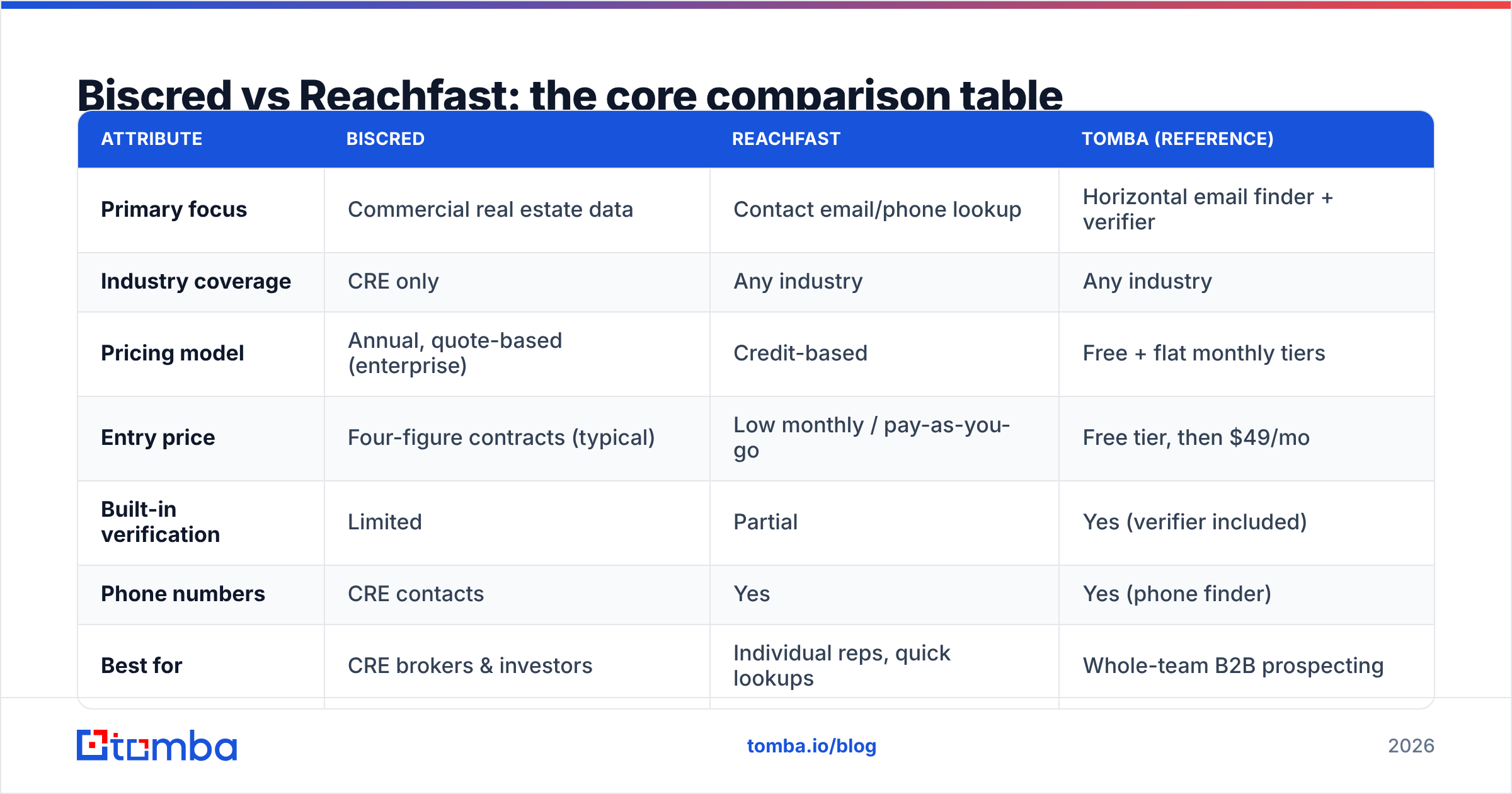
Here's the side-by-side on the attributes that actually drive a buying decision.
| Attribute | Biscred | Reachfast | Tomba (reference) |
|---|---|---|---|
| Primary focus | Commercial real estate data | Contact email/phone lookup | Horizontal email finder + verifier |
| Industry coverage | CRE only | Any industry | Any industry |
| Pricing model | Annual, quote-based (enterprise) | Credit-based | Free + flat monthly tiers |
| Entry price | Four-figure contracts (typical) | Low monthly / pay-as-you-go | Free tier, then $49/mo |
| Built-in verification | Limited | Partial | Yes (verifier included) |
| Phone numbers | CRE contacts | Yes | Yes (phone finder) |
| Best for | CRE brokers & investors | Individual reps, quick lookups | Whole-team B2B prospecting |
| Free trial / tier | Demo only | Limited credits | 25 searches/mo free |
The pattern is clear: Biscred trades breadth for vertical depth, Reachfast trades depth for speed and low entry cost, and a horizontal platform tries to give you reasonable depth across every vertical with verification baked in.
Is Biscred better than Reachfast for accuracy?#
It depends entirely on who you're researching. For a multifamily acquisitions director at a regional CRE firm, Biscred will almost always have richer, more correct data — that's its home turf. For a VP of Engineering at a SaaS company, Biscred has nothing and Reachfast (or any horizontal tool) wins by default.
Accuracy in this space is less about a single vendor's magic and more about three things:
- Source freshness — how recently the underlying record was confirmed.
- Verification depth — whether the tool runs SMTP and catch-all checks before returning an email.
- Coverage fit — a perfect database for the wrong industry is 0% accurate for you.
This is why teams that prospect across industries often layer a verification step on top of whatever finder they use. Even a "verified" email benefits from a fresh check at send time, especially on catch-all domains where SMTP responses lie.

If accuracy across many verticals matters more than depth in one, a horizontal tool with transparent data sources and a built-in verifier is the safer structural bet — you're not betting your whole pipeline on one industry's data staying fresh.
How do Biscred and Reachfast pricing compare?#
This is where the two tools separate hardest.
Biscred is enterprise software. Expect an annual commitment, seat-based pricing, and a sales conversation before you see a number. That model makes sense if CRE is your entire business and the data pays for itself on a single closed deal — a commercial property commission dwarfs the subscription. It makes no sense as an experiment.
Reachfast is consumption-priced. You buy credits, you spend credits, your cost tracks usage. Cheaper to start, but two risks: costs balloon at scale, and you can burn credits on lookups that return low-confidence or unverified data.
Neither is wrong — they're priced for different buyers. But if you're a generalist B2B team, both pricing models can feel punishing: Biscred because you pay for a vertical you barely touch, Reachfast because per-credit economics get ugly past a few thousand lookups a month.
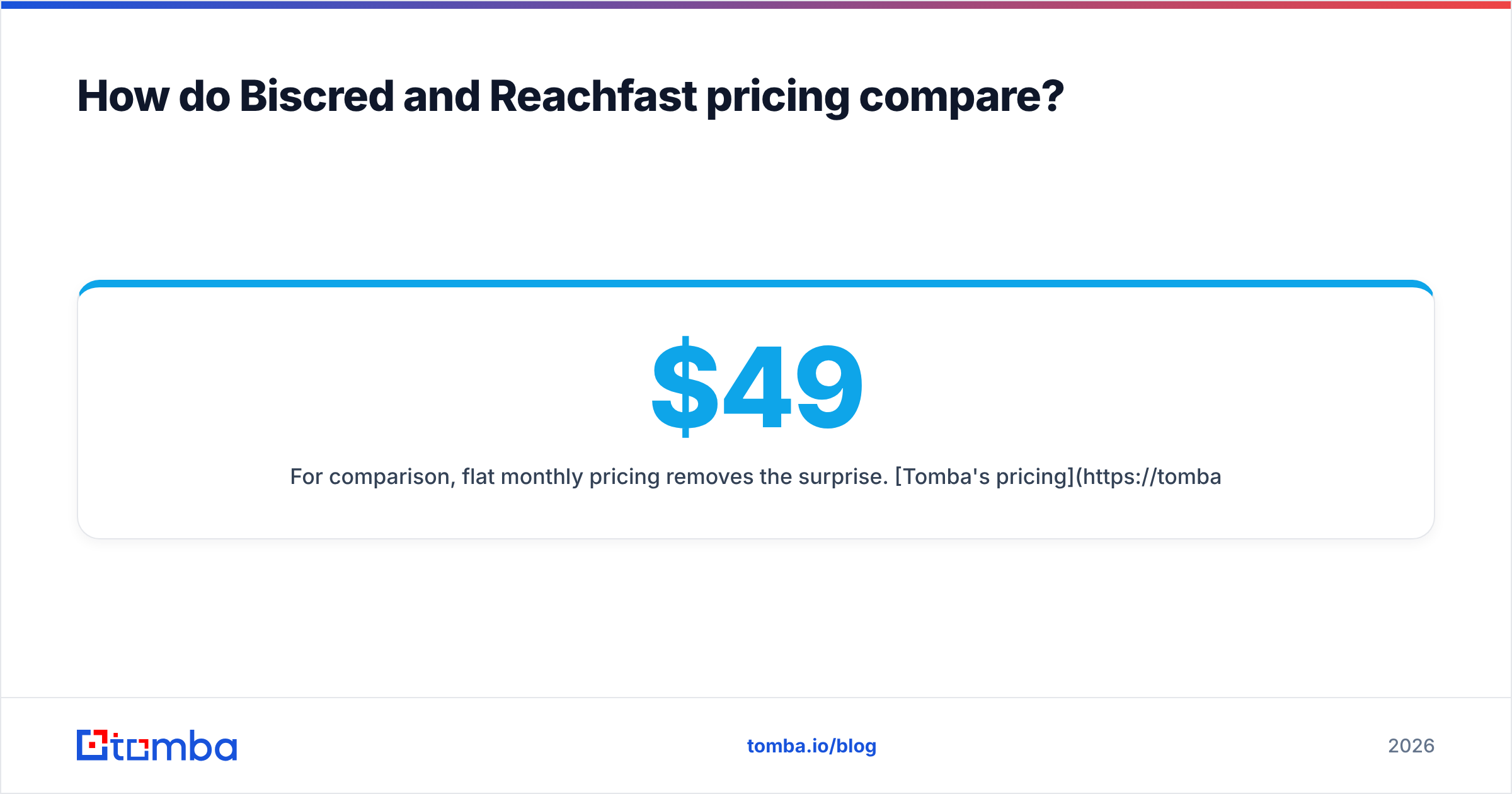
For comparison, flat monthly pricing removes the surprise. Tomba's pricing runs a free tier (25 searches/mo), then $49/mo Starter, $99/mo Growth, $249/mo Pro, and custom Enterprise — predictable regardless of how the month goes.
When should you actually choose Biscred?#
Pick Biscred when all of these are true:
- Your ICP is commercial real estate. Brokers, owners, lenders, investors, property managers.
- You sell high-value deals. The data cost is trivial against a single CRE commission or PropTech enterprise contract.
- You need role and asset-class filtering that horizontal tools can't replicate.
- You can commit annually. You're not testing — you're standardizing your CRE go-to-market on it.
If you're a PropTech vendor, a CRE-focused lender, or a brokerage building an outbound motion, Biscred's depth is hard to beat and probably worth the premium.
When should you choose Reachfast — or something else?#
Reachfast fits when you want fast individual lookups without a contract: a single rep enriching a short list, a founder doing manual outreach, or anyone who values "get me this person's email now" over bulk coverage.
But "I need contact data across industries at predictable cost" describes most B2B teams, and that's exactly the gap a horizontal platform fills better than either contender. Consider the broader category before you commit:
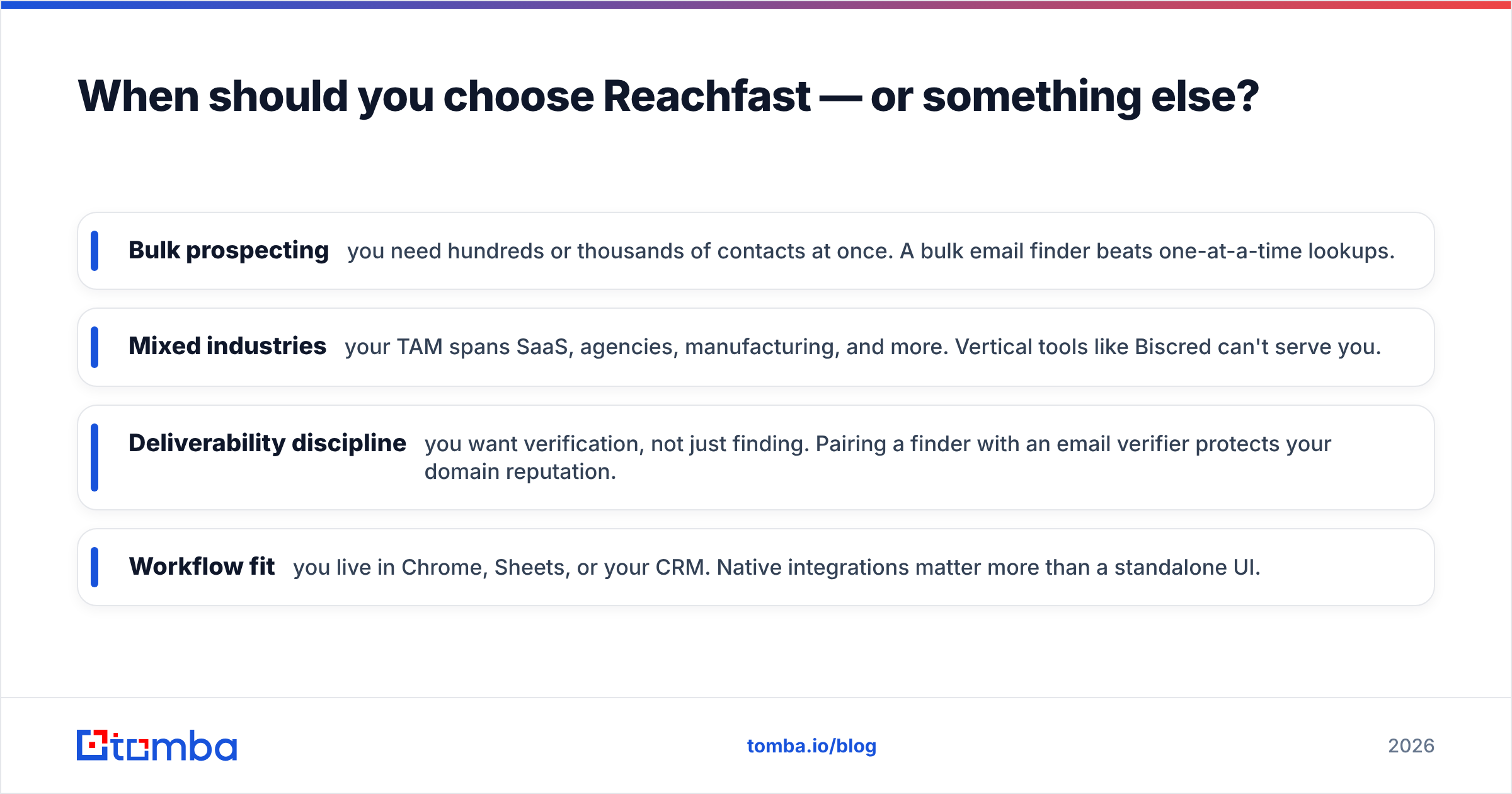
- Bulk prospecting — you need hundreds or thousands of contacts at once. A bulk email finder beats one-at-a-time lookups.
- Mixed industries — your TAM spans SaaS, agencies, manufacturing, and more. Vertical tools like Biscred can't serve you.
- Deliverability discipline — you want verification, not just finding. Pairing a finder with an email verifier protects your domain reputation.
- Workflow fit — you live in Chrome, Sheets, or your CRM. Native integrations matter more than a standalone UI.
How does a horizontal alternative compare to both?#
Here's the structured breakdown of why generalist B2B teams often skip both Biscred and Reachfast:
- Coverage breadth — A horizontal email finder works for any domain or industry, so you're never locked out of a segment the way Biscred locks out non-CRE.
- Predictable cost — Flat monthly tiers (free → $49 → $99 → $249) avoid both Biscred's enterprise floor and Reachfast's per-credit creep.
- Verification included — Finding and verifying in one platform means fewer bounces than a finder that hands you unchecked guesses.
- Multiple data products — Beyond emails, you get domain search, a phone finder, and data enrichment under one roof.
- Self-serve start — A free tier and instant signup beat "book a demo" when you just want to test data quality on your own list.

None of this makes Biscred bad — for CRE, its depth is the point. It makes the category matter: match the tool's shape to your market's shape. A laser tool for a wide target misses; a wide tool for a laser target wastes nothing because you simply ignore the segments you don't need.
Biscred vs Reachfast: which should you buy in 2026?#
Conclusion first: buy Biscred if commercial real estate is your entire business, buy Reachfast for cheap one-off lookups, and look at a horizontal finder if you prospect across industries at any real volume.
- Choose Biscred for CRE depth, role/asset-class filtering, and high-ticket deals that justify enterprise pricing.
- Choose Reachfast for low-commitment, individual contact lookups when you don't need bulk or industry breadth.
- Choose a horizontal platform when you need predictable pricing, multi-industry coverage, built-in verification, and bulk workflows.
The most common mistake is buying for the logo instead of the fit — signing an annual CRE contract for a team that sells to everyone, or running thousands of per-credit lookups when a flat plan would cost a fraction. Map your ICP first, then pick the tool whose data model matches it.
For broader context, you can cross-check vendor claims on independent review sites like G2 and Capterra before committing to any annual contract — real user reviews surface coverage gaps that sales demos hide. And if you're evaluating CRE data specifically, HubSpot's guidance on sales prospecting is a useful neutral baseline for what "good" contact data should deliver.
Ready to test data quality without a contract?#
If your prospecting isn't locked to a single vertical, start with a tool you can try in minutes instead of a quarter-long enterprise rollout. Tomba Email Finder covers any industry, verifies emails before it hands them over, and adds phone lookup, domain search, and enrichment on top — all on a free tier (25 searches/mo) you can use today, scaling to flat $49/mo when you're ready. Run your own list through it, compare the hit rate and bounce rate against Biscred or Reachfast, and let the numbers decide. That's the only comparison that matters.
Ready to find emails that actually work?
Join 150,000+ professionals who stopped guessing and started sending. Free credits on signup — no credit card required.
Get the Tomba newsletter
Practical outbound tactics and product updates — once every two weeks.
About the author