Biscred vs Reachstream 2026: B2B Data Platforms Compared
Biscred targets commercial real estate intelligence; Reachstream sells broad B2B contact lists. Here's how the two stack up on data, pricing, and accuracy in 2026 — and where a verification-first stack beats both.
TL;DR
- Biscred is a niche commercial real estate (CRE) intelligence platform — it maps owners, brokers, lenders, and property records, then attaches contacts to that graph.
- Reachstream is a broad, generalist B2B contact database — millions of records across industries sold as searchable lists and CSV exports.
- They are not really the same tool: pick Biscred if your entire motion is CRE, pick Reachstream if you need cheap horizontal coverage across many sectors.
- Both share the same weakness static databases have: records decay 25–30% a year, so accuracy at the moment of send is what actually matters.
- The smart 2026 stack pairs a data source with a real-time verification and enrichment layer like Tomba so you only contact addresses that still resolve.
What are Biscred and Reachstream?#
Biscred and Reachstream both sell B2B contact data, but they solve different problems. Biscred is vertical; Reachstream is horizontal.
Think of it like grocery shopping. Biscred is the specialty butcher who knows exactly which cut came from which farm — narrow, deep, and authoritative inside one category. Reachstream is the warehouse club: huge aisles, low prices, and you grab what you can in bulk. Neither is "better" in the abstract; it depends on what you came to buy.
Technically:
- Biscred focuses on commercial real estate. It connects properties, ownership entities, debt, and the people behind them — investors, brokers, asset managers, lenders — so a CRE seller can work an account by building, not just by company name.
- Reachstream is a generalist B2B database covering tens of millions of contacts across most industries, exposed through filters (title, industry, geography, company size) and exported as lists.
If your sales motion lives entirely inside CRE, the specialist usually wins on relevance. If you sell horizontally — SaaS, agencies, staffing, recruiting — the generalist gives you reach the specialist can't.
How do Biscred and Reachstream compare head-to-head?#
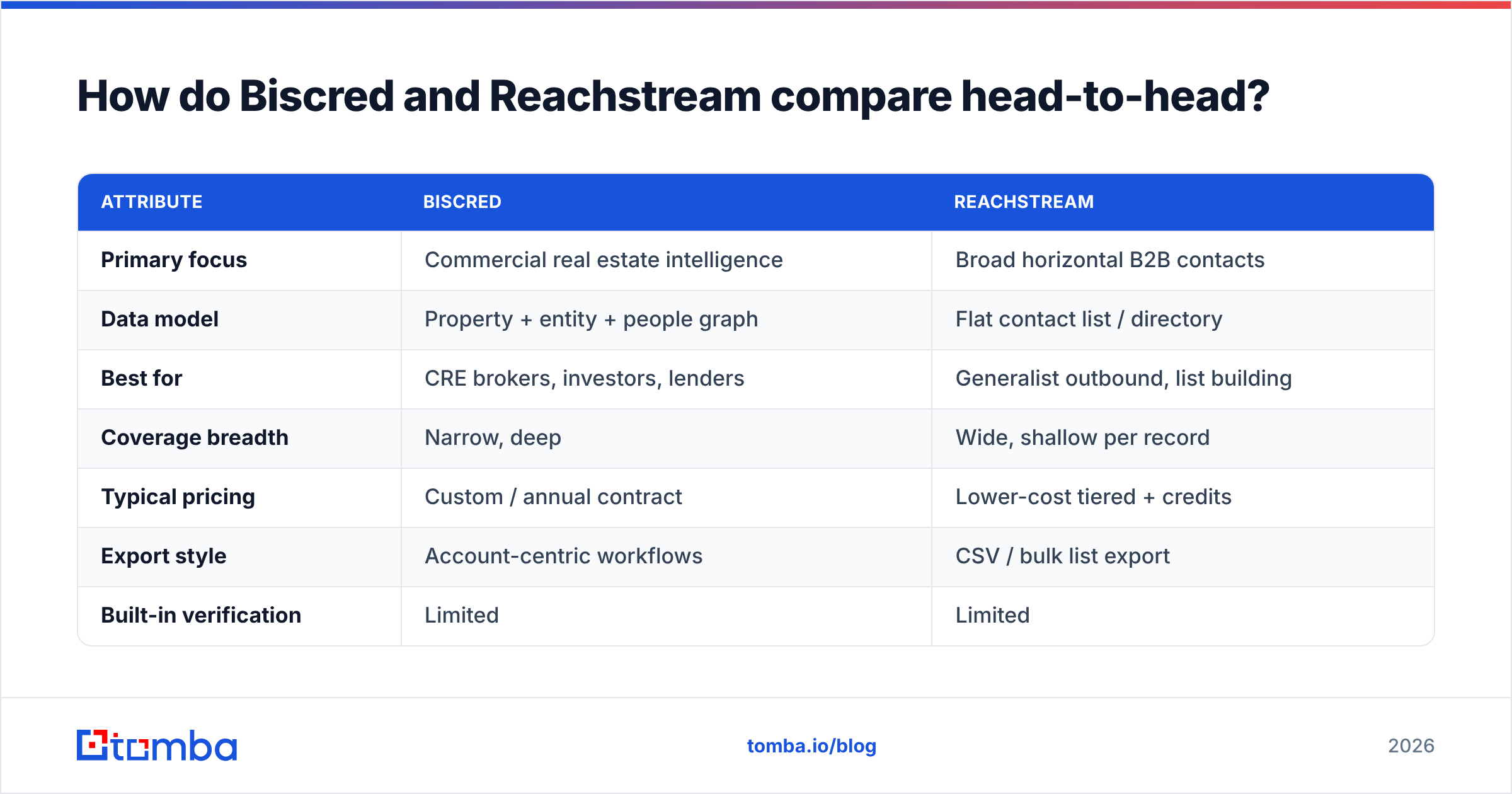
Here's the practical breakdown. Pricing for both is quote-based and changes, so treat dollar figures as directional rather than locked.
| Attribute | Biscred | Reachstream |
|---|---|---|
| Primary focus | Commercial real estate intelligence | Broad horizontal B2B contacts |
| Data model | Property + entity + people graph | Flat contact list / directory |
| Best for | CRE brokers, investors, lenders | Generalist outbound, list building |
| Coverage breadth | Narrow, deep | Wide, shallow per record |
| Typical pricing | Custom / annual contract | Lower-cost tiered + credits |
| Export style | Account-centric workflows | CSV / bulk list export |
| Built-in verification | Limited | Limited |
| Free trial | Demo-gated | Limited free option |
The pattern is clear: Biscred sells depth in one vertical, Reachstream sells breadth across many. The column that matters most — and where both score "limited" — is built-in verification. That's the gap your stack has to close.
)
Is Biscred better than Reachstream?#
Only if you sell commercial real estate. Outside CRE, the question barely makes sense.
Use Biscred when:
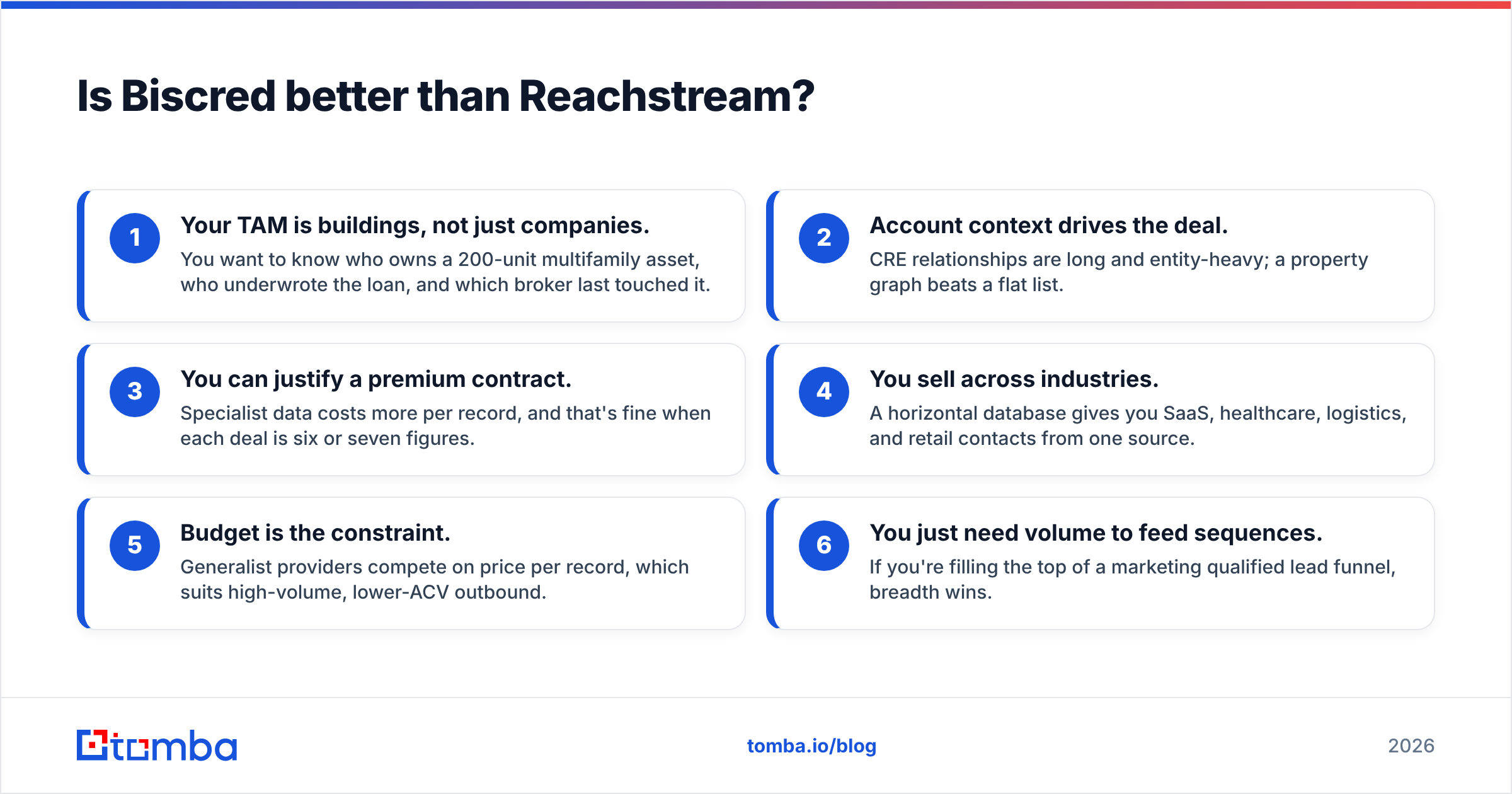
- Your TAM is buildings, not just companies. You want to know who owns a 200-unit multifamily asset, who underwrote the loan, and which broker last touched it.
- Account context drives the deal. CRE relationships are long and entity-heavy; a property graph beats a flat list.
- You can justify a premium contract. Specialist data costs more per record, and that's fine when each deal is six or seven figures.
Use Reachstream when:
- You sell across industries. A horizontal database gives you SaaS, healthcare, logistics, and retail contacts from one source.
- Budget is the constraint. Generalist providers compete on price per record, which suits high-volume, lower-ACV outbound.
- You just need volume to feed sequences. If you're filling the top of a marketing qualified lead funnel, breadth wins.
Neither tool removes the core problem of bought data: it ages. A list that was 95% accurate when it was compiled is materially worse three quarters later. According to widely cited B2B benchmarks, contact databases decay roughly 25–30% per year as people change jobs, companies rebrand, and domains migrate.
Why does data accuracy matter more than the source?#
Because your sender reputation is spent on every bad send — not on every good record you bought.
Bounce rates are the hinge. Mailbox providers read a high bounce rate as a spam signal, and once your sender reputation drops, even your good emails land in spam. So the most expensive line item isn't the database subscription; it's the deliverability you burn pushing stale records.
This is where both Biscred and Reachstream leave you exposed. They are acquisition tools, not validation tools. A modern process treats data sourcing and data verification as two separate jobs:
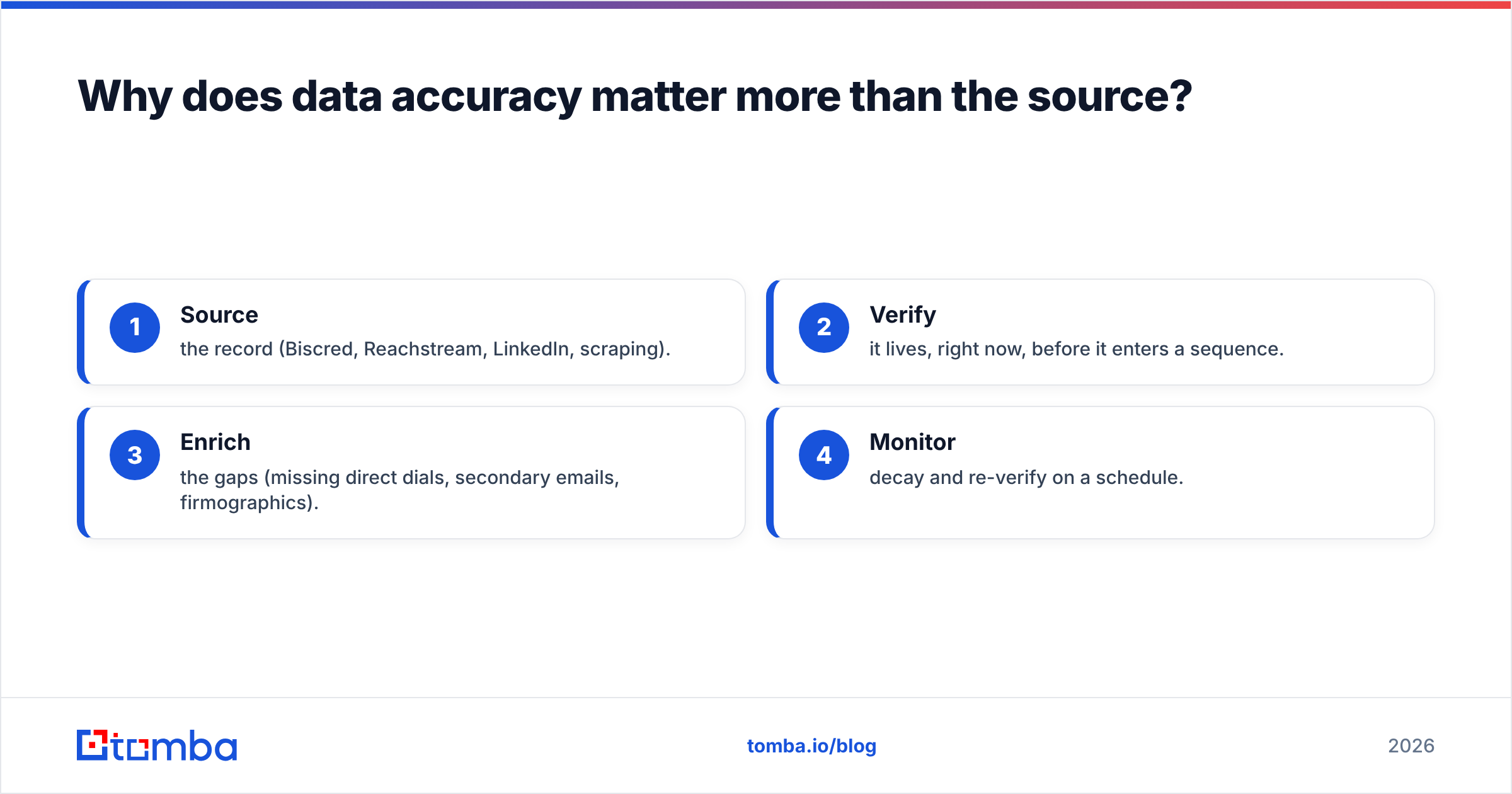
- Source the record (Biscred, Reachstream, LinkedIn, scraping).
- Verify it lives, right now, before it enters a sequence.
- Enrich the gaps (missing direct dials, secondary emails, firmographics).
- Monitor decay and re-verify on a schedule.
Tomba slots into steps 2–4 regardless of where the record came from. You can run any imported list through the email verifier to strip dead addresses, confirm catch-all domains, and protect email deliverability before the first send. That's the part the static databases don't do well.
)
How does Tomba fit alongside Biscred or Reachstream?#
Tomba is the verification-and-fill layer, not a replacement for either niche. You keep your source of record and bolt on accuracy.
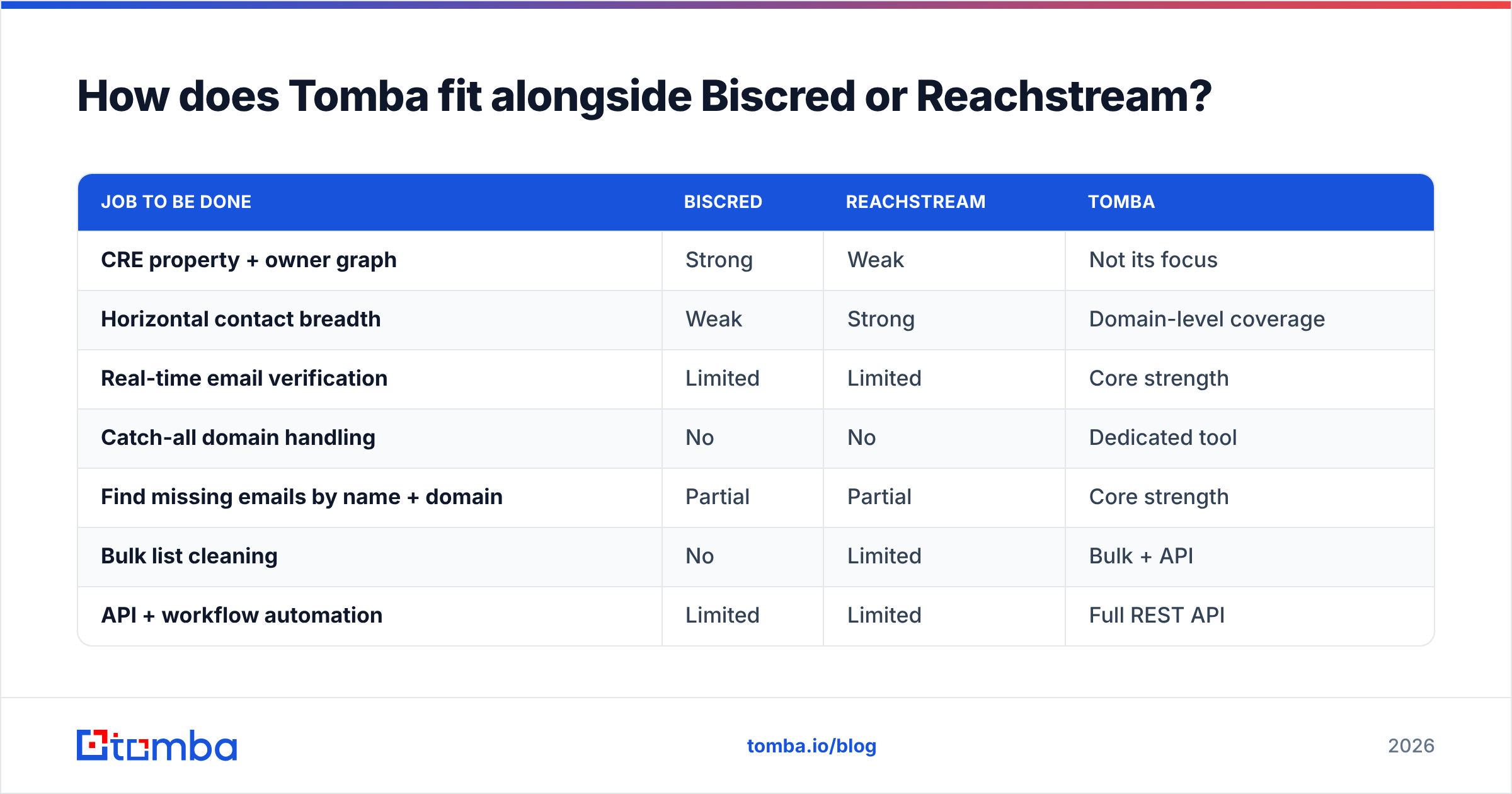
Here's how the combination plays out in practice:
| Job to be done | Biscred | Reachstream | Tomba |
|---|---|---|---|
| CRE property + owner graph | Strong | Weak | Not its focus |
| Horizontal contact breadth | Weak | Strong | Domain-level coverage |
| Real-time email verification | Limited | Limited | Core strength |
| Catch-all domain handling | No | No | Dedicated tool |
| Find missing emails by name + domain | Partial | Partial | Core strength |
| Bulk list cleaning | No | Limited | Bulk + API |
| API + workflow automation | Limited | Limited | Full REST API |
A typical workflow: export your target accounts from Biscred or Reachstream, then use Tomba's domain search to pull current addresses for the named decision-makers, run the whole file through bulk verification, and push the survivors into your CRM. If you live in spreadsheets, the Google Sheets add-on and Tomba API do the same thing without manual exports.
Tomba's pricing is transparent and self-serve, which is a contrast to the quote-gated enterprise contracts common with niche data vendors:
| Plan | Price | Best for |
|---|---|---|
| Free | $0 (25 searches/mo) | Testing accuracy on your own list |
| Starter | $49/mo | Solo reps and small teams |
| Growth | $99/mo | Scaling outbound teams |
| Pro | $249/mo | High-volume prospecting |
| Enterprise | Custom | API-heavy, large data ops |
You can see the full Tomba pricing breakdown before committing — there's no demo wall to clear just to evaluate accuracy. Start on Free, verify a sample of your existing Biscred or Reachstream export, and measure the bounce rate before you scale.
What about pricing and total cost of ownership?#
The sticker price of the database is rarely the real cost. The real cost is wasted sends plus rep time chasing dead contacts.
Run the math on a 10,000-record list:
- At a 28% decay rate, ~2,800 records are wrong within a year.
- Sending to even half of those (1,400 bounces) can tank your domain reputation for weeks.
- Recovering deliverability — warmup, new domains, throttling — costs far more than a verification pass would have.
A generalist provider like Reachstream looks cheaper up front, but if the data isn't verified you pay the difference in deliverability. A specialist like Biscred costs more up front, but in CRE the relevance can justify it — provided you still verify before sending. In both cases, a low-cost verification layer is the highest-ROI line in the budget.
Independent review sites like G2 and Capterra are useful for sanity-checking vendor claims, but treat star ratings as a starting point — they rarely test live accuracy on your target segment. The only reliable benchmark is running a sample of each provider's data through a verifier and comparing real bounce rates.
Which one should you choose in 2026?#
Choose by motion, not by marketing.
- You sell commercial real estate → Biscred. The property-and-entity graph is genuinely differentiated, and no horizontal database replicates it. Layer Tomba on top to verify the contacts before outreach.
- You sell horizontally and watch budget → Reachstream. Broad coverage at a lower entry price feeds high-volume sequences. Layer Tomba on top because generalist lists decay fastest.
- You're not sure / you sell into mixed segments → start with a verification-first approach. Source from whichever fits the account, but standardize on one accuracy layer so your deliverability stays clean across every list.
The mistake teams make is treating "which database" as the whole decision. The database is step one. Whether you go with the CRE specialist or the horizontal generalist, the records will be wrong about a quarter of the time within a year — and that's the part a verifier fixes.
The bottom line#
Biscred and Reachstream answer two different questions. Biscred answers "who's behind this building?" Reachstream answers "who else is out there across every industry?" If you forced a single winner, you'd be comparing a scalpel to a chainsaw.
What they share is the static-data problem: neither was built to tell you whether a contact is still reachable today. That's the job that actually protects your pipeline.
If you want to find current, verified email addresses for the accounts you pull from either platform — and skip the bounces that wreck your sender reputation — start with the Tomba Email Finder. Drop in a name and a domain, get a confidence-scored address, and verify your whole list in bulk before the first send. The Free tier (25 searches a month) is enough to benchmark accuracy against your existing Biscred or Reachstream export today.
// get started
Find, verify and enrich your first contacts today
Start on the free plan with 25 searches a month, then scale when your team is ready.
Free plan · No credit card required · GDPR & CCPA
// about the author