Biscred vs Salesbot 2026: Which B2B Sales Data Tool Wins?
Biscred vs Salesbot compared head-to-head: data coverage, pricing models, accuracy, and the best-fit use cases for B2B prospecting teams in 2026.
Choosing between Biscred and Salesbot usually means choosing between two very different bets about how your team finds and reaches prospects. One leans into niche, vertical-specific data; the other leans into broad automation and conversational workflows. Picking wrong costs you a year of contract spend and a pipeline full of stale records.
This guide breaks down the real differences — data depth, accuracy, pricing structure, and the use cases each one actually fits — so you can decide without a six-week trial.
TL;DR: Biscred vs Salesbot in 30 seconds#
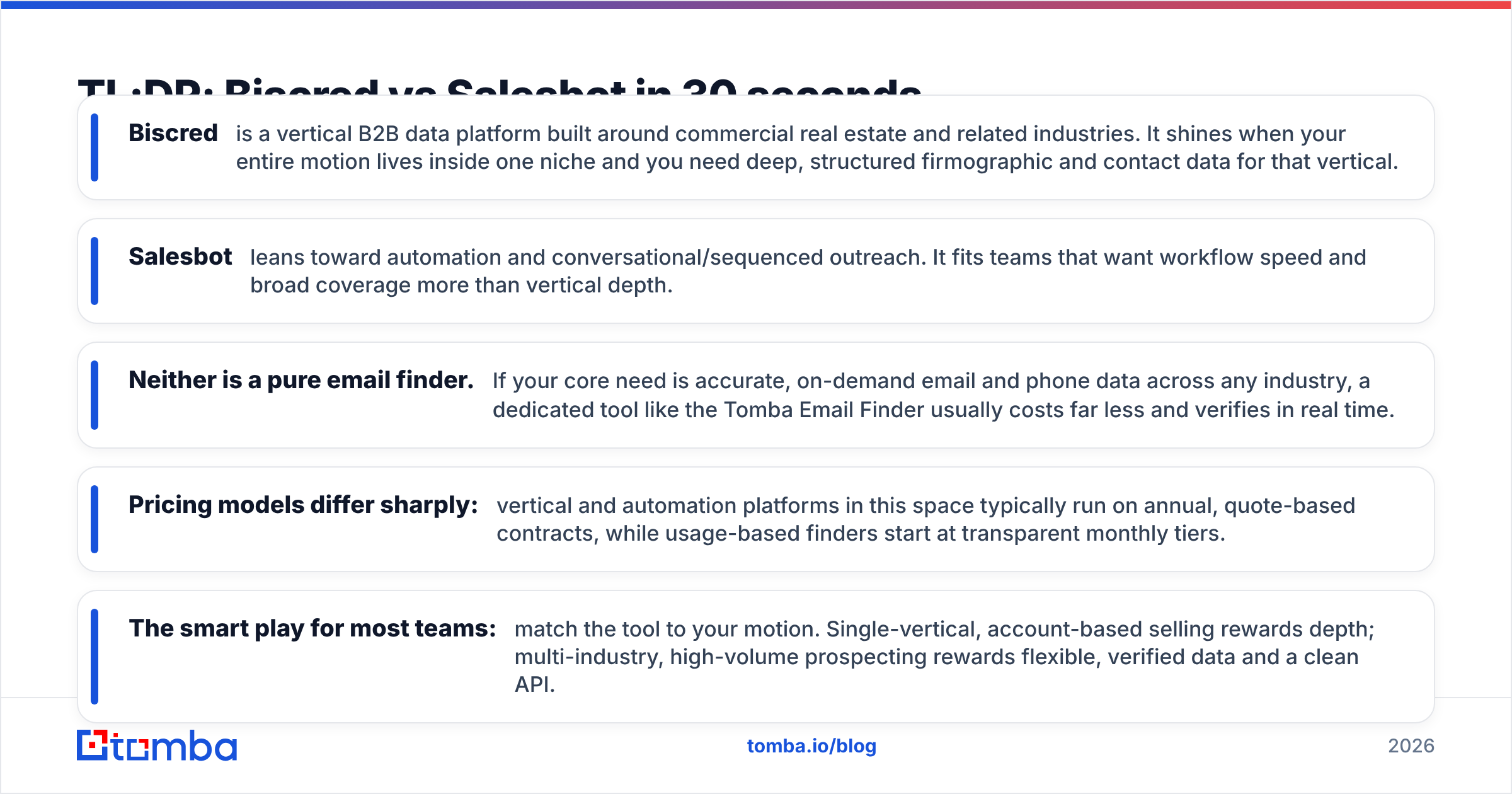
- Biscred is a vertical B2B data platform built around commercial real estate and related industries. It shines when your entire motion lives inside one niche and you need deep, structured firmographic and contact data for that vertical.
- Salesbot leans toward automation and conversational/sequenced outreach. It fits teams that want workflow speed and broad coverage more than vertical depth.
- Neither is a pure email finder. If your core need is accurate, on-demand email and phone data across any industry, a dedicated tool like the Tomba Email Finder usually costs far less and verifies in real time.
- Pricing models differ sharply: vertical and automation platforms in this space typically run on annual, quote-based contracts, while usage-based finders start at transparent monthly tiers.
- The smart play for most teams: match the tool to your motion. Single-vertical, account-based selling rewards depth; multi-industry, high-volume prospecting rewards flexible, verified data and a clean API.
What is Biscred?#
Biscred is a B2B data and intelligence platform that focuses on a defined set of industries — most notably commercial real estate (CRE) and adjacent professional services. Instead of trying to cover every company on earth, it goes deep on its verticals: structured firmographics, role-based contacts, and the kind of attributes that matter when you sell into a specialized market.
Think of Biscred like a specialist bookstore. A generic store has a little of everything; the specialist stocks every edition, annotation, and out-of-print title in one genre. If you live in that genre, the specialist is unbeatable. If you read widely, you'll hit its limits fast.
That depth is the value proposition. When you need to know which firms manage which assets, who the decision-makers are, and how accounts relate to one another inside a vertical, a focused dataset beats a broad-but-shallow one. The tradeoff is obvious: step outside the covered industries and coverage thins out quickly.
What is Salesbot?#
"Salesbot" is used by a few different products, but in the sales-tooling context it refers to automation-first software that combines prospecting data with conversational or sequenced outreach — chat-style qualification, automated follow-ups, and workflow triggers that move a lead from first touch to booked meeting with less manual effort.
The bet here is different. Where Biscred sells you depth of data, a Salesbot-style platform sells you speed and breadth of execution. The data layer is meant to be "good enough" across many industries, and the differentiation lives in automation: how quickly you can launch sequences, route replies, and keep reps out of repetitive tasks.
That makes Salesbot attractive to teams running high-volume, multi-industry outbound where the bottleneck is execution capacity, not vertical knowledge. The risk is the usual one with broad automation tools — coverage and accuracy can be uneven, and automating outreach on top of weak data just helps you email the wrong people faster.
How do Biscred and Salesbot compare?#
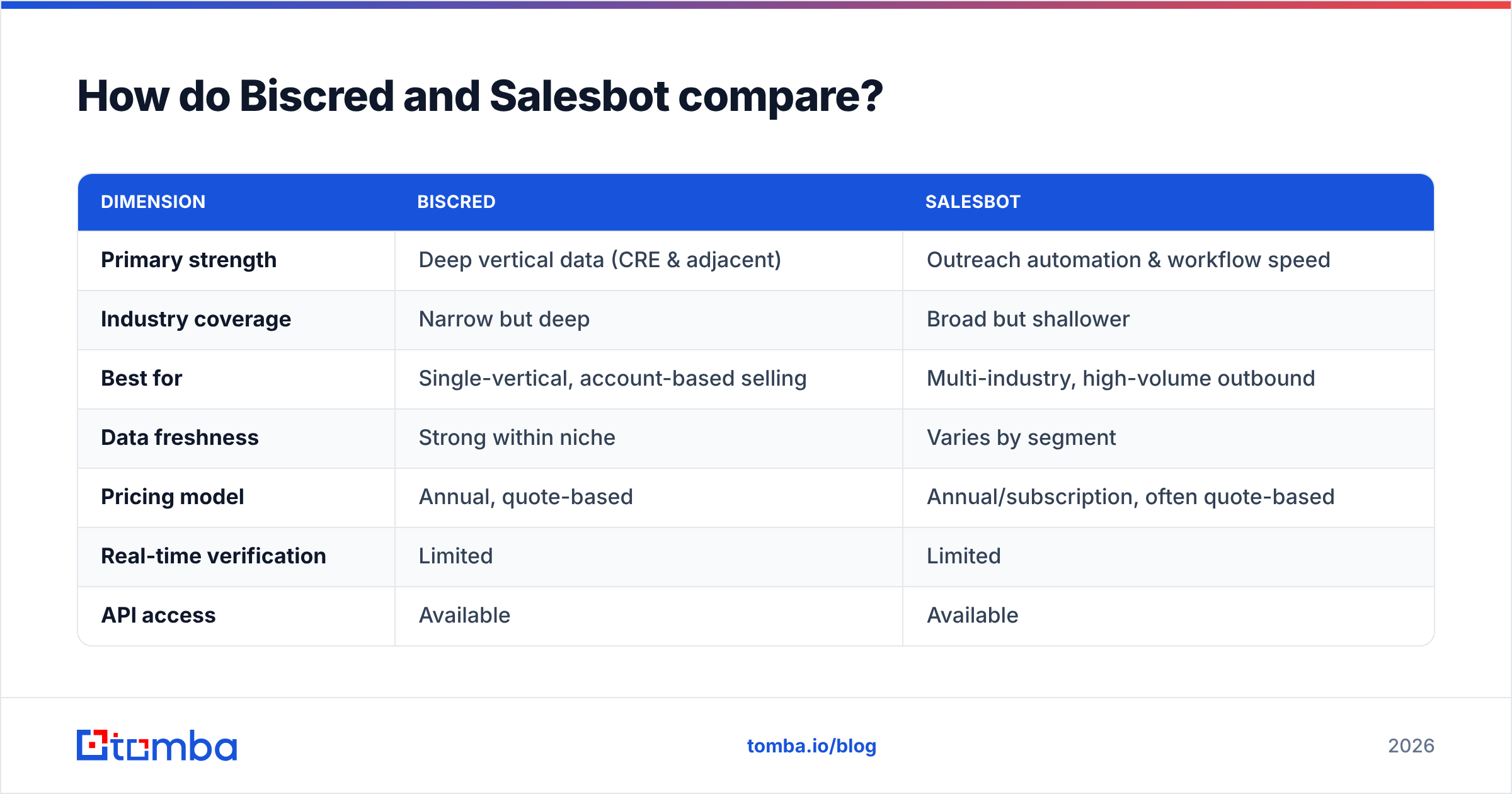
Here's the head-to-head on the dimensions that actually change your results. Pricing for vertical-data and automation platforms in this category is typically annual and quote-based, so treat the pricing row as directional rather than a published rate card.
| Dimension | Biscred | Salesbot |
|---|---|---|
| Primary strength | Deep vertical data (CRE & adjacent) | Outreach automation & workflow speed |
| Industry coverage | Narrow but deep | Broad but shallower |
| Best for | Single-vertical, account-based selling | Multi-industry, high-volume outbound |
| Data freshness | Strong within niche | Varies by segment |
| Pricing model | Annual, quote-based | Annual/subscription, often quote-based |
| Real-time verification | Limited | Limited |
| API access | Available | Available |
| Learning curve | Moderate (data-heavy) | Moderate (automation-heavy) |
The pattern is clear: these tools optimize for opposite ends of the funnel. Biscred optimizes for who you target inside a vertical; Salesbot optimizes for how fast you work a list. Neither one is primarily built to find and verify a specific contact's email or phone on demand — which is where many teams discover they actually need a third tool anyway.
Which one has better data accuracy?#
Accuracy depends on whether you stay inside the tool's sweet spot. Inside its covered verticals, a specialist like Biscred tends to hold an edge: tighter records, better role mapping, fewer obviously dead accounts. A broad automation platform spreads its data investment across far more companies, so accuracy is naturally more variable segment to segment.
But there's a catch that applies to both: most platforms in this category refresh data in batches, not at the moment you reach out. B2B contact data decays fast — people change jobs, companies rebrand, domains shift. By the time you export a list, a meaningful slice is already stale, and neither a vertical database nor an automation suite re-checks each address before you hit send.
That's why high-performing teams pair their data platform with on-demand verification. Running your list through a dedicated email verifier before a campaign catches the bounces that batch data misses, protects your sender reputation, and keeps deliverability high. The accuracy question isn't only "whose database is cleaner" — it's "what do you verify at the moment of outreach."
How does pricing compare?#
Biscred and Salesbot both lean toward annual, sales-led contracts — you book a demo, get a quote, and commit for a term. That model rewards teams with predictable, year-round volume in a defined motion, and it can genuinely pay off when the vertical depth or automation drives enough pipeline to justify the spend.
The downside is rigidity. You pay for the full platform whether or not you use every module, and scaling up or down mid-contract is awkward. For teams whose core need is simply accurate contact data on demand, that's a lot of overhead to carry.
Compare that to usage-based pricing on a focused data tool:
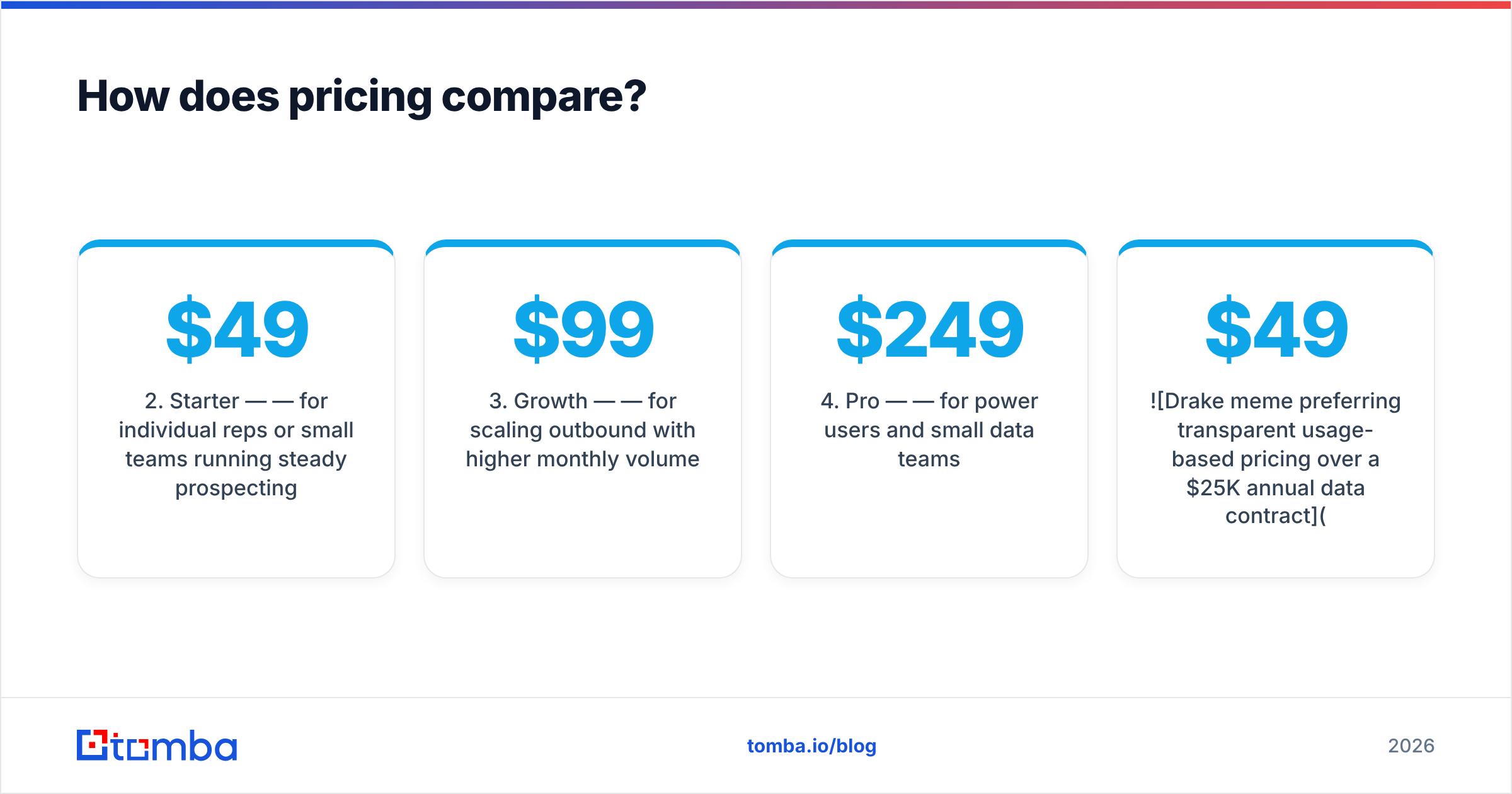
- Free tier — Tomba includes 25 searches per month at no cost, enough to test accuracy on your own target accounts before paying anything.
- Starter — $49/mo — for individual reps or small teams running steady prospecting.
- Growth — $99/mo — for scaling outbound with higher monthly volume.
- Pro — $249/mo — for power users and small data teams.
- Enterprise — custom — for high-volume and API-driven workflows.
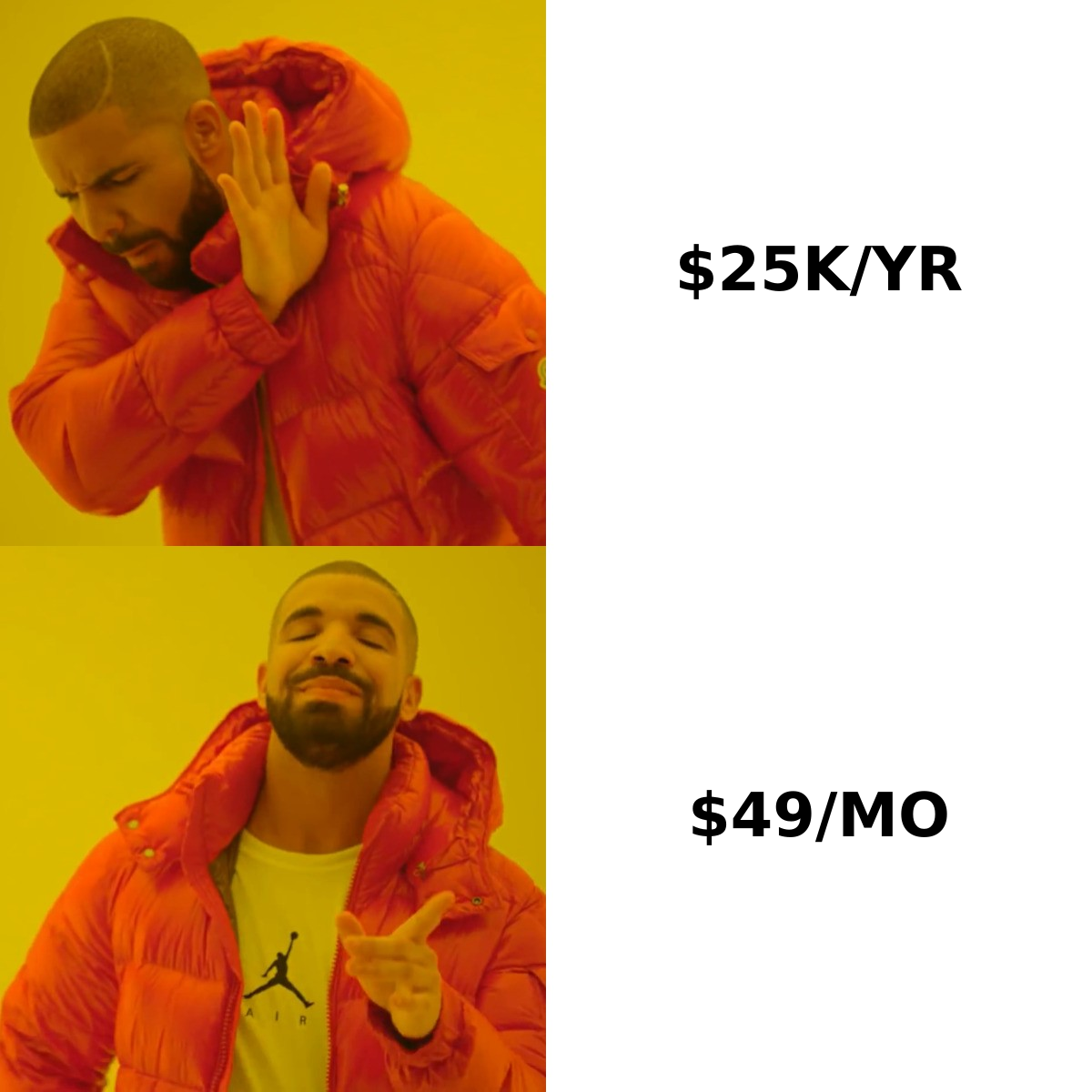
You can see the full breakdown on the Tomba pricing page. The point isn't that cheaper is always better — it's that transparent, monthly, usage-based pricing removes the annual-contract risk when your real requirement is data, not a full vertical or automation suite.
When should you choose Biscred?#
Choose Biscred when your business lives almost entirely inside its covered verticals — commercial real estate being the flagship example. The deeper signal is whether you'd describe your motion as "we sell one thing to one industry, and we need to know that industry cold."
Biscred is the right call if:
- Your TAM is a single vertical. You don't need 200 million generic records; you need every relevant firm and contact in one specialized market.
- You run account-based selling. Relationship mapping and role-level depth matter more than raw volume.
- Niche firmographics drive your qualification. Attributes that only exist in your vertical are part of how you score and route leads.
- You can commit annually. Your pipeline is steady enough that a year-long contract is low-risk.
If that's you, the depth is worth paying for, and a generic database would actively slow you down.
When should you choose Salesbot?#
Choose a Salesbot-style platform when your bottleneck is execution, not targeting. If reps are drowning in manual follow-ups and you sell across many industries rather than one, automation breadth is the lever that moves your numbers.
It's the right fit if:
- You run high-volume, multi-industry outbound where no single vertical dataset would cover your list.
- Workflow speed is your constraint — you need sequences, auto-replies, and routing more than deep firmographics.
- You value an all-in-one motion and are comfortable trading some data precision for execution speed.
- Your team will actually use the automation rather than fall back to manual work.
Just remember the failure mode: automation amplifies whatever data quality you feed it. Pair it with verification or you'll scale your bounce rate alongside your send volume.
Is there a better alternative for most teams?#
For most teams, the honest answer is that the real job — getting accurate, verified contact data across any industry — is better served by a dedicated finder than by either a vertical database or an automation suite. You can keep your CRM and sequencer and simply plug in a precise data layer.
That's the gap a tool like Tomba fills. Instead of locking you into one vertical or one workflow, it focuses on the one thing both platforms treat as secondary: finding and verifying the right contact, right now.
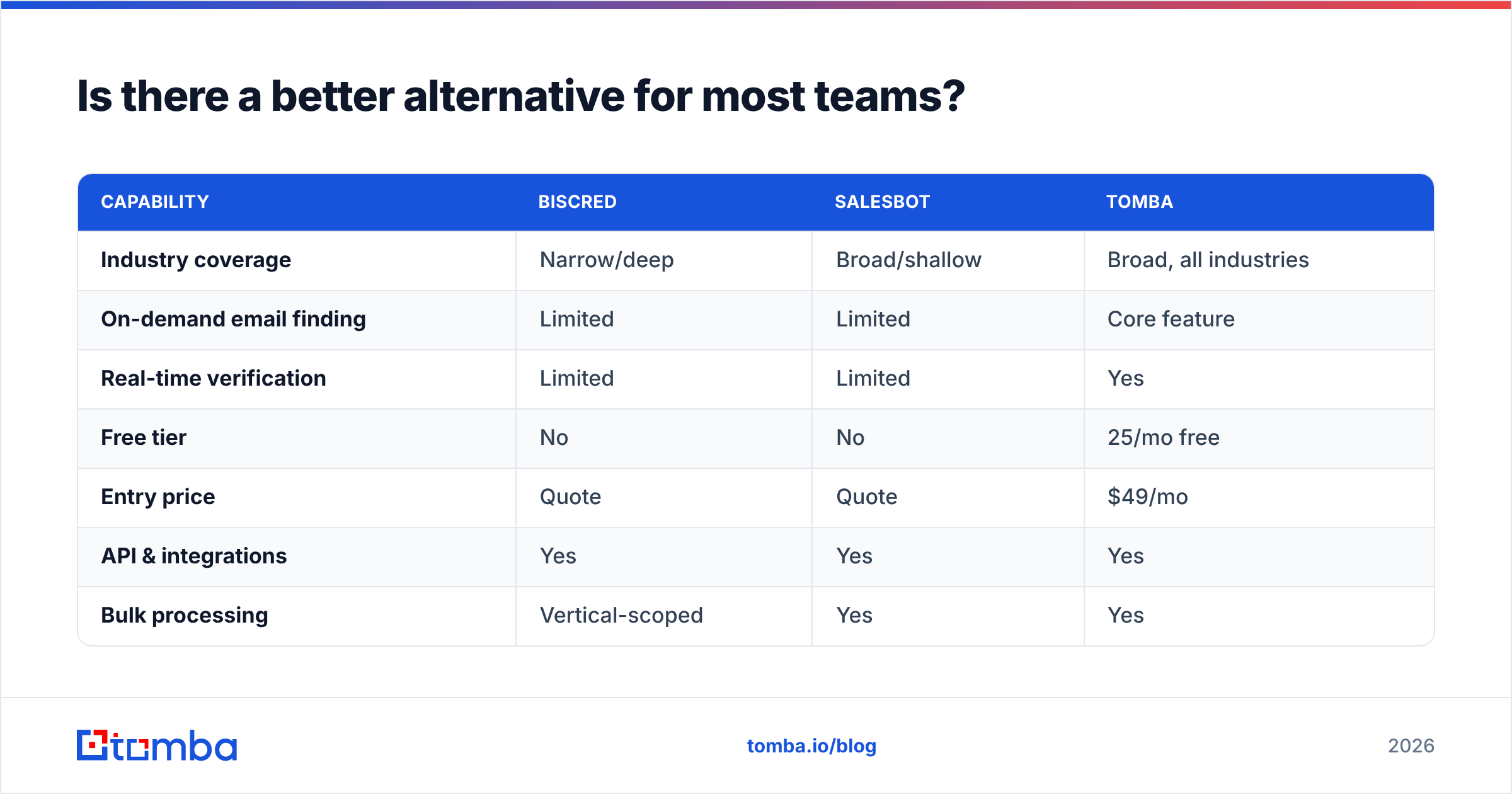
| Capability | Biscred | Salesbot | Tomba |
|---|---|---|---|
| Industry coverage | Narrow/deep | Broad/shallow | Broad, all industries |
| On-demand email finding | Limited | Limited | Core feature |
| Real-time verification | Limited | Limited | Yes |
| Free tier | No | No | 25/mo free |
| Entry price | Quote | Quote | $49/mo |
| API & integrations | Yes | Yes | Yes |
| Bulk processing | Vertical-scoped | Yes | Yes |
Where Tomba fits the workflow:
- Find emails by domain or name with the email finder, then push verified contacts straight into your sequencer.
- Map a company's whole team using domain search when you're building account-based lists.
- Enrich thin records from either platform with data enrichment so your CRM stays current.
- Scale safely with bulk tools and a clean API instead of a rigid annual seat license.
You can sanity-check any of these claims against third-party reviews on G2 or Capterra before you commit — and you should, for every vendor on this list, including Biscred's own site.
Final verdict: Biscred vs Salesbot#
There's no single winner — there's a winner for your motion. Pick Biscred if you sell deep into one vertical and need specialist data that a generic database can't match. Pick a Salesbot-style platform if you sell broadly and your real constraint is execution speed and automation. Both are defensible choices when matched to the right team.
But if you read this whole comparison and kept thinking "I just need accurate contacts I can verify before I send," that's your signal. You don't need a year-long vertical contract or a heavy automation suite to solve a data problem — you need a precise, verifiable data layer that works across every industry and plugs into the tools you already run.
Start with the Tomba Email Finder: find professional emails by domain, name, or company, verify them in real time, and test it free with 25 searches a month before you spend a dollar. Match the tool to the job, and let your contract dollars follow your pipeline — not the other way around.
Ready to find emails that actually work?
Join 150,000+ professionals who stopped guessing and started sending. Free credits on signup — no credit card required.
Get the Tomba newsletter
Practical outbound tactics and product updates — once every two weeks.
About the author