Biscred vs Zintlr (2026): Which B2B Data Tool Wins?
Biscred targets commercial real estate data while Zintlr sells personality-driven sales intelligence. Here's a neutral 2026 breakdown of pricing, coverage, accuracy, and the cheaper way to get verified B2B emails.
Choosing between Biscred and Zintlr is really choosing between two different jobs. Biscred is a niche commercial real estate (CRE) intelligence database. Zintlr is a broad B2B sales-intelligence platform with a personality-profiling twist. They get compared because both promise "find the right contact, fast" — but they solve that problem for very different teams.
This guide breaks down what each tool actually does, where the data comes from, how pricing shakes out in 2026, and when neither is the right answer.
TL;DR: Biscred vs Zintlr at a glance#
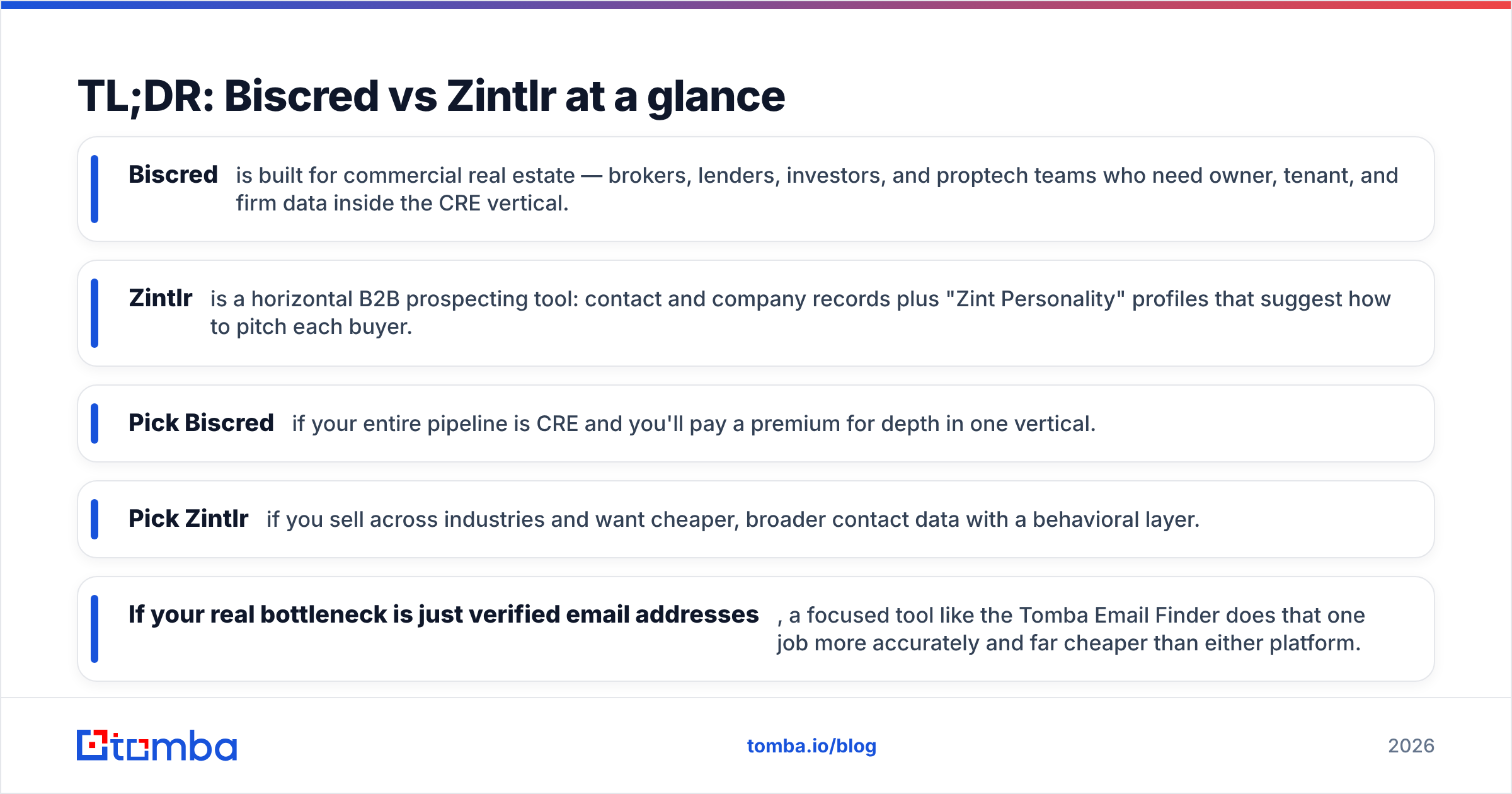
- Biscred is built for commercial real estate — brokers, lenders, investors, and proptech teams who need owner, tenant, and firm data inside the CRE vertical.
- Zintlr is a horizontal B2B prospecting tool: contact and company records plus "Zint Personality" profiles that suggest how to pitch each buyer.
- Pick Biscred if your entire pipeline is CRE and you'll pay a premium for depth in one vertical.
- Pick Zintlr if you sell across industries and want cheaper, broader contact data with a behavioral layer.
- If your real bottleneck is just verified email addresses, a focused tool like the Tomba Email Finder does that one job more accurately and far cheaper than either platform.
What is Biscred?#
Biscred is a commercial real estate data platform. It aggregates property records, company firmographics, and professional contact details specifically for the CRE ecosystem — think building owners, property managers, brokerages, lenders, and the people inside those firms.
The pitch is depth, not breadth. Instead of giving you "every company on earth," Biscred goes deep on CRE: which firm controls which asset, who the decision-makers are, and how to reach them. Teams selling proptech, construction services, insurance, or brokerage software use it to build account lists that a general database simply doesn't map well.
That focus is the whole value proposition. If you sell outside real estate, most of Biscred's depth is irrelevant to you. You can confirm the vertical positioning on their own site at biscred.com.

What is Zintlr?#
Zintlr is a horizontal B2B sales-intelligence and prospecting platform. It offers a contact and company database, intent signals, and a Chrome extension for pulling details while you browse LinkedIn or company sites.
Its differentiator is "Zint Personality" — behavioral profiles that try to predict how a prospect thinks and what messaging will land. The idea is to pair contact data with a psychological read so reps can tailor outreach instead of blasting the same script. You can see the current feature set at zintlr.com.
Zintlr competes with the broad sales-intelligence crowd (Apollo, Lusha, RocketReach), so it lives or dies on database size, accuracy, and price rather than vertical depth.
Biscred vs Zintlr: how do they compare?#
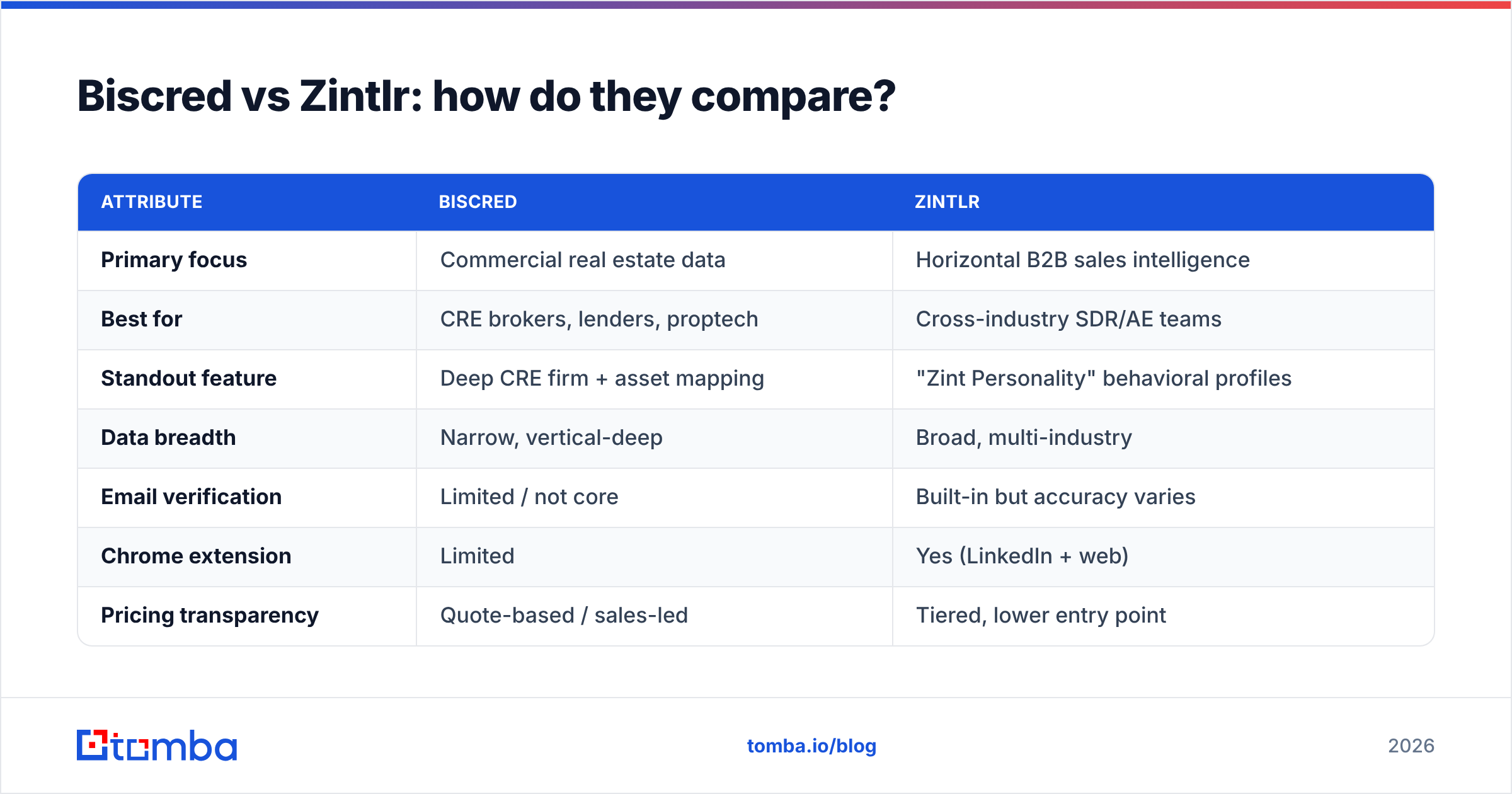
Here's the core comparison across the attributes that actually change a buying decision.
| Attribute | Biscred | Zintlr |
|---|---|---|
| Primary focus | Commercial real estate data | Horizontal B2B sales intelligence |
| Best for | CRE brokers, lenders, proptech | Cross-industry SDR/AE teams |
| Standout feature | Deep CRE firm + asset mapping | "Zint Personality" behavioral profiles |
| Data breadth | Narrow, vertical-deep | Broad, multi-industry |
| Email verification | Limited / not core | Built-in but accuracy varies |
| Chrome extension | Limited | Yes (LinkedIn + web) |
| Pricing transparency | Quote-based / sales-led | Tiered, lower entry point |
| Typical entry cost | Premium (niche tax) | Lower / mid-market |
The pattern is clear: Biscred charges a premium for vertical depth, while Zintlr competes on breadth and price. Neither is "better" in the abstract — they're optimized for different buyers.
)
Which has better data accuracy?#
Accuracy depends on what you're measuring. For CRE-specific records — who owns a building, which firm manages it, who the leasing contact is — Biscred is hard to beat because that's its entire reason to exist. A general database will have gaps and stale records in that vertical.
For general B2B contacts, Zintlr is the broader source, but breadth comes with a known trade-off: the wider a database casts its net, the more decayed records and unverified emails slip in. B2B contact data decays fast — people change jobs constantly — so any horizontal provider needs aggressive re-verification to stay useful.
This is where a lot of teams get burned. They buy a big-database subscription, export 5,000 contacts, and discover that a meaningful slice bounce. High bounce rates hurt your sender reputation and drag down email deliverability across your whole domain. That's why running exports through a dedicated email verifier before you send is non-negotiable, regardless of which platform you start with.
If you want an objective read on either tool's data quality, skip the vendor's own claims and check recent reviews on G2 and Capterra where buyers report real bounce and match rates.
How does pricing compare?#
Neither platform competes with a low-cost email finder on raw price, and they price for different markets.
Biscred is sales-led and quote-based — expect a premium that reflects its niche CRE positioning. The value math works if real estate is your only market and the data depth shortens deal cycles. It does not work if you only need a few hundred contacts a month.
Zintlr publishes tiered plans with a lower entry point, aimed at SDR teams that need volume across industries. It's friendlier to a smaller budget, but the cost climbs as you add seats, credits, and the personality-intelligence features.
For comparison, here's what a focused, single-job tool costs:
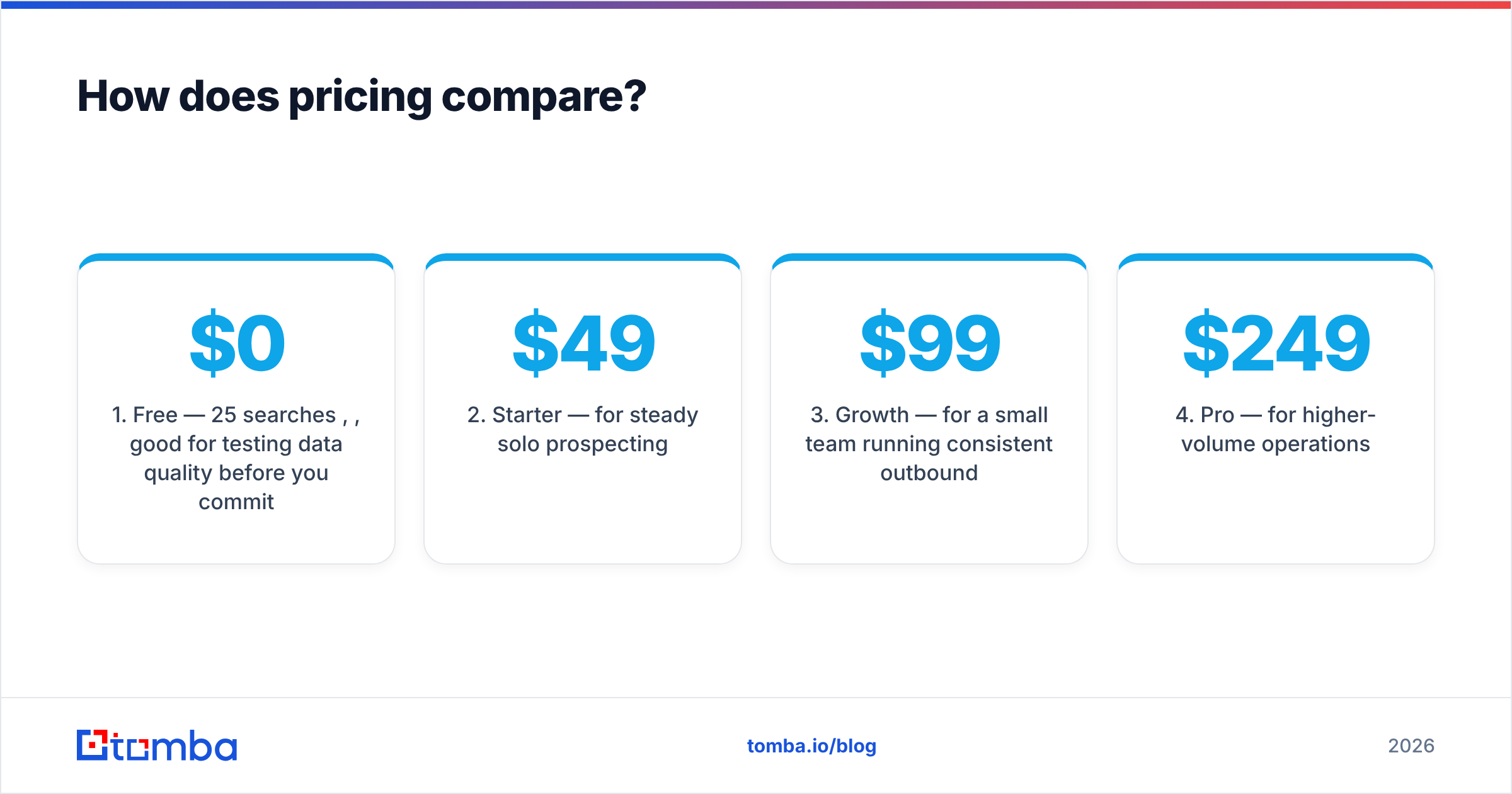
- Free — 25 searches/month, $0, good for testing data quality before you commit.
- Starter — $49/month for steady solo prospecting.
- Growth — $99/month for a small team running consistent outbound.
- Pro — $249/month for higher-volume operations.
- Enterprise — custom, for API-heavy and high-seat usage.
You can see the full breakdown on the Tomba pricing page. The point isn't that Tomba replaces a CRE database or an intent platform — it's that if "I just need verified emails" is your actual problem, you're overpaying when you buy a full intelligence suite to solve it.
)
When should you choose Biscred?#
Choose Biscred when:
- Your entire pipeline is commercial real estate. You need owner, tenant, lender, and brokerage mapping that horizontal tools don't model well.
- Deal sizes justify premium data. One closed CRE deal pays for the subscription many times over.
- You need asset-level context, not just a contact list — who controls which property and why that matters for your pitch.
If you sell CRE software, construction, insurance, or capital, Biscred's depth is a genuine edge. Outside that vertical, you're paying for data you'll never touch.
When should you choose Zintlr?#
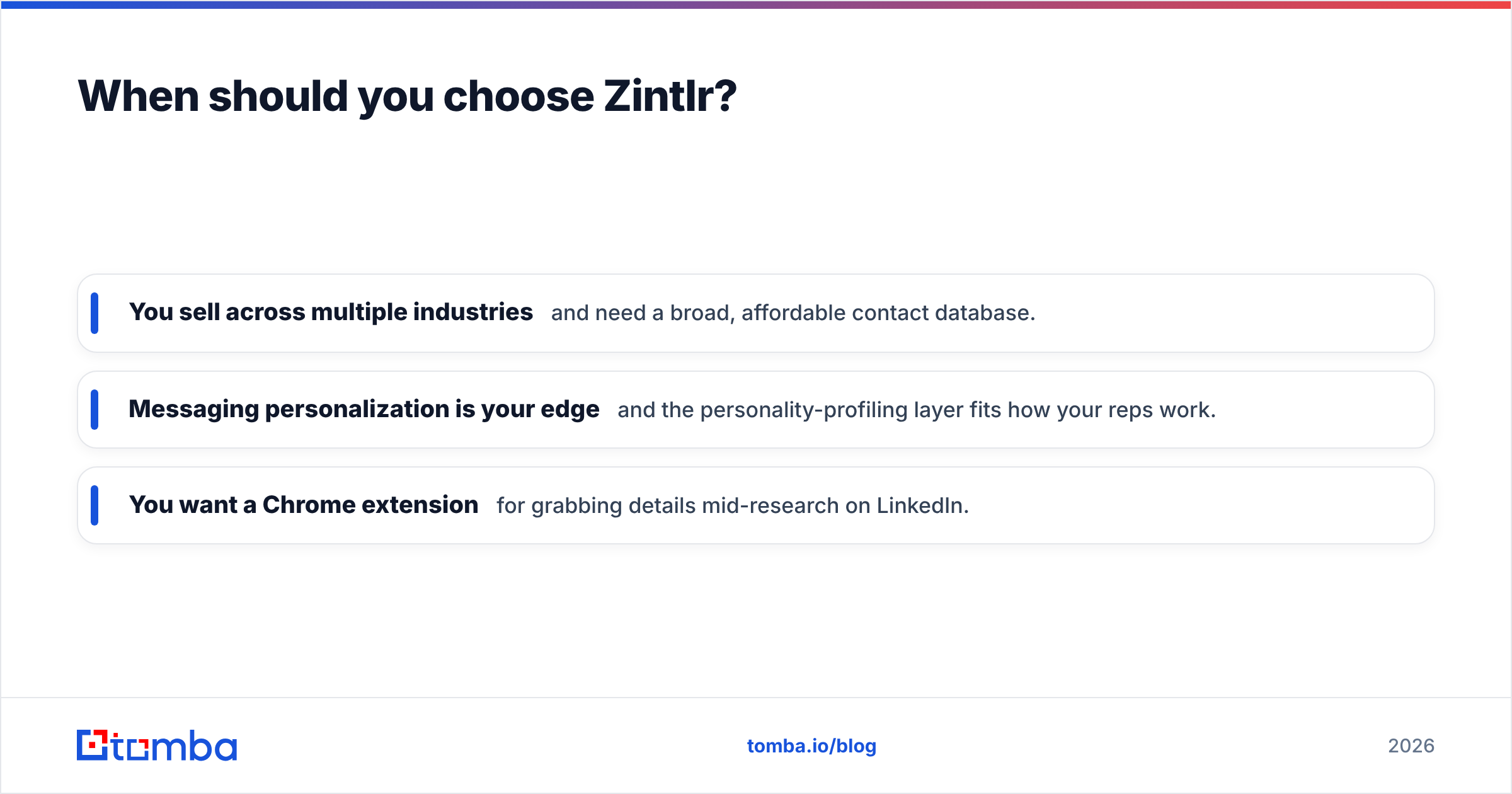
Choose Zintlr when:
- You sell across multiple industries and need a broad, affordable contact database.
- Messaging personalization is your edge and the personality-profiling layer fits how your reps work.
- You want a Chrome extension for grabbing details mid-research on LinkedIn.
Zintlr is the more flexible, lower-cost generalist. Just budget for verification — treat its emails as candidates to validate, not as send-ready records, and pair it with LinkedIn outreach workflows where its behavioral data is most useful.
What if you only need verified emails?#
Then both tools are overkill. This is the most common mismatch we see: a team buys a full intelligence platform when their real constraint is simply "I have a name and a company — get me the verified work email."
That's a single, well-defined job, and a focused tool does it more accurately and far more cheaply than a broad suite. A dedicated email finder lets you:
- Find an address from a name + domain, or pull every public address at a company via domain search.
- Verify deliverability before sending so you protect your sender reputation.
- Run lists in bulk with the bulk email finder and push results straight into your CRM via the Tomba API.
You can layer this on top of either Biscred or Zintlr, too: use them to build the account list, then run the contacts through a verifier so your outbound doesn't bounce.
The bottom line#
Biscred and Zintlr aren't really rivals — they're tools for different teams. Biscred wins if you live and breathe commercial real estate and will pay for vertical depth. Zintlr wins if you sell broadly and want cheaper, behavior-aware contact data. Match the tool to your market, and budget for verification either way.
But if you strip the decision down to its most common core — getting accurate, send-ready email addresses without a five-figure data contract — start lean. Test the data quality yourself with the free tier, find and verify contacts at a fraction of suite pricing, and only graduate to a heavyweight platform when your use case genuinely demands it. Try the Tomba Email Finder free for 25 searches and see how far verified-first prospecting gets you before you commit to a bigger bill.
// get started
Find, verify and enrich your first contacts today
Start on the free plan with 25 searches a month, then scale when your team is ready.
Free plan · No credit card required · GDPR & CCPA
// about the author