Bizkonnect vs Leadsforge 2026: Which Lead Tool Wins?
A hands-on, neutral breakdown of Bizkonnect vs Leadsforge in 2026 — data depth, AI list-building, pricing, and which one actually fills your pipeline.
Bizkonnect vs Leadsforge: Which Lead Tool Actually Fills Your Pipeline in 2026?
Choosing between Bizkonnect and Leadsforge comes down to one question: do you want deep, human-curated company intelligence, or fast AI-assembled lead lists? Both promise more meetings, but they get there in very different ways — and the gap matters for how your SDRs spend their day.
This is a neutral, hands-on comparison. We'll cover what each tool does, where the data comes from, pricing realities, and the use cases where one clearly beats the other. We'll also be honest about the one thing neither tool was built to do well — and where a dedicated email-finding layer earns its keep.
TL;DR#
- Bizkonnect is a sales-intelligence platform built around actionable org charts, account mapping, and curated company data — strong for enterprise account-based selling.
- Leadsforge is an AI-first lead-generation tool that turns a plain-English prompt into a targeted contact list in minutes — strong for speed and high-volume outbound.
- Pick Bizkonnect if you sell into large accounts and need to understand reporting structures and decision-makers before you reach out.
- Pick Leadsforge if you need volume fast and value a conversational, low-learning-curve workflow over deep account research.
- Either way, verify before you send. Neither tool is a deliverability engine, so pair it with a real email verifier to protect your sender reputation.
What is Bizkonnect?#
Bizkonnect is a B2B sales-intelligence provider whose signature feature is "actionable org charts" — visual maps of who reports to whom inside a target account. Instead of handing you a flat list of names, it tries to show the buying committee: the economic buyer, the champion, the blockers, and the lines connecting them.
Around that core, Bizkonnect bundles company data, contact details, technographics, and email-campaign tooling. The pitch is account depth. If you run account-based marketing (ABM) into enterprise logos, knowing that the VP of Engineering sits two rungs below the CTO who actually owns the budget changes how you sequence your outreach.
The trade-off is that depth takes time to produce. Curated org charts are more labor-intensive than scraped lists, which shows up in both the pricing model (typically custom quotes) and the volume you can realistically work.
What is Leadsforge?#
Leadsforge is an AI-powered lead-generation tool built around a conversational interface. You describe your ideal customer — "SaaS marketing directors at 50–200 person companies in the US" — and it assembles a contact list for you, no Boolean filter gymnastics required.
The appeal is speed and approachability. A new rep can be productive in an afternoon because the tool does the query-building for you. It leans on AI to interpret intent, match firmographic criteria, and return contacts with emails attached, ready to push into your sequencer or CRM.
The trade-off is the inverse of Bizkonnect's: you get breadth and velocity, but less of the structured, decision-maker-level context that account-based teams rely on. It's a list-builder, not an account-mapping platform.
Bizkonnect vs Leadsforge: How do they compare head to head?#
Here's the side-by-side. Treat exact pricing as directional — both vendors move tiers and offer custom quotes, so confirm current numbers on their sites before you commit.
| Attribute | Bizkonnect | Leadsforge |
|---|---|---|
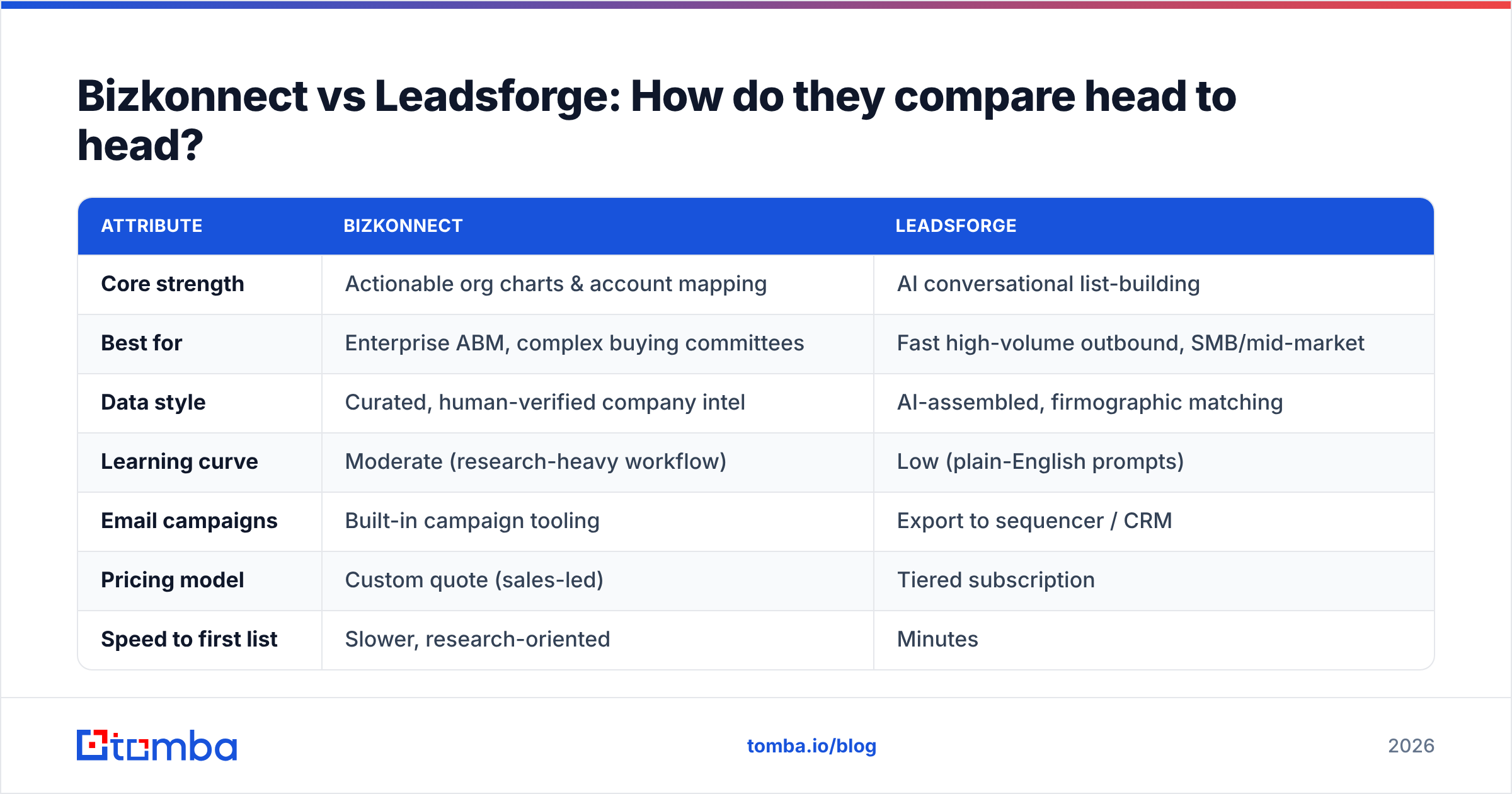
| Core strength | Actionable org charts & account mapping | AI conversational list-building |
| Best for | Enterprise ABM, complex buying committees | Fast high-volume outbound, SMB/mid-market |
| Data style | Curated, human-verified company intel | AI-assembled, firmographic matching |
| Learning curve | Moderate (research-heavy workflow) | Low (plain-English prompts) |
| Email campaigns | Built-in campaign tooling | Export to sequencer / CRM |
| Pricing model | Custom quote (sales-led) | Tiered subscription |
| Speed to first list | Slower, research-oriented | Minutes |
| Decision-maker context | High (reporting lines, hierarchy) | Low to moderate |
The pattern is clear: Bizkonnect optimizes for understanding an account, Leadsforge optimizes for reaching many accounts. Neither is "better" in the abstract — they're tuned for different motions.
Which one fits your sales motion?#
Rather than crowning a winner, match the tool to how you actually sell. Use these five lenses:
- Deal size. Six-figure enterprise deals reward the org-chart depth of Bizkonnect; transactional or PLG-style motions reward the volume of Leadsforge.
- Team maturity. A trained SDR team can exploit account maps; a lean or new team gets to value faster with conversational list-building.
- Sales cycle. Long, multi-stakeholder cycles need hierarchy intelligence. Short cycles need throughput.
- Volume targets. If your quota is "book 40 meetings this month from cold," velocity wins. If it's "land three strategic logos," depth wins.
- Data hygiene tolerance. AI-assembled lists move fast but vary in accuracy — budget for verification. Curated data starts cleaner but costs more per record.
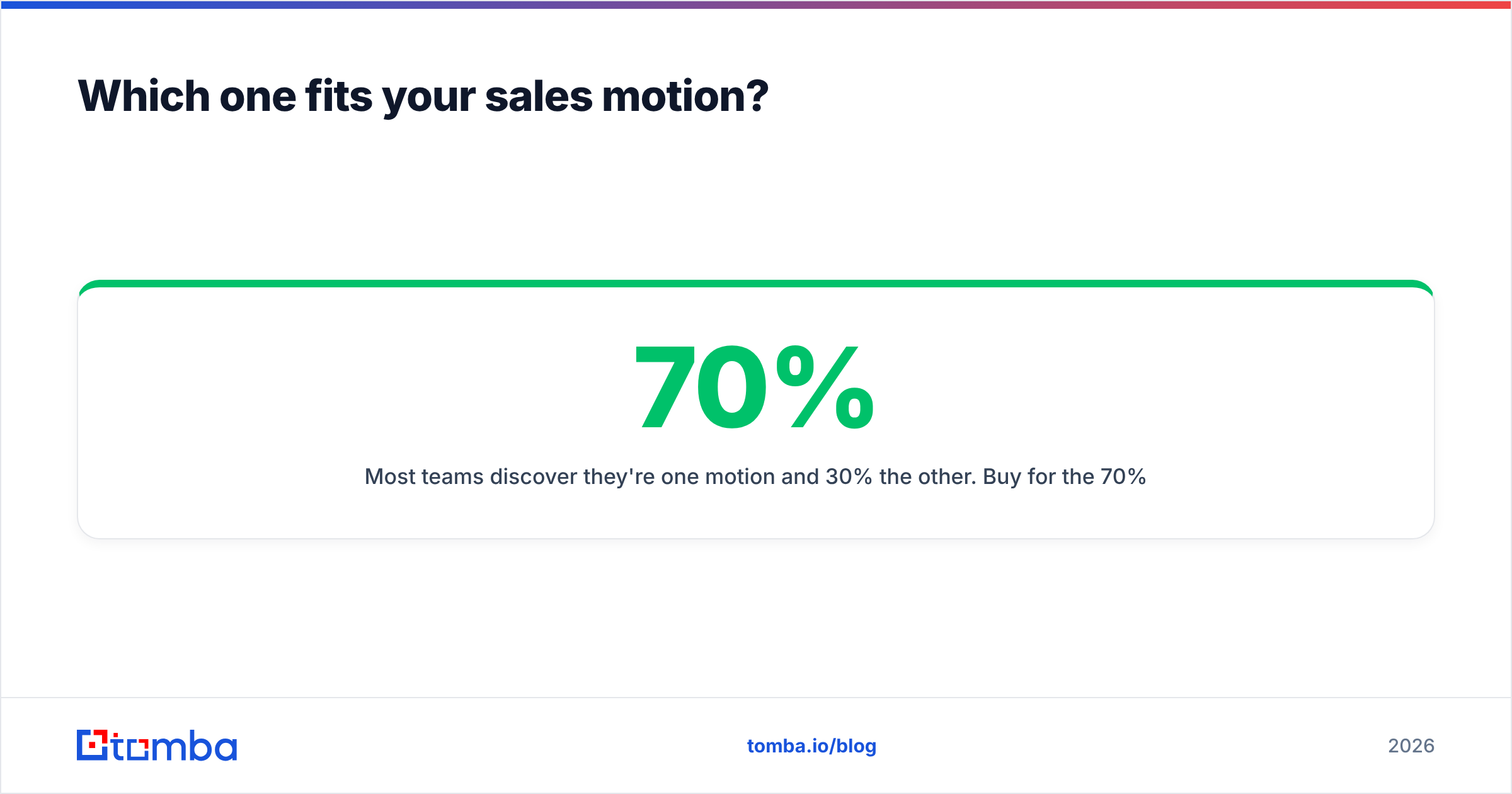
Most teams discover they're 70% one motion and 30% the other. Buy for the 70%.
Where does the data actually come from?#
This is the question that decides whether your campaigns land or bounce. Curated providers like Bizkonnect invest human review into their records, which tends to raise baseline accuracy but limits scale. AI-assembled tools like Leadsforge cover more ground quickly, but the freshness and validity of any individual email can swing widely.
Either way, the contact data you export is a snapshot, and B2B data decays fast — roughly 2–3% of contacts churn every month as people change jobs. Independent review sites like G2 and Capterra are full of the same recurring complaint about nearly every data vendor: "great coverage, but a chunk of the emails bounced."
That's not a knock on any single tool — it's the nature of B2B data. It's also exactly why a verification step is non-negotiable. Running your exported list through an email verifier before your first send catches dead addresses and catch-all domains, protecting the sender reputation you can't easily rebuild once it's burned.
What about pricing?#
Bizkonnect runs a sales-led, custom-quote model. That's typical for curated, enterprise-focused intelligence platforms — you talk to sales, you get a number scaled to seats and data volume. Expect it to land in enterprise territory, and expect an annual commitment.
Leadsforge uses tiered subscriptions, which makes it easier to start small and predictable to budget. For a self-serve buyer who wants to swipe a card and start prospecting this week, that's a meaningful advantage.
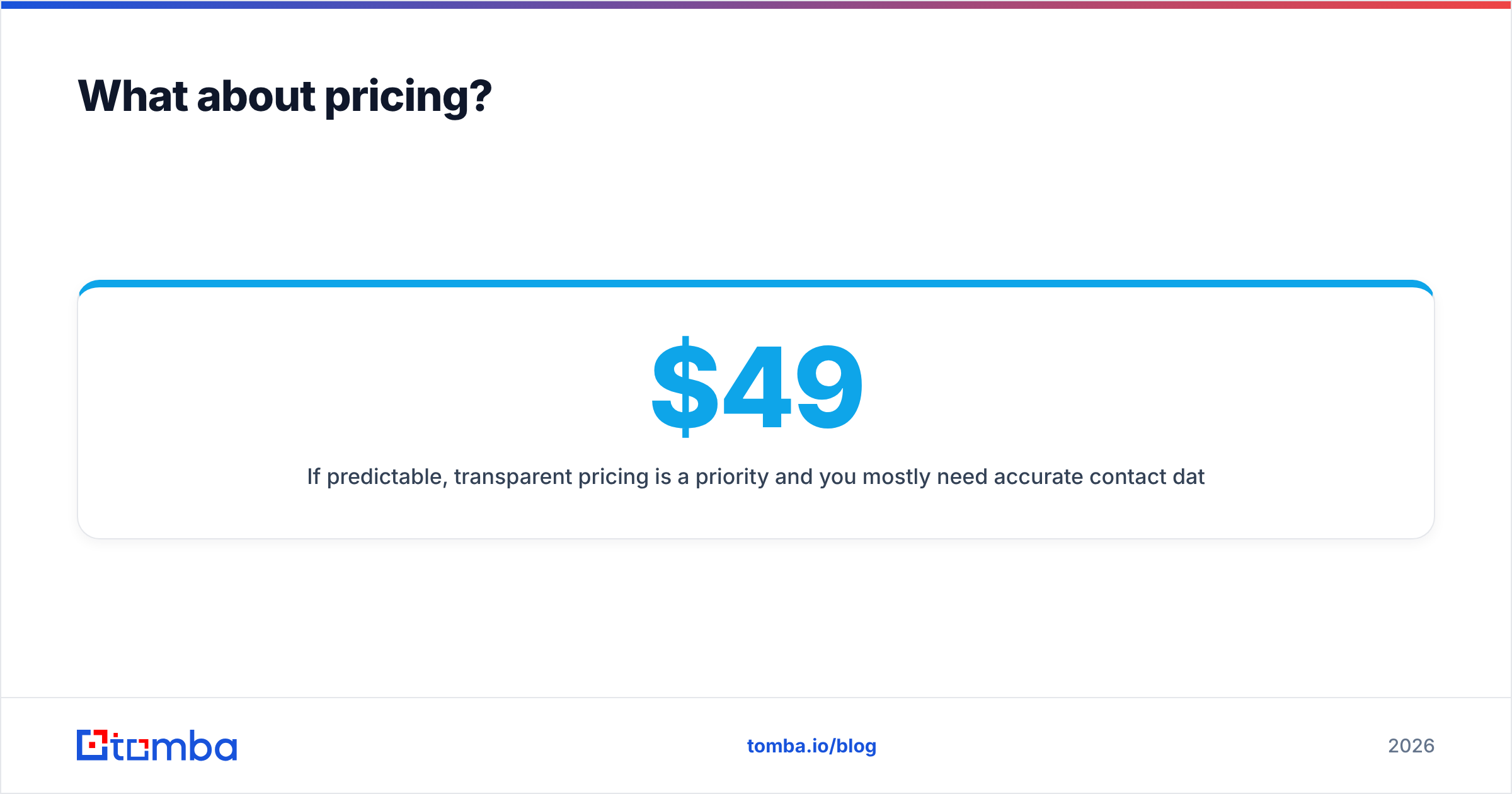
If predictable, transparent pricing is a priority and you mostly need accurate contact data rather than a full account-mapping suite, it's worth benchmarking both against a usage-based finder. For reference, Tomba pricing starts with a free tier (25 searches/month), then Starter at $49/mo, Growth at $99/mo, and Pro at $249/mo — so you can validate data quality on a small spend before scaling.
Bizkonnect vs Leadsforge: pros and cons#
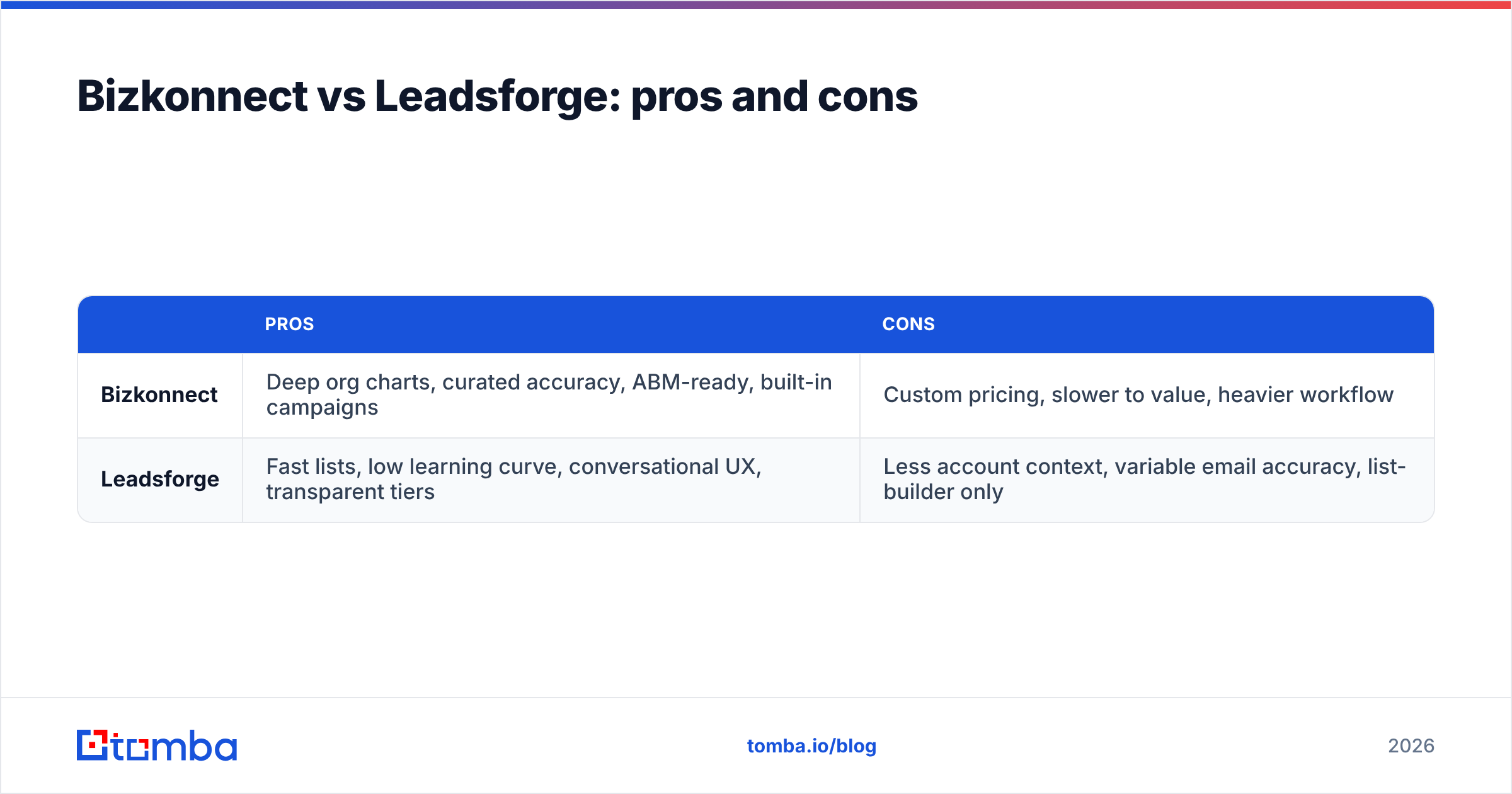
| Pros | Cons | |
|---|---|---|
| Bizkonnect | Deep org charts, curated accuracy, ABM-ready, built-in campaigns | Custom pricing, slower to value, heavier workflow |
| Leadsforge | Fast lists, low learning curve, conversational UX, transparent tiers | Less account context, variable email accuracy, list-builder only |
Read this table against your motion, not in isolation. A "con" like Bizkonnect's slower workflow is irrelevant if you only chase a handful of strategic accounts. A "con" like Leadsforge's variable accuracy is fully manageable with a verification layer.
What neither tool is built to be: a precision email-finding layer#
Here's the honest gap. Bizkonnect is an account-intelligence platform. Leadsforge is an AI list-builder. Both include contact emails, but neither is a specialized email-finding and verification engine — and that's the part of the stack that most directly controls whether your messages reach an inbox.
When you already know the company and the person but need the right verified email — or when you want to enrich an existing list — a dedicated tool is faster and more accurate. A domain search pulls every discoverable address at a target company; a focused email finder resolves a specific person's address by name and domain; and data enrichment fills the gaps in records you already have.
This isn't an either/or. The strongest stacks pair a sourcing tool (Bizkonnect or Leadsforge) with a verification-and-finding layer:
- Source the accounts and contacts (your chosen platform).
- Find or fix the exact email when it's missing or stale (email finder + domain search).
- Verify every address before send (email verifier + catch-all checks).
- Enrich records with phone, role, and firmographics for routing and personalization.
That four-step flow is what separates a 2% bounce rate from a 20% one.
How do you decide quickly?#
If you want a one-line rule: Bizkonnect for depth, Leadsforge for speed. Sell into complex enterprise accounts where understanding the buying committee changes your win rate? Lean Bizkonnect. Need a high volume of decent leads with minimal setup and a predictable bill? Lean Leadsforge.
And whichever you choose, don't skip the verification step. The most expensive lead is the one that bounces, drags your domain reputation down, and quietly sinks the deliverability of every other email you send that week. For a deeper background read, the concept of email deliverability explains why one bad list can poison an entire sending domain.
You can also pressure-test both vendors the same way: pull a sample list of 100 contacts from each, run them through a verifier, and compare valid-rate side by side. Real bounce data beats marketing claims every time. Check current vendor specifics on the Bizkonnect site and Leadsforge's own homepage before signing.
The bottom line#
Bizkonnect and Leadsforge solve different problems. Bizkonnect gives account-based teams the org-level intelligence to navigate complex deals. Leadsforge gives volume-driven teams a fast, conversational way to build lists. Match the tool to your deal size, cycle length, and team maturity, and you'll rarely go wrong.
But both are sourcing tools, and sourcing is only half the job. To make sure the contacts you collect actually convert into conversations, add a precision finding-and-verification layer on top. Start free with the Tomba Email Finder — find and verify professional email addresses by name, company, or domain, run your Bizkonnect or Leadsforge exports through verification, and stop paying the bounce tax on data you already worked hard to source.
// get started
Find, verify and enrich your first contacts today
Start on the free plan with 25 searches a month, then scale when your team is ready.
Free plan · No credit card required · GDPR & CCPA
// about the author