Bizkonnect vs Mailarrow 2026: Which Sales Tool Wins?
Bizkonnect sells account intelligence and org charts; Mailarrow sends cold email sequences. Here's an honest 2026 breakdown of which one fits your pipeline — and the data layer both depend on.
Bizkonnect and Mailarrow get lumped together in "best sales tools" lists, but they solve opposite halves of the same problem. One tells you who to email. The other sends the email. Picking between them as if they compete is like choosing between a map and a car — you probably need both, and the real question is which gap hurts your pipeline most right now.
TL;DR — Bizkonnect vs Mailarrow at a glance#
- Bizkonnect is a sales-intelligence platform: org charts, account mapping, contact data, and "actionable" trigger events. It answers who and why.
- Mailarrow is a cold-email outreach tool: multi-step sequences, inbox rotation, deliverability features, and reply tracking. It answers how and when.
- They are complements, not substitutes. Bizkonnect feeds targets in; Mailarrow pushes messages out.
- Neither is primarily an email-finding or verification engine — both lean on third-party data that you should validate before you send.
- If your bottleneck is bad contact data, fix that first with a dedicated email finder and email verifier — otherwise a great sequencer just delivers garbage faster.
What is Bizkonnect?#
Bizkonnect is an account-intelligence and sales-prospecting platform aimed at teams running account-based outbound. Its signature feature is org-chart mapping: visual hierarchies of who reports to whom inside a target company, so you can route a message to the actual decision-maker instead of a generic info@ inbox. On top of that it layers company data, contact records, and trigger events (funding, hiring, leadership changes) that give reps a reason to reach out.
Think of Bizkonnect as the scout who walks the building before the meeting and hands you a labeled floor plan. It does not send anything. Its value is targeting precision — knowing that the VP of Engineering, not the CTO, owns the budget line you're chasing.
Where it gets fuzzy: org charts and contact records are only as fresh as the underlying data. People change jobs every few years, and any static intelligence database decays. That decay is exactly why a verification step matters before outreach — more on that below.
What is Mailarrow?#
Mailarrow is a cold-email sequencing tool in the same family as Instantly, Smartlead, or Saleshandy. Its job starts after you have a list. You upload contacts, build a multi-step sequence (initial email, follow-ups, breakup message), connect one or more sending inboxes, and Mailarrow handles the schedule, the rotation across mailboxes, the personalization tokens, and the reply detection.
Its core selling points are deliverability and scale: warming up inboxes, spreading volume across accounts to protect sender reputation, and tracking opens and replies so you can iterate on copy. If Bizkonnect is the scout, Mailarrow is the delivery fleet — it moves volume reliably, but it has no opinion about whether the address on the package is correct.
Bizkonnect vs Mailarrow: the core comparison#
Here's the honest side-by-side. Notice that most rows aren't "better/worse" — they're "different job entirely."
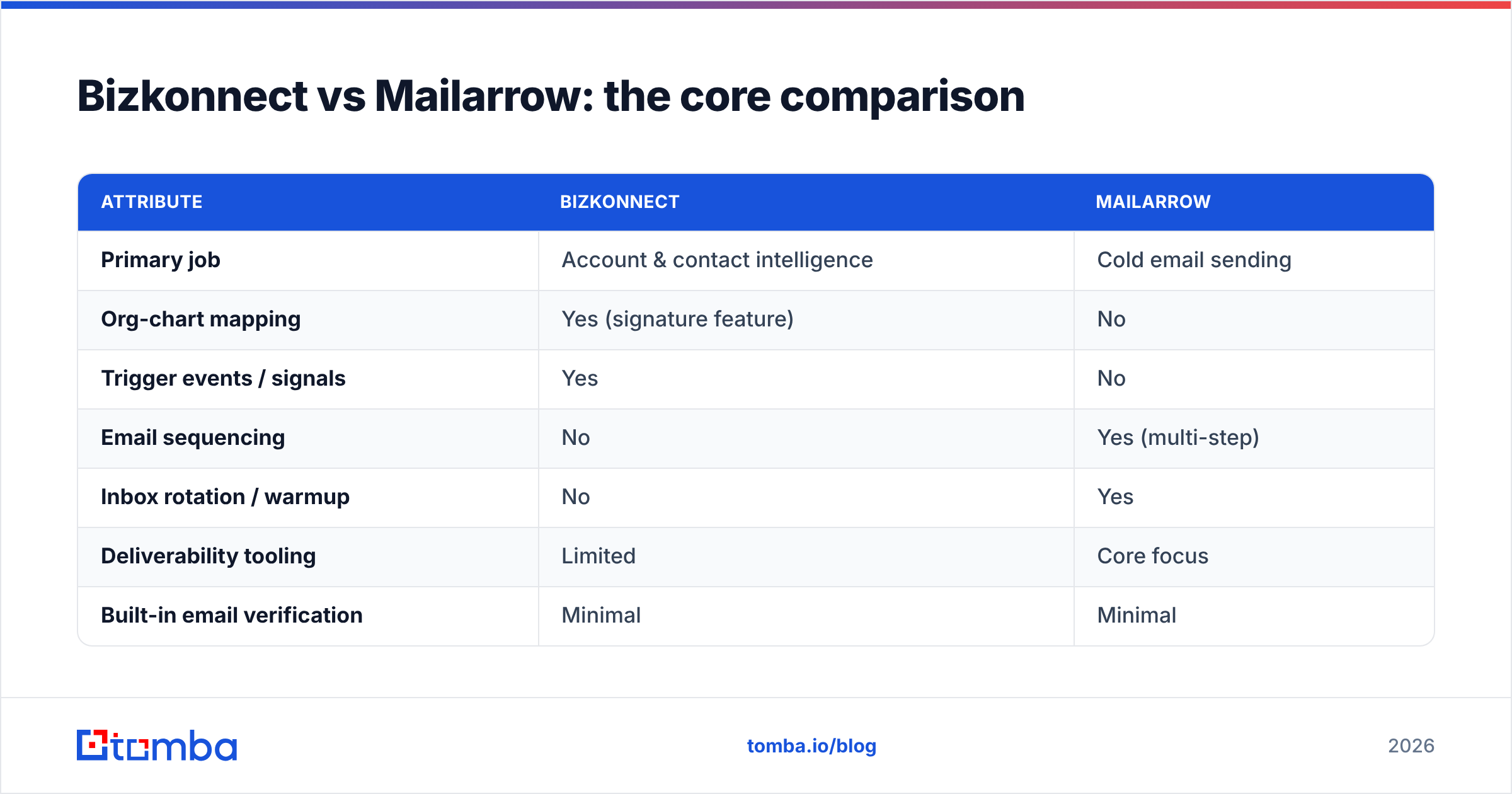
| Attribute | Bizkonnect | Mailarrow |
|---|---|---|
| Primary job | Account & contact intelligence | Cold email sending |
| Org-chart mapping | Yes (signature feature) | No |
| Trigger events / signals | Yes | No |
| Email sequencing | No | Yes (multi-step) |
| Inbox rotation / warmup | No | Yes |
| Deliverability tooling | Limited | Core focus |
| Built-in email verification | Minimal | Minimal |
| Best for | ABM targeting, list building | Outbound at volume |
| Replaces a data tool? | Partially | No |
| Replaces a sender? | No | Partially |
The pattern is clear: Bizkonnect lives at the top of the funnel (who to contact), Mailarrow lives in the middle (reaching them at scale). Asking "which is better" is the wrong frame. The better question is "which stage of my outbound is leaking?"
Which problem are you actually trying to solve?#
Use this quick decision list before you spend a dollar on either:
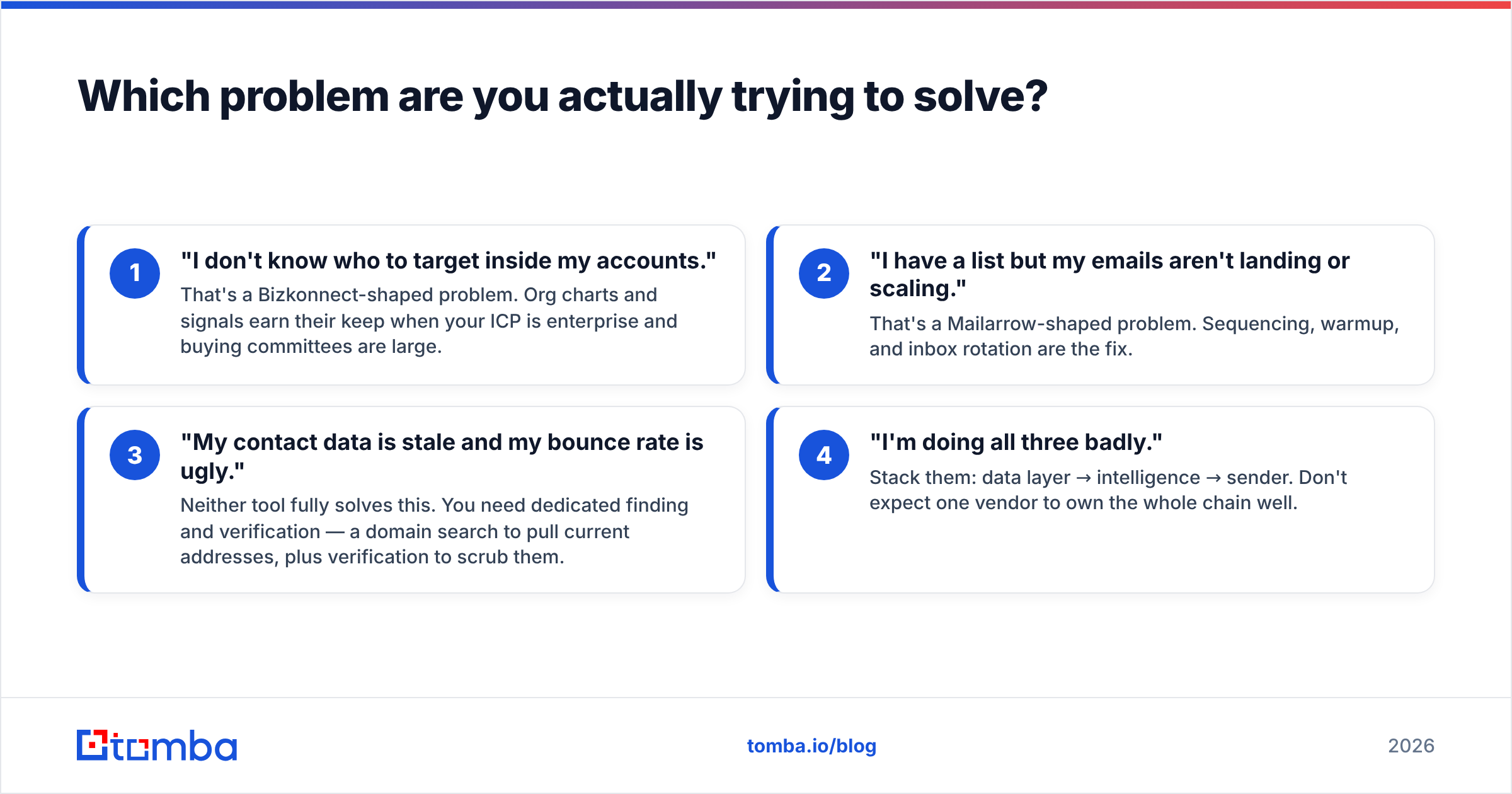
- "I don't know who to target inside my accounts." That's a Bizkonnect-shaped problem. Org charts and signals earn their keep when your ICP is enterprise and buying committees are large.
- "I have a list but my emails aren't landing or scaling." That's a Mailarrow-shaped problem. Sequencing, warmup, and inbox rotation are the fix.
- "My contact data is stale and my bounce rate is ugly." Neither tool fully solves this. You need dedicated finding and verification — a domain search to pull current addresses, plus verification to scrub them.
- "I'm doing all three badly." Stack them: data layer → intelligence → sender. Don't expect one vendor to own the whole chain well.
Most teams that complain about "low reply rates" assume it's a copy or sequencing issue (Mailarrow's domain) when the real culprit is data quality (the layer underneath both tools). Fixing the wrong stage is the most expensive mistake in outbound.
How do pricing and value compare?#
Both vendors publish limited public pricing and lean on demos and custom quotes, which makes apples-to-apples hard. As a rough framing for 2026:
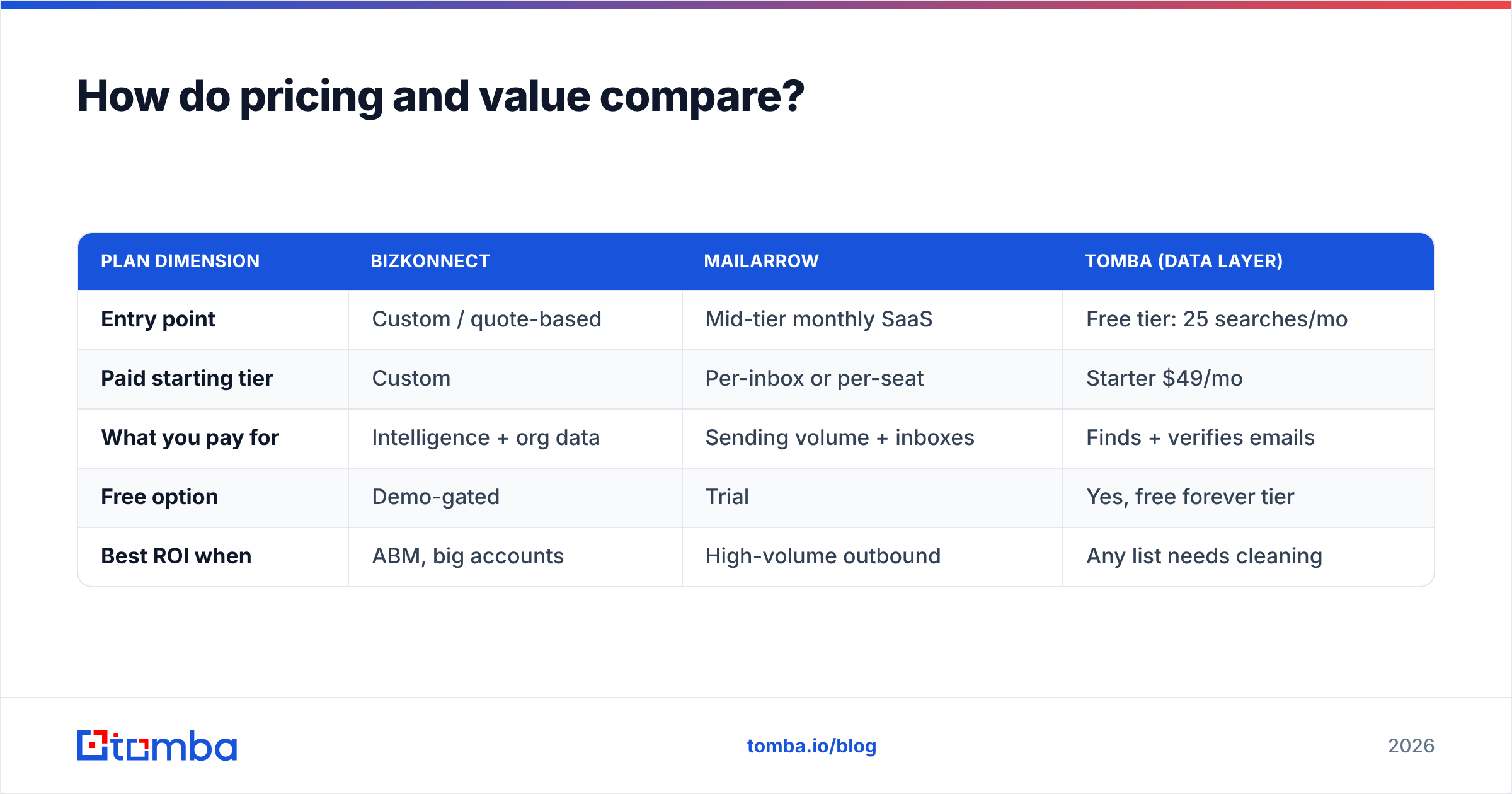
| Plan dimension | Bizkonnect | Mailarrow | Tomba (data layer) |
|---|---|---|---|
| Entry point | Custom / quote-based | Mid-tier monthly SaaS | Free tier: 25 searches/mo |
| Paid starting tier | Custom | Per-inbox or per-seat | Starter $49/mo |
| What you pay for | Intelligence + org data | Sending volume + inboxes | Finds + verifies emails |
| Free option | Demo-gated | Trial | Yes, free forever tier |
| Best ROI when | ABM, big accounts | High-volume outbound | Any list needs cleaning |
Because Bizkonnect's pricing is quote-driven, budget-conscious SMB teams often find it heavy; it shines for enterprise ABM where one closed deal pays for the year. Mailarrow's per-inbox model scales linearly with how aggressive your sending is. And the data layer — the part both tools quietly depend on — is where a transparent option like Tomba pricing keeps costs predictable: a free tier to test, then $49/mo Starter, $99/mo Growth, and $249/mo Pro.
What about data accuracy and deliverability?#
This is the section nobody markets hard, and it's the one that decides whether your campaign works.
Mailarrow can have flawless warmup and perfect inbox rotation, but if 18% of your list bounces, mailbox providers read that as a spam signal and your email deliverability collapses — for the good addresses too. Bizkonnect can hand you a beautiful org chart, but if the contact moved companies eight months ago, you're personalizing a message to a ghost.
The fix is a verification gate between "list" and "send":
- Find current addresses with an email finder instead of trusting an aging export.
- Verify every address with an email verifier so dead and risky addresses never reach Mailarrow.
- Handle catch-all domains explicitly with a catch-all verifier, since those are where most "unknown" bounces hide.
- Enrich thin records with firmographics via data enrichment so your sequences have real personalization tokens.
Independent reviews on sites like G2 consistently show that bounce rate, not copy, is the first thing that tanks new sending domains. Clean data is the cheapest deliverability insurance you can buy.
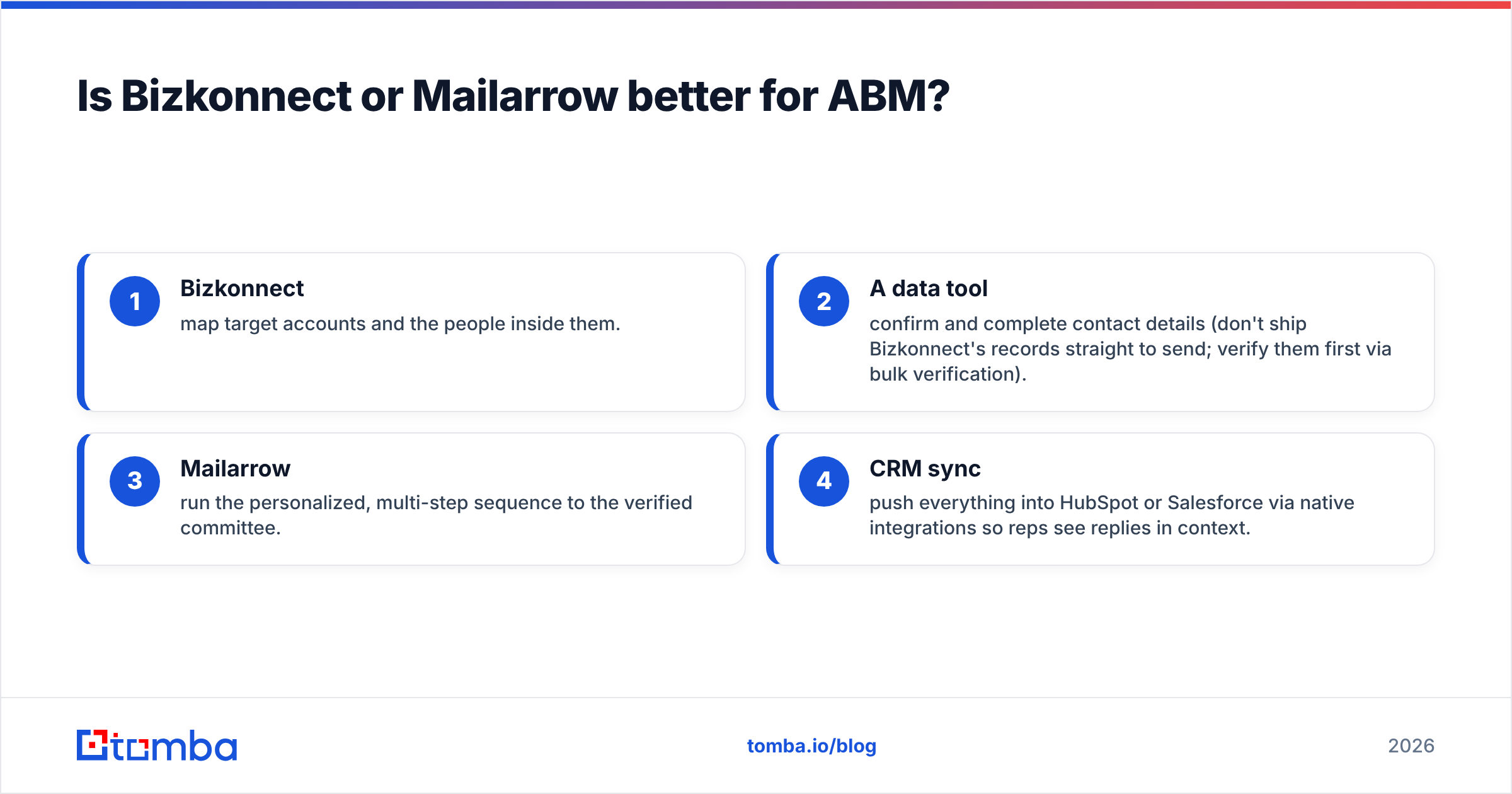
Is Bizkonnect or Mailarrow better for ABM?#
For account-based marketing, Bizkonnect has the more natural fit. Org-chart mapping and trigger events are built for the ABM motion: pick named accounts, map the buying committee, and time outreach to a signal. Mailarrow then becomes the execution arm — but only after your list is built and verified.
A realistic ABM stack looks like this:
- Bizkonnect — map target accounts and the people inside them.
- A data tool — confirm and complete contact details (don't ship Bizkonnect's records straight to send; verify them first via bulk verification).
- Mailarrow — run the personalized, multi-step sequence to the verified committee.
- CRM sync — push everything into HubSpot or Salesforce via native integrations so reps see replies in context.
Skip step 2 and the whole chain inherits whatever decay sits in the intelligence database. That's the most common failure I see in "we tried ABM and it didn't work" post-mortems.
Is Mailarrow better than other cold email tools?#
Mailarrow competes in a crowded category. Its strengths are a clean sequencing UX and solid deliverability defaults, which make it a reasonable pick for small teams that want to start sending fast. Where it's thinner than enterprise rivals: native CRM depth, advanced branching logic, and built-in data. It assumes you bring your own verified list.
If you're evaluating Mailarrow, also weigh it against tools like Instantly and Saleshandy — and note that all of them share Mailarrow's blind spot: they send what you give them. You can read more on cleaning the list you feed any sequencer in our email verification guide. The sender is interchangeable; the data discipline is not.
When do you actually need both?#
You need both Bizkonnect and Mailarrow when:
- You sell into mid-market or enterprise with multi-person buying committees (intelligence pays off).
- You run high-volume, personalized outbound rather than one-off emails (sequencing pays off).
- You have the budget for two specialized tools instead of one generalist.
You do not need both when:
- You're an SMB selling a simple product — a finder, a verifier, and one sequencer is enough.
- Your accounts are small and flat — org charts add little.
- Your real problem is data quality, in which case money spent on either tool is wasted until the list is clean.
The verdict#
Neither tool "wins" because they don't actually compete. Bizkonnect wins the targeting layer; Mailarrow wins the sending layer. The mistake is treating either as a complete outbound stack. Both quietly assume the contact data is correct — and that assumption is wrong often enough to sink campaigns.
So before you pick between them, fix the layer underneath. Find current, verified email addresses, scrub the bounces, and enrich the thin records. Then let Bizkonnect tell you who to hit and Mailarrow do the hitting.
That data layer is where Tomba fits. Use the Tomba Email Finder to pull accurate, source-backed professional emails by domain, name, or company — then verify them in bulk before they ever touch your sequencer. Start on the free tier (25 searches a month, no card), and only scale to a paid plan once you've watched your bounce rate drop. The fanciest intelligence and the slickest sequencer are both worthless aimed at a dead inbox — get the addresses right first.
Ready to find emails that actually work?
Join 150,000+ professionals who stopped guessing and started sending. Free credits on signup — no credit card required.
Get the Tomba newsletter
Practical outbound tactics and product updates — once every two weeks.
About the author