Bizkonnect vs Power Almanac: B2B Data Compared (2026)
Bizkonnect maps org charts and account intelligence; Power Almanac sells local-government contacts. See which B2B data source fits your 2026 pipeline — and where a live email API beats both.
Choosing between Bizkonnect and Power Almanac is really a choice between two very different kinds of B2B data. One sells you organizational maps of private companies. The other sells you a fixed directory of U.S. local-government officials. Picking the wrong one means paying for records you can't act on.
This guide breaks down what each platform actually delivers, where the data comes from, how pricing works, and which sales motions each one fits. It also covers the gap both leave open — fresh, verified contact data you can pull on demand instead of buying a static list.
TL;DR#
- Bizkonnect is an account-intelligence tool: org charts, decision-maker mapping, and company signals for private-sector B2B selling.
- Power Almanac is a niche database of U.S. local-government officials (cities, counties, towns) — ideal if you sell to municipalities, useless otherwise.
- They barely compete. Your real question is "which audience am I selling to?" not "which tool is better?"
- Both ship static or slow-moving data. Contact details decay ~22–30% per year, so any purchased list needs verification before you send.
- A live email API like Tomba's email finder fills the freshness gap — find and verify contacts at the moment you need them, across any industry.
What is Bizkonnect?#
Bizkonnect is a sales-intelligence platform built around actionable org charts. Instead of just handing you a list of names, it tries to show you how a target company is structured — who reports to whom, which executives own which functions, and where the buying committee likely sits.
Its core value is account mapping for complex, multi-stakeholder deals. If you sell enterprise software with a six-person buying committee, knowing that the VP of Engineering reports to a CTO who sits under a specific CEO helps you build a multi-threaded outreach plan. Bizkonnect layers on company "trigger" signals — leadership changes, expansions, and similar events — so reps can time their outreach.
It sits in the same broad space as tools you'd reach for in B2B data and intelligence workflows: account research, territory planning, and decision-maker identification. The trade-off is that org-chart data is inference-heavy and ages quickly — people change roles constantly, and a chart built last quarter may already be stale.
What is Power Almanac?#
Power Almanac is a specialized database of U.S. local-government decision-makers. It covers roughly 40,000+ municipal entities — cities, towns, townships, counties — and the officials inside them: mayors, city managers, council members, department heads (public works, finance, IT, police, parks, and so on).
This is its entire reason to exist. If your buyers are local-government officials — you sell GovTech, municipal equipment, infrastructure services, public-sector SaaS, or you run a public-affairs campaign — Power Almanac is purpose-built for you. You get titles, jurisdictions, phone numbers, and email addresses formatted for direct mail and email outreach.
If you sell to private companies, Power Almanac is the wrong tool. There's no overlap with corporate org charts or commercial firmographics. It's a vertical directory, and its strength is the depth of that one vertical, not breadth.
Bizkonnect vs Power Almanac: how do they compare?#
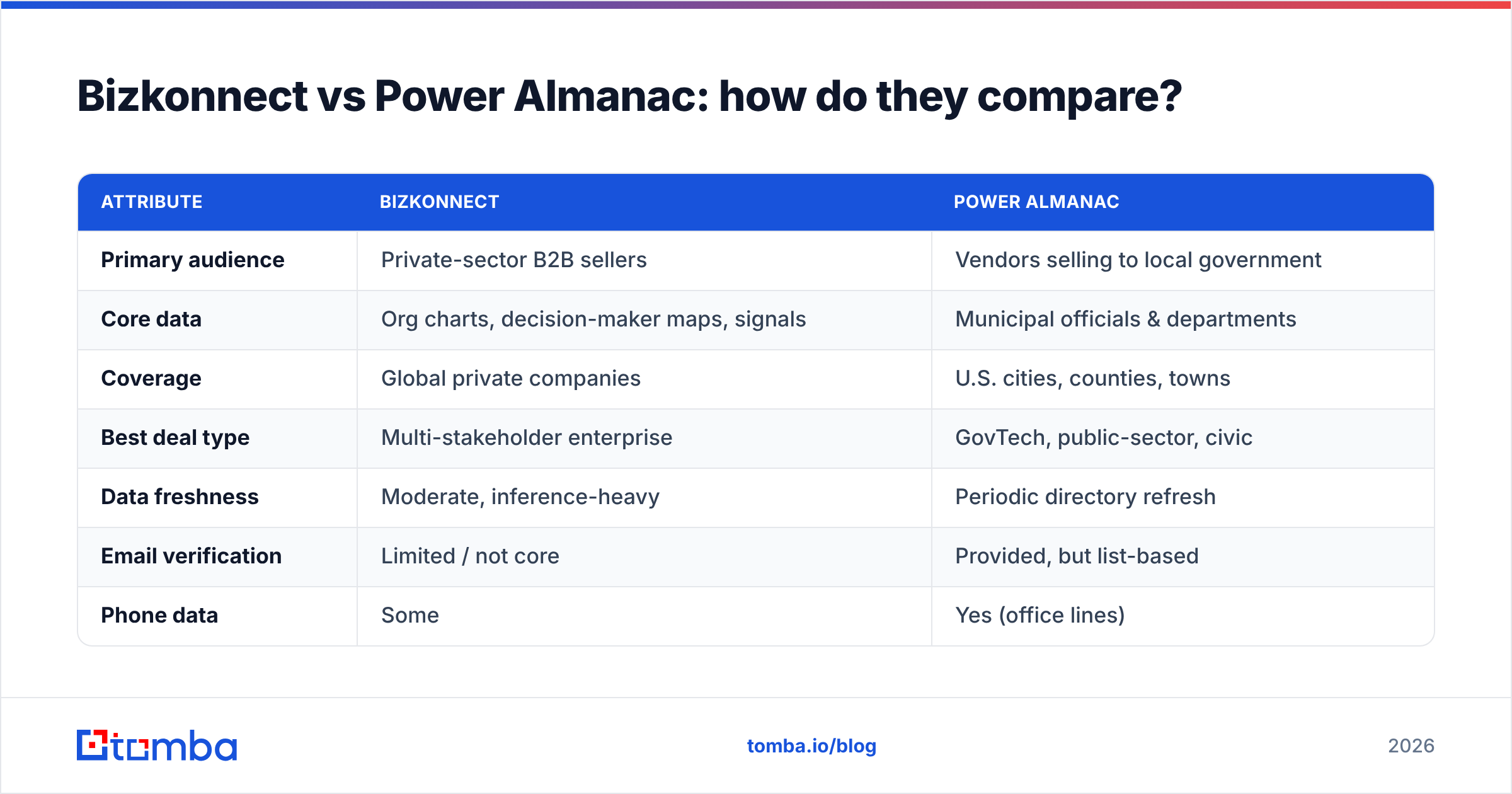
Here's the side-by-side. Notice that the most important row is "who you sell to" — it decides everything else.
| Attribute | Bizkonnect | Power Almanac |
|---|---|---|
| Primary audience | Private-sector B2B sellers | Vendors selling to local government |
| Core data | Org charts, decision-maker maps, signals | Municipal officials & departments |
| Coverage | Global private companies | U.S. cities, counties, towns |
| Best deal type | Multi-stakeholder enterprise | GovTech, public-sector, civic |
| Data freshness | Moderate, inference-heavy | Periodic directory refresh |
| Email verification | Limited / not core | Provided, but list-based |
| Phone data | Some | Yes (office lines) |
| Pricing model | Subscription / custom quote | Subscription by record access |
| Export | CRM/CSV | CSV / direct mail formats |
The pattern is clear: these tools don't really overlap. Bizkonnect wins when your deals are complex and private-sector. Power Almanac wins when your total addressable market literally is U.S. municipalities.
)
When Bizkonnect is the better pick#
- You run enterprise or mid-market deals with multiple stakeholders and long cycles.
- You need to multi-thread and want a visual of reporting relationships.
- Account-based selling is your motion, and timing signals matter.
When Power Almanac is the better pick#
- Your buyers are local-government officials — full stop.
- You need departmental contacts (IT director, public-works head) by jurisdiction.
- Direct mail and phone are part of your outreach mix, not just email.
Where does the data come from, and how accurate is it?#
Accuracy is where both tools — and every static B2B database — get tested. Org-chart inference and periodic directory refreshes both fight the same enemy: contact data decays fast. Industry estimates put B2B data decay at roughly 22–30% per year as people switch jobs, get promoted, or leave. A municipal clerk who was accurate in last year's almanac may have retired; an org chart built from last quarter's signals may show a VP who's already gone.
Neither approach is "wrong" — they're just snapshots. The practical issue is that a snapshot you bought in January is a liability by summer unless you re-verify before you send. Bouncing emails hurt your sender reputation and drag down email deliverability across your whole domain, not just the bad addresses.
That's why a verification step is non-negotiable with any purchased list. Running contacts through an email verifier before a campaign catches dead addresses, role accounts, and catch-all domains that would otherwise tank your bounce rate.
When you evaluate any data vendor — including these two — ask three questions:
- How is the data sourced? Public records, web crawling, user contributions, or inference each have different decay curves.
- When was it last refreshed? A "40,000 entities" claim means little if half were verified two years ago.
- Can I verify on demand? Static exports can't; an API can.
You can read how a live provider documents sourcing on Tomba's data sources page — useful as a benchmark for what transparency should look like.
What do Bizkonnect and Power Almanac cost?#
Neither vendor publishes simple flat pricing the way many self-serve tools do, so treat these as directional rather than exact.
- Bizkonnect uses a subscription/custom-quote model tied to seats and the depth of account intelligence you need. Expect a sales conversation rather than a checkout page.
- Power Almanac prices by record access — typically an annual subscription scaled to how many contacts and jurisdictions you can pull. Add-ons exist for full national coverage and direct-mail formatting.
Because both quote rather than list, build a per-usable-record cost into your evaluation: divide the annual price by the number of contacts you'll actually email, after verification, in your real territory. A cheap-looking list with 30% decay and 60% out-of-territory records can cost more per usable contact than a metered API.
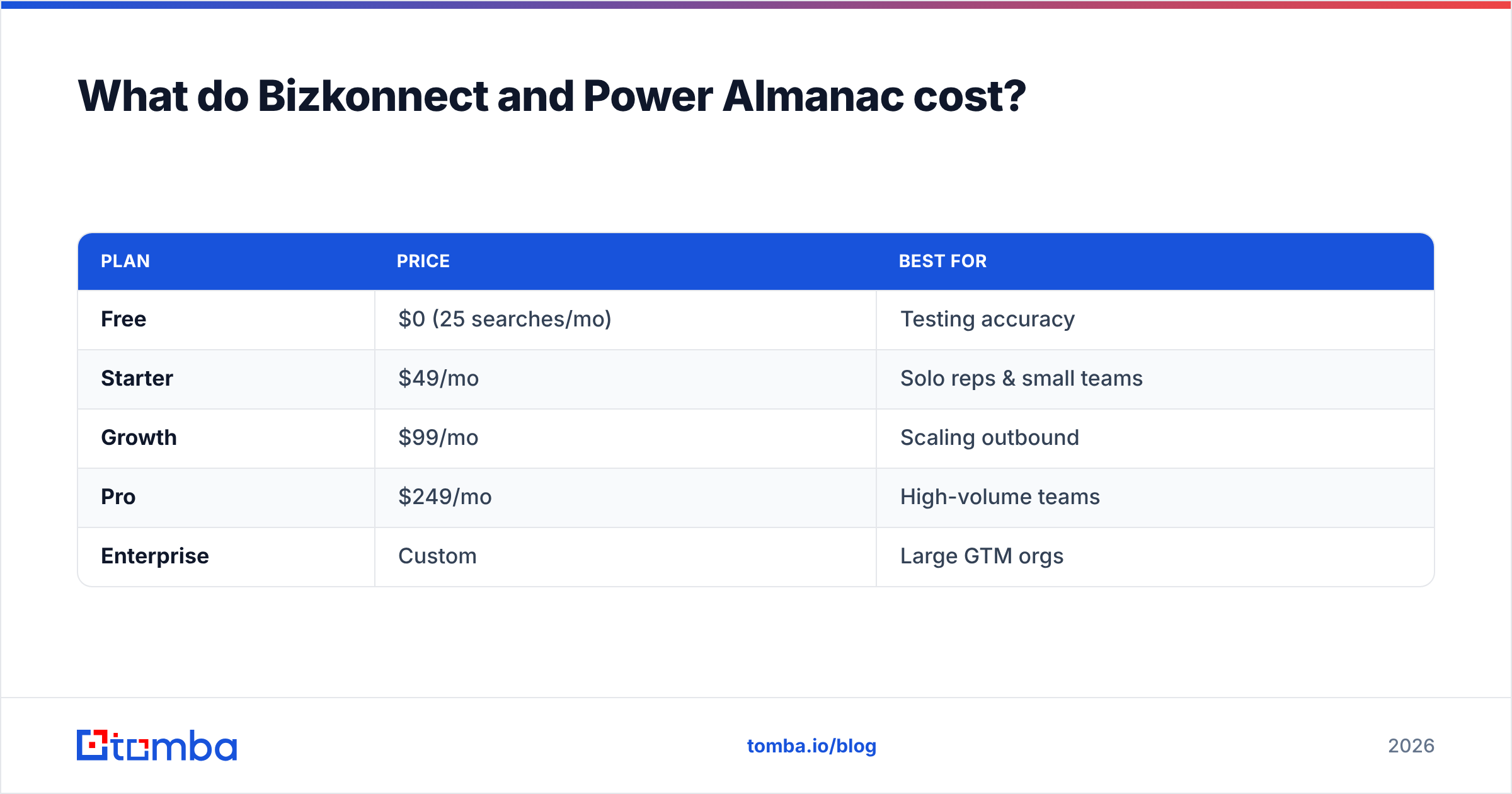
For comparison, here's how a transparent, self-serve email-data model looks — predictable monthly tiers instead of an annual commitment:
| Plan | Price | Best for |
|---|---|---|
| Free | $0 (25 searches/mo) | Testing accuracy |
| Starter | $49/mo | Solo reps & small teams |
| Growth | $99/mo | Scaling outbound |
| Pro | $249/mo | High-volume teams |
| Enterprise | Custom | Large GTM orgs |
See full Tomba pricing for credit allowances per tier. The point isn't that one model is universally cheaper — it's that you should know your cost per usable contact before signing anything.
Can you replace either tool with an email-finding API?#
Partly — and that's the honest answer. An email-finding API doesn't draw org charts and it isn't a pre-built municipal directory. What it does solve is the freshness problem both tools share.
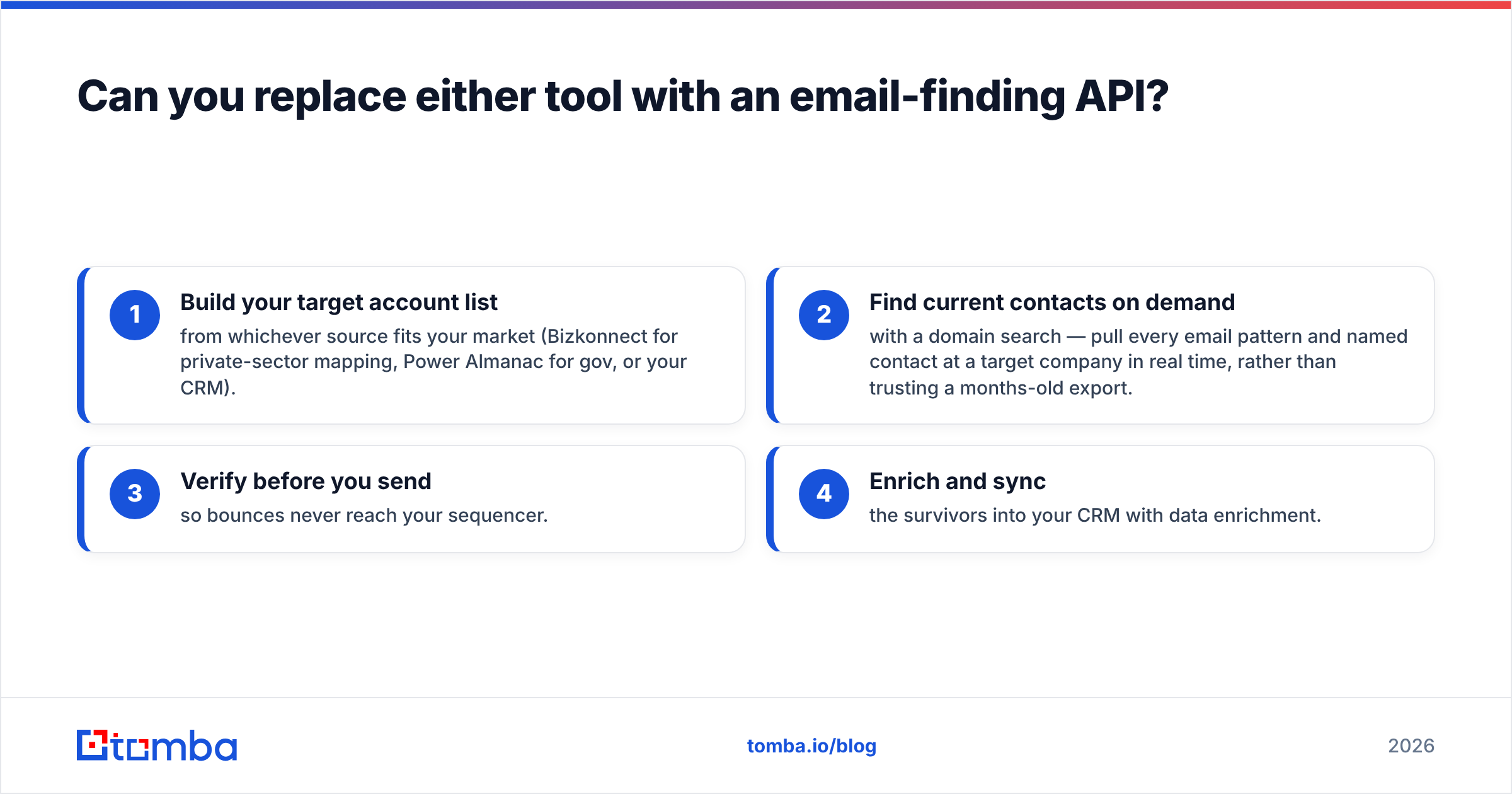
Here's the practical workflow most modern teams run:
- Build your target account list from whichever source fits your market (Bizkonnect for private-sector mapping, Power Almanac for gov, or your CRM).
- Find current contacts on demand with a domain search — pull every email pattern and named contact at a target company in real time, rather than trusting a months-old export.
- Verify before you send so bounces never reach your sequencer.
- Enrich and sync the survivors into your CRM with data enrichment.
This is where a live API earns its keep. Static lists answer "who worked here last quarter?" An API answers "who works here right now?" For high-volume needs, a bulk email finder processes thousands of domains at once, and the Tomba API drops the same capability straight into your own tooling.
)
It's not an either/or. The smartest stacks use a directory or intelligence tool for targeting and a live finder for contact accuracy. You can pressure-test this yourself for free — run a handful of your target domains through a finder and a catch-all verifier, then compare the results against whatever list you're about to buy.
Which one should you choose?#
Decide by audience first, then by motion:
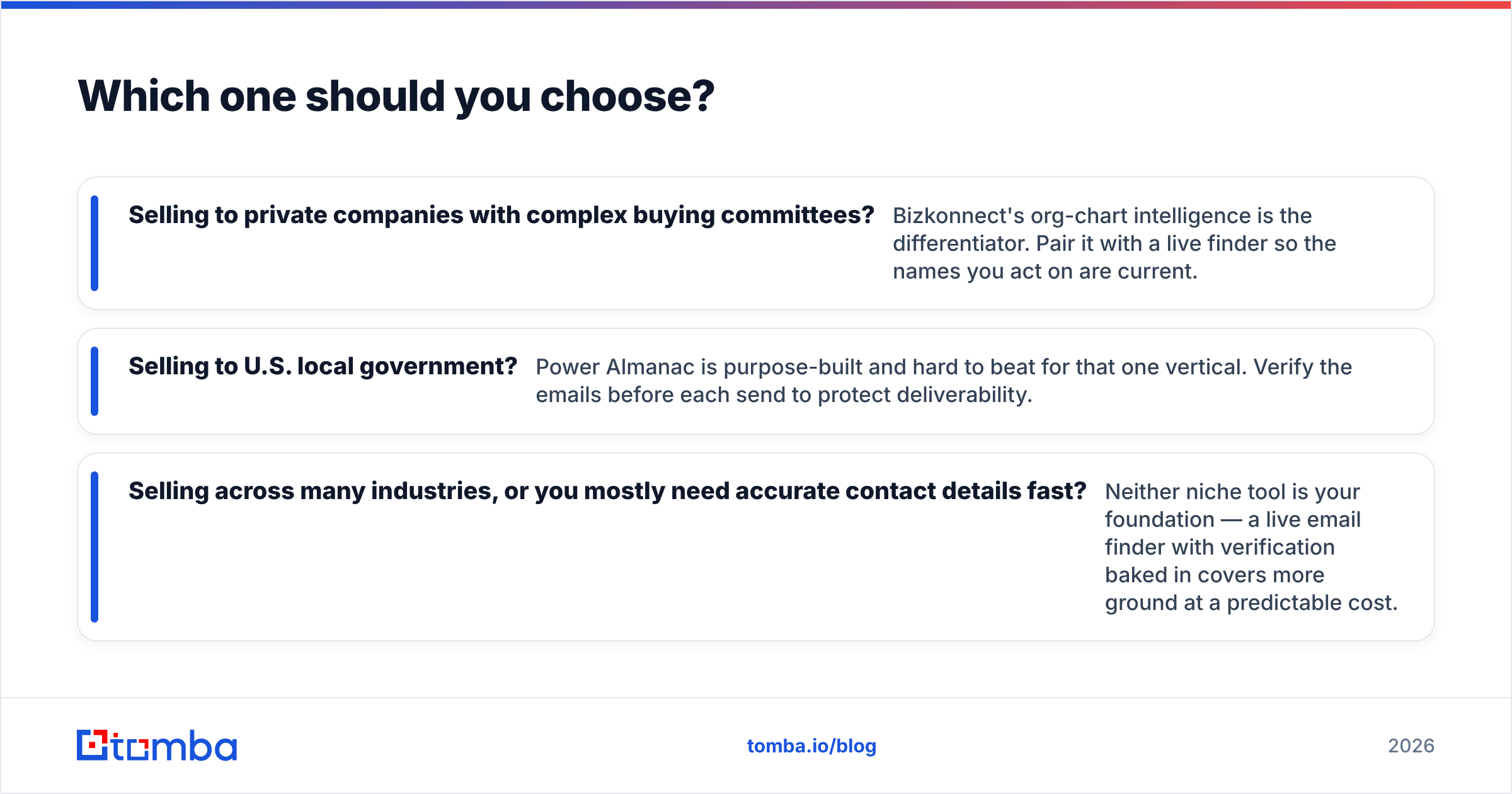
- Selling to private companies with complex buying committees? Bizkonnect's org-chart intelligence is the differentiator. Pair it with a live finder so the names you act on are current.
- Selling to U.S. local government? Power Almanac is purpose-built and hard to beat for that one vertical. Verify the emails before each send to protect deliverability.
- Selling across many industries, or you mostly need accurate contact details fast? Neither niche tool is your foundation — a live email finder with verification baked in covers more ground at a predictable cost.
Most teams over-index on the database and under-invest in verification. The database tells you who to chase; verification decides whether your message arrives. Get both right and your response rate climbs because you're reaching real people at real addresses.
A reasonable benchmark for evaluating any of these vendors is a third-party review site — check current user ratings on G2 or Capterra before you commit, and read each vendor's own documentation (for example, Power Almanac's site) for coverage claims you can verify.
The bottom line#
Bizkonnect and Power Almanac aren't really rivals — they serve different buyers. Bizkonnect maps private-sector decision-makers; Power Almanac catalogs public-sector ones. Choose based on who you sell to, then accept that every static dataset decays and budget for verification.
If your real constraint is reaching current, deliverable contacts across any industry, start with a live source instead of a frozen list. Tomba's Email Finder finds professional emails by name, domain, or company and verifies them on the spot, so your outreach lands in inboxes instead of bouncing. Spin up the free tier with 25 searches, test it against your existing list, and keep only the data that proves accurate.
// get started
Find, verify and enrich your first contacts today
Start on the free plan with 25 searches a month, then scale when your team is ready.
Free plan · No credit card required · GDPR & CCPA
// about the author