Bizkonnect vs RocketReach 2026: Which B2B Data Tool Wins?
Bizkonnect sells org charts and account intelligence; RocketReach sells contact lookups at scale. Here's an honest 2026 breakdown of which fits your team — and where a cheaper finder beats both.
Bizkonnect vs RocketReach: Picking the Right B2B Data Tool in 2026
Choosing between Bizkonnect and RocketReach comes down to one question: do you need to understand an account, or reach the people inside it? They sound like competitors, but they solve different halves of the same problem — and buying the wrong one means paying for data you'll never use.
TL;DR — Bizkonnect vs RocketReach at a glance#
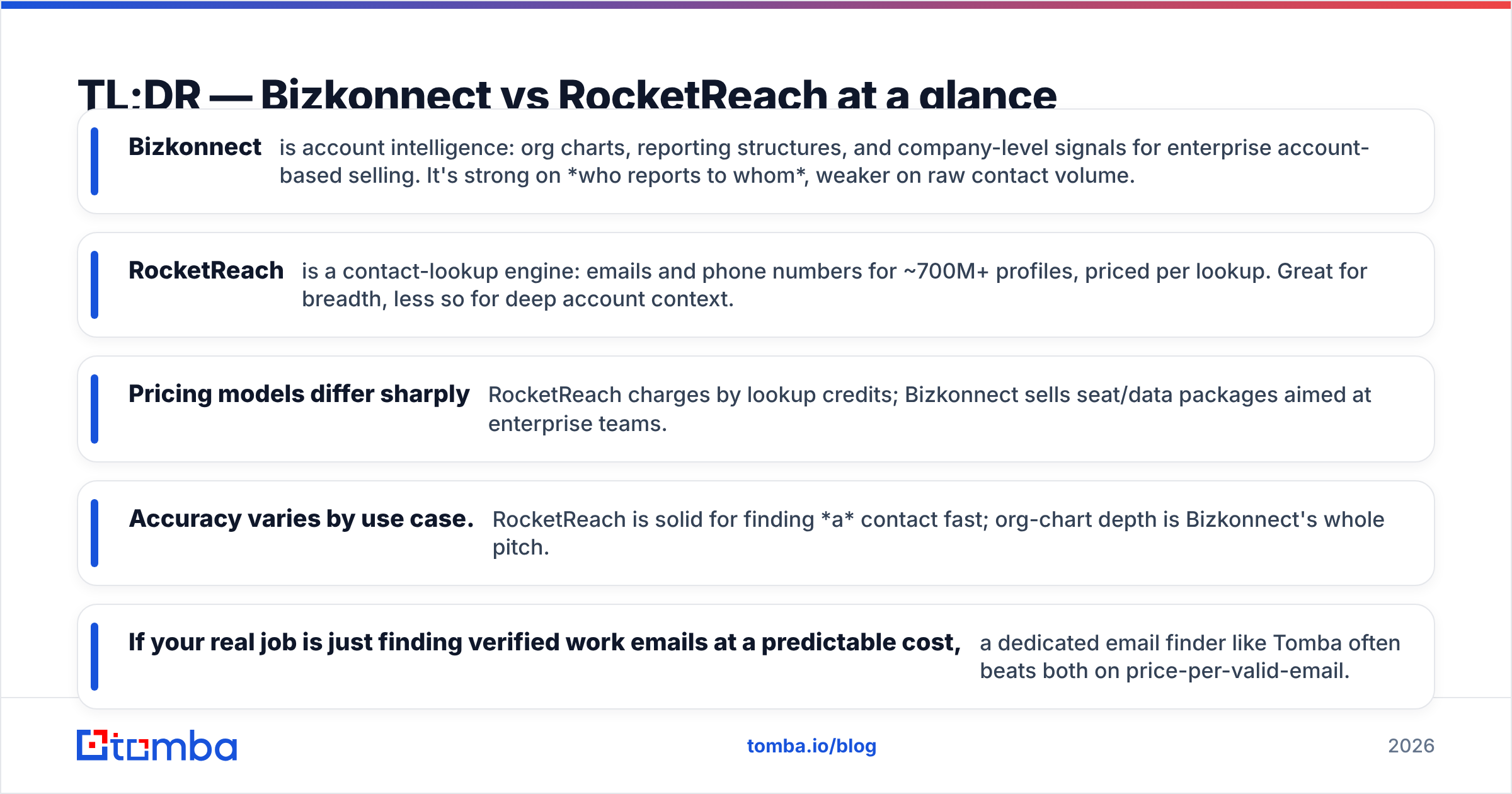
- Bizkonnect is account intelligence: org charts, reporting structures, and company-level signals for enterprise account-based selling. It's strong on who reports to whom, weaker on raw contact volume.
- RocketReach is a contact-lookup engine: emails and phone numbers for ~700M+ profiles, priced per lookup. Great for breadth, less so for deep account context.
- Pricing models differ sharply — RocketReach charges by lookup credits; Bizkonnect sells seat/data packages aimed at enterprise teams.
- Accuracy varies by use case. RocketReach is solid for finding a contact fast; org-chart depth is Bizkonnect's whole pitch.
- If your real job is just finding verified work emails at a predictable cost, a dedicated email finder like Tomba often beats both on price-per-valid-email.
What is Bizkonnect?#
Bizkonnect is a sales intelligence platform built around actionable org charts. Think of it like a building's floor plan versus a phone book: most data tools hand you a list of names, while Bizkonnect tries to show you how the floors connect — who sits above whom, which department owns the budget, and where your champion actually sits in the hierarchy.
Its core deliverables are visual org charts, account-based "sales plays," and company intelligence designed for teams running formal account-based selling motions into mid-market and enterprise accounts. Reps use it to map a buying committee before a single email goes out.
The trade-off: org-chart data is expensive to build and maintain, so Bizkonnect's sweet spot is a smaller set of high-value target accounts — not spray-and-pray prospecting across tens of thousands of SMBs.
What is RocketReach?#
RocketReach is a contact-lookup database. You search a person or company, and it returns likely emails and phone numbers drawn from a profile graph the company says spans hundreds of millions of professionals. It's the digital equivalent of a very large, constantly re-checked Rolodex.
It shines on breadth and speed. Need the email for a specific VP at a specific company in ten seconds? That's the job RocketReach was built for, and its Chrome extension and bulk lookups make single-contact retrieval painless. You can read more on their official site.
The catch is the pricing model. RocketReach meters usage in lookup credits, so cost scales with how much prospecting you do. Heavy outbound teams can burn through credits — and budgets — faster than they expect.

How accurate is the data in Bizkonnect vs RocketReach?#
Accuracy is where most "vs" posts get lazy. The honest answer: neither tool is accurate in the abstract — accuracy depends on what you're asking it for.
- For org structure and reporting lines, Bizkonnect is purpose-built. Its org charts are hand-curated and refreshed, so you're paying for depth on a defined account list. The risk is staleness — people change roles constantly, and any curated chart decays the moment someone gets promoted.
- For raw contact discovery, RocketReach wins on coverage. With a profile graph that large, the odds it has something for your target are high. But coverage isn't the same as correctness: a found email still needs verification before it hits your sequence, or your bounce rate climbs and your sender reputation takes the hit.
This is the gap a lot of teams miss. A contact "found" by any database is a guess until an SMTP check confirms it. That's why pairing any finder with a real-time email verifier matters more than the raw database size on the marketing page.
Use the image above as a mental model: the strong side is freshly verified data at the moment you export it; the weak side is any record that's been sitting in a database since last quarter.
Bizkonnect vs RocketReach: full comparison table#
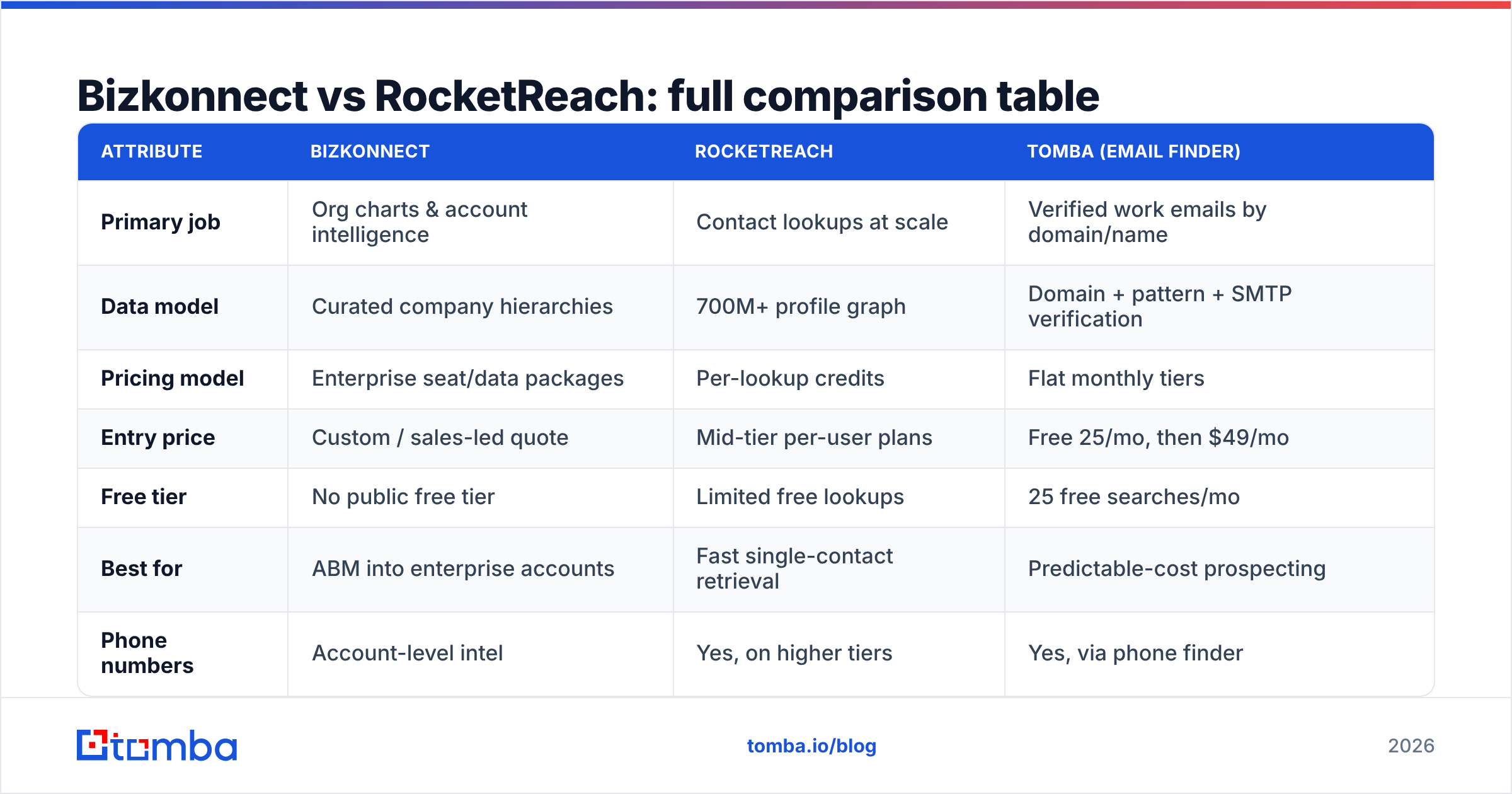
Here's the side-by-side, with a verified email-finder column for context so you can see where a focused tool changes the math.
| Attribute | Bizkonnect | RocketReach | Tomba (email finder) |
|---|---|---|---|
| Primary job | Org charts & account intelligence | Contact lookups at scale | Verified work emails by domain/name |
| Data model | Curated company hierarchies | 700M+ profile graph | Domain + pattern + SMTP verification |
| Pricing model | Enterprise seat/data packages | Per-lookup credits | Flat monthly tiers |
| Entry price | Custom / sales-led quote | Mid-tier per-user plans | Free 25/mo, then $49/mo |
| Free tier | No public free tier | Limited free lookups | 25 free searches/mo |
| Best for | ABM into enterprise accounts | Fast single-contact retrieval | Predictable-cost prospecting |
| Phone numbers | Account-level intel | Yes, on higher tiers | Yes, via phone finder |
| Built-in verification | Not the focus | Limited | Real-time SMTP verifier |
| Weak spot | Narrow account focus, cost | Credit burn at volume | Less org-chart depth |
The pattern is clear: Bizkonnect and RocketReach are premium tools optimized for depth and breadth respectively, while a dedicated finder optimizes for cost-per-valid-email. Most teams need all three jobs done — but rarely from one vendor.
Which is better for account-based selling?#
Bizkonnect, if your motion is genuinely ABM. If you're selling six-figure deals into named enterprise accounts where the buying committee has eight people across three departments, the org chart is the product. You'll close faster by knowing the economic buyer reports to the CFO, not by having ten extra email addresses.
But be honest about your motion. A lot of teams say they do ABM while actually running high-volume outbound. If your rep is contacting 200 accounts a week, hand-curated org charts are overkill — you need verified contacts fast and cheap, and the curation premium is wasted spend.
For that high-volume reality, look at how the contact actually gets sourced. A domain search returns every discoverable email at a company in one call, and bulk lead generation processes thousands of rows at a predictable price — no per-credit anxiety.
Which is better for high-volume prospecting?#
RocketReach edges Bizkonnect here, but watch the credit meter. Its breadth means fewer dead-end searches, and the workflow is fast. The problem is structural: per-lookup pricing punishes exactly the behavior high-volume teams need to do — looking up a lot of people.
Think of credits like a taxi meter versus a monthly transit pass. For occasional rides, the meter is fine. For a daily commute — i.e., real outbound at scale — the meter quietly becomes the most expensive option, and you start rationing prospecting to protect budget. That's a terrible incentive to build into your sales process.
This is the precise spot where a flat-rate finder wins on unit economics:
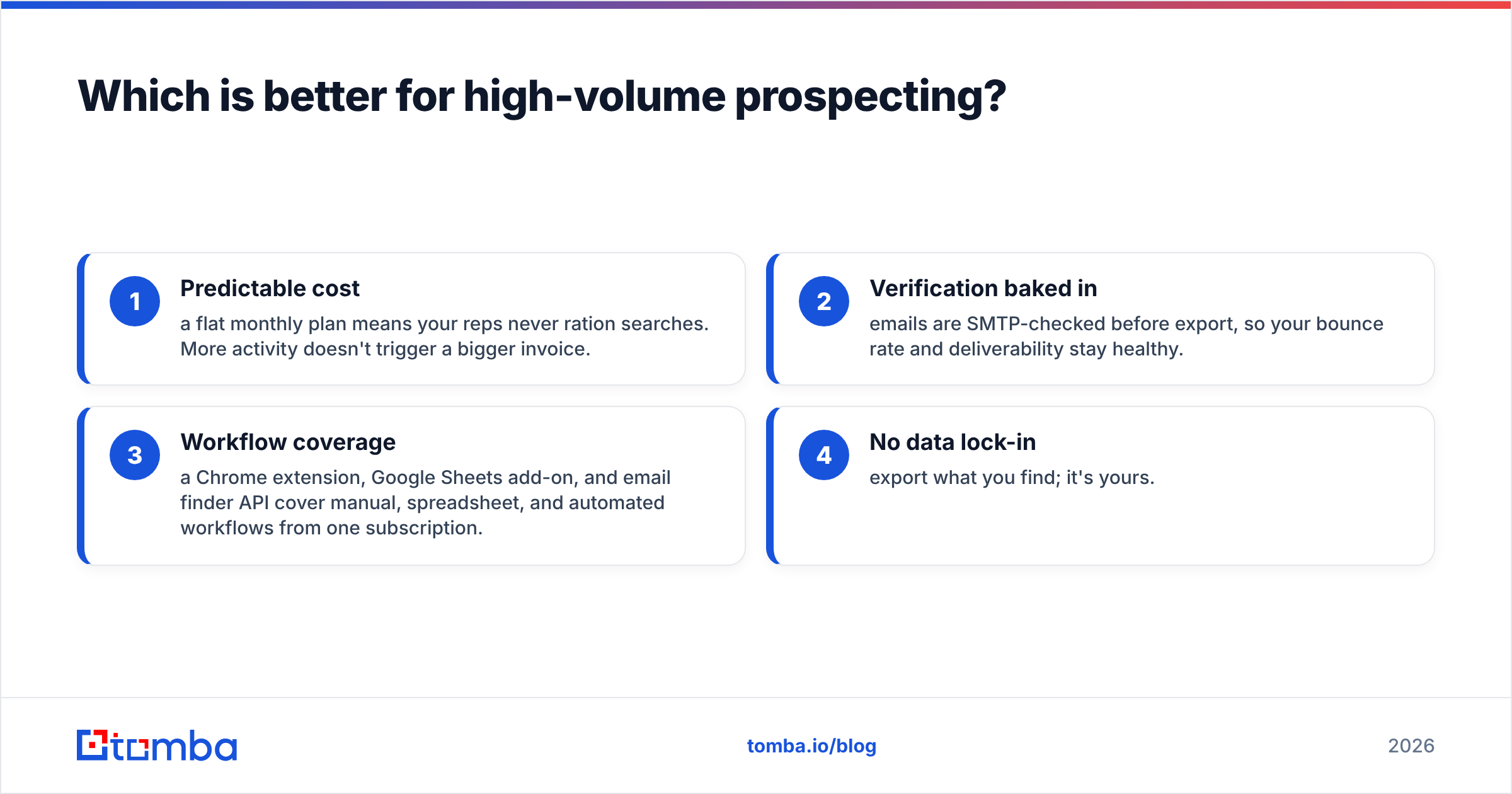
- Predictable cost — a flat monthly plan means your reps never ration searches. More activity doesn't trigger a bigger invoice.
- Verification baked in — emails are SMTP-checked before export, so your bounce rate and deliverability stay healthy.
- Workflow coverage — a Chrome extension, Google Sheets add-on, and email finder API cover manual, spreadsheet, and automated workflows from one subscription.
- No data lock-in — export what you find; it's yours.
)

How does pricing really compare?#
Pricing is where the three approaches diverge most, and it's the thing that should drive your decision.
- Bizkonnect is sales-led and enterprise-oriented. You'll get a custom quote tied to seats and the size of your target-account universe. Expect a meaningful annual commitment — this is not a tool you trial casually, and there's no public free tier to kick the tires.
- RocketReach publishes per-user tiers metered by lookups. The headline price looks reasonable, but the real cost is headline price plus credit consumption. Model your actual monthly lookup volume before committing, or you'll be surprised on renewal.
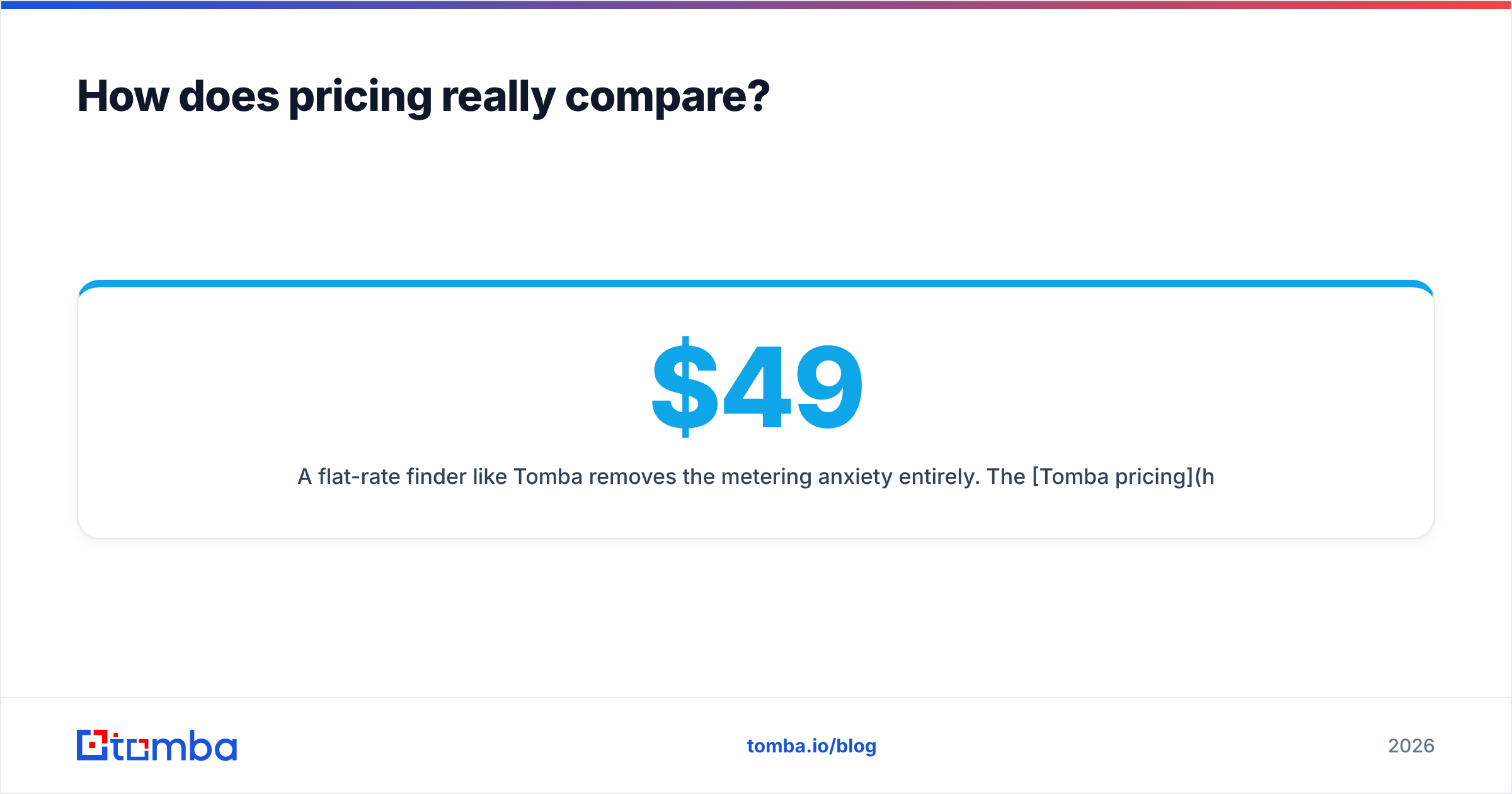
- A flat-rate finder like Tomba removes the metering anxiety entirely. The Tomba pricing ladder runs from a free tier (25 searches/mo) to Starter at $49/mo, Growth at $99/mo, and Pro at $249/mo — with the count known in advance regardless of how hard your team prospects.
For a comparison-shopper, the buying lesson is simple: don't compare sticker prices, compare cost-per-validated-contact at your real volume. A tool that looks cheap per seat can be the most expensive per usable email once the meter runs.

Where does each tool fall short?#
No tool is the hero of every story. Here's the unflinching version.
Bizkonnect's limits: the curated-data model is its strength and its ceiling. Depth costs money and decays over time, so you're paying a premium for an asset that needs constant refreshing. If your ICP is broad or SMB-heavy, the org-chart value evaporates and you're overpaying.
RocketReach's limits: credit-based pricing creates the wrong incentives for outbound teams, and breadth without strong built-in verification means you should still run found emails through a catch-all verifier before trusting them. Coverage is a starting point, not a guarantee.
The dedicated-finder limit: a pure email finder won't hand you a rendered org chart or an account-intelligence dashboard. If buying-committee mapping is your core need, you'll want to pair it with a CRM workflow or an ABM layer.
The realistic stack for many teams is finder for volume + verification for quality + a CRM for context — and only adding a premium intelligence tool like Bizkonnect when named-account depth genuinely justifies the spend. You can sanity-check any vendor's reputation on G2 before signing.
Bizkonnect vs RocketReach: which should you choose?#
Here's the decision in one paragraph. Choose Bizkonnect if you run true enterprise ABM into a defined set of high-value accounts and org-chart depth shortens your sales cycle. Choose RocketReach if you need fast, ad-hoc single-contact lookups and your volume is moderate enough that credit costs stay sane. Choose a flat-rate email finder if your reality is high-volume outbound where predictable cost-per-valid-email and built-in verification matter more than curated hierarchies.
Most growing sales teams discover their actual bottleneck isn't org charts — it's getting enough verified, deliverable emails without a runaway bill. If that's you, start with the finder and add intelligence layers only when a deal actually needs them.
Get verified emails without the credit meter#
If your goal is reaching the right people at a predictable cost, start with the Tomba Email Finder. Search by domain, name, or company; get SMTP-verified results before they ever enter your sequence; and scale from a free 25-search tier to flat monthly plans that don't punish you for prospecting harder. Pair it with the built-in email verifier and you've covered the two jobs — breadth and quality — that Bizkonnect and RocketReach each only do half of. Run your first 25 searches free, then decide what premium intelligence, if any, you actually need on top.
// get started
Find, verify and enrich your first contacts today
Start on the free plan with 25 searches a month, then scale when your team is ready.
Free plan · No credit card required · GDPR & CCPA
// about the author