Bizkonnect vs Sendigram (2026): Which Sales Tool Wins?
Bizkonnect vs Sendigram compared on data, org charts, outreach, pricing, and fit. See which B2B sales tool matches your 2026 pipeline goals — and where a dedicated email finder beats both.
Choosing between Bizkonnect and Sendigram comes down to one question: do you need richer account intelligence, or do you need to actually send and track outreach at scale? The two tools sit on opposite ends of the same pipeline, and picking the wrong one wastes a quarter.
TL;DR — Bizkonnect vs Sendigram in 30 seconds#
- Bizkonnect is an account-intelligence and org-chart platform. Its strength is mapping who reports to whom inside target accounts so you can plan multi-threaded deals.
- Sendigram leans toward outreach execution — sequencing, sending, and tracking messages once you already know who to contact.
- They solve different jobs. Bizkonnect answers "who should I talk to?" Sendigram answers "how do I reach them at volume?"
- Neither is a best-in-class email finder. If contact discovery and verified emails are your real bottleneck, a dedicated tool like Tomba Email Finder usually outperforms a bundled feature.
- Best move for most teams: layer a verified-data source under whichever workflow tool you pick, rather than trusting one vendor's "rented" database.
What is Bizkonnect?#
Bizkonnect is a B2B sales intelligence provider known for actionable org charts and account-level company data. Instead of handing you a flat list of contacts, it tries to show the reporting structure inside an account — which VP owns which function, who the likely champion is, and who can block a deal.
That structure matters for enterprise selling. When your average deal involves five to seven stakeholders, knowing the hierarchy lets you multi-thread instead of betting everything on one contact. Bizkonnect packages this as visual org charts, account dossiers, and trigger-based company intelligence.
Where it gets weaker is execution. Bizkonnect is a planning and research layer. It doesn't replace your sequencer, your CRM, or a high-accuracy email finder. Teams typically pull intelligence out of it and act somewhere else.

What is Sendigram?#
Sendigram sits closer to the outreach and engagement side of the funnel. Its job is to take a list of prospects and help you contact them through structured sequences — email steps, follow-ups, and basic performance tracking — so reps aren't manually copy-pasting templates.
If Bizkonnect is the map, Sendigram is the vehicle. It assumes you already have contacts and intent data, and it focuses on getting messages out the door consistently. For a team whose pain is "we have leads but no system to work them," that framing is appealing.
The trade-off mirrors Bizkonnect's, just inverted: Sendigram is light on deep account intelligence and org mapping. You won't get the same hierarchical view of an enterprise account, and its contact data is only as good as the list you feed it.
Bizkonnect vs Sendigram: full comparison table#
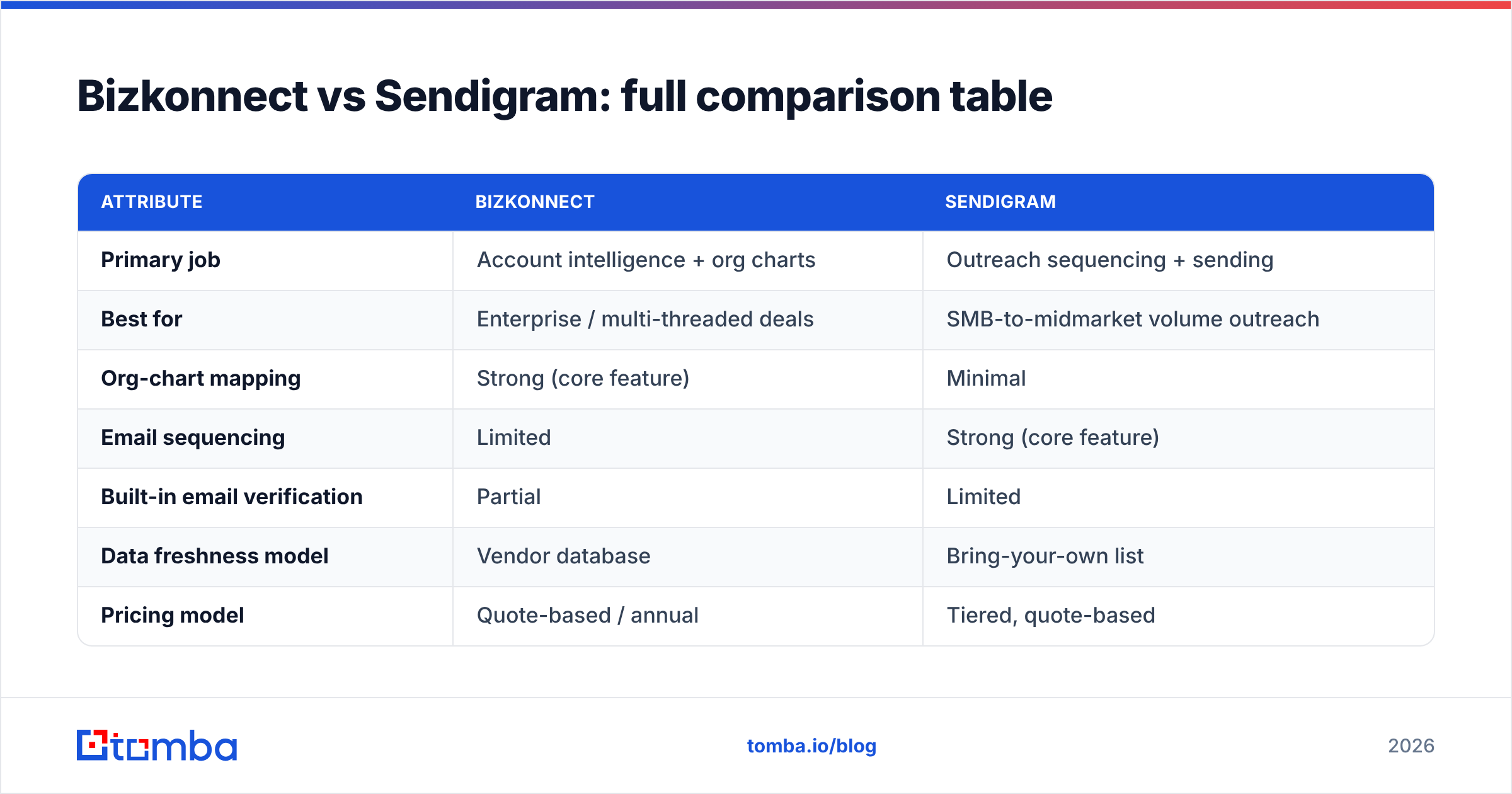
Here is the head-to-head on the attributes that actually change a buying decision. Treat pricing as directional — both vendors lean toward quote-based plans, so confirm current numbers on their sites before you commit.
| Attribute | Bizkonnect | Sendigram |
|---|---|---|
| Primary job | Account intelligence + org charts | Outreach sequencing + sending |
| Best for | Enterprise / multi-threaded deals | SMB-to-midmarket volume outreach |
| Org-chart mapping | Strong (core feature) | Minimal |
| Email sequencing | Limited | Strong (core feature) |
| Built-in email verification | Partial | Limited |
| Data freshness model | Vendor database | Bring-your-own list |
| Pricing model | Quote-based / annual | Tiered, quote-based |
| Learning curve | Moderate–high | Low–moderate |
| Standout strength | Stakeholder hierarchy | Speed to first send |
The pattern is clear: these are complementary, not interchangeable. The mistake is buying one expecting it to cover the other's job.
Is Bizkonnect better than Sendigram?#
It's better for research-heavy, enterprise motions — and worse for high-volume sending. If your reps spend more time figuring out who to engage inside a 5,000-person company than actually emailing, Bizkonnect's org charts pay for themselves.
But "better" is the wrong frame. Ask instead: where is your pipeline leaking?
- Leaking at targeting (wrong people, no champion map)? Bizkonnect helps.
- Leaking at activity (great list, no consistent follow-up)? Sendigram helps.
- Leaking at data quality (bounces, stale contacts, no direct emails)? Neither fully solves this — and this is the most common leak of all.
That third category is where most teams actually bleed. According to widely cited B2B data decay benchmarks, contact databases degrade roughly 22–30% per year as people change jobs. A beautiful org chart or a slick sequence built on stale emails still bounces.
How do they handle data accuracy and email verification?#
This is the quiet weakness in both tools, and it's the reason a layered stack beats an all-in-one bet.
Bizkonnect's intelligence is only as current as its underlying database refresh cycle. Org charts built on last year's headcount will list people who have already left. Sendigram, meanwhile, generally trusts the list you import — garbage in, garbage out — and lighter verification means more of your sends hit invalid mailboxes, dragging down sender reputation.
A practical fix is to verify and enrich before anything enters either tool. Run lists through a dedicated email verifier to strip dead addresses, and use data enrichment to fill missing direct emails and phone numbers. The difference in bounce rate alone often justifies the extra step.
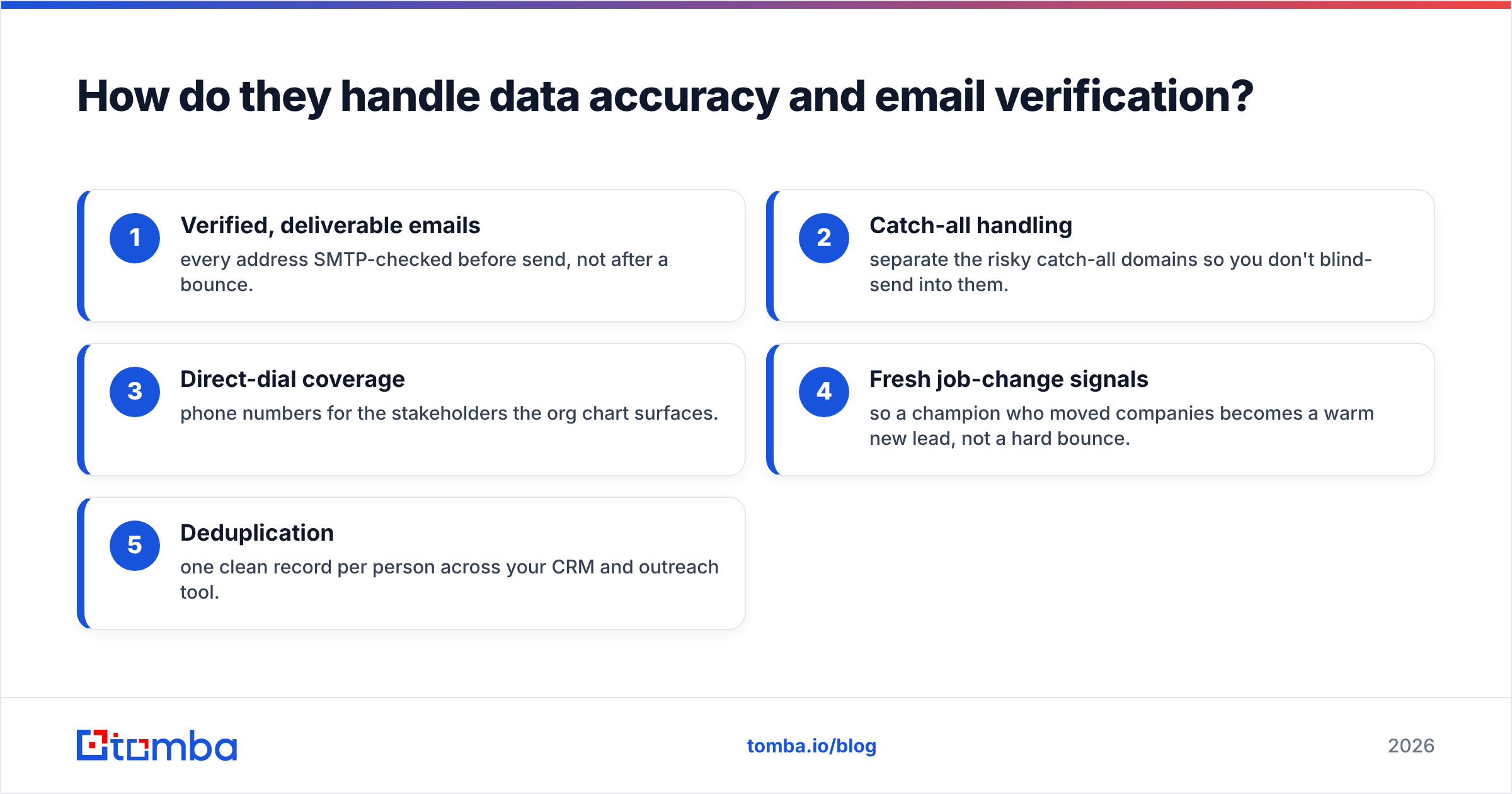
Concretely, a clean-data layer should give you:
- Verified, deliverable emails — every address SMTP-checked before send, not after a bounce.
- Catch-all handling — separate the risky catch-all domains so you don't blind-send into them.
- Direct-dial coverage — phone numbers for the stakeholders the org chart surfaces.
- Fresh job-change signals — so a champion who moved companies becomes a warm new lead, not a hard bounce.
- Deduplication — one clean record per person across your CRM and outreach tool.
When should you use Bizkonnect vs Sendigram?#
Match the tool to the motion. Quick decision guide:
- You sell six-figure deals into large enterprises. Lead with Bizkonnect for stakeholder mapping, then push contacts into your sequencer.
- You run high-volume SMB or mid-market outbound. Sendigram's sending engine fits the cadence better; pair it with a fast contact-discovery tool.
- You're a lean team that can only buy one tool. Buy neither first — start with verified contact data, because both tools assume you already have it.
- You already have a CRM and sequencer. You may only need Bizkonnect's intelligence, not Sendigram's overlapping send features.
A common winning stack looks like this: a verified-data foundation (find + verify), Bizkonnect-style intelligence for account planning, and a sequencer for execution. The data layer is the part teams skip — and it's the part that determines whether the other two tools produce revenue or just activity.
How does pricing compare?#
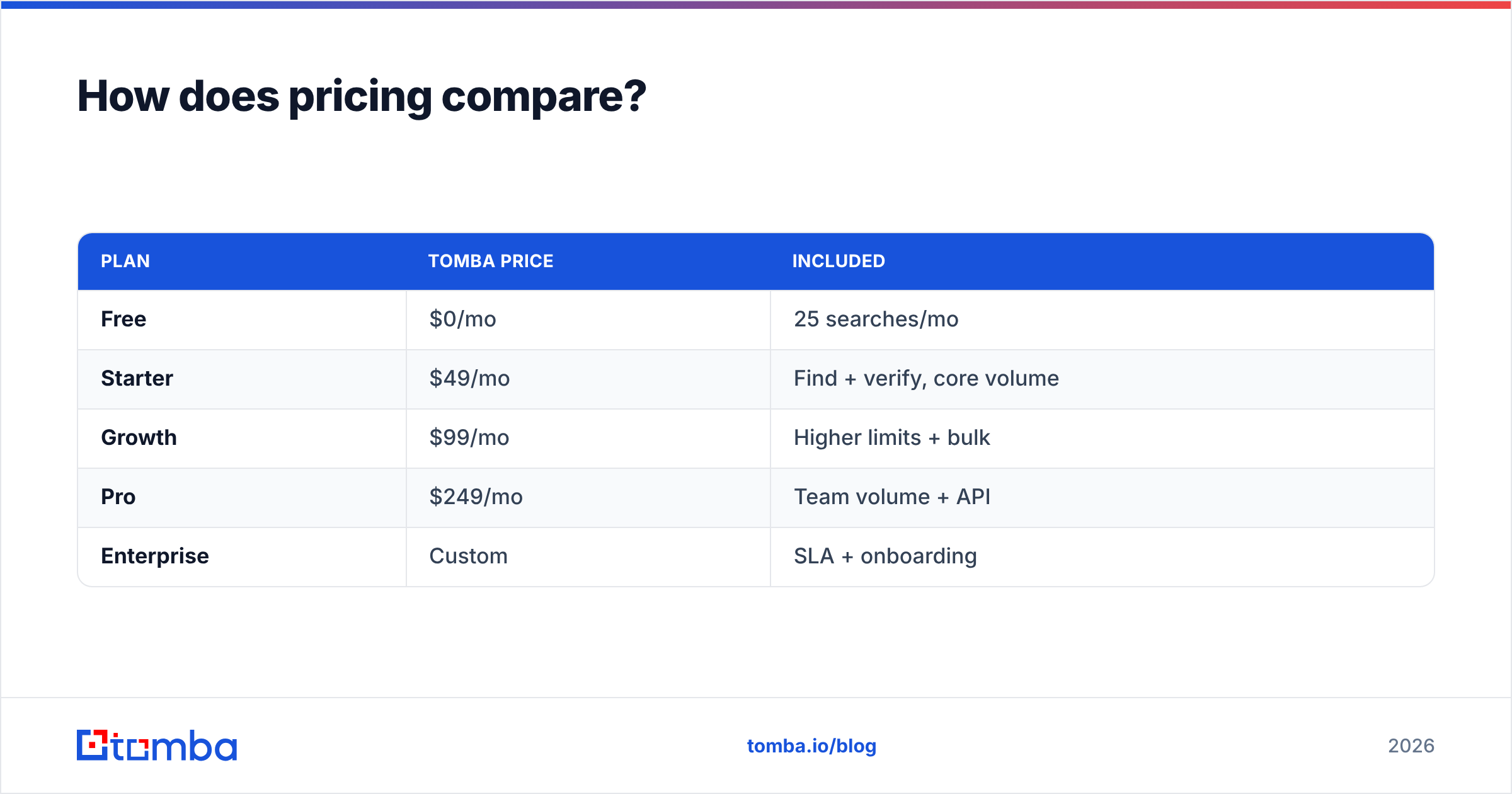
Both Bizkonnect and Sendigram steer buyers toward annual, quote-based contracts, which makes apples-to-apples comparison hard and tends to favor larger teams. That's standard for intelligence and outreach platforms, but it's worth modeling total cost against a usage-based alternative.
For comparison, a usage-based data tool like Tomba keeps entry costs low and predictable:
| Plan | Tomba price | Included |
|---|---|---|
| Free | $0/mo | 25 searches/mo |
| Starter | $49/mo | Find + verify, core volume |
| Growth | $99/mo | Higher limits + bulk |
| Pro | $249/mo | Team volume + API |
| Enterprise | Custom | SLA + onboarding |
The point isn't that a data tool replaces Bizkonnect or Sendigram — it's that you can add a verified-data foundation for the price of a few coffees a week, instead of bolting your whole motion onto a single annual contract. See full Tomba pricing for current limits.
When you evaluate any of these vendors, sanity-check claims against third-party reviews on G2 and Capterra rather than trusting marketing pages alone. Real buyers flag data-freshness and deliverability issues there long before you'll see them in a demo.
What about combining them with a dedicated email finder?#
This is where most teams land after a year of trial and error: use the workflow tools for their strengths, and outsource contact discovery to a specialist.
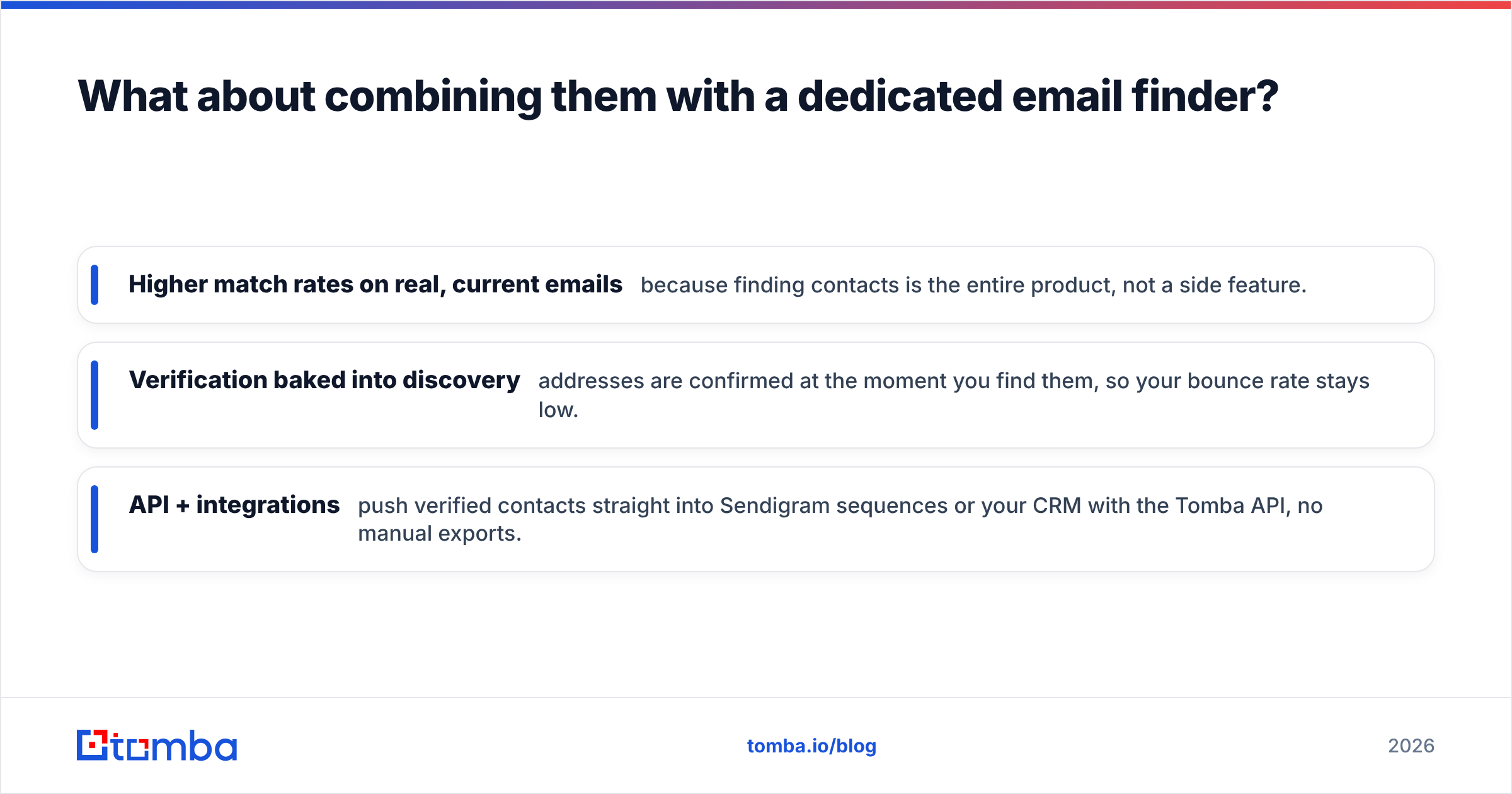
A specialist email finder does three things that bundled features rarely match:
- Higher match rates on real, current emails — because finding contacts is the entire product, not a side feature.
- Verification baked into discovery — addresses are confirmed at the moment you find them, so your bounce rate stays low.
- API + integrations — push verified contacts straight into Sendigram sequences or your CRM with the Tomba API, no manual exports.
If your reps work LinkedIn, a LinkedIn finder turns profiles into verified work emails in seconds. For account-based plays, domain search pulls every known contact at a company — a natural complement to Bizkonnect's org charts. You get the hierarchy from one tool and the deliverable contact details from another, instead of hoping a single vendor nailed both.
Bizkonnect vs Sendigram: the verdict#
There's no universal winner because they're not really competing — they're two stages of the same pipeline.
- Pick Bizkonnect if your bottleneck is knowing who to engage inside complex accounts.
- Pick Sendigram if your bottleneck is consistent execution against a list you already trust.
- Fix data quality first either way, because both tools amplify whatever list you give them — clean or stale.
The teams that win in 2026 aren't the ones with the fanciest single platform. They're the ones who built a layered stack: verified data underneath, intelligence and execution on top.
Start with the layer both tools depend on#
Before you sign an annual contract with either vendor, fix the foundation. Tomba Email Finder gives you verified, deliverable B2B emails by name, company, or domain — the exact input Bizkonnect's org charts and Sendigram's sequences need to actually convert. Find and verify contacts in one step, push them into your existing tools via API or native integrations, and stop paying for outreach that bounces.
Try it free with 25 searches a month, then scale on the Starter plan at $49/mo when the pipeline proves out. Get the data right first — and let Bizkonnect or Sendigram do what they're actually good at.
// get started
Find, verify and enrich your first contacts today
Start on the free plan with 25 searches a month, then scale when your team is ready.
Free plan · No credit card required · GDPR & CCPA
// about the author