Bizkonnect vs SignalHire 2026: Which Sales Data Tool Wins?
Bizkonnect sells org charts and account intelligence; SignalHire sells contact data and phone numbers. Here's how the two compare on data, pricing, and use cases — plus where a focused email finder beats both.
Choosing between Bizkonnect and SignalHire usually means you are stuck somewhere between "I need to understand an account" and "I need to email a specific person today." They sound similar on a feature checklist, but they solve different halves of the prospecting problem. This guide breaks down what each one actually does, what it costs, where the data holds up, and when a focused email finder beats paying for either.
TL;DR — Bizkonnect vs SignalHire at a glance#
- Bizkonnect is an account-intelligence and org-chart platform. It shines when you need to map decision-makers, visualize reporting lines, and build ABM target lists — not when you need a verified email in two seconds.
- SignalHire is a contact-finder browser extension and database. It pulls emails and phone numbers from social profiles and a 650M+ contact pool, billed per credit.
- Neither is a pure email-finder. Bizkonnect bundles contacts inside intelligence; SignalHire bundles finding inside a recruiting-leaning toolset.
- Pricing models clash: Bizkonnect is quote-based and contract-heavy; SignalHire sells credit packs that expire. Costs creep fast on both.
- If your core job is verified B2B email at scale, a dedicated tool like Tomba Email Finder is cheaper and more accurate than either — starting at a free tier and $49/mo paid.
What is Bizkonnect?#
Bizkonnect is a sales-intelligence company that sells "actionable sales intelligence" — primarily org charts, decision-maker mapping, and account-based prospect lists. Think of it less like a phone book and more like a corporate family tree: it tries to show you who reports to whom inside a target account, so you can route a deal to the right VP instead of guessing.
Its core outputs are:
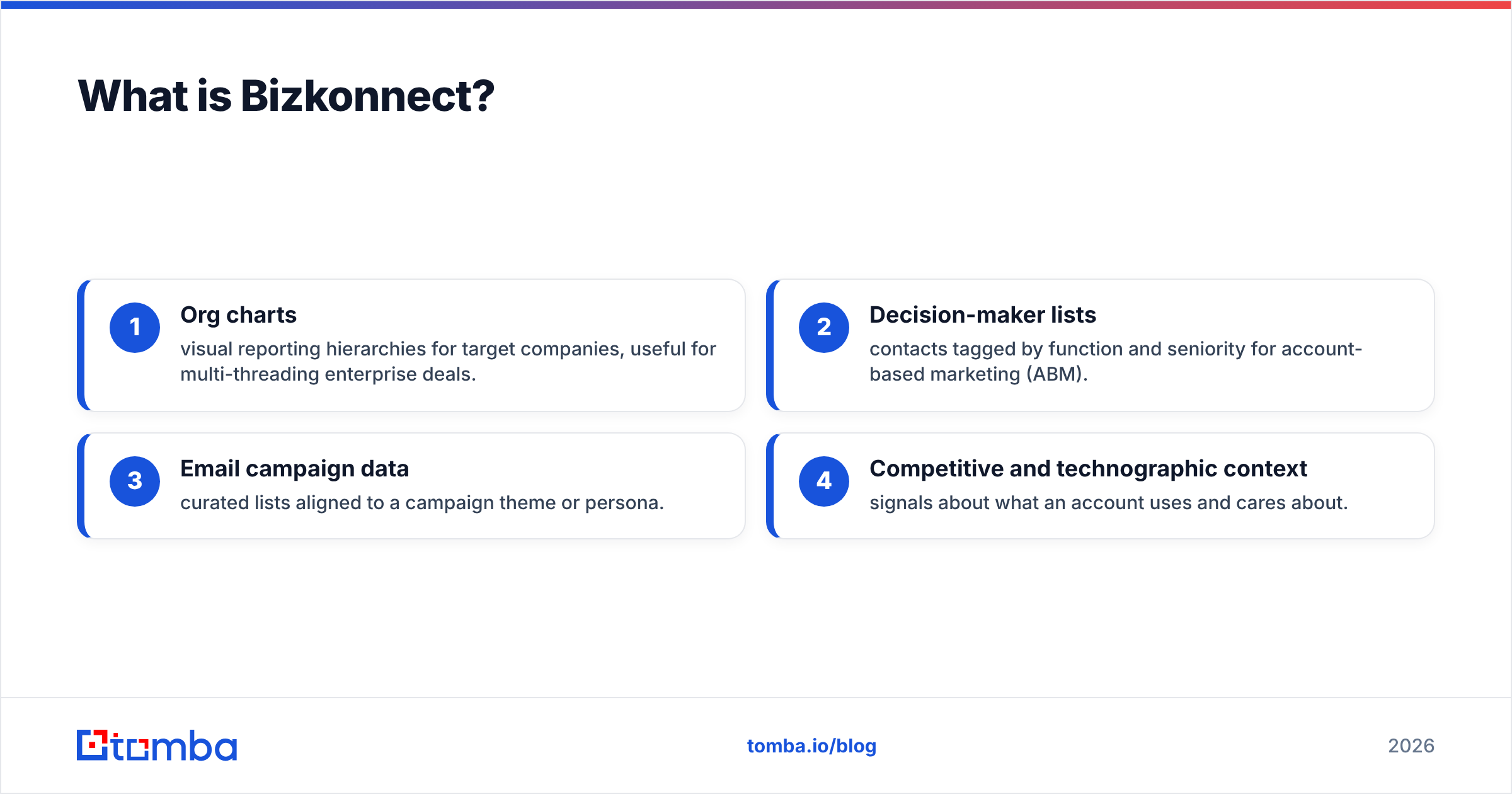
- Org charts — visual reporting hierarchies for target companies, useful for multi-threading enterprise deals.
- Decision-maker lists — contacts tagged by function and seniority for account-based marketing (ABM).
- Email campaign data — curated lists aligned to a campaign theme or persona.
- Competitive and technographic context — signals about what an account uses and cares about.
Bizkonnect's sweet spot is the enterprise ABM motion where understanding the buying committee matters more than raw contact volume. You can read more about the product on the official bizkonnect.com site. The trade-off: it is sold as a managed, contract-based service, so pricing is opaque and onboarding is slower than a self-serve tool.

What is SignalHire?#
SignalHire is a contact-finder built around a browser extension and a searchable database of 650M+ profiles. You install the extension, open a LinkedIn profile or company page, click "reveal," and SignalHire returns the person's email and phone number where it has them. It leans heavily toward recruiting and sourcing use cases, though sales teams use it for outbound too.
Its core pieces:
- Browser extension for one-click reveals on social profiles.
- Database search with filters for title, location, industry, and skills.
- Bulk lookups for processing lists of profiles.
- Basic ATS-style tracking for recruiters managing candidates.
SignalHire's strength is speed of discovery on a single profile and its recruiter-friendly filters. The catch is the credit model: each reveal burns a credit, credits expire, and phone/email accuracy varies by region and seniority. The official details live at signalhire.com.
Bizkonnect vs SignalHire: how do they compare?#
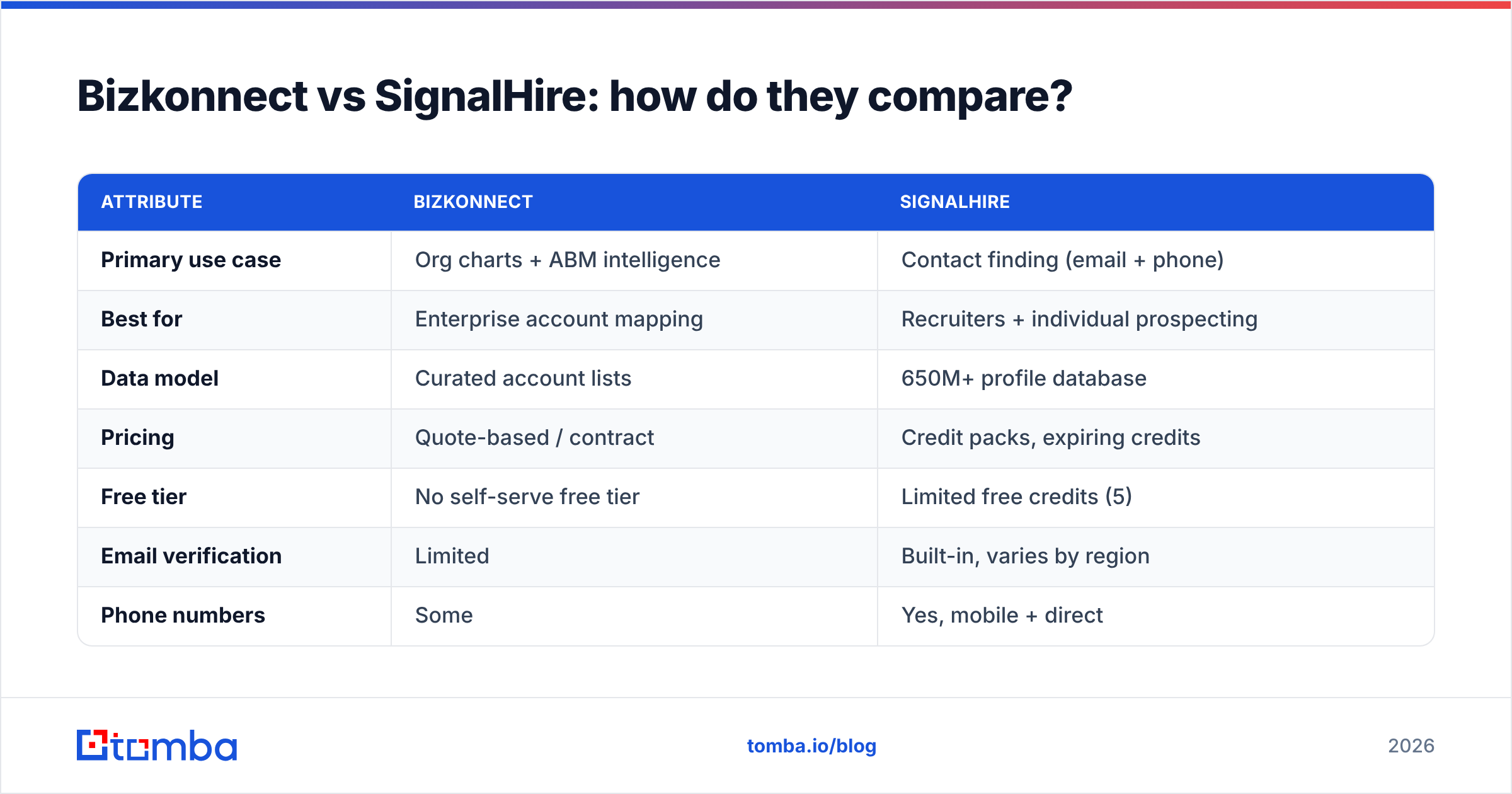
Here is the side-by-side. The short version: Bizkonnect is an intelligence layer, SignalHire is a discovery layer, and only one of them is genuinely built for high-volume email finding (and it is arguably neither).
| Attribute | Bizkonnect | SignalHire |
|---|---|---|
| Primary use case | Org charts + ABM intelligence | Contact finding (email + phone) |
| Best for | Enterprise account mapping | Recruiters + individual prospecting |
| Data model | Curated account lists | 650M+ profile database |
| Pricing | Quote-based / contract | Credit packs, expiring credits |
| Free tier | No self-serve free tier | Limited free credits (5) |
| Email verification | Limited | Built-in, varies by region |
| Phone numbers | Some | Yes, mobile + direct |
| API access | Limited / managed | Yes |
| Bulk processing | Yes (managed lists) | Yes (credit-gated) |
| Onboarding speed | Slow (sales-led) | Fast (self-serve) |
The pattern is clear: if your team's central problem is "we don't understand the account," Bizkonnect earns its keep. If it is "I found the person on LinkedIn and need their contact info," SignalHire is faster. But if your problem is "I have 5,000 domains and need verified emails this week," both tools start fighting their own design.
Which one is more accurate?#
Accuracy depends on what you mean by accurate. Bizkonnect's org-chart data is researched and curated, so the structural intelligence (who runs what) tends to be reliable, but the contact-level emails attached to those charts are not its main selling point and can lag. SignalHire pulls from a large aggregated database, which means high coverage but inconsistent verification — you will hit stale emails and disconnected numbers, especially for non-US contacts and senior titles that change roles often.
Neither publishes a transparent, independently audited accuracy rate the way dedicated email tools do. That is the real gap. A contact platform that bundles finding into a broader workflow optimizes for "good enough to start a conversation," not for "verified deliverable so your domain reputation survives." If you are running cold email at volume, the difference between a 92% and a 97% valid rate is the difference between landing in the inbox and landing on a blocklist.
This is where running every address through a dedicated email verifier before you send matters more than which finder you used. Verification is the cheap insurance policy that protects months of sender reputation work.
How much do Bizkonnect and SignalHire cost?#
Pricing is where the two diverge hardest — and where buyers get surprised.
Bizkonnect does not publish standard pricing. It is sold as a service with custom quotes based on the number of accounts, org charts, and data volume you need. Expect annual contracts and a sales conversation before you see a number. That is fine for an enterprise ABM program with budget, and painful for a small team that wants to test before committing.
SignalHire is transparent but credit-based. You buy a pack of credits, each reveal spends one, and unused credits expire at the end of the billing period. That "use it or lose it" pressure inflates your real cost-per-usable-contact, because you pay for reveals that turn out to be wrong numbers or bounced emails.
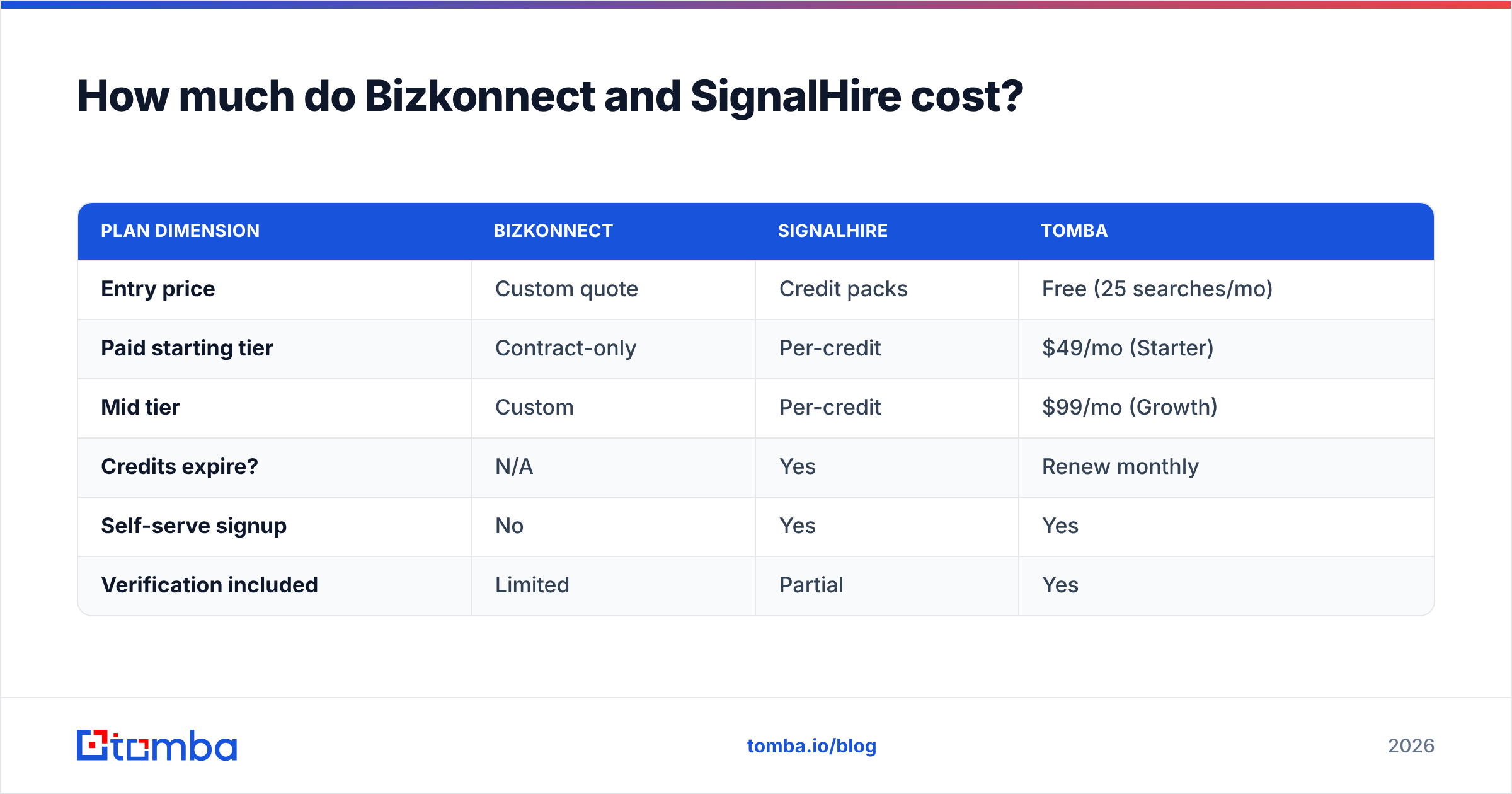
Here is how a focused alternative stacks up against both on the dimension most teams actually care about — predictable cost for verified contacts:
| Plan dimension | Bizkonnect | SignalHire | Tomba |
|---|---|---|---|
| Entry price | Custom quote | Credit packs | Free (25 searches/mo) |
| Paid starting tier | Contract-only | Per-credit | $49/mo (Starter) |
| Mid tier | Custom | Per-credit | $99/mo (Growth) |
| Credits expire? | N/A | Yes | Renew monthly |
| Self-serve signup | No | Yes | Yes |
| Verification included | Limited | Partial | Yes |
You can see the full Tomba pricing breakdown rather than taking the table's word for it. The takeaway: when finding-and-verifying email is the job, a tool priced around that job beats a tool that treats email as a side feature.

When should you pick Bizkonnect?#
Pick Bizkonnect when the buying committee is the bottleneck. Specifically:
- You sell enterprise deals with 5+ stakeholders and need to map who influences whom.
- You run a real ABM program and want curated, persona-aligned lists instead of raw exports.
- Org structure changes your routing — you need to know that the new VP of Engineering, not the old CTO, owns the budget.
- You have budget and patience for a sales-led onboarding and an annual contract.
If you are a two-person startup trying to book 50 demos this month, Bizkonnect is overkill. The intelligence is valuable, but you are paying for a strategy layer when you need a tactics layer.
When should you pick SignalHire?#
Pick SignalHire when discovery on individual profiles is your daily motion:
- You are a recruiter sourcing candidates one LinkedIn profile at a time.
- You want phone numbers alongside emails for a calling-heavy workflow.
- You prefer self-serve and want to start today without a sales call.
- Your volume is moderate — a few hundred reveals a month, not tens of thousands.
SignalHire breaks down when you scale. The credit model punishes high volume, the expiry clock wastes spend, and verification gaps force you to re-check everything anyway. At that point you are paying SignalHire to find and a second tool to verify — two bills for one job.
Is there a better alternative for email finding?#
Yes — if email finding is the actual job, a dedicated tool beats a bundled feature. This is the honest gap both Bizkonnect and SignalHire share: contact data is something they do, not the thing they are built around.
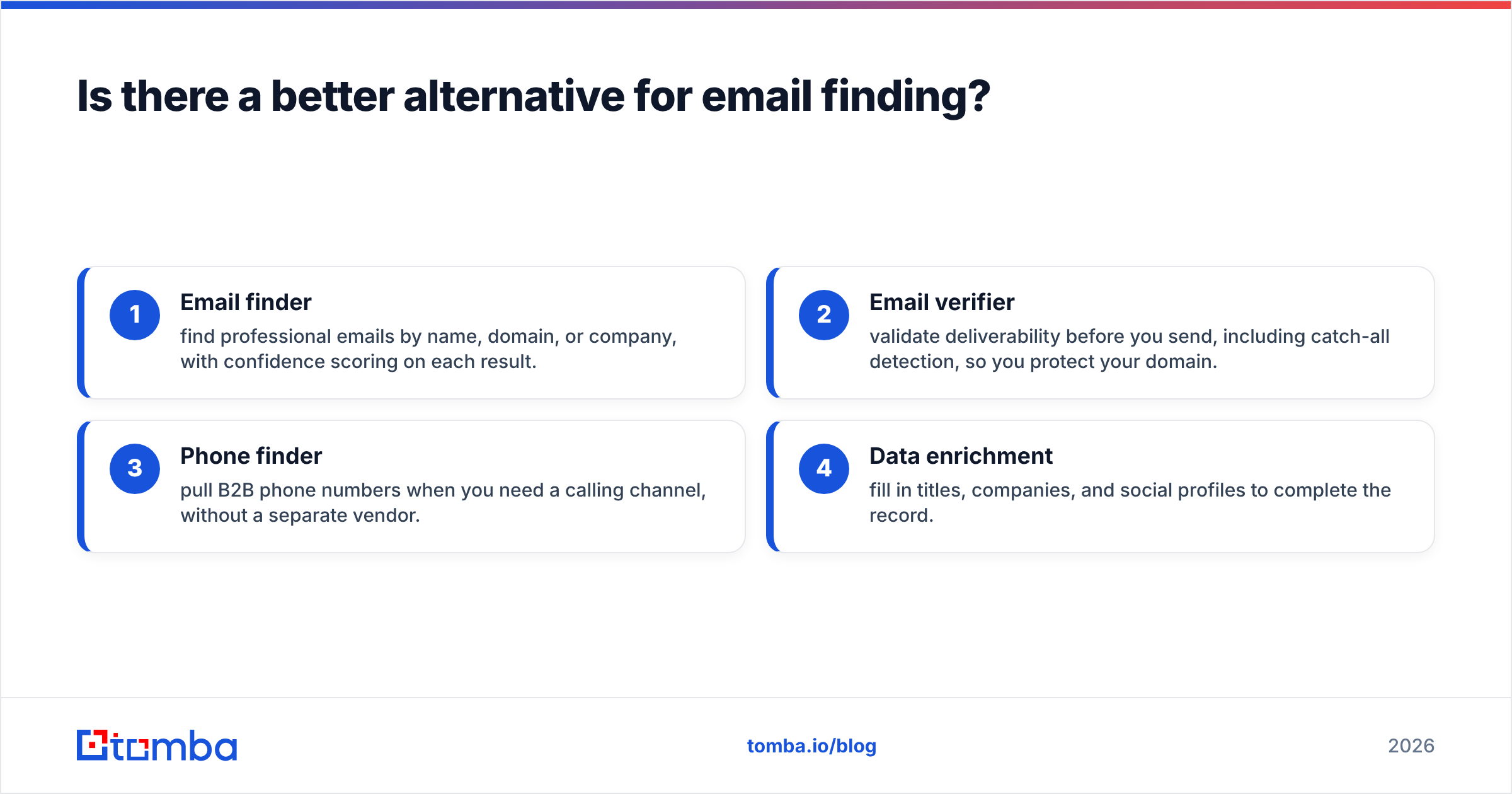
A focused platform like Tomba is engineered around the find-verify-enrich loop:
- Email finder — find professional emails by name, domain, or company, with confidence scoring on each result.
- Email verifier — validate deliverability before you send, including catch-all detection, so you protect your domain.
- Phone finder — pull B2B phone numbers when you need a calling channel, without a separate vendor.
- Data enrichment — fill in titles, companies, and social profiles to complete the record.
The difference is altitude. Bizkonnect gives you the org map. SignalHire gives you the quick reveal. A purpose-built finder gives you verified, deliverable contacts at predictable cost — which is what most outbound and lead-gen teams actually run on day to day. For an unbiased view of how these categories of tools stack up, the user reviews on G2 are a useful neutral starting point before you commit budget.
Bizkonnect vs SignalHire: which should you choose?#
Decide by your bottleneck, not the brochure:
- Bottleneck is understanding the account → Bizkonnect. Its org charts and ABM intelligence are the product, not an add-on.
- Bottleneck is grabbing a contact off a profile → SignalHire. Fast, self-serve, recruiter-friendly, credit-priced.
- Bottleneck is verified email at volume → neither. Use a dedicated finder + verifier so deliverability and cost stay under control.
Most teams overbuy. They sign a contract for intelligence they consult once a quarter, or burn credit packs on reveals they never verify. Match the tool to the job that fills your calendar.
The bottom line#
Bizkonnect and SignalHire are not really competitors — they are two answers to two different questions. Bizkonnect answers "who is in this account and how are they organized?" SignalHire answers "what is this one person's contact info?" Both bundle email finding as a feature, and both make you compromise on either price transparency or verification quality when email is your real priority.
If your growth depends on reliably reaching the right people by email, start with a tool designed for exactly that. Tomba Email Finder gives you verified professional emails by name, domain, or company — with a free tier to test (25 searches/month) and self-serve plans from $49/mo, no annual contract and no expiring credits. Find the person, verify the address, and send with confidence. Try it free, then scale into Tomba's plans when the pipeline proves itself.
// get started
Find, verify and enrich your first contacts today
Start on the free plan with 25 searches a month, then scale when your team is ready.
Free plan · No credit card required · GDPR & CCPA
// about the author