Bizkonnect vs SMARTe 2026: Which B2B Data Tool Wins?
Bizkonnect sells org charts and account intelligence; SMARTe sells global contact data and enrichment. Here's which one fits your GTM motion in 2026 — and where a leaner stack beats both.
Choosing between Bizkonnect and SMARTe usually means you're trying to fix one of two problems: you either can't see how a target account is structured, or you can't reach the right people inside it. These two tools solve different halves of that puzzle, and picking the wrong one wastes a year of budget.
This guide breaks down what each platform actually does, where the data holds up, how pricing works, and when a focused email-and-enrichment stack outperforms both.
TL;DR#
- Bizkonnect is an account-intelligence and org-chart tool. Its standout asset is visual organization charts and "actionable sales intelligence" plays mapped to people inside target accounts.
- SMARTe is a B2B contact-data and enrichment platform, strongest on mobile numbers and global (EMEA/APAC) coverage with a compliance-first posture.
- They are not direct substitutes. Bizkonnect answers who reports to whom; SMARTe answers what's their direct dial and email.
- Pricing is opaque on both — quote-based, annual-contract heavy, with seat minimums that hurt small teams.
- If your core need is verified emails and clean enrichment without an enterprise contract, a usage-based tool like Tomba covers the reachability layer at a fraction of the cost.
What is Bizkonnect?#
Bizkonnect is a sales-intelligence company best known for org charts — visual maps of a company's reporting structure — paired with what it calls "actionable sales intelligence." Instead of just handing you a list of contacts, it tries to give you context: who sits where, who the decision-makers are, and which "sales plays" or trigger events apply to a given account.
The pitch is account-based. If you sell a six-figure deal that needs sign-off from five stakeholders across three departments, knowing the wiring of the buying committee is worth more than another 10,000 raw rows. Bizkonnect leans into that ABM use case.
The trade-off: org charts are expensive to build and harder to keep fresh. People change roles constantly, and a chart that was accurate last quarter can mislead you today. Coverage is also deepest on larger enterprises — SMB and mid-market org data thins out fast.
What is SMARTe?#
SMARTe is a B2B contact and account data provider focused on giving sales and marketing teams accurate, compliant contact details at global scale. Its reputation is built on mobile/direct-dial coverage and strong international data, particularly across EMEA and APAC where many US-centric databases fall apart.
SMARTe positions itself around compliance (GDPR/CCPA awareness) and data enrichment — appending firmographics, technographics, and verified contact points to records you already have or to net-new prospect lists. It plugs into CRMs and outbound workflows so reps can enrich on the fly rather than exporting static files.
Where it's weaker: it's a data layer, not an org-mapping tool. You get contacts and attributes, but not the visual buying-committee intelligence Bizkonnect specializes in. And like most enterprise data vendors, pricing and credit models are negotiated, not published.
How do Bizkonnect and SMARTe compare at a glance?#
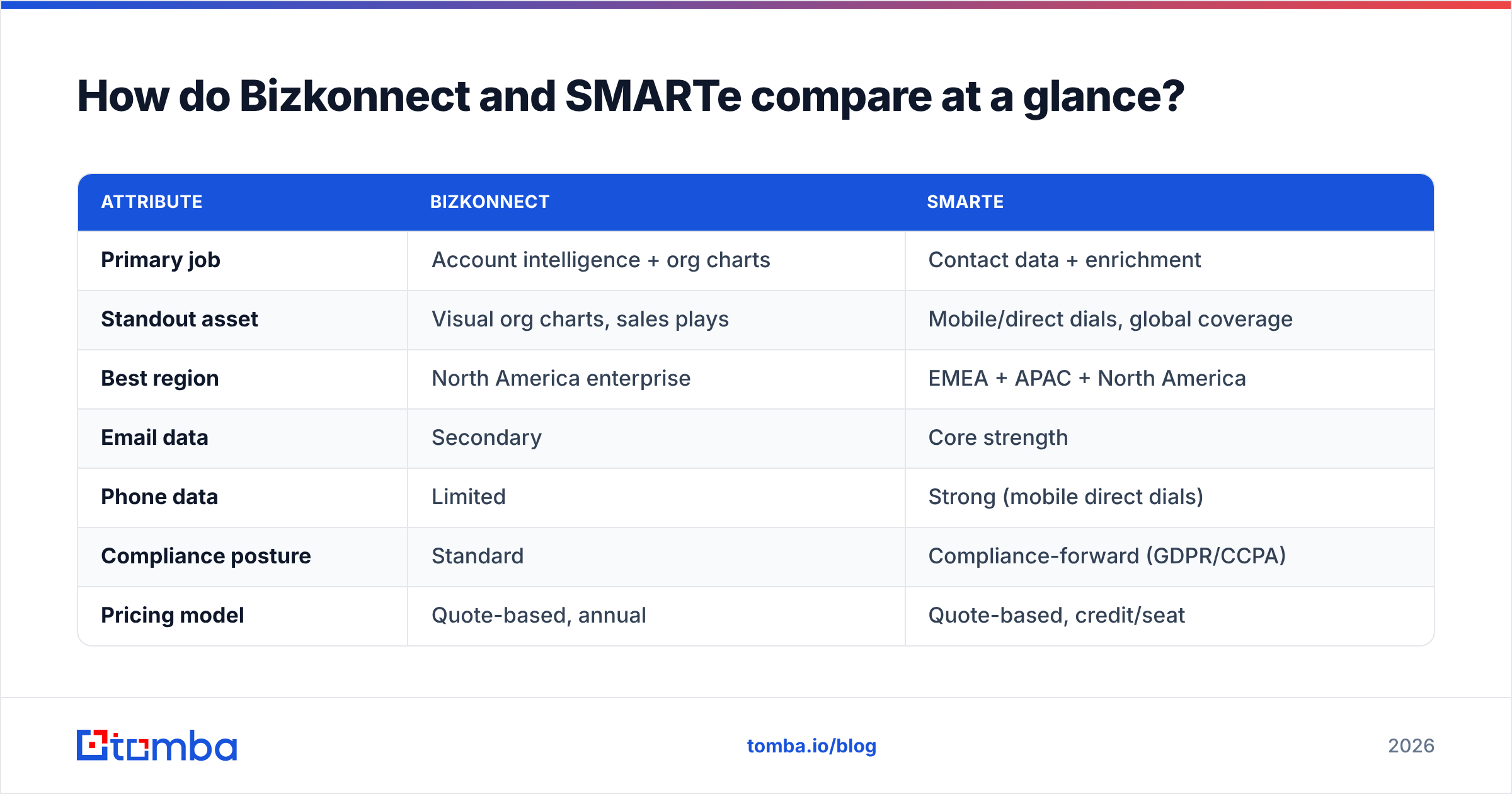
Here's the core-concept breakdown. These two tools overlap less than their marketing implies — read the "Primary job" row first.
| Attribute | Bizkonnect | SMARTe |
|---|---|---|
| Primary job | Account intelligence + org charts | Contact data + enrichment |
| Standout asset | Visual org charts, sales plays | Mobile/direct dials, global coverage |
| Best region | North America enterprise | EMEA + APAC + North America |
| Email data | Secondary | Core strength |
| Phone data | Limited | Strong (mobile direct dials) |
| Compliance posture | Standard | Compliance-forward (GDPR/CCPA) |
| Pricing model | Quote-based, annual | Quote-based, credit/seat |
| Best for | ABM, complex buying committees | High-volume outbound, global SDR teams |
If you're mapping a 7-person buying committee at a Fortune 500 target, Bizkonnect's structure data earns its keep. If you're an SDR team firing 500 touches a week across three continents, SMARTe's reachability data matters more.

Which has better data accuracy?#
Accuracy is the whole game, and both tools have real but bounded strengths.
SMARTe tends to score better on contactability — its mobile and direct-dial numbers connect more often than industry averages, which is why outbound and cold-calling teams gravitate to it. Independent reviews on G2 consistently praise its phone data and international reach, while flagging occasional stale email records and credit-burn frustration.
Bizkonnect's accuracy story is different. Its org charts are valuable when current, but reporting structures decay quickly. The data is curated rather than purely automated, which can mean higher quality on covered accounts and thinner coverage outside them.
A practical rule for any vendor, these two included: never trust a contact record you haven't re-verified at send time. Data ages the moment it's exported. Running emails through a dedicated email verifier before a campaign catches the bounces that quarterly database refreshes miss — and protects your sender reputation regardless of where the record came from.
That re-verification step is also where many teams discover that the "accuracy" gap between expensive vendors is smaller than the gap between verified and unverified sending.
How do Bizkonnect and SMARTe price their plans?#
Neither company publishes transparent pricing, which is the single biggest friction point for buyers under enterprise scale.
- Bizkonnect runs quote-based annual contracts. Expect seat minimums and a sales-led process; there's no meaningful self-serve free tier for evaluating it the way you'd test a SaaS tool.
- SMARTe uses a credit/seat model, also quote-based and annual-leaning. It offers limited trials through its site and Chrome extension, but real usage requires a contract conversation.
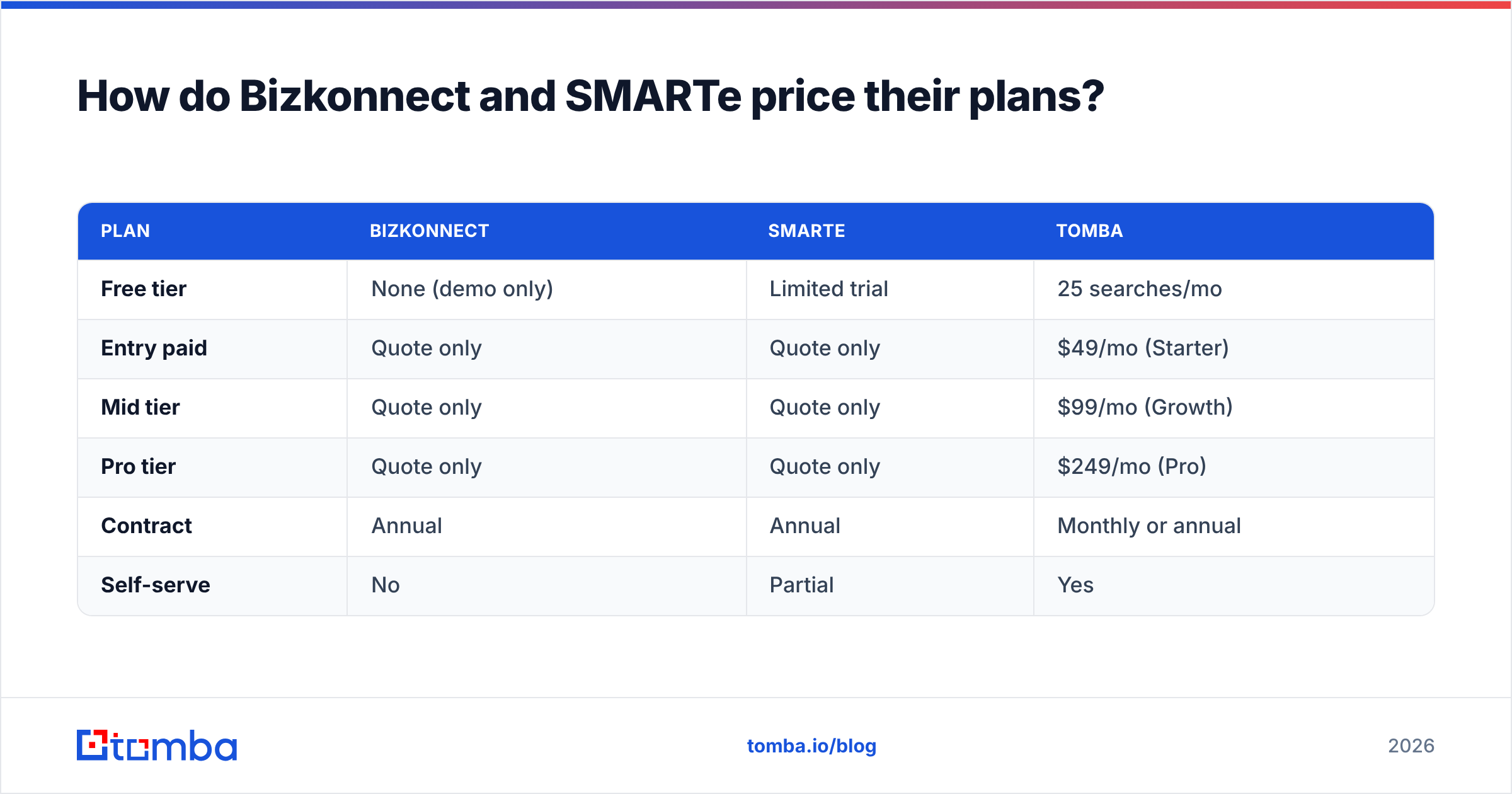
Here's how that compares to a usage-based reachability tool, using published Tomba pricing as the transparent reference point:
| Plan | Bizkonnect | SMARTe | Tomba |
|---|---|---|---|
| Free tier | None (demo only) | Limited trial | 25 searches/mo |
| Entry paid | Quote only | Quote only | $49/mo (Starter) |
| Mid tier | Quote only | Quote only | $99/mo (Growth) |
| Pro tier | Quote only | Quote only | $249/mo (Pro) |
| Contract | Annual | Annual | Monthly or annual |
| Self-serve | No | Partial | Yes |
The pattern is clear: the two incumbents optimize for enterprise procurement, while a tool like Tomba optimizes for teams that want to start today and scale spend with usage.
When should you choose Bizkonnect over SMARTe?#
Choose Bizkonnect when your bottleneck is understanding the account, not reaching it:
- Complex, multi-threaded deals. You're selling into buying committees of 5+ people and need to see reporting lines before you craft messaging.
- Enterprise ABM. Your target list is a few hundred named accounts, not tens of thousands, and depth beats breadth.
- Champion mapping. You want to identify and track influence, not just titles.
- Sales-play workflows. You value pre-built triggers and plays mapped to org structure.
Choose SMARTe when your bottleneck is reaching people at volume:
- High-velocity outbound. SDRs need fresh dials and emails every week.
- Global territories. You sell into EMEA/APAC where US-only databases collapse.
- CRM enrichment at scale. You're appending data to thousands of records.
- Phone-first motions. Cold calling is central and direct dials are the priority.
What's the catch with both tools?#
Three recurring complaints show up across reviews of enterprise data vendors, and they apply to both Bizkonnect and SMARTe:
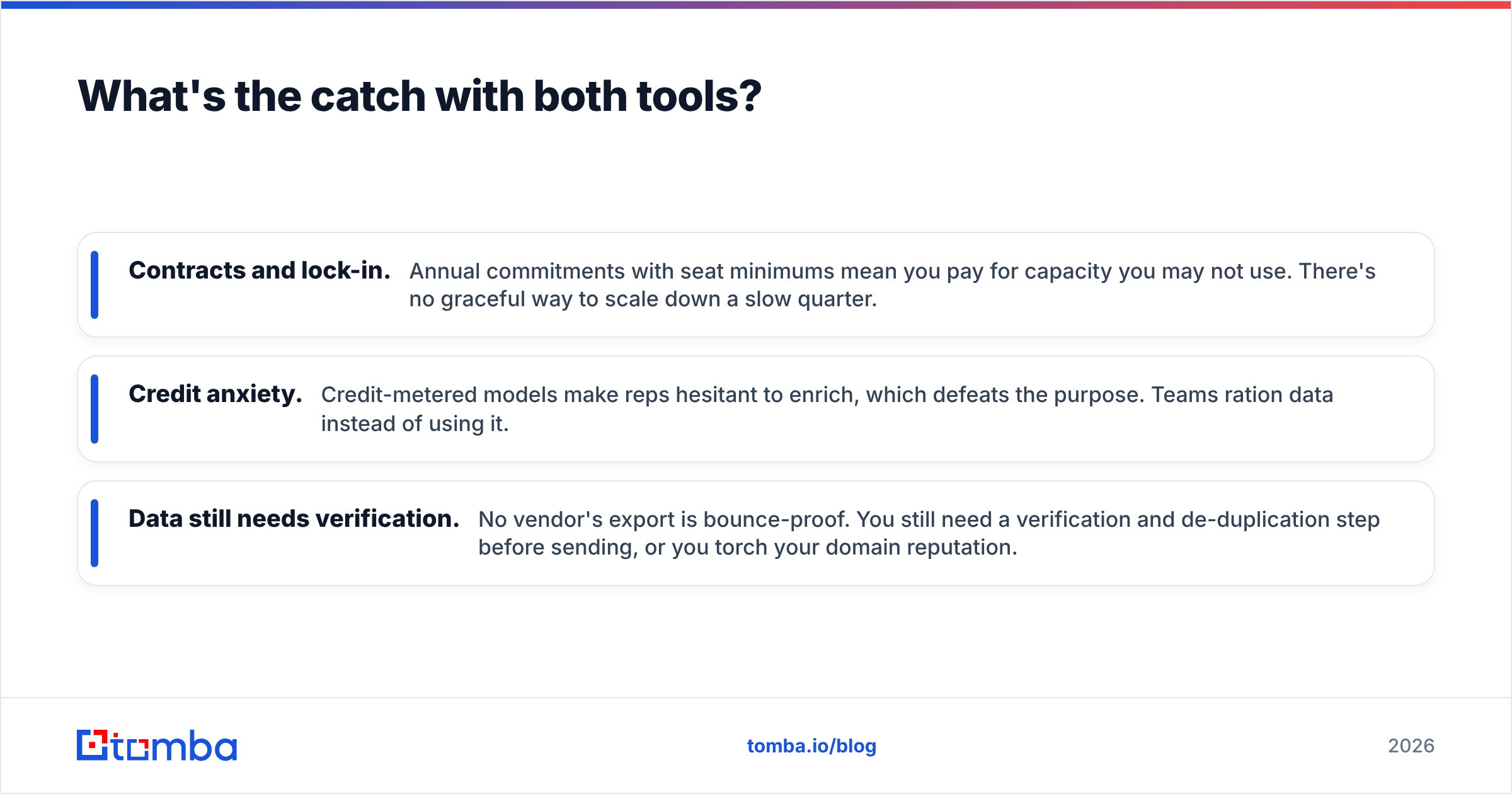
- Contracts and lock-in. Annual commitments with seat minimums mean you pay for capacity you may not use. There's no graceful way to scale down a slow quarter.
- Credit anxiety. Credit-metered models make reps hesitant to enrich, which defeats the purpose. Teams ration data instead of using it.
- Data still needs verification. No vendor's export is bounce-proof. You still need a verification and de-duplication step before sending, or you torch your domain reputation.
This is where many teams adopt a hybrid stack: keep the specialist tool for its unique strength (org charts from Bizkonnect, dials from SMARTe) and bolt on a flexible, pay-as-you-grow layer for the high-frequency work of finding and verifying emails.
How does a leaner email-and-enrichment stack compare?#
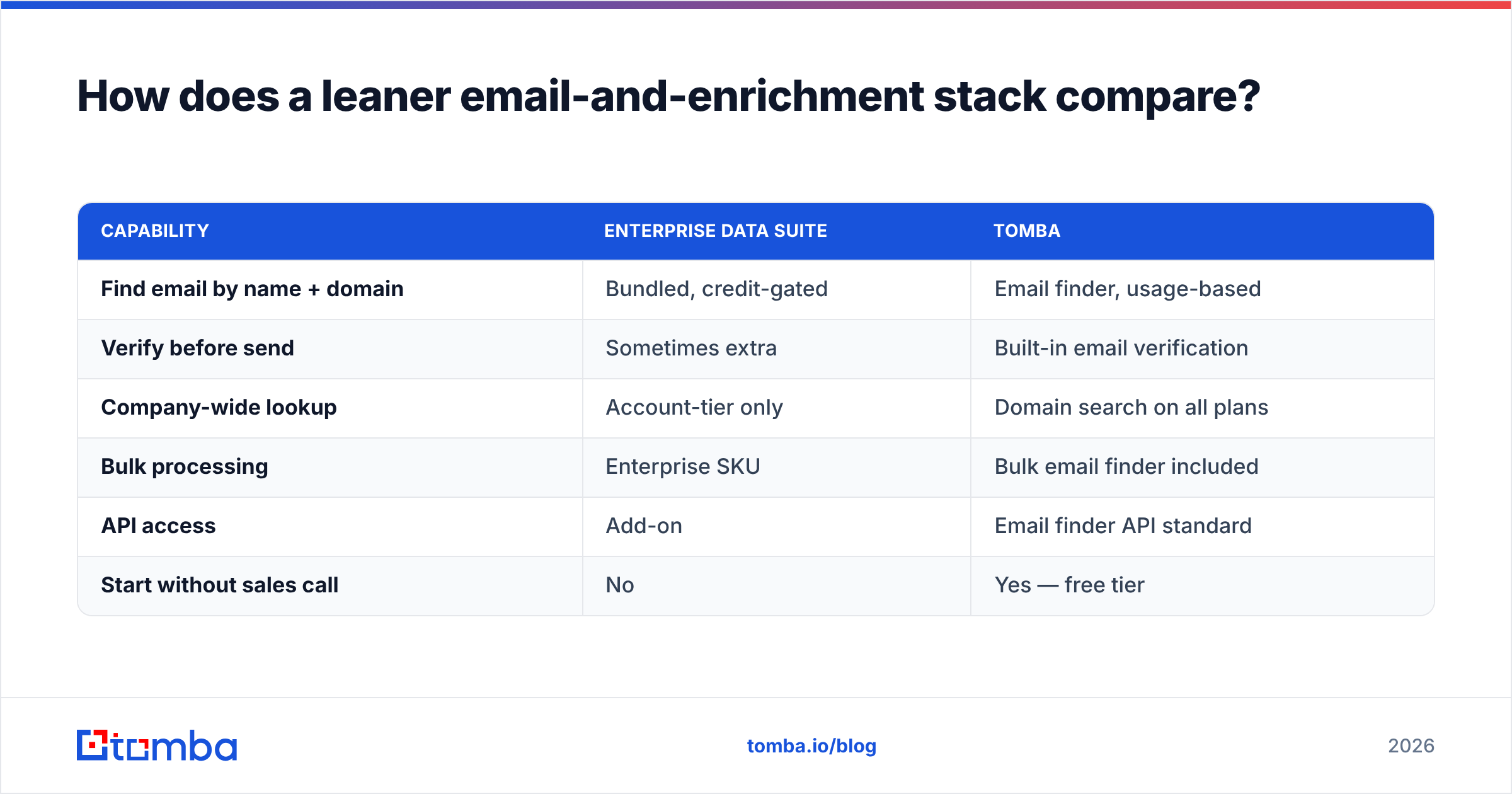
For the reachability half of the problem — finding and verifying work emails, and enriching records — a focused tool often beats a broad enterprise contract on both cost and speed.
| Capability | Enterprise data suite | Tomba |
|---|---|---|
| Find email by name + domain | Bundled, credit-gated | Email finder, usage-based |
| Verify before send | Sometimes extra | Built-in email verification |
| Company-wide lookup | Account-tier only | Domain search on all plans |
| Bulk processing | Enterprise SKU | Bulk email finder included |
| API access | Add-on | Email finder API standard |
| Start without sales call | No | Yes — free tier |
The point isn't that Tomba replaces account-intelligence platforms — it doesn't draw org charts. The point is that the email + verification + enrichment layer, which is the most-used workflow for most reps, doesn't require a five-figure annual contract. You can run it self-serve, verify everything before it hits the inbox, and feed clean records into whatever account-mapping tool you keep.
For teams pairing a CRM with outbound, Tomba's published pricing and monthly billing remove the procurement drag that makes Bizkonnect and SMARTe slow to adopt.
So which one should you actually buy?#
Conclusion first: match the tool to your bottleneck, and don't pay enterprise rates for the part of the job a usage-based tool does better.
- Buy Bizkonnect if your deals live or die on understanding org structure and buying committees, and you have the budget for an annual ABM-grade contract.
- Buy SMARTe if you run global, phone-heavy, high-volume outbound and need reliable direct dials at scale.
- Pair either (or skip both) with a flexible reachability layer if your daily reality is finding and verifying work emails fast, without a contract or credit anxiety.
Most teams overspend by buying one big suite and using 20% of it. The leaner play is to isolate what you uniquely need — structure or dials — and run the everyday email-finding work on a transparent, self-serve tool.
If reaching the right inbox is the part that actually moves your pipeline, start with the Tomba Email Finder. Find professional emails by name, company, or domain, verify them before you send, and scale spend with usage instead of signing a year-long contract. Spin up the free tier in minutes, test it against your own target accounts, and keep your specialist data tool for the niche it's genuinely best at.
Ready to find emails that actually work?
Join 150,000+ professionals who stopped guessing and started sending. Free credits on signup — no credit card required.
Get the Tomba newsletter
Practical outbound tactics and product updates — once every two weeks.
About the author