Bizkonnect vs Sparklane: B2B Sales Intelligence Compared 2026
Bizkonnect sells org-chart intelligence; Sparklane sells predictive lead scoring. Here's how they really compare on data, pricing, and accuracy in 2026 — and where a leaner alternative fits.
Choosing between Bizkonnect and Sparklane usually means you've already accepted one thing: a clean CRM and a guessed-at email pattern aren't enough anymore. You want to know who sits where in an account, which accounts are heating up, and how to reach the right person before a competitor does. These two platforms attack that problem from opposite ends.
This is a neutral, side-by-side breakdown of Bizkonnect vs Sparklane in 2026 — what each does well, where each falls short, how pricing actually shakes out, and which type of team should pick which. At the end, we'll also cover where a leaner contact-data layer fits if you don't need the full enterprise platform.
TL;DR#
- Bizkonnect is an org-chart and actionable-sales-intelligence tool. Its standout feature is visual organization charts mapped to real contacts — great for account-based selling into large, complex enterprises.
- Sparklane is a predictive lead-generation platform (strong in Europe) that scores and surfaces accounts likely to buy, using AI signals and business news triggers.
- Different jobs: Bizkonnect answers "who do I talk to inside this account?" Sparklane answers "which accounts should I chase first?"
- Pricing for both is quote-based and enterprise-leaning; neither publishes a true self-serve free tier with transparent per-seat costs.
- If you mostly need accurate emails, phone numbers, and enrichment rather than a full intelligence suite, a focused tool like Tomba covers that gap from $49/mo with a published Tomba pricing page.
What is Bizkonnect?#
Bizkonnect is a B2B sales intelligence provider best known for "actionable org charts." Instead of handing you a flat CSV of contacts, it visualizes reporting structures inside a target company — who reports to whom, which departments exist, and where your champion sits relative to the economic buyer.
For account-based marketing (ABM) and enterprise sellers, this is the core value. When you're selling a six-figure deal into a 5,000-person company, knowing the org map is often worth more than another 200 raw emails. Bizkonnect layers contact details and "sales triggers" (leadership changes, initiatives, tech signals) on top of that map so reps can build a multi-threaded plan.
Its sweet spot is large, complex accounts where the buying committee is the obstacle. Where it's weaker: it's not a self-serve, run-a-quick-search tool, and coverage is strongest for big enterprises rather than the long tail of SMBs.

What is Sparklane?#
Sparklane is a predictive lead-generation and sales-intelligence platform with deep roots in the European (especially French) market. Its engine ingests company data and business signals — funding rounds, hiring, expansion, leadership moves, financial news — and scores accounts on how likely they are to become customers.
The pitch is prioritization. Rather than mapping a single account in depth, Sparklane tells your team which accounts deserve attention this quarter and why, then feeds enriched company and contact data into your CRM and outreach tools. It leans heavily on GDPR-compliant data handling, which matters if your pipeline is EU-heavy.
Sparklane's strength is the top of the funnel: building and ranking a target list. Its limitation is that "predictive scoring" is only as good as the signals and your ICP definition — and like Bizkonnect, it's an enterprise-priced commitment rather than a try-it-today tool.
Bizkonnect vs Sparklane: how do they compare?#
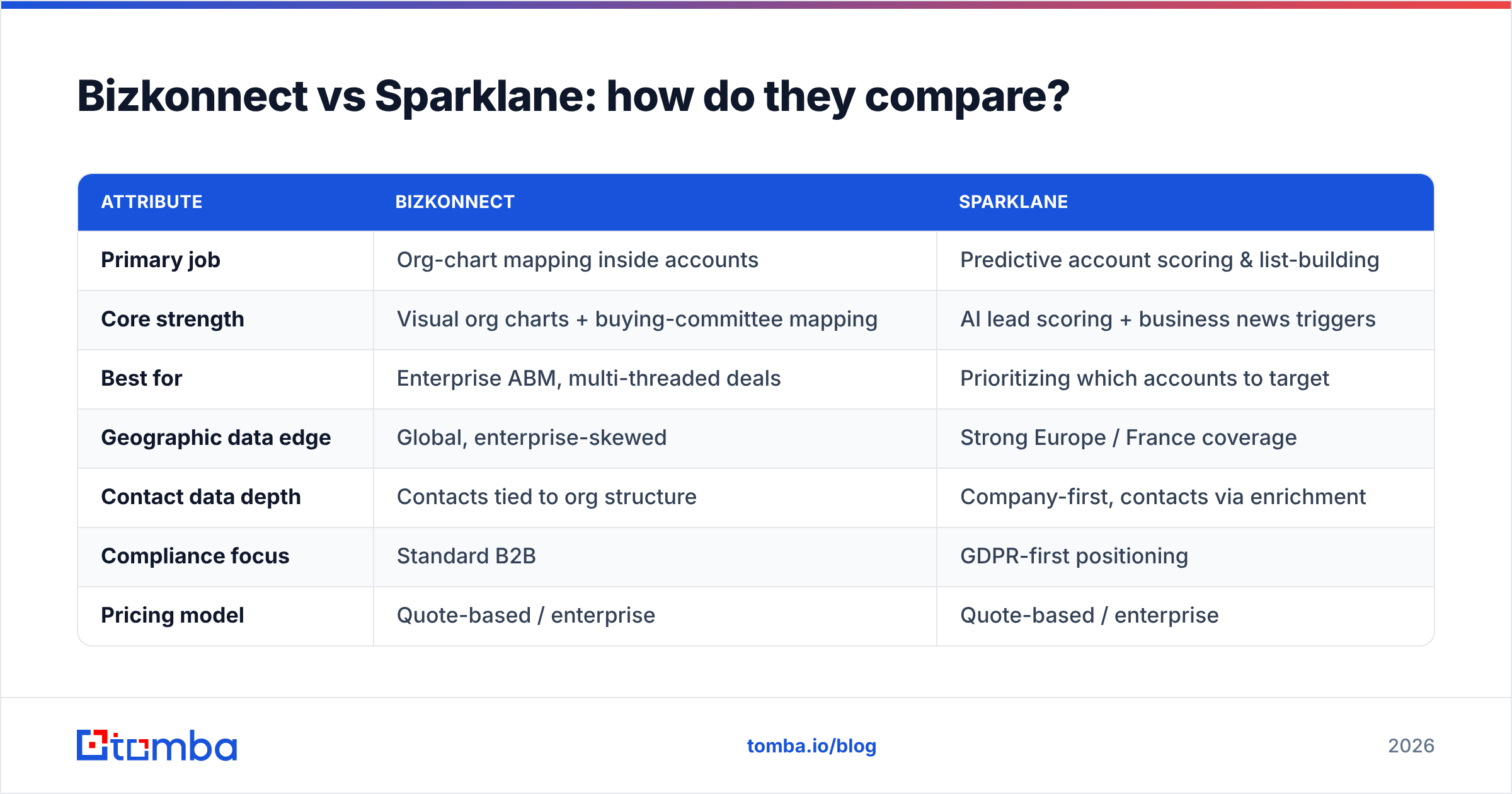
The fastest way to see the difference is feature by feature. Both are "sales intelligence," but they solve different parts of the workflow.
| Attribute | Bizkonnect | Sparklane |
|---|---|---|
| Primary job | Org-chart mapping inside accounts | Predictive account scoring & list-building |
| Core strength | Visual org charts + buying-committee mapping | AI lead scoring + business news triggers |
| Best for | Enterprise ABM, multi-threaded deals | Prioritizing which accounts to target |
| Geographic data edge | Global, enterprise-skewed | Strong Europe / France coverage |
| Contact data depth | Contacts tied to org structure | Company-first, contacts via enrichment |
| Compliance focus | Standard B2B | GDPR-first positioning |
| Pricing model | Quote-based / enterprise | Quote-based / enterprise |
| Free self-serve tier | No | No |
| Learning curve | Moderate (account-mapping workflow) | Moderate (ICP + scoring setup) |
The honest read: these aren't really head-to-head competitors for the same buyer. They're two tools you might even run together — Sparklane to pick the accounts, Bizkonnect to navigate them.
)
Which one is better for your team?#
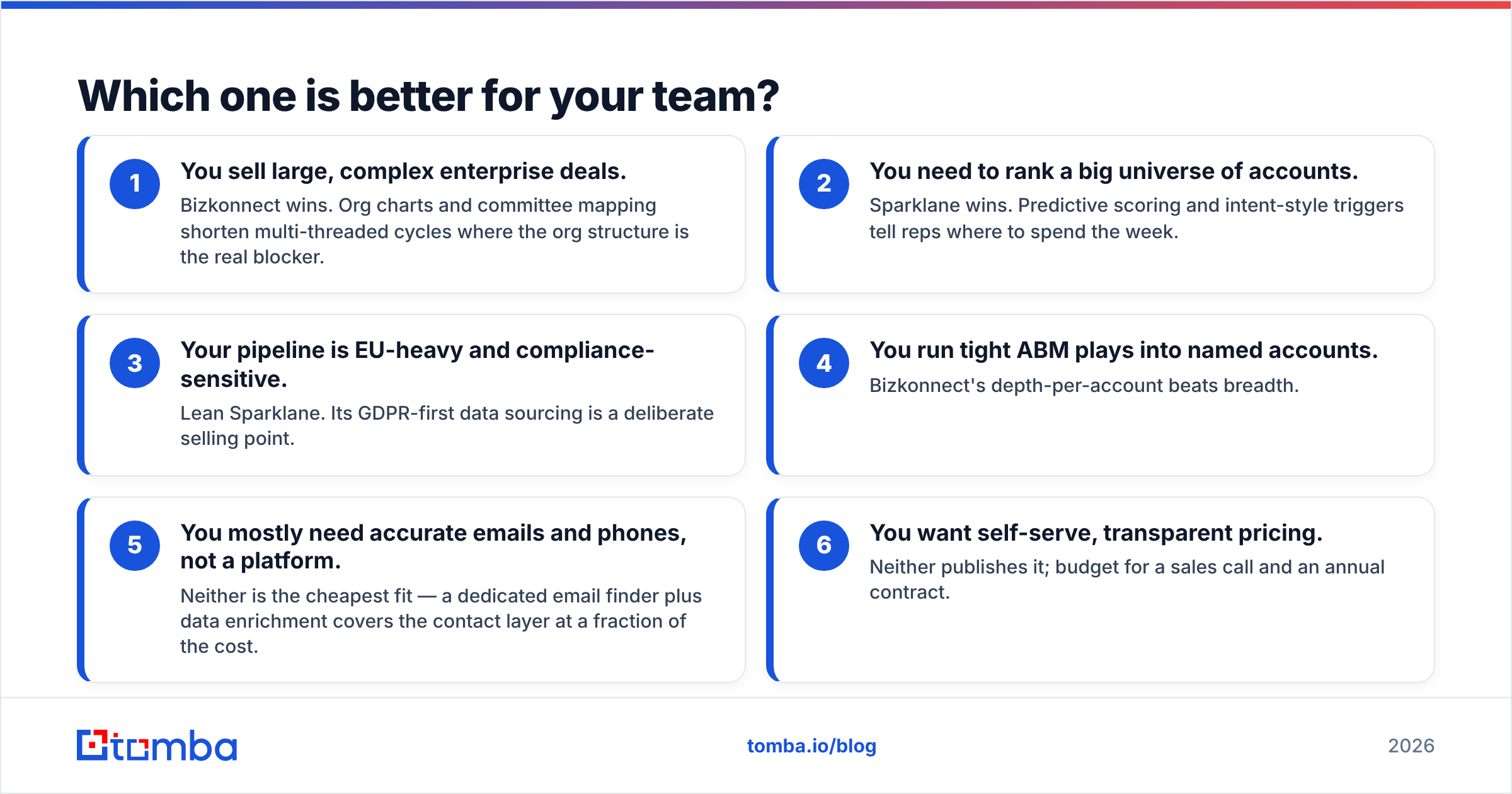
Use this quick decision guide instead of a generic "it depends."
- You sell large, complex enterprise deals. Bizkonnect wins. Org charts and committee mapping shorten multi-threaded cycles where the org structure is the real blocker.
- You need to rank a big universe of accounts. Sparklane wins. Predictive scoring and intent-style triggers tell reps where to spend the week.
- Your pipeline is EU-heavy and compliance-sensitive. Lean Sparklane. Its GDPR-first data sourcing is a deliberate selling point.
- You run tight ABM plays into named accounts. Bizkonnect's depth-per-account beats breadth.
- You mostly need accurate emails and phones, not a platform. Neither is the cheapest fit — a dedicated email finder plus data enrichment covers the contact layer at a fraction of the cost.
- You want self-serve, transparent pricing. Neither publishes it; budget for a sales call and an annual contract.
How accurate and fresh is the data?#
Data quality is where both platforms live or die, and it's also where buyers get burned. A beautiful org chart built on a contact who left 18 months ago is worse than no chart, because reps trust it.
Bizkonnect's contact accuracy is tied to how recently a given account was refreshed; enterprise accounts tend to be better maintained than the long tail. Sparklane's predictive scores depend on signal recency — a "hot" account based on a year-old funding round isn't actually hot. With any sales-intelligence vendor, ask two questions before you sign:
- How often is each record re-verified, and what's the bounce/return guarantee?
- What happens to scoring or org data when a person changes jobs?
This is also why many teams pair a platform with a standalone email verifier. Even the best B2B database degrades roughly 2–3% per month as people switch roles, so a verification step before send protects your sender reputation regardless of which intelligence tool you chose. You can cross-check vendor claims on third-party review sites like G2 and Capterra rather than trusting marketing pages.
)
What about pricing?#
Here's the part both vendors keep behind a "request a demo" button: neither Bizkonnect nor Sparklane publishes transparent, self-serve pricing. Both are quote-based, typically annual, and scoped to seats plus data volume. That's normal for enterprise sales intelligence, but it has real consequences:
- You can't start small for $49 and scale — you negotiate a contract.
- Procurement and a security review are usually involved.
- Your effective cost per usable contact is hard to model until you've used it for a quarter.
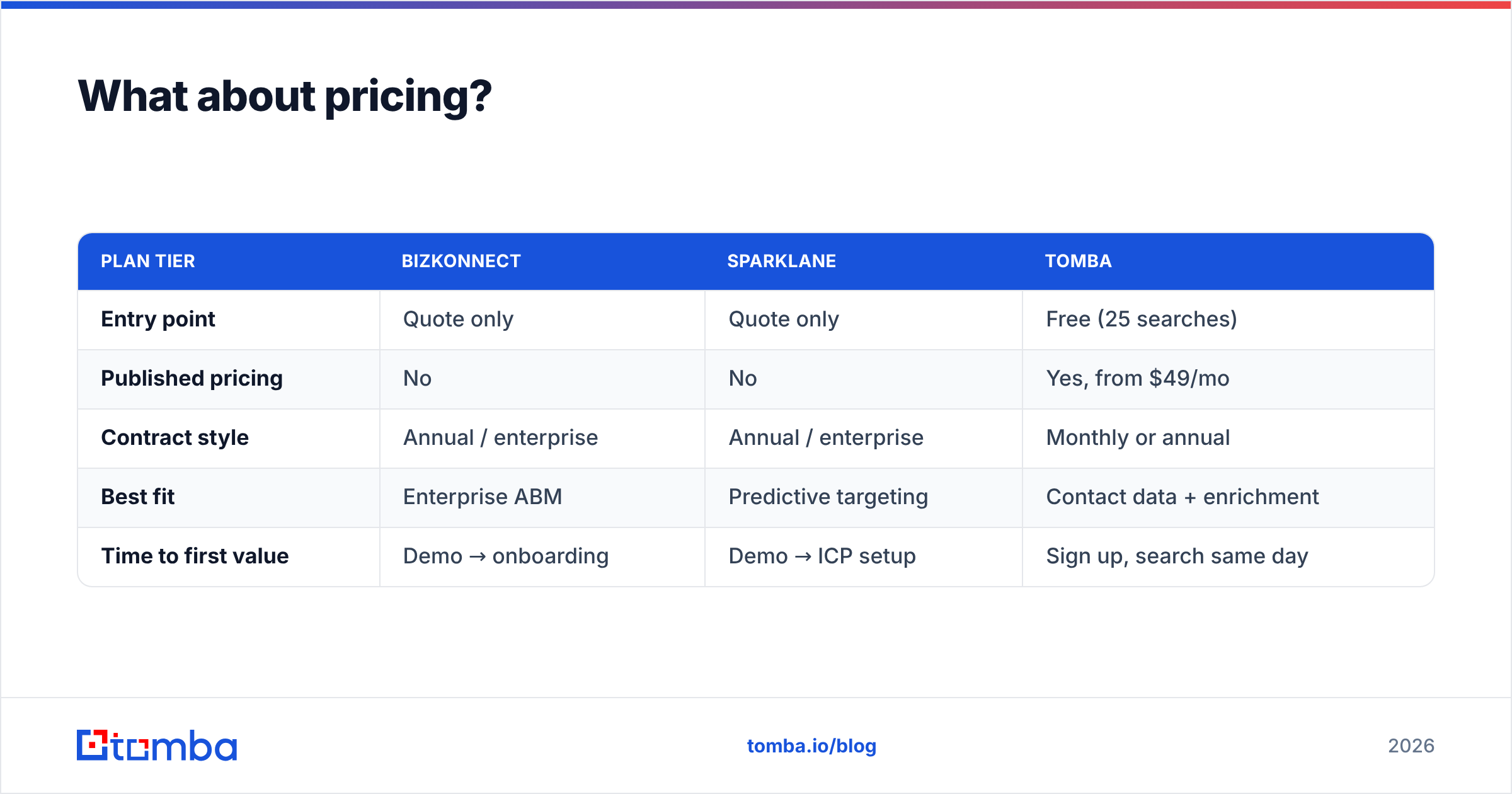
For comparison, a focused contact-data tool publishes its tiers openly. Tomba, for example, lists a Free tier (25 searches/mo), Starter at $49/mo, Growth at $99/mo, Pro at $249/mo, and custom Enterprise pricing — no demo required to see the numbers.
| Plan tier | Bizkonnect | Sparklane | Tomba |
|---|---|---|---|
| Entry point | Quote only | Quote only | Free (25 searches) |
| Published pricing | No | No | Yes, from $49/mo |
| Contract style | Annual / enterprise | Annual / enterprise | Monthly or annual |
| Best fit | Enterprise ABM | Predictive targeting | Contact data + enrichment |
| Time to first value | Demo → onboarding | Demo → ICP setup | Sign up, search same day |
To be fair to both platforms: their value isn't a single email lookup — it's the intelligence layer. If org charts or predictive scoring close one extra enterprise deal a year, the contract pays for itself. The question is whether your motion needs that layer or just clean, reachable contacts.
Can you replace either tool with a lighter stack?#
Often, yes — and it's worth being honest about it. A lot of teams buy a heavy sales-intelligence platform when their actual bottleneck is simpler: they can't reliably get a decision-maker's verified email and phone number.
If that's you, a leaner stack looks like this:
- Find contacts: an email finder and domain search to pull verified addresses by company.
- Clean the list: an email verifier to drop risky addresses before you send.
- Fill the gaps: data enrichment to add titles, companies, and firmographics to records you already have.
That won't draw you an org chart or predict which account is about to buy. But it costs a fraction of an enterprise contract and ships value the same day. Many teams start there, prove the motion, then add Bizkonnect or Sparklane only when account complexity or list-prioritization becomes the real constraint.
Bizkonnect vs Sparklane: the verdict#
There's no universal winner, because they answer different questions:
- Pick Bizkonnect if your deals stall inside the buying committee and you need to map and multi-thread large enterprise accounts. Its org-chart intelligence is the differentiator.
- Pick Sparklane if your problem is where to aim — you have too many possible accounts and want AI scoring plus business triggers to prioritize, especially across Europe.
- Pick neither (yet) if your real gap is reachable, accurate contact data. Start with a focused finder-and-verify stack, then layer intelligence on top once you've outgrown it.
Both are credible tools. The mistake is buying a $20k+ intelligence platform to solve a $49/mo contact-data problem. Match the tool to the bottleneck.
Get accurate contact data without the enterprise contract#
If your honest blocker is reaching the right person — not mapping their org or scoring their company — start with the contact layer first. Tomba Email Finder lets you find and verify professional emails by name, company, or domain, then enrich them with titles and firmographics, all on transparent pricing that starts free and scales to $49/mo. You can validate the workflow this week, keep your sender reputation clean, and add Bizkonnect or Sparklane later only if account complexity demands it. Try the Tomba Email Finder and build a reachable pipeline before you sign an annual deal.
// get started
Find, verify and enrich your first contacts today
Start on the free plan with 25 searches a month, then scale when your team is ready.
Free plan · No credit card required · GDPR & CCPA
// about the author