Bland AI Pricing, Reviews, Pros and Cons: 2026 Guide
A neutral breakdown of Bland AI pricing, real user reviews, and the pros and cons of running AI phone agents for outbound sales in 2026.
Bland AI is one of the most talked-about AI voice platforms for sales and support calls, but its pricing model confuses a lot of buyers. This guide breaks down what you actually pay, what reviewers say, and where the trade-offs hide — without the hype.
TL;DR#
- Bland AI charges per minute, not per seat. Pay-as-you-go starts around $0.09/minute for AI phone calls, with volume and enterprise pricing negotiated separately.
- Strengths: fast call latency, programmable conversation pathways, an API-first design, and the ability to run thousands of concurrent calls.
- Weaknesses: per-minute costs compound fast at scale, voice realism still trips some prospects, and you supply your own contact data and compliance setup.
- Reviews are polarized — builders love the flexibility, while non-technical teams find the setup steep.
- Bland AI only dials numbers you feed it, so lead-data quality decides your ROI. Pair it with verified phone and email data from a source like Tomba's phone finder.
What is Bland AI?#
Bland AI is a platform for building AI phone agents — software that places and answers calls in a human-sounding voice, follows a scripted conversation, and takes actions like booking meetings or qualifying leads. Think of it as a programmable call center employee: you write the "playbook," and the agent runs it on every call without coffee breaks.
It is API-first, which means most of the power lives in code. You define conversation pathways, connect tools (calendars, CRMs, webhooks), choose a voice, and Bland handles the telephony, speech-to-text, language model, and text-to-speech in one pipeline. For sales teams, the appeal is obvious: AI agents can handle outbound dials, lead qualification, appointment setting, and follow-up calls at a volume no human team could match.
The official product lives at bland.ai. It competes with platforms like Vapi, Retell AI, and Synthflow, and increasingly overlaps with traditional sales automation tooling as voice agents move from novelty to pipeline infrastructure.

How does Bland AI pricing work in 2026?#
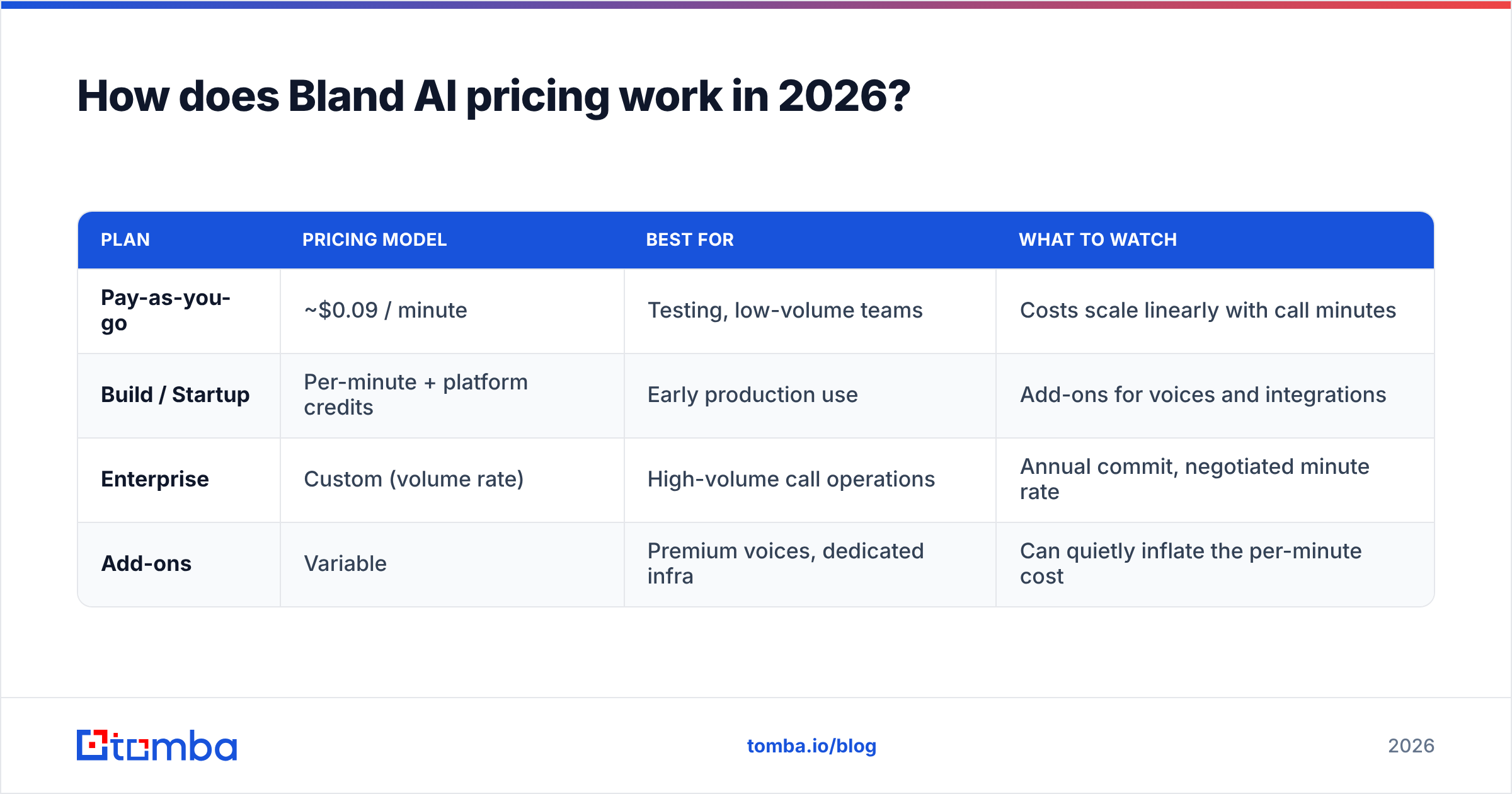
Bland AI uses usage-based, per-minute pricing rather than fixed monthly seats. You are billed for the minutes your AI agents spend on calls, which makes the model cheap to start and harder to forecast at scale.
Here is the practical breakdown of how the tiers compare, based on Bland's published model and what teams report paying:
| Plan | Pricing model | Best for | What to watch |
|---|---|---|---|
| Pay-as-you-go | ~$0.09 / minute | Testing, low-volume teams | Costs scale linearly with call minutes |
| Build / Startup | Per-minute + platform credits | Early production use | Add-ons for voices and integrations |
| Enterprise | Custom (volume rate) | High-volume call operations | Annual commit, negotiated minute rate |
| Add-ons | Variable | Premium voices, dedicated infra | Can quietly inflate the per-minute cost |
A few things the pricing page does not shout about:
- Per-minute means per-minute of connected call time. Long discovery calls cost more than quick confirmations, so your average handle time is a real budget lever.
- Telephony and carrier fees can stack on top depending on your setup and region.
- Premium voices and dedicated capacity are typically priced separately from the base minute rate.
- Volume discounts are negotiable, so the list rate is a ceiling, not a floor, for serious buyers.
- You still pay for bad calls — a wrong number, voicemail, or instant hang-up still consumes minutes and budget.
That last point matters more than most pricing comparisons admit. If 30% of your dials hit dead numbers, you are paying Bland's per-minute rate to talk to nobody. Clean data is not a "nice to have" here; it is a direct cost multiplier.
Is Bland AI worth it? Pros and cons#
Bland AI is worth it for technical, high-volume teams that can feed it good data and own the buildout — and overkill for small teams wanting plug-and-play dialing. Here is the honest ledger.
| Pros | Cons |
|---|---|
| Low call latency, near real-time responses | Per-minute cost compounds fast at scale |
| API-first, deeply programmable pathways | Steep setup for non-technical users |
| Massive concurrency (thousands of calls) | Voice realism still breaks on some prospects |
| Transparent usage-based entry pricing | You supply data, compliance, and scripts |
| Strong for outbound + inbound automation | Forecasting spend is harder than flat SaaS |
The pros are real. Latency is genuinely good, and the concurrency ceiling means you can launch a campaign to 5,000 leads without queuing. The pathway builder gives you fine control over how a call branches, which beats rigid IVR trees.
The cons are equally real. Because everything is programmable, everything is also your responsibility — including TCPA and consent compliance, which Bland does not handle for you. And because billing is per-minute, inefficiency is expensive in a way that flat-rate tools hide.

What do Bland AI reviews say?#
Reviews cluster into two camps. On platforms like G2 and Capterra, developers and ops-heavy teams praise the flexibility, the API, and the call quality. The recurring criticism from less technical reviewers is the learning curve and the time it takes to get a production-ready agent live.
Common themes across reviews:
- "Powerful but you build it yourself." Buyers expecting a turnkey dialer are surprised by how much engineering the first agent takes.
- "Latency is excellent." This is the most consistent praise — conversations feel responsive.
- "Costs crept up." Several reviewers note that per-minute pricing looked cheap in testing and got expensive in production.
- "Voice can still get caught." Sophisticated prospects sometimes detect the AI, which affects response rate on cold calls.
The signal: Bland AI rewards teams that treat it as infrastructure, not a magic button. If you have engineering resources and high call volume, the reviews skew positive. If you want something a rep can configure in an afternoon, expect friction.
How does Bland AI compare to the alternatives?#
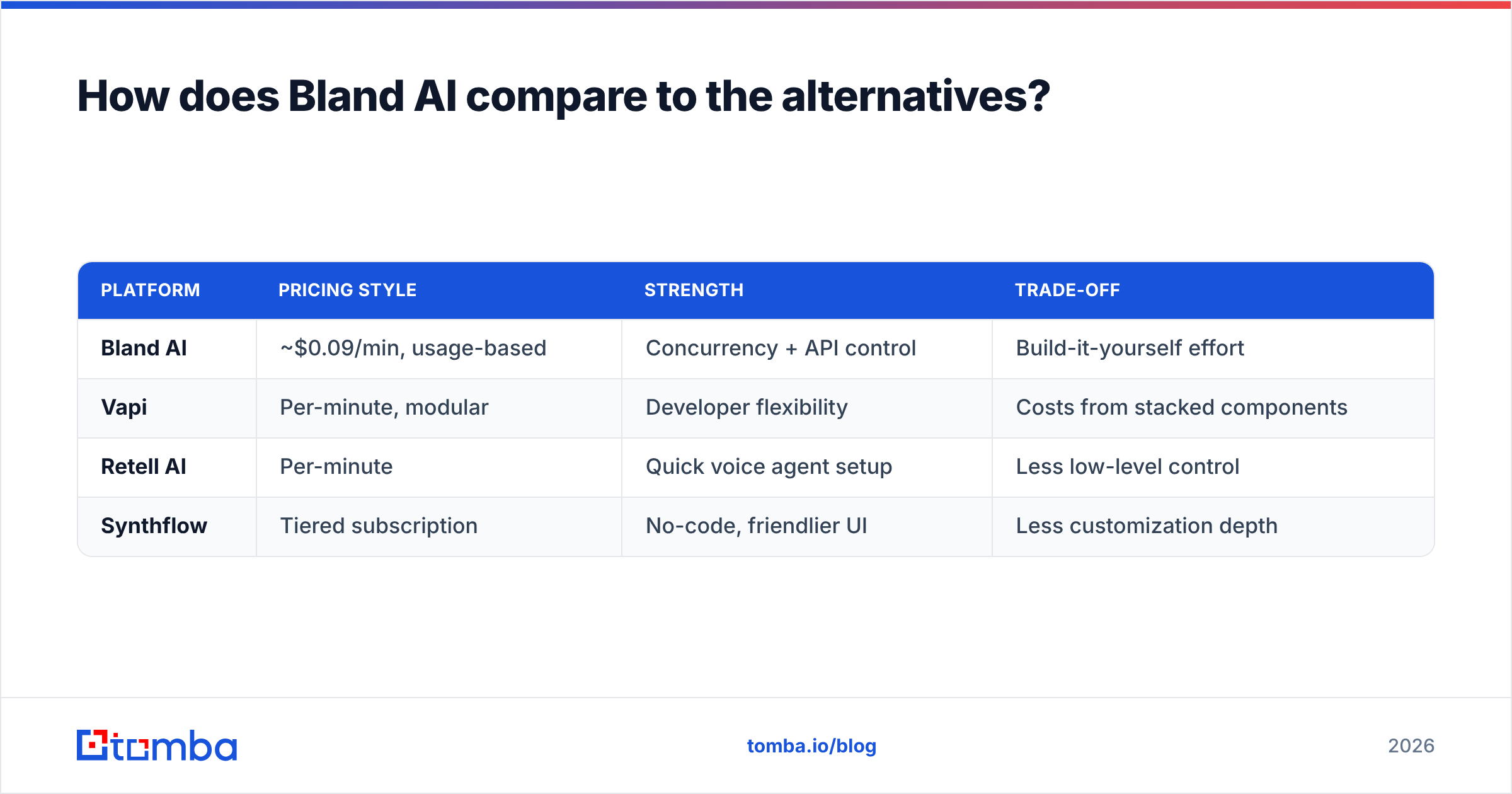
Bland AI sits in a crowded field of AI voice platforms. The right pick depends on whether you prioritize raw control, speed of setup, or all-in-one features.
| Platform | Pricing style | Strength | Trade-off |
|---|---|---|---|
| Bland AI | ~$0.09/min, usage-based | Concurrency + API control | Build-it-yourself effort |
| Vapi | Per-minute, modular | Developer flexibility | Costs from stacked components |
| Retell AI | Per-minute | Quick voice agent setup | Less low-level control |
| Synthflow | Tiered subscription | No-code, friendlier UI | Less customization depth |
No single platform wins outright. Bland AI competes best on concurrency and programmability; the no-code tools win on time-to-launch. Pricing across all of them is close enough that the deciding factor is usually your team's technical depth and your data quality — not a few cents per minute.
What does Bland AI not solve for you?#
Bland AI dials numbers; it does not find or verify them. This is the gap that quietly kills ROI. An AI agent calling a list that is 25% outdated burns minutes, hurts your caller reputation, and inflates your cost per connected conversation.
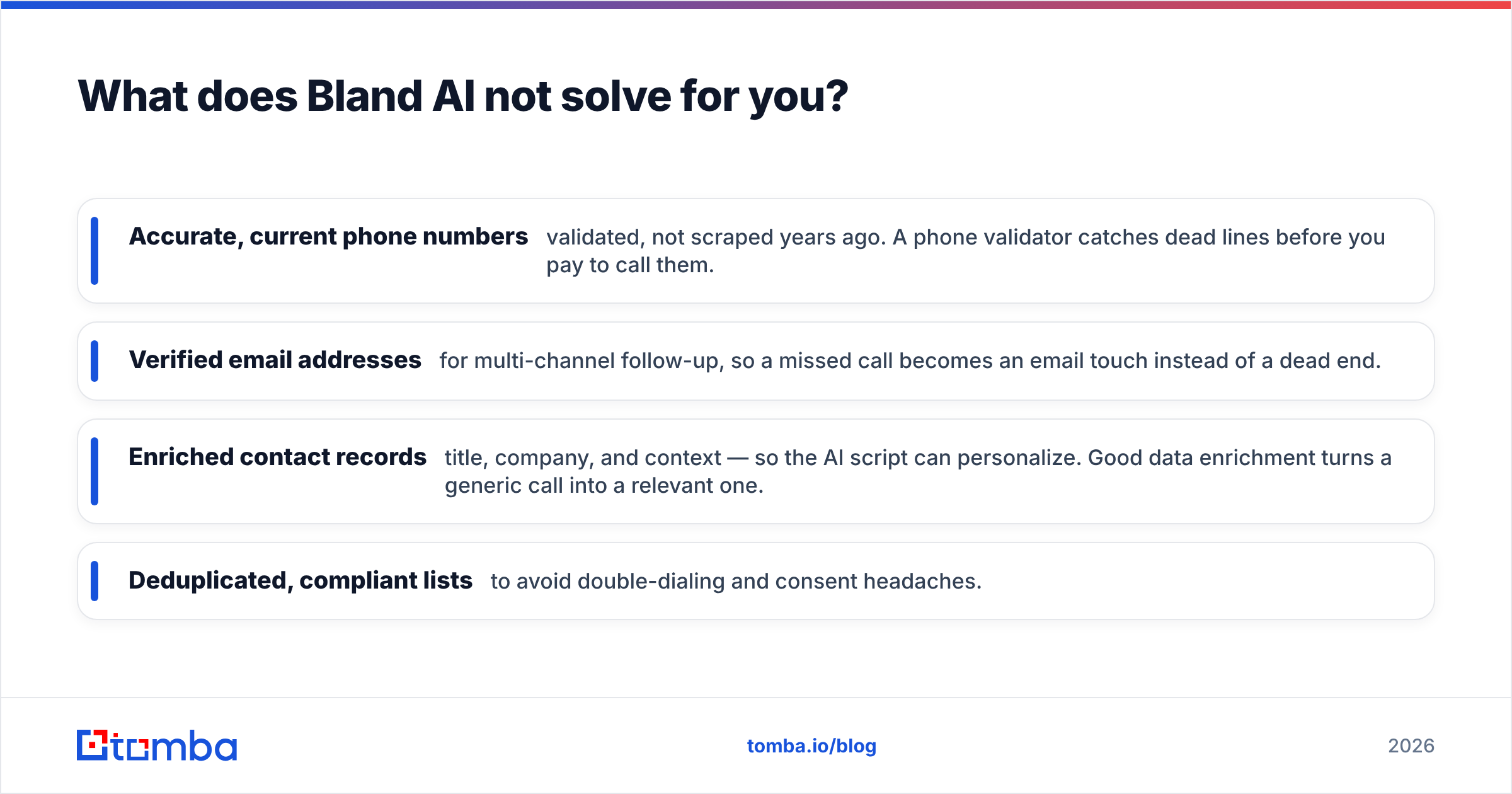
That is where your data layer matters more than your voice layer. Before you point any AI dialer at a list, you want:
- Accurate, current phone numbers — validated, not scraped years ago. A phone validator catches dead lines before you pay to call them.
- Verified email addresses for multi-channel follow-up, so a missed call becomes an email touch instead of a dead end.
- Enriched contact records — title, company, and context — so the AI script can personalize. Good data enrichment turns a generic call into a relevant one.
- Deduplicated, compliant lists to avoid double-dialing and consent headaches.
Tools like Bland AI assume you already have this. Most teams do not, and they discover it after the first invoice. Building your call list on verified contact data — the kind you can pull from a B2B database — is what makes per-minute pricing economical instead of painful. (For the full picture on what AI calling costs, weigh it against your blended cost per meeting, not just the minute rate.)
How much should you actually budget for Bland AI?#
Budget for connected minutes plus a data-quality buffer, not just the headline rate. A simple way to model it:
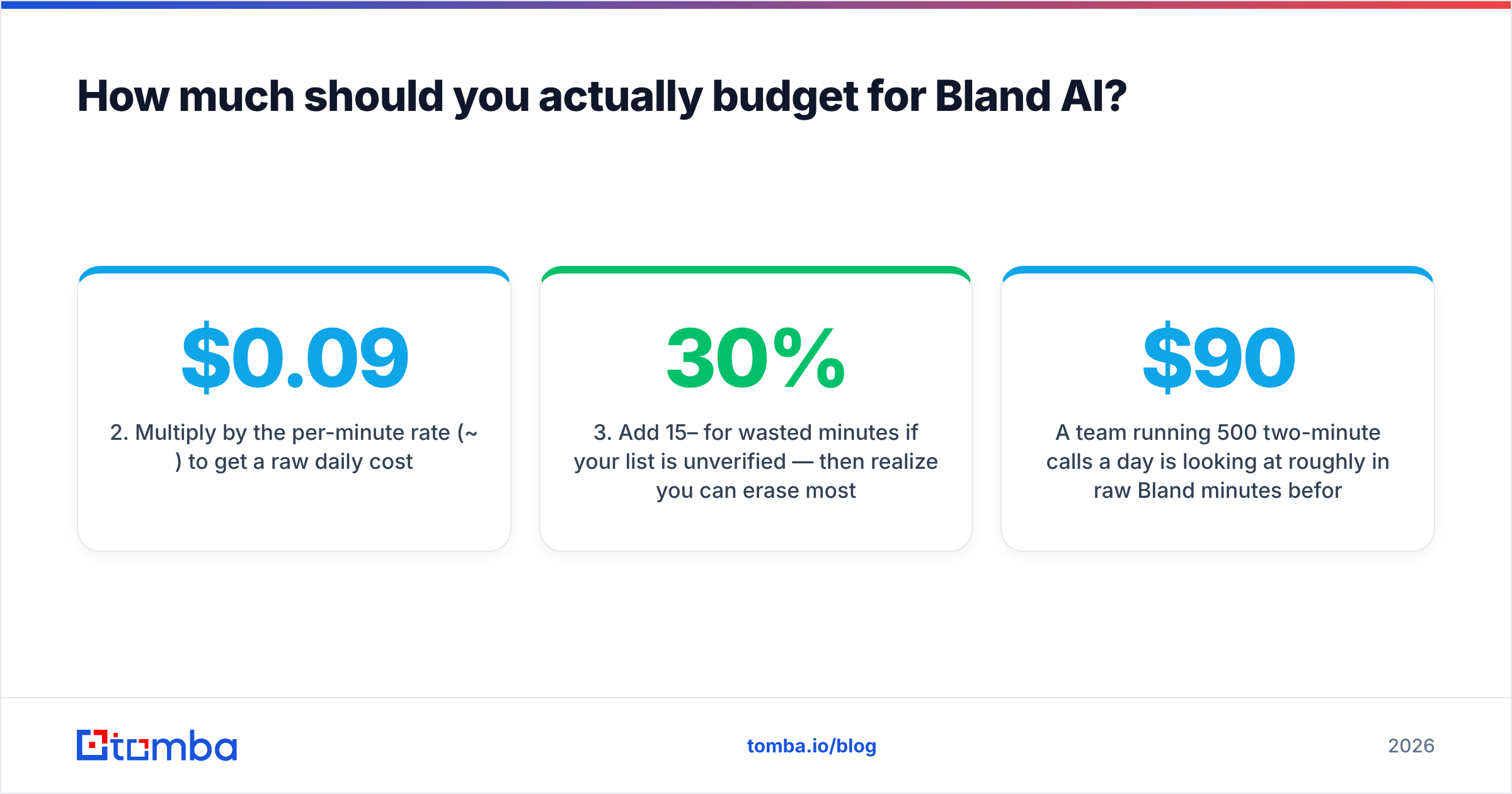
- Estimate average call length (e.g., 2 minutes) and calls per day.
- Multiply by the per-minute rate (~$0.09) to get a raw daily cost.
- Add 15–30% for wasted minutes if your list is unverified — then realize you can erase most of that by cleaning the list first.
- Layer in premium voice and telephony add-ons where relevant.
- Compare the total to your cost per booked meeting, which is the only number that matters.
A team running 500 two-minute calls a day is looking at roughly $90/day in raw Bland minutes before add-ons — manageable, until you multiply by inefficiency. The cheapest optimization is almost never switching platforms; it is calling the right numbers. You can review current Tomba pricing to see how cheap the data layer is relative to wasted call minutes.
Frequently asked questions#
Is Bland AI free? There is no meaningful free tier for production — you pay per minute, though testing volumes are inexpensive enough to evaluate cheaply.
Why is Bland AI cheaper than human callers? Because you pay only for talk-time and one agent handles unlimited concurrency. The hidden cost is engineering and data, not the per-minute rate.
Does Bland AI handle compliance? No. TCPA, consent, and call-recording laws are your responsibility — build them into your pathways.
What makes Bland AI expensive in practice? Calling unverified numbers. Dead lines and voicemails consume paid minutes without producing pipeline.
The bottom line#
Bland AI is a strong, flexible AI voice platform with fair usage-based pricing — if you have the technical resources to build with it and the data hygiene to feed it. The per-minute model is honest, but it punishes bad lists ruthlessly.
Before you spend a cent on AI calling minutes, make sure every number and email on your list is real. Start with the Tomba Email Finder to build verified, enriched contact lists by domain, name, or company — then let your AI dialer spend its minutes on conversations that actually convert. Accurate data is the cheapest performance upgrade you will ever buy.
Ready to find emails that actually work?
Join 150,000+ professionals who stopped guessing and started sending. Free credits on signup — no credit card required.
Get the Tomba newsletter
Practical outbound tactics and product updates — once every two weeks.
About the author