Boberdoo Pricing & Reviews 2026: Pros, Cons, and Costs
A neutral breakdown of Boberdoo pricing, real user reviews, and the honest pros and cons of its lead distribution platform — plus when a leaner stack wins.
Boberdoo is one of the oldest names in lead distribution software, but its pricing is famously opaque and its feature set is built for a specific kind of buyer. If you sell leads, route them, or run a ping-post marketplace, you have probably been told Boberdoo is the gold standard. Is it? And what does it actually cost in 2026?
This is a neutral teardown of Boberdoo pricing, reviews, pros and cons — written for lead buyers, agencies, and marketers who need to route contacts, not just admire a feature list.
TL;DR — Boberdoo at a glance#
- Boberdoo is lead distribution and ping-post software, not an email finder or a CRM. It routes, sells, and tracks leads between buyers and sellers.
- Pricing is custom and quote-based. Expect a one-time setup/onboarding fee plus a recurring monthly platform fee that scales with volume and modules.
- Strengths: mature ping-post engine, flexible routing rules, lead-seller billing, and call routing. It is genuinely deep for lead marketplaces.
- Weaknesses: steep learning curve, real setup cost and time, dated UI, and pricing you cannot see before a sales call.
- Reality check: most teams that just need accurate contact data and simple routing are overpaying. A lean data layer (like the Tomba Email Finder) plus a CRM often covers 80% of the need.
What is Boberdoo and who is it for?#
Boberdoo is a SaaS platform for companies that buy, sell, and distribute leads. Think of it like an air-traffic control tower for leads: contacts come in from many sources, and Boberdoo decides — in milliseconds — which buyer gets which lead, at what price, through which channel.
Its core audience is narrow but well-defined:
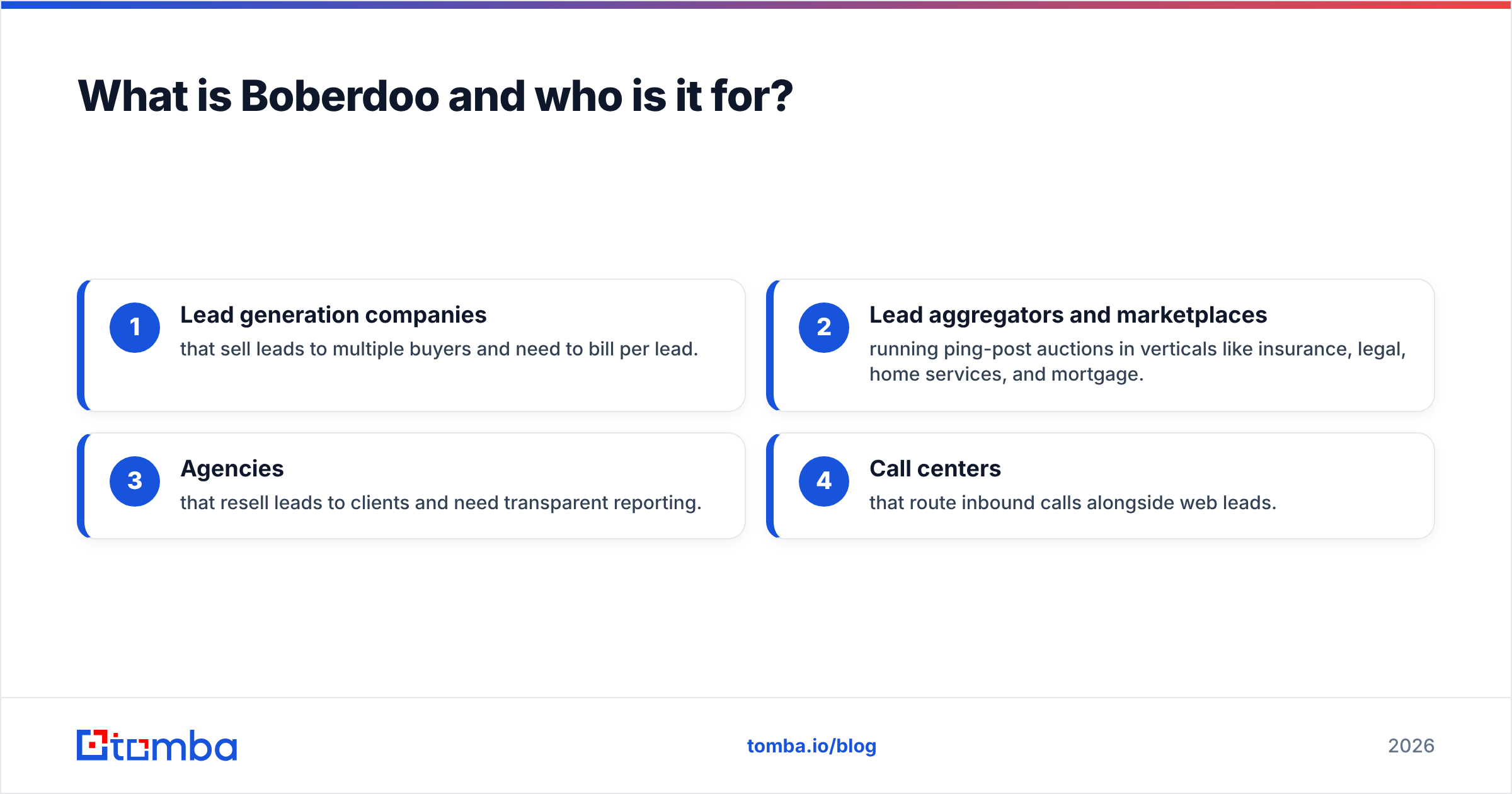
- Lead generation companies that sell leads to multiple buyers and need to bill per lead.
- Lead aggregators and marketplaces running ping-post auctions in verticals like insurance, legal, home services, and mortgage.
- Agencies that resell leads to clients and need transparent reporting.
- Call centers that route inbound calls alongside web leads.
If you are a normal B2B sales team trying to find and contact prospects, Boberdoo is almost certainly the wrong tool — that is a job for an email finder and a CRM, not a ping-post engine. Boberdoo only earns its keep when you are literally in the business of moving leads between parties for money.
Placeholder: Boberdoo lead routing dashboard — distribution rules and buyer assignment view.
How much does Boberdoo cost in 2026?#
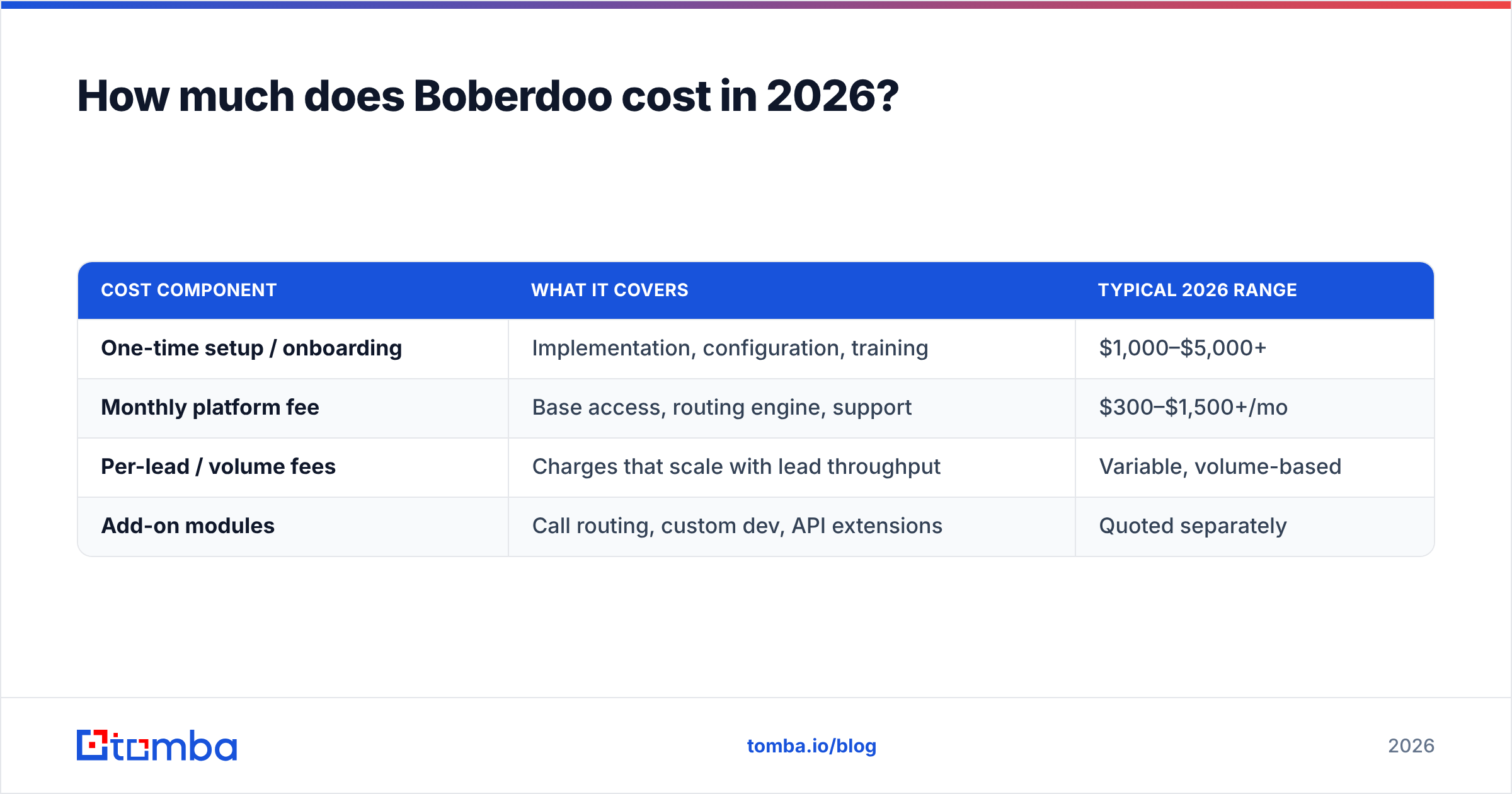
Short answer: there is no public price list. Boberdoo uses custom, quote-based pricing that you only get after a discovery call. Based on publicly available reviews and historical buyer reports, costs typically break into three buckets.
| Cost component | What it covers | Typical 2026 range |
|---|---|---|
| One-time setup / onboarding | Implementation, configuration, training | $1,000–$5,000+ |
| Monthly platform fee | Base access, routing engine, support | $300–$1,500+/mo |
| Per-lead / volume fees | Charges that scale with lead throughput | Variable, volume-based |
| Add-on modules | Call routing, custom dev, API extensions | Quoted separately |
A few honest caveats: these ranges are directional, not a quote. Boberdoo tailors pricing to your volume, the number of modules, and how much custom development you need. High-volume marketplaces can pay far more than the figures above; a small lead seller might land near the floor.
The thing buyers consistently mention in reviews is that the total cost of ownership is higher than the sticker — setup time, internal admin, and ongoing configuration all add up. Compare that to a transparent, self-serve tool where you can read the pricing before you ever talk to sales.
Want a contrast in pricing philosophy? Tomba publishes its tiers openly: Free (25 searches/mo), Starter $49/mo, Growth $99/mo, Pro $249/mo, and custom Enterprise. No call required to see the number.
)
What do Boberdoo reviews actually say?#
Pulling from public review platforms like G2 and Capterra, the sentiment is consistent and reasonable. Boberdoo is respected, not beloved — a workhorse, not a delight.
What reviewers praise:
- Routing depth. The ping-post engine and rule builder handle complex distribution logic that generic CRMs cannot.
- Reliability. Uptime and lead delivery are dependable once configured.
- Support quality. The team is knowledgeable about the lead industry specifically.
- Billing for sellers. Per-lead invoicing and buyer management are built in, not bolted on.
What reviewers criticize:
- Learning curve. New admins describe weeks before they feel fluent.
- Dated interface. The UI feels functional rather than modern.
- Setup cost and time. Onboarding is a project, not a signup.
- Opaque pricing. You cannot self-evaluate cost without a sales conversation.
That pattern — deep capability, heavy setup — is typical for vertical lead software. It is the right trade-off if lead distribution is your business model and the wrong one if it is a side need.
What are the pros and cons of Boberdoo?#
Here is the honest ledger, condensed.
Pros
- Best-in-class ping-post for real-time lead auctions.
- Granular routing rules by source, vertical, geography, price, and buyer caps.
- Native lead-seller billing and buyer account management.
- Call routing alongside web leads in one platform.
- Industry-specific expertise baked into the product and support.
Cons
- No transparent pricing — quote-only, with real setup fees.
- Steep onboarding that demands internal time and a dedicated admin.
- Overkill for simple needs — most teams use a fraction of the features.
- Aging UX compared to modern SaaS.
- Not a data source — Boberdoo routes the leads you already have; it does not find or verify new contacts.
That last point is the one buyers miss most often. Boberdoo is a distribution layer. It assumes you already have a pipeline of leads with valid contact details. If your real problem is getting accurate emails and phone numbers in the first place, Boberdoo solves nothing — you need a data layer underneath it.
Is Boberdoo worth it, or do you need something simpler?#
Conclusion first: Boberdoo is worth it only if you run a lead marketplace or sell leads to multiple buyers. For everyone else, it is too much tool.
Think of it like buying a commercial freight terminal when you just need to ship a few packages a week. The terminal is incredible at what it does — but you would never buy one to mail invoices. Match the tool to the job.
Here is a simple decision framework:
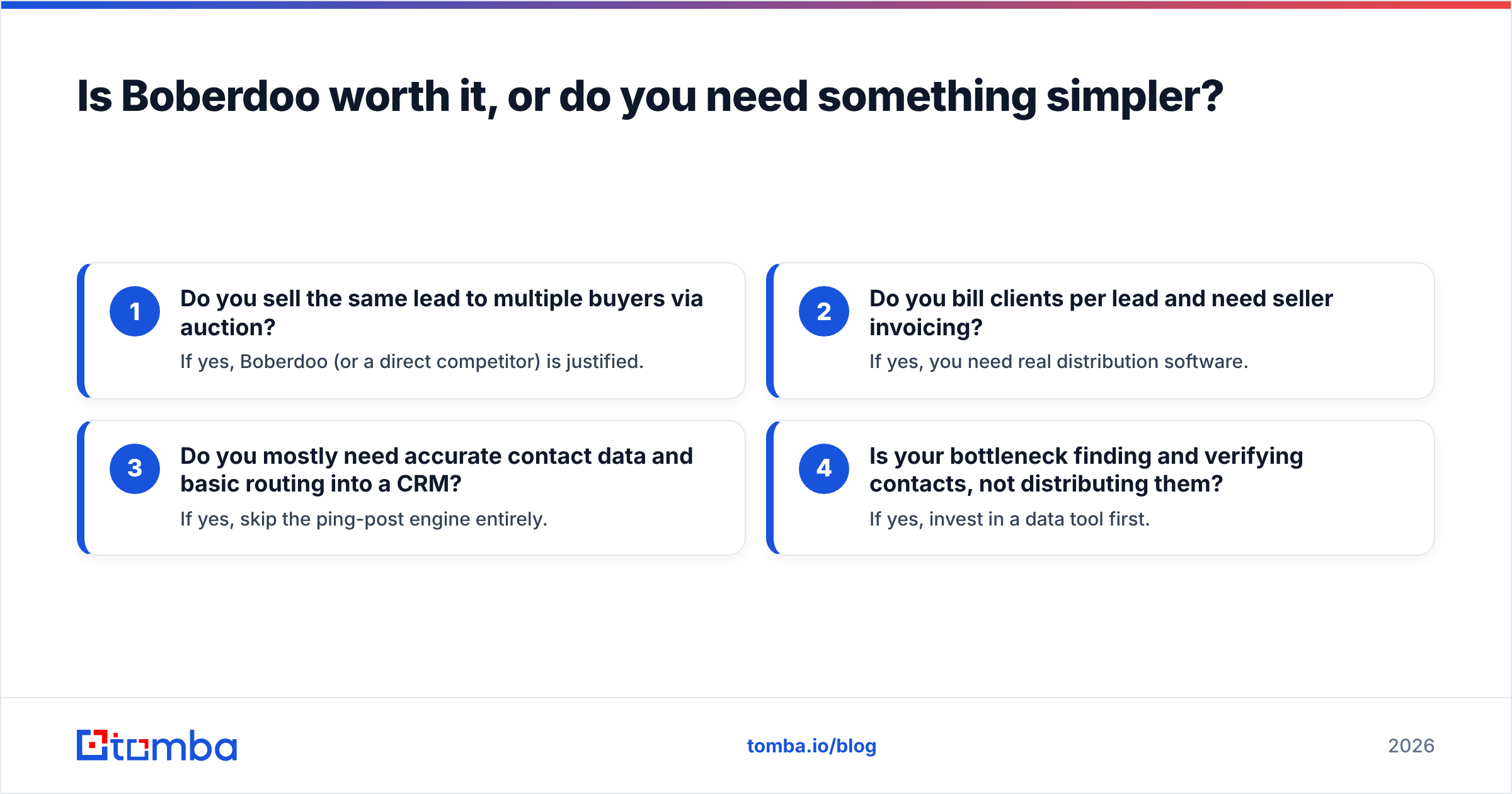
- Do you sell the same lead to multiple buyers via auction? If yes, Boberdoo (or a direct competitor) is justified.
- Do you bill clients per lead and need seller invoicing? If yes, you need real distribution software.
- Do you mostly need accurate contact data and basic routing into a CRM? If yes, skip the ping-post engine entirely.
- Is your bottleneck finding and verifying contacts, not distributing them? If yes, invest in a data tool first.
For categories 3 and 4 — which is most B2B teams — the smarter spend is a focused contact-data stack: an email finder, an email verifier, and your existing CRM. You get the outcome (clean, routable leads) without the six-month implementation.
)
How does Boberdoo compare to a lean lead-data stack?#
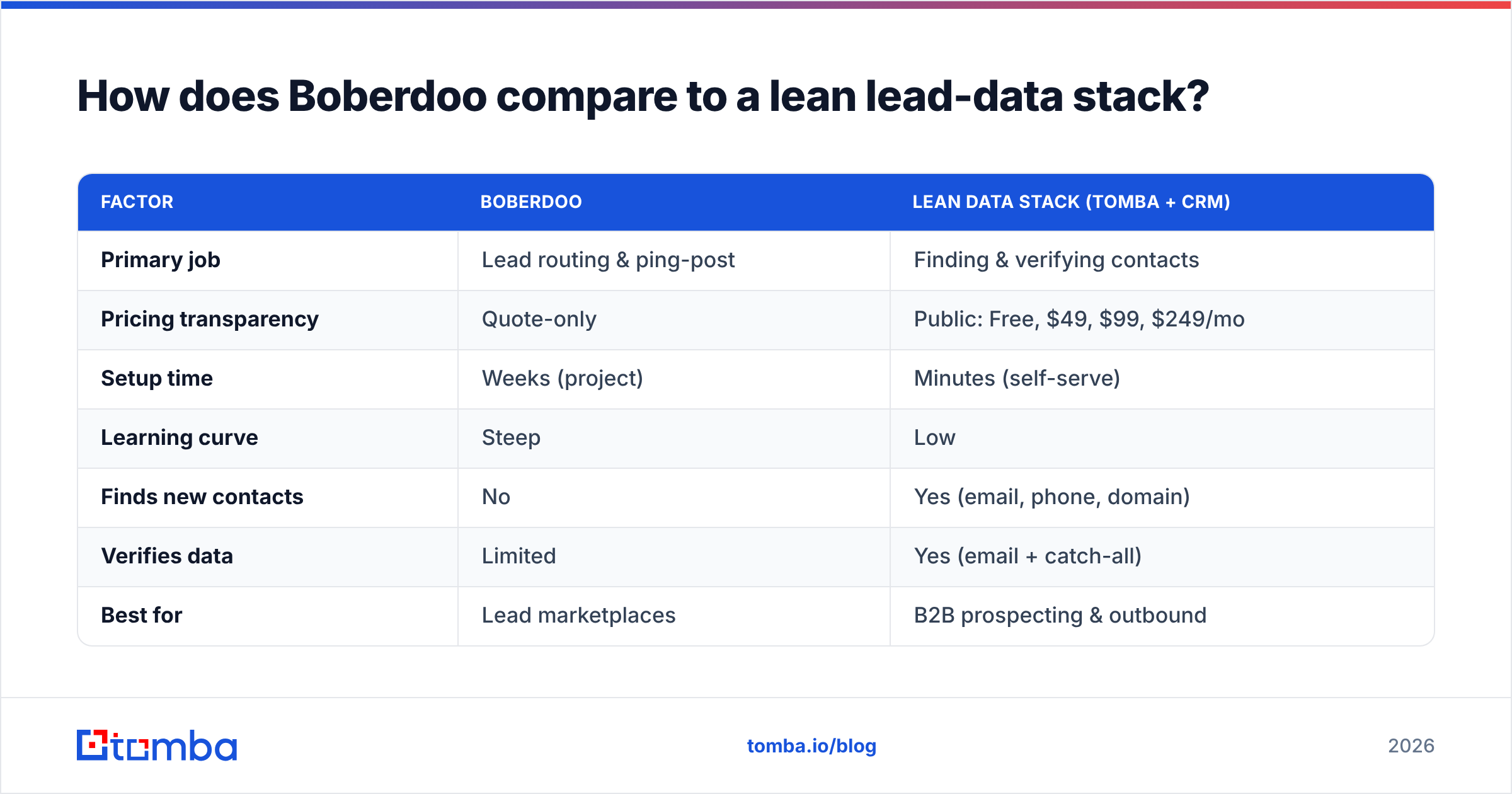
This is the comparison that matters most, because the two approaches solve different halves of the problem. Boberdoo distributes leads. A data tool like Tomba creates and validates them. Many teams think they need the former when they actually need the latter.
| Factor | Boberdoo | Lean data stack (Tomba + CRM) |
|---|---|---|
| Primary job | Lead routing & ping-post | Finding & verifying contacts |
| Pricing transparency | Quote-only | Public: Free, $49, $99, $249/mo |
| Setup time | Weeks (project) | Minutes (self-serve) |
| Learning curve | Steep | Low |
| Finds new contacts | No | Yes (email, phone, domain) |
| Verifies data | Limited | Yes (email + catch-all) |
| Best for | Lead marketplaces | B2B prospecting & outbound |
| Free tier | No | Yes (25 searches/mo) |
The point is not that Tomba replaces Boberdoo — it does not route ping-post auctions. The point is that most buyers evaluating Boberdoo are actually trying to fix a data problem, and a data tool fixes it faster and cheaper. You can always add distribution software later if your model genuinely demands it.
If you do need to enrich and route at scale, a programmatic approach helps: pull verified contacts via the Tomba API, enrich them with data enrichment, then push clean records into whatever routing layer you use. That keeps your spend proportional to the actual job.
What should you ask Boberdoo before signing?#
If you have decided distribution software is genuinely your need, go into the sales call prepared. Ask these directly:
- What is the all-in first-year cost including setup, monthly fees, and per-lead charges?
- Which modules are included in the base price versus quoted separately?
- What is the realistic onboarding timeline and what internal resources do I need?
- Are there volume tiers or overage fees I should model against my forecast?
- What happens to pricing as I scale — does the monthly fee step up, and when?
- Can I export my routing rules and lead data if I leave?
The answers tell you whether the quote fits your margin per lead. If a single lead nets you a few dollars and the platform overhead is heavy, the math may not work — and that is exactly when a leaner data-first approach wins.
Frequently asked questions#
Is Boberdoo good for a small lead-gen business? Usually not. The setup cost and learning curve are hard to justify at low volume. Small operators are often better served by a CRM plus a contact-data tool until volume justifies dedicated distribution software.
Does Boberdoo find email addresses or phone numbers? No. Boberdoo distributes leads you already have. To source and verify contacts, you need a dedicated tool — for example, an email finder for emails and a phone finder for direct-dial numbers.
Why is Boberdoo pricing not public? Because it is volume- and module-based, tailored per customer. That flexibility helps large marketplaces but frustrates buyers who just want to compare costs quickly.
What are the main Boberdoo alternatives? Other lead distribution platforms exist (LeadByte, Phonexa, and similar), but if your real need is contact data and simple routing, the better "alternative" is a data tool plus your CRM rather than another heavyweight distributor.
The bottom line on Boberdoo pricing, reviews, pros and cons#
Boberdoo is a mature, capable lead distribution platform that earns its price for lead marketplaces and sellers — and frustrates everyone else with opaque quotes, heavy setup, and features they will never use. The reviews are fair: deep where it counts, dated where it shows, and expensive in ways the sticker does not reveal.
Before you book that sales call, be honest about your actual bottleneck. If it is distributing leads between buyers, Boberdoo belongs on your shortlist. If it is finding and verifying the contacts in the first place — which is the real problem for most B2B teams — start with the data layer.
That is where Tomba fits. Use the Tomba Email Finder to source accurate, verified professional emails by name, company, or domain, then route those clean leads into whatever stack you run. Start free with 25 searches a month, scale to a transparent $49/mo when you are ready, and put your budget into leads that actually convert — not into a platform you only half use.
// get started
Find, verify and enrich your first contacts today
Start on the free plan with 25 searches a month, then scale when your team is ready.
Free plan · No credit card required · GDPR & CCPA
// about the author