Bombora vs ZoomInfo 2026: Intent Data Showdown Compared
Bombora vs ZoomInfo in 2026: how their intent data, contact coverage, pricing, and accuracy stack up — plus where a leaner stack wins.
TL;DR
- Bombora is a pure-play intent data provider — it tells you which companies are researching a topic, but it does not hand you contacts to email or call.
- ZoomInfo is a full-stack B2B database — contacts, firmographics, technographics, and its own intent signal (powered partly by a Bombora relationship in the past, now largely first-party).
- They are not true substitutes: Bombora is a signal layer, ZoomInfo is a data-and-signal platform. Most teams that "compare" them actually need both a signal and a way to action it.
- Both carry enterprise pricing — Bombora is quote-only and ZoomInfo commonly lands in the $15k–$40k+/year range with annual lock-in.
- If your real job is turning a target account into a verified email you can send today, a focused email finder like Tomba does that for a fraction of the cost.
What is the real difference between Bombora and ZoomInfo?#
Bombora sells intent; ZoomInfo sells contacts plus intent. That single sentence resolves most of the confusion.
Think of it like weather forecasting. Bombora is the meteorologist telling you a storm is coming over a particular city — useful, directional, but it won't drive you there. ZoomInfo is the meteorologist plus a car, a map, and the addresses of every house in that city. One is a signal; the other is a signal bundled with the means to act.
Bombora's flagship product is Company Surge, a co-operative of thousands of B2B publishers that track content consumption. When accounts spike their research on a topic — say "data warehouse migration" — Bombora flags those accounts as showing intent. You then feed that list into your CRM, ABM platform, or ad tool.
ZoomInfo, by contrast, is a database company. You search by title, industry, headcount, tech stack, or location and pull direct dials and emails. ZoomInfo layers its own intent product on top, so a rep can see both who to contact and which accounts are warming up.

How do Bombora and ZoomInfo compare head to head?#
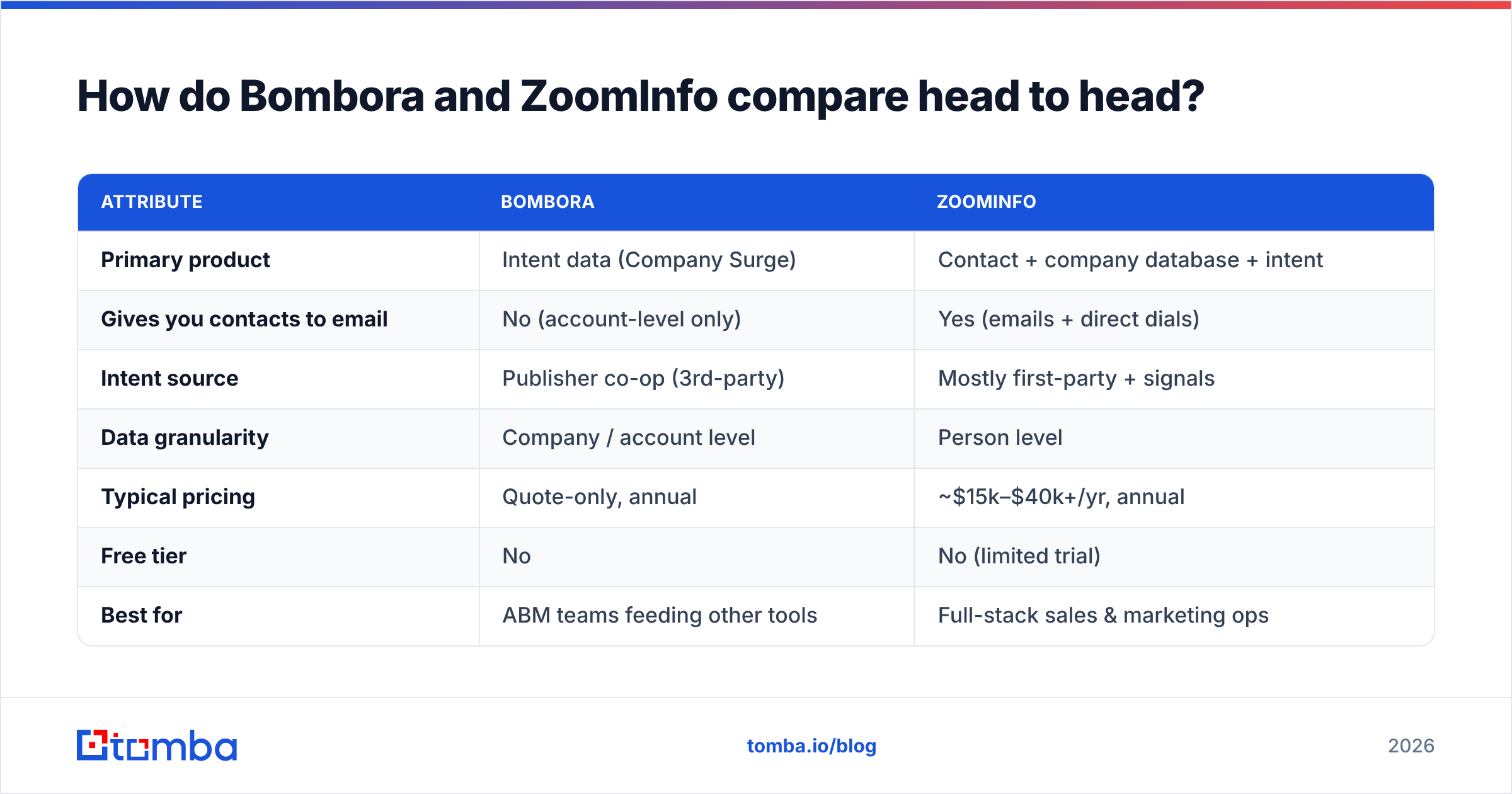
Here is the practical breakdown most buyers actually want before a sales call.
| Attribute | Bombora | ZoomInfo |
|---|---|---|
| Primary product | Intent data (Company Surge) | Contact + company database + intent |
| Gives you contacts to email | No (account-level only) | Yes (emails + direct dials) |
| Intent source | Publisher co-op (3rd-party) | Mostly first-party + signals |
| Data granularity | Company / account level | Person level |
| Typical pricing | Quote-only, annual | ~$15k–$40k+/yr, annual |
| Free tier | No | No (limited trial) |
| Best for | ABM teams feeding other tools | Full-stack sales & marketing ops |
| Contract style | Annual commitment | Annual commitment |
| Integrations | Pushes into ABM/CRM/ad tools | Native CRM/sales engagement |
The core takeaway: you rarely choose one instead of the other. Bombora is often a feeder into platforms (including, historically, ZoomInfo's own signal stack). ZoomInfo is the place reps actually live and work accounts.
If you only have budget for one and you need to contact people, ZoomInfo is the more complete tool. If you already have a contact source and just want a sharper "who's in-market" signal, Bombora is the specialist.
What is intent data and do you actually need it?#
Intent data is the digital body language of a buying committee — the searches, content downloads, and page visits that suggest an account is in a buying cycle before they ever fill out a form.
There are two flavors:
- Third-party intent — collected across a publisher network (Bombora's model). Broad reach, but you see topic-level surges, not the individual reader.
- First-party intent — your own website and product signals. Highly accurate but limited to traffic you already get. Tools like website visitor identification turn anonymous first-party traffic into named companies.
Intent data is genuinely valuable when you have a large addressable market and need to prioritize. It is far less useful if your total list of target accounts is small enough to work every week anyway. Spending five figures to learn that 40 of your 200 accounts are "surging" is a poor trade when a rep could touch all 200.
Before you buy a signal layer, be honest about volume. The teams that get ROI from Bombora or ZoomInfo intent are running hundreds-to-thousands of accounts through orchestrated plays. For a focused outbound motion, the bottleneck is almost never signal — it's verified contact data and clean sending.
Is ZoomInfo better than Bombora for sales teams?#
For most sales teams, yes — because ZoomInfo closes the loop and Bombora does not. A rep cannot send an email to "Acme Corp is surging." They need a name, a title, a verified address, and a phone number. ZoomInfo provides those natively.
Bombora's value lands earlier in the funnel and with different owners — demand gen, ABM, and ad-ops teams who route surging accounts into campaigns. If you handed a Bombora seat to an SDR with no other tooling, they'd be stuck.
That said, ZoomInfo's strength comes with two well-documented frictions, visible across reviews on G2:
- Cost and contracts. Annual commitments, seat minimums, and credit caps make it expensive to start and hard to leave.
- Data drift. Direct dials and emails decay fast as people change jobs, so even a premium database needs ongoing verification.
That second point is why a verification layer matters regardless of which platform you buy. Even ZoomInfo records should pass through an email verifier before a campaign to protect your sender reputation.
How much do Bombora and ZoomInfo cost in 2026?#
Both are enterprise-priced and quote-driven — neither publishes a self-serve plan.
- Bombora does not list public pricing. Company Surge is sold as an annual subscription scoped to your topics and account universe. Expect a five-figure starting point for meaningful coverage.
- ZoomInfo also negotiates per deal. Public reporting and buyer reviews put typical contracts anywhere from roughly $15,000 to $40,000+ per year, scaling with seats, credits, and add-ons like Intent, Scoops, and the engagement suite.
Neither offers a free tier you can build a workflow on. That is the structural gap a tool like Tomba fills: transparent, monthly, self-serve pricing.
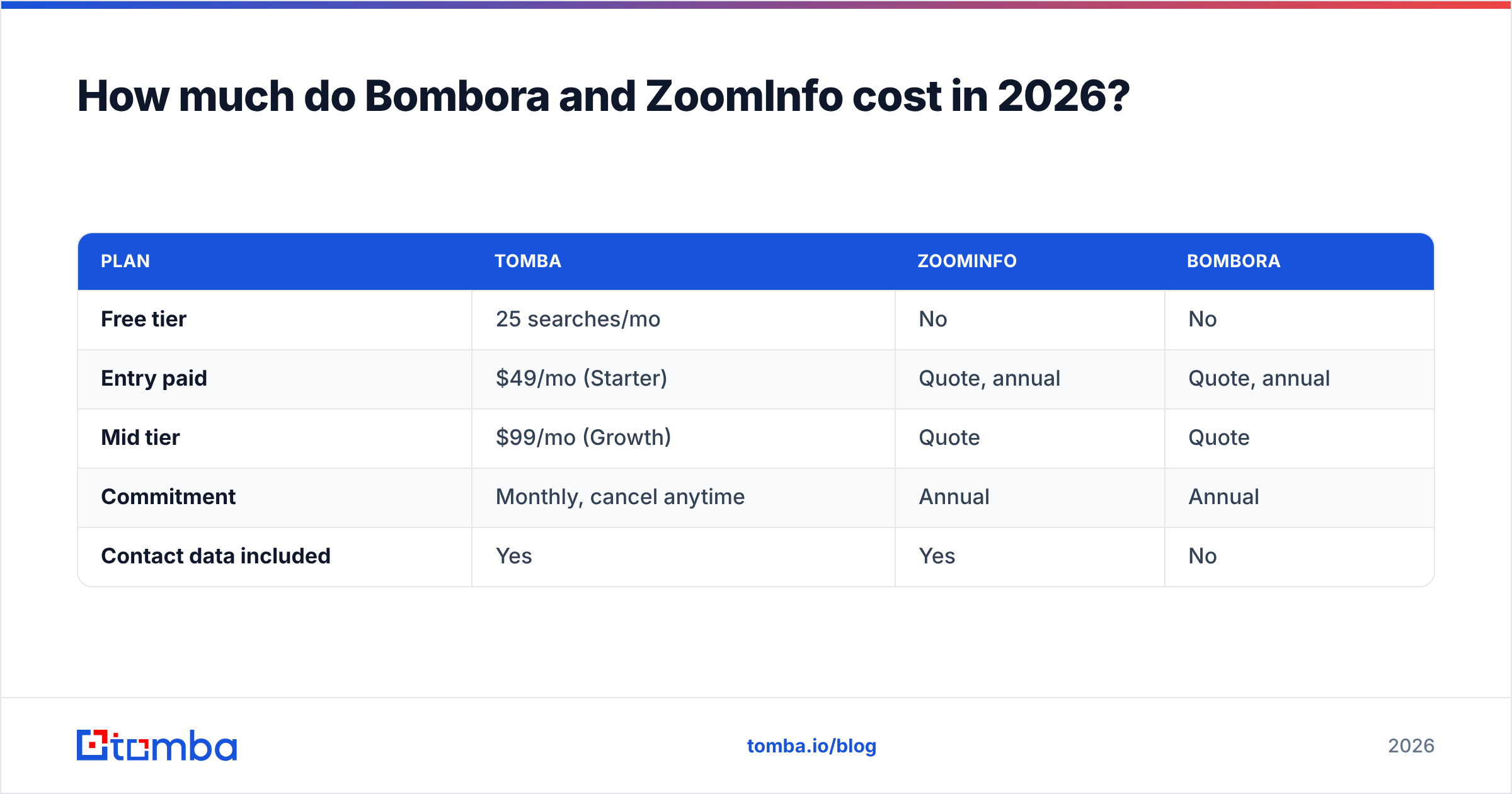
| Plan | Tomba | ZoomInfo | Bombora |
|---|---|---|---|
| Free tier | 25 searches/mo | No | No |
| Entry paid | $49/mo (Starter) | Quote, annual | Quote, annual |
| Mid tier | $99/mo (Growth) | Quote | Quote |
| Commitment | Monthly, cancel anytime | Annual | Annual |
| Contact data included | Yes | Yes | No |
You can see the full Tomba pricing breakdown without talking to a rep — Free, Starter at $49/mo, Growth at $99/mo, Pro at $249/mo, and custom Enterprise.
When should you use Bombora, ZoomInfo, or something leaner?#
Match the tool to the job, not the brand:
- You run large-scale ABM and feed multiple downstream tools → Bombora. Its signal is purpose-built to route into ad platforms, CRMs, and orchestration tools.
- You want one platform for contacts, firmographics, and intent and have enterprise budget → ZoomInfo. It is the most complete single-vendor option.
- You need verified emails and phone numbers for a defined target list, fast and affordably → a focused finder + verifier stack. This is where most small and mid-market teams actually sit.
- You already have intent (first-party or a signal vendor) and just need to action it → skip the second enterprise contract and add an email finder plus enrichment.
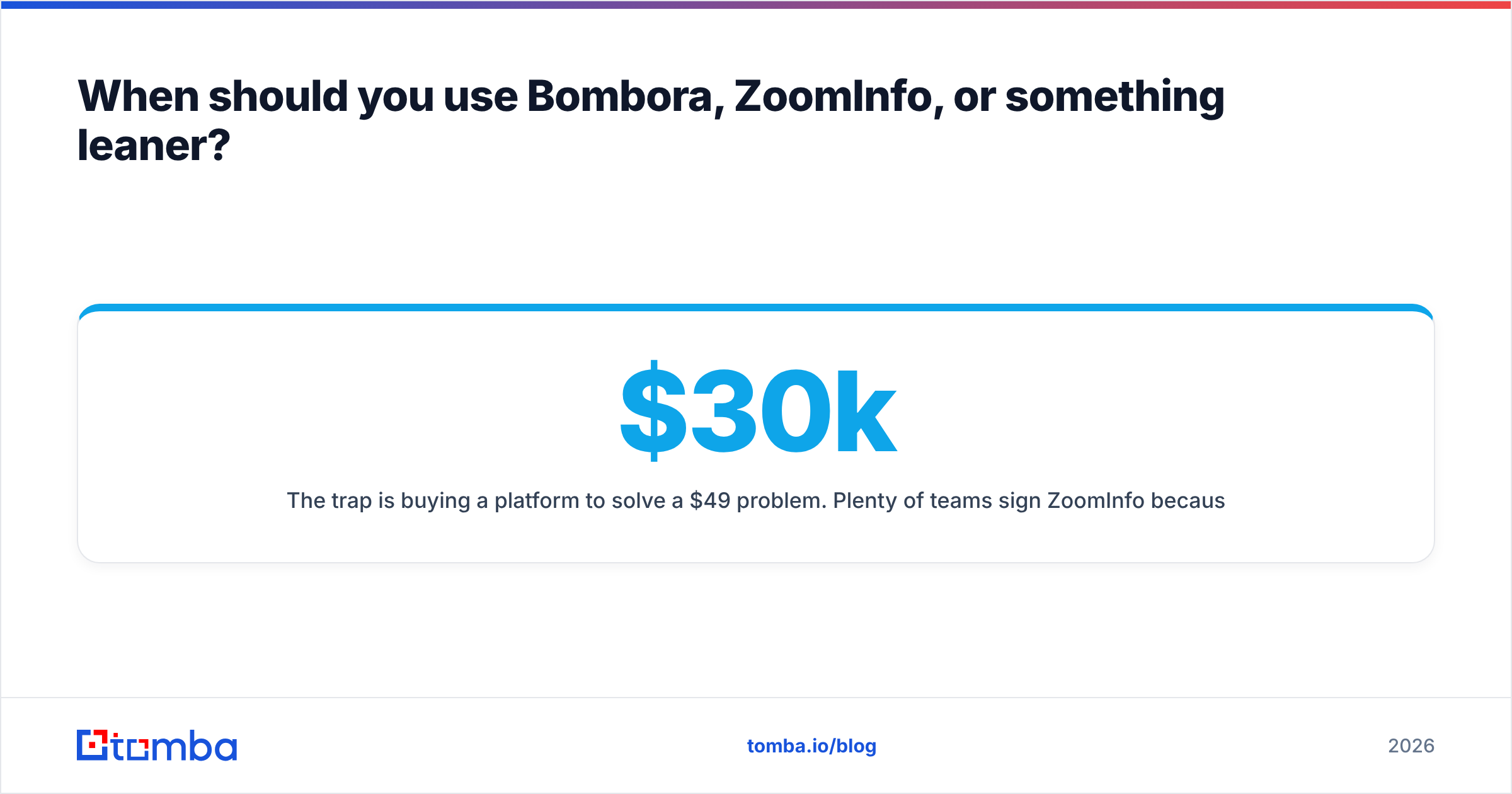
The trap is buying a $30k platform to solve a $49/month problem. Plenty of teams sign ZoomInfo because they "need data," then use 10% of it — contact lookups they could have run on a self-serve tool with a B2B database and transparent credits.
How does Tomba fit into the Bombora vs ZoomInfo decision?#
Tomba is not an intent vendor — it's the action layer that makes any signal useful. Whether your "who's in-market" list comes from Bombora, ZoomInfo, or your own website, you still have to find a verified, sendable contact for each account. That is exactly what Tomba does.
The workflow is simple:
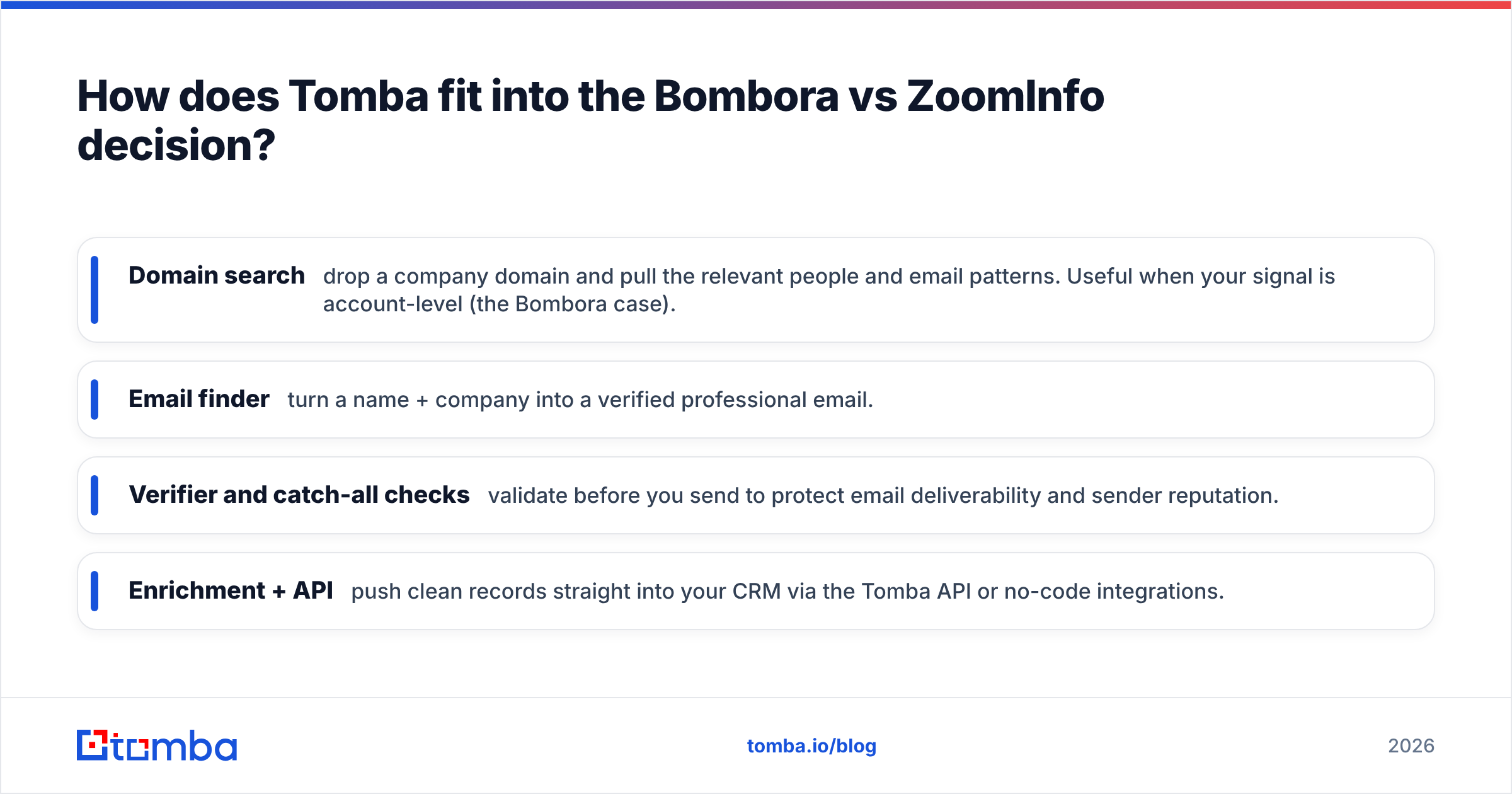
- Domain search — drop a company domain and pull the relevant people and email patterns. Useful when your signal is account-level (the Bombora case).
- Email finder — turn a name + company into a verified professional email.
- Verifier and catch-all checks — validate before you send to protect email deliverability and sender reputation.
- Enrichment + API — push clean records straight into your CRM via the Tomba API or no-code integrations.
Compared to a five-figure annual seat, Tomba is a monthly, cancel-anytime tool with a free tier to test on real data. It won't tell you a topic is "surging" — but if you already know your accounts, it gets you to the inbox faster and cheaper than either incumbent's contact module.
Bombora vs ZoomInfo: which should you choose?#
Choose ZoomInfo if you want one enterprise platform and have the budget; choose Bombora if you specifically need third-party intent to feed an existing ABM machine; choose a lean finder-plus-verifier stack if your real bottleneck is sendable contacts, not signals.
Most teams overestimate how much intent they need and underestimate how fast contact data decays. The honest sequence for a growing outbound team is: define your accounts, find verified contacts, send clean, then add a signal layer once volume justifies it — not before.
A quick decision summary:
| If you are… | Best fit |
|---|---|
| Enterprise ABM, multi-tool stack | Bombora (signal) + a database |
| Want everything in one vendor | ZoomInfo |
| SMB/mid-market, defined target list | Tomba (find + verify) |
| Already have intent, need contacts | Tomba alongside your signal |
Ready to turn target accounts into real conversations?#
You don't need a $30,000 annual contract to start reaching the right people. If you already know which companies to chase — from Bombora, ZoomInfo, your CRM, or your own site traffic — the Tomba Email Finder turns those accounts into verified, sendable contacts in seconds. Start on the free tier with 25 searches a month, scale to Starter at $49/mo when you're ready, and keep your deliverability clean with built-in verification. Spend your budget on conversations, not on data you'll barely touch.
// get started
Find, verify and enrich your first contacts today
Start on the free plan with 25 searches a month, then scale when your team is ready.
Free plan · No credit card required · GDPR & CCPA
// about the author