Bonzo Pricing, Reviews, Pros and Cons: 2026 Buyer Guide
A neutral 2026 breakdown of Bonzo pricing, real user reviews, and the honest pros and cons—plus how to feed it clean contact data so your campaigns actually land.
TL;DR
- Bonzo is a conversational CRM and follow-up automation platform built for loan officers, insurance agents, real estate teams, and small sales orgs that live in SMS, email, and voicemail drops.
- Pricing is per-seat and starts in the ~$79–$99/user/month range, with team and enterprise tiers stacking on phone numbers, integrations, and onboarding—always confirm current numbers on getbonzo.com.
- Reviews are broadly positive on G2 and Capterra for ease of use and responsive support, with recurring complaints about deliverability limits, reporting depth, and per-seat cost as teams grow.
- The biggest hidden cost is bad data: Bonzo automates outreach, but it does not find or verify the contacts you load into it.
- Pair Bonzo with an accurate email finder and verifier so your automated sequences reach real inboxes instead of bouncing.
What is Bonzo?#
Bonzo is a sales engagement and CRM tool that automates personal-feeling follow-up across text, email, and ringless voicemail. Think of it as a tireless assistant that sends the right message at the right time so a lead never falls through the cracks—the kind of nudging a great salesperson does manually, turned into repeatable campaigns.
It is most popular in high-touch, relationship-driven industries: mortgage, insurance, real estate, and solar. Reps in those verticals win on speed-to-lead and consistency, and Bonzo is engineered around exactly that. You import contacts, drop them into a campaign, and the platform fires sequenced touches until the prospect replies—at which point conversations route into a shared inbox.
Where Bonzo differs from a heavyweight CRM like Salesforce is focus. It is not trying to be your system of record for a 500-seat enterprise. It is trying to make a small team's outbound and nurture motion feel personal at scale.
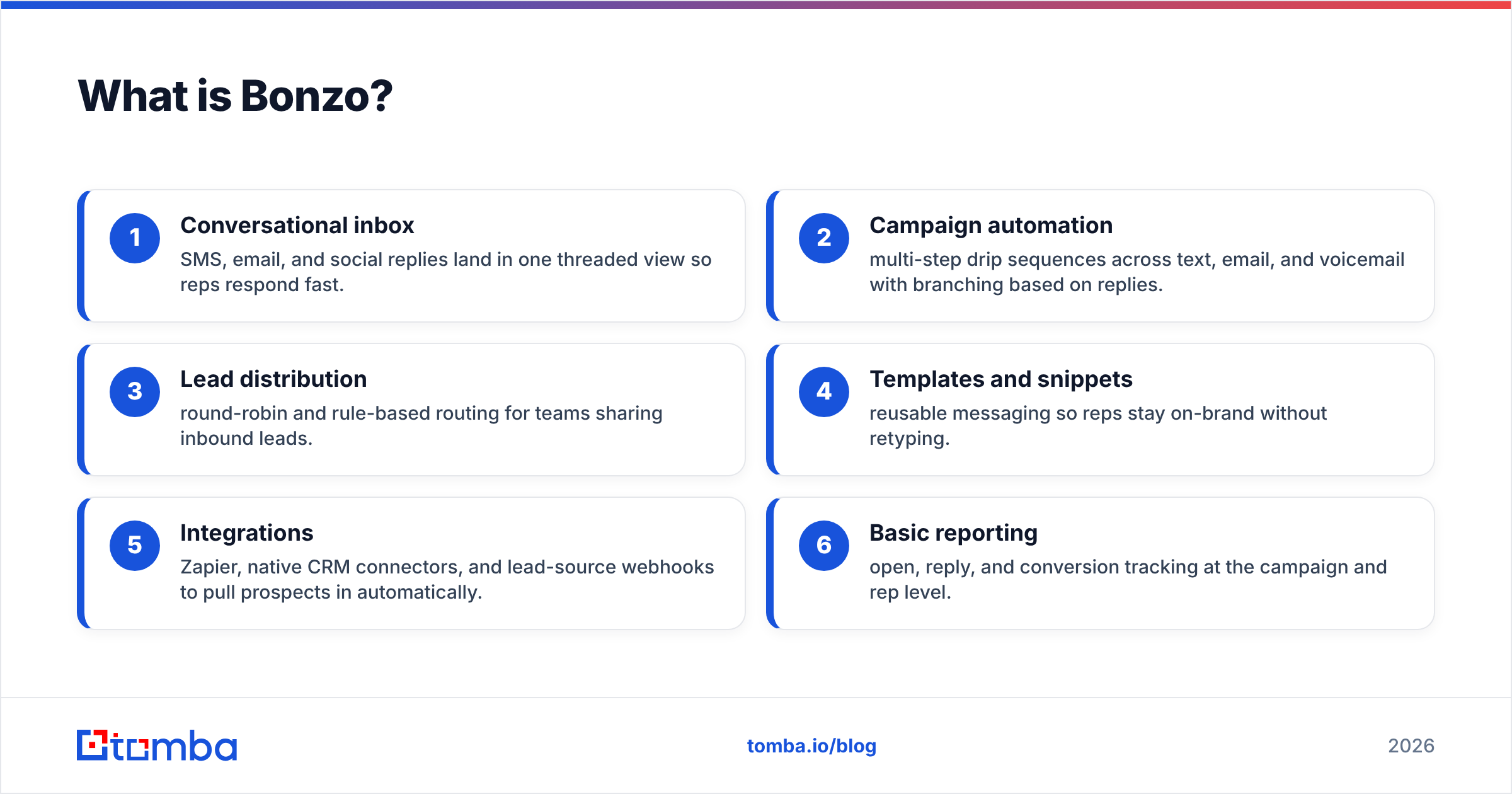
Here is what sits inside the platform:
- Conversational inbox — SMS, email, and social replies land in one threaded view so reps respond fast.
- Campaign automation — multi-step drip sequences across text, email, and voicemail with branching based on replies.
- Lead distribution — round-robin and rule-based routing for teams sharing inbound leads.
- Templates and snippets — reusable messaging so reps stay on-brand without retyping.
- Integrations — Zapier, native CRM connectors, and lead-source webhooks to pull prospects in automatically.
- Basic reporting — open, reply, and conversion tracking at the campaign and rep level.
How much does Bonzo cost?#
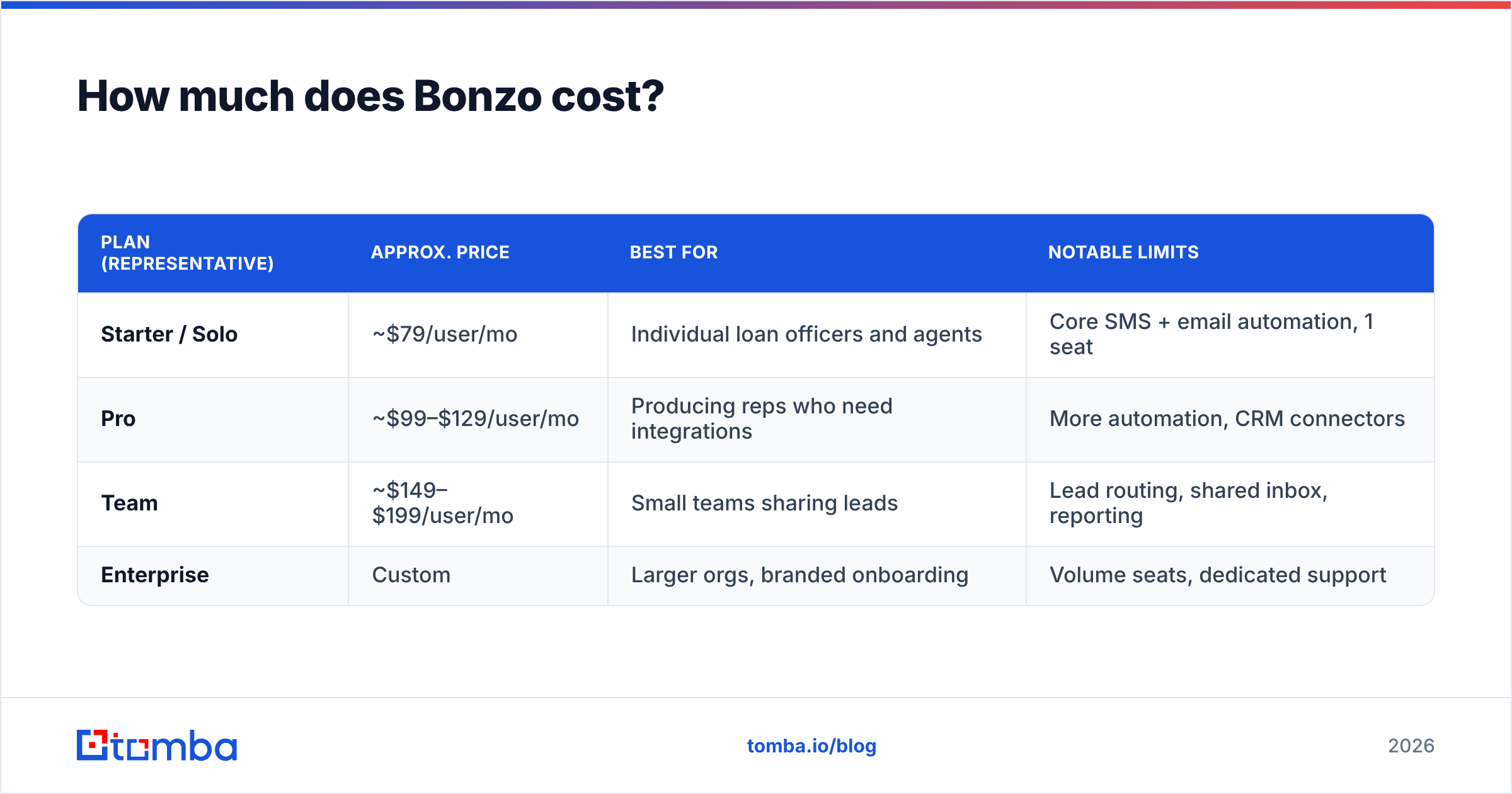
Bottom line: Bonzo is priced per user, and most teams land in the roughly $79–$199 per seat, per month range depending on tier and contract length. Bonzo does not publish a fully transparent pricing page the way some SaaS tools do—pricing is usually confirmed on a demo call—so treat the figures below as representative of what users commonly report rather than a locked quote. Always verify the current numbers directly on the official Bonzo site.
| Plan (representative) | Approx. price | Best for | Notable limits |
|---|---|---|---|
| Starter / Solo | ~$79/user/mo | Individual loan officers and agents | Core SMS + email automation, 1 seat |
| Pro | ~$99–$129/user/mo | Producing reps who need integrations | More automation, CRM connectors |
| Team | ~$149–$199/user/mo | Small teams sharing leads | Lead routing, shared inbox, reporting |
| Enterprise | Custom | Larger orgs, branded onboarding | Volume seats, dedicated support |
A few cost realities worth planning around:
- Per-seat math scales fast. A five-rep team at ~$129/seat is roughly $645/month before add-ons. Compare that against your average deal size before committing.
- Annual contracts usually discount. Like most engagement tools, paying yearly tends to shave the monthly rate—ask what the annual versus month-to-month delta is.
- Messaging carries downstream costs. SMS-heavy workflows can run into carrier compliance (10DLC registration) and per-message considerations, which are easy to overlook in the headline seat price.
If budget predictability matters to you, model the total cost of ownership—seats plus messaging plus any onboarding fee—rather than anchoring on the per-seat sticker.
What do Bonzo reviews say?#
Across G2 and Capterra, Bonzo tends to score well, typically in the 4.5-out-of-5 neighborhood, with a clear pattern in the feedback.
What reviewers consistently praise:
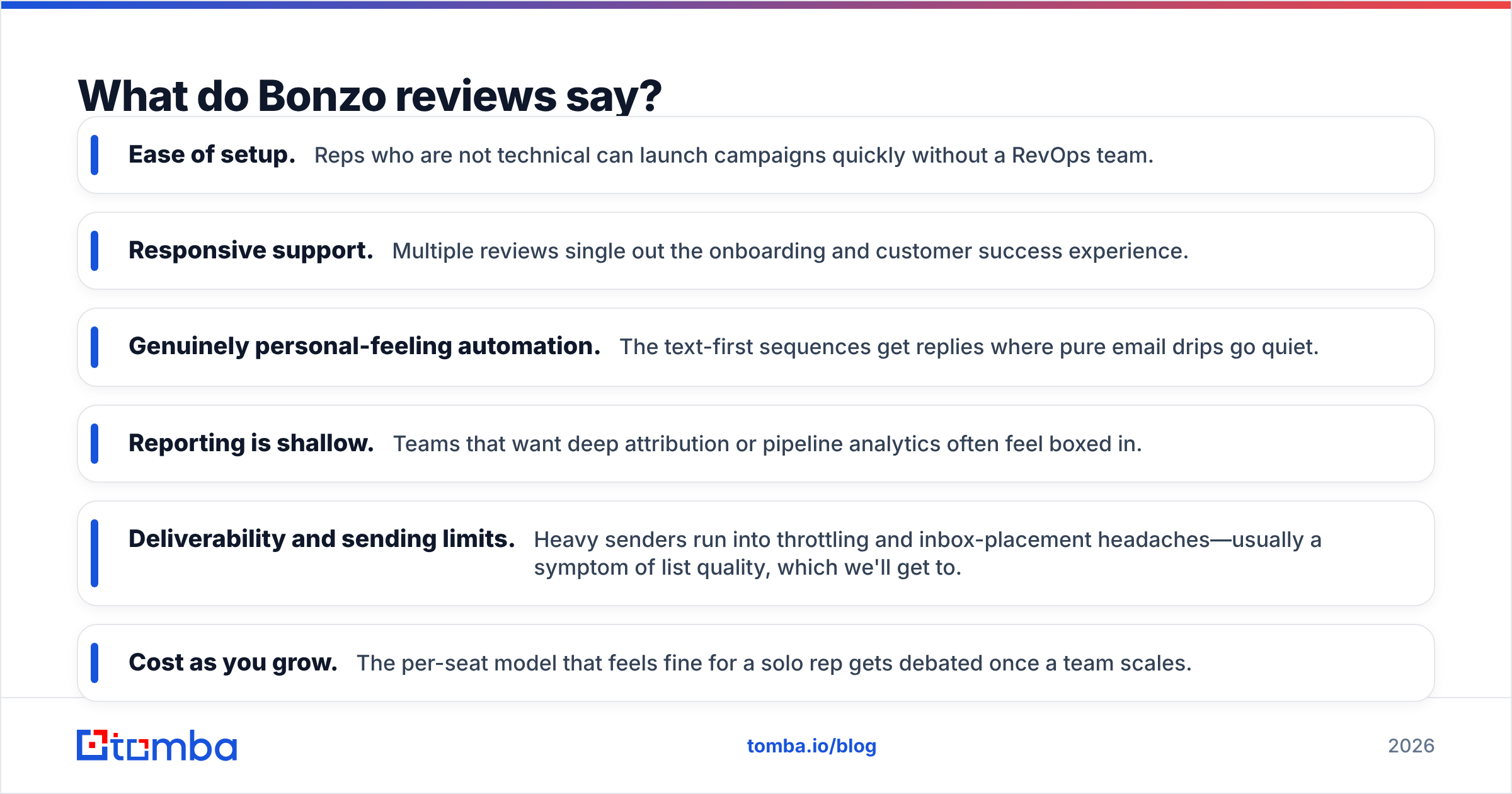
- Ease of setup. Reps who are not technical can launch campaigns quickly without a RevOps team.
- Responsive support. Multiple reviews single out the onboarding and customer success experience.
- Genuinely personal-feeling automation. The text-first sequences get replies where pure email drips go quiet.
What reviewers consistently flag:
- Reporting is shallow. Teams that want deep attribution or pipeline analytics often feel boxed in.
- Deliverability and sending limits. Heavy senders run into throttling and inbox-placement headaches—usually a symptom of list quality, which we'll get to.
- Cost as you grow. The per-seat model that feels fine for a solo rep gets debated once a team scales.
The takeaway: people who buy Bonzo for what it is—a fast, friendly follow-up engine for small relationship-driven teams—are happy. People who expect an enterprise CRM with BI-grade reporting are the ones who churn.
What are the pros of Bonzo?#
- Speed to value. You can build and launch a working campaign in an afternoon. For a solo producer, that is the entire pitch.
- Multi-channel in one place. Text, email, and voicemail from a single inbox removes the tab-juggling that kills follow-up consistency.
- Built for its niche. The templates, compliance posture, and workflows are tuned for mortgage, insurance, and real estate, so you are not bending a generic tool to fit.
- Conversational tone. Sequences read like a human texting, not a marketing blast, which is why reply rates hold up.
- Solid support and onboarding. A real differentiator for non-technical buyers who do not want to fight software.
What are the cons of Bonzo?#
- Thin analytics. If you live in dashboards, Bonzo's reporting will frustrate you.
- Per-seat pricing pressure. Costs climb predictably with headcount, and there is no cheap "viewer" seat for managers.
- Deliverability depends entirely on your list. Bonzo will happily send to a contact that does not exist—and every bounce drags your sender reputation down.
- Not a full CRM. Teams needing complex pipelines, custom objects, or deep forecasting will outgrow it.
- Vertical focus cuts both ways. Outside its core industries, the opinionated workflows can feel like a constraint.
That third point is the one that quietly wrecks campaigns, so it deserves its own section.
How do you feed Bonzo clean contact data?#
Conclusion first: Bonzo is only as good as the contacts you pour into it—and Bonzo does not find or verify those contacts for you. It is an outreach engine, not a data source. Garbage in, bounced out.
Here is the analogy: Bonzo is a high-end espresso machine. It makes a beautiful drink fast and consistently. But if you grind in stale, low-grade beans, no machine saves the cup. Your contact list is the bean. When you load unverified emails and dead numbers, you get hard bounces, spam-folder placement, and a sender reputation that tanks the deliverability of every future send—exactly the complaint that shows up in Bonzo reviews.
This is where a dedicated data layer earns its keep, and it is cheap insurance compared to a damaged sending domain:
- Use an email finder to source accurate, current professional email addresses for the leads you actually want to reach.
- Run every list through an email verifier before import so you strip dead addresses and protect your sender reputation.
- Add data enrichment to fill in titles, companies, and context that make Bonzo's personalization tokens land instead of reading as "Hi [FirstName]."
- For the call-and-text side, pull validated B2B numbers with a phone finder so your voicemail drops are not dialing into the void.
Tomba's free tier covers 25 searches a month, and paid plans start at $49/month—so you can clean a list before it ever touches your Bonzo seat. See the full Tomba pricing breakdown to match it to your volume.
Is Bonzo better than the alternatives?#
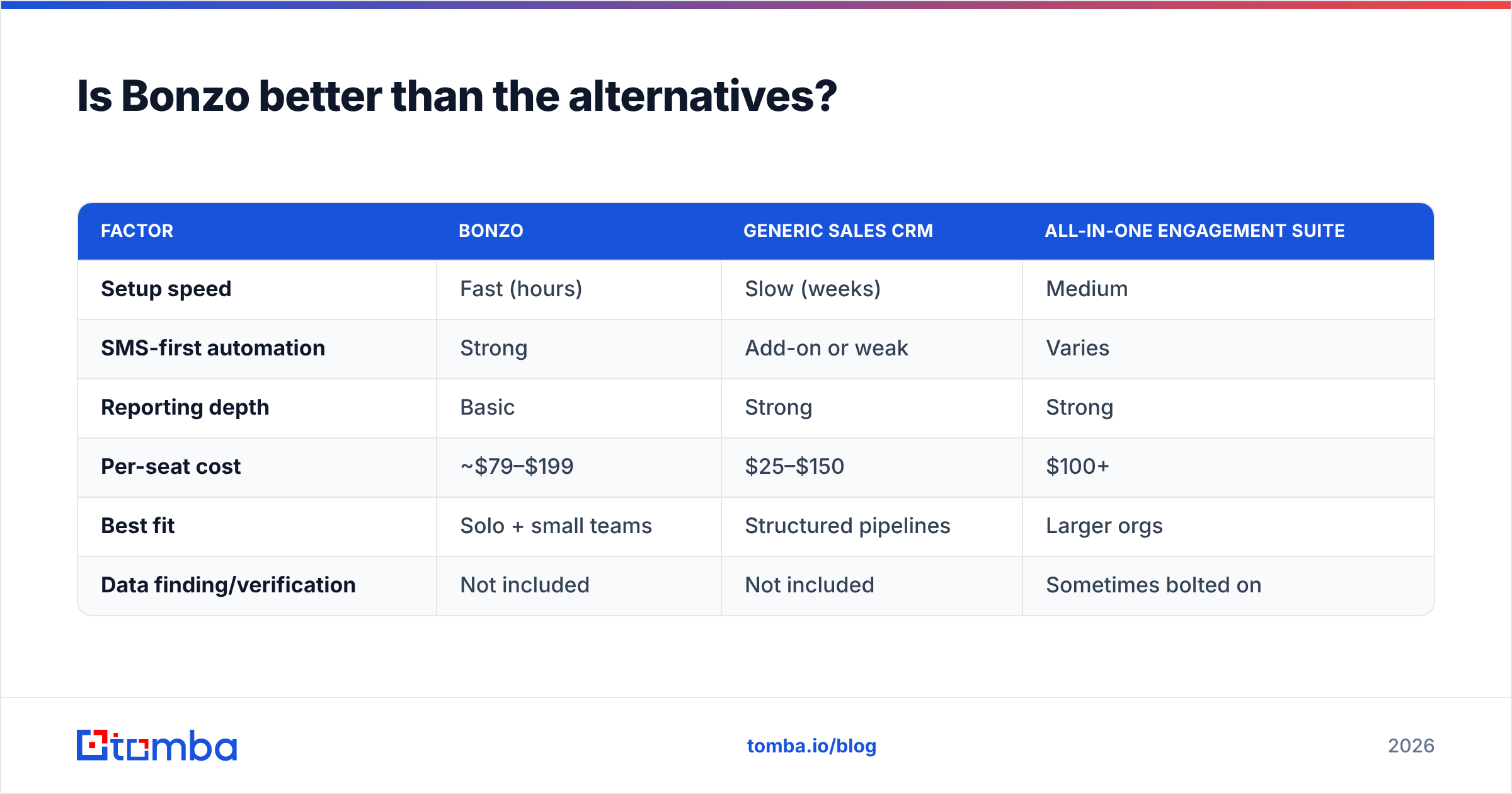
It depends on what you are optimizing for. Bonzo wins on simplicity and text-first follow-up; competitors win on analytics, scale, or all-in-one CRM depth. Here is an honest side-by-side.
| Factor | Bonzo | Generic sales CRM | All-in-one engagement suite |
|---|---|---|---|
| Setup speed | Fast (hours) | Slow (weeks) | Medium |
| SMS-first automation | Strong | Add-on or weak | Varies |
| Reporting depth | Basic | Strong | Strong |
| Per-seat cost | ~$79–$199 | $25–$150 | $100+ |
| Best fit | Solo + small teams | Structured pipelines | Larger orgs |
| Data finding/verification | Not included | Not included | Sometimes bolted on |
Notice the last row: almost none of these tools solve the data problem. Whichever engagement platform you choose, you still need a clean, verified contact source feeding it. That is a layer you add, not a box the CRM checks.
If you are weighing Bonzo against broader prospecting platforms, it also helps to understand what those tools actually do versus what Bonzo does—Bonzo nurtures contacts you already have, while prospecting tools help you discover them. They are complements, not substitutes.
Who is Bonzo best for?#
Buy Bonzo if you are:
- A solo loan officer, insurance agent, or realtor who wins on speed-to-lead and personal follow-up.
- A small team (2–15 reps) that wants shared inboxes and lead routing without standing up Salesforce.
- A relationship-driven seller who closes over text and call, not long email nurtures.
Look elsewhere if you are:
- An enterprise needing deep pipeline analytics, forecasting, and custom objects.
- A high-volume cold outbound shop where reporting and deliverability tooling are non-negotiable.
- A team that wants finding, verification, and outreach in a single bill—Bonzo intentionally stays in its lane.
Frequently asked questions#
Does Bonzo offer a free trial? Bonzo typically runs through a demo rather than a self-serve free trial. Pricing and trial availability are confirmed on a call, so reach out via getbonzo.com for current terms.
Is Bonzo a full CRM? It is a conversational CRM focused on follow-up and engagement. It handles contacts and pipelines lightly but is not built to replace an enterprise system of record.
Why are my Bonzo emails bouncing? Almost always because the list contains invalid or outdated addresses. Verify every contact before import and your bounce rate—and inbox placement—will improve immediately.
Can I use Bonzo with my existing tools? Yes—Bonzo connects via Zapier and native integrations to common CRMs and lead sources, so you can route new leads in automatically.
The smartest dollar you'll spend before buying Bonzo#
Bonzo is a strong follow-up engine for the teams it was built for—fast to launch, genuinely conversational, and well supported. But every honest review of its pricing, pros, and cons circles back to the same truth: the platform amplifies whatever data you give it. Feed it dead emails and you pay per seat to torch your sender reputation.
Before your contacts ever hit a Bonzo campaign, run them through the Tomba Email Finder to source accurate addresses and verify them clean. Start free with 25 searches a month, scale on a $49 plan when you are ready, and let Bonzo do what it does best—on a list that actually reaches real people.
// get started
Find, verify and enrich your first contacts today
Start on the free plan with 25 searches a month, then scale when your team is ready.
Free plan · No credit card required · GDPR & CCPA
// about the author