Book Like A Boss vs Calendly: Which Scheduler Wins in 2026?
A hands-on, no-fluff breakdown of Book Like A Boss vs Calendly: pricing, payments, branding, integrations, and which scheduling tool actually fits your sales motion in 2026.
Picking a scheduling tool sounds trivial until you realize the wrong one quietly costs you booked meetings, payment friction, and hours of back-and-forth email. Book Like A Boss and Calendly are two of the most common shortlisted options, but they solve the booking problem from opposite ends. This is a straight comparison so you can decide in one read.
TL;DR#
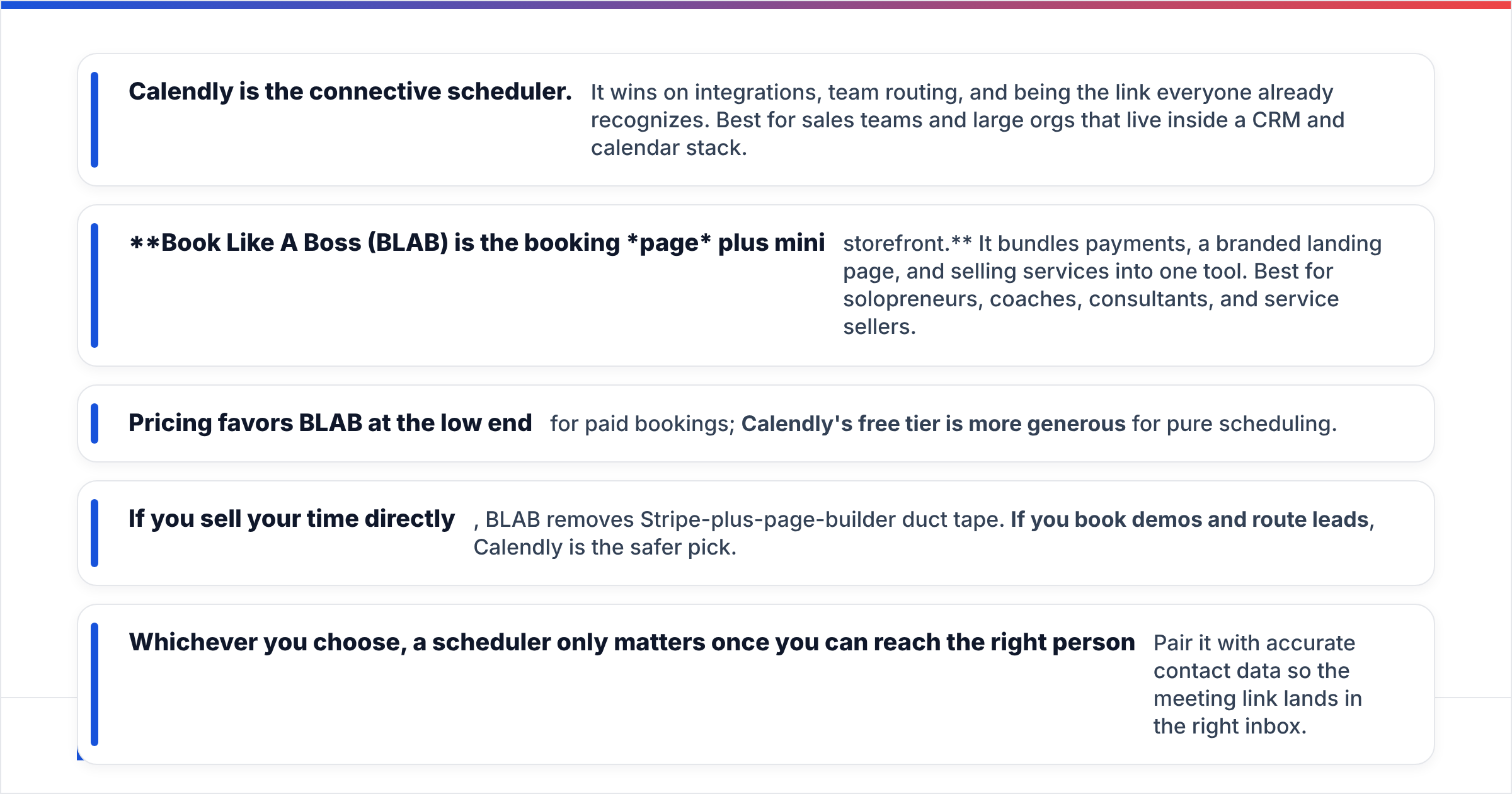
- Calendly is the connective scheduler. It wins on integrations, team routing, and being the link everyone already recognizes. Best for sales teams and large orgs that live inside a CRM and calendar stack.
- Book Like A Boss (BLAB) is the booking page plus mini-storefront. It bundles payments, a branded landing page, and selling services into one tool. Best for solopreneurs, coaches, consultants, and service sellers.
- Pricing favors BLAB at the low end for paid bookings; Calendly's free tier is more generous for pure scheduling.
- If you sell your time directly, BLAB removes Stripe-plus-page-builder duct tape. If you book demos and route leads, Calendly is the safer pick.
- Whichever you choose, a scheduler only matters once you can reach the right person. Pair it with accurate contact data so the meeting link lands in the right inbox.
What is Book Like A Boss?#
Book Like A Boss is an all-in-one booking platform built around a hosted, customizable booking page. Think of it less as a calendar widget and more as a one-page website that happens to take appointments and money. You get a branded page, service listings, testimonials, payment collection through Stripe, PayPal, and Square, plus the scheduling engine underneath.
The pitch is consolidation: instead of stitching together a page builder, a payments processor, and a scheduling app, you run all three from one dashboard. For a coach selling 60-minute sessions or a freelancer packaging consulting calls, that consolidation is the entire value.
)
What is Calendly?#
Calendly is the category-defining scheduling layer. Its job is to kill the "what time works for you?" email thread. You connect your calendar, define event types, share a link, and invitees pick an open slot. Done.
Where Calendly pulls ahead is depth on the team and integration side: round-robin and collective scheduling, meeting routing forms, CRM sync, and a long list of native integrations. It's the tool most B2B buyers have already clicked at least once, which lowers friction on the recipient's end. That ubiquity is a real, underrated advantage — nobody hesitates over a Calendly link.
Book Like A Boss vs Calendly: the core comparison#
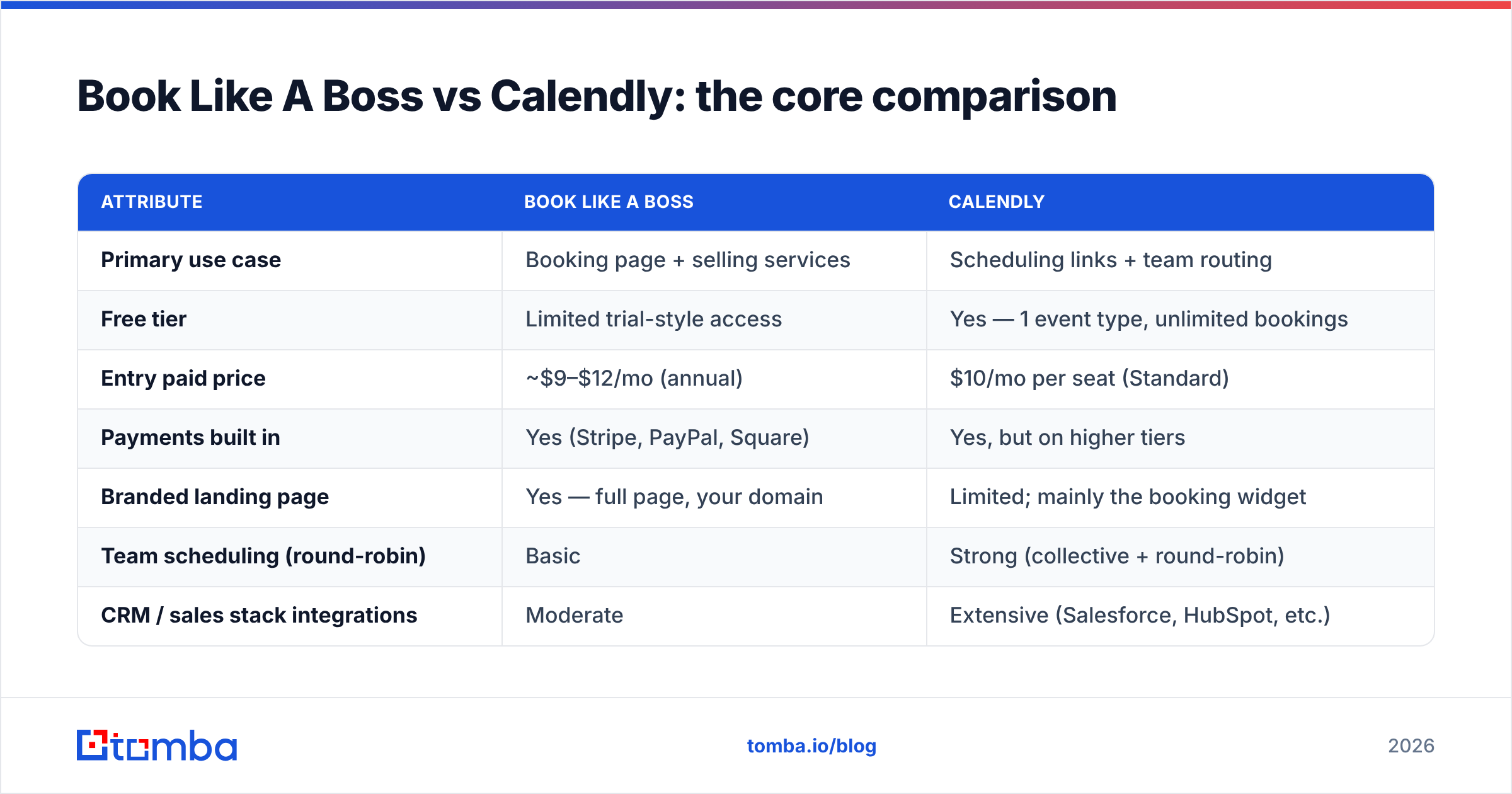
Here is the head-to-head on the attributes that actually change your decision.
| Attribute | Book Like A Boss | Calendly |
|---|---|---|
| Primary use case | Booking page + selling services | Scheduling links + team routing |
| Free tier | Limited trial-style access | Yes — 1 event type, unlimited bookings |
| Entry paid price | ~$9–$12/mo (annual) | $10/mo per seat (Standard) |
| Payments built in | Yes (Stripe, PayPal, Square) | Yes, but on higher tiers |
| Branded landing page | Yes — full page, your domain | Limited; mainly the booking widget |
| Team scheduling (round-robin) | Basic | Strong (collective + round-robin) |
| CRM / sales stack integrations | Moderate | Extensive (Salesforce, HubSpot, etc.) |
| Best for | Coaches, consultants, service sellers | Sales teams, recruiters, large orgs |
A few honest caveats: exact prices shift with promotions and annual-vs-monthly billing, so confirm current numbers on each vendor's pricing page before you commit. Calendly's payment collection and tighter integrations sit on its paid tiers, while BLAB front-loads payments even on its cheaper plans.
Which one fits your workflow? A 5-point decision guide#
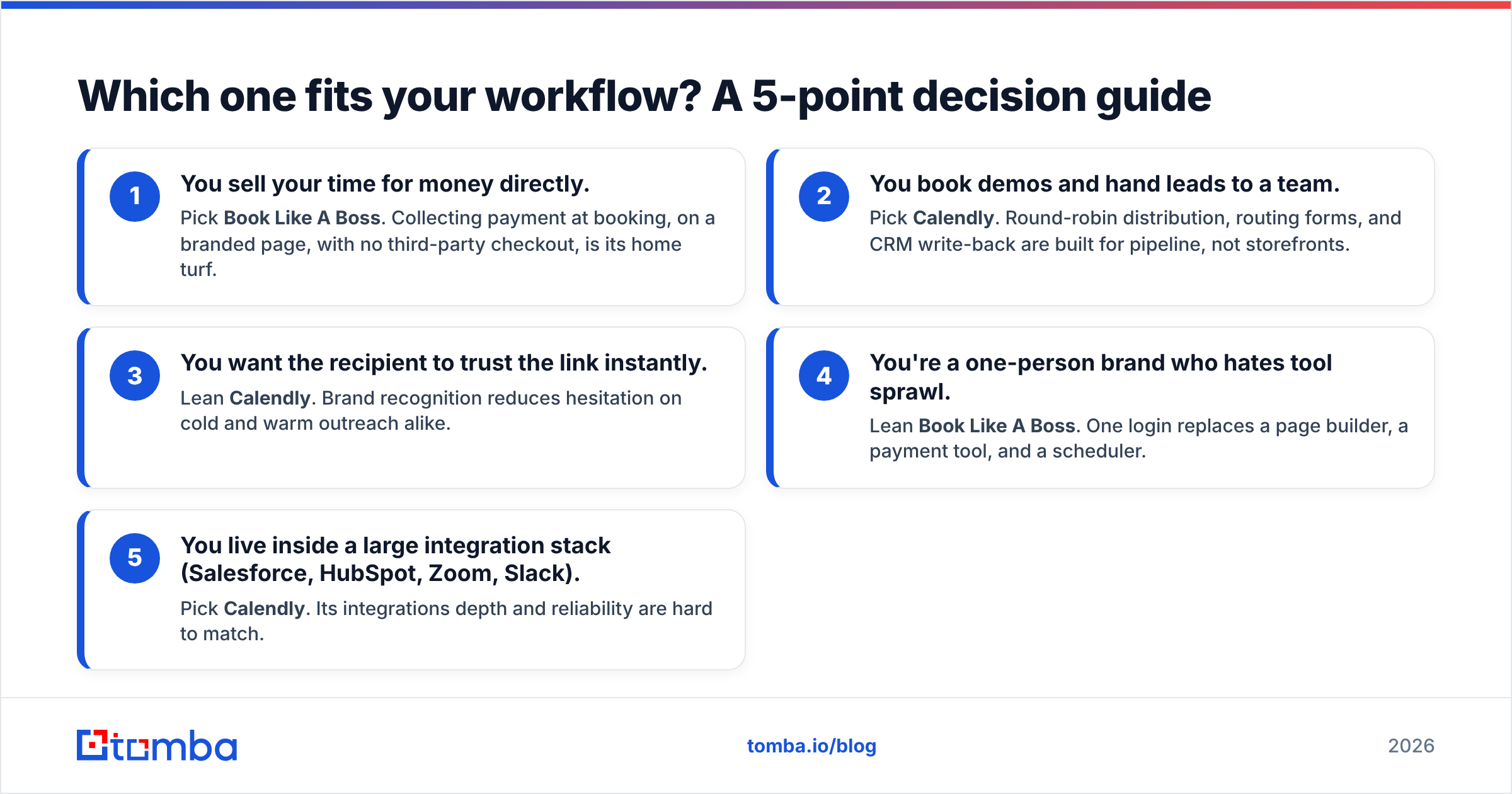
Rather than a generic "it depends," match the tool to how you actually book.
- You sell your time for money directly. Pick Book Like A Boss. Collecting payment at booking, on a branded page, with no third-party checkout, is its home turf.
- You book demos and hand leads to a team. Pick Calendly. Round-robin distribution, routing forms, and CRM write-back are built for pipeline, not storefronts.
- You want the recipient to trust the link instantly. Lean Calendly. Brand recognition reduces hesitation on cold and warm outreach alike.
- You're a one-person brand who hates tool sprawl. Lean Book Like A Boss. One login replaces a page builder, a payment tool, and a scheduler.
- You live inside a large integration stack (Salesforce, HubSpot, Zoom, Slack). Pick Calendly. Its integrations depth and reliability are hard to match.
Is Book Like A Boss better than Calendly?#
Neither is universally "better" — they optimize for different buyers. Book Like A Boss is better when the booking is a transaction: you're selling a session, a class, or a packaged service, and you want payment, branding, and scheduling in one place. Calendly is better when the booking is a step in a process: qualifying a lead, routing to the right rep, syncing to a CRM, and keeping a shared team calendar clean.
A simple gut check: if you'd otherwise need a separate landing page and a Stripe checkout, BLAB collapses that into one product. If you'd otherwise need to manually assign meetings across a team and log them in your CRM, Calendly does that natively.
How do pricing and payments compare?#
Pricing is where the two diverge most, because they're priced for different problems.
- Calendly's free plan is genuinely usable for an individual: unlimited one-on-one bookings on a single event type. That makes it the default for anyone who just needs a link and nothing else.
- Book Like A Boss is built to monetize from the start. Its paid plans are inexpensive and include payment collection, so a consultant can charge for a call on day one without bolting on extra software.
- For teams, Calendly scales per seat with routing and admin controls that justify the cost in a sales org. BLAB's team features exist but are lighter.
When you factor in the "hidden" cost of extra tools, BLAB often wins for solo service sellers, while Calendly wins on total cost for teams that need routing and integrations more than payments.
)
What about integrations and the wider sales stack?#
This is Calendly's clearest edge. It plugs into the tools B2B teams already run — calendars, video conferencing, CRMs, marketing automation, and workflow tools like Zapier. If your goal is to make a booked meeting automatically create a CRM record, fire a Slack alert, and queue a follow-up sequence, Calendly's ecosystem gets you there with less glue code.
Book Like A Boss covers the essentials — calendar sync, Zoom/Google Meet, Zapier, and payment processors — which is plenty for a solo operator. It just isn't trying to be the connective tissue of a 50-person revenue team.
Either way, scheduling is only the last mile. The meeting link is worthless if it never reaches a real, reachable decision-maker. That's why teams treating booking as part of sales automation pair their scheduler with a reliable source of verified contacts. A clean booking flow with a high response rate starts with reaching the right person, not just owning the slickest calendar.
Where does contact data fit into all this?#
Schedulers assume you already know who to invite. In real outbound, that's the hard part. You can have the most elegant Calendly routing or the prettiest BLAB page and still stall because you're emailing info@ addresses or guessing at formats.
This is the gap a email finder closes. Before the booking link ever goes out, you confirm the prospect's real, deliverable email — so your meeting invite lands in a monitored inbox instead of a catch-all void. The workflow is simple:
- Find the verified email for the exact person you want to meet.
- Send your outreach with the scheduling link embedded.
- Book via Calendly or BLAB once they click.
Skip step one and the fanciest scheduler in the world books you zero meetings.
Pros and cons at a glance#
Book Like A Boss
- Pros: payments built in early, full branded page, great for selling services, low solo pricing, less tool sprawl.
- Cons: lighter team/routing features, smaller integration catalog, less recipient brand recognition.
Calendly
- Pros: best-in-class routing and team scheduling, huge integration ecosystem, instantly recognized link, strong free tier.
- Cons: payments and advanced features gated to paid tiers, per-seat cost adds up, less of a "storefront."
Common questions#
Can I use both? Yes, and some people do — Calendly for sales/demo routing, BLAB for paid service bookings. It's redundant for most, but valid if the two jobs are genuinely separate.
Which has better no-show prevention? Both offer automated reminders. Reminder cadence quality matters more than the brand; configure SMS/email reminders on whichever you pick.
Is Calendly overkill for a solo coach? Often, yes — unless you specifically need its integrations. A solo coach selling sessions is BLAB's ideal user.
Does either improve deliverability of my outreach? No. Schedulers don't help your email reach the inbox. That's determined by your sender reputation and, upstream, by emailing verified addresses.
The verdict#
Choose Book Like A Boss if you sell your time and want booking, branding, and payments in one tool. Choose Calendly if you book demos, route leads across a team, and live inside a CRM stack. The decision is less "which is better" and more "which problem are you actually solving."
But both tools share one blind spot: they start after you know who to contact. The real bottleneck in booking more meetings is finding and verifying the right people to invite. That's where Tomba's Email Finder earns its place in your stack — surface verified, deliverable emails by name, domain, or company, then let your scheduler do the easy part. Start free with 25 searches a month, scale on the Starter plan at $49/mo, and stop sending great booking links to inboxes nobody reads.
Compare current details directly on the vendors' own sites: Calendly, Book Like A Boss, and verified user reviews on G2.
// get started
Find, verify and enrich your first contacts today
Start on the free plan with 25 searches a month, then scale when your team is ready.
Free plan · No credit card required · GDPR & CCPA
// about the author