How to Book More Demos With AI in 2026: The SDR Playbook
AI won't book demos for you by accident. Here's the exact stack and workflow top SDR teams use to book more demos with AI in 2026 — without spamming.
You can book more demos with AI in 2026 — but only if you fix the data and targeting first. AI writes faster than any human, yet a perfect message sent to the wrong inbox still books zero meetings. This guide shows the exact stack and workflow that turns AI from a novelty into a reliable demo machine.
TL;DR#
- AI multiplies your inputs, good or bad. Clean data and tight targeting come first; copy generation comes last.
- The winning workflow is four layers: verified contact data → AI research → AI-personalized outreach → AI follow-up and routing.
- Personalization at scale is the real unlock — AI can reference a prospect's role, company, and trigger event in seconds.
- Deliverability is non-negotiable. The best AI copy lands in spam if your sender setup is broken.
- Start with accurate emails. Tools like the Tomba Email Finder feed the rest of the funnel.
Why does AI alone not book more demos?#
AI does not book demos. Targeted, verified, well-timed outreach books demos — and AI makes that outreach faster to produce. The distinction matters because most teams bolt an AI writer onto a broken process and wonder why reply rates drop.
Think of AI like a high-powered espresso machine. Give it stale beans and dirty water, and you get fast, consistent, terrible coffee. Give it fresh inputs, and it scales quality. Your "beans" are your contact data and your targeting. If the email is wrong, the prospect never reads your perfectly crafted line. If the persona is wrong, no amount of clever phrasing earns a meeting.
So the goal isn't "use more AI." It's "use AI to remove the manual bottlenecks that throttle good outreach" — research, list building, first-draft copy, and follow-up sequencing.
What does the AI demo-booking stack look like in 2026?#
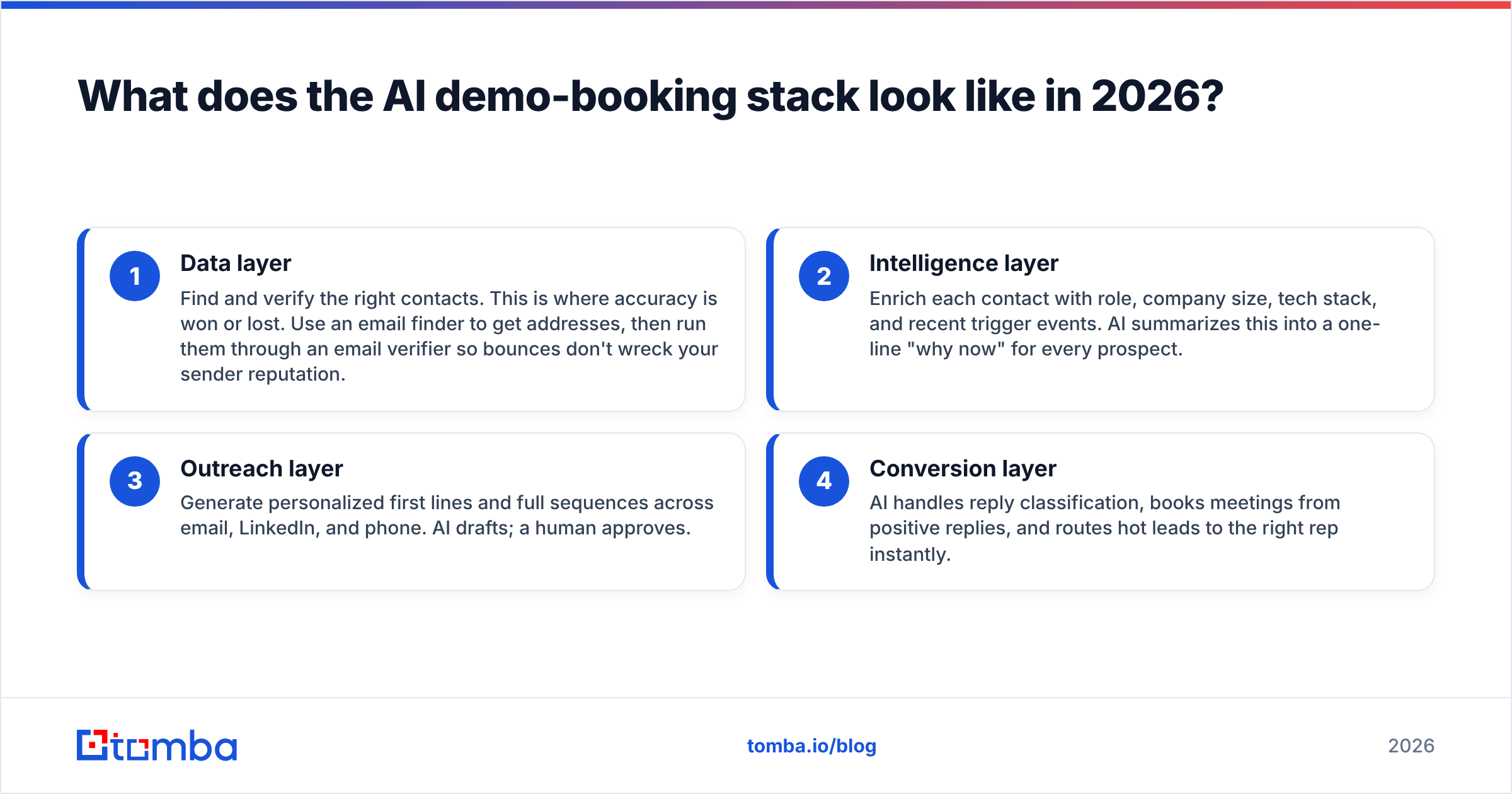
A modern demo-booking engine has four layers. Each one feeds the next, and AI sits inside each layer rather than replacing it.
- Data layer — Find and verify the right contacts. This is where accuracy is won or lost. Use an email finder to get addresses, then run them through an email verifier so bounces don't wreck your sender reputation.
- Intelligence layer — Enrich each contact with role, company size, tech stack, and recent trigger events. AI summarizes this into a one-line "why now" for every prospect.
- Outreach layer — Generate personalized first lines and full sequences across email, LinkedIn, and phone. AI drafts; a human approves.
- Conversion layer — AI handles reply classification, books meetings from positive replies, and routes hot leads to the right rep instantly.
The mistake teams make is buying one all-in-one tool and assuming it covers all four layers well. In practice, the data layer is the weakest link in most "AI SDR" platforms — they generate beautiful copy on top of guessed email addresses. That's why pairing a dedicated data source with your AI outreach tool consistently outperforms a single bundled product.
How do you build a high-intent list with AI?#
Start narrow, then let AI widen efficiently. A list of 200 perfectly matched prospects beats 5,000 vague ones every time, because reply rate — not volume — drives booked demos.
Here's the practical sequence:
- Define the trigger. New funding, a recent hire in a relevant role, a tech-stack change, or expansion into a new market. Triggers give AI a reason to reach out now.
- Find the companies that match. Use a B2B database or domain-based search to pull companies fitting your ICP.
- Find the people. Run domain search to surface decision-makers and their email patterns at each target account.
- Verify before you send. Push every address through verification. Catch-all domains need special handling — a catch-all verifier tells you which "valid" addresses are actually safe.
- Enrich for context. Layer on data enrichment so AI has titles, seniority, and company details to personalize against.
This is the part teams skip — and it's the part AI cannot fake. A language model will happily write a confident email to john@company.com that doesn't exist. Verified data is the foundation every other AI step stands on.
Which AI approach books more demos: spray-and-pray or precision?#
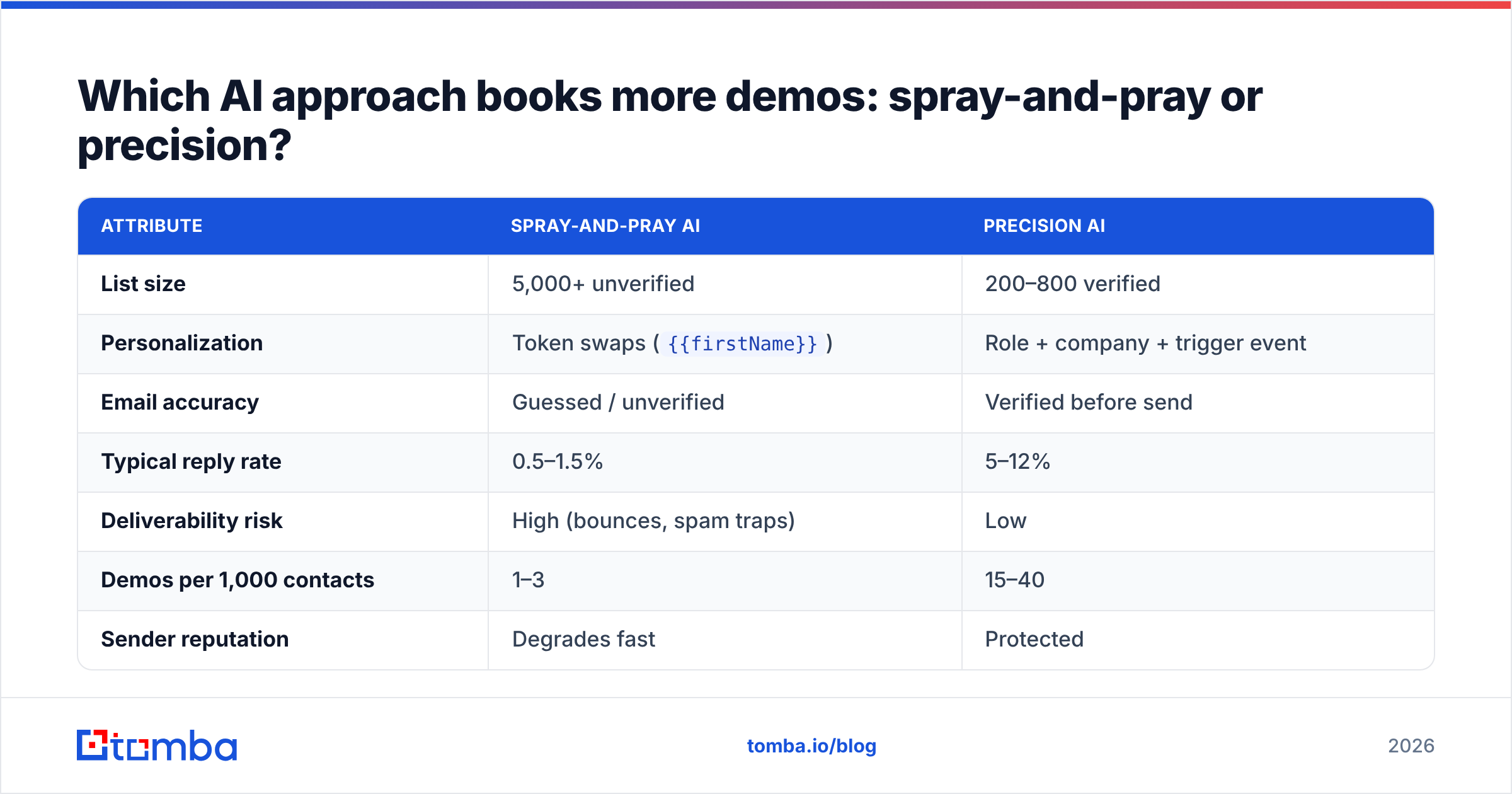
Precision wins, and it isn't close. The table below compares the two dominant approaches teams take with AI outreach in 2026.
| Attribute | Spray-and-Pray AI | Precision AI |
|---|---|---|
| List size | 5,000+ unverified | 200–800 verified |
| Personalization | Token swaps ({{firstName}}) |
Role + company + trigger event |
| Email accuracy | Guessed / unverified | Verified before send |
| Typical reply rate | 0.5–1.5% | 5–12% |
| Deliverability risk | High (bounces, spam traps) | Low |
| Demos per 1,000 contacts | 1–3 | 15–40 |
| Sender reputation | Degrades fast | Protected |
The math is brutal for spray-and-pray. Sending ten times more email feels productive, but a 1% reply rate on bad data books fewer meetings than a 10% reply rate on a clean list — and the bad-data approach burns your domain in the process. AI makes precision cheap for the first time, because the research and writing that used to make precision slow are now automated.
How does AI personalize outreach without sounding robotic?#
The trick is to feed AI specific facts and constrain its output. Generic AI copy sounds robotic because it's prompted with nothing specific — "write a cold email about our CRM." Give the model real inputs and tight rules, and the output reads human.
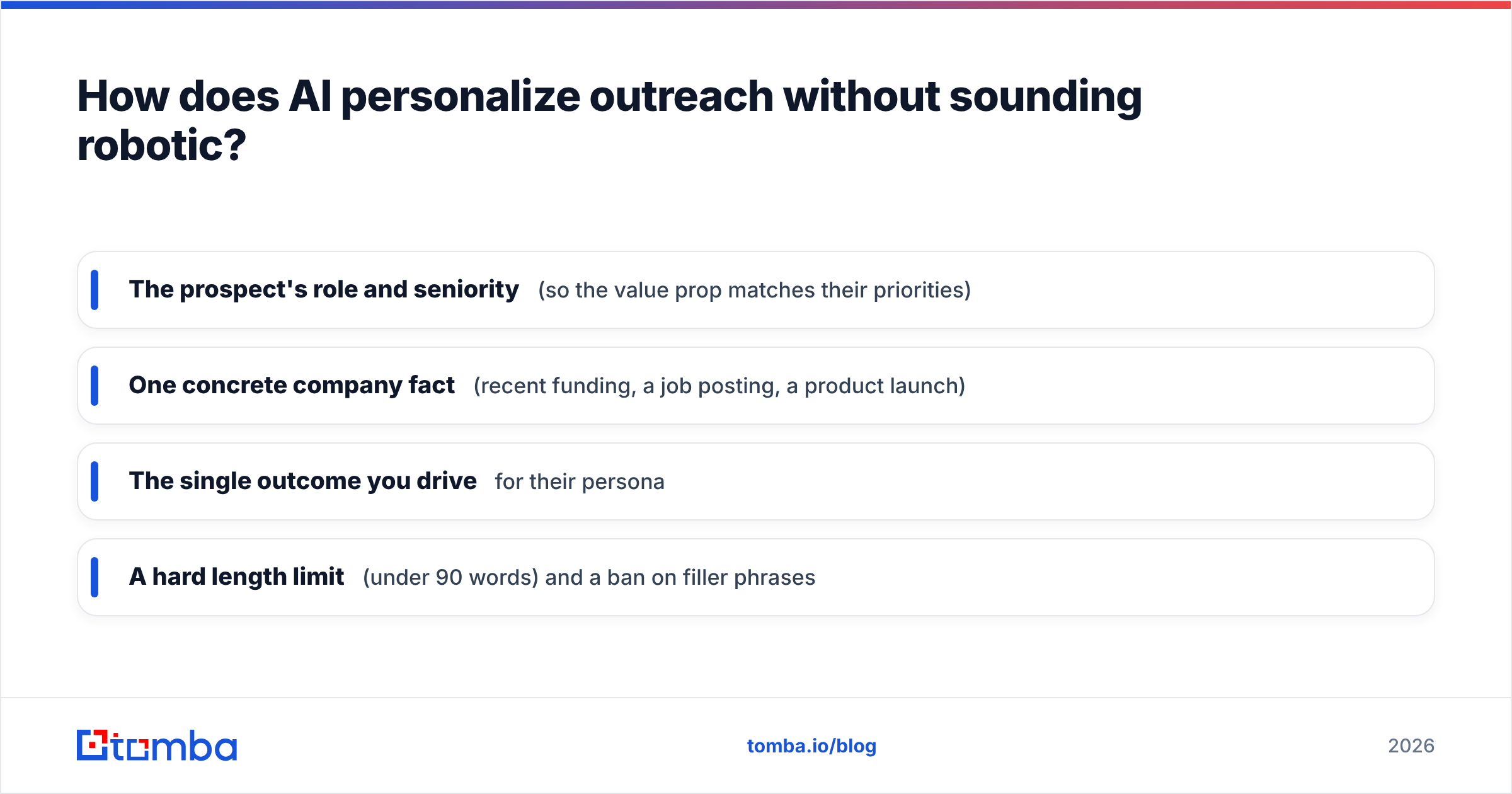
A strong personalization prompt includes:
- The prospect's role and seniority (so the value prop matches their priorities)
- One concrete company fact (recent funding, a job posting, a product launch)
- The single outcome you drive for their persona
- A hard length limit (under 90 words) and a ban on filler phrases
The result is a first line that references something real — "Saw you're hiring three AEs this quarter" — followed by a relevant, short pitch. Tools like Tomba's cold email AI writer and a subject line generator handle the drafting so reps spend their time approving and tweaking, not staring at a blank screen.
One rule that separates good teams from great ones: AI drafts, humans approve. Batch-generate 50 personalized openers, then have an SDR spend 15 minutes culling the weak ones. You get the speed of AI with the judgment of a human, and you never send a hallucinated claim to a prospect.

Does deliverability still matter when AI writes the email?#
Deliverability matters more with AI, not less, because AI lets you send more volume — and volume is exactly what trips spam filters. The best-written email in the world books zero demos if it lands in the junk folder.
Protect your sending with the fundamentals before you scale:
- Authenticate your domain. Set up SPF, DKIM, and DMARC. Check your SPF record and confirm your sender reputation is clean.
- Warm up new domains and inboxes gradually rather than blasting day one.
- Keep bounce rates under 2%. This is why verification is mandatory, not optional.
- Monitor blacklists and pull back the moment your reputation dips.
Google and Yahoo tightened bulk-sender requirements significantly, and those rules keep getting stricter. The HubSpot guide to email deliverability is a solid primer on staying compliant. The point is simple: AI can write a thousand emails an hour, but your infrastructure decides whether they're ever seen.
What does an end-to-end AI demo-booking workflow look like?#
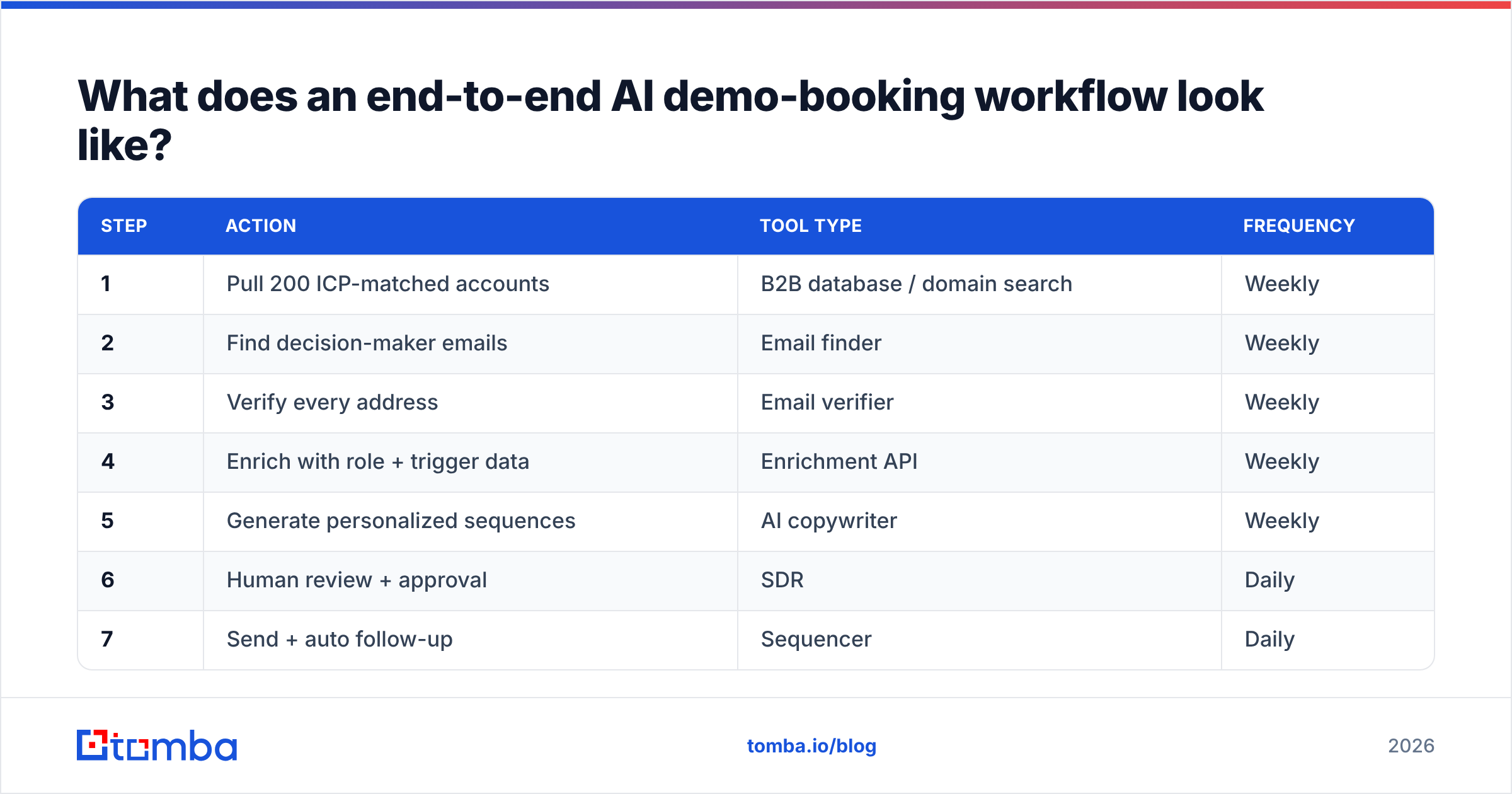
Here's a repeatable weekly workflow that combines all four layers. Treat it as a template and adjust volumes to your domain's health.
| Step | Action | Tool type | Frequency |
|---|---|---|---|
| 1 | Pull 200 ICP-matched accounts | B2B database / domain search | Weekly |
| 2 | Find decision-maker emails | Email finder | Weekly |
| 3 | Verify every address | Email verifier | Weekly |
| 4 | Enrich with role + trigger data | Enrichment API | Weekly |
| 5 | Generate personalized sequences | AI copywriter | Weekly |
| 6 | Human review + approval | SDR | Daily |
| 7 | Send + auto follow-up | Sequencer | Daily |
| 8 | AI classifies replies, books demos | AI inbox assistant | Daily |
Notice that AI touches steps 4, 5, and 8 heavily, assists in steps 1–3, and a human still owns step 6. That balance — automate the grind, keep judgment human — is what separates teams that book more demos from teams that just send more email and get flagged as spam.
For teams that want to run this programmatically, the Tomba API lets you wire finding, verifying, and enrichment directly into your sequencer or CRM, so the entire data layer runs without manual exports.
How do you measure whether AI is actually working?#
Track demos booked per 1,000 contacts, not vanity metrics. Open rates and "AI emails sent" tell you nothing about pipeline. Watch these instead:
- Reply rate (positive + neutral) — your copy and targeting signal
- Bounce rate — your data quality signal; should stay under 2%
- Positive reply → demo booked rate — your conversion-layer signal
- Demos per 1,000 verified contacts — the north-star efficiency metric
- Spam complaint rate — keep it under 0.1% or pull back immediately
If reply rates are healthy but demos aren't booking, the gap is in your conversion layer — slow follow-up or weak qualification. If bounce rates are high, go back to the data layer. The beauty of the four-layer model is that your metrics tell you exactly which layer to fix. Industry review sites like G2's sales engagement category are useful for benchmarking tools against these same metrics before you buy.
What are the common mistakes when using AI to book demos?#
Most failures trace back to the same handful of errors:
- Skipping verification. Sending to unverified emails tanks deliverability and wastes AI-generated copy on dead inboxes.
- Over-automating the reply. Auto-sending AI responses to interested prospects feels efficient and reads as cold. Have a human handle hot replies.
- Token-swap "personalization."
Hi {{firstName}}is not personalization. Reference something real or don't bother. - Ignoring sending limits. AI volume + new domain = spam folder. Warm up and ramp slowly.
- No human in the loop. AI hallucinates claims and stats. Every batch needs a human gate before it sends.
Avoid these five and you're ahead of most teams already experimenting with AI outreach.
The bottom line#
AI is the best thing to happen to demo booking in a decade — but only when it sits on top of accurate data and tight targeting. The teams winning in 2026 don't send more email; they send better email to verified people at the right moment, and they let AI handle the heavy lifting in between.
Start where the leverage is highest: your data. If your contacts are wrong, everything downstream fails, no matter how good your AI copy is. The Tomba Email Finder gives you accurate, verified professional emails by name, company, or domain — the clean foundation your AI outreach needs to actually book meetings. Pair it with verification and enrichment, plug it into your sequencer, and let AI do what it does best on top of data you can trust. Check the Tomba plans — including a free tier with 25 searches a month — and build your demo-booking engine on solid ground.
Ready to find emails that actually work?
Join 150,000+ professionals who stopped guessing and started sending. Free credits on signup — no credit card required.
Get the Tomba newsletter
Practical outbound tactics and product updates — once every two weeks.
About the author