BookYourData Pros and Cons: A 2026 Honest Review
A neutral 2026 breakdown of BookYourData's pros and cons — pricing, data accuracy, the 95% guarantee, and where a real-time email finder beats a static list.
BookYourData Pros and Cons: A 2026 Honest Review
BookYourData sells prebuilt, downloadable B2B contact lists with a headline 95% accuracy guarantee. That model is fast and predictable, but it also carries real trade-offs around data freshness, credit economics, and how well a one-time download fits a modern outbound motion. This review walks through both sides so you can decide whether a static list provider or a real-time email finder is the better fit for your team in 2026.
TL;DR#
- Best for: marketers and SDRs who want to build and download a targeted list in minutes, pay per record, and accept a one-time snapshot of data.
- Biggest pro: a transparent pay-as-you-go model plus a 95% accuracy guarantee that re-credits bad records.
- Biggest con: lists are static snapshots — emails decay roughly 22–30% per year, so a download you bought in Q1 is meaningfully stale by Q4.
- Watch the credits: revealing a contact spends a credit whether or not you ever email them, which can get expensive at scale.
- Strong alternative: a real-time tool like the Tomba Email Finder verifies on demand, so you pull fresh addresses at the moment of outreach instead of from a frozen file.
What is BookYourData and how does it work?#
BookYourData is a self-serve B2B contact database. You filter by job title, industry, location, company size, and a handful of technographic fields, see a live count of matching records, then buy and download those contacts as a CSV or push them into your CRM. You can read the full product details on the official bookyourdata.com site.
The core promise is speed and predictability. Instead of running individual lookups, you assemble a list, pay per record, and walk away with a file. The company backs its data with a 95% accuracy guarantee — if more than 5% of a list bounces or is invalid, you get credits back.
That's a fundamentally different model from an email finder, which resolves and verifies a specific person's address at the moment you ask. One sells you a frozen snapshot; the other queries live. Both are legitimate — they just suit different workflows, and the distinction drives almost every pro and con below.

What are the main pros of BookYourData?#
Here are the strengths that show up consistently in user reviews on platforms like G2:
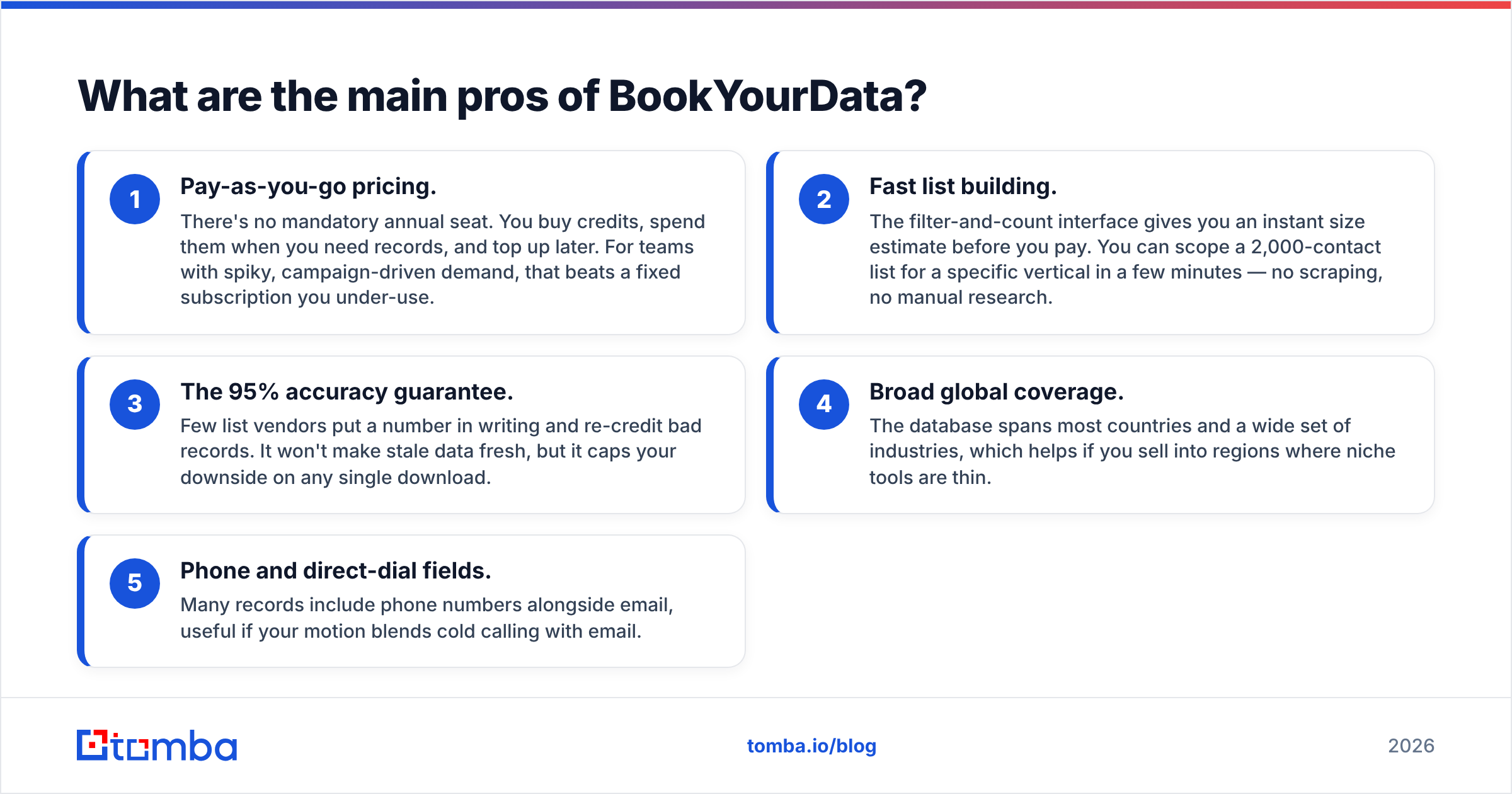
- Pay-as-you-go pricing. There's no mandatory annual seat. You buy credits, spend them when you need records, and top up later. For teams with spiky, campaign-driven demand, that beats a fixed subscription you under-use.
- Fast list building. The filter-and-count interface gives you an instant size estimate before you pay. You can scope a 2,000-contact list for a specific vertical in a few minutes — no scraping, no manual research.
- The 95% accuracy guarantee. Few list vendors put a number in writing and re-credit bad records. It won't make stale data fresh, but it caps your downside on any single download.
- Broad global coverage. The database spans most countries and a wide set of industries, which helps if you sell into regions where niche tools are thin.
- Phone and direct-dial fields. Many records include phone numbers alongside email, useful if your motion blends cold calling with email.
For a marketer who needs a defined list today and is comfortable treating it as a perishable asset, these are genuine advantages.
What are the cons of BookYourData?#
The trade-offs are mostly structural — they come from the static-list model itself:
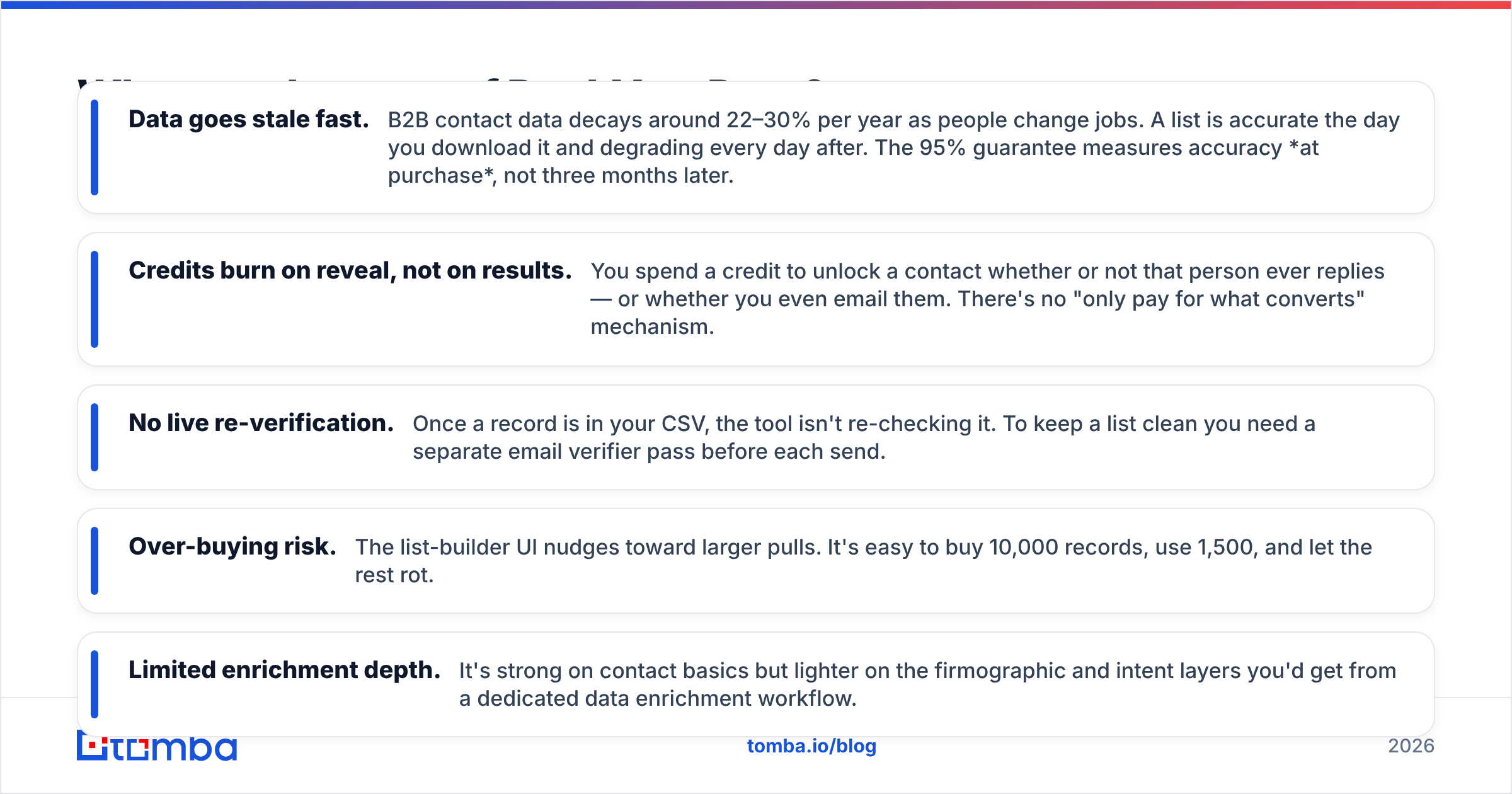
- Data goes stale fast. B2B contact data decays around 22–30% per year as people change jobs. A list is accurate the day you download it and degrading every day after. The 95% guarantee measures accuracy at purchase, not three months later.
- Credits burn on reveal, not on results. You spend a credit to unlock a contact whether or not that person ever replies — or whether you even email them. There's no "only pay for what converts" mechanism.
- No live re-verification. Once a record is in your CSV, the tool isn't re-checking it. To keep a list clean you need a separate email verifier pass before each send.
- Over-buying risk. The list-builder UI nudges toward larger pulls. It's easy to buy 10,000 records, use 1,500, and let the rest rot.
- Limited enrichment depth. It's strong on contact basics but lighter on the firmographic and intent layers you'd get from a dedicated data enrichment workflow.

How accurate is BookYourData's data?#
The honest answer: accurate at the moment of download, then decaying. A 95% guarantee on a fresh pull is competitive, but accuracy guarantees and durable accuracy are two different things. Any static list is a photograph, and people in your photograph keep changing jobs after the shutter clicks.
This is the single most important thing to understand before you buy. If your sales cycle is short and you email the list within days, decay barely matters. If you're slowly working a list over a quarter, expect a meaningful share to bounce by the end — regardless of the headline guarantee. That's exactly the gap real-time verification closes: a finder confirms the address the day you reach out, not the day a vendor compiled a file.

If you want to understand where contact data comes from and how providers source it, Tomba documents its data sources publicly — a useful benchmark for evaluating any vendor's accuracy claims.
BookYourData vs Tomba: which model fits your workflow?#
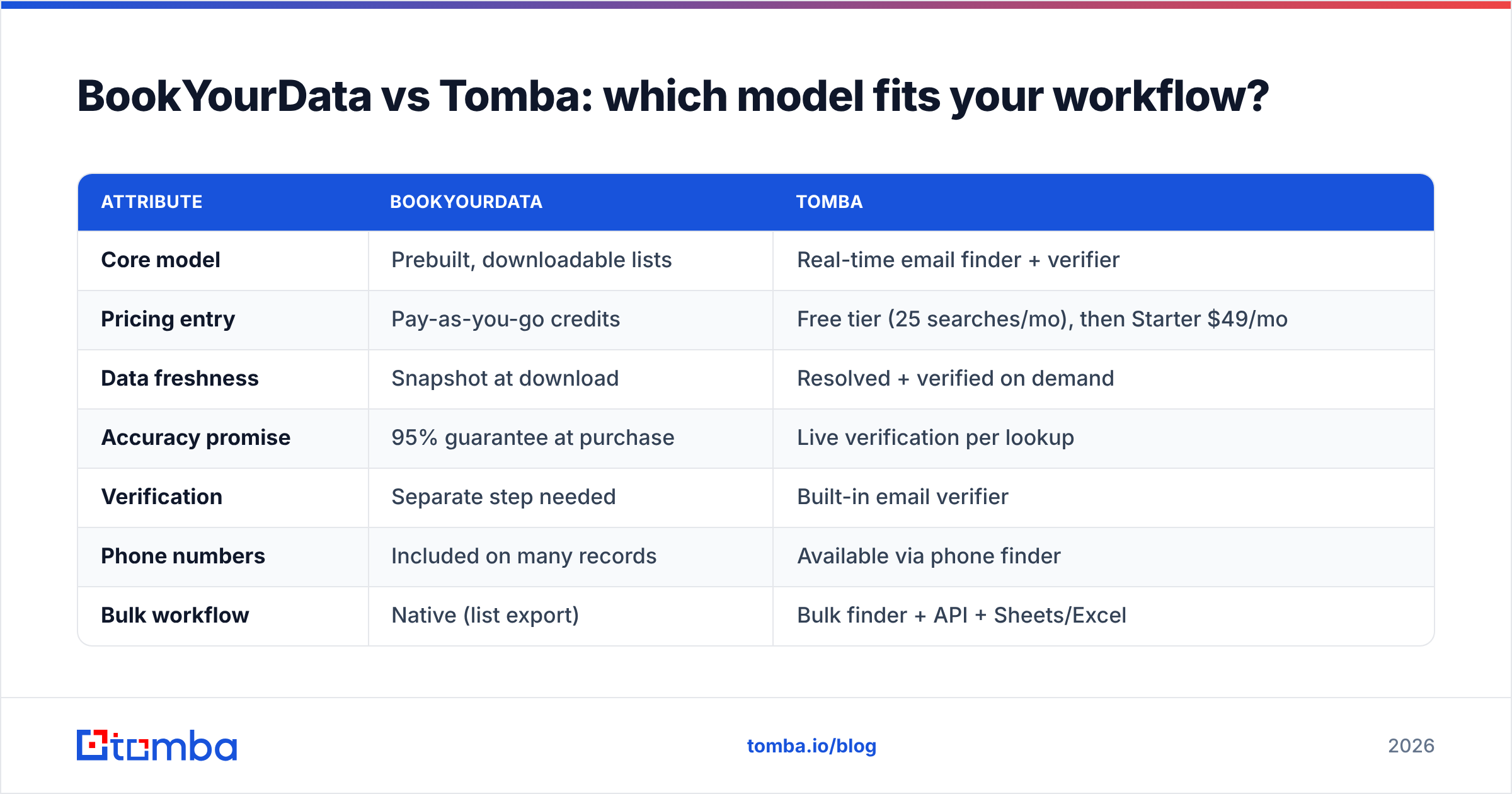
The real decision isn't "which brand" — it's "static list or real-time finder." Here's a side-by-side of how the approaches differ.
| Attribute | BookYourData | Tomba |
|---|---|---|
| Core model | Prebuilt, downloadable lists | Real-time email finder + verifier |
| Pricing entry | Pay-as-you-go credits | Free tier (25 searches/mo), then Starter $49/mo |
| Data freshness | Snapshot at download | Resolved + verified on demand |
| Accuracy promise | 95% guarantee at purchase | Live verification per lookup |
| Verification | Separate step needed | Built-in email verifier |
| Phone numbers | Included on many records | Available via phone finder |
| Bulk workflow | Native (list export) | Bulk finder + API + Sheets/Excel |
| Best for | One-time targeted list pulls | Ongoing, always-fresh outreach |
A quick way to choose:
- Pick a static list provider when you need a defined audience once, plan to email it immediately, and want to pay per record with no subscription.
- Pick a real-time finder when you prospect continuously, care about bounce rates over a long cycle, or want verification baked into the same step as discovery.
- Use both if you buy a base list and then re-verify and enrich it on an ongoing basis — many teams treat the list as a seed and keep it fresh with a finder.

How much does BookYourData cost compared to alternatives?#
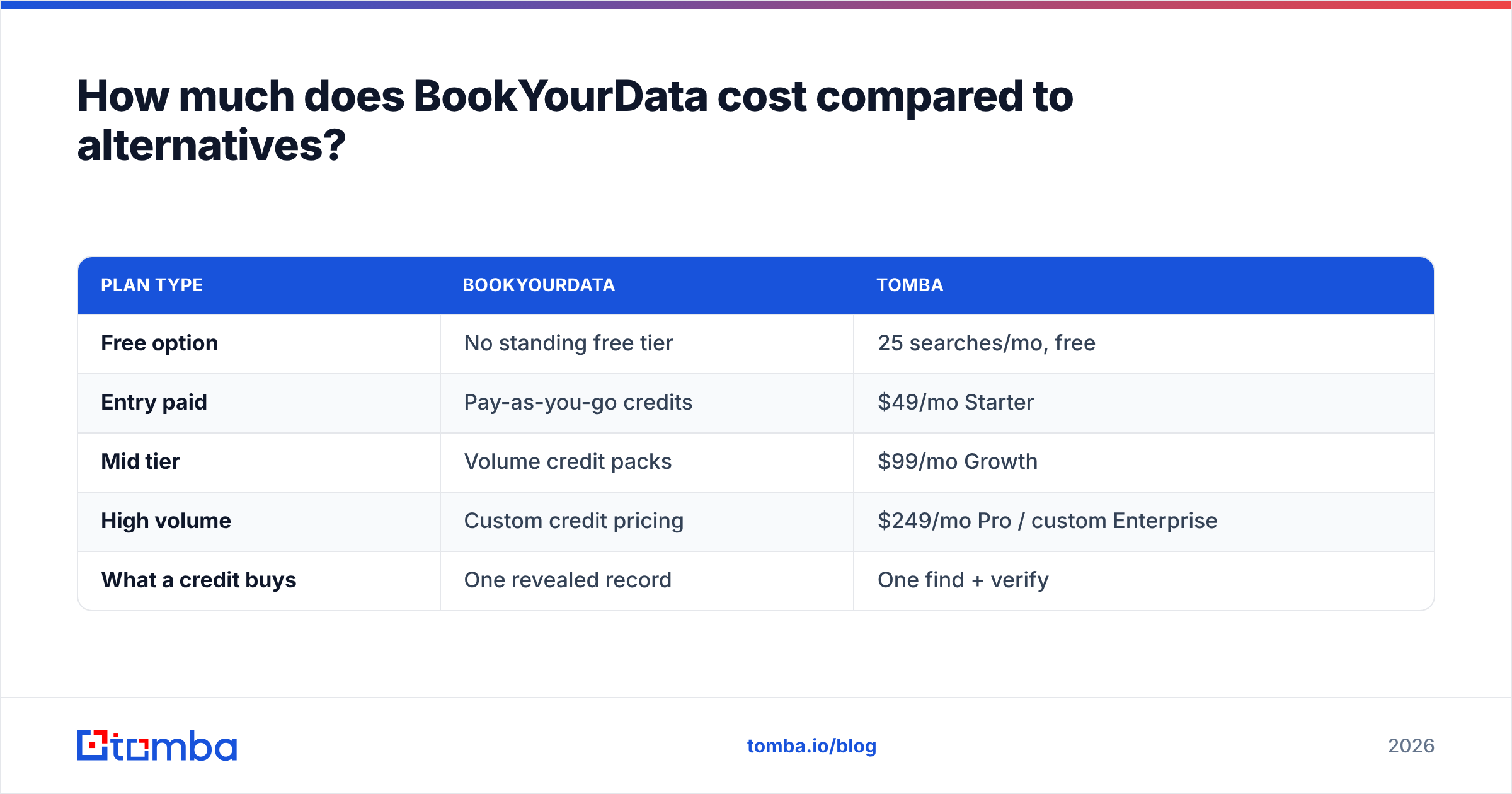
BookYourData uses a credit model: you buy a balance and spend it per revealed contact, with volume discounts as you scale. There's no fixed monthly floor, which is friendly for occasional buyers but harder to forecast for high-volume teams — your cost scales linearly with every reveal, used or not.
Subscription-based finders price differently. Tomba, for example, runs a free tier with 25 searches per month, then Starter at $49/mo, Growth at $99/mo, and Pro at $249/mo, with searches that pair finding and verification in one credit. The mental model is different: you're paying for capacity to find fresh, verified contacts on demand rather than for a frozen file.
| Plan type | BookYourData | Tomba |
|---|---|---|
| Free option | No standing free tier | 25 searches/mo, free |
| Entry paid | Pay-as-you-go credits | $49/mo Starter |
| Mid tier | Volume credit packs | $99/mo Growth |
| High volume | Custom credit pricing | $249/mo Pro / custom Enterprise |
| What a credit buys | One revealed record | One find + verify |
The cheaper option depends entirely on usage shape. Spiky, one-off list needs favor pay-as-you-go. Steady, ongoing prospecting usually favors a subscription where verification is included and you're not paying to reveal contacts you never touch.
Who should use BookYourData — and who shouldn't?#
Good fit: demand-gen marketers running periodic campaigns, agencies assembling client lists, and teams entering a new region who need broad coverage fast. If you'll download a list and act on it within a week, the decay problem mostly disappears and the speed is a real win.
Poor fit: SDR teams running continuous outbound, anyone with a long sales cycle, and ops teams that need data to stay clean inside a CRM month after month. For those workflows, a static list becomes a liability the moment it lands, and you'll end up bolting on verification anyway. In that case, starting with a real-time finder and a connected B2B database is the simpler architecture.
It's also worth checking your data-compliance posture regardless of vendor. Industry analysts like Gartner consistently flag data hygiene and consent as the top risks in B2B prospecting — and stale lists amplify both.
Frequently asked questions#
Is BookYourData accurate? At the moment of download, its 95% guarantee is competitive. The caveat is decay: accuracy erodes by roughly a quarter per year as contacts change roles, and the guarantee measures the day you bought the list, not the day you email it.
Does BookYourData verify emails in real time? No. It sells snapshots. To keep a list clean you run a separate verification pass — either internally or with an external email verifier — before each send.
Is a list provider or an email finder better for cold outreach? For ongoing cold outreach, a real-time finder usually wins because freshness directly controls bounce rate and sender reputation. For a single targeted campaign you'll send immediately, a downloadable list is faster.
Can I use both together? Yes. A common pattern is to buy a base list, then re-verify and enrich it continuously with a finder so the data stays usable over time.
The bottom line#
BookYourData is a solid, transparent way to buy targeted B2B lists fast, and its accuracy guarantee is more than many competitors offer. Its limits are baked into the static-list model: data decays, credits burn on reveal, and verification is a separate chore. Map those trade-offs to your actual workflow before committing.
If your outreach is continuous and you care about freshness, start with a tool that finds and verifies in the same step. The Tomba Email Finder gives you 25 free searches a month to test the real-time model on your own target accounts — pull a few addresses, check the bounce rate against a list you already own, and let the data decide. It's the fastest way to see whether a live finder or a downloadable list is the right backbone for your 2026 pipeline.
// get started
Find, verify and enrich your first contacts today
Start on the free plan with 25 searches a month, then scale when your team is ready.
Free plan · No credit card required · GDPR & CCPA
// about the author