Bookyourdata vs Bounceban: Data & Verification 2026
Bookyourdata sells pay-as-you-go B2B contact lists; Bounceban verifies emails in real time. Here's which one actually fits your outbound stack in 2026 — and where a finder beats both.
You typed "Bookyourdata vs Bounceban" into a search bar because you have a budget, a quota, and a vague sense that these two tools do similar things. They don't. One sells you contacts; the other tells you whether contacts are real. Picking between them without understanding that gap is how teams end up paying twice and still bouncing.
This guide breaks down what each tool actually does, where the pricing traps hide, and when neither is the right buy.
TL;DR#
- Bookyourdata is a B2B contact database — you buy verified email/phone records on a pay-as-you-go credit model, with a claimed 97%+ deliverability guarantee.
- Bounceban is an email verification tool — it checks whether an address (including catch-all domains) is valid and safe to send to. It does not give you new contacts.
- They solve different problems: Bookyourdata answers "who do I email?", Bounceban answers "will this email land?".
- If you need both fresh contacts and verification in one workflow, a dedicated finder like the Tomba Email Finder covers the full loop at a lower combined cost.
- For most outbound teams, the real question isn't "Bookyourdata or Bounceban" — it's "buy a static list, or find and verify on demand?"
What is Bookyourdata?#
Bookyourdata is a B2B contact data marketplace. You filter by industry, job title, location, company size, and technology, then buy the resulting records as a list. The pitch is a pay-as-you-go credit model — no forced annual subscription — and a deliverability guarantee that refunds credits spent on bad emails.
The strength is breadth. You can pull a few thousand CMO contacts in manufacturing across three countries in one session, export to CSV, and load them into your sequencer. The records typically include email, phone, company, and firmographic fields.
The weakness is the nature of static data. A list is a snapshot. The day you buy it, decay starts: people change jobs, companies fold, domains migrate. Industry studies consistently put B2B data decay at roughly 22–30% per year, which means a list bought in January is measurably worse by summer. A guarantee softens the cost of bad records but doesn't stop them from aging.
What is Bounceban?#
Bounceban is an email verification service. You feed it addresses — one at a time via API, or in bulk via upload — and it returns a status: valid, invalid, risky, or unknown. Its headline feature is catch-all verification, the hardest case in the verification world.
A catch-all domain accepts every address at the SMTP layer, so a standard verifier can't tell a real mailbox from a typo. Bounceban claims to resolve a high share of these by going beyond a simple SMTP handshake. If your lists are heavy on catch-all domains — common in enterprise and education — that capability matters.
What Bounceban does not do is find anyone. It has no database of contacts. It is a filter, not a faucet. You bring the addresses; it grades them. If your list is empty, Bounceban has nothing to work with.
Bookyourdata vs Bounceban: how do they actually compare?#
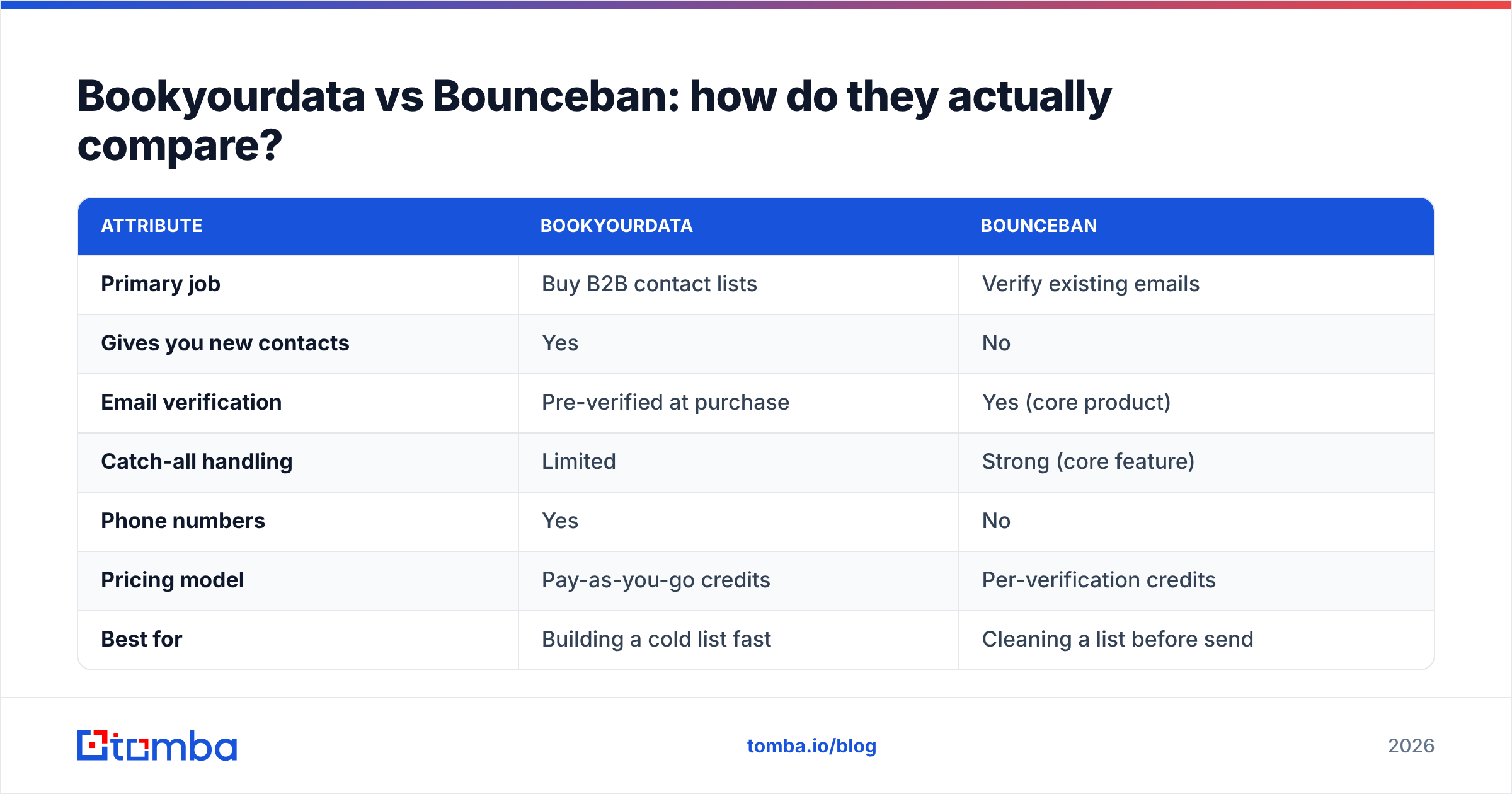
Because these tools sit at different stages of the pipeline, a feature-by-feature table makes the gap obvious.
| Attribute | Bookyourdata | Bounceban |
|---|---|---|
| Primary job | Buy B2B contact lists | Verify existing emails |
| Gives you new contacts | Yes | No |
| Email verification | Pre-verified at purchase | Yes (core product) |
| Catch-all handling | Limited | Strong (core feature) |
| Phone numbers | Yes | No |
| Pricing model | Pay-as-you-go credits | Per-verification credits |
| Best for | Building a cold list fast | Cleaning a list before send |
| Data freshness | Snapshot (decays over time) | Real-time at check |
| API access | Yes | Yes |
The pattern: Bookyourdata is a source, Bounceban is a gate. Using both in sequence — buy from one, scrub with the other — is a legitimate workflow. But it's also two bills, two integrations, and two vendors to manage for what one good finder-plus-verifier can do.
Which one do you actually need?#
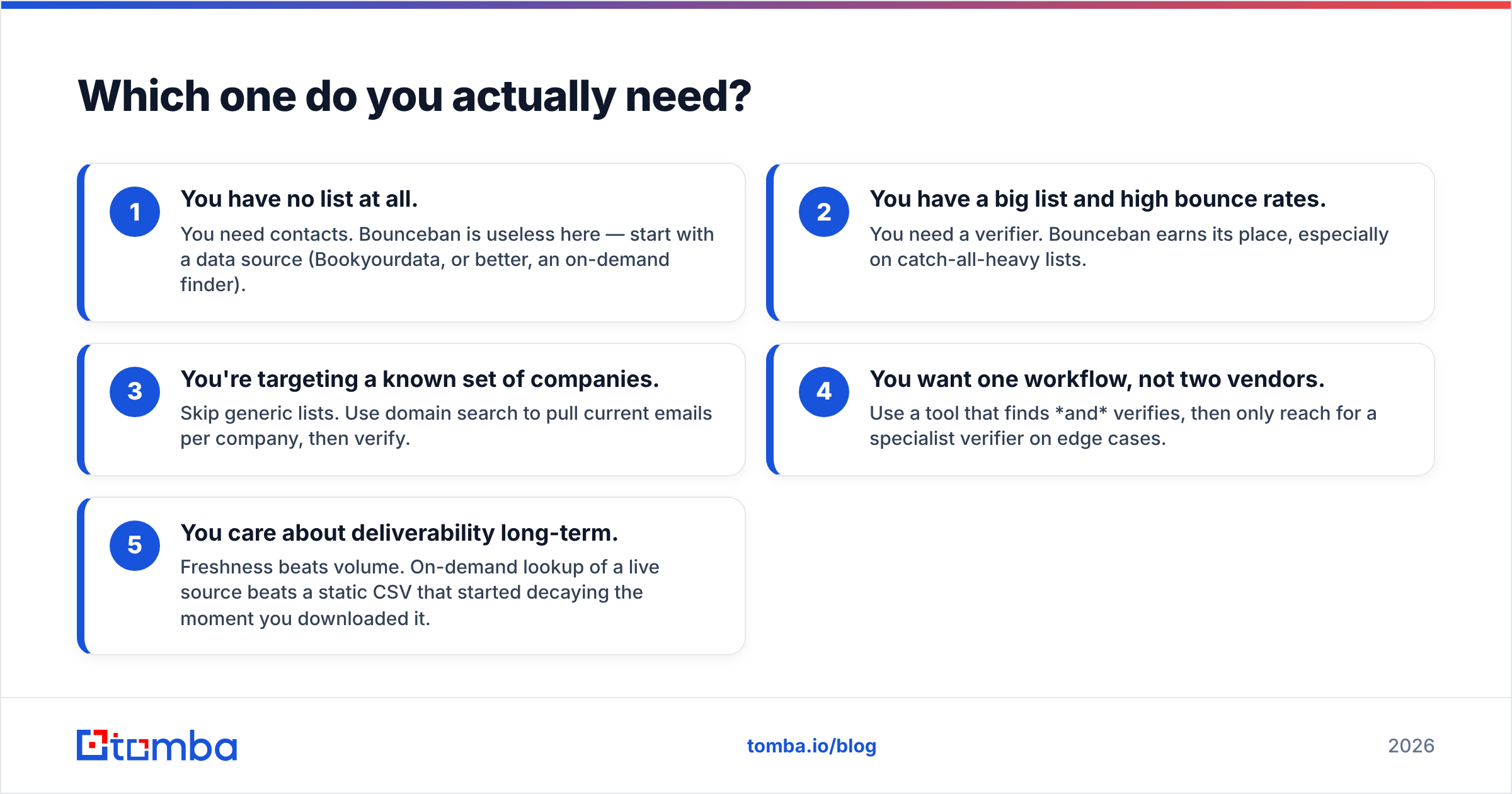
Decide by the bottleneck you're hitting right now. Here's the honest mapping:
- You have no list at all. You need contacts. Bounceban is useless here — start with a data source (Bookyourdata, or better, an on-demand finder).
- You have a big list and high bounce rates. You need a verifier. Bounceban earns its place, especially on catch-all-heavy lists.
- You're targeting a known set of companies. Skip generic lists. Use domain search to pull current emails per company, then verify.
- You want one workflow, not two vendors. Use a tool that finds and verifies, then only reach for a specialist verifier on edge cases.
- You care about deliverability long-term. Freshness beats volume. On-demand lookup of a live source beats a static CSV that started decaying the moment you downloaded it.
)
Notice that points 1, 3, and 4 are all really saying the same thing: a static list is a weaker foundation than a live lookup. That's the part the "Bookyourdata vs Bounceban" framing hides — it assumes you've already committed to buying a list.
How does pricing compare?#
Both use credits, but the credits buy different things, so a straight number-to-number comparison misleads. With Bookyourdata, a credit buys a contact record. With Bounceban, a credit buys a verification. If you buy 5,000 contacts and then verify them, you spend credits twice — once to acquire, once to check.
That stacking is the hidden cost of the two-tool approach. A 5,000-record list that's 25% stale means you paid for 1,250 records you'll never email, plus the verification credits to discover they're dead.
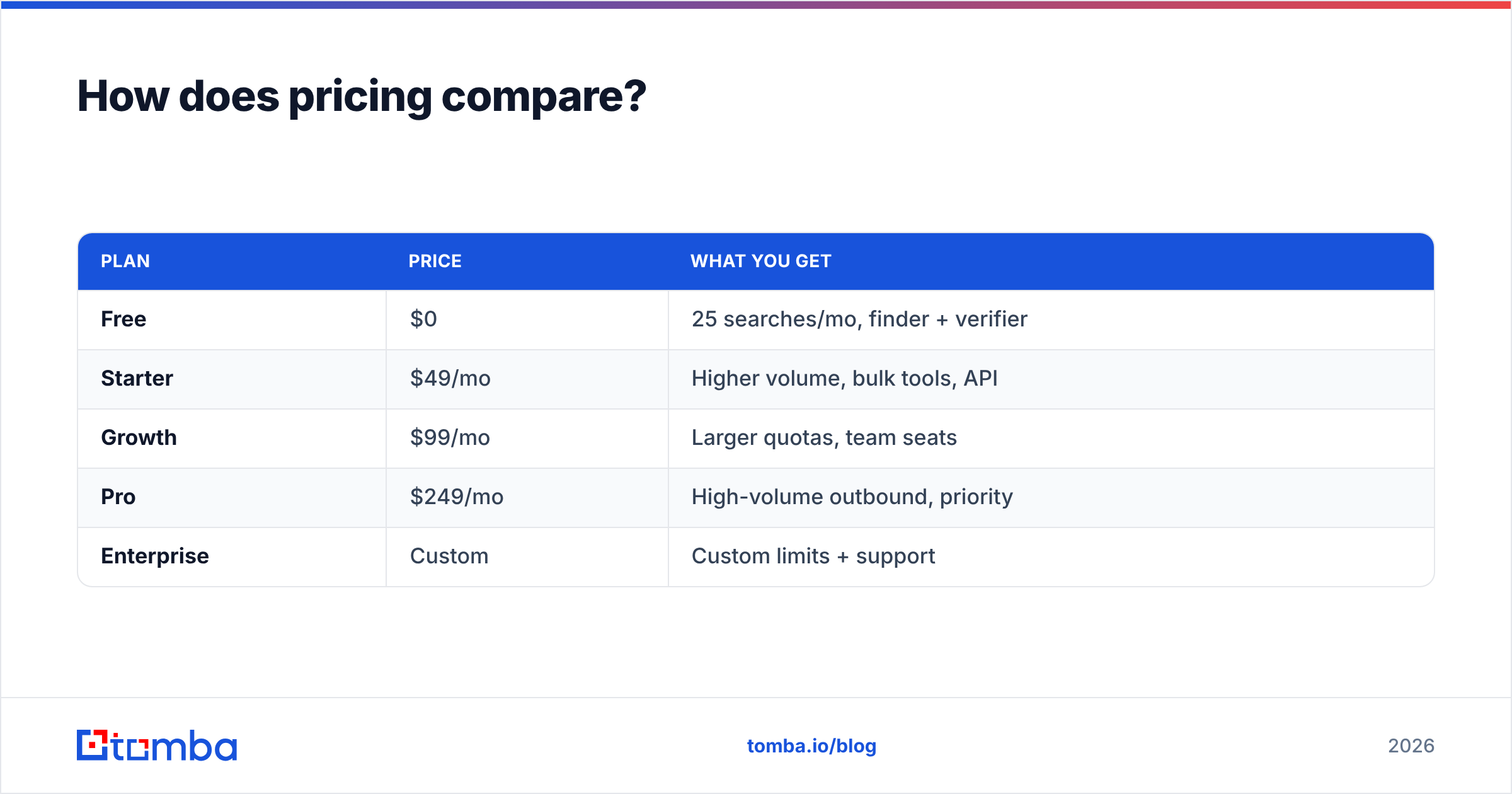
This is where a single finder changes the math. Tomba's pricing bundles finding and verification into one plan:
| Plan | Price | What you get |
|---|---|---|
| Free | $0 | 25 searches/mo, finder + verifier |
| Starter | $49/mo | Higher volume, bulk tools, API |
| Growth | $99/mo | Larger quotas, team seats |
| Pro | $249/mo | High-volume outbound, priority |
| Enterprise | Custom | Custom limits + support |
One credit system, find and verify in the same flow, and you only pull contacts you're about to use — so there's no shelf of decaying records. For a cold-outreach team running steady volume, that's usually cheaper than buying lists and verifying them as separate line items.
Is the data accurate enough to send?#
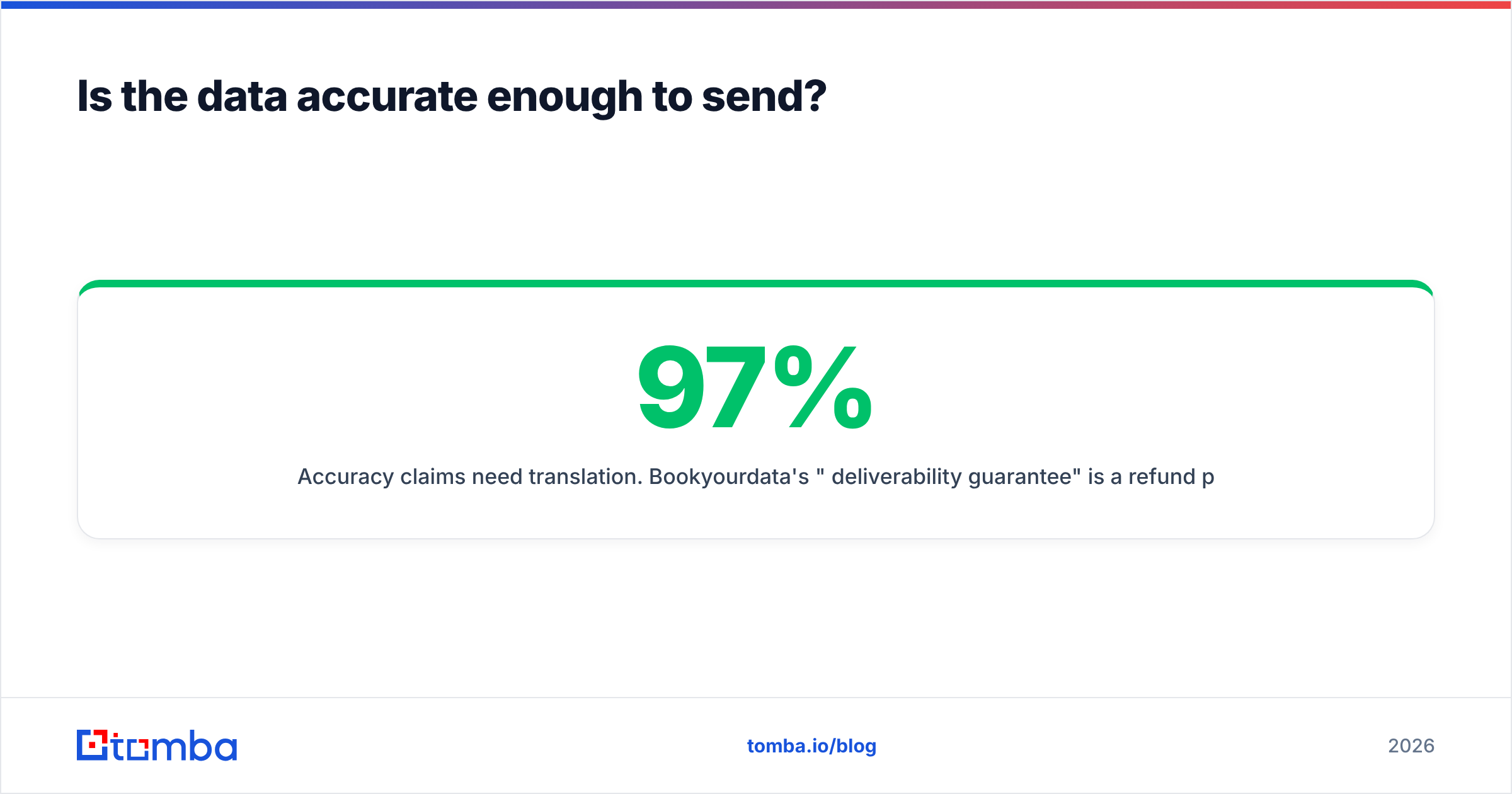
Accuracy claims need translation. Bookyourdata's "97% deliverability guarantee" is a refund promise, not a live-accuracy figure — it covers credits, not your sender reputation. If 3% of a 10,000-record send bounces, that's 300 bounces. A bounce rate above roughly 2% is enough to start dragging your sender reputation down, and a guarantee doesn't refund a damaged domain.
That's exactly why verification at send-time matters more than verification at purchase-time. A record verified six months ago when you bought the list tells you little about today. Verifying the moment before you send — with a proper email verifier — is what actually protects deliverability.
For catch-all domains specifically, neither a stale list nor a basic verifier helps. You need a tool built for it. Tomba's catch-all verifier targets the same hard case Bounceban specializes in, but inside the same platform where you found the contact — no second vendor required.
)
What about scale and automation?#
If you're running outbound at volume, the integration surface matters as much as the data. Bookyourdata exports lists; Bounceban exposes a verification API. To automate the full loop with both, you're wiring two services into your CRM and accepting two points of failure.
A unified API collapses that. The Tomba API handles finding and verification in one contract, and the bulk email finder processes large jobs without manual CSV juggling. If your stack lives in spreadsheets, the Google Sheets add-on and Chrome extension put both functions where you already work. That's one vendor, one credit pool, one thing to debug.
For teams already standardized on a CRM, native connectors — like the HubSpot integration — push verified contacts straight into the pipeline instead of through an export-import shuffle.
When should you use Bookyourdata or Bounceban anyway?#
Neither tool is bad; they're just narrow. There are real situations where each is the right call:
- Use Bookyourdata when you need a large, broad list fast, you're testing a brand-new market segment you can't enumerate by company, and you accept that you'll re-verify before every send.
- Use Bounceban when you've inherited a large list of unknown quality — say from an acquisition, an old CRM, or a partner — and your single biggest problem is catch-all domains you can't otherwise resolve.
- Use neither when you're doing targeted outbound to companies you can name. There, finding current emails per domain and verifying on the spot beats both buying a generic list and bolt-on verification.
The mistake is treating "Bookyourdata vs Bounceban" as the whole decision. It's one branch of a bigger tree, and for most targeted B2B outreach, the better branch is a finder that verifies as it goes.
How do the third-party reviews stack up?#
Don't take any vendor's word — including this page's. Cross-check on independent platforms. Bookyourdata and Bounceban both maintain listings on G2 and Capterra, where you can filter reviews by company size and use case to see whether reviewers match your profile. Pay attention to comments about data freshness for any list provider and catch-all accuracy for any verifier — those are the two claims most likely to fall apart in production.
For broader context on how data decay erodes B2B lists, vendor research from HubSpot is a useful neutral reference; it's the clearest explanation of why a list you bought last quarter underperforms today.
The bottom line#
Bookyourdata and Bounceban aren't really competitors — they're two halves of a workflow you'd otherwise pay for separately. Bookyourdata fills the top of the funnel with bought contacts; Bounceban guards the bottom by filtering bad addresses. Run them together and you get a working pipeline at the cost of two subscriptions, two integrations, and a pile of decaying records between purchase and send.
For most teams the smarter move is to skip the static list entirely. Find current, deliverable emails the moment you need them, verify them in the same step, and never warehouse data that's quietly rotting. That's exactly what the Tomba Email Finder is built for — find by name, domain, or company, with verification and catch-all handling in one plan starting free at 25 searches a month and scaling to $49/mo when you're ready. One vendor, one credit pool, fresh data every time you hit send.
// get started
Find, verify and enrich your first contacts today
Start on the free plan with 25 searches a month, then scale when your team is ready.
Free plan · No credit card required · GDPR & CCPA
// about the author