Bookyourdata vs Bouncer 2026: Data and Verification Compared
Bookyourdata sells prepackaged B2B contact lists; Bouncer verifies the emails you already have. Here is how they actually differ in 2026 — and the smarter middle path.
Bookyourdata vs Bouncer: Which One Do You Actually Need in 2026?
Here is the short answer most comparison posts bury: Bookyourdata and Bouncer are not really competitors. Bookyourdata sells you prebuilt B2B contact lists. Bouncer checks whether email addresses — yours or anyone's — are still valid. Putting them head to head is like comparing a grocery store to a refrigerator. You can use one, the other, or both, but they solve different problems.
This post untangles that confusion, shows you exactly where each tool wins, and explains why the "buy a list" model is aging badly compared to a find-and-verify workflow.
TL;DR#
- Bookyourdata is a pay-as-you-go B2B data marketplace — you filter a database and buy contact records, often with a stated accuracy guarantee.
- Bouncer is a dedicated email verification tool — it cleans lists you already own to protect your sender reputation and deliverability.
- They overlap only slightly: Bookyourdata claims verified data on export; Bouncer doesn't source any contacts.
- Buying static lists carries real risk — staleness, GDPR exposure, and spam-trap contamination — that verification alone can't fix.
- A modern alternative is to find emails on demand and verify them at the moment of outreach with a tool like Tomba Email Finder, so your data is never older than your last search.
What Is Bookyourdata?#
Bookyourdata is a B2B contact-data provider built around a self-serve list builder. You pick filters — industry, job title, company size, location, technology used — and the platform returns matching records with emails, phone numbers, and firmographic fields. You then pay per record, typically on a credit or pay-as-you-go basis, and export to CSV or push into your CRM.
Its main selling points are an accuracy guarantee (the company advertises a high verified-email percentage and credit refunds for bounces) and no forced subscription — you can buy a small batch without an annual contract. For teams that want a list today and don't want to scrape, that's appealing.
The catch is structural, not a knock on the vendor: any prebuilt database is a snapshot. People change jobs roughly every two to four years, and B2B data decays at an estimated 22–30% per year. The day you export, decay starts.
What Is Bouncer?#
Bouncer (usebouncer.com) is a focused email verification service. Feed it a list of addresses and it runs syntax checks, MX-record lookups, SMTP handshakes, and spam-trap and disposable-domain detection, then returns a status for each: deliverable, risky, or undeliverable. It also offers real-time API verification for signup forms and a "Toxicity" check for known complainers and traps.
Bouncer does not find or sell contacts. It assumes you already have addresses — from a CRM export, a signup form, a scrape, or, yes, a purchased list. Its job is to stop you from emailing dead inboxes that wreck your sender reputation.
In other words: Bookyourdata gives you the contacts; Bouncer tells you which of them are safe to email. If you bought a list from Bookyourdata and ran it through Bouncer, that's a coherent (if expensive) two-step pipeline — which tells you they're complements, not rivals.

Bookyourdata vs Bouncer: Core Comparison#
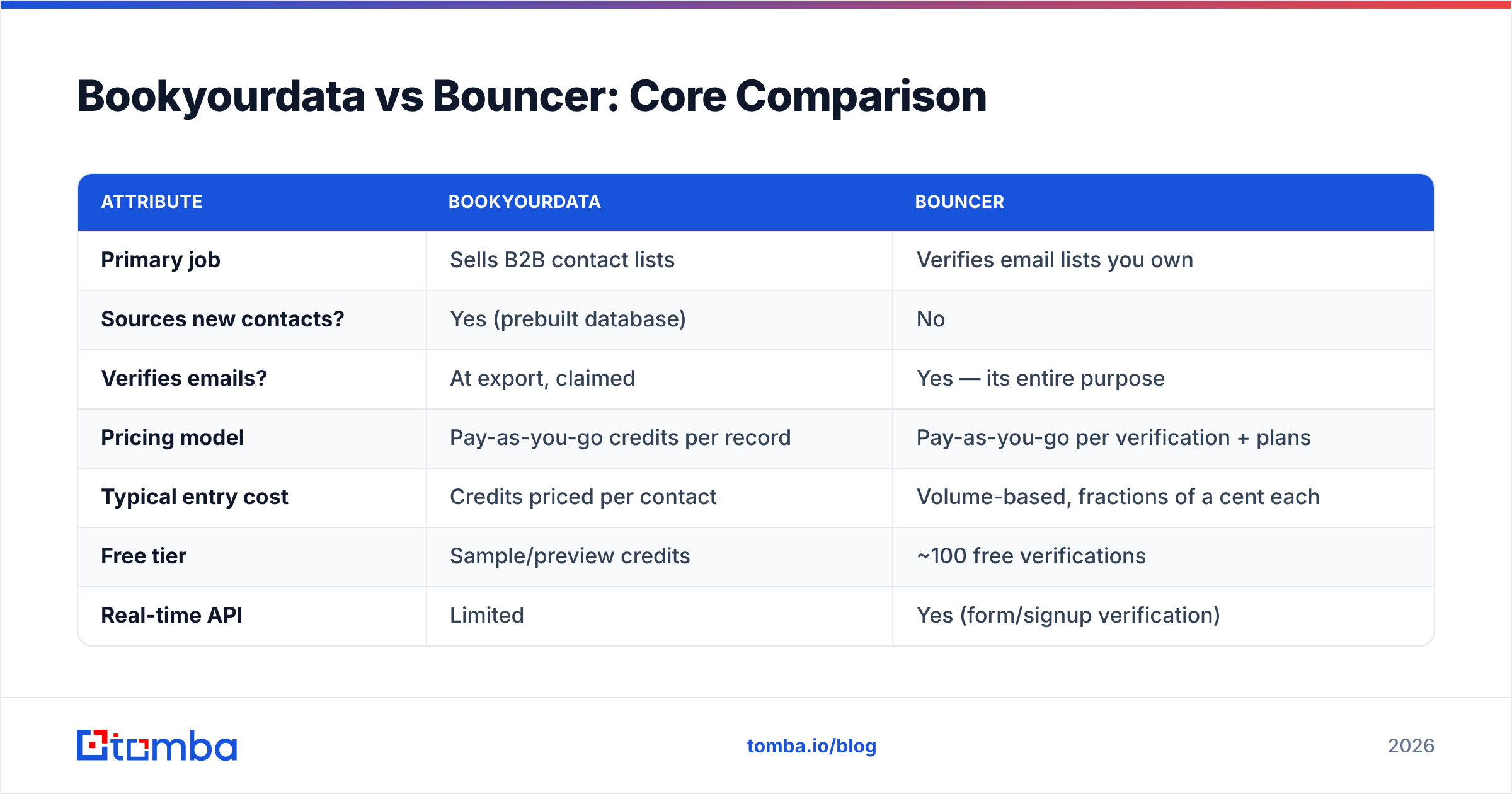
The fastest way to see the difference is feature by feature. These two tools sit at different stages of the lead lifecycle.
| Attribute | Bookyourdata | Bouncer |
|---|---|---|
| Primary job | Sells B2B contact lists | Verifies email lists you own |
| Sources new contacts? | Yes (prebuilt database) | No |
| Verifies emails? | At export, claimed | Yes — its entire purpose |
| Pricing model | Pay-as-you-go credits per record | Pay-as-you-go per verification + plans |
| Typical entry cost | Credits priced per contact | Volume-based, fractions of a cent each |
| Free tier | Sample/preview credits | ~100 free verifications |
| Real-time API | Limited | Yes (form/signup verification) |
| Best for | Cold list acquisition | List hygiene & deliverability |
| Biggest risk | Data staleness, compliance | Can't fix a bad source |
The decision is not "which is better." It's "which problem do I have." If you have no contacts, Bouncer is useless to you alone. If you have a dirty list, Bookyourdata doesn't clean it.
Is Buying a List From Bookyourdata Worth It?#
It depends on how fast your market moves and how much compliance risk you can absorb.
Purchased lists have three persistent problems that no verifier fully solves:
- Decay outpaces verification. Bouncer can confirm an address still accepts mail today, but it can't tell you the person left the company last month and someone else now reads that inbox. You'll reach a valid mailbox with the wrong human.
- Compliance exposure. Under GDPR and similar regimes, buying and cold-emailing personal data without a lawful basis is legally fraught. A clean SMTP response doesn't grant you consent.
- Spam-trap and reputation risk. Recycled lists are seeded with traps. One reason verification exists is precisely because purchased lists are dangerous — but if you have to scrub a list this hard before sending, the list quality was the problem.
That's the case for moving away from static lists entirely. Instead of buying 10,000 rows and praying, you find the specific people you want, when you want them, and verify each address at that moment.
For a deeper look at where contact data comes from and how freshness is maintained, see how Tomba sources its data.
How Does a Find-and-Verify Workflow Compare?#
This is the third option most "X vs Y" posts ignore. Rather than choosing between buying a list (Bookyourdata) and cleaning a list (Bouncer), you can collapse both steps: find the email by name and domain, then verify it in the same flow.
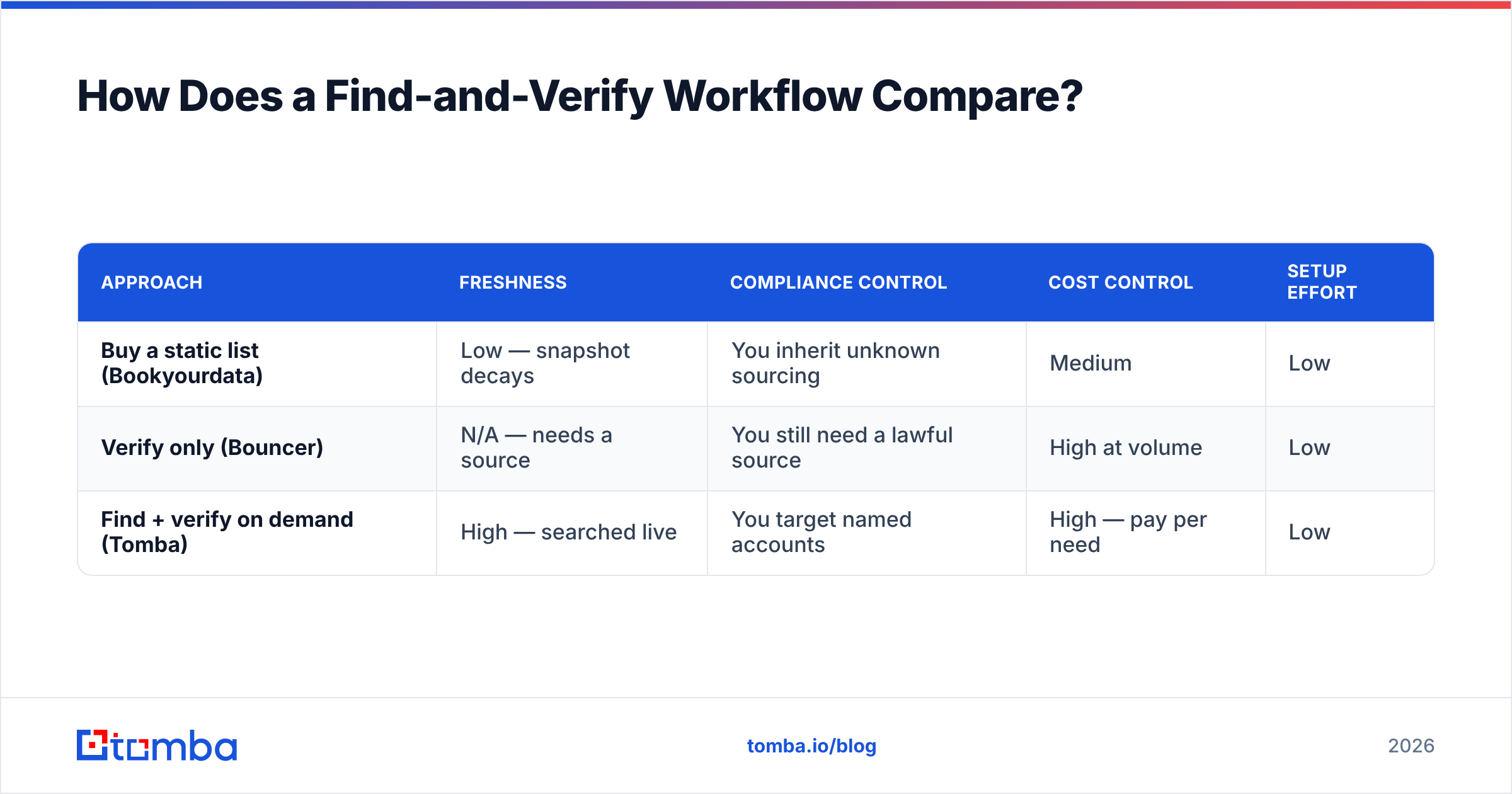
Here's how the three approaches stack up on the metrics that actually affect your reply rate:
| Approach | Freshness | Compliance control | Cost control | Setup effort |
|---|---|---|---|---|
| Buy a static list (Bookyourdata) | Low — snapshot decays | You inherit unknown sourcing | Medium | Low |
| Verify only (Bouncer) | N/A — needs a source | You still need a lawful source | High at volume | Low |
| Find + verify on demand (Tomba) | High — searched live | You target named accounts | High — pay per need | Low |
A find-and-verify model means you never carry a 30%-rotten database. You search for the decision-maker at the account you're targeting, pull the current email, confirm it's deliverable, and move on. Tools that bundle this include a domain search for mapping every contact at a company and a built-in verifier so the address is checked before it hits your sequence.
Pricing: Bookyourdata vs Bouncer vs Tomba#
Pricing models here are genuinely different, so compare them by what you're paying for, not just the sticker number.
- Bookyourdata charges per contact record. You pay for data you may or may not use, and quality degrades over time whether you email it or not.
- Bouncer charges per verification, often a fraction of a cent at volume, plus optional monthly plans. You only pay to check addresses you already have.
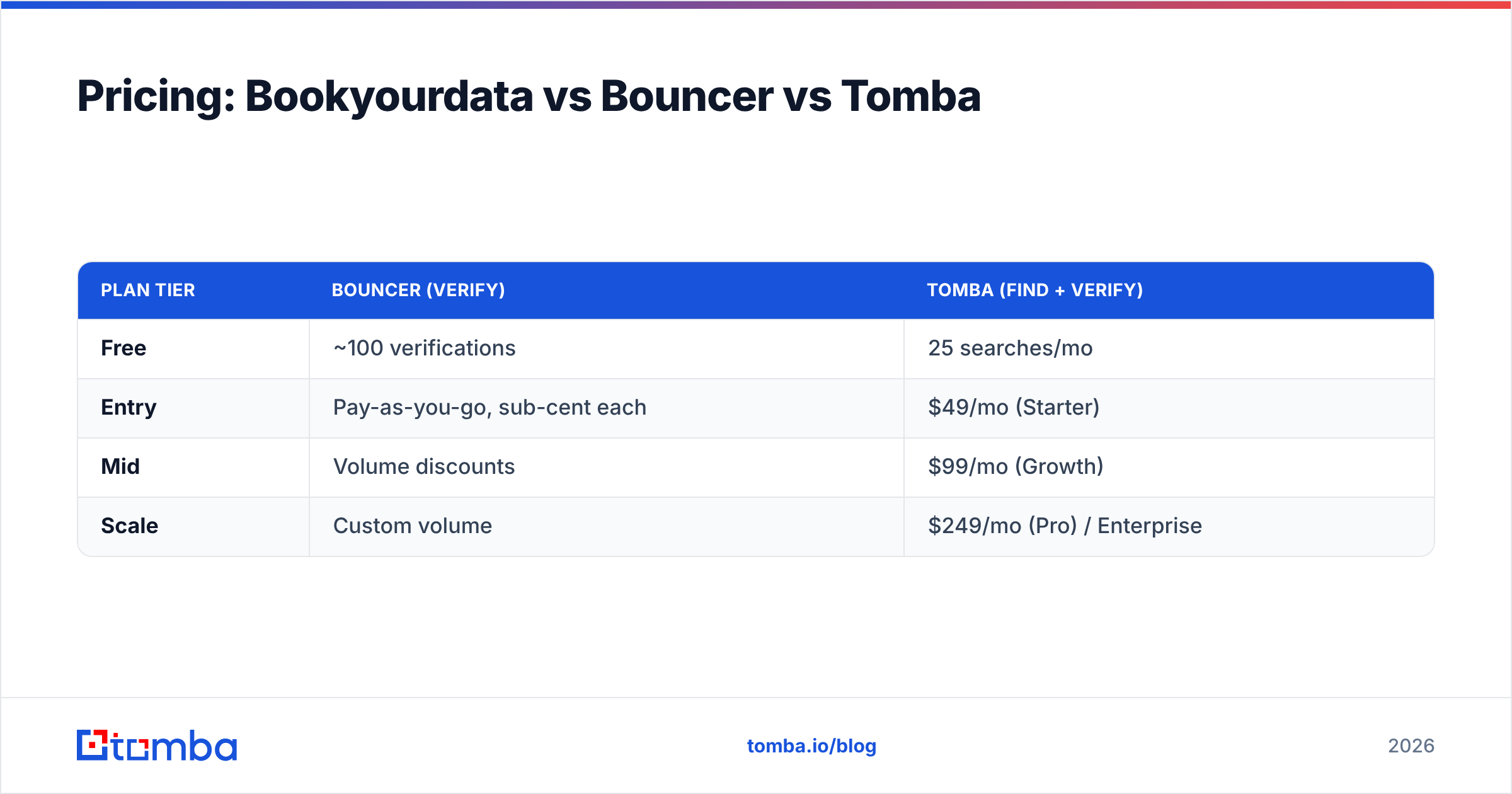
- Tomba bundles finding and verifying into one credit system. Pricing runs from a Free tier (25 searches/month), Starter at $49/mo, Growth at $99/mo, Pro at $249/mo, and Enterprise custom.
| Plan tier | Bouncer (verify) | Tomba (find + verify) |
|---|---|---|
| Free | ~100 verifications | 25 searches/mo |
| Entry | Pay-as-you-go, sub-cent each | $49/mo (Starter) |
| Mid | Volume discounts | $99/mo (Growth) |
| Scale | Custom volume | $249/mo (Pro) / Enterprise |
You can review full Tomba pricing to map credits to your outreach volume. The key point: with Bookyourdata you pay up front for a depreciating asset; with a find-and-verify tool you pay for live results as you need them.
Which Tool Should You Choose?#
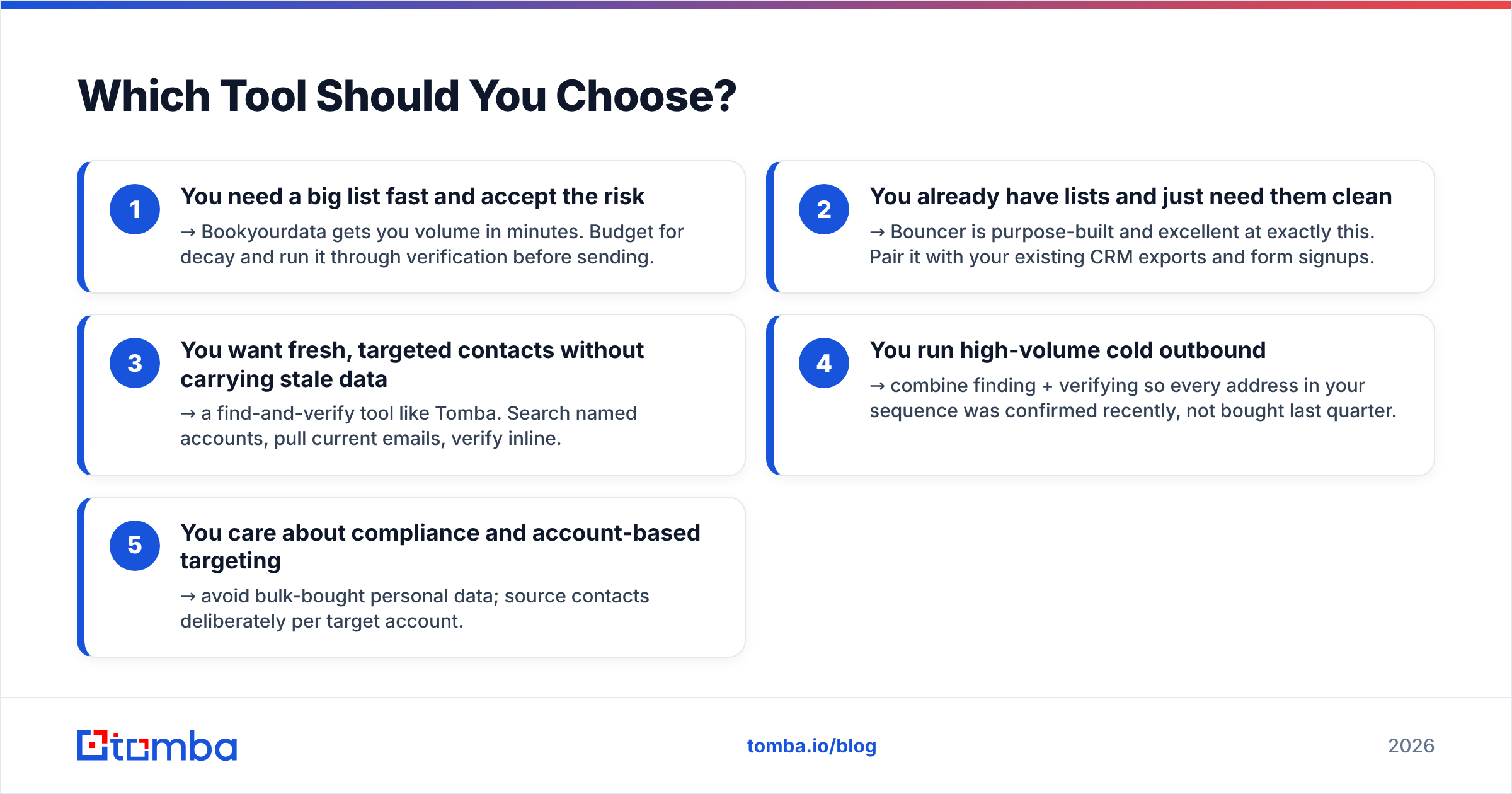
Match the tool to the situation rather than the brand:
- You need a big list fast and accept the risk → Bookyourdata gets you volume in minutes. Budget for decay and run it through verification before sending.
- You already have lists and just need them clean → Bouncer is purpose-built and excellent at exactly this. Pair it with your existing CRM exports and form signups.
- You want fresh, targeted contacts without carrying stale data → a find-and-verify tool like Tomba. Search named accounts, pull current emails, verify inline.
- You run high-volume cold outbound → combine finding + verifying so every address in your sequence was confirmed recently, not bought last quarter.
- You care about compliance and account-based targeting → avoid bulk-bought personal data; source contacts deliberately per target account.
For verifying addresses at scale regardless of where they came from, an email verifier and bulk tools cover the same hygiene job Bouncer does, inside the same platform you use to find contacts — so you're not stitching two vendors together.
How Do These Tools Affect Deliverability?#
Deliverability is where the real money is won or lost, and it's where the buy-vs-verify distinction matters most.
Verification (Bouncer's strength) directly protects email deliverability by removing addresses that would bounce or hit traps. Mailbox providers like Google and Yahoo weigh bounce rates and spam complaints heavily — Google's own Postmaster guidelines make low complaint rates a condition of inbox placement. So verification isn't optional; it's table stakes.
But verification can't repair a fundamentally bad source. If you email a purchased list of people who never heard of you, complaints rise even when every address is technically valid. That's the gap a find-and-verify workflow closes: you're reaching people you deliberately researched, at addresses confirmed seconds before sending, which keeps both bounce and complaint rates low.
If you want independent perspective on each vendor, both Bouncer and Bookyourdata carry public reviews on G2 and Capterra worth scanning before you commit.
The Bottom Line#
Bookyourdata and Bouncer answer two different questions. Bookyourdata answers "where do I get contacts?" Bouncer answers "are these contacts safe to email?" If you only adopt one, you've solved half the problem — and if you buy a static list and verify it, you've spent twice to ship data that's already decaying.
The cleaner path for most B2B teams in 2026 is to find contacts on demand and verify them in the same motion, so the data is never older than your last search and never larger than what you actually need.
Ready to skip the stale-list tax? Start with the Tomba Email Finder — search by name, company, or domain, get verified professional emails on the spot, and keep your sender reputation clean without juggling two vendors. The free tier gives you 25 searches a month to test it against whatever list you'd otherwise buy.
// get started
Find, verify and enrich your first contacts today
Start on the free plan with 25 searches a month, then scale when your team is ready.
Free plan · No credit card required · GDPR & CCPA
// about the author