Bookyourdata vs Bounceshield: Best B2B Data Tool 2026
BookYourData sells pre-built B2B lists; BounceShield verifies them. We compare accuracy, pricing, and workflow fit so you know which to pick in 2026 — and where a finder-plus-verifier beats both.
You are comparing two tools that do almost opposite jobs. BookYourData hands you a pre-built list of B2B contacts you buy by the record. BounceShield takes a list you already have and tells you which addresses are safe to send. Picking "the better one" without knowing that distinction is how teams end up paying for data they then can't trust — or verifying a list that was never accurate to begin with.
This guide breaks down what each tool actually does, where the pricing bites, and which one belongs in your stack. Spoiler: for most outbound teams the real answer is neither one alone — it's a finder that pulls fresh contacts and verifies them in the same pass.
TL;DR: Bookyourdata vs Bounceshield at a glance#
- BookYourData is a pay-as-you-go B2B contact database. You filter by industry, title, and geography, then buy emails and phone numbers by the credit. Strength: instant volume. Weakness: list-shop data ages fast.
- BounceShield is an email verification service. It checks syntax, MX records, and mailbox status to cut bounces. Strength: protects deliverability. Weakness: it verifies — it does not find anyone.
- They are complementary, not competitors: buy from one, verify with the other. Comparing them head-to-head only makes sense if you're deciding which problem to solve first.
- Accuracy decays at the source. A verifier can only confirm what's in your list today; it can't refresh a contact who changed jobs last quarter.
- The cleaner path is a tool that finds and verifies in one workflow, so the data is fresh and validated before it ever reaches your sequencer. That's where Tomba's email finder and built-in email verifier fit.
What is BookYourData?#
BookYourData is a self-serve B2B data marketplace. You build a segment with filters — job title, company size, industry, location, technology used — and the platform returns a count of matching contacts. You pay per record to unlock emails and direct-dial numbers, typically on a pay-as-you-go credit model rather than a flat subscription.
The pitch is speed. Need 2,000 marketing directors in SaaS companies headquartered in the US? You can export that in minutes. For teams that need volume today and don't want to prospect contact by contact, a list shop removes friction.
The catch is the same one every static-list vendor carries: the data is only as fresh as the last refresh cycle. B2B contact data decays at roughly 22–30% per year as people change roles, companies rebrand, and domains get retired. When you buy a list, you inherit whatever staleness is baked in — and you usually can't see how old any individual record is. That's why a verification step (or a vendor with transparent, recent sourcing) is non-negotiable.

What is BounceShield?#
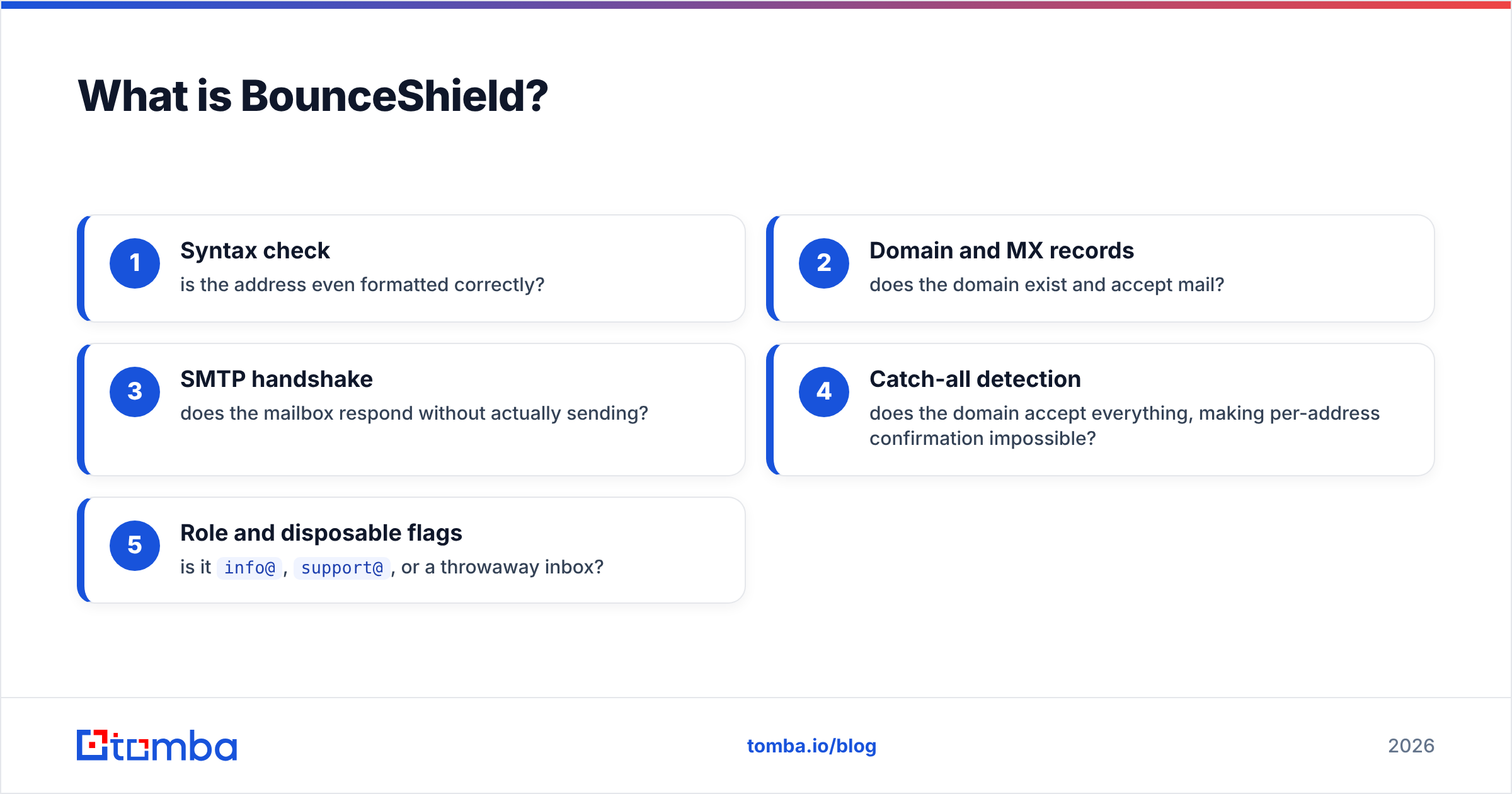
BounceShield sits on the other side of the funnel. It is an email verification tool: feed it a list, and it returns a status for each address — valid, invalid, risky, catch-all, or unknown. Under the hood, verifiers run a sequence of checks:
- Syntax check — is the address even formatted correctly?
- Domain and MX records — does the domain exist and accept mail?
- SMTP handshake — does the mailbox respond without actually sending?
- Catch-all detection — does the domain accept everything, making per-address confirmation impossible?
- Role and disposable flags — is it
info@,support@, or a throwaway inbox?
The payoff is deliverability. Cutting invalid addresses before a campaign protects your sender reputation, keeps bounce rates under the ~2% threshold mailbox providers watch, and stops you from torching a warmed-up domain. Independent reviews on G2 consistently rank deliverability protection as the top reason teams adopt a verifier.
But verification has a hard ceiling: it cannot create data. If a contact left the company, a verifier may still mark their old address "valid" right up until the mailbox is deactivated — and it has no idea who replaced them. Verification cleans; it does not enrich.
Bookyourdata vs Bounceshield: full comparison table#
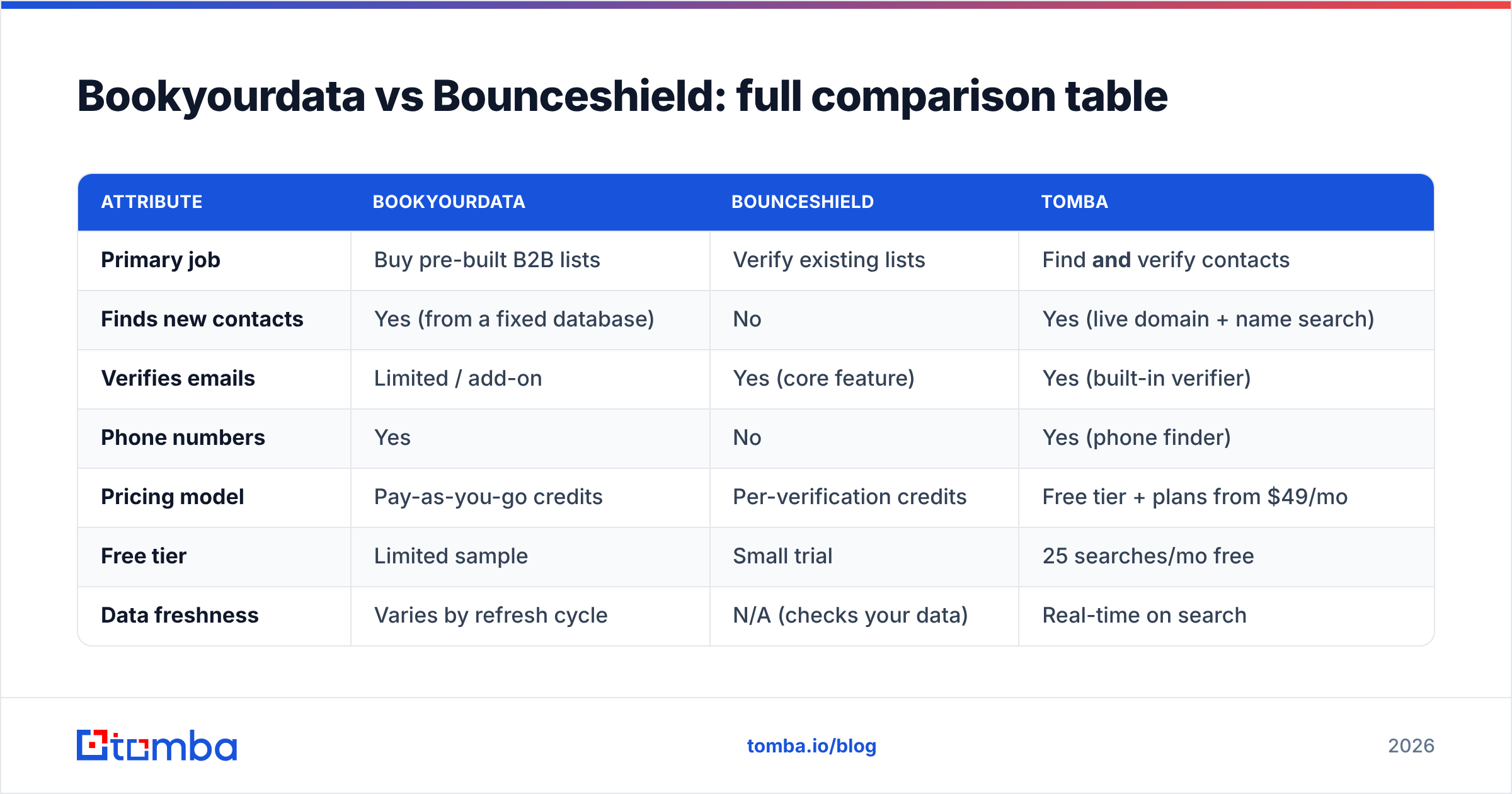
Here is the head-to-head on the attributes that actually drive a buying decision.
| Attribute | BookYourData | BounceShield | Tomba |
|---|---|---|---|
| Primary job | Buy pre-built B2B lists | Verify existing lists | Find and verify contacts |
| Finds new contacts | Yes (from a fixed database) | No | Yes (live domain + name search) |
| Verifies emails | Limited / add-on | Yes (core feature) | Yes (built-in verifier) |
| Phone numbers | Yes | No | Yes (phone finder) |
| Pricing model | Pay-as-you-go credits | Per-verification credits | Free tier + plans from $49/mo |
| Free tier | Limited sample | Small trial | 25 searches/mo free |
| Data freshness | Varies by refresh cycle | N/A (checks your data) | Real-time on search |
| Best for | Fast list volume | Cleaning owned lists | End-to-end prospecting |
| API access | Yes | Yes | Yes (REST API + CLI) |
The pattern is clear: BookYourData and BounceShield each own one half of the job, while a finder-plus-verifier covers both. If you only ever buy lists, you still need verification. If you only verify, you still need a source of fresh contacts.
Is Bookyourdata or Bounceshield more accurate?#
Neither is "more accurate" — they measure different things, and accuracy starts at the source. This is the most misunderstood part of the comparison.
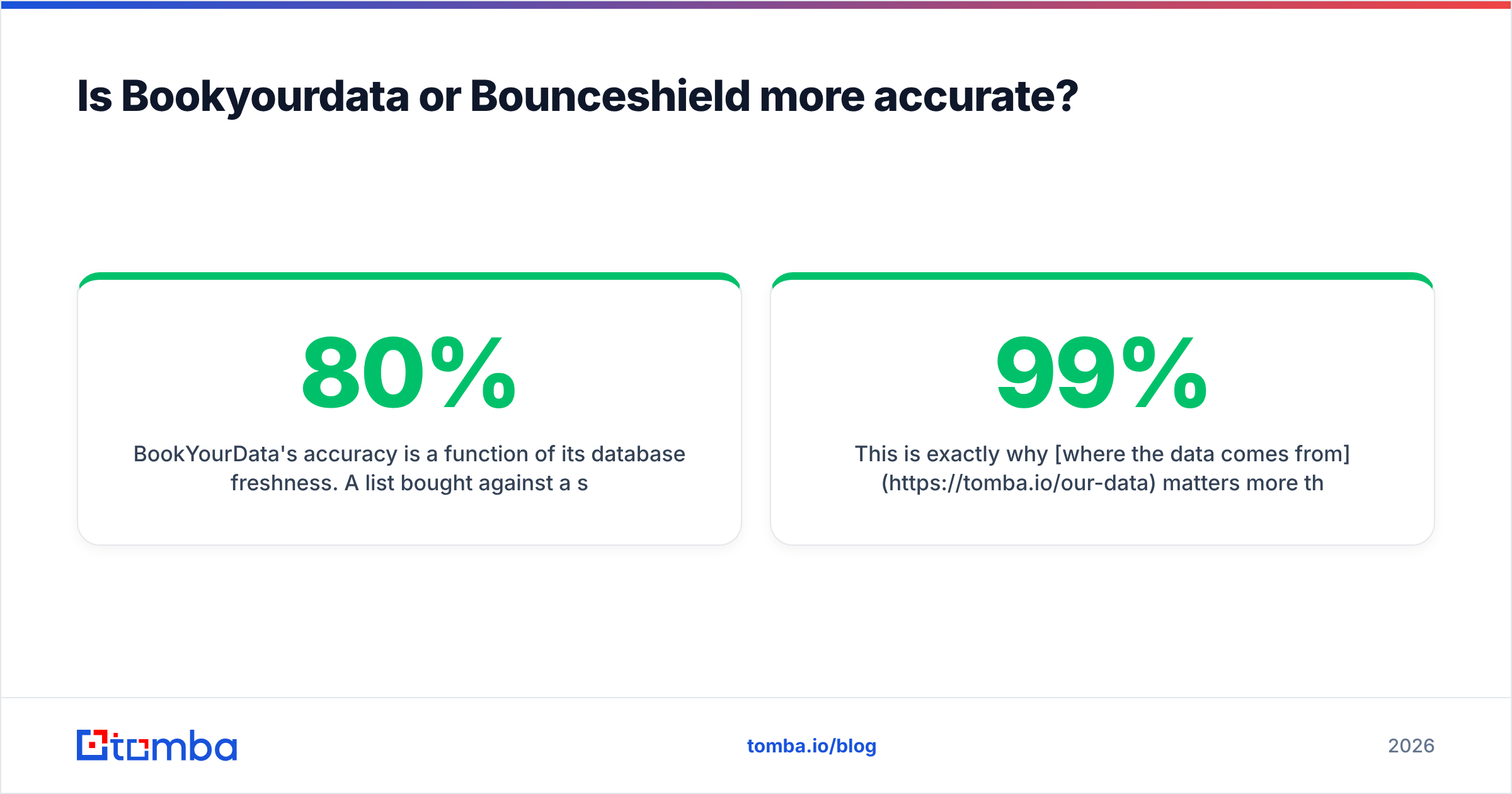
BookYourData's accuracy is a function of its database freshness. A list bought against a stale segment can be 70–80% deliverable on a good day and far worse for fast-moving industries like tech and startups. BounceShield's accuracy is about detection — how reliably it flags an invalid mailbox without false positives. A strong verifier might hit 95%+ detection accuracy, but that only tells you the current state of an address. It cannot tell you the person quit.
So the honest framing is:
- Buying a list then skipping verification = you mail stale data and bounce.
- Verifying a list you can't refresh = you confirm the deadwood is dead, but you still have gaps where contacts moved on.
- Finding fresh contacts and verifying them in one pass = the only flow that closes both holes.
This is exactly why where the data comes from matters more than any single accuracy percentage on a marketing page. Sourcing transparency beats a vague "99% accurate" badge every time. If you want to pressure-test a vendor's claim, run a sample through an independent email verifier and measure the real bounce rate yourself.
How does pricing compare?#
Pricing is where the two models diverge most.
BookYourData charges per record unlocked. That's attractive for one-off pulls but unpredictable at scale — a large segment with phone numbers can get expensive fast, and you re-pay every time you need fresh contacts because the data ages.
BounceShield charges per verification. Cheap per check, but it's an add-on cost layered on top of whatever you paid to acquire the list in the first place. You're effectively paying twice: once to get the data, once to confirm it.
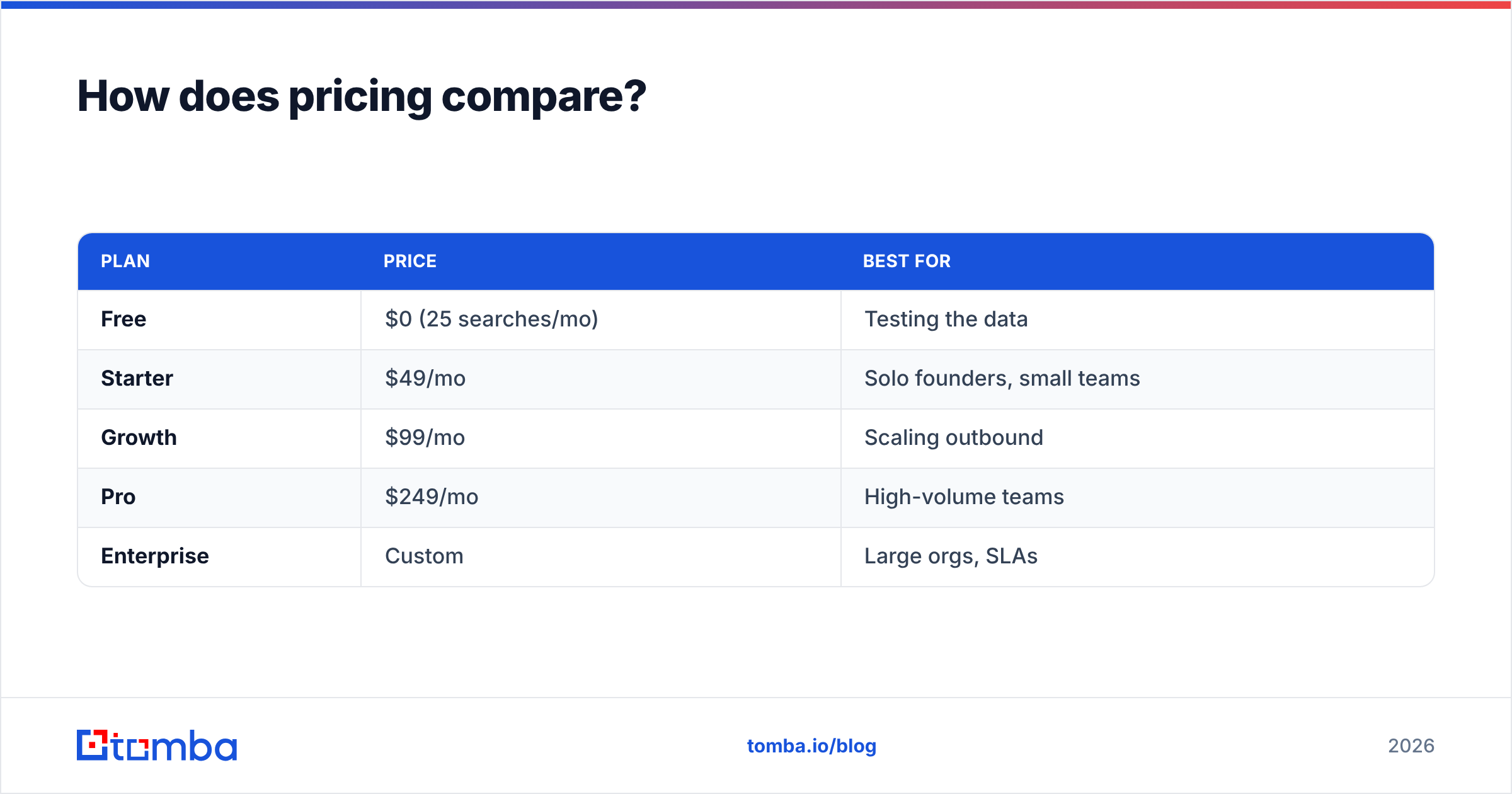
Tomba folds both into one subscription with a transparent ladder:
| Plan | Price | Best for |
|---|---|---|
| Free | $0 (25 searches/mo) | Testing the data |
| Starter | $49/mo | Solo founders, small teams |
| Growth | $99/mo | Scaling outbound |
| Pro | $249/mo | High-volume teams |
| Enterprise | Custom | Large orgs, SLAs |
Finding and verification are part of the same credit pool, so you're not stacking a verifier bill on top of a data bill. Full Tomba pricing is public — no "contact sales to see a number" wall. For teams running large jobs, the bulk email finder processes thousands of domains at once under the same plan.
When should you use a list-buying tool vs a verifier?#
Use this quick decision logic:
- Choose a list shop like BookYourData when you need raw volume immediately, you operate in slow-moving industries where data ages gently, and you have a verification step waiting downstream. Never mail a purchased list raw.
- Choose a verifier like BounceShield when you already own a list — inbound signups, an old CRM export, a webinar registration dump — and your only job is to clean it before sending. Verification is also smart before re-engaging a dormant list.
- Choose a finder-plus-verifier like Tomba when you're building targeted outbound from scratch and want fresh, validated contacts without the two-vendor tax. Search by company domain, pull the right person, and the address is verified before export.
Most growing teams cycle through all three needs, which is the practical argument for consolidating: one tool that finds, verifies, enriches, and exports beats stitching a data vendor to a separate verifier and reconciling the credits.
What about deliverability beyond the tools?#
Worth saying plainly: no tool — BookYourData, BounceShield, or Tomba — fixes deliverability on its own. Clean data is necessary but not sufficient. You still need:
- Authenticated sending — SPF, DKIM, and DMARC aligned on your domain.
- A warmed-up domain — gradual volume ramp, not zero-to-thousands overnight.
- Engagement hygiene — pruning non-openers, honoring unsubscribes, and watching complaint rates.
A verifier reduces bounces, which is one input to email deliverability, but pairing clean data with proper authentication is what actually lands you in the inbox. HubSpot's email deliverability guidance is a solid, vendor-neutral primer if you're setting this up from scratch. Treat the tool as one layer of a system, not a silver bullet.
Bookyourdata vs Bounceshield: the verdict#
If you're forced to pick one, pick based on the problem in front of you: BookYourData if you have no contacts and need volume now; BounceShield if you have a list and need it clean. They're two halves of the same workflow, and choosing one means accepting you'll eventually need the other.
But the framing itself is the trap. Buying static lists and bolting on verification is a two-vendor, two-bill, two-tool workaround for something a single platform now does in one pass. Fresh data validated at the moment of search beats a purchased list cleaned after the fact — because verification can confirm an address is live today, but only a live search can tell you it's still the right person.
Find fresh, verified contacts in one workflow#
Stop paying the list-shop tax and the verifier tax separately. The Tomba Email Finder pulls professional email addresses by name, company, or domain — and verifies them in the same step, so what you export is fresh and deliverable, not a stale CSV you have to clean afterward. Start free with 25 searches a month, no credit card, and test the data against your own list before you commit. When you're ready to scale, plans start at $49/mo with finding, verification, and enrichment in one pool. Skip the two-tool juggle and build outbound on data you can actually trust.
// get started
Find, verify and enrich your first contacts today
Start on the free plan with 25 searches a month, then scale when your team is ready.
Free plan · No credit card required · GDPR & CCPA
// about the author