Bookyourdata vs Brandnav 2026: Which B2B Data Tool Wins?
Bookyourdata sells pay-as-you-go lists; Brandnav pushes real-time enrichment. We compare accuracy, pricing, and coverage to show which B2B data tool fits your 2026 pipeline.
Bookyourdata vs Brandnav: Which B2B Data Tool Should You Trust in 2026?
You need contact data that actually connects. The question is whether you buy a pre-built list from Bookyourdata, lean on the real-time enrichment angle of Brandnav, or skip the trade-off entirely. This breakdown compares both on the things that decide whether your emails land or bounce.
TL;DR#
- Bookyourdata is a pay-as-you-go list marketplace with a 97%-accuracy guarantee and credits that never expire — strong for one-off list pulls, weaker for live, always-fresh data.
- Brandnav positions itself as a real-time enrichment and email-finding platform — better for on-demand lookups, but coverage and pricing transparency are thinner.
- Neither wins on every axis: Bookyourdata leads on instant volume, Brandnav leads on freshness, and both charge for verification you should already expect.
- If your priority is verified, real-time email discovery by domain or name, a dedicated finder like Tomba usually beats both on cost-per-valid-contact.
- Read the comparison table before you commit a budget — the cheapest sticker price is rarely the cheapest valid contact.
What Is Bookyourdata?#
Bookyourdata is a self-service B2B contact database where you build and download targeted lists on demand. You filter by job title, industry, location, company size, and technology, then pay per record. Its headline pitch is a 97% accuracy guarantee with credits that don't expire, which appeals to teams that buy in bursts rather than subscribe monthly.
The model is straightforward: you're buying a snapshot. That snapshot is verified at download time, but a list bought in January is only as good as the day you pulled it. People change jobs, domains get retired, and roles shift — so the "97%" is a point-in-time figure, not a permanent one.
Where Bookyourdata shines is instant volume. Need 5,000 marketing directors in SaaS companies with 50–200 employees? You can have a CSV in minutes. That speed is real, and for list-based campaigns it's a legitimate advantage.
What Is Brandnav?#
Brandnav markets itself as a real-time B2B data and email-finding platform, emphasizing on-demand lookups and enrichment rather than bulk list sales. The pitch is that instead of buying a frozen list, you query data closer to the moment you need it, which theoretically reduces decay.
In practice, Brandnav competes in the same lane as email finders and enrichment APIs: you give it a name and company or a domain, and it returns business contact details. The appeal is freshness and flexibility — you pull what you need, when you need it, instead of paying for a 10,000-row file where half the rows go stale before you email them.
The trade-offs are coverage depth and pricing clarity. Real-time providers live or die on how wide their underlying data sources reach and how honest their verification is. If a tool returns a guess instead of a verified address, your bounce rate pays the bill — and your sender reputation takes the hit.
Bookyourdata vs Brandnav: Full Comparison Table#
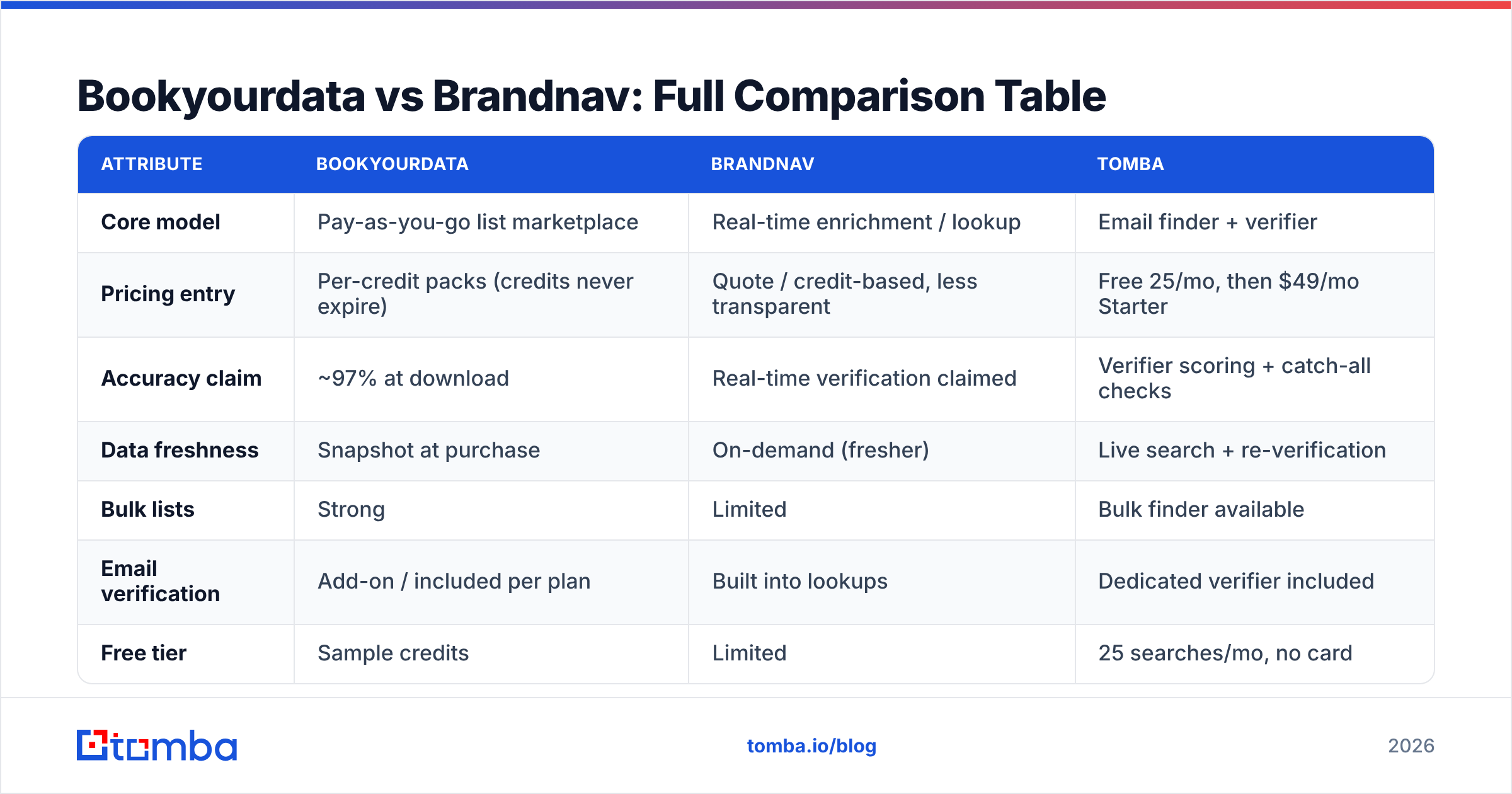
Here's how the two stack up on the attributes that actually affect your pipeline. Treat vendor-published accuracy numbers as marketing claims until you test them on your own segment.
| Attribute | Bookyourdata | Brandnav | Tomba |
|---|---|---|---|
| Core model | Pay-as-you-go list marketplace | Real-time enrichment / lookup | Email finder + verifier |
| Pricing entry | Per-credit packs (credits never expire) | Quote / credit-based, less transparent | Free 25/mo, then $49/mo Starter |
| Accuracy claim | ~97% at download | Real-time verification claimed | Verifier scoring + catch-all checks |
| Data freshness | Snapshot at purchase | On-demand (fresher) | Live search + re-verification |
| Bulk lists | Strong | Limited | Bulk finder available |
| Email verification | Add-on / included per plan | Built into lookups | Dedicated verifier included |
| Free tier | Sample credits | Limited | 25 searches/mo, no card |
| Best for | One-off bulk list pulls | Ad-hoc enrichment | Verified prospecting at scale |
The pattern is clear: Bookyourdata optimizes for volume now, Brandnav for freshness on demand, and a dedicated finder for cost-per-valid-contact. Your choice should follow your dominant workflow, not the loudest accuracy number.
Is Bookyourdata More Accurate Than Brandnav?#
Short answer: it depends on when you measure. Bookyourdata's 97% claim is a download-moment figure, while Brandnav's real-time angle aims to keep accuracy higher over time by pulling fresher records. Neither claim survives contact with a stale segment unless you re-verify.
Accuracy in B2B data has three layers most vendors blur together:
- Syntax validity — the address is formatted correctly. Easy and nearly meaningless on its own.
- Deliverability — the mailbox exists and accepts mail right now. This is the one that protects your bounce rate.
- Person-match — the email actually belongs to the person you targeted. The hardest to guarantee and the most valuable.
A list can score 97% on syntax and far lower on person-match. That gap is exactly where campaigns quietly fail. The defensible move with either tool is to run every record through an independent email verifier before you send, and to treat catch-all domains separately with a dedicated catch-all verifier rather than trusting a blanket "valid" flag.

If you want the methodology behind accuracy testing, vendor-neutral review sites like G2 and Capterra collect enough real user reports to spot when a published number drifts from field reality.
How Do Bookyourdata and Brandnav Price Their Data?#
Pricing is where the two diverge most. Bookyourdata uses transparent, pay-as-you-go credit packs with credits that never expire — you can buy once, use slowly, and not feel pressured into a subscription. Brandnav leans toward quote-based and credit pricing that's less visible up front, which makes apples-to-apples budgeting harder until you talk to sales.
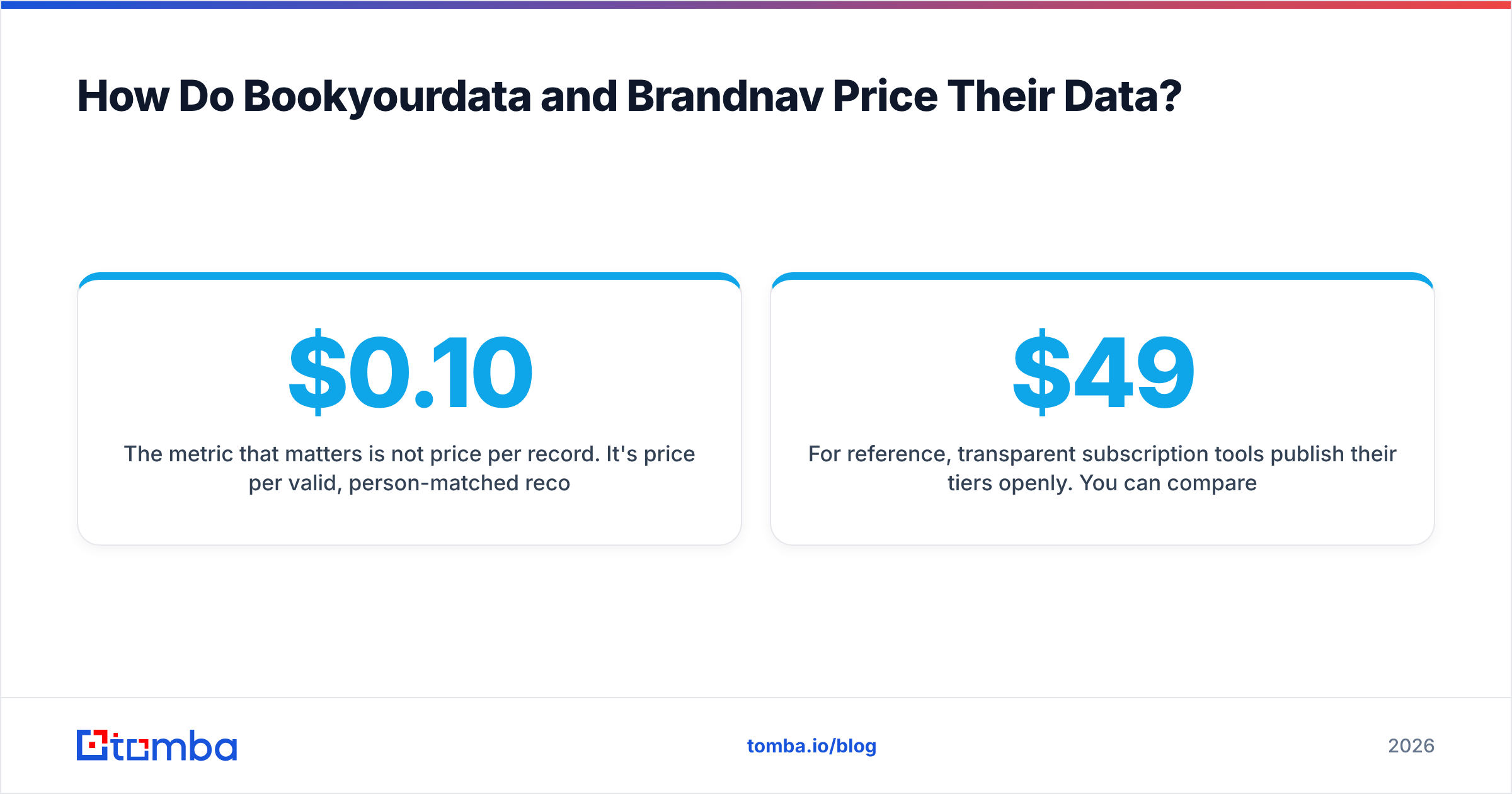
The metric that matters is not price per record. It's price per valid, person-matched record, because invalid rows cost you twice — once at purchase, once in deliverability damage. A list at $0.10/record with 70% real deliverability costs more per usable contact than a $0.15/record source at 92%.
Run this simple math before buying from either:
- Effective cost = list price ÷ (records × real deliverability rate)
- Always discount the vendor's headline accuracy by your own test sample
- Factor in re-verification cost if it isn't bundled
For reference, transparent subscription tools publish their tiers openly. You can compare Tomba pricing — free 25 searches/month, Starter at $49/mo, Growth at $99/mo, Pro at $249/mo — against a per-credit pack to see which model fits your monthly volume.
Which Tool Fits Which Use Case?#
Match the tool to the job, not the hype. Here's the honest split:
- Choose Bookyourdata if you run periodic, list-heavy campaigns, want credits that never expire, and you have a verification step downstream to catch decay.
- Choose Brandnav if your workflow is ad-hoc enrichment — you look up contacts a few at a time and value freshness over bulk volume.
- Choose a dedicated finder if your core need is repeatable, verified discovery by domain search or by name, with verification built into the same workflow rather than bolted on.
The hidden cost in both Bookyourdata and Brandnav is the second tool you'll still need: a verifier, an enrichment layer, or a CRM connector. When you add those up, the "cheap list" often isn't.
What About Data Coverage and Compliance?#
Coverage is the quiet differentiator. A list provider with deep North American data may be thin in EMEA or APAC, and a real-time tool is only as good as the sources it queries. Before committing, test both on your exact ICP segment — not a generic sample — because aggregate coverage stats hide regional gaps that wreck a targeted campaign.
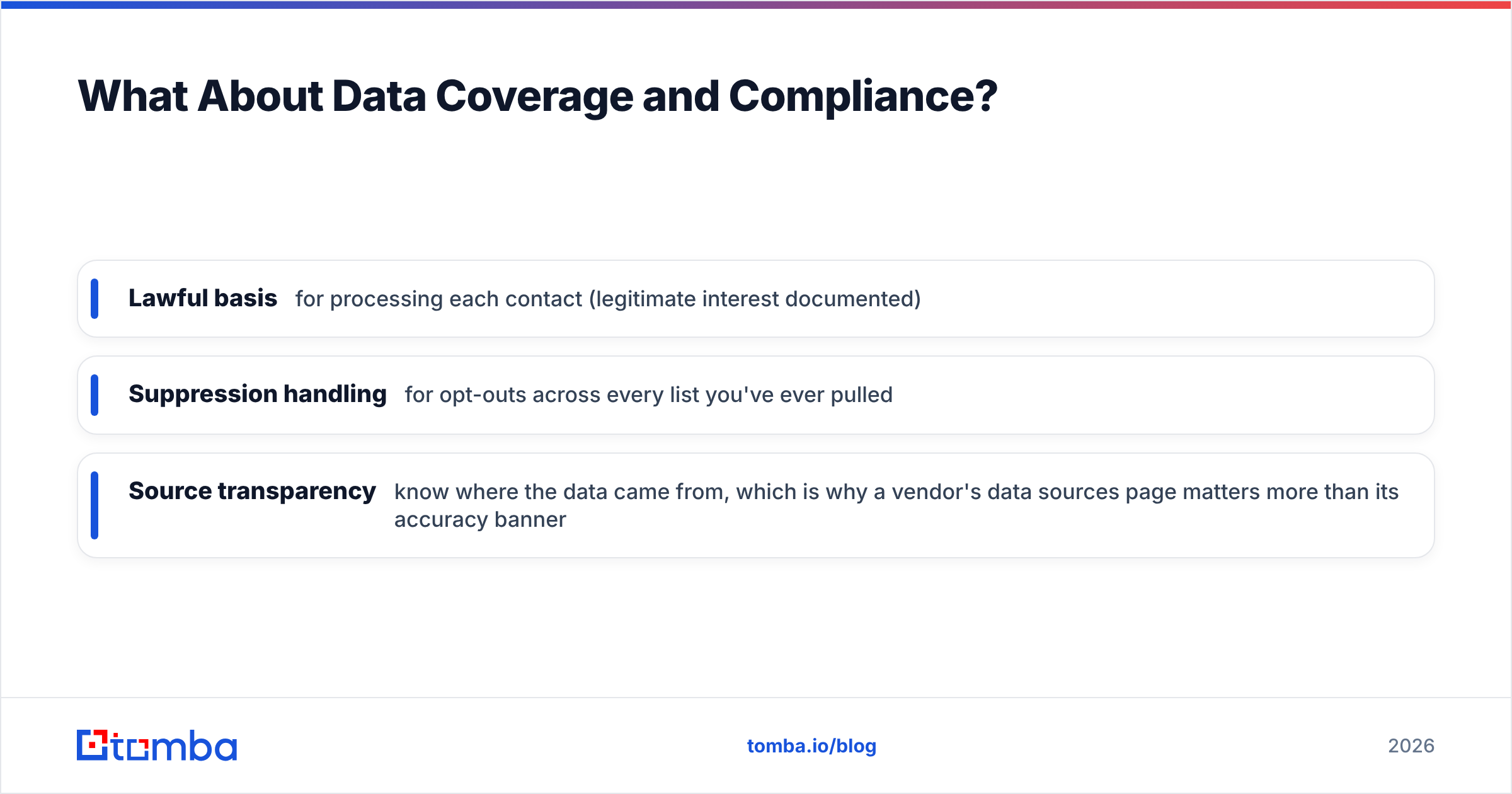
Compliance is non-negotiable in 2026. Both tools claim GDPR and CCPA alignment, but you remain the data controller the moment you import a record. That means:
- Lawful basis for processing each contact (legitimate interest documented)
- Suppression handling for opt-outs across every list you've ever pulled
- Source transparency — know where the data came from, which is why a vendor's data sources page matters more than its accuracy banner
For the regulatory baseline, the EU's own GDPR overview is the authoritative reference; don't take a vendor's one-line "we're compliant" as your legal cover.
Bookyourdata vs Brandnav vs a Dedicated Email Finder#
Here's the comparison most head-to-head posts skip: both list/enrichment tools solve part of the problem, but neither is purpose-built for verified email discovery at scale with the verification in the same loop.

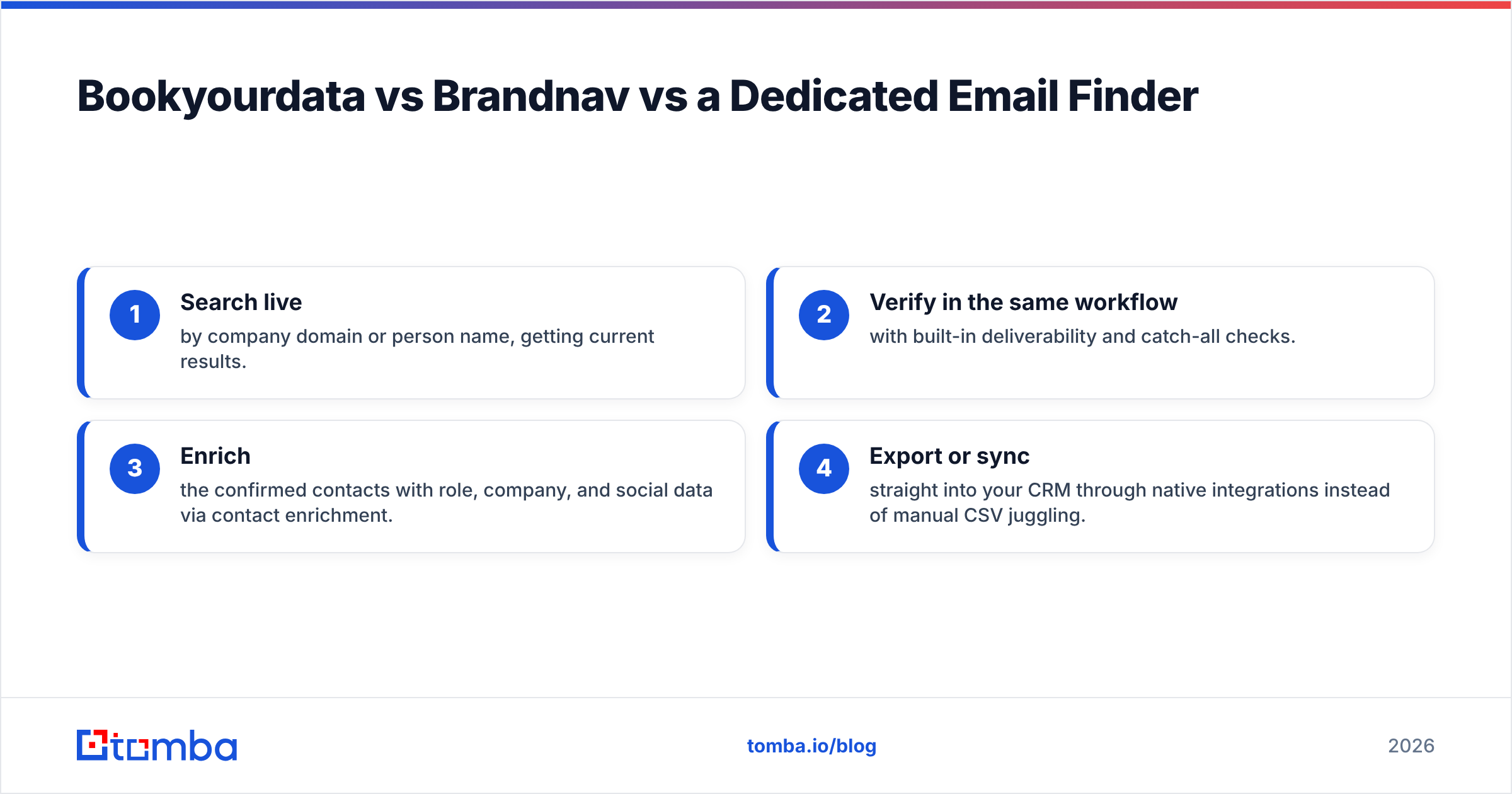
A dedicated finder flips the model. Instead of buying a frozen file or querying a black-box enrichment API, you:
- Search live by company domain or person name, getting current results.
- Verify in the same workflow with built-in deliverability and catch-all checks.
- Enrich the confirmed contacts with role, company, and social data via contact enrichment.
- Export or sync straight into your CRM through native integrations instead of manual CSV juggling.
That loop kills the decay problem Bookyourdata fights and the coverage opacity Brandnav fights, because every contact is found and validated at the moment you need it. For high-volume teams, the bulk email finder handles thousands of lookups without forcing you into a pre-built list you can't trust.
This isn't to say list providers are useless — they're genuinely fast for one-off volume. It's to say that if email discovery is a recurring part of your motion, a finder-plus-verifier wins on cost-per-valid-contact almost every time.
Frequently Asked Questions#
Is Bookyourdata legit? Yes — it's an established pay-as-you-go contact database with a published accuracy guarantee and non-expiring credits. Just verify lists independently before sending, because accuracy is measured at download, not forever.
Is Brandnav better for real-time data? Its real-time positioning is its main edge over a static list, but real-time only helps if the underlying coverage is wide and the verification is honest. Test it on your own ICP segment first.
What's the cheapest option overall? Per record, list packs can look cheapest, but per valid record, a verified finder with a free tier and transparent tiers often costs less. Run the effective-cost math above.
Do I still need an email verifier? Almost always. Whether you buy from Bookyourdata, query Brandnav, or use a finder, an independent verification pass is the cheapest insurance against bounces and reputation damage.
The Bottom Line#
Bookyourdata and Brandnav are both reasonable for what they are: one is a fast bulk-list marketplace, the other an on-demand enrichment play. Your decision comes down to whether your data need is periodic and bulk (Bookyourdata) or ad-hoc and fresh (Brandnav) — and in both cases you'll still want a verification layer to protect deliverability.
But if your real job is finding verified business emails again and again, stop paying for snapshots you have to re-clean. Tomba's Email Finder lets you search by domain, name, or company, verifies deliverability in the same workflow, and starts free with 25 searches a month — no card, no expiring credits, no black box. Test it against your toughest segment and compare the cost-per-valid-contact yourself. That's the only number that matters.
// get started
Find, verify and enrich your first contacts today
Start on the free plan with 25 searches a month, then scale when your team is ready.
Free plan · No credit card required · GDPR & CCPA
// about the author