Bookyourdata vs BriteVerify 2026: Which B2B Data Tool Wins?
Bookyourdata sells B2B contacts; BriteVerify cleans the list you already have. Here's how they compare on pricing, accuracy, and which one your outreach stack actually needs in 2026.
Most people who type "Bookyourdata vs BriteVerify" into Google are quietly comparing the wrong two things. One sells you contacts. The other tells you whether the contacts you already own still bounce. They overlap at the edges, but they are not substitutes — and picking the wrong one wastes either your budget or your sender reputation.
This guide breaks down what each tool actually does, where they compete, what they cost in 2026, and how to decide which belongs in your stack. We'll also cover the case for a single platform that finds and verifies, so you stop paying two vendors for half a workflow each.
TL;DR — Bookyourdata vs BriteVerify in 30 seconds#
- Bookyourdata is a data provider. You filter a 250M+ B2B contact database, build a list, and download verified emails and phone numbers on a pay-as-you-go basis.
- BriteVerify is a verification engine. You upload a list you already have and it flags invalid, risky, and catch-all addresses before you send.
- They solve different problems. Bookyourdata answers "who do I email?" BriteVerify answers "will this email land?"
- Cost models differ. Bookyourdata charges per credit/record; BriteVerify charges roughly $0.01 per verification with volume discounts.
- If you want both jobs in one tool, an email-finder-plus-verifier like Tomba covers discovery and validation under one subscription.
)
What is Bookyourdata?#
Bookyourdata is a self-service B2B contact database. Instead of finding one prospect at a time, you open a builder, apply filters — job title, industry, company size, location, technology used — and the platform returns a list of matching decision-makers with work emails and direct-dial numbers. You pay for the records you download.
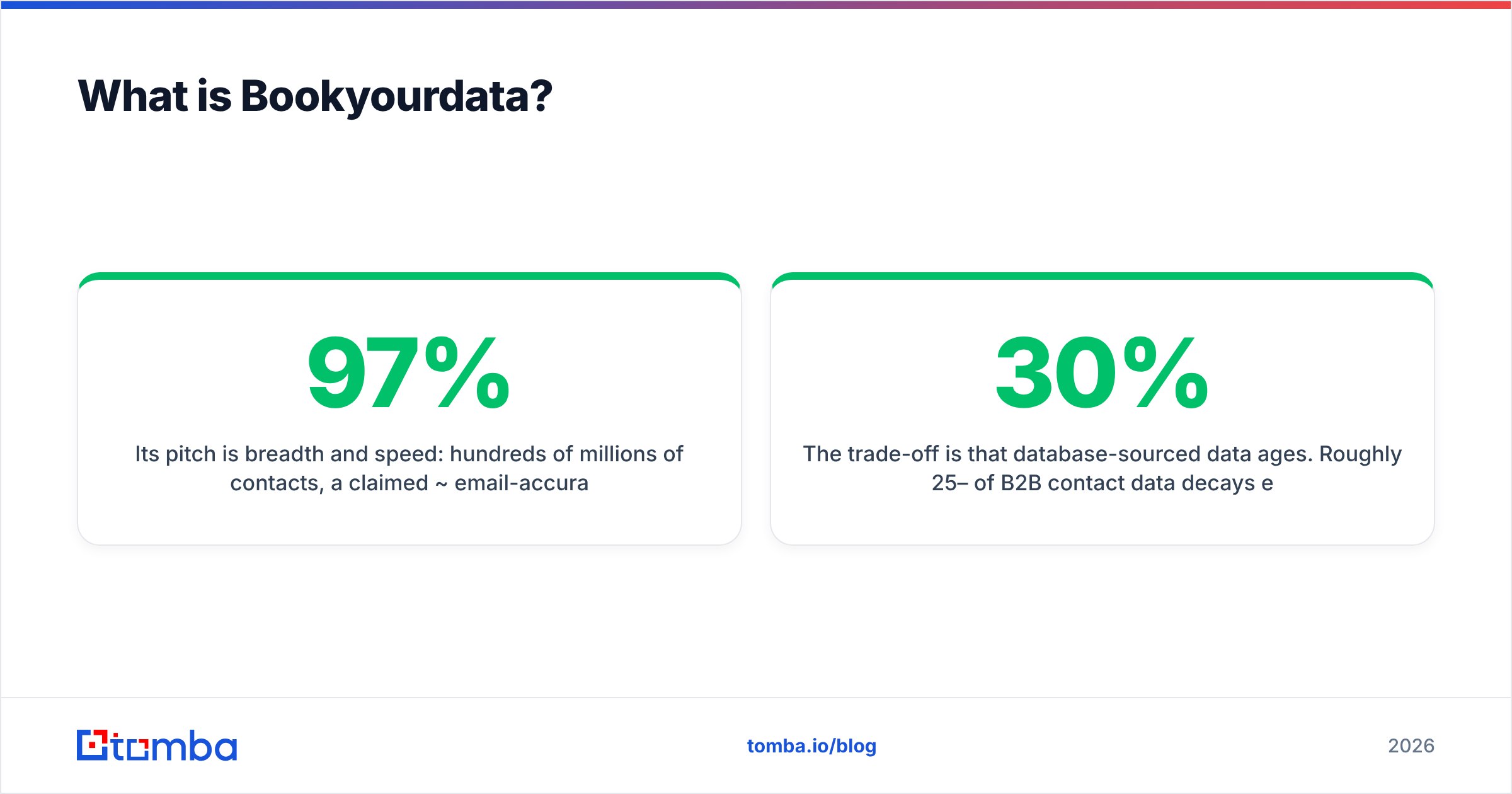
Its pitch is breadth and speed: hundreds of millions of contacts, a claimed ~97% email-accuracy guarantee, and pay-as-you-go credits so you're not locked into a subscription. For teams that need to generate a list from scratch — say, "500 marketing directors at SaaS companies in North America" — that builder is the entire value proposition.
The trade-off is that database-sourced data ages. Roughly 25–30% of B2B contact data decays every year as people change jobs, so even a 97%-at-export figure drifts the longer a list sits in a spreadsheet. That decay is exactly the gap a verifier is built to close.
What is BriteVerify?#
BriteVerify, part of Validity, is an email verification service. It doesn't give you new contacts — it inspects the ones you bring. Upload a list (or call the API in real time on a signup form), and BriteVerify checks syntax, domain and MX records, mailbox existence, and known traps, then returns a status: valid, invalid, accept-all (catch-all), or unknown.
The point is deliverability protection. Every invalid address you mail increases your bounce rate, and mailbox providers like Google and Microsoft read high bounce rates as a spam signal. Cleaning a list before a send keeps your sender reputation intact and your inbox-placement high. BriteVerify is well-known for being fast and conservative, which marketing teams running large ESP sends tend to value.
But BriteVerify starts with data you already have. If your list is empty, it has nothing to do.
Bookyourdata vs BriteVerify: the core difference#
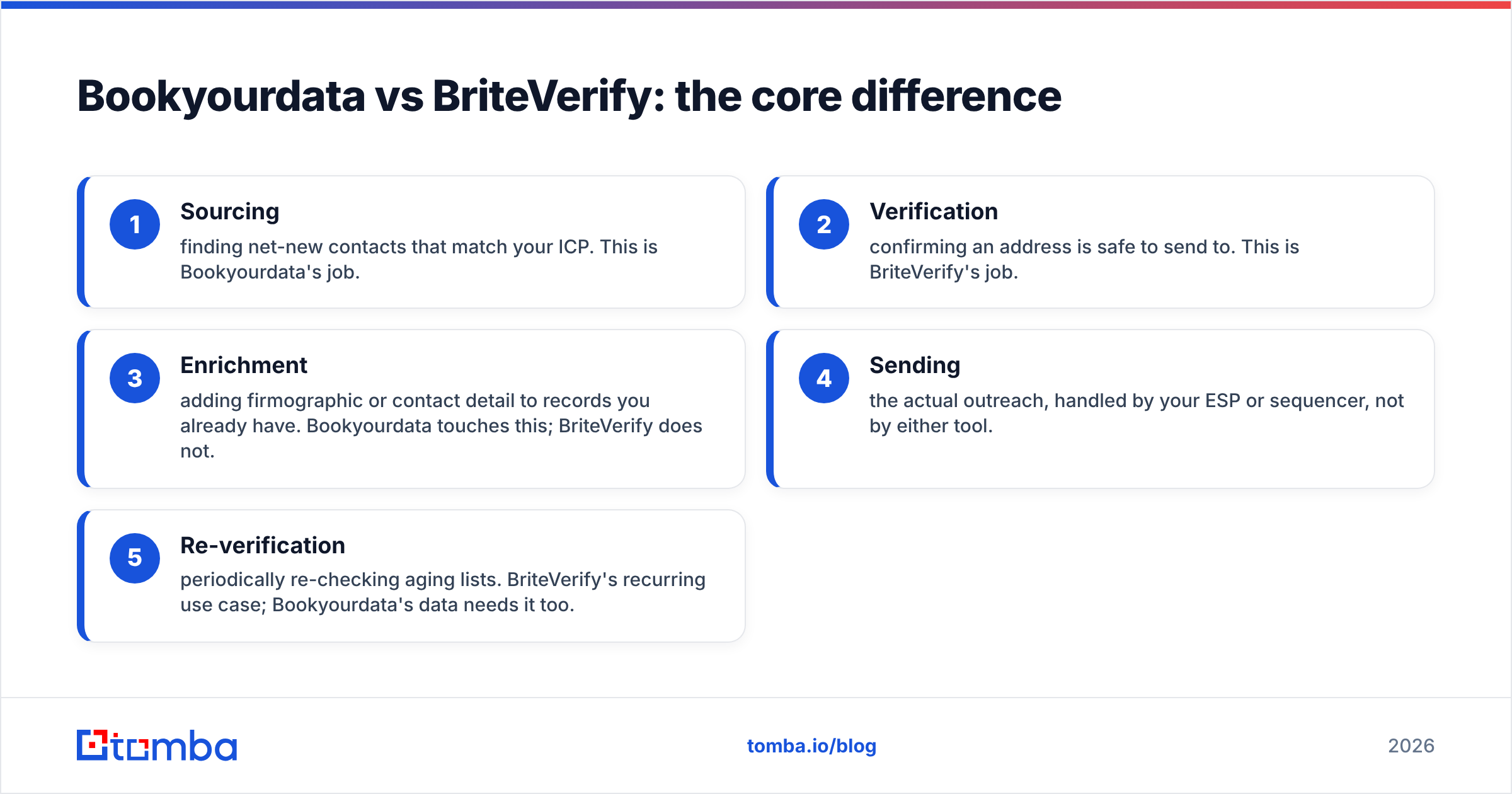
Here's the cleanest way to think about it. These two tools sit at different stages of the same pipeline:
- Sourcing — finding net-new contacts that match your ICP. This is Bookyourdata's job.
- Verification — confirming an address is safe to send to. This is BriteVerify's job.
- Enrichment — adding firmographic or contact detail to records you already have. Bookyourdata touches this; BriteVerify does not.
- Sending — the actual outreach, handled by your ESP or sequencer, not by either tool.
- Re-verification — periodically re-checking aging lists. BriteVerify's recurring use case; Bookyourdata's data needs it too.
So the honest answer to "which is better" is: better at what? A team with no list needs sourcing first. A team sitting on a 50,000-row CSV from last year needs verification first. Most growing teams need both — which is why the comparison so often ends with people buying two tools.
How do Bookyourdata and BriteVerify compare on features and pricing?#
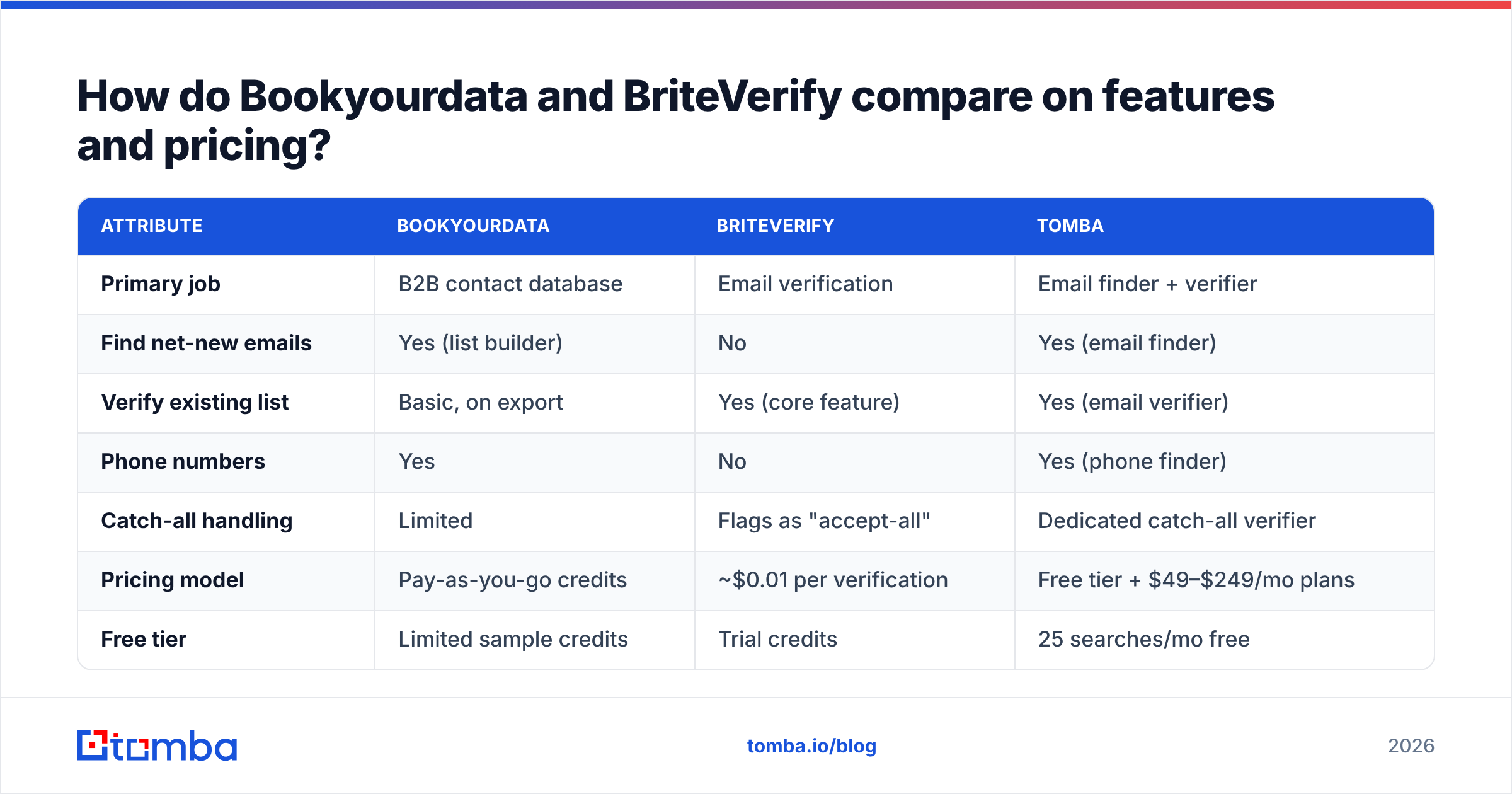
The table below lays the two side by side, with Tomba added as the find-and-verify option for context.
| Attribute | Bookyourdata | BriteVerify | Tomba |
|---|---|---|---|
| Primary job | B2B contact database | Email verification | Email finder + verifier |
| Find net-new emails | Yes (list builder) | No | Yes (email finder) |
| Verify existing list | Basic, on export | Yes (core feature) | Yes (email verifier) |
| Phone numbers | Yes | No | Yes (phone finder) |
| Catch-all handling | Limited | Flags as "accept-all" | Dedicated catch-all verifier |
| Pricing model | Pay-as-you-go credits | ~$0.01 per verification | Free tier + $49–$249/mo plans |
| Free tier | Limited sample credits | Trial credits | 25 searches/mo free |
| Best for | Building lists from scratch | Cleaning ESP/CRM lists | Doing both in one workflow |
| API access | Yes | Yes | Yes (REST API) |
A few notes on cost, because the models aren't directly comparable. Bookyourdata bills per record you pull, so your spend scales with how many contacts you download. BriteVerify bills per address checked — list size times roughly a cent, with discounts at volume. Tomba uses flat monthly tiers (see full Tomba pricing), which is more predictable when you're doing high volumes of both finding and verifying.

Which one is more accurate?#
Accuracy means two different things here, so don't compare the headline numbers directly.
Bookyourdata's "97% accuracy" is about its database — the share of records it expects to be correct at the moment you export. That's a sourcing claim. BriteVerify's accuracy is about its verdicts — how reliably it labels an address valid or invalid. That's a verification claim. A perfect database with a weak verifier still ships bounces; a great verifier with no database still has nothing to send.
In practice the two compound. If you source from Bookyourdata and then run the export through a dedicated verifier before sending, you catch the slice of records that decayed between collection and your campaign. That second pass is where dedicated verification — BriteVerify, or Tomba's verifier — earns its keep. The risk is the catch-all addresses: domains configured to accept any message at the server level. BriteVerify flags these as "accept-all" but can't always tell you whether a specific mailbox exists, which is why a purpose-built catch-all check matters for those domains.
Bottom line: neither tool is "more accurate" in the abstract. Bookyourdata is graded on the data it hands you; BriteVerify is graded on the judgments it returns about data you hand it.
When should you choose Bookyourdata?#
Pick Bookyourdata when your bottleneck is not having contacts. Specifically:
- You're entering a new market and need a list of decision-makers fast.
- You want direct-dial phone numbers alongside emails for a multi-channel play.
- You prefer pay-as-you-go over a subscription and your volume is bursty.
- You don't already own a large list that needs cleaning.
The thing to plan for: budget a verification step downstream. Database data is fresh-ish at export and decays from there, so a verifier — whether BriteVerify or another — should sit between your download and your send. Read more on why data sources matter in our note on where contact data comes from.
When should you choose BriteVerify?#
Pick BriteVerify when your bottleneck is list quality, not list size:
- You have an existing CRM or ESP list and bounce rates are creeping up.
- You're about to run a large marketing send and want to protect inbox placement.
- You need real-time form validation to stop fake signups at the point of entry.
- Your sourcing is already handled by another tool or an SDR team.
BriteVerify won't help you build a prospect list — that's simply not what it's for. If you reach for it expecting new contacts, you'll be disappointed. Reach for it to keep a list you already trust from quietly rotting.
)
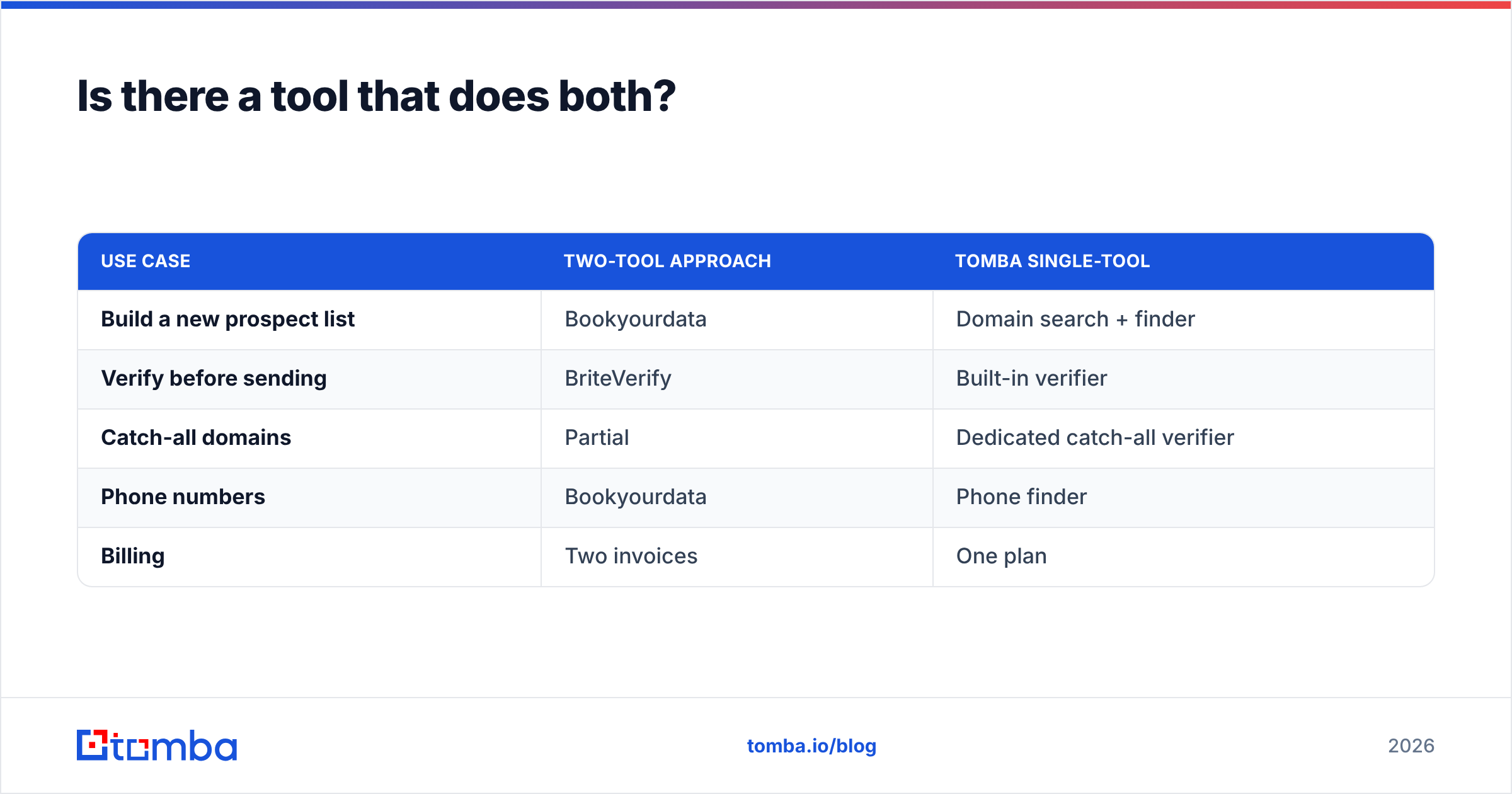
Is there a tool that does both?#
Yes — and for a lot of teams it's the cheaper, simpler answer. The "Bookyourdata vs BriteVerify" framing assumes you'll buy one for sourcing and another for cleaning. A combined email-finder-and-verifier collapses that into a single workflow.
Tomba is built around that overlap. The email finder locates professional addresses by name, company, or domain; the built-in verifier validates them in the same pass; and a dedicated catch-all verifier handles the accept-all domains that trip up generic checkers. For list work, bulk email finder and bulk verification run the whole CSV at once. You're finding and validating under one subscription instead of paying a data vendor and a verification vendor separately.
| Use case | Two-tool approach | Tomba single-tool |
|---|---|---|
| Build a new prospect list | Bookyourdata | Domain search + finder |
| Verify before sending | BriteVerify | Built-in verifier |
| Catch-all domains | Partial | Dedicated catch-all verifier |
| Phone numbers | Bookyourdata | Phone finder |
| Billing | Two invoices | One plan |
That's not to say Tomba replaces every use case — if you specifically need a massive pre-built database with deep firmographic filtering and pay-as-you-go records, Bookyourdata's builder is purpose-made for that. And if you only ever clean lists at huge ESP scale, BriteVerify's verification-only focus is hard to beat. The combined tool wins when you're doing both jobs regularly and don't want two bills.
How to decide: a quick framework#
Run your situation through three questions:
- Do I have a list, or do I need one? No list → start with sourcing (Bookyourdata or a finder). Have a list → start with verification (BriteVerify or a verifier).
- How often do I do each job? Occasional one-off → buy the single tool that matches that job. Both, regularly → a combined platform is cheaper than two subscriptions.
- What's my real cost driver? If it's record volume, weigh Bookyourdata's per-credit math. If it's send volume, weigh BriteVerify's per-check math. If it's both, flat monthly tiers are more predictable.
You can compare real user reviews of all three on G2 before committing, and most vendors — including Bookyourdata and BriteVerify — offer trial credits so you can test data quality on your own ICP rather than trusting a headline number.
The verdict#
Bookyourdata and BriteVerify aren't really rivals — they're neighbors in the same pipeline. Bookyourdata gets you contacts; BriteVerify keeps your sends clean. Choose Bookyourdata when you need to build a list, choose BriteVerify when you need to protect one, and choose a combined finder-plus-verifier when you're doing both often enough that two subscriptions stop making sense.
If that last description fits you, start with the Tomba Email Finder. The free tier gives you 25 searches a month to find and verify real, deliverable addresses in one workflow — no second invoice, no exporting a CSV into a separate cleaner before every campaign. Source it, verify it, and send it from one place.
// get started
Find, verify and enrich your first contacts today
Start on the free plan with 25 searches a month, then scale when your team is ready.
Free plan · No credit card required · GDPR & CCPA
// about the author