Bookyourdata vs Bytemine: Which B2B Data Tool Wins in 2026?
Bookyourdata sells pay-as-you-go contact lists; Bytemine pitches enriched B2B records. We compare accuracy, pricing, verification, and fit for cold outreach in 2026.
Bookyourdata vs Bytemine: Which B2B Data Tool Wins in 2026?
Choosing between Bookyourdata and Bytemine comes down to one question: do you want a one-time list you own forever, or an enrichment layer that keeps records fresh? Both promise B2B contact data, but they solve different problems — and neither is the right answer for every team.
TL;DR#
- Bookyourdata sells pay-as-you-go, downloadable B2B contact lists with a per-record pricing model and an accuracy guarantee on verified emails.
- Bytemine positions itself as a data enrichment and lead-intelligence layer, leaning on appended firmographic and contact fields rather than raw list downloads.
- Accuracy is the deciding factor — static lists decay roughly 22–30% per year, so a "95% accurate" CSV is far less accurate six months later.
- Pricing models differ sharply: Bookyourdata charges per record up front; Bytemine bundles enrichment into subscription credits.
- For most outbound teams, a real-time email finder plus verification (like Tomba) beats both for freshness and cost-per-valid-contact.
What are Bookyourdata and Bytemine?#
Bookyourdata is a self-serve B2B contact database. You filter by industry, job title, location, and company size, then buy the resulting list as a one-time export. Its main selling point is a verification guarantee — pay for verified emails and you get credits back for bounces beyond their stated threshold. You can read its own description on bookyourdata.com.
Bytemine sits in the data-enrichment and lead-intelligence space. Instead of handing you a raw export, it focuses on appending or enriching the records you already have — firmographics, contact details, and intent-style signals — so your CRM rows get fuller over time. Its model is closer to a data layer than a list shop.
The practical difference: Bookyourdata answers "give me 5,000 marketing directors in fintech." Bytemine answers "I have 5,000 company names — fill in the blanks." That distinction drives everything else in this comparison.
How do Bookyourdata and Bytemine compare on features?#
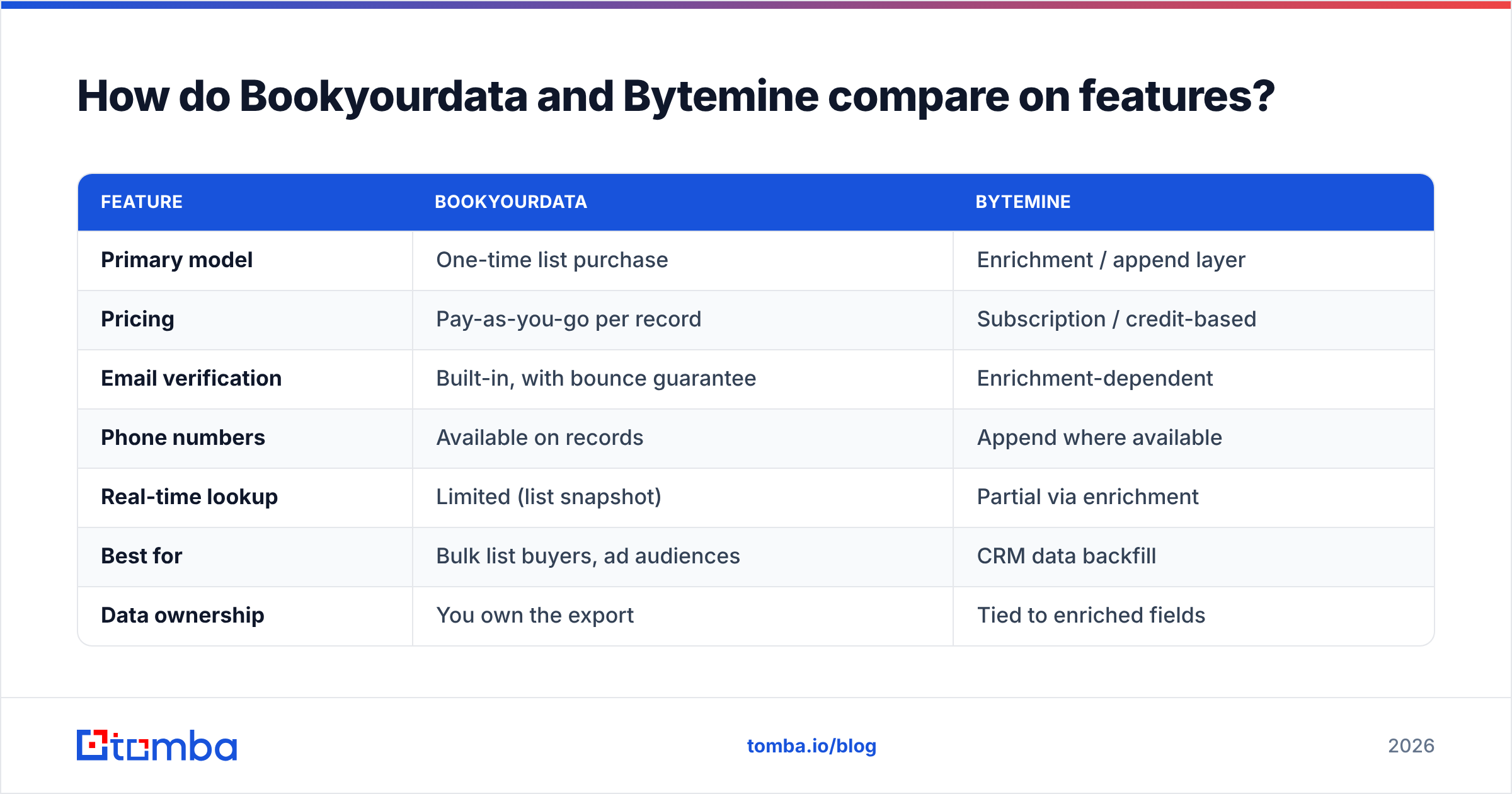
Here is the side-by-side on the attributes that actually affect a sales or marketing workflow.
| Feature | Bookyourdata | Bytemine |
|---|---|---|
| Primary model | One-time list purchase | Enrichment / append layer |
| Pricing | Pay-as-you-go per record | Subscription / credit-based |
| Email verification | Built-in, with bounce guarantee | Enrichment-dependent |
| Phone numbers | Available on records | Append where available |
| Real-time lookup | Limited (list snapshot) | Partial via enrichment |
| Best for | Bulk list buyers, ad audiences | CRM data backfill |
| Data ownership | You own the export | Tied to enriched fields |
| API access | Available | Core to the product |
The headline takeaway: Bookyourdata is optimized for acquiring net-new contacts in bulk, while Bytemine is optimized for improving the records you already hold. Teams often think they need one when they actually need the other.
Which has better data accuracy?#
Accuracy is where list-based tools live or die — and it is the single most misleading metric in this category.
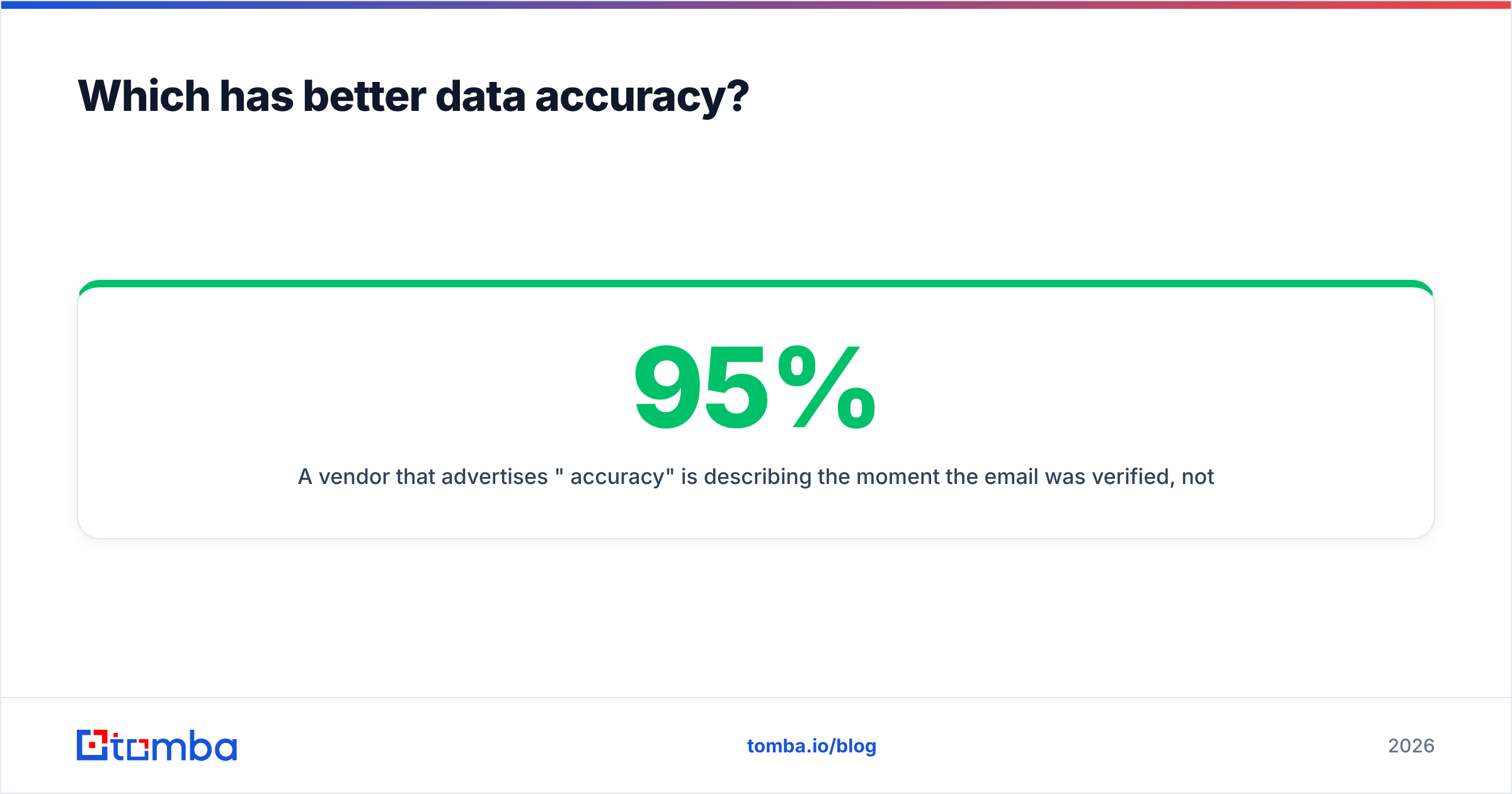
A vendor that advertises "95% accuracy" is describing the moment the email was verified, not the moment you send to it. B2B data decays fast: people change jobs, companies rebrand, and email formats shift. Industry estimates put contact data decay at 22% to 30% per year, which means a static list bought in January is materially worse by summer.
This is the structural weakness of any download-and-own model like Bookyourdata's. The guarantee covers bounces at delivery time, but it can't stop a valid address from going stale three months later. Bytemine's enrichment model ages more gracefully in theory — re-enriching a record refreshes it — but you only benefit if you actually re-run enrichment on a schedule, and that consumes credits.
The accuracy question is exactly why a real-time approach matters. When you find email addresses at the moment you need them and run email verification right before sending, you sidestep the decay problem entirely. You can see how a real-time finder's accuracy stacks up against list vendors below.

How do they price B2B data?#
Pricing is where the two diverge most, and where the hidden cost of "cheap per record" shows up.
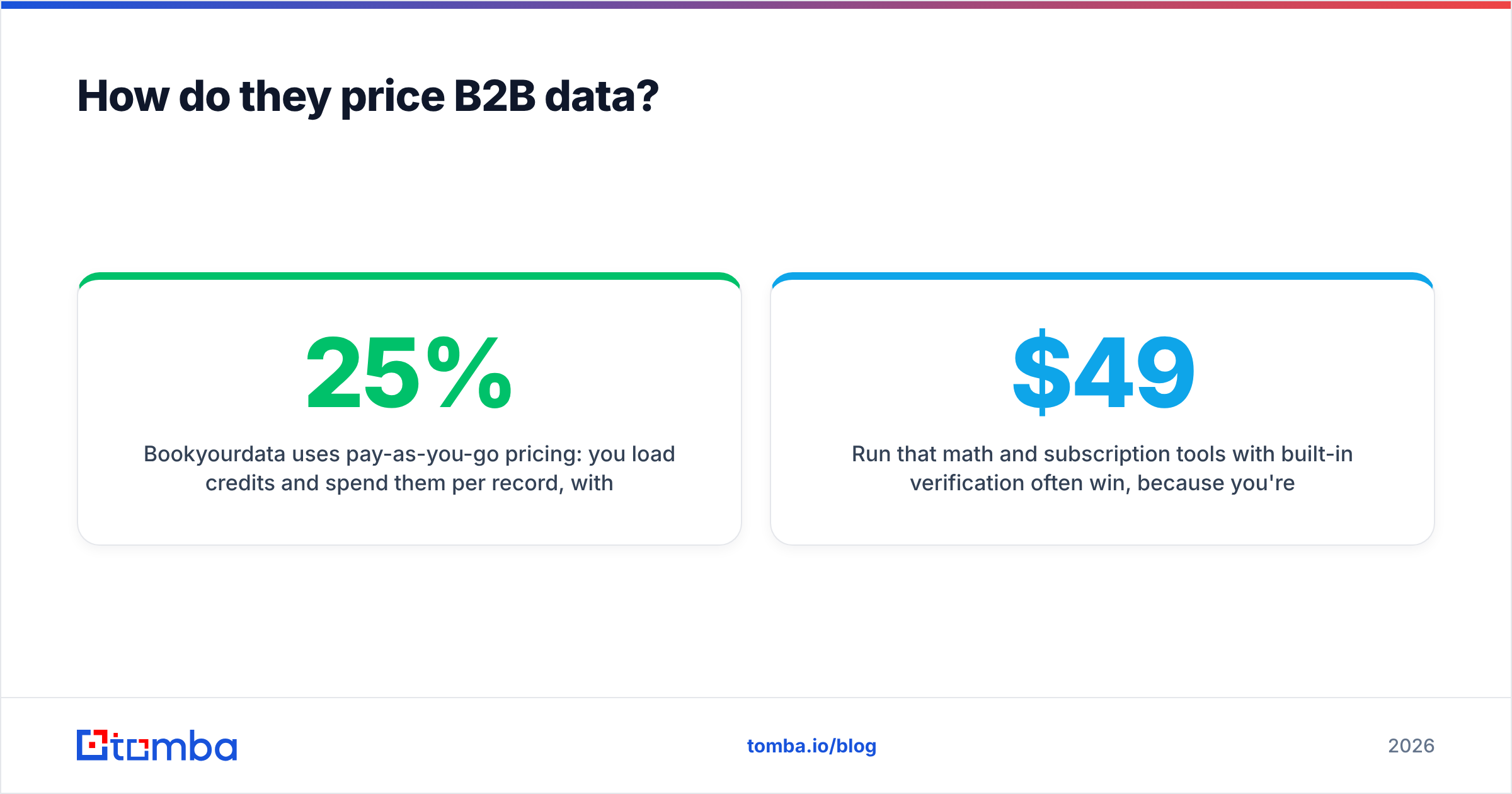
Bookyourdata uses pay-as-you-go pricing: you load credits and spend them per record, with volume discounts at higher tiers. The appeal is no recurring commitment — buy a list, leave, come back next quarter. The catch is cost-per-valid-contact. If you buy 10,000 records and 25% have decayed by send time, your effective price per usable contact is one-third higher than the sticker.
Bytemine leans subscription/credit, which suits teams enriching continuously but penalizes infrequent users — you pay whether or not you run a big append that month.
To compare honestly, ignore the per-record sticker and compute cost-per-valid-contact:
- Take the quoted price per record or per credit.
- Apply the real bounce/decay rate at your actual send time, not the verification date.
- Add re-verification cost if you scrub before sending (you should).
- Divide total spend by deliverable contacts — that's your true number.
- Factor wasted sender reputation from bounces, which is hard to price but very real.
- Compare against a real-time tool's per-search cost.
Run that math and subscription tools with built-in verification often win, because you're not paying for dead records. For reference, Tomba pricing starts with a free tier (25 searches/month), then Starter at $49/mo, Growth at $99/mo, and Pro at $249/mo — with verification included rather than billed as a separate line.
Is Bookyourdata or Bytemine better for cold outreach?#
For cold outreach specifically, freshness beats volume every time.
Cold email lives or dies on deliverability, and deliverability is wrecked by bounces. A single batch with a 5%+ bounce rate can tank your domain's sender reputation for weeks. That makes a large, slightly-stale Bookyourdata list riskier than it looks: the volume that feels like an advantage becomes a liability the moment you load it into a sequencer and hit send.
Bytemine's enrichment model is gentler on outreach if — and only if — you re-enrich before each campaign. Most teams don't, which means enriched records drift just like purchased lists.
Either way, the non-negotiable step is verification at send time. Buying or enriching data and then skipping a fresh scrub is the most common cause of cold-email flameouts. If you want the mechanics, our guides on email deliverability and using a dedicated bulk email finder walk through the safe workflow.
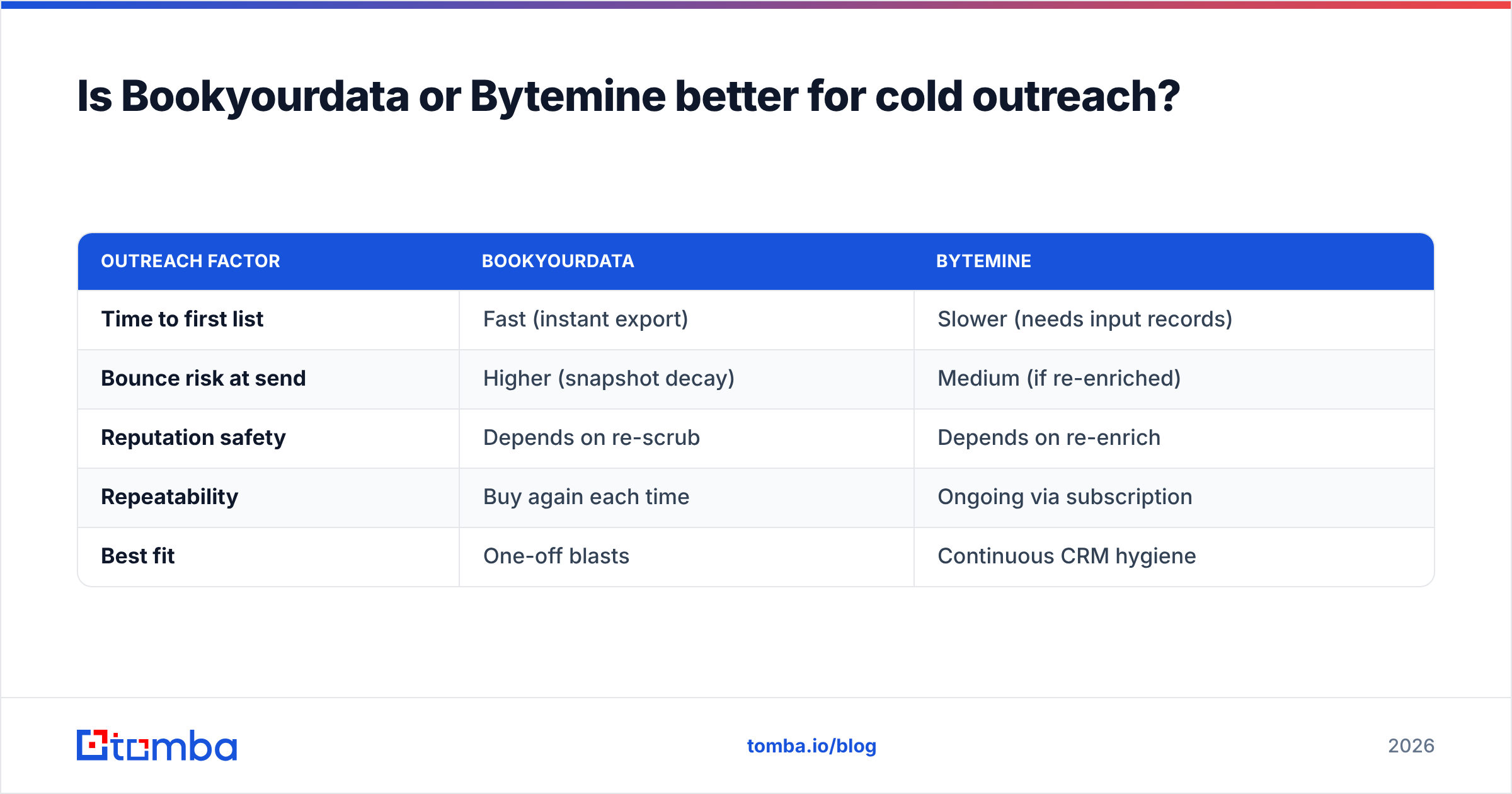
Here's how the two stack up for a cold-outreach use case:
| Outreach factor | Bookyourdata | Bytemine |
|---|---|---|
| Time to first list | Fast (instant export) | Slower (needs input records) |
| Bounce risk at send | Higher (snapshot decay) | Medium (if re-enriched) |
| Reputation safety | Depends on re-scrub | Depends on re-enrich |
| Repeatability | Buy again each time | Ongoing via subscription |
| Best fit | One-off blasts | Continuous CRM hygiene |
What about compliance and data sourcing?#
Compliance matters more in 2026 than it did even two years ago, with GDPR enforcement and U.S. state privacy laws tightening the rules on B2B data.
Bookyourdata publishes a compliance stance covering GDPR and CCPA, which is table stakes for any list vendor. Bytemine, as an enrichment provider, inherits compliance questions about where appended data originates. With any third-party data, the question to ask is the same: where did this record come from, and can the vendor show a lawful basis? Vendors that are vague about sourcing are a risk regardless of their accuracy claims.
This is worth scrutinizing because legitimate-interest outreach in the EU and consent rules elsewhere hinge on provenance. Transparent providers document their data sources openly. Before you commit budget to either tool, read their data-processing terms and confirm they'll sign a DPA. You can cross-check user reports on independent review sites like G2 and Capterra to see how each handles deletion requests and source disputes in practice.
When should you choose a real-time alternative instead?#
Choose a real-time email finder when your priority is deliverable contacts, not a big number in a CSV — which is most outbound teams.
The core limitation of both Bookyourdata and Bytemine is structural, not a flaw in execution: any pre-built or pre-enriched dataset starts decaying the instant it's created. A real-time tool flips the model. You search for a contact when you're ready to act on it, verify it on the spot, and never carry the cost of records that died on a shelf.
Here's where each model genuinely wins:
| Scenario | Best choice |
|---|---|
| One-time bulk list for an ad audience | Bookyourdata |
| Continuously backfilling CRM gaps | Bytemine |
| Cold outreach with low bounce tolerance | Real-time finder + verifier |
| Building lists from specific domains | Domain search |
| Enriching a few hundred known leads | Data enrichment |
| API-driven, on-demand lookups | Email finder API |
The practical workflow that beats both: identify your target accounts, run a domain or name lookup to find current emails, verify each one, and only then load them into your sequencer. Nothing sits long enough to decay. For teams already living in spreadsheets or a CRM, the same engine plugs into Google Sheets and a Chrome extension so you're not exporting and re-importing CSVs.
The bottom line: Bookyourdata vs Bytemine#
Both tools are legitimate, and both have a clear home. Pick Bookyourdata if you need to buy a large, self-serve list in one shot and you'll re-verify before sending. Pick Bytemine if your real problem is half-empty CRM records and you'll commit to re-enriching on a schedule. Don't buy either expecting a "set it and forget it" database — that product doesn't exist, because data doesn't sit still.
If your actual goal is cold outreach that lands in the inbox, the smarter spend is a real-time stack: find current emails on demand, verify them at send time, and stop paying for decay. That's exactly what the Tomba Email Finder is built for — find professional emails by domain, name, or company, verify them in the same flow, and start free with 25 searches a month before scaling to a plan that fits your volume. Try it against a sample of your target accounts and compare the bounce rate to your last purchased list. The difference is usually the whole argument.
// get started
Find, verify and enrich your first contacts today
Start on the free plan with 25 searches a month, then scale when your team is ready.
Free plan · No credit card required · GDPR & CCPA
// about the author