Bookyourdata vs Coldlytics: Best B2B Lead Data in 2026
Bookyourdata sells a pay-as-you-go contact database; Coldlytics hand-builds prospect lists on demand. Here is which one fits your outbound motion in 2026 — and where a live email finder beats both.
TL;DR
- Bookyourdata is a self-serve, pay-as-you-go B2B contact database — you filter, preview, and buy records on the spot with a 97% accuracy guarantee.
- Coldlytics is a done-for-you (and DIY) prospecting service — a human-plus-tool team researches and verifies a fresh list against your exact criteria.
- Choose Bookyourdata for instant volume and broad firmographic filtering; choose Coldlytics for niche, hard-to-find roles where a pre-built database comes up empty.
- Both sell lists. Neither replaces a live email finder that verifies an address the moment you need it — which is where a tool like Tomba changes the math.
- Below: a side-by-side table, pricing reality, accuracy notes, and a decision framework so you stop overpaying for stale rows.
What are Bookyourdata and Coldlytics?#
Quick answer: they solve the same problem — "get me contacts to email" — from opposite ends.
Bookyourdata is a contact-database platform. You log in, apply filters (industry, job title, location, company size, technology used), see a live count, and pay only for the records you export. It markets a 97% accuracy guarantee and bills on a credit basis, so you can buy 500 contacts or 50,000 without a forced annual seat.
Coldlytics is a prospecting service. Instead of querying a giant pre-built database, you submit your ideal-customer criteria and a team (backed by their own tooling and research process) builds a fresh list to match — including the awkward titles and small companies that big databases miss. Lists are built and verified close to delivery time, so the data is current rather than warehoused.
Here is the everyday analogy: Bookyourdata is the supermarket — everything is on the shelf, you grab what you want and check out. Coldlytics is the personal shopper — you describe what you need and someone sources it to order. The supermarket is faster and cheaper per item; the personal shopper finds the rare thing the supermarket never stocks.
Bookyourdata vs Coldlytics: the side-by-side comparison#
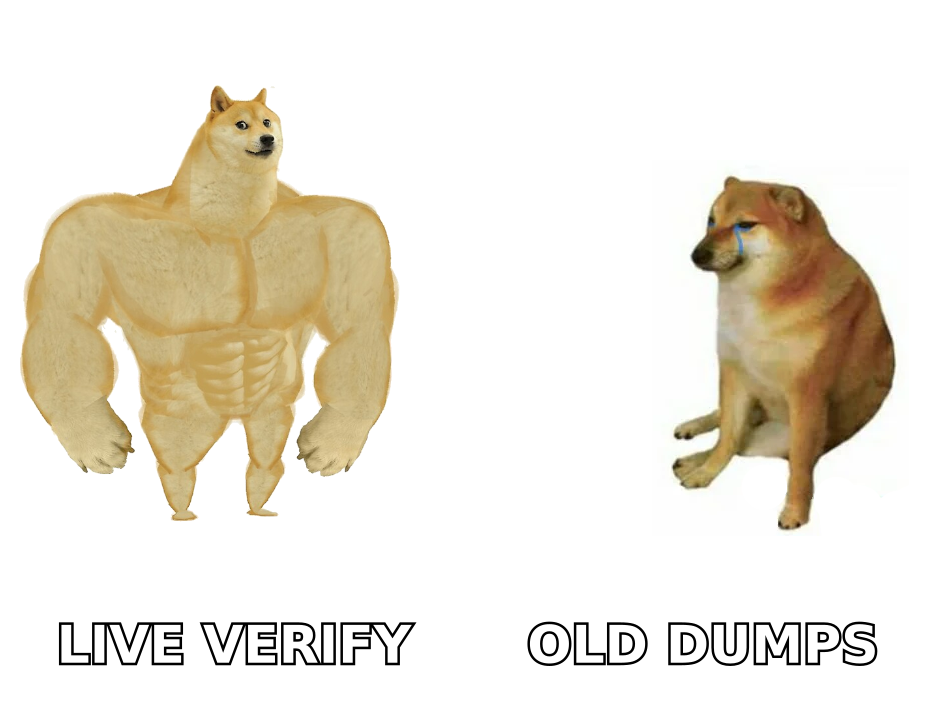
The core difference is inventory model: a static (but instantly searchable) database versus an on-demand (but slower) build. That single choice drives price, freshness, and how much volume you can pull on a Tuesday afternoon.
| Attribute | Bookyourdata | Coldlytics |
|---|---|---|
| Model | Self-serve contact database | Done-for-you / DIY list building |
| Data freshness | Warehoused, periodically refreshed | Built and verified near delivery |
| Best for | Instant volume, broad filtering | Niche titles, small companies, hard finds |
| Accuracy claim | ~97% guarantee | Per-build verification |
| Speed to first list | Minutes | Hours to days (build queue) |
| Pricing model | Pay-as-you-go credits | Credit / subscription per researched lead |
| Filtering depth | Strong firmographic + tech filters | Defined by your custom brief |
| Volume ceiling | Very high (large database) | Limited by research throughput |
| Typical buyer | SMB to mid-market outbound teams | Agencies, niche B2B, recruiters |
Read the table as a trade-off curve, not a winner board. Bookyourdata wins the top of the funnel — speed and scale. Coldlytics wins the long tail — precision on roles a database has never indexed. Most teams that grow eventually use both: a database for the obvious 80% and a build service for the stubborn 20%.
If you want to see how either dataset performs before you commit budget, run a sample through an email verifier first. A 97% claim on a vendor's marketing page and a 97% result on your exported segment are not the same number.
Which has better data quality and accuracy?#
Conclusion first: accuracy depends on recency, and recency depends on the model. A warehoused database is only as fresh as its last refresh; a built-to-order list is verified close to send time, so it tends to bounce less on niche segments — but it costs more per record and takes longer.
B2B contact data decays fast. Industry estimates from data vendors and analysts like Gartner put B2B data decay at roughly 30% per year as people change jobs, companies merge, and domains migrate. That means a record sitting in a database for ten months is meaningfully riskier than one verified last week — regardless of the headline accuracy guarantee.
Three practical checks before you trust either provider:
- Ask when records were last verified, not just the accuracy percentage. "97% accurate" with no timestamp is a marketing number.
- Re-verify on export. Run every list through verification immediately — a catch-all verifier matters here because catch-all domains pass naive checks but still bounce.
- Sample before scaling. Buy or build 200 records, send a small test, measure real bounce and reply rates, then decide whether to scale that source.
This is also where the "buy a list" model shows its ceiling. Whether the CSV came from a database or a research team, it is a snapshot frozen at purchase. The address that was valid on Monday can be dead by the time your sequence reaches it on Thursday.
How do Bookyourdata and Coldlytics price their data?#
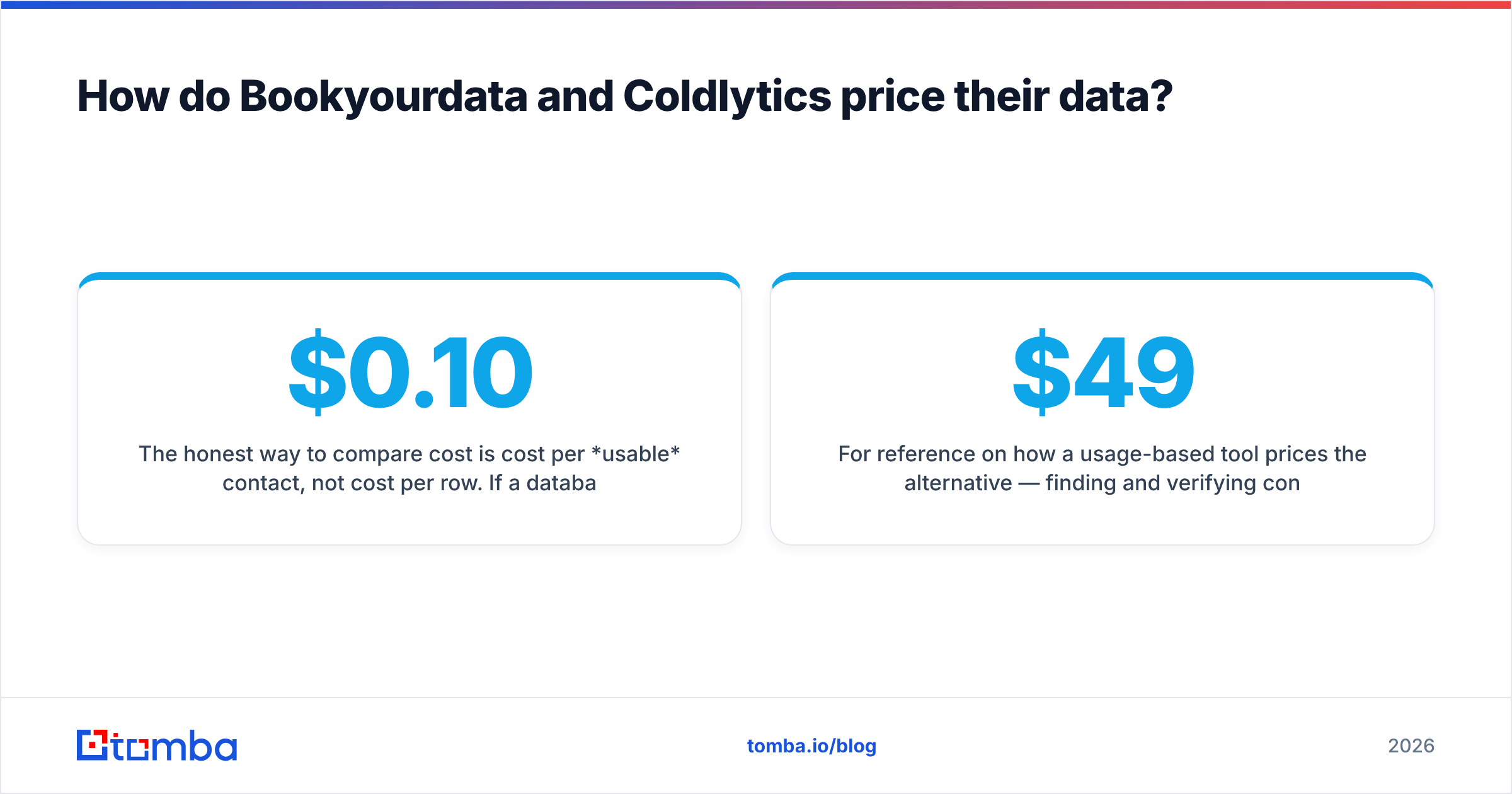
Short version: Bookyourdata is cheaper per record and pay-as-you-go; Coldlytics charges more per lead because a human-plus-tool process is doing custom work. You are paying for labor and freshness, not just rows.
- Bookyourdata runs on credits with no forced seat. You can top up, export, and stop — attractive if your outbound is seasonal or campaign-based. Per-record cost is low, which is the whole point of a self-serve database.
- Coldlytics prices per researched lead (with credit packs or subscription tiers). The per-lead number looks high next to a database, but the comparison is unfair: you are buying fresh, hand-qualified contacts in segments a database may not cover at all.
The honest way to compare cost is cost per usable contact, not cost per row. If a $0.10 database record bounces 25% of the time and a $0.60 researched lead bounces 3%, the gap narrows fast once you factor in deliverability damage, wasted sequence slots, and sender-reputation risk. Bounces do not just cost you the lead — they cost you future inbox placement. Keep your sender reputation out of it by verifying before you send.
For reference on how a usage-based tool prices the alternative — finding and verifying contacts yourself rather than buying lists — see Tomba pricing: a free tier (25 searches/mo), Starter at $49/mo, Growth at $99/mo, and Pro at $249/mo.
When should you pick each one?#
Match the tool to the motion, not to the brand.
Pick Bookyourdata when:
- You need volume today and your ICP is broad enough that a big database covers it.
- Your filters are firmographic — industry, size, location, tech stack — rather than exotic titles.
- You want pay-as-you-go with no annual commitment.
- Your team will re-verify on export and treat the database as a starting point, not gospel.
Pick Coldlytics when:
- Your targets are niche: unusual job titles, sub-50-person companies, regional players a database under-indexes.
- You would rather hand off research than run filters yourself.
- Freshness matters more than instant turnaround and you can wait for a build.
- Precision beats volume for your campaign economics (high ACV, low list size).
Look past both when your real need is finding and verifying a specific person on demand — for example, you already know the company and the role, and you want that one decision-maker's verified email right now. That is not a list-buying problem; it is a lookup problem, and it is exactly what an email finder is built for.
How does a live email finder compare to buying lists?#
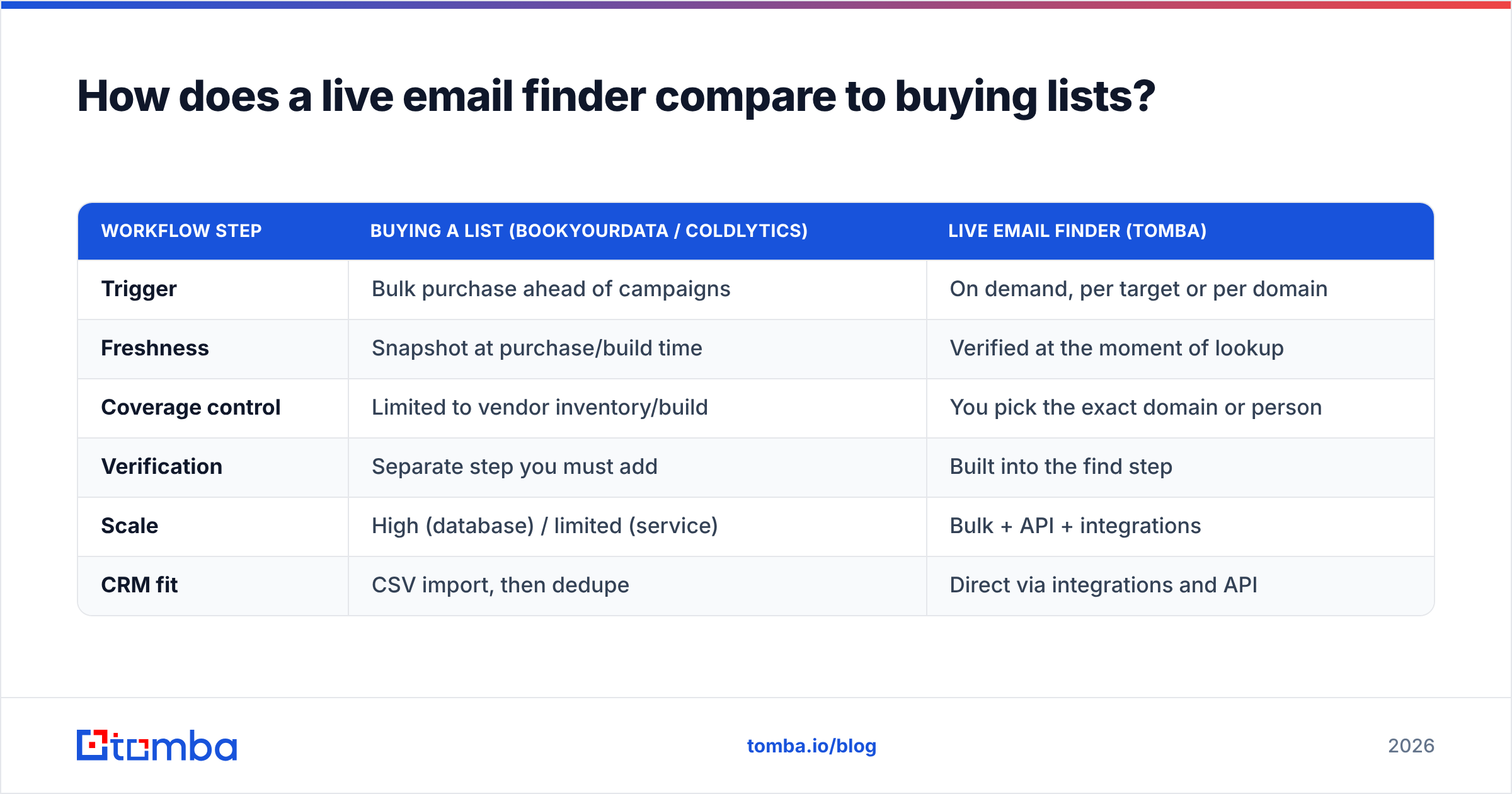
Direct answer: a live email finder flips the model from buy a frozen snapshot to generate a verified contact at the moment of need. For most modern outbound and ABM workflows, that is the more accurate and more flexible path — and it composes with both providers above rather than replacing them outright.
Here is the workflow difference, mapped to a structured comparison:
| Workflow step | Buying a list (Bookyourdata / Coldlytics) | Live email finder (Tomba) |
|---|---|---|
| Trigger | Bulk purchase ahead of campaigns | On demand, per target or per domain |
| Freshness | Snapshot at purchase/build time | Verified at the moment of lookup |
| Coverage control | Limited to vendor inventory/build | You pick the exact domain or person |
| Verification | Separate step you must add | Built into the find step |
| Scale | High (database) / limited (service) | Bulk + API + integrations |
| CRM fit | CSV import, then dedupe | Direct via integrations and API |
Four concrete ways teams use a finder instead of (or alongside) a purchased list:
- Domain sweep — feed a target account's domain into domain search and pull the verified, role-relevant contacts at that company, only when you actually work the account.
- Single-target lookup — know the name and company, get the verified email in seconds without buying a 5,000-row pack to reach one person.
- Bulk on demand — run a bulk email finder over a list of companies you already care about, so you pay for relevance instead of a vendor's pre-cut segment.
- Pipeline automation — wire the Tomba API or a HubSpot integration so enrichment happens inside your CRM as records arrive, keeping data fresh continuously instead of decaying after one purchase.
The strategic point: lists decay the instant you buy them, but a finder is queried fresh every time. If your outbound depends on email deliverability, the source that verifies at lookup protects your reputation better than the source that verified months ago.
Bookyourdata vs Coldlytics: the verdict#
If you only compare the two head-to-head:
- Bookyourdata is the better default for teams that need broad, high-volume B2B data fast and cheap, with the discipline to re-verify before sending.
- Coldlytics is the better pick for niche, hard-to-source segments where a database simply has no rows — the value is in the custom research, not the raw count.
But the smarter framing is don't anchor on a static list at all if your motion is account-based or precision-led. Buy or build a list when you genuinely need volume in a covered segment; use a live finder for everything you can target by domain or by name. Many of the best outbound teams in 2026 run a hybrid: a database for breadth, a build service for the long tail, and an always-on email finder as the verification and on-demand layer that keeps the whole stack honest.
Before any of it touches your sequencer, run the data through verification. A clean list from a mediocre source beats a dirty list from a premium one, every time.
Start finding verified contacts on demand#
If you are weighing bookyourdata vs coldlytics because you need reliable B2B contacts, try solving the part both of them leave to you: getting a verified address at the moment you need it. The Tomba Email Finder lets you search by name, company, or domain, verifies as it finds, and plugs into your CRM through the API and native integrations — so you stop paying for rows that bounced before you opened the file. Start on the free tier (25 searches/mo), then scale on a plan that matches your volume instead of a database you outgrow. Find the people you actually want to reach, verify them live, and keep your sender reputation intact.
// get started
Find, verify and enrich your first contacts today
Start on the free plan with 25 searches a month, then scale when your team is ready.
Free plan · No credit card required · GDPR & CCPA
// about the author