Bookyourdata vs Coresignal (2026): B2B Data Showdown
Bookyourdata sells verified contact lists; Coresignal pipes raw firmographic and employee data via API. Here's which B2B data source fits your GTM stack in 2026 — and where a finder beats both.
Choosing between Bookyourdata and Coresignal feels like comparing a grocery store to a wholesale farm. One hands you a finished basket of contacts you can email today. The other ships you raw data by the truckload and expects you to cook. Both are legitimate B2B data plays in 2026 — they just solve different problems, and picking the wrong one burns budget fast.
This breakdown cuts through the marketing. You'll get a side-by-side on data type, pricing model, accuracy, compliance, and the exact use case each one wins. And because neither tool is built primarily for finding a specific person's email on demand, we'll show where a dedicated email finder fits into the same workflow.
TL;DR — Bookyourdata vs Coresignal at a glance#
- Bookyourdata is a pay-as-you-go B2B contact list builder. You filter by title, industry, and location, then buy verified emails and phone numbers as ready-to-export rows.
- Coresignal is a raw data-as-a-service provider. It delivers firmographic, employee, and job-posting datasets through an API or bulk delivery — built for engineers and data teams, not reps.
- Pick Bookyourdata if you want a list you can email this afternoon with no engineering. Pick Coresignal if you're building a product, scoring model, or enrichment pipeline that needs fresh structured data at scale.
- Neither is a precision email finder. For "I have this person and company, get me their verified email," a tool like Tomba does it cheaper and on demand.
- Cost shape differs wildly: Bookyourdata charges per record; Coresignal charges per API credit or dataset subscription that runs into the thousands.
What is Bookyourdata?#
Bookyourdata is a self-serve contact database aimed at sales and marketing teams who want lists now. You log in, apply filters — job title, seniority, industry, company size, geography — and the platform shows you a count of matching contacts. You pay per record and export emails, direct dials, and company fields to CSV or push them into your CRM.
The pitch is simplicity and a "95% accuracy" guarantee, with credits refunded for bounces beyond that threshold. There's no contract floor for the basic pay-as-you-go path, which makes it approachable for a solo founder or a small SDR team running a one-off campaign.
The tradeoff: you're buying a snapshot. The data is pre-packaged, so you inherit whatever staleness sits in the underlying database between refreshes. For broad, top-of-funnel list building that's fine. For pinpoint accuracy on a single high-value prospect, a snapshot is weaker than a live lookup.
What is Coresignal?#
Coresignal is a different animal. It's a public web data company that sells structured, large-scale datasets: company firmographics, employee records, job postings, and technographic signals. Delivery is via REST API, bulk file drops, or a queryable search API — and the buyers are typically data engineers, ML teams, investors, and product builders.
You don't log in and "buy 500 marketing managers in Texas." You query an API for, say, every company in fintech that posted a backend engineering role in the last 30 days, then join that against your own models. Coresignal sells signal and scale, not a polished outreach list.
That power comes with weight. You need engineering resources to integrate it, parse it, and keep it fresh. Pricing reflects the enterprise audience — subscriptions and credit packs that start well above what a typical SDR team would expense. If you just need emails for a cold campaign, Coresignal is overkill.
Bookyourdata vs Coresignal: the core comparison table#
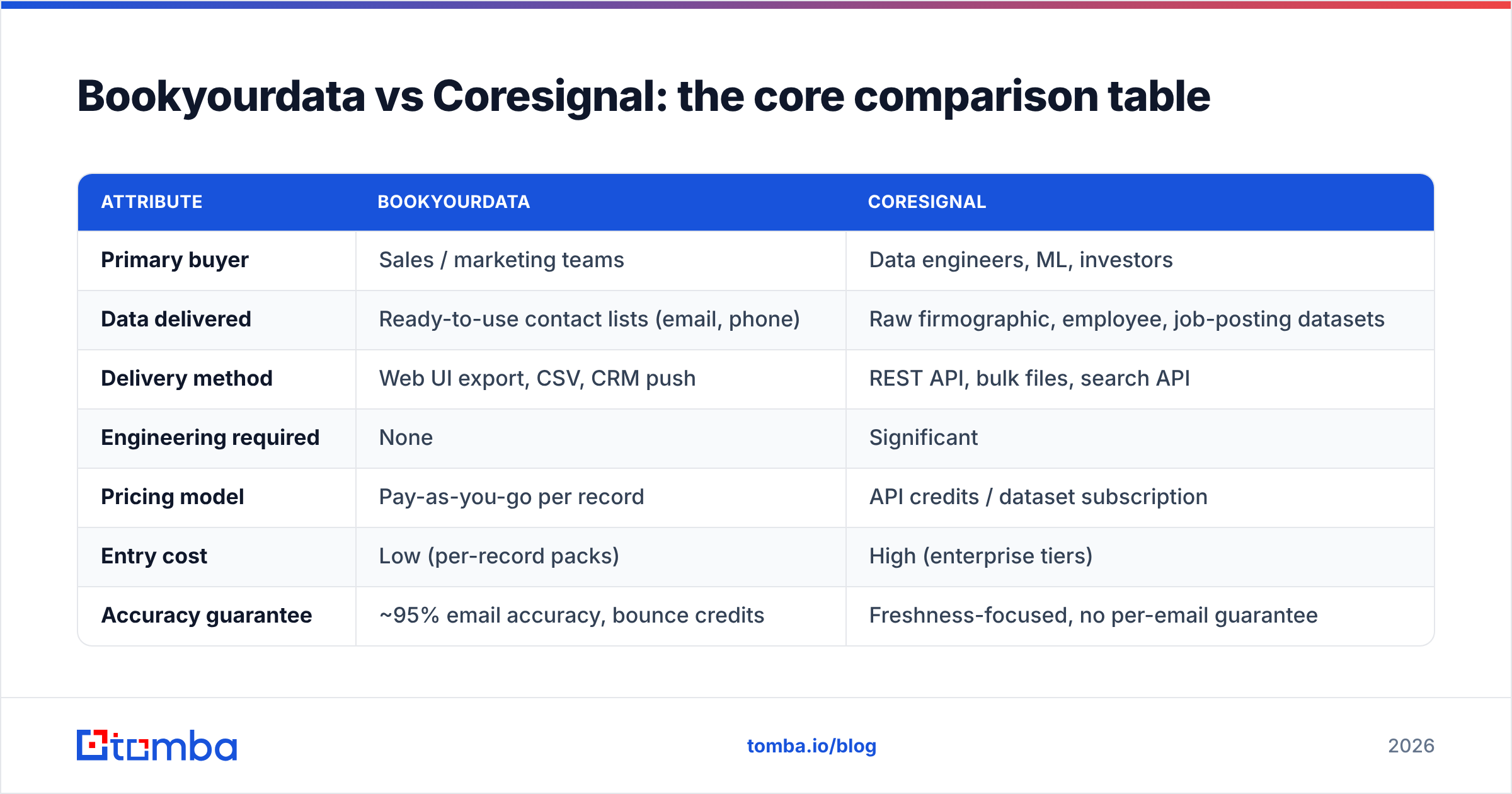
| Attribute | Bookyourdata | Coresignal |
|---|---|---|
| Primary buyer | Sales / marketing teams | Data engineers, ML, investors |
| Data delivered | Ready-to-use contact lists (email, phone) | Raw firmographic, employee, job-posting datasets |
| Delivery method | Web UI export, CSV, CRM push | REST API, bulk files, search API |
| Engineering required | None | Significant |
| Pricing model | Pay-as-you-go per record | API credits / dataset subscription |
| Entry cost | Low (per-record packs) | High (enterprise tiers) |
| Accuracy guarantee | ~95% email accuracy, bounce credits | Freshness-focused, no per-email guarantee |
| Best for | Fast cold outreach lists | Building products, scoring, enrichment at scale |
| Weakest at | Pinpoint single-contact lookups | Plug-and-play outreach |
Is Bookyourdata better than Coresignal?#
Neither is "better" — they're built for opposite jobs, and the honest answer depends on who's asking.
Choose Bookyourdata if you are a revenue team that needs contacts to email this week. You have no data engineers, you want a UI, and you're running outbound or paid campaigns. Bookyourdata's per-record model means you only pay for what you pull, and the export lands in your CRM without a build phase.
Choose Coresignal if you are building something. A lead-scoring model, an investment-signals dashboard, a market-mapping tool, a TAM analysis, or an internal data enrichment pipeline. You have engineers, you want raw breadth and freshness, and you'll do the shaping yourself.
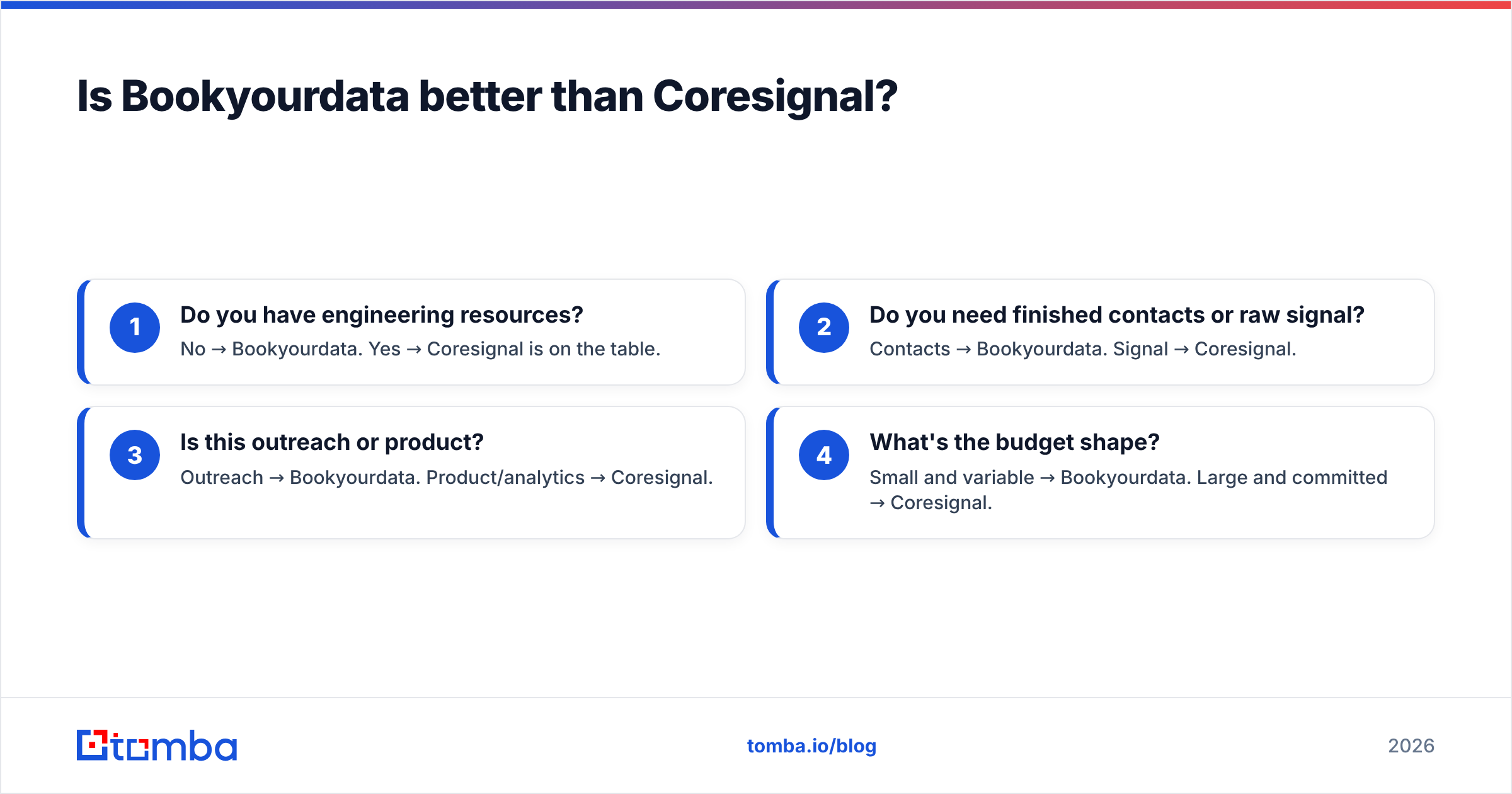
Here's the decision in four checks:
- Do you have engineering resources? No → Bookyourdata. Yes → Coresignal is on the table.
- Do you need finished contacts or raw signal? Contacts → Bookyourdata. Signal → Coresignal.
- Is this outreach or product? Outreach → Bookyourdata. Product/analytics → Coresignal.
- What's the budget shape? Small and variable → Bookyourdata. Large and committed → Coresignal.
If you answered "I just need verified emails for people I already know about," the real answer is neither — keep reading.
How accurate is the data, and how do you verify it?#
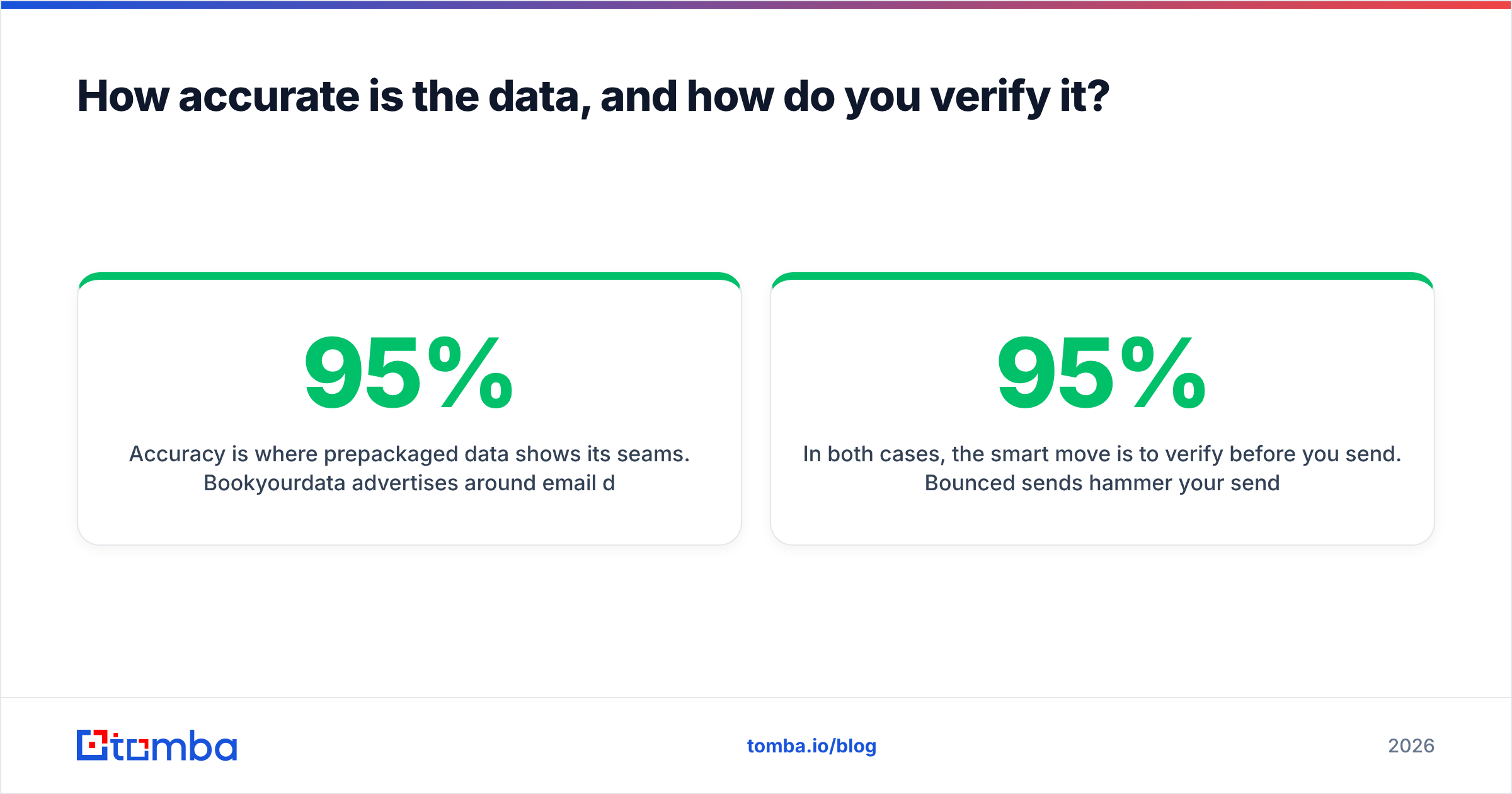
Accuracy is where prepackaged data shows its seams. Bookyourdata advertises around 95% email deliverability and refunds credits on excess bounces, which is reasonable for bulk lists. Coresignal optimizes for freshness and coverage at scale rather than promising a verified inbox for every row — that's your job downstream.
In both cases, the smart move is to verify before you send. Bounced sends hammer your sender reputation, and a list that was "95% accurate" at export decays roughly 2–3% per month as people change jobs. Running any purchased or queried list through a dedicated email verifier catches dead addresses, role accounts, and catch-all domains before they touch your sequencer.
This is also the gap where a finder earns its place. When you have a named prospect at a known company — the classic case prepackaged datasets handle poorly — an on-demand lookup returns a single verified address with a confidence score, instead of forcing you to buy a bracket of rows hoping yours is inside. You can validate the same workflow with a free email checker before committing credits.
What does each one cost in 2026?#
Cost structure matters more than headline price, because the two tools bill on different axes.
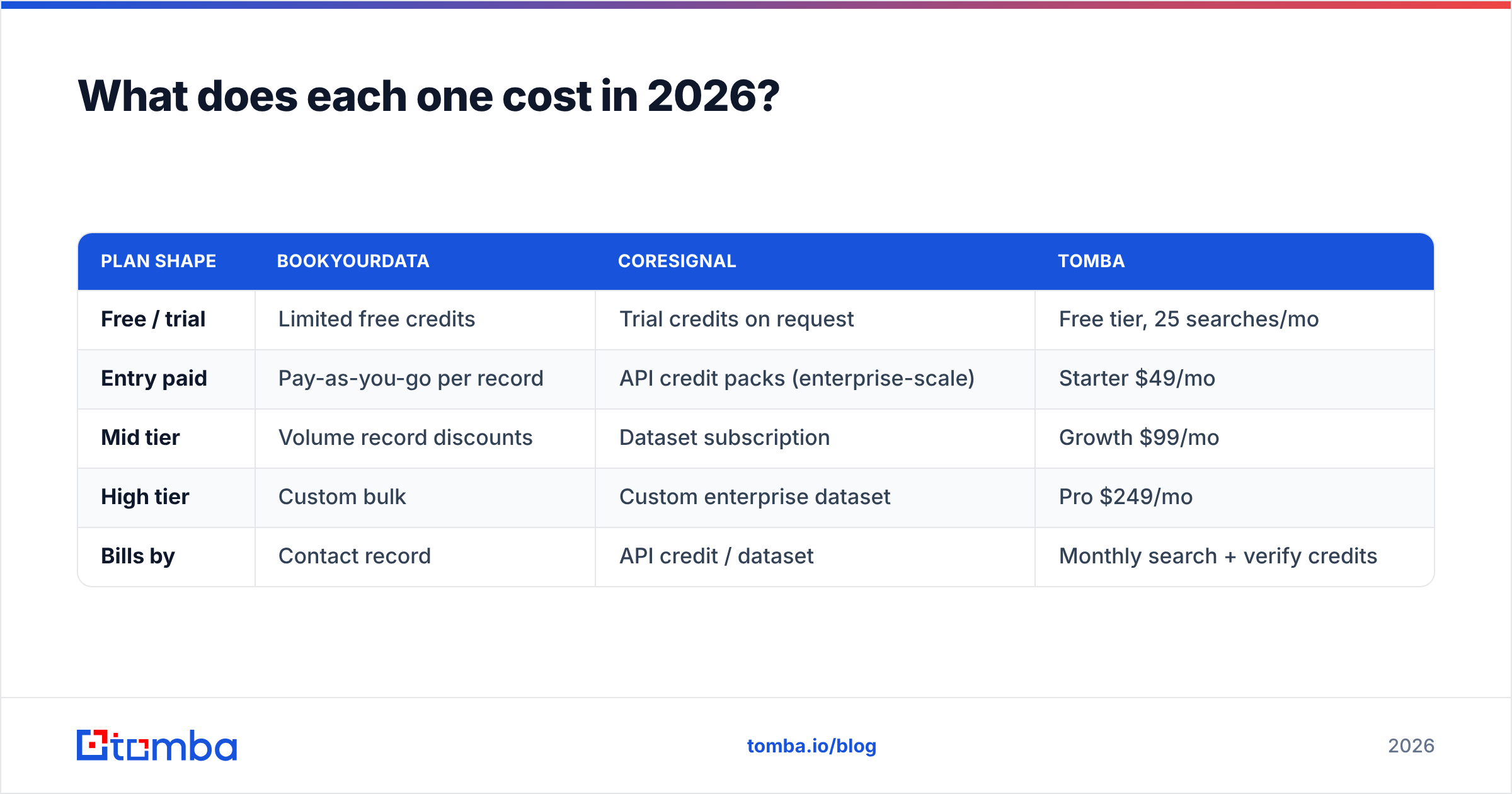
| Plan shape | Bookyourdata | Coresignal | Tomba |
|---|---|---|---|
| Free / trial | Limited free credits | Trial credits on request | Free tier, 25 searches/mo |
| Entry paid | Pay-as-you-go per record | API credit packs (enterprise-scale) | Starter $49/mo |
| Mid tier | Volume record discounts | Dataset subscription | Growth $99/mo |
| High tier | Custom bulk | Custom enterprise dataset | Pro $249/mo |
| Bills by | Contact record | API credit / dataset | Monthly search + verify credits |
Bookyourdata's pay-per-record model is friendly for unpredictable, bursty needs — buy 2,000 records this quarter, nothing the next. Coresignal's subscriptions assume sustained, high-volume consumption and reward you with scale and freshness, but the commitment is real.
For teams that mostly need verified emails and phone numbers without a data-engineering project, a flat monthly finder is often the cheapest path. See full Tomba pricing for the credit math — the Starter plan is $49/mo, not the $39 some roundups misquote.
Where does a dedicated email finder fit?#
A finder solves the one job both of these tools handle awkwardly: turning a known person + company into a verified email, instantly, without buying a list or building a pipeline.
Think of it as the difference between buying a phone book (Bookyourdata), licensing the census (Coresignal), and asking a directory assistant for one specific number (a finder). All three are valid; the finder is what you reach for during live prospecting.
A few patterns where this beats both providers:
- Account-based outreach. You have a target account and a named champion. A domain search returns the verified contacts at that company without buying the whole industry vertical.
- CRM enrichment on signup. When a lead fills a form, hit an email finder API to enrich the record in real time instead of batch-buying data you may never use.
- Catch-all handling. Many corporate domains accept everything, fooling bulk lists. A catch-all verifier tells you whether the box is actually reachable.
Tomba's data sourcing and verification approach is documented openly on its data sources page, which matters when you're defending list quality to a compliance team.
What about compliance and data sourcing?#
Both providers gather business contact data from public and licensed sources, and both position themselves as GDPR- and CCPA-aware. But compliance posture is something you verify yourself, not something you take on faith from a homepage.
Before you buy from either, check three things: where the data originates, whether there's a documented opt-out and suppression process, and whether the vendor will sign a DPA. Independent reviews on G2 and the vendors' own trust documentation — Bookyourdata and Coresignal both publish theirs — are the right places to confirm claims rather than relying on a comparison post.
The practical rule for outbound: legally sourced data still needs relevance to survive deliverability filters. A perfectly compliant list sent to uninterested inboxes still tanks your sender reputation. Targeting tightly and verifying before send protects you on both the legal and the deliverability front.
Which should you actually pick?#
Quick verdict by team type:
- Solo founder / small SDR team, outbound this week: Bookyourdata. Low entry cost, no build, export and go — then verify before sending.
- Data/ML/product team building at scale: Coresignal. Raw breadth, freshness, and API-native delivery justify the spend.
- Anyone doing precise, live, account-based prospecting or CRM enrichment: a dedicated finder. You'll spend less and get a single verified address per lookup instead of a bracket of rows.
- Mixed needs: pair a finder for daily prospecting with one bulk source for periodic list refreshes.
The mistake teams make is forcing one tool to do all three jobs. Bookyourdata isn't built for pinpoint lookups; Coresignal isn't built for plug-and-play outreach; and a finder isn't built for licensing ten million firmographic rows. Match the tool to the job and your cost-per-meeting drops.
The bottom line#
Bookyourdata vs Coresignal isn't really a head-to-head — it's two different layers of the B2B data stack. Bookyourdata sells finished lists for revenue teams; Coresignal sells raw data infrastructure for builders. Decide which layer you're operating at, confirm compliance directly with each vendor, and always verify before you send.
If most of your work is finding and verifying the right contacts during live prospecting — not buying lists or running data pipelines — start with the Tomba Email Finder. You get verified emails by name, company, or domain on demand, a free tier with 25 searches a month to test it, and built-in verification so your sender reputation stays intact. Run a few searches against your current list and compare the hit rate yourself before you commit a dollar to bulk data.
// get started
Find, verify and enrich your first contacts today
Start on the free plan with 25 searches a month, then scale when your team is ready.
Free plan · No credit card required · GDPR & CCPA
// about the author