Bookyourdata vs D7 Lead Finder: 2026 B2B Data Showdown
Bookyourdata sells pay-as-you-go verified contacts; D7 Lead Finder scrapes local business leads. Here is which one fits your pipeline in 2026 — and the verification gap both leave open.
You are choosing a B2B data source and two names keep coming up: Bookyourdata and D7 Lead Finder. They sound similar, but they solve different problems. Pick the wrong one and you either overpay for contacts you do not need, or you build a pipeline on leads that bounce.
This guide breaks down where each tool wins, where each one quietly fails, and how to plug the verification gap both of them leave open.
TL;DR — Bookyourdata vs D7 Lead Finder#
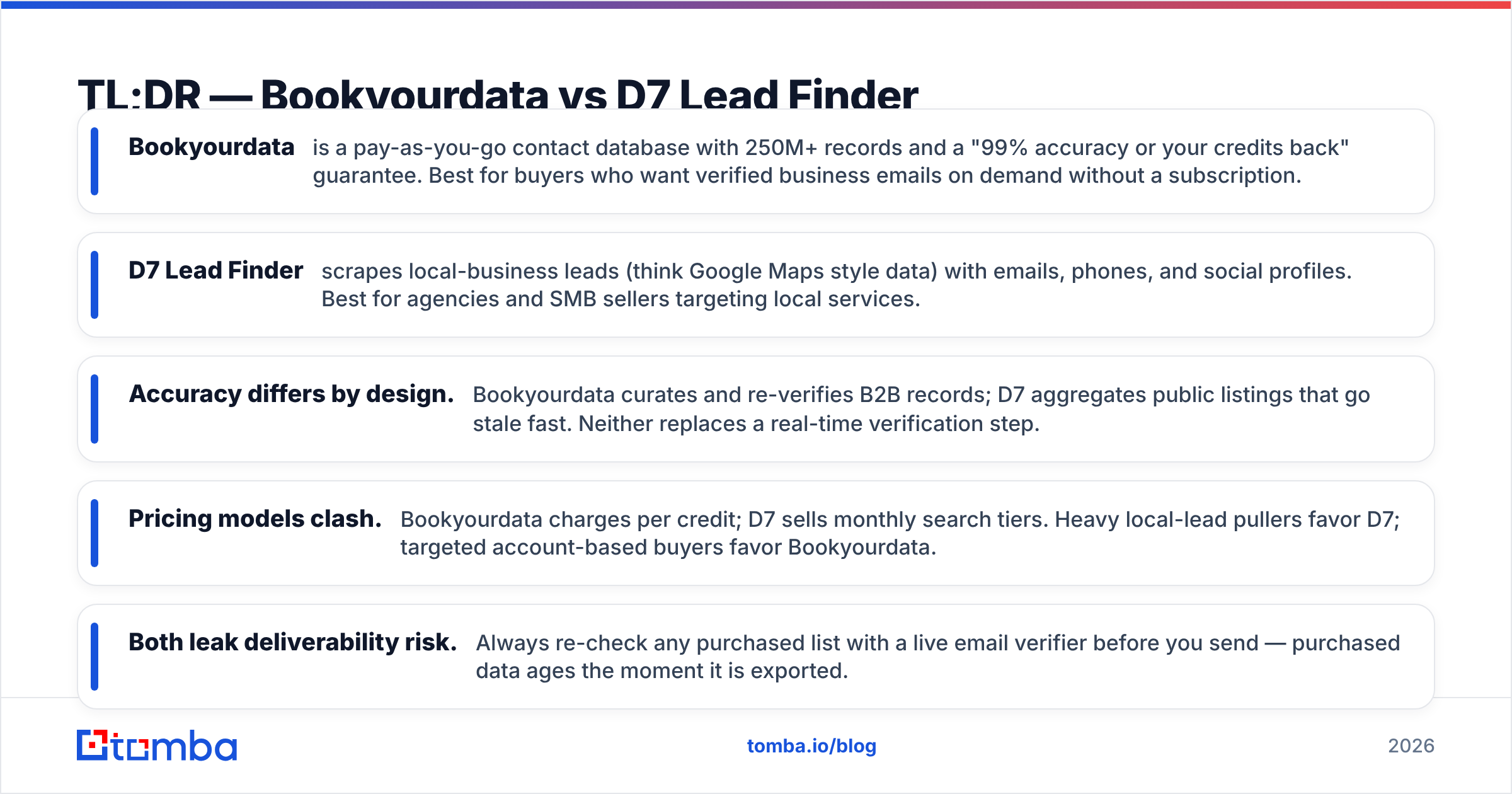
- Bookyourdata is a pay-as-you-go contact database with 250M+ records and a "99% accuracy or your credits back" guarantee. Best for buyers who want verified business emails on demand without a subscription.
- D7 Lead Finder scrapes local-business leads (think Google Maps style data) with emails, phones, and social profiles. Best for agencies and SMB sellers targeting local services.
- Accuracy differs by design. Bookyourdata curates and re-verifies B2B records; D7 aggregates public listings that go stale fast. Neither replaces a real-time verification step.
- Pricing models clash. Bookyourdata charges per credit; D7 sells monthly search tiers. Heavy local-lead pullers favor D7; targeted account-based buyers favor Bookyourdata.
- Both leak deliverability risk. Always re-check any purchased list with a live email verifier before you send — purchased data ages the moment it is exported.
What is Bookyourdata?#
Bookyourdata is a self-serve B2B contact database. You filter by job title, industry, location, company size, and technology, then buy the contacts you want with prepaid credits. There is no annual lock-in — credits never expire, which is the feature most of its customers actually buy it for.
The pitch is accuracy. Bookyourdata advertises a 95–99% deliverability guarantee and refunds credits for any email that hard-bounces. That guarantee is the differentiator: most pay-as-you-go list sellers hand you a CSV and disappear. For account-based outbound where you know exactly which titles you want at which companies, this model is efficient — you pay only for the rows you export.
Where it gets expensive is volume. Because pricing is per credit, pulling tens of thousands of contacts a month adds up quickly compared with a flat subscription. And like every static database, the data is a snapshot. A "verified" record from last quarter can still be stale today if the person changed jobs.

What is D7 Lead Finder?#
D7 Lead Finder is a local-business lead generator. You type a keyword and a location — "dentists in Austin," "plumbers in Manchester" — and it returns a list of businesses with website, email, phone, social links, and basic SEO signals. It is essentially a structured scraper over public listings, packaged for non-technical sellers.
This is a fundamentally different shape of data from Bookyourdata. D7 gives you the business, not a specific decision-maker. You get info@ or contact@ inboxes far more often than named-person emails. For agencies selling web design, SEO, or local services, that is fine — you are pitching the owner of a one-location business anyway, and the generic inbox reaches them.
D7's strength is speed and breadth for local niches. Its weakness is exactly what you would expect from aggregated public data: duplicates, generic catch-all addresses, and listings that have not been touched in years. The emails are often unverified at the point of export, so bounce rates can be punishing if you send blind.
Bookyourdata vs D7 Lead Finder: side-by-side comparison#
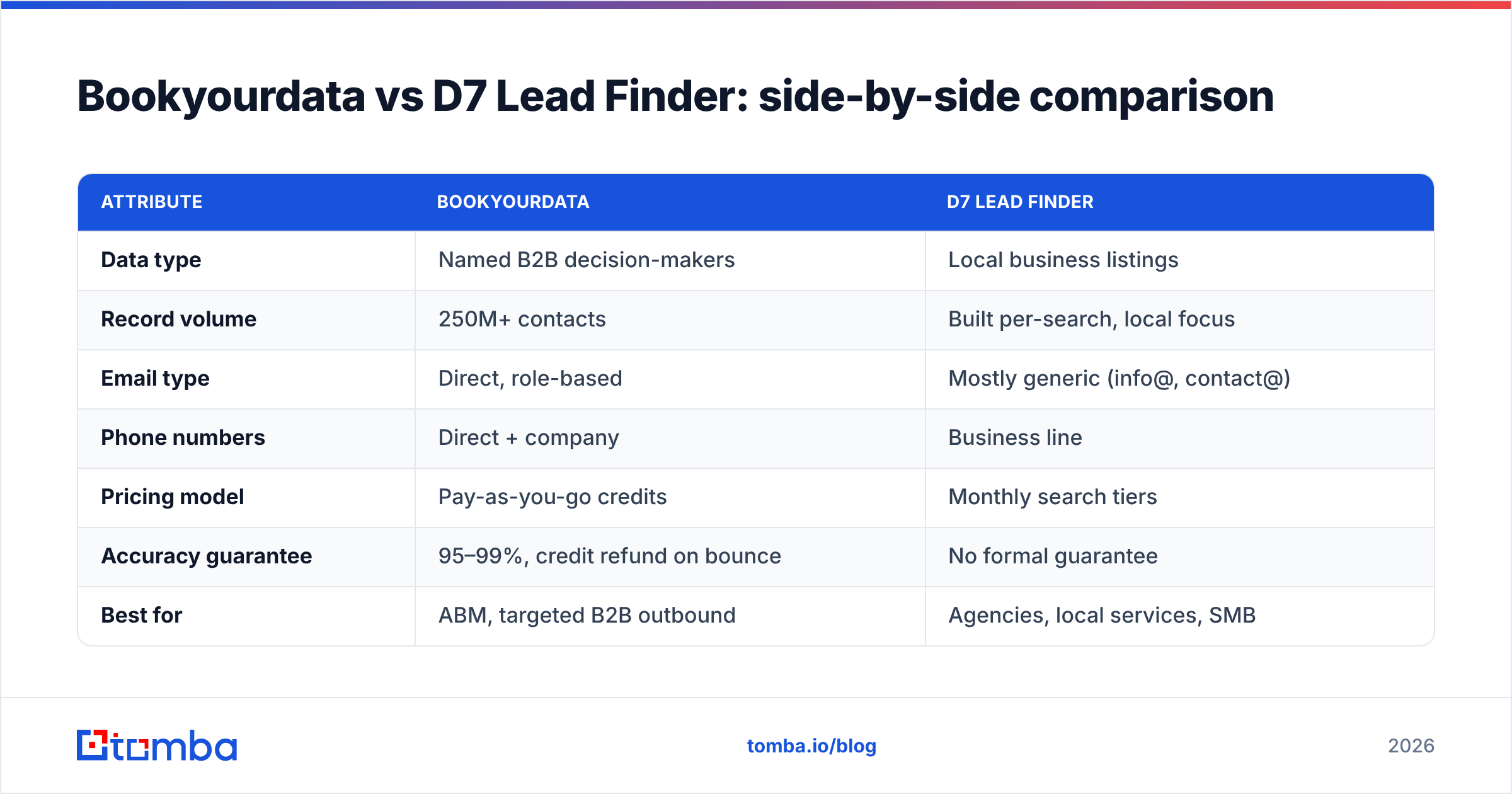
Here is the core decision in one table. Read it against your actual motion — account-based B2B versus local SMB outreach — not against a generic "which is better" question.
| Attribute | Bookyourdata | D7 Lead Finder |
|---|---|---|
| Data type | Named B2B decision-makers | Local business listings |
| Record volume | 250M+ contacts | Built per-search, local focus |
| Email type | Direct, role-based | Mostly generic (info@, contact@) |
| Phone numbers | Direct + company | Business line |
| Pricing model | Pay-as-you-go credits | Monthly search tiers |
| Accuracy guarantee | 95–99%, credit refund on bounce | No formal guarantee |
| Best for | ABM, targeted B2B outbound | Agencies, local services, SMB |
| Verification at export | Curated + re-verified | Often unverified |
| Data freshness risk | Snapshot, ages over time | High (public-listing decay) |
| Catch-all handling | Limited | Not addressed |
The pattern is clear: Bookyourdata optimizes for precision on named contacts, D7 optimizes for coverage of local businesses. They are not really competitors for the same job — they are competitors for your budget.

Which one has more accurate data?#
Bookyourdata wins on accuracy for named B2B contacts — but with an asterisk. Its records are curated and re-verified, and the credit-refund guarantee gives you real recourse when an email bounces. That accountability is rare among list vendors and it matters.
D7's data is aggregated from public sources, which means accuracy is structurally lower. A restaurant that closed, a dentist who sold the practice, a phone number that changed — all of these persist in scraped listings until someone re-crawls them. D7 is honest that it surfaces what is publicly available; it does not promise the listing is current.
But here is the part both tools gloss over: a guarantee on a static export is not the same as real-time verification. Bookyourdata refunds the credit after the bounce — which means the bounce already happened, already hit your sender reputation, and already counted against your domain. The damage to your email deliverability is done before the refund posts.
That is why serious outbound teams treat any purchased list — from either vendor — as raw input, not finished data. You run it through a live verification pass that checks MX records, SMTP response, and catch-all status before the first send. According to deliverability research aggregated by platforms like G2, keeping hard-bounce rates under 2% is the single biggest lever for inbox placement.

How does pricing compare?#
The pricing models are too different to compare on price alone — you have to compare on cost per usable contact.
Bookyourdata sells credits. One credit roughly equals one revealed contact, and pricing tiers down as you buy more. Because credits never expire, you can buy a chunk and draw it down over months. For a team pulling a few thousand targeted contacts, the effective cost per verified, named decision-maker is competitive — you are not paying for rows you never use.
D7 Lead Finder sells monthly subscriptions keyed to how many searches and exports you run. For an agency pulling thousands of local leads every week, the flat-rate model is dramatically cheaper per row. But remember those rows include generic inboxes and stale listings, so your cost per usable contact is higher than the sticker suggests once you discount the dead weight.
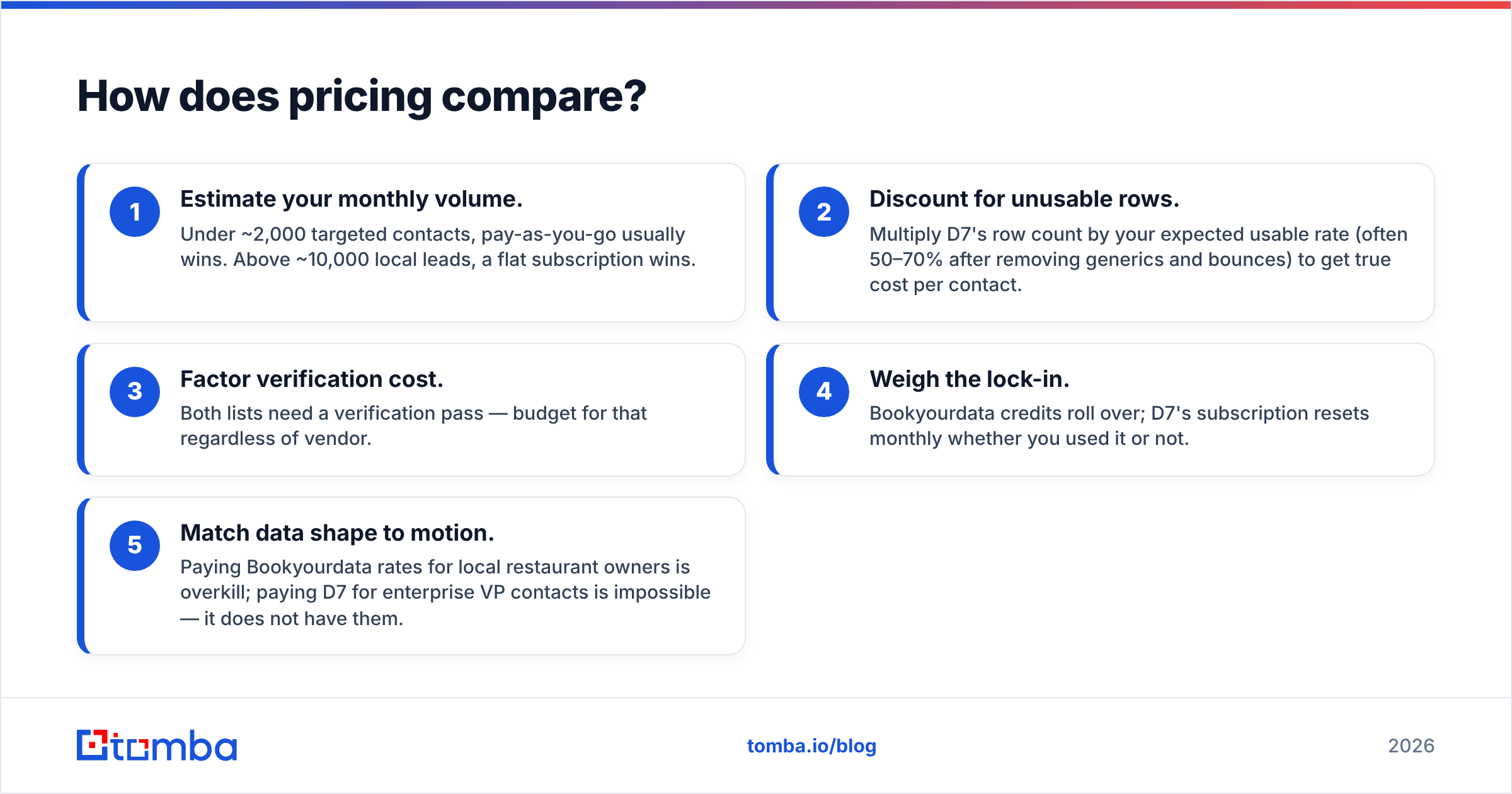
Here is the structured trade-off to run before you commit:
- Estimate your monthly volume. Under ~2,000 targeted contacts, pay-as-you-go usually wins. Above ~10,000 local leads, a flat subscription wins.
- Discount for unusable rows. Multiply D7's row count by your expected usable rate (often 50–70% after removing generics and bounces) to get true cost per contact.
- Factor verification cost. Both lists need a verification pass — budget for that regardless of vendor.
- Weigh the lock-in. Bookyourdata credits roll over; D7's subscription resets monthly whether you used it or not.
- Match data shape to motion. Paying Bookyourdata rates for local restaurant owners is overkill; paying D7 for enterprise VP contacts is impossible — it does not have them.
For reference on how transparent per-seat and per-credit pricing should look, compare both against published Tomba pricing, which keeps a free tier and flat monthly plans rather than opaque enterprise quotes.
Which tool fits your use case?#
Choose Bookyourdata if you run account-based or title-based B2B outbound. You know you want VPs of Engineering at 200-employee SaaS companies, you want named contacts, and you would rather pay per export than commit to a subscription. The accuracy guarantee is worth real money when your deal sizes are large enough that one good meeting pays for the data.
Choose D7 Lead Finder if you sell to local businesses at scale. You are an agency offering web design, SEO, ads, or reputation management, and you need volume across a city or vertical. Generic business inboxes are acceptable because you are reaching owner-operators, and your per-deal value is low enough that you cannot afford premium per-contact pricing.
Choose neither as your only source if you are doing serious cold outbound. Both are list vendors, and a list is a starting point. You still need to verify, enrich, and often find the specific person a generic listing hides. That is where a dedicated finder-and-verifier stack earns its place alongside whichever database you pick.

Where both tools fall short — and how to close the gap#
Both Bookyourdata and D7 hand you data that starts decaying the moment it leaves their platform. People change jobs every few years; businesses close; domains switch providers and turn into catch-alls. No static export survives contact with reality for long.
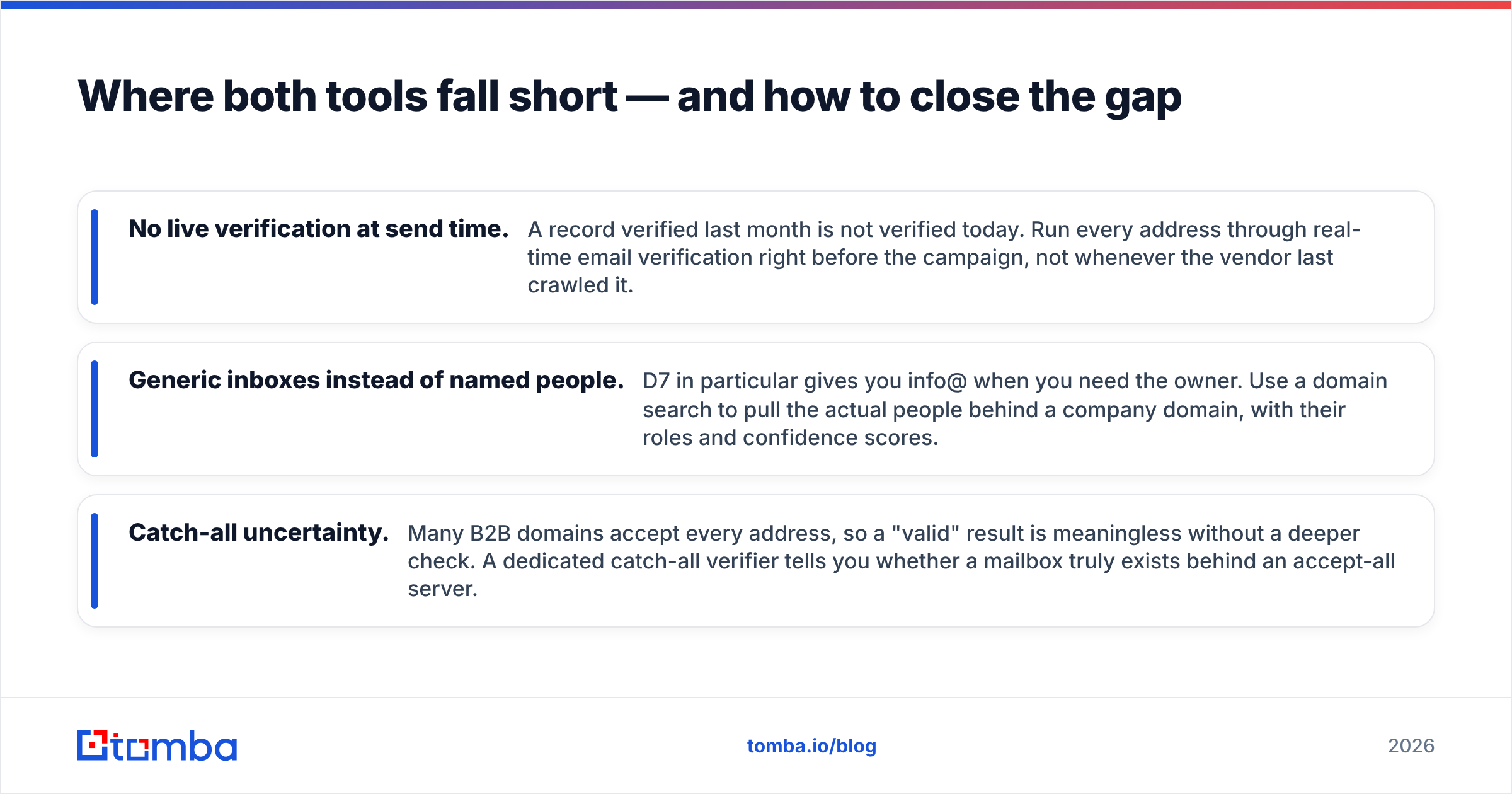
Three gaps show up no matter which tool you buy:
- No live verification at send time. A record verified last month is not verified today. Run every address through real-time email verification right before the campaign, not whenever the vendor last crawled it.
- Generic inboxes instead of named people. D7 in particular gives you info@ when you need the owner. Use a domain search to pull the actual people behind a company domain, with their roles and confidence scores.
- Catch-all uncertainty. Many B2B domains accept every address, so a "valid" result is meaningless without a deeper check. A dedicated catch-all verifier tells you whether a mailbox truly exists behind an accept-all server.
This is the layer where Tomba complements — rather than replaces — a database purchase. You buy targeted rows from Bookyourdata or local rows from D7, then use the Tomba Email Finder to fill in named contacts and the verifier to confirm deliverability before you send. The result is a list you can actually trust, sourced from public data with transparent data sources rather than a black-box export.
For teams running outbound through a CRM, the same verification step can run automatically. Tomba's HubSpot integration and Tomba API let you verify and enrich records as they enter the pipeline, so stale data never reaches a sequence. That closes the loop that a one-time CSV from either Bookyourdata or D7 leaves wide open.
Frequently asked questions#
Is Bookyourdata better than D7 Lead Finder? For named B2B decision-makers and account-based outbound, yes — Bookyourdata's curated data and accuracy guarantee make it the stronger choice. For high-volume local-business leads, D7 Lead Finder is more cost-effective. They serve different motions.
Does Bookyourdata really guarantee 99% accuracy? Bookyourdata offers a deliverability guarantee and refunds credits for emails that hard-bounce. The refund is real, but it comes after the bounce — so you should still verify before sending to protect your sender reputation, not rely on the refund alone.
Are D7 Lead Finder emails verified? Often not at the point of export. D7 aggregates public listings, so emails are frequently generic and unverified. Always run D7 exports through a live verifier before you send to keep bounce rates low.
Can I use these tools together? Yes. Many teams use one for raw sourcing and a finder-plus-verifier layer like Tomba on top to add named contacts, confirm deliverability, and handle catch-all domains. The database supplies breadth; the verification layer supplies trust.
The bottom line#
Bookyourdata and D7 Lead Finder are not really rivals — they are tools for different jobs. Bookyourdata gives you precise, guaranteed B2B contacts on a pay-as-you-go basis, ideal for targeted outbound. D7 gives you cheap local-business volume, ideal for agencies. Pick based on your motion, not on which marketing page is louder.
Whichever you choose, do not skip verification. Purchased data ages instantly, and a bounce costs you far more than a refunded credit. Start with the free tier of the Tomba Email Finder — 25 searches a month, no card — to find the named decision-makers your database missed and verify every address before it touches a sequence. Buy the list, then make it real.
// get started
Find, verify and enrich your first contacts today
Start on the free plan with 25 searches a month, then scale when your team is ready.
Free plan · No credit card required · GDPR & CCPA
// about the author