Bookyourdata vs Datanyze: Which B2B Data Wins in 2026?
Bookyourdata sells pay-as-you-go B2B lists; Datanyze leans on technographics and a Chrome extension. Here's how the two stack up on accuracy, pricing, and fit in 2026.
Choosing between Bookyourdata and Datanyze usually means you've already hit the same wall most outbound teams hit: you have a target market, but you don't have clean, reachable contacts to put in front of it. Both tools promise to fix that — but they solve very different halves of the problem, and picking the wrong one wastes both budget and sender reputation.
This guide breaks down how the two compare on data accuracy, pricing model, coverage, and real-world fit, then shows where a verified-first email tool fits into the picture.
TL;DR#
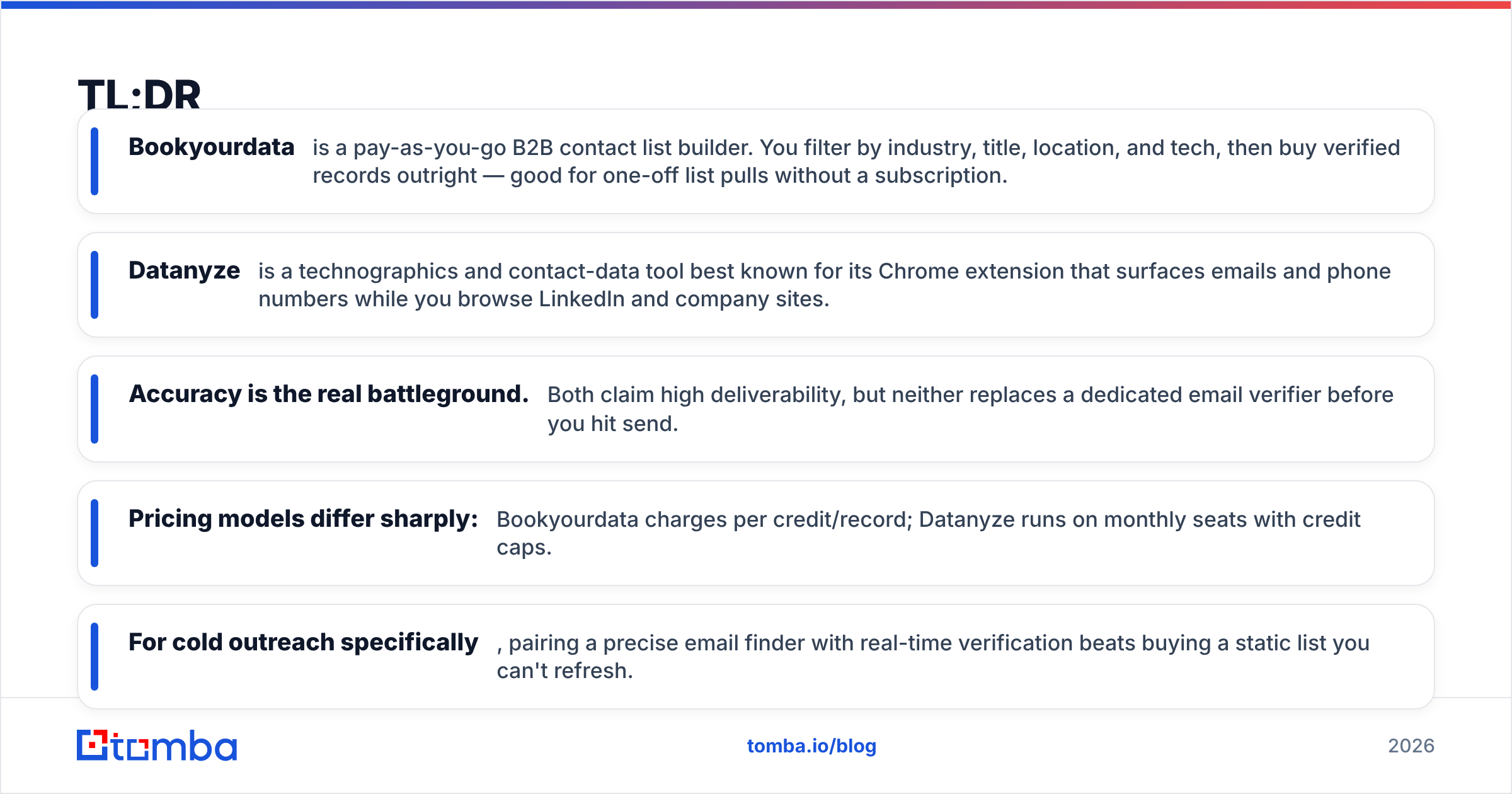
- Bookyourdata is a pay-as-you-go B2B contact list builder. You filter by industry, title, location, and tech, then buy verified records outright — good for one-off list pulls without a subscription.
- Datanyze is a technographics and contact-data tool best known for its Chrome extension that surfaces emails and phone numbers while you browse LinkedIn and company sites.
- Accuracy is the real battleground. Both claim high deliverability, but neither replaces a dedicated email verifier before you hit send.
- Pricing models differ sharply: Bookyourdata charges per credit/record; Datanyze runs on monthly seats with credit caps.
- For cold outreach specifically, pairing a precise email finder with real-time verification beats buying a static list you can't refresh.
What is Bookyourdata?#
Bookyourdata is a self-serve B2B data marketplace. You log in, apply filters across roughly 100+ data points (job title, seniority, industry, company size, location, and technology used), and the platform returns a count of matching contacts. You then buy exactly the number of records you want — no annual contract required.
Its main selling point is the pay-as-you-go model plus a deliverability guarantee: the company advertises a 97%+ accuracy rate on email addresses and offers credit refunds for bounces above its threshold. For teams that need a clean list for a single campaign — an event invite, an ABM pilot, a territory expansion — that "buy what you need and leave" structure is genuinely useful.
The trade-off is that you're buying a snapshot. The moment a contact changes jobs, your record is stale, and you have to repurchase to refresh it. There's no live enrichment baked into your everyday browsing workflow.
What is Datanyze?#
Datanyze, owned by ZoomInfo, is a lightweight contact-and-company data tool built around a Chrome extension. As you visit a prospect's LinkedIn profile or company website, Datanyze surfaces business email addresses, direct-dial and mobile numbers, and company firmographics in a side panel. You "spend" credits to reveal contact details.
Its historical strength is technographics — identifying what software and tools a company runs — which is valuable if your product's fit depends on a prospect's existing stack (for example, "companies running Shopify Plus" or "teams on a specific CRM"). Datanyze also offers icebreakers pulled from social and news signals to personalize outreach.
The catch: Datanyze is positioned as an entry-level tool, and its database depth and refresh cadence sit below the full ZoomInfo platform. Coverage can be thin outside North America and mid-market tech.
Bookyourdata vs Datanyze: how do they compare?#
Here's the side-by-side on the attributes that actually drive a buying decision.
| Attribute | Bookyourdata | Datanyze |
|---|---|---|
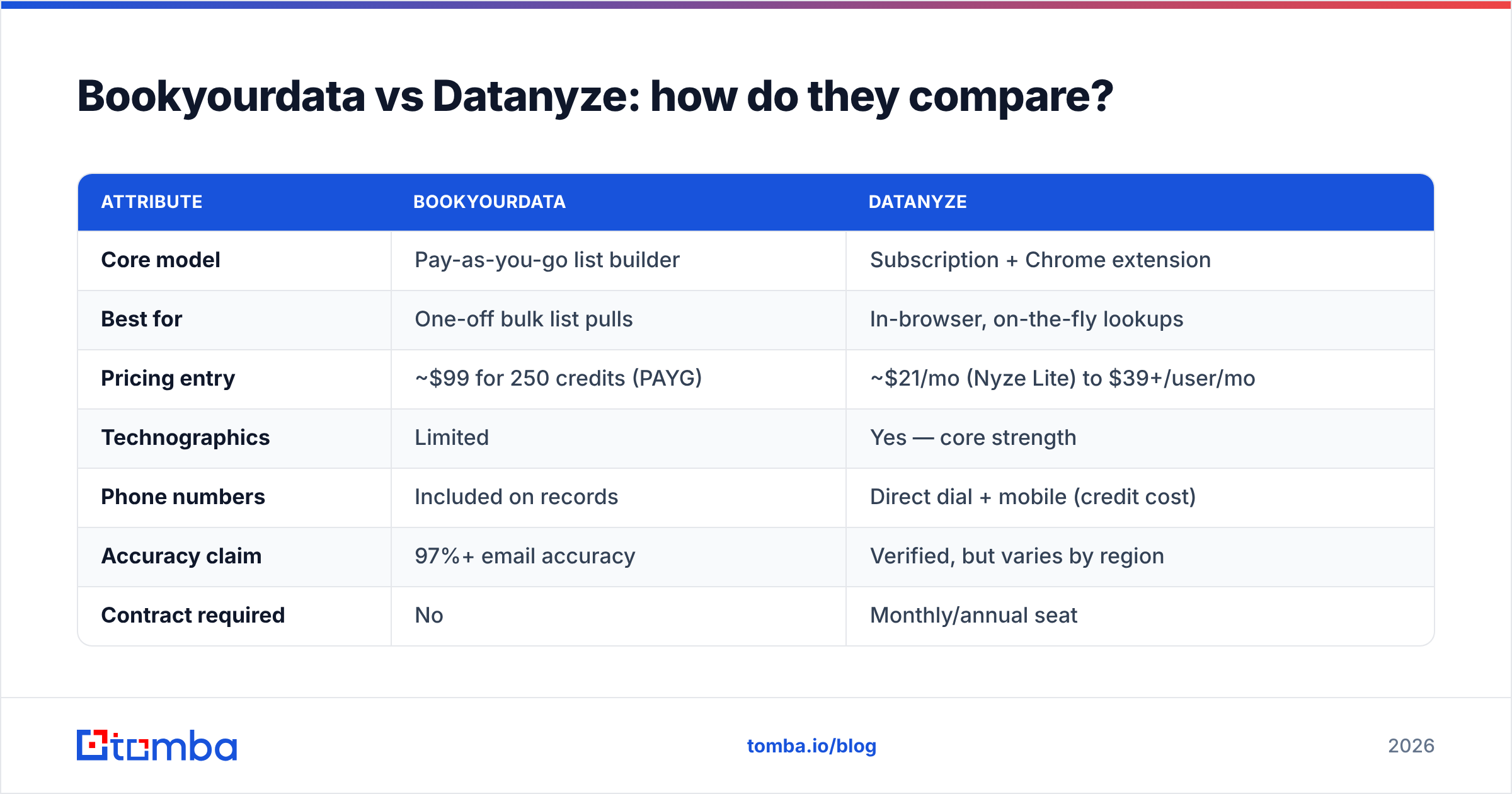
| Core model | Pay-as-you-go list builder | Subscription + Chrome extension |
| Best for | One-off bulk list pulls | In-browser, on-the-fly lookups |
| Pricing entry | ~$99 for 250 credits (PAYG) | ~$21/mo (Nyze Lite) to $39+/user/mo |
| Technographics | Limited | Yes — core strength |
| Phone numbers | Included on records | Direct dial + mobile (credit cost) |
| Accuracy claim | 97%+ email accuracy | Verified, but varies by region |
| Contract required | No | Monthly/annual seat |
| Data freshness | Snapshot at purchase | Live lookup, but shallower DB |
| Geographic depth | Broad, list-driven | Strongest in North America |
The pattern is clear: Bookyourdata optimizes for buying a list, and Datanyze optimizes for grabbing a contact mid-workflow. Neither is wrong — they're built for different motions. If your SDRs live inside LinkedIn all day, a browser extension wins on speed. If your ops team builds quarterly lists for sequencing, a PAYG marketplace wins on cost control.
)
Which has better data accuracy?#
Accuracy is where most of the disappointment lives, so it deserves its own section.
Bookyourdata leans on a deliverability guarantee — if bounces exceed its stated threshold, you get credits back. That's a meaningful safety net for bulk buys, but it's a post-hoc refund, not prevention. You still send to bad addresses, you still take the reputation hit, and you still clean up the mess.
Datanyze verifies at the point of reveal, which feels fresher, but its underlying database is shallower than tier-one providers, so coverage gaps show up as "no email found" more often outside its core market.
The honest takeaway: treat any third-party email as a hypothesis, not a fact. Independent testing across data vendors routinely shows accuracy rates drift the moment data ages — and even a 95% list means 1 in 20 sends bounces, which is enough to drag down sender reputation on a cold domain.
That's why the highest-performing teams run a verification pass regardless of source. A real-time check against the mail server — including catch-all verification for domains that accept everything — is what actually protects deliverability.
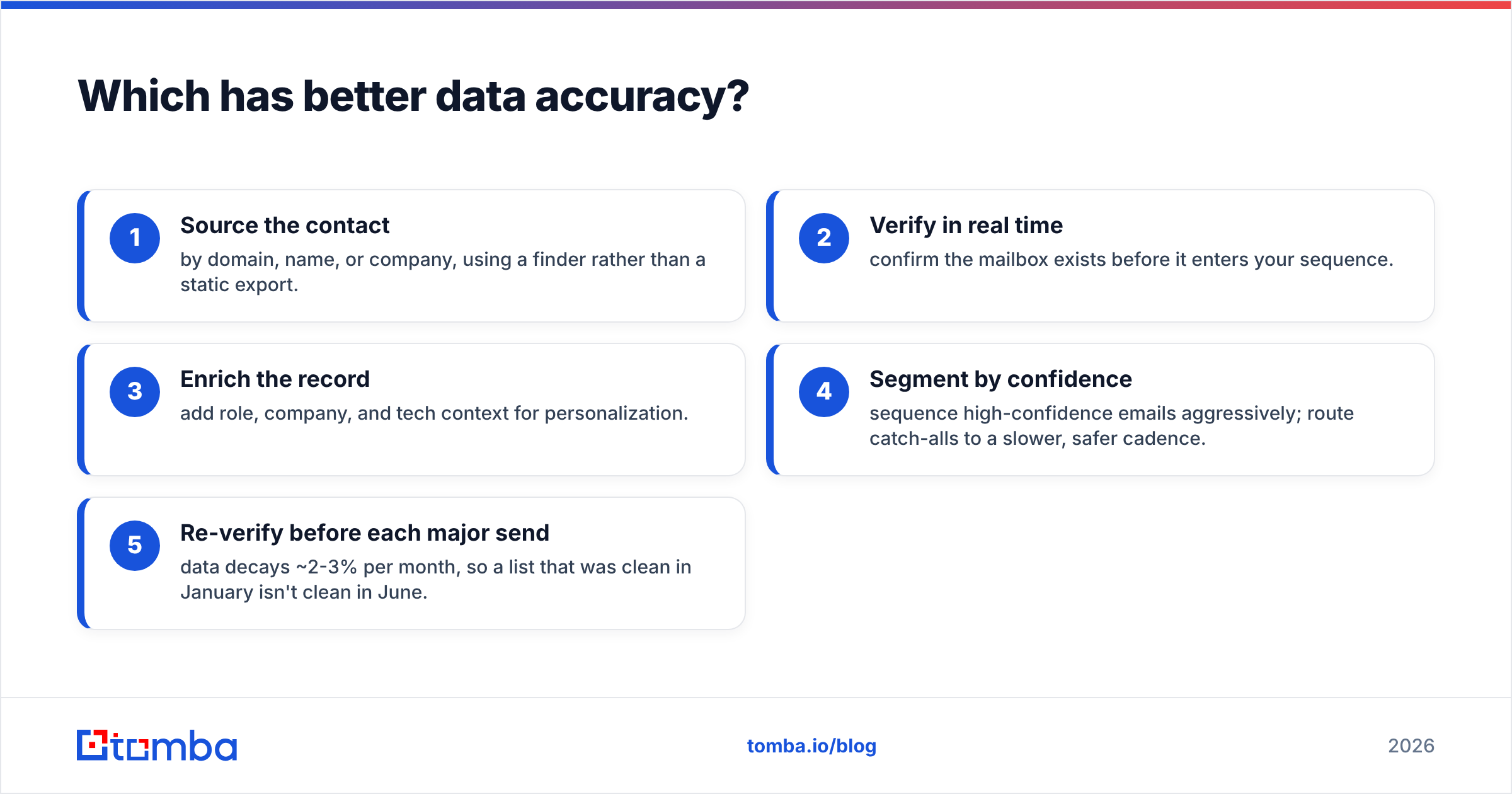
Here's the workflow that consistently beats "buy and blast":
- Source the contact — by domain, name, or company, using a finder rather than a static export.
- Verify in real time — confirm the mailbox exists before it enters your sequence.
- Enrich the record — add role, company, and tech context for personalization.
- Segment by confidence — sequence high-confidence emails aggressively; route catch-alls to a slower, safer cadence.
- Re-verify before each major send — data decays ~2-3% per month, so a list that was clean in January isn't clean in June.
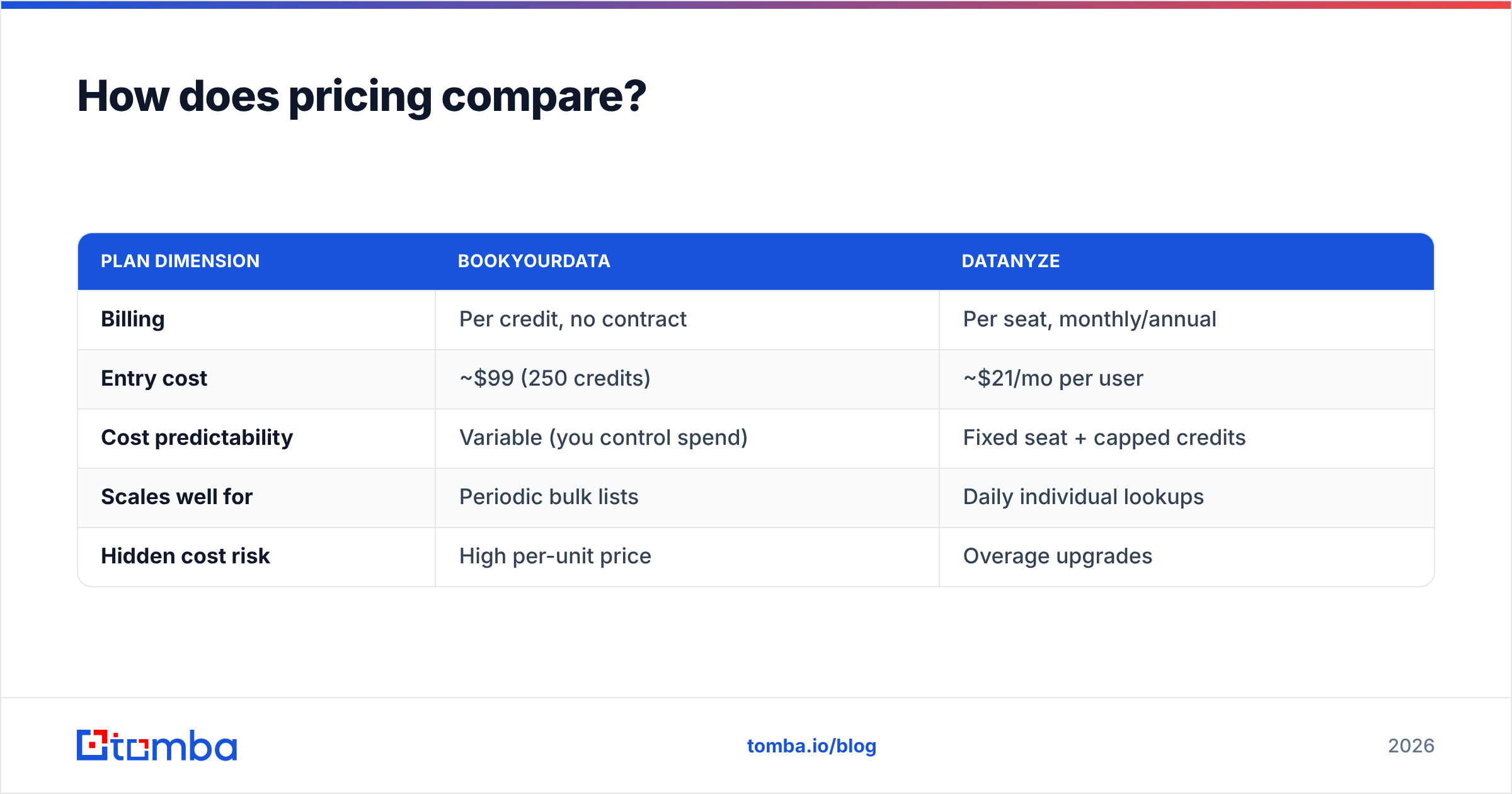
How does pricing compare?#
Pricing is the clearest practical difference, and it maps directly to how you work.
Bookyourdata is consumption-based. You pay per credit (one credit ≈ one record), with packages that bring the per-record cost down as volume rises. There's no recurring fee, so a team that pulls one big list a quarter never pays for idle months. The downside is unit cost: PAYG records are typically pricier each than what you'd pay inside a subscription with a large credit allowance.
Datanyze runs on seats. Its entry tier is inexpensive on paper, but credits are capped monthly, and exceeding them means upgrading. For an individual rep doing steady, daily lookups, that predictability is fine. For a team that scales reveal volume, per-seat costs add up fast.
| Plan dimension | Bookyourdata | Datanyze |
|---|---|---|
| Billing | Per credit, no contract | Per seat, monthly/annual |
| Entry cost | ~$99 (250 credits) | ~$21/mo per user |
| Cost predictability | Variable (you control spend) | Fixed seat + capped credits |
| Scales well for | Periodic bulk lists | Daily individual lookups |
| Hidden cost risk | High per-unit price | Overage upgrades |
For comparison, a dedicated finder like Tomba prices on monthly search volume rather than per-record or per-seat — the Tomba pricing ladder runs from a free tier (25 searches/mo) through Starter at $49/mo, Growth at $99/mo, and Pro at $249/mo, which tends to land cheaper than PAYG once you're running outbound at any real scale.
When should you pick each tool?#
Pick Bookyourdata if you need a defined list, right now, without committing to a subscription — a conference attendee follow-up, a new vertical test, or a hand-off to an agency. The deliverability guarantee gives you a fallback, and the no-contract model means you can use it once and walk away.
Pick Datanyze if your reps work prospect-by-prospect inside LinkedIn and company sites, and technographics genuinely qualify your leads. The extension's speed-in-context is its real value; you're trading database depth for workflow convenience.
Pick a verified email finder if your priority is cold-outreach deliverability and repeatable, fresh sourcing rather than a one-time list. This is where buying a static export hurts you — the data is dead on arrival the moment someone changes roles.
)
What about coverage and compliance?#
Two factors quietly decide whether either tool works for you specifically.
Geographic and role coverage. Datanyze is strongest in North American tech mid-market; if you're selling into EMEA, APAC, or non-tech verticals, run a sample search before you commit. Bookyourdata's list-driven model casts a wider net, but breadth isn't depth — always pull a test count and spot-check a sample.
Compliance. Buying B2B contact data carries GDPR and CAN-SPAM obligations. Reputable vendors document their sourcing; you should still maintain your own suppression lists, honor opt-outs, and keep records of consent basis. Review each vendor's data-processing terms and check independent reviews on G2 and Capterra before signing — buyer reviews surface coverage gaps and support issues that marketing pages won't.
For a deeper primer on the mechanics, HubSpot's overview of B2B data and lead enrichment is a solid neutral reference, and the broader concept of data enrichment explains how raw contacts become sales-ready records.
Is there a better alternative for cold outreach?#
For outbound specifically, yes — and it's a different category than either tool. Bookyourdata and Datanyze both sell you access to a database. What cold email actually needs is the right address, confirmed live, at the moment you send.
That's the gap a dedicated finder-plus-verifier closes. Instead of buying a snapshot or revealing a possibly-stale record, you:
- Find professional emails by domain, name, or company with an email finder tuned for accuracy.
- Pull every reachable contact at a target account via domain search.
- Run a real-time email verifier so bounces never enter your sequence.
- Scale it with a bulk email finder when you do need volume — without paying static-list per-record rates.
Where Tomba is honestly not your pick: if technographic targeting (filtering by the exact software a company runs) is the core of your qualification, Datanyze's stack-detection does something Tomba doesn't. And if you truly only need one list, once, and never again, Bookyourdata's no-contract PAYG can be the cheaper one-off. Match the tool to the motion.
The bottom line#
Bookyourdata and Datanyze are both legitimate, but they answer different questions. Bookyourdata answers "how do I buy a clean list without a subscription?" Datanyze answers "how do I grab a contact and its tech stack while I browse?" Neither answers "how do I keep my cold-email deliverability high over months of sending" — because static and shallow data both decay.
If outbound deliverability is your real goal, source and verify in the same motion rather than buying a snapshot. Start free with the Tomba Email Finder — 25 searches a month, real-time verification built in, and pricing that scales with your sending instead of penalizing it. Find the right person, confirm the address is live, and put only verified contacts into your sequence. That's the difference between a list that bounces and a pipeline that books meetings.
// get started
Find, verify and enrich your first contacts today
Start on the free plan with 25 searches a month, then scale when your team is ready.
Free plan · No credit card required · GDPR & CCPA
// about the author