Bookyourdata vs DealSignal 2026: Which B2B Data Tool Wins?
A neutral, side-by-side breakdown of Bookyourdata vs DealSignal in 2026 — pricing, data accuracy, coverage, and which B2B data tool actually fits your pipeline.
Choosing between Bookyourdata and DealSignal usually comes down to one question: do you want to buy a list or build a pipeline? Both promise accurate B2B contact data, but they sell it in fundamentally different ways — and that difference decides whether you overpay, end up with stale records, or actually book meetings.
This is a neutral, hands-on comparison. No vendor here is perfect, and where a third option makes more sense, this guide says so.
TL;DR — Bookyourdata vs DealSignal at a glance#
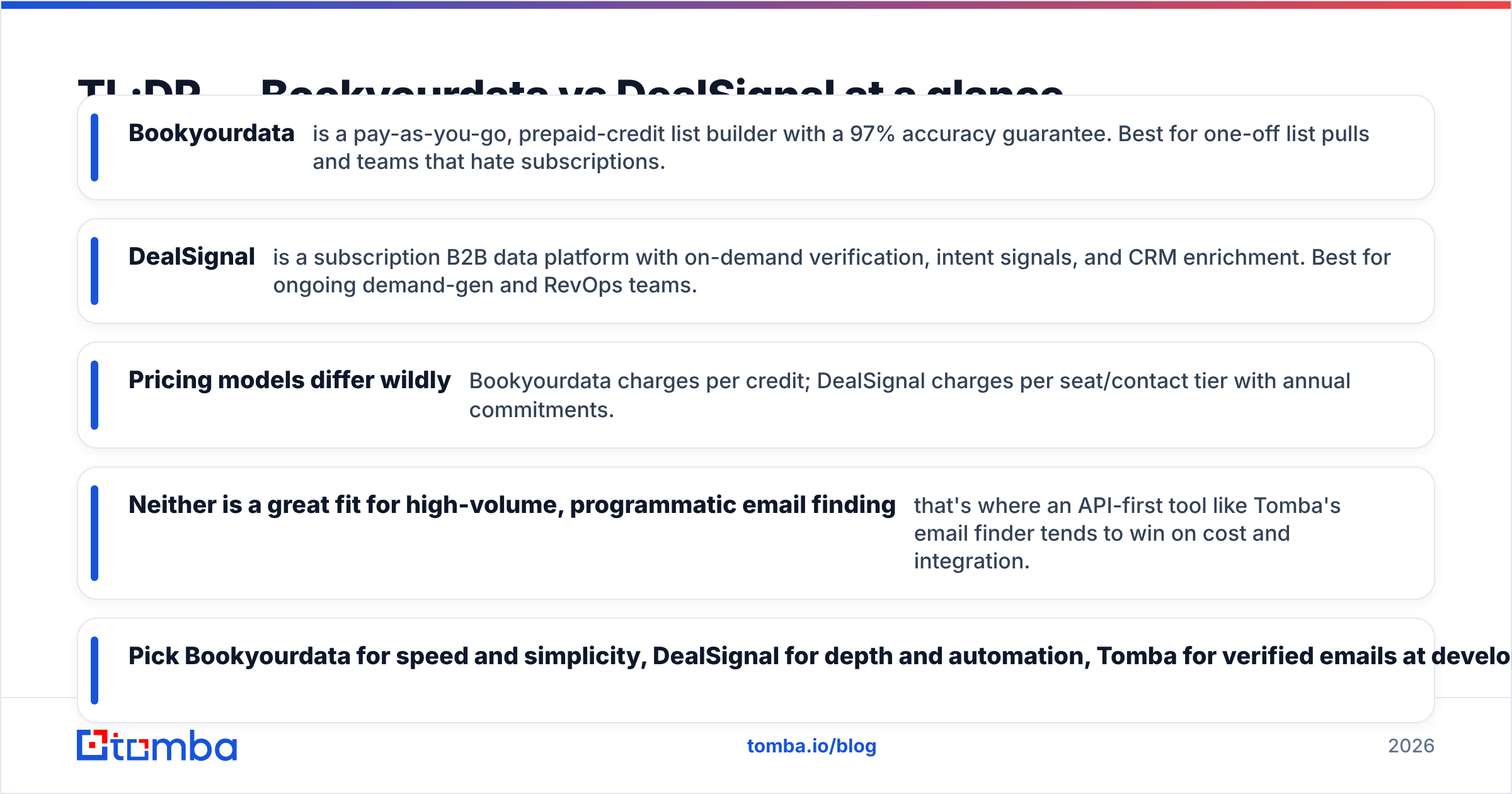
- Bookyourdata is a pay-as-you-go, prepaid-credit list builder with a 97% accuracy guarantee. Best for one-off list pulls and teams that hate subscriptions.
- DealSignal is a subscription B2B data platform with on-demand verification, intent signals, and CRM enrichment. Best for ongoing demand-gen and RevOps teams.
- Pricing models differ wildly: Bookyourdata charges per credit; DealSignal charges per seat/contact tier with annual commitments.
- Neither is a great fit for high-volume, programmatic email finding — that's where an API-first tool like Tomba's email finder tends to win on cost and integration.
- Pick Bookyourdata for speed and simplicity, DealSignal for depth and automation, Tomba for verified emails at developer-friendly prices.
What is Bookyourdata?#
Bookyourdata is a self-serve B2B contact database that sells data on a prepaid, pay-as-you-go model. You filter by job title, industry, location, company size, and technology, then buy only the records you export — no annual contract required. Its headline promise is a 97% accuracy guarantee, with credits refunded for emails that bounce beyond that threshold.
The platform leans into simplicity. You build a list in the browser, preview counts, pay with credits, and download a CSV or push to your CRM. For a founder who needs 2,000 verified contacts this week and doesn't want a sales call, that frictionless flow is the whole pitch. You can verify the current feature set on the Bookyourdata homepage.
The trade-off: it's a list product. Data is accurate at the moment of export, but there's no continuous re-verification, no intent layer, and no native workflow to keep records fresh as people change jobs.

What is DealSignal?#
DealSignal is a subscription-based B2B data platform aimed at marketing and RevOps teams running always-on demand generation. Instead of static lists, it emphasizes on-demand verification (data is re-verified at the point of delivery), buyer intent signals, and CRM enrichment that fills gaps in records you already own.
DealSignal's positioning is closer to an enterprise data engine: large contact and company coverage, technographic and firmographic filters, and integrations that feed Salesforce, HubSpot, and marketing automation platforms. You can review its capabilities on the DealSignal homepage.
The trade-off here is the mirror image of Bookyourdata: more power, more setup, more cost, and an annual commitment. If you only need a list once a quarter, you're paying for an engine you barely idle.
Bookyourdata vs DealSignal: full comparison table#
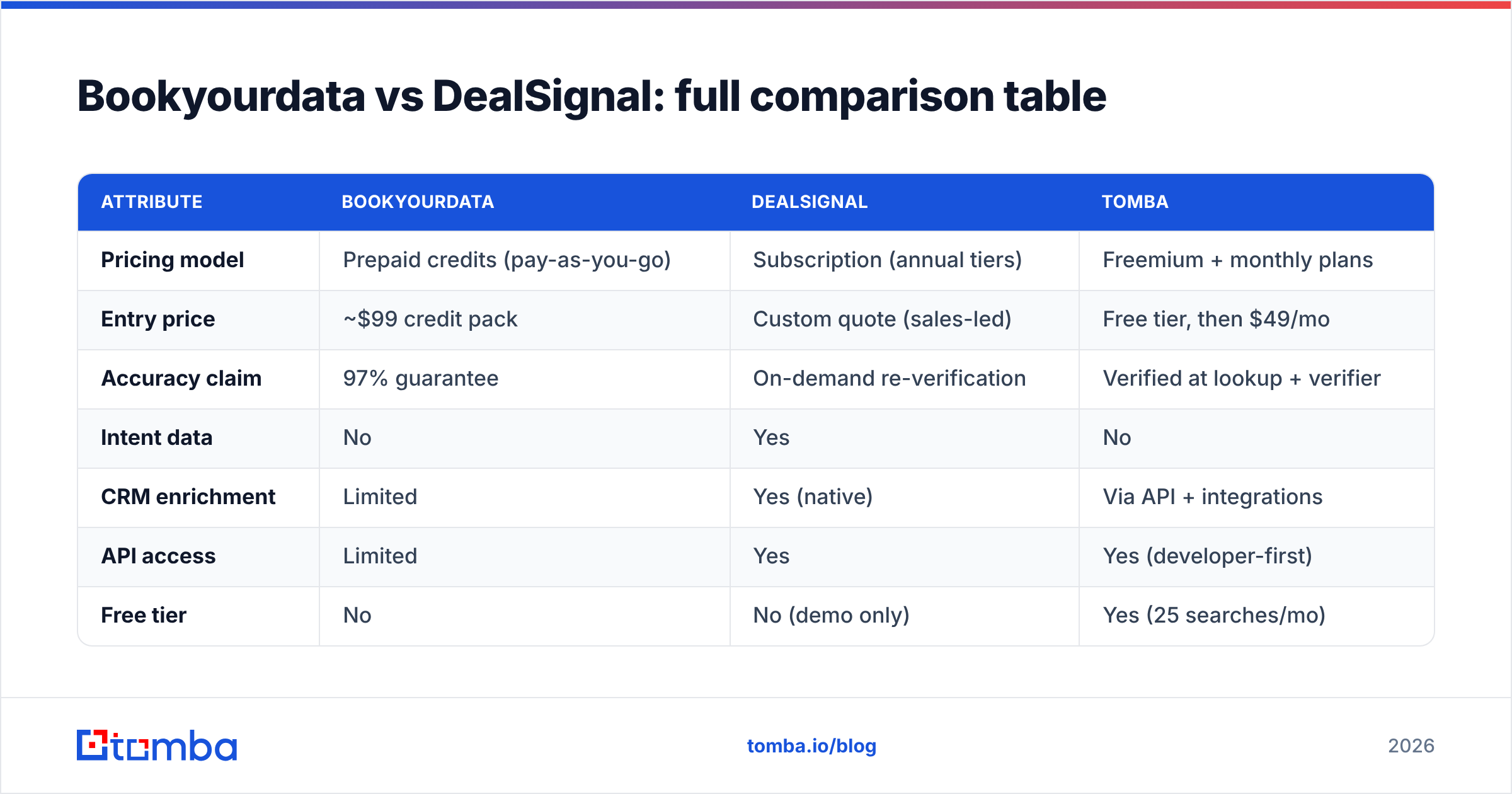
| Attribute | Bookyourdata | DealSignal | Tomba |
|---|---|---|---|
| Pricing model | Prepaid credits (pay-as-you-go) | Subscription (annual tiers) | Freemium + monthly plans |
| Entry price | ~$99 credit pack | Custom quote (sales-led) | Free tier, then $49/mo |
| Accuracy claim | 97% guarantee | On-demand re-verification | Verified at lookup + verifier |
| Intent data | No | Yes | No |
| CRM enrichment | Limited | Yes (native) | Via API + integrations |
| API access | Limited | Yes | Yes (developer-first) |
| Free tier | No | No (demo only) | Yes (25 searches/mo) |
| Best for | One-off list pulls | Ongoing demand gen | Programmatic email finding |
| Contract | None | Annual | Monthly, cancel anytime |
Use this as a starting filter, not a verdict — the right pick depends on volume and workflow, which the next sections break down.
Is Bookyourdata more accurate than DealSignal?#
Short answer: they measure accuracy differently, so the headline numbers aren't directly comparable.
Bookyourdata's 97% guarantee is a static promise tied to the moment you export. If more than 3% of emails bounce, you get credits back. That's clean and verifiable, but it says nothing about records that go stale a month later when someone changes companies.
DealSignal's on-demand verification re-checks each record at delivery, which in theory keeps freshness higher for ongoing campaigns. But "freshness at delivery" depends on how often you pull, and the platform doesn't publish a single guaranteed bounce rate the way Bookyourdata does.
In practice, no provider's guarantee replaces your own verification step. Before any cold send, run your list through a dedicated email verifier and, critically, a catch-all verifier — catch-all domains are where both list vendors quietly inflate "valid" counts. Verifying twice (vendor + independent) is the only way to protect your sender reputation.

How does pricing compare?#
This is where the two products split hardest, and where most buyers make the wrong call.
Bookyourdata is transparent and prepaid. You buy credit packs, spend one credit per exported contact, and credits don't auto-renew. There's no seat fee and no contract. For sporadic, project-based list buying, the math is simple and the downside is capped.
DealSignal is sales-led and subscription-based. Pricing scales with contact volume, seats, and the modules you enable (intent, enrichment, API). You'll get a custom quote, typically annual. For a team pulling and enriching data every week, the per-record cost can beat pay-as-you-go — but only at sustained volume.
Here's the decision framework:
- Occasional buyer (a few lists a year) — Bookyourdata almost always wins on total cost. No idle subscription.
- Continuous demand gen (weekly pulls + enrichment) — DealSignal's amortized per-record price can be lower, and the automation saves labor.
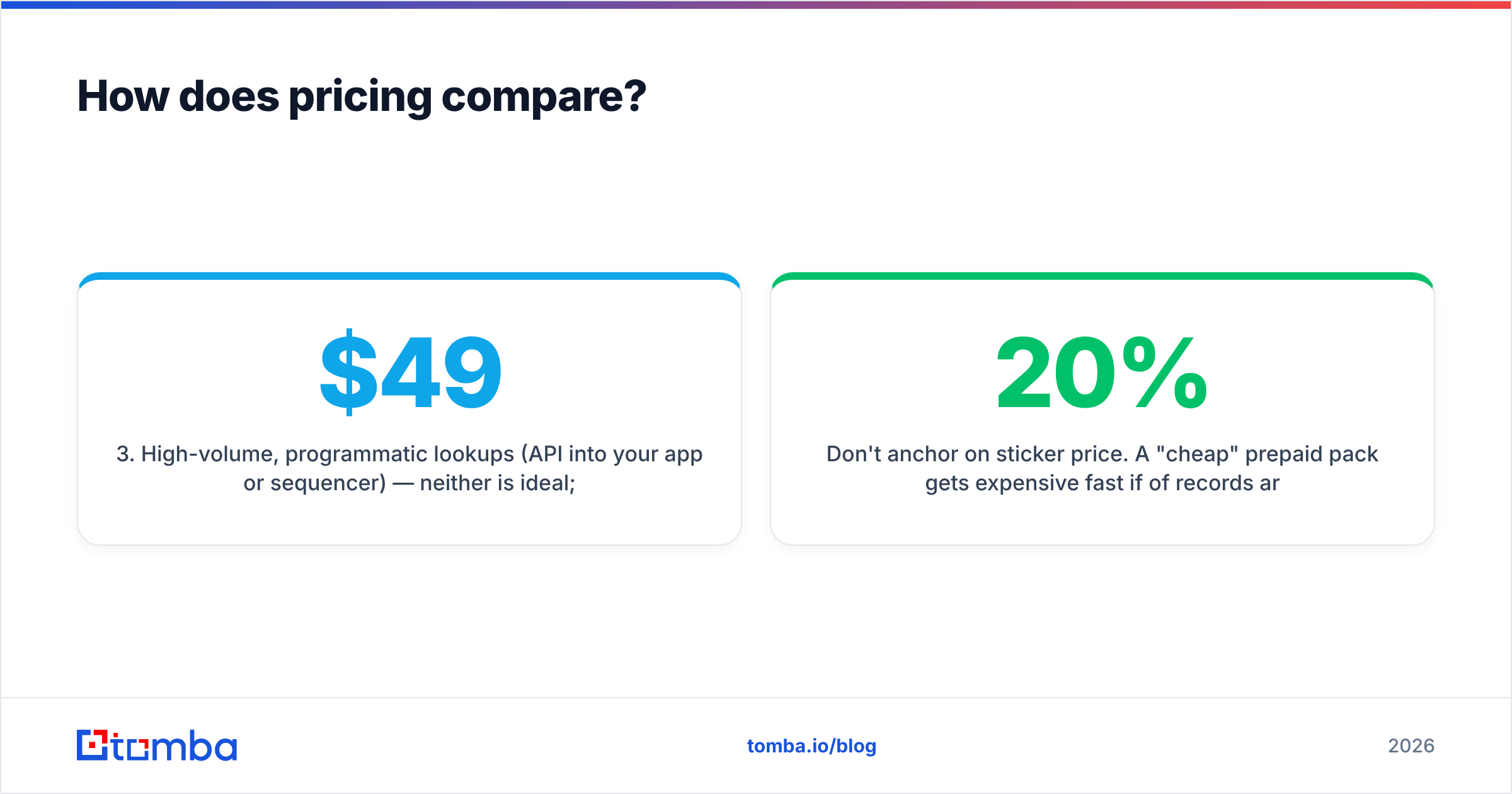
- High-volume, programmatic lookups (API into your app or sequencer) — neither is ideal; an API-first email tool is usually cheaper per verified contact. Compare against Tomba pricing, which starts free and runs $49/mo Starter, $99/mo Growth, and $249/mo Pro.
- Bulk enrichment of an existing CRM — DealSignal's native enrichment or a bulk email finder both work; the choice is build-vs-buy on integration effort.
Don't anchor on sticker price. A "cheap" prepaid pack gets expensive fast if 20% of records are catch-alls you can't safely email.
Which one fits your team?#
Match the tool to how your team actually works, not to the flashiest feature.
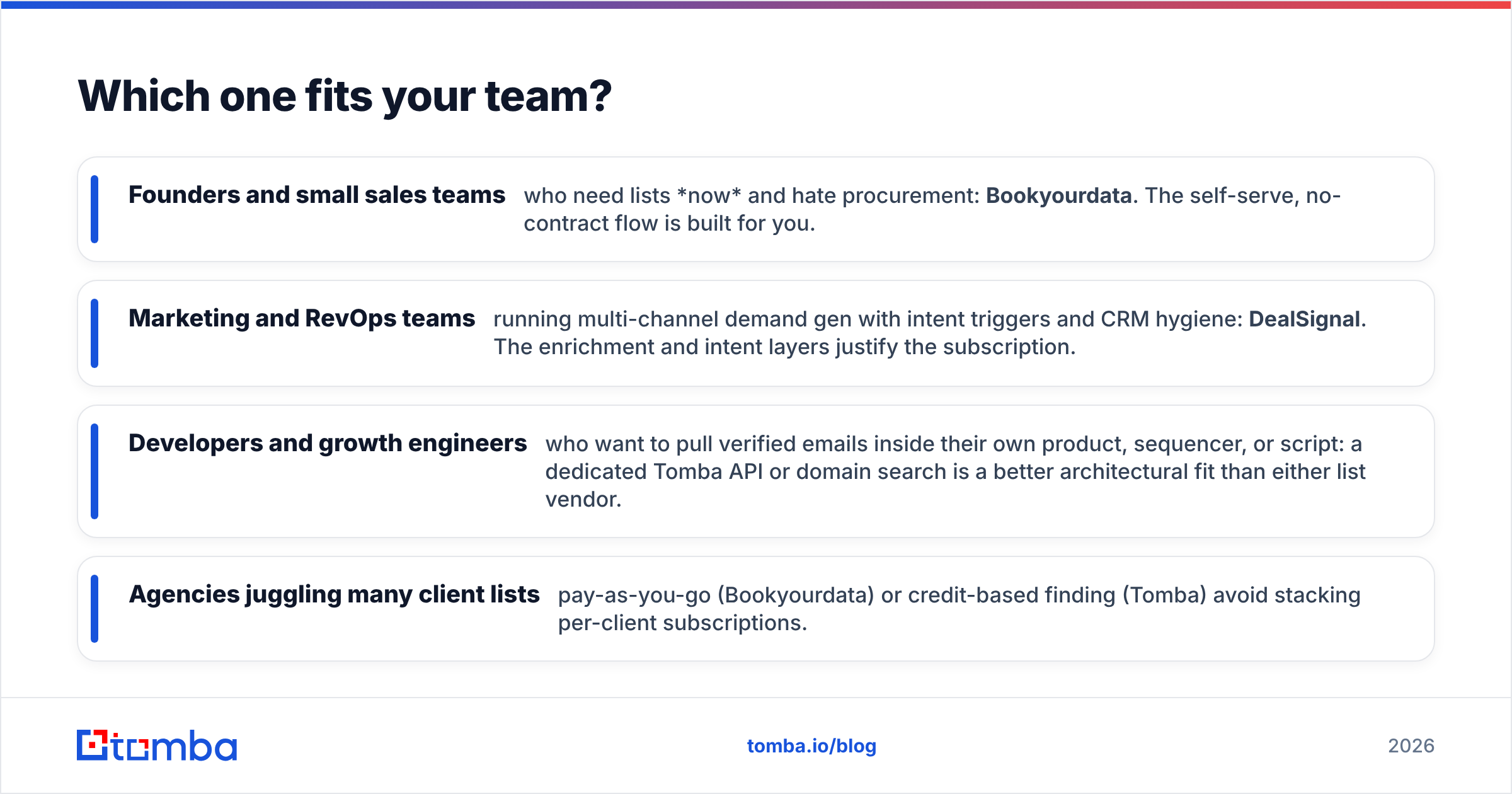
- Founders and small sales teams who need lists now and hate procurement: Bookyourdata. The self-serve, no-contract flow is built for you.
- Marketing and RevOps teams running multi-channel demand gen with intent triggers and CRM hygiene: DealSignal. The enrichment and intent layers justify the subscription.
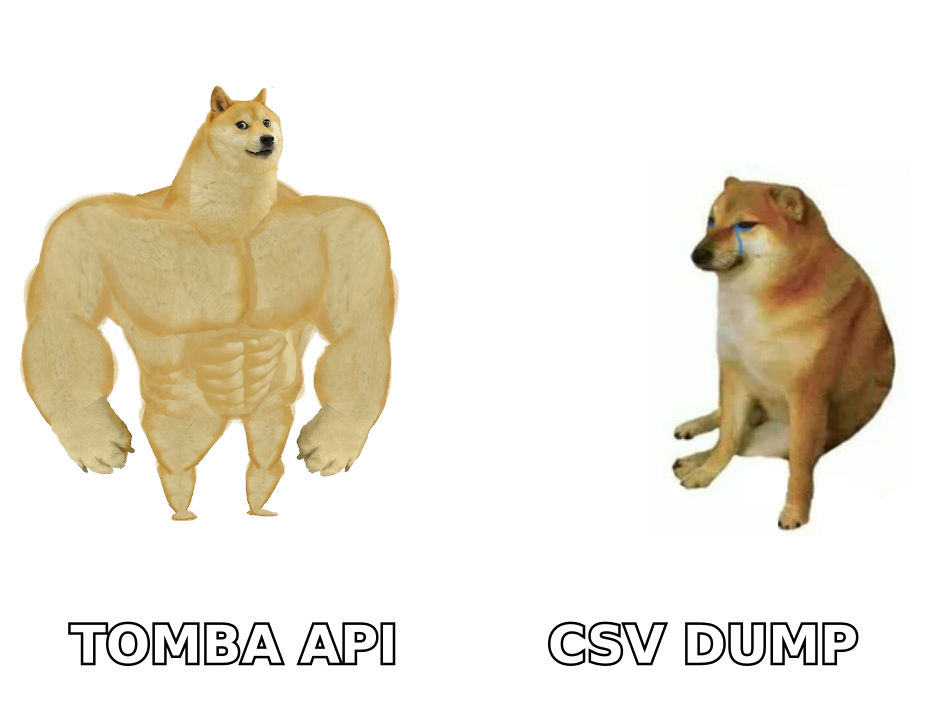
- Developers and growth engineers who want to pull verified emails inside their own product, sequencer, or script: a dedicated Tomba API or domain search is a better architectural fit than either list vendor.
- Agencies juggling many client lists: pay-as-you-go (Bookyourdata) or credit-based finding (Tomba) avoid stacking per-client subscriptions.
What are the main pros and cons?#
Bookyourdata — pros: no contract, transparent credit pricing, fast self-serve export, clear 97% guarantee, strong for one-off campaigns.
Bookyourdata — cons: static data ages quickly, limited intent and enrichment, catch-all records can pad "valid" counts, no free tier to test.
DealSignal — pros: on-demand re-verification, intent signals, native CRM enrichment, deep firmographic and technographic filters, API access.
DealSignal — cons: sales-led annual pricing, longer setup, overkill for occasional buyers, no transparent self-serve entry point.
The honest takeaway: both are competent at what they're designed for. Friction shows up when you use a list product for continuous workflows (Bookyourdata) or pay for an enterprise engine you rarely run (DealSignal).
Where does Tomba fit in this comparison?#
Tomba isn't a static list vendor — it's a verified email-finding and enrichment platform built API-first. That makes it a different shape of tool, and often a better one for the jobs where Bookyourdata and DealSignal feel forced.
If your real need is "find and verify the email for this person or this domain, repeatedly, inside my own stack," you want lookup-and-verify primitives, not a quarterly CSV. Tomba covers that with an email finder, domain search, a standalone email verifier, data enrichment, and a bulk email finder for batch jobs. There's a genuine free tier (25 searches/month) so you can test accuracy before paying — something neither Bookyourdata nor DealSignal offers.
You can also cross-reference user reviews of all three on independent directories like G2 and Capterra before committing budget. Treat vendor accuracy claims as marketing until your own bounce tests confirm them.
Frequently asked questions#
Is Bookyourdata or DealSignal cheaper? For occasional, project-based buying, Bookyourdata is cheaper because there's no subscription. For sustained weekly volume, DealSignal's amortized per-record cost can be lower. For programmatic API use, an email finder like Tomba usually beats both.
Does Bookyourdata offer a free trial? No. It uses prepaid credit packs with no free tier. DealSignal offers a demo but not self-serve free access. Tomba offers 25 free searches per month.
Can I use either for cold email? Yes, but always run vendor lists through an independent email verifier and catch-all verifier first to protect deliverability.
Which has better data accuracy? Bookyourdata publishes a 97% static guarantee; DealSignal re-verifies on demand. Both depend on your own verification step for safe sending.
The bottom line#
Bookyourdata wins on simplicity and pay-as-you-go pricing; DealSignal wins on depth, intent, and ongoing enrichment. Pick by workflow, not by feature count — and verify every list yourself before you send.
But if your core need is finding and verifying professional emails on demand, by domain or by name, without a contract or a sales call, start with the Tomba Email Finder. Spin up the free tier, test accuracy against your own targets, and scale into $49/mo Starter only when the numbers prove out. That's the fastest, lowest-risk way to put verified contacts into your pipeline today.
// get started
Find, verify and enrich your first contacts today
Start on the free plan with 25 searches a month, then scale when your team is ready.
Free plan · No credit card required · GDPR & CCPA
// about the author